Monthly Archives: October 2012

Open letter to President Obama (Part 155B)

Welfare Can And Must Be Reformed

Uploaded by on Jun 29, 2010

If America does not get welfare reform under control, it will bankrupt America. But the Heritage Foundation’s Robert Rector has a five-step plan to reform welfare while protecting our most vulnerable.

______________

President Obama c/o The White House
1600 Pennsylvania Avenue NW
Washington, DC 20500

Dear Mr. President,

I know that you receive 20,000 letters a day and that you actually read 10 of them every day. I really do respect you for trying to get a pulse on what is going on out here.

I don’t understand why liberals do not see that they are hurting and not helping the poor with these programs.

Rachel Sheffield

April 12, 2012 at 3:00 pm

A new report from the U.S. Department of Agriculture states that the Supplemental Nutrition Assistance Program (SNAP, more commonly known as food stamps) helps “alleviate” poverty.

Essentially, the report says that by including the dollar amount of food stamps as part of a family’s income, fewer families are considered poor—or at least not as poor.

No surprises here. Not even the federal government can spend over $70 billion on food stamps annually and have no impact on a family’s bottom line. (Of course, federal poverty calculations don’t include the value of food stamps or most of the benefits received from federal welfare programs as part of a household’s income, so it’s little wonder that federal poverty rates have remained nearly unchanged over the last several decades despite massive increases in welfare spending. But that’s another story.)

The report also notes that “SNAP’s contribution to reducing poverty increased between 2000 and 2009, a period when the SNAP caseload nearly doubled and total SNAP benefits more than quadrupled.”

In other words, the federal government seems to be saying that federal dependence translates to poverty relief.

If dependence on the federal government is the standard of success, then certainly the food stamps program is a smash hit. Not only is it the largest of the federal government’s roughly 10 food assistance programs, but it’s also one of the largest of all the federal government’s welfare programs.

And it’s been growing, recession or not. Since 2000, as the report points out, participation rates have skyrocketed from just 17.2 million to 44.7 million in 2011—an increase of roughly 260 percent. Naturally, this means that the federal government has “successfully” increased the program’s cost—in fact, more than tripled it—from approximately $20 billion in 2000 to a whopping $72 billion in fiscal year 2011.

While some of the program’s most recent “successes” in growth are no doubt partly attributed to the recession, roles were already steadily growing prior to 2008. In fact, food stamps has for the most part been continually growing since it began in the 1960s.

To what can such “accomplishment” be attributed? As the report notes, some of the growth is due to policy changes over the last decade “designed to increase SNAP participation among working poor households.” The report notes that states have “implemented a number of program changes to simplify the administrative process to apply for and remain on SNAP.”

So the secret of “success” is not only expanding eligibility but making sure people stay on food stamps.

Tragically, such a measure of success is completely counter to what the purpose of any good welfare program should be: to help individuals become independent and enjoy the fruits of their own labor—not dependent on government largesse.

Food stamps, along with just about every other of the federal government’s over 70 welfare assistance programs, fails to include any functional provisions to promote personal responsibility, such as work requirements and time limits. Rather than addressing the causes of poverty, the federal government’s method of operation has been to pour more taxpayer dollars into more welfare programs, edging near a cost of $1 trillion annually. Not only does this approach fail to help individuals, but it creates a growing burden on taxpayers.

Successfully helping the poor should mean promoting individual freedom through self-reliance, not promoting dependence through a government dole.

____________

Thank you so much for your time. I know how valuable it is. I also appreciate the fine family that you have and your commitment as a father and a husband.

Sincerely,

Everette Hatcher III, 13900 Cottontail Lane, Alexander, AR 72002, ph 501-920-5733, lowcostsqueegees@yahoo.com

Milton Friedman helped get Reagan elected

Bob Chitester Discusses Milton Friedman and ‘Free to Choose’

Published on Jul 30, 2012 by

“There are very few people over the generations who have ideas that are sufficiently original to materially alter the direction of civilization. Milton is one of those very few people.”

That is how former Federal Reserve Chairman Alan Greenspan described the Nobel laureate economist Milton Friedman. But it is not for his technical work in monetary economics that Friedman is best known. Like mathematician Jacob Bronowski and astronomer Carl Sagan, Friedman had a gift for communicating complex ideas to a general audience.

It was this gift that brought him to the attention of filmmaker Bob Chitester. At Chitester’s urging, Friedman agreed to make a 10 part documentary series explaining the power of economic freedom. It was called “Free to Choose,” and became one of the most watched documentaries in history.

The series not only reached audiences in liberal democracies, but was smuggled behind the iron curtain where it played, in secret, to large audiences. Reflecting on its impact, Czech president Vaclav Klaus has said: “For us, who lived in the communist world, Milton Friedman was the greatest champion of freedom, of limited and unobtrusive government and of free markets. Because of him I became a true believer in the unrestricted market economy.”

July 31st, 2012 is the 100th anniversary of Friedman’s birth. To commemorate that occasion, we’d like to share an interview with “Free to Choose” producer Bob Chitester. Like this interview, the entire series can now be viewed on-line at no cost at http://www.freetochoose.tv/, thanks to the incredible technological progress brought about by the economic freedom that Milton Friedman celebrated.

Produced by Andrew Coulson, Caleb O. Brown, Austin Bragg, and Lou Richards, with help from the Free to Choose Network.

_____________

We got to stop spending so much money on the federal level. It will bankrupt us. I remember back in 1980 when I really started getting into the material of Milton Friedman as a result of reading his articles in Newsweek and reading his book “Free to Choose,” I really did get facts and figures to back on the view that we need more freedom giving back to us and the government needs to spend less.

As a result of Friedman’s writings I was able to discuss these issues with my fellow students at the university and by the time the 1980 election came around I had been attending political rallies and went out and worked hard for Ronald Reagan’s election. In this article below Dr. Thomas Sowell (who was featured twice in the film “Free to Choose”) notes how much influence Milton Friedman had on the election outcome in 1980:

Milton Friedman at 90

by Thomas Sowell

Thomas Sowell is a senior fellow at the Hoover Institute in Stanford, California.

Added to cato.org on July 25, 2002

This article originally appeared on TownHall.com, July 25, 2002.

Milton Friedman’s 90th birthday on July 31st provides an occasion to think back on his role as the pre-eminent economist of the 20th century. To those of us who were privileged to be his students, he also stands out as a great teacher.

When I was a graduate student at the University of Chicago, back in 1959, one day I was waiting outside Professor Friedman’s office when another graduate student passed by. He noticed my exam paper on my lap and exclaimed: “You got a B?”

“Yes,” I said. “Is that bad?”

Thomas Sowell is a senior fellow at the Hoover Institute in Stanford, California.


“There were only two B’s in the whole class,” he replied.

“How many A’s?” I asked.

“There were no A’s!”

Today, this kind of grading might be considered to represent a “tough love” philosophy of teaching. I don’t know about love, but it was certainly tough.

Professor Friedman also did not let students arrive late at his lectures and distract the class by their entrance. Once I arrived a couple of minutes late for class and had to turn around and go back to the dormitory.

All the way back, I thought about the fact that I would be held responsible for what was said in that lecture, even though I never heard it. Thereafter, I was always in my seat when Milton Friedman walked in to give his lecture.

On a term paper, I wrote that either (a) this would happen or (b) that would happen. Professor Friedman wrote in the margin: “Or (c) your analysis is wrong.”

“Where was my analysis wrong?” I asked him.

“I didn’t say your analysis was wrong,” he replied. “I just wanted you to keep that possibility in mind.”

Perhaps the best way to summarize all this is to say that Milton Friedman is a wonderful human being — especially outside the classroom. It has been a much greater pleasure to listen to his lectures in later years, after I was no longer going to be quizzed on them, and a special pleasure to appear on a couple of television programs with him and to meet him on social occasions.

Milton Friedman’s enduring legacy will long outlast the memories of his students and extends beyond the field of economics. John Maynard Keynes was the reigning demi-god among economists when Friedman’s career began, and Friedman himself was at first a follower of Keynesian doctrines and liberal politics.

Yet no one did more to dismantle both Keynesian economics and liberal welfare-state thinking. As late as the 1950s, those with the prevailing Keynesian orthodoxy were still able to depict Milton Friedman as a fringe figure, clinging to an outmoded way of thinking. But the intellectual power of his ideas, the fortitude with which he persevered, and the ever more apparent failures of Keynesian analyses and policies, began to change all that, even before Professor Friedman was awarded the Nobel Prize in economics in 1976.

A towering intellect seldom goes together with practical wisdom, or perhaps even common sense. However, Milton Friedman not only excelled in the scholarly journals but also on the television screen, presenting the basics of economics in a way that the general public could understand.

His mini-series “Free to Choose” was a classic that made economic principles clear to all with living examples. His good nature and good humor also came through in a way that attracted and held an audience.

Although Friedrich Hayek launched the first major challenge to the prevailing thinking behind the welfare state and socialism with his 1944 book “The Road to Serfdom,” Milton Friedman became the dominant intellectual force among those who turned back the leftward tide in what had seemed to be the wave of the future.

Without Milton Friedman’s role in changing the minds of so many Americans, it is hard to imagine how Ronald Reagan could have been elected president.

Nor was Friedman’s influence confined to the United States. His ideas reached around the world, not only among economists, but also in political circles which began to understand why left-wing ideas that sounded so good produced results that were so bad.

Milton Friedman rates a 21-gun salute on his birthday. Or perhaps a 90-gun salute would be more appropriate.

Open letter to President Obama (Part 155)

David Barton on Glenn Beck – Part 2 of 5

Uploaded by  on Apr 9, 2010

Wallbuilders’ Founder and President David Barton joins Glenn Beck on the Fox News Channel for the full hour to discuss our Godly heritage and how faith was the foundational principle upon which America was built.

President Obama c/o The White House
1600 Pennsylvania Avenue NW
Washington, DC 20500

Dear Mr. President,

I know that you receive 20,000 letters a day and that you actually read 10 of them every day. I really do respect you for trying to get a pulse on what is going on out here. 

There have been many articles written by evangelicals like me who fear that our founding fathers would not recognize our country today because secular humanism has rid our nation of spiritual roots. Read these comments by Ken Ham below!!!!

Lillian Kwon noted in her article, “Christianity losing out to Secular Humanism?” :

America once stood on the foundation of God’s Word. But that foundation is crumbling – even in the church – and being replaced by man’s word, observed one Christian apologist.

“Whatever we (America) once were, we are no longer. We have changed,” said Ken Ham, president of Answers in Genesis, in his second State of the Nation address on Tuesday.

The Young Earth creationist was citing President Obama’s well-known mantra that America is no longer just a Christian nation as he delivered an hour-long speech outlining where America and Christianity stand today – just weeks after Obama’s State of the Union address.

He sees Christianity being thrown out of the public sector and mocked and generations of Americans building their worldview on secular humanism.

“Most of the founding fathers of this nation … built the worldview of this nation on the authority of the Word of God,” he said. “Because of that, there have been reminders in this culture concerning God’s Word, the God of creation.”

David Barton did a great job with this article America’s Religious Heritage As Demonstrated in Presidential Inaugurations :

David Barton – 01/2009
America’s Religious Heritage
As Demonstrated in Presidential InaugurationsReligious activities at presidential inaugurations have become the target of criticism in recent years, 1 with legal challenges being filed to halt activities as simple as inaugural prayers and the use of “so help me God” in the presidential oath. 2 These critics – evidently based on a deficient education – wrongly believe that the official governmental arena is to be aggressively secular and religion-free. The history of inaugurations provides some of the most authoritative proof of the fallacy of these modern arguments.Signer of the Constitution Rufus King similarly affirmed:

[B]y the oath which they [the laws] prescribe, we appeal to the Supreme Being so to deal with us hereafter as we observe the obligation of our oaths. The Pagan world were and are without the mighty influence of this principle which is proclaimed in the Christian system – their morals were destitute of its powerful sanction while their oaths neither awakened the hopes nor fears which a belief in Christianity inspires. 8

James Iredell, a ratifier of the Constitution and a U. S. Supreme Court justice appointed by George Washington, also confirmed:

According to the modern definition [1788] of an oath, it is considered a “solemn appeal to the Supreme Being for the truth of what is said by a person who believes in the existence of a Supreme Being and in a future state of rewards and punishments according to that form which would bind his conscience most.” 9

The great Daniel Webster – considered the foremost lawyer of his time 10 – also declared:

“What is an oath?” . . . [I]t is founded on a degree of consciousness that there is a Power above us that will reward our virtues or punish our vices. . . . [O]ur system of oaths in all our courts, by which we hold liberty and property and all our rights, are founded on or rest on Christianity and a religious belief. 11

Clearly, at the time the Constitution was written, an oath was a religious obligation. George Washington understood this, and at the beginning of his presidency had prayed “So help me God” with his oath; at the end of his presidency eight years later in 1796 in his “Farewell Address,” he reaffirmed that an oath was religious when he pointedly queried:

[W]here is the security for property, for reputation, for life, if the sense of religious obligation desert the oaths . . . ? 12

Numerous other authoritative sources affirm that oaths were inherently religious. 13

The evidence is clear: from a constitutional viewpoint, the administering of a presidential oath was the administering of a religious obligation – something that was often acknowledged during presidential inaugurations following Washington’s. For example, during his 1825 inauguration, John Quincy Adams declared:

I appear, my fellow-citizens, in your presence and in that of Heaven to bind myself by the solemnities of religious obligation to the faithful performance of the duties allotted to me in the station to which I have been called. 14  

8. Reports of the Proceedings and Debates of the Convention of 1821, Assembled for the Purpose of Amending The Constitution of the State of New York (Albany: E. and E. Hosford, 1821), p. 575, Rufus King, October 30, 1821.(Return)

9. Jonathan Elliot, The Debates in the Several State Conventions, on the Adoption of the Federal Constitution (Washington: 1836), Vol. IV, p. 196, James Iredell, July 30, 1788. (Return)

10. Dictionary of American Biography, s. v. “Webster, Daniel.” (Return)

11. Daniel Webster, Mr. Webster’s Speech in Defense of the Christian Ministry and in Favor of the Religious Instruction of the Young, Delivered in the Supreme Court of the United States, February 10, 1844, in the Case of Stephen Girard’s Will (Washington: Gales and Seaton, 1844), pp. 43, 51. (Return)

12. George Washington, Address of George Washington, President of the United States . . . Preparatory to His Declination (Baltimore: George and Henry S. Keatinge, 1796), p. 23. (Return)

13. See, for example, James Coffield Mitchell, The Tennessee Justice’s Manual and Civil Officer’s Guide (Nashville: Mitchell and C. C. Norvell, 1834), pp. 457-458; see also City Council of Charleston v. S.A. Benjamin, 2 Strob. 508, 522-524 (Sup. Ct. S.C. 1846); and many other legal sources. (Return)

14. John Quincy Adams, Messages and Papers of the Presidents, James D. Richardson, editor (Washington, D.C.: 1900), Vol. 2, p. 860, March 4th 1825.(Return)

Thank you so much for your time. I know how valuable it is. I also appreciate the fine family that you have and your commitment as a father and a husband.

Sincerely,

Everette Hatcher III, 13900 Cottontail Lane, Alexander, AR 72002, ph 501-920-5733, lowcostsqueegees@yahoo.com

Music Monday: Chris Martin and Religion Part 7

Coldplay Live in Dallas – Lover’s in Japan Ball Drop

Published on Jun 23, 2012 by

Live From the American Airlines Center in Dallas Texas June 22, 2012
Coldplay – Lover’s in Japan
Ball Drop

Coldplay brought confetti, lights and thousands of fans to the American Airlines Center; see photos from their colorful show


6/11

Chris Martin was brought up as an evangelical Christian but he left the faith once he left his childhood home. However, there are been some actions in his life in the last few years that demonstrate that he still is grappling with his childhood Chistian beliefs. This is the seventh part of a series I am starting on this subject and today I want to talk about the word “heaven” which is mentioned in some Coldplay songs. Chris Martin grew up with the biblical view that heaven exists and he has left his biblical views behind now but he just can’t shake this view that heaven exists and he wants to go there someday.

On June 23, 2012 my son Wilson and I got to attend a Coldplay Concert in Dallas. It was great. One of my favorite songs is “Glass of Water” from 2008 but they didn’t play it. Here is a clip of it off youtube:

The song “Glass of Water” sheds some more light on where we could possibly go after we die: “Oh he said you could see a future inside a glass of water, with riddles and the rhymes, He asked ‘Will I see heaven in mine?’ ”

Coldplay is clearly searching for spiritual answers but it seems they have not found them quite yet. The song “42“: “Time is so short and I’m sure, There must be something more.” Then in the song “Lost” Martin sings these words: “Every river that I tried to cross, Every door I ever tried was locked..”

Christian Today reported in 2008:

Coldplay’s encounter with God in Viva La Vida or Death and All His Friends

by George Critchley, Damaris TrustPosted: Wednesday, July 9, 2008, 11:13 (BST)

The writer of Ecclesiastes shares this experience as he writes:Utterly meaningless! Everything is meaningless.
What does anyone gain from their toil under the sun?
Generations come and go but the earth remains forever. (Ecclesiastes 1:2-4, NIV)
The reason he sees for this lack of meaning, is that ‘God has put eternity in the hearts of men’ (Ecc. 3:11), which suggests that, compared to eternity, everything else is temporary and therefore useless. In the chorus of ‘Viva La Vida’, the thought comes to the displaced king that, despite all his time and effort constructing a great and powerful kingdom, with security and wealth, he has wasted his time, as all his work has not earned him a place in heaven: ‘I know Saint Peter won’t call my name.’Even the singer says it is about arriving at the Pearly gates. ‘It’s about . . .[finding] you’re not on the list . . . It’s always fascinated me, that idea of finishing your life and then being analyzed on it,’ Martin told Q magazine.Thankfully, this bitter regret at the realisation of a wasted life does not need to be an inevitability, as Jesus revealed that there is a way to ‘store up treasure in heaven’(Matthew 6:19-24). This doesn’t mean working just as hard for worthy causes, but instead making Jesus your treasure, for when all else passes away, all kingdoms have fallen, and all security is gone, God will remain: timeless, everlasting, unchanging and secure.As this Coldplay album finishes, the final track illustrates the conclusion they have reached as a result of this discovery of the temporary nature of the world, and the inevitability of death, as the whole band sing in unison:I don’t want to battle from beginning to end,
I don’t want a cycle of recycled revenge,
I don’t want to follow death and all of his friends.
It appears that the best selling album of the year, a record-breaker by many accounts, is one which taps into the yearning of every heart, for eternity, for peace, and ultimately, for God.

This article was first published on Damaris’ Culturewatch website (www.culturewatch.org) – used with permission.
© Copyright George Critchley (2008)

Maybe Chris Martin will return to Christianity and find his way to heaven. I pray that he does.

Open letter to President Obama (Part 154B)

Milton Friedman The Power of the Market 5-5

President Obama c/o The White House
1600 Pennsylvania Avenue NW
Washington, DC 20500

Dear Mr. President,

I know that you receive 20,000 letters a day and that you actually read 10 of them every day. I really do respect you for trying to get a pulse on what is going on out here.


How can we have personal freedom without economic freedom? That is why I don’t understand why socialists who value individual freedoms want to take away our economic freedoms.  I wanted to share this info below with you from Milton Friedman who has influenced me greatly over the last 30 plus years. Here is part five which consists of a lively discussion between Friedman and several other interested scholars concerning his film.
____________
 
I’m Linda Chavez. Welcome to Free to Choose. Joining Dr. Friedman in a discussion of the power of the market are David Brooks of the Wall Street Journal, and James Galbraith of the University of Texas at Austin.

Friedman: In any event, I am not trying to defend one political party or another. As David says, a major enemy of a free market is a business interest. The business community is a major enemy and the problem in this society is to have the public at large understand the importance of free markets so as to protect themselves against the depredation of the business community with their tariffs, their quotas, their special provisions, and so on. But you cover all of these good things that society is supposed to do, you have to look at how many of them have been perverse in their influences and their effect. You mentioned the FDA and that is a very important case because that’s cost tens of thousands of lives over the course of time.

Brooks: You can start with the AIDS virus where the FDA tries again __ recently there have been reforms but they were very slow, even people who knew they were going to die and were going to die without any drug to try experimental drugs.

Chavez: Let me ask another question.

Galbraith: You have to establish that those experimental drugs would have, in fact, saved their lives.

Brooks: They couldn’t have done worse __ they were going to die.

Chavez: Let me give you another hypothetical. What if you have a social need, say a disease which is very lethal but effects very few people and you don’t have a company who has an interest because it is not going to make very much money, there is not a large market for the good to produce a drug, does the government have any role there to step in and try to stimulate certain social purposes?

Brooks: It’s hard for me to imagine how the government would, in the first place.

Friedman: In any event, you must realize that government isn’t the only recourse. The great period, when were the nonprofit hospitals of the United States founded? Almost all of them were in the 19th century, during the hay day of laissez faire. There are private charitable activities which are essentially the most effective way of handling the kinds of things you have described.

Galbraith: A little bit of faithfulness to history surely would cause you to concede that in 1937, when we inaugurated social security, 1965 when we inaugurated Medicare, we did so because the private charitable systems, the private insurance systems to care for people when they were old and when they were sick were failing in a gross way to meet the needs of the American people. And those programs, which are government programs, have at least had the virtue of extending the access to health care and extending income security when you are old to a very large part of the population that never had it before.

I would argue too that in addition to the regulatory functions and the judicial functions that we certainly agree on, that there is, in a rich society which can afford to take care of people who fell out of the market process, who aren’t lucky or gifted or fortunate in their economic lives, to take care of those people when they are old and when they are sick.

Friedman: What about the extent to which the same society that you described, the same logic you described, makes them poor. What about the minimum wage which prevents many people from getting employment. What about the rent controls which destroy housing in the cities.

Brooks: To switch over, you can point to the minimum wage which everybody agrees increases unemployment among the poor especially, but what about the environment. If you have a simple environmental law __ the reason the West is cleaner than the Eastern Bloc, the main reason is that we are richer. We can afford to do it.

Friedman: The problem, so far as the environment is concerned, the real function of the government is to define the property rights and it is quite clear that if I force you to take bad water for good water, then I ought to pay you. I am not quarreling with that. But if you look at the actual environmental measures that government takes, they often have harmful effects and not positive effects. The new Clean Air Bill that has just been passed, for example, is going to cost an enormous amount of money.

Brooks: Nobody knows how much.

Galbraith: It is in principle, of course, your argument is one which many economists are sympathetic to and I have some sympathy for it, but the technical facts of environmental control are such that it is often very costly to define the property rights in a way in which you can generate a efficiently functioning market. That is why you don’t have a private and organized market. The information cost of those transactions is extremely high. So, in some cases, what you want to have the government do is say, if there is mercury in the water, you find out who is putting it in and . . . . . that is the reasonable way to proceed because the alternative is extremely costly.

Friedman: Let’s look at what the government actually does. In the United States today, the federal government spends an amount of money which is 25% of the national income. State and local governments spend an additional 17% of the national income. That is 42% all together. Now, some of that is doing good, of course. It would be very hard to spend that amount of money. But an enormous amount of that is simply taking money from some and giving it to others and very often taking it from poor, giving it to well-to-do, . . . .

Galbraith: . . . social security in that which is taking money from the payroll tax from working people . . .

Friedman: On the whole, as far as social security is concerned, the people who pay are poorer than the people who benefit.

Chavez: Gentlemen, we are out of time. Thank you for watching Free to Choose. Next week we will be discussing what happens when government enters the marketplace.

____________

Thank you so much for your time. I know how valuable it is. I also appreciate the fine family that you have and your committment as a father and a husband.

Sincerely,

Everette Hatcher III, 13900 Cottontail Lane, Alexander, AR 72002, ph 501-920-5733, lowcostsqueegees@yahoo.com

Listing of transcripts and videos of “Free to Choose” episode 3 – Anatomy of a Crisis on www.theDailyHatch.org


Milton Friedman in his series “Free to Choose” used a pencil as a simple example to should have the “invisible hand” of the freemarket works (phrase originally used by Adam Smith).

“How grateful I have been over the years for the cogency of Friedman’s ideas which have influenced me. Cherishers of freedom will be indebted to him for generations to come.”
Alan Greenspan, former Chairman, Federal Reserve System

“Right at this moment there are people all over the land, I could put dots on the map, who are trying to prove Milton wrong. At some point, somebody else is trying to prove he’s right That’s what I call influence.”
Paul Samuelson, Nobel Laureate in Economic Science

In 1980 when I first sat down and read the book “Free to Choose” I was involved in Ronald Reagan’s campaign for president and excited about the race. Milton Friedman’s books and film series really helped form my conservative views. Take a look at one of my favorite films of his and if you take time to watch these episodes on inflation then you see how Ronald Reagan was able to bring inflation under control in the 1980’s with the help of Paul Volker of the Federal Reserve:

Milton Friedman’s Free to Choose (1980), episode 3 – Anatomy of a Crisis. part 1

FREE TO CHOOSE: Anatomy of Crisis
Friedman Delancy Street in New York’s lower east side, hardly one of the city’s best known sites, yet what happened in this street nearly 50 years ago continues to effect all of us today. Wall Street. Most of us know what happened here 50 years ago. Inside the Stock Exchange on October 29, 1929, the market collapsed. It came to be known as Black Thursday. The Wall Street crash was followed by the worst depression in American history. That depression has been blamed on the failure of capitalism. It was no such thing but the myth lives on. What really happened was very different.
Although things looked healthy on the surface, business had begun to turn down in mid 1929. The crash intensified the recession. So did continuing bank failures in the south and Midwest. But the recession only became a crisis when these failures spread to New York and in particular to this building, then the headquarters of the Bank of United States. The failure of this bank had far reaching effects and need never have happened.
It was something of a historical accident that this particular bank played the role it did. Why did it fail? It was a perfectly good bank. Banks that were in far worse financial shape had come under difficulties before it did and had, through the cooperation of other banks, been saved. The reason why it wasn’t saved has to do with its rather special character. First its name, Bank of United States, a name that made immigrants believe it was an official governmental bank although in fact it was an ordinary commercial bank. Second its ownership, Jewish, both its name and the character of its ownership which had so much to do with attracting the large number of depositors from the many Jewish businessmen in the city of New York. Both of them also had the effect of alienating other bankers who did not like the special advantage of the name and did not like the character of the ownership. As a result, other banks were all too ready to spread rumors, to help promote an atmosphere in which runs got started on the bank and which it came into difficulty. And they were less then usually willing to cooperate in the efforts that were made to save it.
Only a few blocks away is the Federal Reserve Bank of New York. It was here that the Bank of United States could have been saved. Indeed, the Federal Reserve System had been set up 17 years earlier precisely to prevent the worst consequences of bank failures.
The Federal Reserve Bank of New York, whose directors today meet in this room, devised a plan in cooperation with the superintendent of banking of the State of New York to save the Bank of United States. Their plan called for merging the Bank of United States with several other banks and also providing a guarantee fund to be subscribed to by still other bankers to assure the depositors that the assets of the Bank of United States were safe and sound. The Reserve Bank called meeting after meeting to try to put the plan into effect. It was on again, off again. But finally, after an all night meeting on December 10, 1930, the other bankers, including in particular John Pierpont Morgan, refused to subscribe to the guarantee fund and the plan was off. The next day the Bank of United States closed its doors, never again to open for business. For its depositors who saw their savings tied up and their businesses destroyed, the closing was tragic. Yet when the bank was finally liquidated, in the worst years of the depression, it paid back 92.5 cents on the dollar. Had the other banks cooperated to save it, no one would have lost a penny.
For the other New York banks, they thought closing the Bank of United States would have purely local effects. They were wrong. Partly because it had so many depositors, partly because so many of the depositors were small businessmen, partly because it was the largest bank that had ever been permitted to fail in the United States up to this time, the effects were far reaching. Depositors all over the country were frightened about the safety of their funds and rushed to withdraw them. There were runs. There were failures of banks by the droves. And all the time the Federal Reserve System stood idly by when it had the power and the duty and the responsibility to provide the cash that would have enabled the banks to meet the insistent demands of their depositors without closing their doors.
The way runs on banks can spread and can be stopped is a consequence of the way our bank system works. You may think that when you take some cash to a bank and deposit it, the bank takes that money and sticks it in a vault somewhere to wait until you need it again to turn it back over to you.
Bank teller: Okay, how would you like this? Two tens, one five and five ones. Okay.
Friedman: The bank does no such thing with it. It immediately takes a large part of what you put in and lends it out to somebody else. How do you suppose it earns interest, to pay its expenses, or pay you something for the use of your money? The result is that if all depositors in all the banks tried all at once to convert their deposits into cash, there wouldn’t be anything like enough cash in the banks of the country to meet their demands. In order to prevent such an outcome, in order to cut short a run, it is necessary to have some way either to stop people from asking for it, or to have some additional source from which cash can be obtained. That was intended to be the purpose of the Federal Reserve System. It was to provide the additional cash to meet the demands of the depositors when a run arose.
A classic example of how this system could and did work properly can be found over 2,000 miles from New York near the great Salt Lake in Utah.
In the early 30’s some banks in Salt Lake City and surrounding towns began to get into difficulties. The owners of one them were smart enough to see what had to be done to keep their banks open and courageous enough to do it. When fearful depositors began to clamor to withdraw all their money, one of George Eccles jobs was to brief his cashiers on how to handle the run.

Links to other segments:

“Friedman Friday” (“Free to Choose” episode 3 – Anatomy of a Crisis. part 7of 7)

TEMIN: We don’t think the big capital arose before the government did? VON HOFFMAN: Listen, what are we doing here? I mean __ defending big government is like defending death and taxes. When was the last time you met anybody that was in favor of big government? FRIEDMAN: Today, today I met Bob Lekachman, I […]

“Friedman Friday” (“Free to Choose” episode 3 – Anatomy of a Crisis. part 6of 7)

worked pretty well for a whole generation. Now anything that works well for a whole generation isn’t entirely bad. From the fact __ from that fact, and the undeniable fact that things are working poorly now, are we to conclude that the Keynesian sort of mixed regulation was wrong __ FRIEDMAN: Yes. LEKACHMAN: __ or […]

“Friedman Friday” (“Free to Choose” episode 3 – Anatomy of a Crisis. part 5 of 7)

MCKENZIE: Ah, well, that’s not on our agenda actually. (Laughter) VOICE OFF SCREEN: Why not? MCKENZIE: I boldly repeat the question, though, the expectation having been __ having been raised in the public mind, can you reverse this process where government is expected to produce the happy result? LEKACHMAN: Oh, no way. And it would […]

“Friedman Friday” (“Free to Choose” episode 3 – Anatomy of a Crisis. part 4 of 7)

The massive growth of central government that started after the depression has continued ever since. If anything, it has even speeded up in recent years. Each year there are more buildings in Washington occupied by more bureaucrats administering more laws. The Great Depression persuaded the public that private enterprise was a fundamentally unstable system. That […]

“Friedman Friday” (“Free to Choose” episode 3 – Anatomy of a Crisis. part 3 of 7)

Worse still, America’s depression was to become worldwide because of what lies behind these doors. This is the vault of the Federal Reserve Bank of New York. Inside is the largest horde of gold in the world. Because the world was on a gold standard in 1929, these vaults, where the U.S. gold was stored, […]

“Friedman Friday” (Part 16) (“Free to Choose” episode 3 – Anatomy of a Crisis. part 2 of 7)

  George Eccles: Well, then we called all our employees together. And we told them to be at the bank at their place at 8:00 a.m. and just act as if nothing was happening, just have a smile on their face, if they could, and me too. And we have four savings windows and we […]

“Friedman Friday” (“Free to Choose” episode 3 – Anatomy of a Crisis. part 1of 7)

Milton Friedman’s Free to Choose (1980), episode 3 – Anatomy of a Crisis. part 1 FREE TO CHOOSE: Anatomy of Crisis Friedman Delancy Street in New York’s lower east side, hardly one of the city’s best known sites, yet what happened in this street nearly 50 years ago continues to effect all of us today. […]


Francis Schaeffer affected pro-life movement (Part 7) “Schaeffer Sunday”

d

photo

___________________________________________

Francis Schaeffer is a hero of mine and I want to honor him with a series of posts on Sundays called “Schaeffer Sundays” which will include his writings and clips from his film series. I have posted many times in the past using his material.

Philosopher and Theologian, Francis A. Schaeffer has argued, “If there are no absolutes by which to judge society, then society is absolute.” Francis Schaeffer, How Shall We Then Live? (Old Tappan NJ: Fleming H Revell Company, 1976), p. 224.

____________________________________

Al Mohler wrote the article ,”FIRST-PERSON: They indeed were prophetic,” Jan 29, 2004, and in this great article he noted:   .

“We stand today on the edge of a great abyss,” they wrote. “At this crucial moment choices are being made and thrust on us that will for many years to come affect the way people are treated. We want to try to help tip the scales on the side of those who believe that individuals are unique and special and have great dignity.”

This year marks the 25th anniversary of “Whatever Happened to the Human Race?” by Francis Schaeffer and C. Everett Koop. The anniversary serves to remind us just how unaware and unawake most evangelicals really were 25 years ago — and how prophetic the voices of Schaeffer and Koop were.

Whatever Happened to the Human Race? was both a book project and a film series, the fruit of an unusual collaboration between Francis Schaeffer, one of the truly significant figures of 20th-century evangelicalism, and C. Everett Koop, one of the nation’s most illustrious pediatric surgeons. They were an odd couple of sorts, but on the crucial issues of human dignity and the threat of what would later be called the “Culture of Death,” they were absolutely united.

Francis Schaeffer, who died in 1984, was nothing less than a 20th-century prophet. He was a genuine eccentric, given to wearing leather breeches and sporting a goatee — then quite unusual for anyone in the evangelical establishment. Then again, Schaeffer was never really a member of any establishment, and that is partly why a generation of questioning young people made their way to his Swiss study center known as L’Abri.

Big ideas were Schaeffer’s business — and the Christian worldview was his consistent framework. Long before most evangelicals even knew they had a worldview, Schaeffer was taking alternative worldviews apart and inculcating in his students a love for the architecture of Christian truth and the dignity of ideas.

Key figures on the evangelical left wrote Schaeffer off as a crank, and he returned the favor by denying that they were evangelicals at all. They complained that he did not follow their rules for scholarly publication. He pointed out that people actually read his books — and young people frustrated with cultural Christianity read his books by the thousands. They were looking for someone with ideas big enough for the age, relevant for the questions of the times, and based without compromise in Christian truth. Francis Schaeffer — knee pants and all — became a prophet for the age.

Dr. C. Everett Koop, on the other hand, is a paragon of the American establishment — a former surgeon-in-chief at the Children’s Hospital in Philadelphia and later surgeon general of the United States under President Reagan. In 1974 Koop catapulted to international attention by performing the first successful surgical separation of conjoined twins. A Presbyterian layman, Koop lives in quasi-retirement in Pennsylvania. His surgical procedures remain textbook cases for medical students today.

Whatever Happened to the Human Race? awakened American evangelicals to the anti-human technologies and ideologies that then threatened human dignity. Most urgently, the project put abortion unquestionably on the front burner of evangelical concern. The tenor of the times is seen in the fact that Schaeffer and Koop had to argue to evangelicals in the late 1970s that abortion was not just a “Catholic” issue. They taught many evangelicals a new and urgently needed vocabulary about embryo ethics, euthanasia and infanticide. They knew they were running out of time.

“Each era faces its own unique blend of problems,” they argued. “Our time is no exception. Those who regard individuals as expendable raw material — to be molded, exploited, and then discarded — do battle on many fronts with those who see each person as unique and special, worthwhile, and irreplaceable.”

Every age is marked by both the “thinkable” and the “unthinkable,” they asserted — and the “thinkable” of late-20th-century Western cultures was dangerously anti-human. The lessons of the century — with the Holocaust at its center — should be sufficient to drive the point home. The problem, as illustrated by those who worked in Hitler’s death camps, was the inevitable result of a loss of conscience and moral truth. They were “people just like all of us,” Koop and Schaeffer reminded. “We seem to be in danger of forgetting our seemingly unlimited capacities for evil, once boundaries to certain behavior are removed.”

By the last quarter of the century, life and death were treated as mere matters of choice. “The schizophrenic nature of our society became further evident as it became common practice for pediatricians to provide the maximum of resuscitative and supportive care in newborn intensive-care nurseries where premature infants were under their care — while obstetricians in the same medical centers were routinely destroying enormous numbers of unborn babies who were normal and frequently of larger size. Minors who could not legally purchase liquor and cigarettes could have an abortion-on-demand and without parental consent or knowledge.”

Schaeffer and Koop pointed to other examples of moral schizophrenia. Disabled persons were given new access to facilities and services in the name of human rights, while preborn infants diagnosed with the same disabilities were often aborted — with the advice that it would be “wrong” to bring such a baby into the world.

Long before the discovery of stem cells and calls for the use of human embryos for such experimentation, Schaeffer and Koop warned of attacks upon human life at its earliest stage. “Embryos ‘created’ in the biologist’s laboratory raise special questions because they have the potential for growth and development if planted in the womb. The disposal of these live embryos is a cause for ethical and moral concern.”

They also saw the specter of infanticide and euthanasia. Infanticide, including what is now called “partial-birth abortion,” is murder, they argued. “Infanticide is being practiced right now in this country, and the saddest thing about this is that it is being carried on by the very segment of the medical profession which has always stood in the role of advocate for the lives of children.” Long before the formal acceptance of euthanasia in countries like the Netherlands, Koop and Schaeffer saw the rise of a “duty to die” argument used against the old, the very sick and the unproductive. They rejected euthanasia in the case of a “so-called vegetative existence” and warned all humanity that disaster awaited a society that lusted for a “beautiful death.”

Abortion, infanticide, and euthanasia are not only questions for women and other relatives directly involved — nor are they the prerogatives of a few people who have thought through the wider ramifications,” they declared. “They are life-and-death issues that concern the whole human race equally and should be addressed as such.”

How did this happen? This embrace of an anti-human “humanism” could only be explained by the rejection of the Christian worldview. “Judeo-Christian teaching was never perfectly applied,” they acknowledged, “but it did lay a foundation for a high view of human life in concept and practice.” Through the inculcation of biblical values, “people viewed human life as unique — to be protected and loved — because each individual is made in the image of God.”

Two great enemies of truth were blamed for this loss of biblical truth — modern secularism and theological liberalism. The secularists insist on the imposition of a “humanism” that defines humanity in terms of productivity, arbitrary standards of beauty and health, and an inverted system of value. Theological liberalism, denying the truthfulness of the Bible, robs the church and the society of any solid authority. The biblical concept of humanity made in the image of God is treated as poetry rather than as truth. But, “if people are not made in the image of God, the pessimistic, realistic humanist is right: The human race is indeed an abnormal wart on the smooth face of a silent and meaningless universe.”

Everything else simply follows. “In this setting, abortion, infanticide, and euthanasia … are completely logical. Any person can be obliterated for what society at one moment thinks of as its own social or economic good.” Once human life and human dignity are devalued to this degree, recovery is extremely difficult — if not impossible.

The past 25 years has been a period of even more rapid technological and moral change. We now face threats to human dignity unimaginable just a quarter-century ago. We must now deal with the ethical challenges of embryo research, human cloning, the Human Genome Project and the rise of transhuman technologies. Even with many Christians aware and active on these issues, we are losing ground.

Francis Schaeffer and Everett Koop ended their book with a call for action. “If, in this last part of the twentieth century, the Christian community does not take a prolonged and vocal stand for the dignity of the individual and each person’s right to life — for the right of each person to be treated as created in the image of God, rather than as a collection of molecules with no unique value — we feel that as Christians we have failed the greatest moral test to be put before us in this century.”

In this new century, that warning is even more threatening and more urgent. The challenges of the 21st century are even greater than those faced in the century before. This should make us even more thankful for the prophetic witness of Francis Schaeffer and C. Everett Koop — and even more determined to contend for life. Humanity still stands on the brink of that abyss.
–30–
Adapted from the Crosswalk.com weblog of R. Albert Mohler Jr., president of Southern Baptist Theological Seminary in Louisville, Ky.

What Ever Happened to the Human Race?

John MacArthur on Romans 1 and the Democratic Party

John MacArthur explains God’s Wrath on unrighteousness from Romans Chapt…

First is what Romans says:

Romans 1:18-32

New American Standard Bible (NASB)

Unbelief and Its Consequences

18 For (A)the wrath of God is revealed from heaven against all ungodliness and unrighteousness of men who (B)suppress the truth [a]in unrighteousness, 19 because (C)that which is known about God is evident [b]within them; for God made it evident to them. 20 For (D)since the creation of the world His invisible attributes, His eternal power and divine nature, have been clearly seen, (E)being understood through what has been made, so that they are without excuse. 21 For even though they knew God, they did not [c]honor Him as God or give thanks, but they became (F)futile in their speculations, and their foolish heart was darkened. 22 (G)Professing to be wise, they became fools, 23 and (H)exchanged the glory of the incorruptible God for an image in the form of corruptible man and of birds and four-footed animals and [d]crawling creatures.

24 Therefore (I)God gave them over in the lusts of their hearts to impurity, so that their bodies would be (J)dishonored among them. 25 For they exchanged the truth of God for [e]a (K)lie, and worshiped and served the creature rather than the Creator, (L)who is blessed [f]forever. Amen.

26 For this reason (M)God gave them over to (N)degrading passions; for their women exchanged the natural function for that which is [g]unnatural, 27 and in the same way also the men abandoned the natural function of the woman and burned in their desire toward one another, (O)men with men committing [h]indecent acts and receiving in [i]their own persons the due penalty of their error.

28 And just as they did not see fit [j]to acknowledge God any longer, (P)God gave them over to a depraved mind, to do those things which are not proper, 29 being filled with all unrighteousness, wickedness, greed, evil; full of envy, murder, strife, deceit, malice; they are (Q)gossips, 30 slanderers, [k](R)haters of God, insolent, arrogant, boastful, inventors of evil, (S)disobedient to parents, 31 without understanding, untrustworthy, (T)unloving, unmerciful; 32 and although they know the ordinance of God, that those who practice such things are worthy of (U)death, they not only do the same, but also (V)give hearty approval to those who practice them.

Here is what John MacArthur had to say:

Now, all of a sudden, not only is this characteristic of our nation, but we now promote it. One of the parties, the Democratic Party, has now made Romans 1, the sins of Romans 1, their agenda. What God condemns, they affirm. What God punishes, they exalt. Shocking, really. The Democratic Party has become the anti-God party, the sin-promoting party. By the way, there are seventy-two million registered Democrats in this country who have identified themselves with that party and maybe they need to rethink that identification.

I know from last week’s message that there was some response from people who said, “Why are you getting political?”

Romans 1 is not politics. The Bible is not politics. This has nothing to do with politics. This has to do with speaking the Word of God through the culture in which we live. It has nothing to do with politics. It’s not about personalities; it’s about iniquity and judgment. And why do we say this? Because this must be recognized for what it is–sin, serious sin, damning sin, destructive sin.

Related posts:

John MacArthur on Romans 1 and the Democratic Party

First is what Romans says: Romans 1:18-32 New American Standard Bible (NASB) Unbelief and Its Consequences 18 For (A)the wrath of God is revealed from heaven against all ungodliness and unrighteousness of men who (B)suppress the truth [a]in unrighteousness, 19 because (C)that which is known about God is evident [b]within them; for God made it evident to […]

Abortion and the Campaign for Immorality (Selected Scriptures) John MacArthur

Abortion and the Campaign for Immorality (Selected Scriptures) John MacArthur Published on Sep 30, 2012 by JohnMacArthurGTY http://www.gty.org/resources/sermons/90-448 What a privilege and joy it is to worship the Lord here at Grace Church. Patricia and I miss it when we’re not here. There’s no place like this. Our hearts are full to overflowing to be […]

John MacArthur: Fulfilled prophecy in the Bible? (Ezekiel 26-28 and the story of Tyre, video clips)

Prophecy–The Biblical Prophesy About Tyre.mp4 Uploaded by TruthIsLife7 on Dec 5, 2010 A short summary of the prophecy about Tyre and it’s precise fulfillment. Go to this link and watch the whole series for the amazing fulfillment from secular sources. http://www.youtube.com/watch?v=qvt4mDZUefo ________________ John MacArthur on the amazing fulfilled prophecy on Tyre and how it was fulfilled […]

Did God kill someone that I knew? What does I John 5:14-17 mean?

1 John 5:14-17 New American Standard Bible (NASB) 14 This is (A)the confidence which we have [a]before Him, that, (B)if we ask anything according to His will, He hears us. 15 And if we know that He hears us in whatever we ask, (C)we know that we have the requests which we have asked from […]

Lybia timeline

The White House Disinformation Campaign on Libya

Published on Oct 7, 2012 by

An Incriminating Timeline: http://herit.ag/WMfTr6 | New evidence shows there were security threats in Benghazi, Libya, in the months prior to the deadly September 11, 2012, attack that killed U.S. Ambassador Christopher Stevens and three other Americans. Despite these threats, the Obama Administration and State Department left its personnel there to fend for themselves.

__________

It seems the White House can not get their facts right, or maybe they didn’t want the American people to know the real facts?

Helle Dale

October 12, 2012 at 5:10 pm

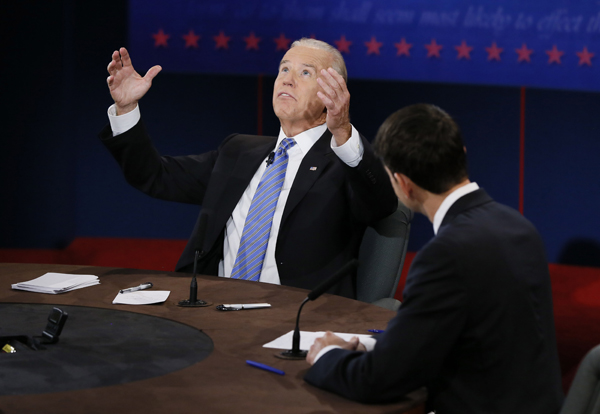
Vice President Biden’s assertions during the debate last night showed either a lack of information or a willful disregard for the facts.

Biden stated in relation to the September 11 attack on the U.S. consulate in Benghazi—which killed four Americans, including Ambassador Christopher Stevens—that “We weren’t told they wanted more security. We did not know they wanted more security there.”

Biden’s assertions squarely contradict headline-grabbing testimony given just the day before to Members of Congress. At Wednesday’s hearing of the House Oversight and Government Accountability Committee, Eric Nordstrom, a regional security officer at the U.S.embassy in Tripoli, described his intense frustration at having his requests for more security turned down by State Department officials. In fact, said the exasperated Nordstrom, fighting violent extremists inLibya was nowhere near as tough as fighting bureaucrats inWashington.

A timeline of the events leading up to the terrorist attack on September 11 shows that terrorism is indeed alive and well in Libya, a very inconvenient fact for the Obama Administration. The U.S. consulate had been attacked with explosive devices twice in six months, and diplomatic vehicles were routinely targets of assault and attempted kidnappings. The British ambassador had also been attacked, as had the building of the International Red Cross.

The Obama Administration continues to cling to the fiction that Libya is an Arab Spring success story, where normalizing relations and downgrading security would be appropriate. Even in the face of this terrorist attack, Charlene Lamb, Deputy Assistant Secretary for Diplomatic Security, stated at Wednesday’s hearing that security in Libya was “exactly right.” Unbelievable.

The aftermath of the Benghazi attack—one might call it the cover-up—is equally messy. The State Department appears determined to not take the blame and is shifting blame back to the White House for the post-attack cover-up. In two conference calls Tuesday—one with staff of five congressional committees and one with reporters (minus Fox News)—unnamed State Department officials denied that there was ever a demonstration outside the Benghazi consulate over the anti-Islam YouTube video “The Innocence of Muslims.” “That was not our conclusion,” the officials said repeatedly.

This distances the State Department from the official White House line that the 14-minute amateurish video was the cause of it all and not resurgent al-Qaeda terrorism. In particular, it distances the State Department from U.N. Ambassador Susan Rice and her five now-famous Sunday show appearances in which she unswervingly peddled the White House line as a fact.

Most importantly, however, it is now amply clear that terrorism did not die with Osama bin Laden and that we do not have a policy to deal with it. The Vice President got that one wrong, too.

Harding,Kennedy and Reagan proved that the Laffer Curve works

 I enjoyed this article below because it demonstrates that the Laffer Curve has been working for almost 100 years now when it is put to the test in the USA. I actually got to hear Arthur Laffer speak in person in 1981 and he told us in advance what was going to happen the 1980’s and it all came about as he said it would when Ronald Reagan’s tax cuts took place. I wish we would lower taxes now instead of looking for more revenue through raised taxes. We have to grow the economy:

What Mitt Romney Said Last Night About Tax Cuts And The Deficit Was Absolutely Right. And What Obama Said Was Absolutely Wrong.

Mitt Romney repeatedly said last night that he would not allow tax cuts to add to the deficit.  He repeatedly said it because over and over again Obama blathered the liberal talking point that cutting taxes necessarily increased deficits.

Romney’s exact words: “I want to underline that — no tax cut that adds to the deficit.”

Meanwhile, Obama has promised to cut the deficit in half during his first four years – but instead gave America the highest deficits in the history of the entire human race.

I’ve written about this before.  Let’s replay what has happened every single time we’ve ever cut the income tax rate.

The fact of the matter is that we can go back to Calvin Coolidge who said very nearly THE EXACT SAME THING to his treasury secretary: he too would not allow any tax cuts that added to the debt.  Andrew Mellon – quite possibly the most brilliant economic mind of his day – did a great deal of research and determined what he believed was the best tax rate.  And the Coolidge administration DID cut income taxes and MASSIVELY increased revenues.  Coolidge and Mellon cut the income tax rate 67.12 percent (from 73 to 24 percent); and revenues not only did not go down, but they went UP by at least 42.86 percent (from $700 billion to over $1 billion).

That’s something called a documented fact.  But that wasn’t all that happened: another incredible thing was that the taxes and percentage of taxes paid actually went UP for the rich.  Because as they were allowed to keep more of the profits that they earned by investing in successful business, they significantly increased their investments and therefore paid more in taxes than they otherwise would have had they continued sheltering their money to protect themselves from the higher tax rates.  Liberals ignore reality, but it is simply true.  It is a fact.  It happened.

Then FDR came along and raised the tax rates again and the opposite happened: we collected less and less revenue while the burden of taxation fell increasingly on the poor and middle class again.  Which is exactly what Obama wants to do.

People don’t realize that John F. Kennedy, one of the greatest Democrat presidents, was a TAX CUTTER who believed the conservative economic philosophy that cutting tax rates would in fact increase tax revenues.  He too cut taxes, and he too increased tax revenues.

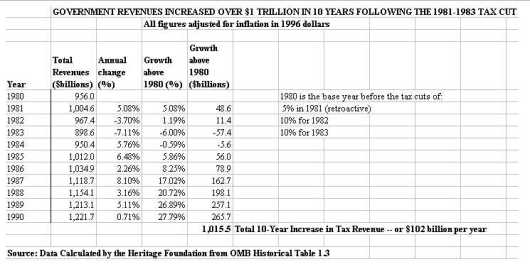
So we get to Ronald Reagan, who famously cut taxes.  And again, we find that Reagan cut that godawful liberal tax rate during an incredibly godawful liberal-caused economic recession, and he increased tax revenue by 20.71 percent (with revenues increasing from $956 billion to $1.154 trillion).  And again, the taxes were paid primarily by the rich:

“The share of the income tax burden borne by the top 10 percent of taxpayers increased from 48.0 percent in 1981 to 57.2 percent in 1988. Meanwhile, the share of income taxes paid by the bottom 50 percent of taxpayers dropped from 7.5 percent in 1981 to 5.7 percent in 1988.”

So we get to George Bush and the Bush tax cuts that liberals and in particular Obama have just demonized up one side and demagogued down the other.  And I can simply quote the New York Times AT the time:

Sharp Rise in Tax Revenue to Pare U.S. Deficit By EDMUND L. ANDREWS Published: July 13, 2005

WASHINGTON, July 12 – For the first time since President Bush took office, an unexpected leap in tax revenue is about to shrink the federal budget deficit this year, by nearly $100 billion.

A Jump in Corporate Payments On Wednesday, White House officials plan to announce that the deficit for the 2005 fiscal year, which ends in September, will be far smaller than the $427 billion they estimated in February.

Mr. Bush plans to hail the improvement at a cabinet meeting and to cite it as validation of his argument that tax cuts would stimulate the economy and ultimately help pay for themselves.

Based on revenue and spending data through June, the budget deficit for the first nine months of the fiscal year was $251 billion, $76 billion lower than the $327 billion gap recorded at the corresponding point a year earlier.

The Congressional Budget Office estimated last week that the deficit for the full fiscal year, which reached $412 billion in 2004, could be “significantly less than $350 billion, perhaps below $325 billion.”

The big surprise has been in tax revenue, which is running nearly 15 percent higher than in 2004. Corporate tax revenue has soared about 40 percent, after languishing for four years, and individual tax revenue is up as well
.

And of course the New York Times, as reliable liberals, use the adjective whenever something good happens under conservative policies and whenever something bad happens under liberal policies: ”unexpected.”   But it WASN’T ”unexpected.”  It was EXACTLY what Republicans had said would happen and in fact it was exactly what HAD IN FACT HAPPENED every single time we’ve EVER cut income tax rates.

The truth is that conservative tax policy has a perfect track record: every single time it has ever been tried, we have INCREASED tax revenues while not only exploding economic activity and creating more jobs, but encouraging the wealthy to pay more in taxes as well.  And liberals simply dishonestly refuse to acknowledge documented history.

Meanwhile, liberals also have a perfect record … of FAILUREThey keep raising taxes and keep not understanding why they don’t get the revenues they predicted.

The following is a section from my article, “Tax Cuts INCREASE Revenues; They Have ALWAYS Increased Revenues“, where I document every single thing I said above:

The Falsehood That Tax Cuts Increase The Deficit

Now let’s take a look at the utterly fallacious view that tax cuts in general create higher deficits.

Let’s take a trip back in time, starting with the 1920s.  From Burton Folsom’s book, New Deal or Raw Deal?:

In 1921, President Harding asked the sixty-five-year-old [Andrew] Mellon to be secretary of the treasury; the national debt [resulting from WWI] had surpassed $20 billion and unemployment had reached 11.7 percent, one of the highest rates in U.S. history.  Harding invited Mellon to tinker with tax rates to encourage investment without incurring more debt. Mellon studied the problem carefully; his solution was what is today called “supply side economics,” the idea of cutting taxes to stimulate investment.  High income tax rates, Mellon argued, “inevitably put pressure upon the taxpayer to withdraw this capital from productive business and invest it in tax-exempt securities. . . . The result is that the sources of taxation are drying up, wealth is failing to carry its share of the tax burden; and capital is being diverted into channels which yield neither revenue to the Government nor profit to the people” (page 128).

Mellon wrote, “It seems difficult for some to understand that high rates of taxation do not necessarily mean large revenue to the Government, and that more revenue may often be obtained by lower taxes.”  And he compared the government setting tax rates on incomes to a businessman setting prices on products: “If a price is fixed too high, sales drop off and with them profits.”

And what happened?

“As secretary of the treasury, Mellon promoted, and Harding and Coolidge backed, a plan that eventually cut taxes on large incomes from 73 to 24 percent and on smaller incomes from 4 to 1/2 of 1 percent.  These tax cuts helped produce an outpouring of economic development – from air conditioning to refrigerators to zippers, Scotch tape to radios and talking movies.  Investors took more risks when they were allowed to keep more of their gains.  President Coolidge, during his six years in office, averaged only 3.3 percent unemployment and 1 percent inflation – the lowest misery index of any president in the twentieth century.

Furthermore, Mellon was also vindicated in his astonishing predictions that cutting taxes across the board would generate more revenue.  In the early 1920s, when the highest tax rate was 73 percent, the total income tax revenue to the U.S. government was a little over $700 million.  In 1928 and 1929, when the top tax rate was slashed to 25 and 24 percent, the total revenue topped the $1 billion mark.  Also remarkable, as Table 3 indicates, is that the burden of paying these taxes fell increasingly upon the wealthy” (page 129-130).

Now, that is incredible upon its face, but it becomes even more incredible when contrasted with FDR’s antibusiness and confiscatory tax policies, which both dramatically shrunk in terms of actual income tax revenues (from $1.096 billion in 1929 to $527 million in 1935), and dramatically shifted the tax burden to the backs of the poor by imposing huge new excise taxes (from $540 million in 1929 to $1.364 billion in 1935).  See Table 1 on page 125 of New Deal or Raw Deal for that information.

FDR both collected far less taxes from the rich, while imposing a far more onerous tax burden upon the poor.

It is simply a matter of empirical fact that tax cuts create increased revenue, and that those [Democrats] who have refused to pay attention to that fact have ended up reducing government revenues even as they increased the burdens on the poorest whom they falsely claim to help.

Let’s move on to John F. Kennedy, one of the most popular Democrat presidents ever.  Few realize that he was also a supply-side tax cutter.

Kennedy said:

“It is a paradoxical truth that tax rates are too high and tax revenues are too low and the soundest way to raise the revenues in the long run is to cut the rates now … Cutting taxes now is not to incur a budget deficit, but to achieve the more prosperous, expanding economy which can bring a budget surplus.”

– John F. Kennedy, Nov. 20, 1962, president’s news conference


“Lower rates of taxation will stimulate economic activity and so raise the levels of personal and corporate income as to yield within a few years an increased – not a reduced – flow of revenues to the federal government.”

– John F. Kennedy, Jan. 17, 1963, annual budget message to the Congress, fiscal year 1964

“In today’s economy, fiscal prudence and responsibility call for tax reduction even if it temporarily enlarges the federal deficit – why reducing taxes is the best way open to us to increase revenues.”

– John F. Kennedy, Jan. 21, 1963, annual message to the Congress: “The Economic Report Of The President”


“It is no contradiction – the most important single thing we can do to stimulate investment in today’s economy is to raise consumption by major reduction of individual income tax rates.”

– John F. Kennedy, Jan. 21, 1963, annual message to the Congress: “The Economic Report Of The President”


“Our tax system still siphons out of the private economy too large a share of personal and business purchasing power and reduces the incentive for risk, investment and effort – thereby aborting our recoveries and stifling our national growth rate.”

– John F. Kennedy, Jan. 24, 1963, message to Congress on tax reduction and reform, House Doc. 43, 88th Congress, 1st Session.


“A tax cut means higher family income and higher business profits and a balanced federal budget. Every taxpayer and his family will have more money left over after taxes for a new car, a new home, new conveniences, education and investment. Every businessman can keep a higher percentage of his profits in his cash register or put it to work expanding or improving his business, and as the national income grows, the federal government will ultimately end up with more revenues.”

– John F. Kennedy, Sept. 18, 1963, radio and television address to the nation on tax-reduction bill

Which is to say that modern Democrats are essentially calling one of their greatest presidents a liar when they demonize tax cuts as a means of increasing government revenues.

So let’s move on to Ronald Reagan.  Reagan had two major tax cutting policies implemented: the Economic Recovery Tax Act (ERTA) of 1981, which was retroactive to 1981, and the Tax Reform Act of 1986.

Did Reagan’s tax cuts decrease federal revenues?  Hardly:

We find that 8 of the following 10 years there was a surplus of revenue from 1980, prior to the Reagan tax cuts.  And, following the Tax Reform Act of 1986, there was a MASSIVE INCREASEof revenue.

So Reagan’s tax cuts increased revenue.  But who paid the increased tax revenue?  The poor?  Opponents of the Reagan tax cuts argued that his policy was a giveaway to the rich (ever heard that one before?) because their tax payments would fall.  But that was exactly wrong.  In reality:

“The share of the income tax burden borne by the top 10 percent of taxpayers increased from 48.0 percent in 1981 to 57.2 percent in 1988. Meanwhile, the share of income taxes paid by the bottom 50 percent of taxpayers dropped from 7.5 percent in 1981 to 5.7 percent in 1988.”

So Ronald Reagan a) collected more total revenue, b) collected more revenue from the rich, while c) reducing revenue collected by the bottom half of taxpayers, and d) generated an economic powerhouse that lasted – with only minor hiccups – for nearly three decades.  Pretty good achievement considering that his predecessor was forced to describe his own economy as a “malaise,” suffering due to a “crisis of confidence.” Pretty good considering that President Jimmy Carter responded to a reporter’s question as to what he would do about the problem of inflation by answering, “It would be misleading for me to tell any of you that there is a solution to it.”

Reagan whipped inflation.  Just as he whipped that malaise and that crisis of confidence.

________

The Laffer Curve, Part III: Dynamic Scoring