Monthly Archives: September 2012

The Declaration of Independence discussed by Heritage Foundation’ Matthew Spalding

God-given liberties are what we have in the USA.

Independence Forever: Why America Celebrates the Fourth of July

By June 28, 2007


The Fourth of July is a great opportunity to renew our dedication to the principles of liberty and equality enshrined in what Thomas Jefferson called “the declaratory charter of our rights.”

As a practical matter, the Declaration of Independence publicly announced to the world the unanimous decision of the American colonies to declare themselves free and independent states, absolved from any allegiance to Great Britain. But its greater meaning-then as well as now-is as a statement of the conditions of legitimate political authority and the proper ends of government, and its proclamation of a new ground of political rule in the sovereignty of the people. “If the American Revolution had produced nothing but the Declaration of Independence,” wrote the great historian Samuel Eliot Morrison, “it would have been worthwhile.”

Although Congress had appointed a distinguished committee-including John Adams, Benjamin Franklin, Roger Sherman, and Robert Livingston-the Declaration of Independence is chiefly the work of Thomas Jefferson. By his own account, Jefferson was neither aiming at originality nor taking from any particular writings but was expressing the “harmonizing sentiments of the day,” as expressed in conversation, letters, essays, or “the elementary books of public right, as Aristotle, Cicero, Locke, Sidney, etc.” Jefferson intended the Declaration to be “an expression of the American mind,” and wrote so as to “place before mankind the common sense of the subject, in terms so plain and firm as to command their assent.”

The structure of the Declaration of Independence is that of a common law legal document. The ringing phrases of the document’s famous second paragraph are a powerful synthesis of American constitutional and republican government theories. All men have a right to liberty only in so far as they are by nature equal, which is to say none are naturally superior, and deserve to rule, or inferior, and deserve to be ruled. Because men are endowed with these rights, the rights are unalienable, which means that they cannot be given up or taken away. And because individuals equally possess these rights, governments derive their just powers from the consent of those governed. The purpose of government is to secure these fundamental rights and, although prudence tells us that governments should not be changed for trivial reasons, the people retain the right to alter or abolish government when it becomes destructive of these ends.

The remainder of the document is a bill of indictment accusing King George III of some 30 offenses, some constitutional, some legal, and some matters of policy. The combined charges against the king were intended to demonstrate a history of repeated injuries, all having the object of establishing “an absolute tyranny” over America. Although the colonists were “disposed to suffer, while Evils are sufferable,” the time had come to end the relationship: “But when a long train of abuses and usurpations, pursuing invariably the same Object, evinces a design to reduce them under absolute Despotism, it is their right, it is their duty, to throw off such Government.”

One charge that Jefferson had included, but Congress removed, was that the king had “waged cruel war against human nature” by introducing slavery and allowing the slave trade into the American colonies. A few delegates were unwilling to acknowledge that slavery violated the “most sacred rights of life and liberty,” and the passage was dropped for the sake of unanimity. Thus was foreshadowed the central debate of the American Civil War, which Abraham Lincoln saw as a test to determine whether a nation “conceived in liberty and dedicated to the proposition that all men are created equal” could long endure.

The Declaration of Independence and the liberties recognized in it are grounded in a higher law to which all human laws are answerable. This higher law can be understood to derive from reason-the truths of the Declaration are held to be “self-evident”-but also revelation. There are four references to God in the document: to “the laws of nature and nature’s God”; to all men being “endowed by their Creator with certain unalienable rights”; to “the Supreme Judge of the world for the rectitude of our intentions”; and to “the protection of Divine Providence.” The first term suggests a deity that is knowable by human reason, but the others-God as creator, as judge, and as providence-are more biblical, and add a theological context to the document. “And can the liberties of a nation be thought secure when we have removed their only firm basis, a conviction in the minds of the people that these liberties are a gift of God?” Jefferson asked in his Notes on the State of Virginia.

The true significance of the Declaration lies in its trans-historical meaning. Its appeal was not to any conventional law or political contract but to the equal rights possessed by all men and “the separate and equal station to which the Laws of Nature and nature’s God” entitled them. What is revolutionary about the Declaration of Independence is not that a particular group of Americans declared their independence under particular circumstances but that they did so by appealing to-and promising to base their particular government on-a universal standard of justice. It is in this sense that Abraham Lincoln praised “the man who, in the concrete pressure of a struggle for national independence by a single people, had the coolness, forecast, and capacity to introduce into a merely revolutionary document, an abstract truth, applicable to all men and all times.”

The ringing phrases of the Declaration of Independence speak to all those who strive for liberty and seek to vindicate the principles of self-government. But it was an aged John Adams who, when he was asked to prepare a statement on the 50th anniversary of the Declaration of Independence, delivered two words that still convey our great hope every Fourth of July: “Independence Forever.”

Matthew Spalding, Ph.D., is Director of the B. Kenneth Simon Center for American Studies at The Heritage Foundation.

Open letter to President Obama (Part 134 B)

President Obama c/o The White House
1600 Pennsylvania Avenue NW
Washington, DC 20500

Dear Mr. President,

I know that you receive 20,000 letters a day and that you actually read 10 of them every day. I really do respect you for trying to get a pulse on what is going on out here.

I feel so strongly about the evil practice of running up our national debt. I was so proud of Rep. Todd Rokita who voted against the Budget Control Act of 2011 on August 11, 2011. He made this comment: 

 For decades now, we have spent too much money on ourselves and have intentionally allowed our kids and grandkids to pay for it.  It is intergenerational theft—literally stealing from our best asset, our posterity.  The correct course of action, as I have said from the beginning, is to enact permanent and structural reform as the price for raising the debt ceiling.  Today’s bill does not do that.

Here he has called it for what it is: THEFT!!!

Ted DeHaven noted his his article, “Freshman Republicans switch from Tea to Kool-Aid,”  Cato Institute Blog, May 17, 2012:

This week the Club for Growth released a study of votes cast in 2011 by the 87 Republicans elected to the House in November 2010. The Club found that “In many cases, the rhetoric of the so-called “Tea Party” freshmen simply didn’t match their records.” Particularly disconcerting is the fact that so many GOP newcomers cast votes against spending cuts.

The study comes on the heels of three telling votes taken last week in the House that should have been slam-dunks for members who possess the slightest regard for limited government and free markets. Alas, only 26 of the 87 members of the “Tea Party class” voted to defund both the Economic Development Administration and the president’s new Advanced Manufacturing Technology Consortia program (see my previous discussion of these votes here) and against reauthorizing the Export-Import Bank (see my colleague Sallie James’s excoriation of that vote here).

One of those Tea Party heroes was Congressman Todd Rokita of Indiana. Last year I posted this below concerning his conservative views and his willingness to vote against the debt ceiling increase:

Rokita Votes Against Debt Ceiling Increase

Aug 1, 2011 Issues: Spending Cuts and Debt


Rep. Todd Rokita voted against the Budget Control Act of 2011 because it fails to implement the long-term permanent and structural reforms necessary to put the nation back on a fiscally sustainable trajectory:

“I have heard a couple different definitions of leadership today.  Let me add mine: leadership is effectively persuading others of the proper course of action.  It is also about standing up for those who have no voice. For decades now, we have spent too much money on ourselves and have intentionally allowed our kids and grandkids to pay for it.  It is intergenerational theft—literally stealing from our best asset, our posterity.  The correct course of action, as I have said from the beginning, is to enact permanent and structural reform as the price for raising the debt ceiling.  Today’s bill does not do that.

This legislation is a Washington deal, and it barely begins to address our long-term spending problem. Our debt crisis is driven by mandatory spending on entitlement programs and this plan fails to address such spending.  Also, this plan only reduces the future debt we will pile on the backs of our kids from $10 trillion to around $7 trillion over the next decade.  It does not begin to reduce our $14 trillion in current debt. 

However, this legislation could eventually lead to the best permanent solution, a balanced budget amendment.  This is certainly worth fighting for and I will lead on that front.  But a vote alone is not worth the $2.5 trillion price tag, again to be paid by future generations. For that price, we should have required passage of a balanced budget amendment for state ratification.

I will continue to fight for a balanced budget amendment, lead our nation to live within its means and tackle out-of-control entitlement spending. It will be a long fight, but the enactment of a balanced budget amendment is the only way to fix the broken system that created this mess, both addressing our long-term fiscal health and giving Americans long-term peace of mind.”  

_______________

Thank you so much for your time. I know how valuable it is. I also appreciate the fine family that you have and your commitment as a father and a husband.

Sincerely,

Everette Hatcher III, 13900 Cottontail Lane, Alexander, AR 72002, ph 501-920-5733, lowcostsqueegees@yahoo.com

The real truth about Obamacare can be seen on the www.thedailyhatch.org

Michael Cannon on Medicare and Healthcare

You want to know the real truth about Obamacare then check out these videos and articles linked below:

American people do not want Obamacare and the regulations that go with it

In this article below you will see that the American people do not want Obamacare but yet it is being crammed down their throats and all the regulations that go with that too. Sickening Regulation by Michael D. Tanner Michael Tanner is a senior fellow at the Cato Institute and author of Leviathan on the […]

Arkansas Times praises good results of Obamacare

Gerard Matthews wrote on March 21, 2012 in the Arkansas Times: Children cannot be denied coverage because of a pre-existing condition. Young people can stay on their parents’ health insurance plan until they are 26 years old. Preventive services, which will ultimately help control health care costs, have been added to some plans at no […]

Brummett is arguing over the chairs on the Titanic as Obamacare will surely bankrupt state

Michael Cannon on Medicare and Healthcare In his article, “Medicaid and the consequences,” Arkansas Democrat-Gazette, March 20, 2012, (paywall), Brummett admits, “Medicaid will break the bank of state government if we don’t do something.” However, he never gets around to saying that Obamacare is going to ruin the state financially. It will expand this failing […]

If the Democrats want to back Obamacare then let them go down with the ship

On March 19, 2012 Jason Tolbert pointed out that the Democrats in Little Rock were using Obama’s talking points concerning Obamacare, but it appears to me that they go down with the ship according to the mood in the country. Take a look at this fine article from the Cato Institute. In this article below […]

Setting Biden Straight on Obamacare’s Anti-Conscience Mandate

Setting Biden Straight on Obamacare’s Anti-Conscience Mandate Uploaded by HeritageFoundation on Mar 3, 2012 Vice President Biden didn’t get the story quite straight. As the Obama Administration reels from the backlash for Obamacare’s anti-conscience mandate that forces religious employers to provide coverage and pay for abortion-inducing drugs, Biden yesterday set out to convince America that […]

Obama’s affordable lightbulb

It seems that government was in control of the desert then we would have a shortage of sand as Milton Friedman used to quip. You Keep Using the Word ‘Affordable.’ I Do Not Think It Means What You Think It Means. Posted by Michael F. Cannon The federal government gave a $10 million “affordability” prize […]

Brummett misses the boat on Obamacare again

Uploaded by HarrysRetroArchive on Aug 7, 2010 The stooges join the “Women Haters” club and vow to have nothing to do with the fair sex. Larry marries a girl anyway and attempts to hide the fact from Moe and Curly as they take a train trip. Director: Archie Gottler Cast: Marjorie White, A.R. Haysel, Monte […]

Brantley is wrong about Republicans losing debate on Obamacare and conscience

Religious Liberty: Obamacare’s First Casualty Uploaded by HeritageFoundation on Feb 22, 2012 http://blog.heritage.org/2012/02/22/morning-bell-religious-liberty-under-attack/ | The controversy over the Obama Administration’s anti-conscience mandate and the fight for religious liberty only serves to highlight the inherent flaws in Obamacare. This conflict is a natural result of the centralization laid out under Obamacare and will only continue until […]

“War on Women?”

Religious Liberty: Obamacare’s First Casualty Uploaded by HeritageFoundation on Feb 22, 2012 http://blog.heritage.org/2012/02/22/morning-bell-religious-liberty-under-attack/ | The controversy over the Obama Administration’s anti-conscience mandate and the fight for religious liberty only serves to highlight the inherent flaws in Obamacare. This conflict is a natural result of the centralization laid out under Obamacare and will only continue until […]

Is anything “free?”: According to Obama there is

Somebody will pay. You can bet on that. Obama’s Political Prophylactic Posted by Roger Pilon “White House compromise still guarantees contraceptive coverage for women,” reads theWashington Post headline coming out of President Obama’s press conference this afternoon. Trying to tamp down the escalating political storm his administration created three weeks ago when it ruled that, under Obamacare, employers with […]

Single-Payer healthcare system work? (Free Market response, Part 2)

_____________________________________________________ I would like to respond the idea of a single payer healthcare system by quoting from David Hogberg’s article “Free Market Cure – The Myths of Single-Payer Health Care.” He notes: A single-payer health care system is one in which a single-entity — the government — collects almost all of the revenue for and pays almost all of […]


Open letter to Republican Presidential Candidate Mitt Romney on our pro-life views (Part 7)

photo

___________________________________________

Francis Schaeffer is a hero of mine and I want to honor him with a series of posts on Sundays called “Schaeffer Sundays” which will include his writings and clips from his film series. I have posted many times in the past using his material.

Philosopher and Theologian, Francis A. Schaeffer has argued, “If there are no absolutes by which to judge society, then society is absolute.” Francis Schaeffer, How Shall We Then Live? (Old Tappan NJ: Fleming H Revell Company, 1976), p. 224.

____________________________________

To Mitt Romney, Box 96994, Washington, DC 20077-7556  From Everette Hatcher of www.thedailyhatch.org 13900 Cottontail Lane, Alexander, AR 72002

Did we forgive George Bush in 1988 for being pro-choice originally in 1980? We sure did. In fact, my former pastor, Adrian Rogers, had a chance to visit with Bush several times. He told him that the Religious Right did not have enough votes to get him elected on their own, but if he ever went against the pro-life view then they could definately derail his election bid.

Today I am writing you to remind you of the same thing. We in the pro-life movement are firmly behind you but we want to know some of the reasons are passionately pro-life.

Al Mohler wrote the article ,”FIRST-PERSON: They indeed were prophetic,” Jan 29, 2004, and in this great article he noted:   .

“We stand today on the edge of a great abyss,” they wrote. “At this crucial moment choices are being made and thrust on us that will for many years to come affect the way people are treated. We want to try to help tip the scales on the side of those who believe that individuals are unique and special and have great dignity.”

This year marks the 25th anniversary of “Whatever Happened to the Human Race?” by Francis Schaeffer and C. Everett Koop. The anniversary serves to remind us just how unaware and unawake most evangelicals really were 25 years ago — and how prophetic the voices of Schaeffer and Koop were.

Whatever Happened to the Human Race? was both a book project and a film series, the fruit of an unusual collaboration between Francis Schaeffer, one of the truly significant figures of 20th-century evangelicalism, and C. Everett Koop, one of the nation’s most illustrious pediatric surgeons. They were an odd couple of sorts, but on the crucial issues of human dignity and the threat of what would later be called the “Culture of Death,” they were absolutely united.

Francis Schaeffer, who died in 1984, was nothing less than a 20th-century prophet. He was a genuine eccentric, given to wearing leather breeches and sporting a goatee — then quite unusual for anyone in the evangelical establishment. Then again, Schaeffer was never really a member of any establishment, and that is partly why a generation of questioning young people made their way to his Swiss study center known as L’Abri.

Big ideas were Schaeffer’s business — and the Christian worldview was his consistent framework. Long before most evangelicals even knew they had a worldview, Schaeffer was taking alternative worldviews apart and inculcating in his students a love for the architecture of Christian truth and the dignity of ideas.

Key figures on the evangelical left wrote Schaeffer off as a crank, and he returned the favor by denying that they were evangelicals at all. They complained that he did not follow their rules for scholarly publication. He pointed out that people actually read his books — and young people frustrated with cultural Christianity read his books by the thousands. They were looking for someone with ideas big enough for the age, relevant for the questions of the times, and based without compromise in Christian truth. Francis Schaeffer — knee pants and all — became a prophet for the age.

Dr. C. Everett Koop, on the other hand, is a paragon of the American establishment — a former surgeon-in-chief at the Children’s Hospital in Philadelphia and later surgeon general of the United States under President Reagan. In 1974 Koop catapulted to international attention by performing the first successful surgical separation of conjoined twins. A Presbyterian layman, Koop lives in quasi-retirement in Pennsylvania. His surgical procedures remain textbook cases for medical students today.

Whatever Happened to the Human Race? awakened American evangelicals to the anti-human technologies and ideologies that then threatened human dignity. Most urgently, the project put abortion unquestionably on the front burner of evangelical concern. The tenor of the times is seen in the fact that Schaeffer and Koop had to argue to evangelicals in the late 1970s that abortion was not just a “Catholic” issue. They taught many evangelicals a new and urgently needed vocabulary about embryo ethics, euthanasia and infanticide. They knew they were running out of time.

“Each era faces its own unique blend of problems,” they argued. “Our time is no exception. Those who regard individuals as expendable raw material — to be molded, exploited, and then discarded — do battle on many fronts with those who see each person as unique and special, worthwhile, and irreplaceable.”

Every age is marked by both the “thinkable” and the “unthinkable,” they asserted — and the “thinkable” of late-20th-century Western cultures was dangerously anti-human. The lessons of the century — with the Holocaust at its center — should be sufficient to drive the point home. The problem, as illustrated by those who worked in Hitler’s death camps, was the inevitable result of a loss of conscience and moral truth. They were “people just like all of us,” Koop and Schaeffer reminded. “We seem to be in danger of forgetting our seemingly unlimited capacities for evil, once boundaries to certain behavior are removed.”

By the last quarter of the century, life and death were treated as mere matters of choice. “The schizophrenic nature of our society became further evident as it became common practice for pediatricians to provide the maximum of resuscitative and supportive care in newborn intensive-care nurseries where premature infants were under their care — while obstetricians in the same medical centers were routinely destroying enormous numbers of unborn babies who were normal and frequently of larger size. Minors who could not legally purchase liquor and cigarettes could have an abortion-on-demand and without parental consent or knowledge.”

Schaeffer and Koop pointed to other examples of moral schizophrenia. Disabled persons were given new access to facilities and services in the name of human rights, while preborn infants diagnosed with the same disabilities were often aborted — with the advice that it would be “wrong” to bring such a baby into the world.

Long before the discovery of stem cells and calls for the use of human embryos for such experimentation, Schaeffer and Koop warned of attacks upon human life at its earliest stage. “Embryos ‘created’ in the biologist’s laboratory raise special questions because they have the potential for growth and development if planted in the womb. The disposal of these live embryos is a cause for ethical and moral concern.”

They also saw the specter of infanticide and euthanasia. Infanticide, including what is now called “partial-birth abortion,” is murder, they argued. “Infanticide is being practiced right now in this country, and the saddest thing about this is that it is being carried on by the very segment of the medical profession which has always stood in the role of advocate for the lives of children.” Long before the formal acceptance of euthanasia in countries like the Netherlands, Koop and Schaeffer saw the rise of a “duty to die” argument used against the old, the very sick and the unproductive. They rejected euthanasia in the case of a “so-called vegetative existence” and warned all humanity that disaster awaited a society that lusted for a “beautiful death.”

Abortion, infanticide, and euthanasia are not only questions for women and other relatives directly involved — nor are they the prerogatives of a few people who have thought through the wider ramifications,” they declared. “They are life-and-death issues that concern the whole human race equally and should be addressed as such.”

How did this happen? This embrace of an anti-human “humanism” could only be explained by the rejection of the Christian worldview. “Judeo-Christian teaching was never perfectly applied,” they acknowledged, “but it did lay a foundation for a high view of human life in concept and practice.” Through the inculcation of biblical values, “people viewed human life as unique — to be protected and loved — because each individual is made in the image of God.”

Two great enemies of truth were blamed for this loss of biblical truth — modern secularism and theological liberalism. The secularists insist on the imposition of a “humanism” that defines humanity in terms of productivity, arbitrary standards of beauty and health, and an inverted system of value. Theological liberalism, denying the truthfulness of the Bible, robs the church and the society of any solid authority. The biblical concept of humanity made in the image of God is treated as poetry rather than as truth. But, “if people are not made in the image of God, the pessimistic, realistic humanist is right: The human race is indeed an abnormal wart on the smooth face of a silent and meaningless universe.”

Everything else simply follows. “In this setting, abortion, infanticide, and euthanasia … are completely logical. Any person can be obliterated for what society at one moment thinks of as its own social or economic good.” Once human life and human dignity are devalued to this degree, recovery is extremely difficult — if not impossible.

The past 25 years has been a period of even more rapid technological and moral change. We now face threats to human dignity unimaginable just a quarter-century ago. We must now deal with the ethical challenges of embryo research, human cloning, the Human Genome Project and the rise of transhuman technologies. Even with many Christians aware and active on these issues, we are losing ground.

Francis Schaeffer and Everett Koop ended their book with a call for action. “If, in this last part of the twentieth century, the Christian community does not take a prolonged and vocal stand for the dignity of the individual and each person’s right to life — for the right of each person to be treated as created in the image of God, rather than as a collection of molecules with no unique value — we feel that as Christians we have failed the greatest moral test to be put before us in this century.”

In this new century, that warning is even more threatening and more urgent. The challenges of the 21st century are even greater than those faced in the century before. This should make us even more thankful for the prophetic witness of Francis Schaeffer and C. Everett Koop — and even more determined to contend for life. Humanity still stands on the brink of that abyss.
–30–
Adapted from the Crosswalk.com weblog of R. Albert Mohler Jr., president of Southern Baptist Theological Seminary in Louisville, Ky.

What Ever Happened to the Human Race?

Senator Pryor asks for Spending Cut Suggestions! Here are a few!(Part 160)

Senator Pryor asks for Spending Cut Suggestions! Here are a few!(Part 160)

Senator Mark Pryor wants our ideas on how to cut federal spending. Take a look at this video clip below:

Senator Pryor has asked us to send our ideas to him at cutspending@pryor.senate.gov and I have done so in the past and will continue to do so in the future.

On May 11, 2011,  I emailed to this above address and I got this email back from Senator Pryor’s office:

Please note, this is not a monitored email account. Due to the sheer volume of correspondence I receive, I ask that constituents please contact me via my website with any responses or additional concerns. If you would like a specific reply to your message, please visit http://pryor.senate.gov/contact. This system ensures that I will continue to keep Arkansas First by allowing me to better organize the thousands of emails I get from Arkansans each week and ensuring that I have all the information I need to respond to your particular communication in timely manner.  I appreciate you writing. I always welcome your input and suggestions. Please do not hesitate to contact me on any issue of concern to you in the future.

I just did. I went to the Senator’s website and sent this below:

Below is an excellent plan to balance the budget through spending cuts from Chris Edwards of the Cato Institute written in April of 2011. Here is the third part.

A Plan to Cut Spending and Balance the Federal Budget

by Chris Edwards, Cato Institute

Introduction
Reducing Spending over 10 Years
Spending Cut Details
Subsidies to Individuals and Businesses
Aid to State and Local Governments
Military Expenses
Medicare, Medicaid, and Social Security
Privatization
Conclusions

Subsidies to Individuals and Businesses

The federal government operates more than 2,000 separate subsidy programs, a doubling of subsidy programs since the mid-1980s.9 The scope of federal activities has greatly expanded in recent decades, along with the size of the federal budget. The federal government subsidizes farm businesses, retirees, school lunches, rural utilities, the energy industry, rental housing, public broadcasting, job training, foreign aid activities, foreign purchases of weapons, urban transit services, and many other types of activities and people.

Each subsidy program costs money, generates a bureaucracy, spawns lobby groups, and encourages more people to demand freebies from the government. Individuals, businesses, and nonprofit groups that become hooked on federal subsidies essentially become tools of the state. They lose their independence, they have less incentive to innovate, and they shy away from criticizing the government.

Table 1 includes cuts to subsidies in agriculture, commerce, energy, housing, foreign aid, and other areas. These cuts wouldn’t eliminate all of the unjustified subsidies in the federal budget, but they would be a good start. Government subsidies are like addictive drugs, undermining America’s traditions of individual reliance, voluntary charity, and entrepreneurialism.

Aid to State and Local Governments

Under the Constitution, the federal government was assigned specific limited powers, and most government functions were left to the states. To ensure that people understood the limits on federal power, the Framers added the Constitution’s Tenth Amendment: “The powers not delegated to the United States by the Constitution, nor prohibited by it to the States, are reserved to the States respectively, or to the people.” The amendment embodies federalism, the idea that federal and state governments have separate areas of activity and that federal responsibilities are supposed to be “few and defined,” as James Madison noted.

Unfortunately, policymakers and the courts have mainly discarded federalism in recent decades. Congress has undertaken many activities that were traditionally reserved to state and local governments through the mechanism of “grants-in-aid.” Grant programs are subsidies that are combined with federal regulatory controls to micromanage state and local activities. In fiscal 2011, federal aid to the states will total $625 billion, which will be distributed through more than 1,100 separate programs.10

The theory behind grants-in-aid is that the federal government can operate programs in the national interest to efficiently solve local problems. However, the federal aid system does not work that way in practice. Most federal politicians are consumed by the competitive scramble to maximize subsidies for their states, regardless of efficiency, fairness, or any appreciation of overall budget limitations.

Furthermore, federal aid stimulates overspending by state governments and creates a web of complex federal regulations that destroy state innovation. At all levels of the aid system, the focus is on regulatory compliance and spending, not on delivering quality public services. The aid system destroys government accountability because each level of government can blame the other levels when programs fail. It is a “triumph of expenditure without responsibility.”

The federal aid system is a roundabout funding system for state and local activities. It serves no important economic purpose. By federalizing state and local activities, we are asking Congress to do the impossible—to efficiently plan for the competing needs of a diverse country of more than 300 million people.

The grants-in-aid system should be dramatically cut. Policymakers need to revive federalism and begin to terminate grant programs. Table 1 includes cuts to grants in the areas of agriculture, education, health care, justice, and transportation. The justice grants, for example, are for funding such items as bulletproof vests for local police.11 There is no reason why such activities should not be funded at the city or county level.

Military Expenses

Cato Institute defense experts Christopher Preble and Benjamin Friedman have proposed a lengthy list of cuts to U.S. military spending totaling $1.2 trillion over 10 years.12 Within 10 years, their proposal would reduce spending by about $150 billion annually, based on a strategy of restraint and reduced intervention abroad.

In proposing their plan, Preble and Friedman argue that the United States would be better off taking a wait-and-see approach to distant threats, while letting friendly nations bear more of the costs of their own defense. They note that U.S. policymakers support many extraneous missions for the military aside from the basic requirement to defend the nation. There is no doubt that America’s military budget is bloated. Even aside from the wars in Iraq and Afghanistan, Department of Defense spending roughly doubled between 2001 and 2011.13

Open letter to President Obama (Part 133 B)

Michael Savage May 17 2012 hr 3 segment 3.wmv

Published on May 17, 2012 by

The Savage Nation

Savage guest Mark Calabria from the Cato Institute discusses J P Morgan in this segment.

www.cato.org

_________________

President Obama c/o The White House
1600 Pennsylvania Avenue NW
Washington, DC 20500

Dear Mr. President,

I know that you receive 20,000 letters a day and that you actually read 10 of them every day. I really do respect you for trying to get a pulse on what is going on out here.

The free market works much better than federal officials do. Take a look at how how our money is managed every year by the federal government. The federal government has 2.1 trillion coming in and 3.6 trillion going out!! I sincerely hope the federal government will stay out of Wall Street business!!! TARP was a joke and it ended up with a government takeover of GM.

Mike Brownfield

May 15, 2012 at 8:55 am

The lingering headline on the front pages this week is that JP Morgan Chase suffered a massive loss on a hedging strategy, costing them $2 billion. That’s no small mistake, and it’s an example of how bad decisions in the free market can cost big money. But just because mistakes have consequences doesn’t mean that the mighty hand of government needs to step in to save us from ourselves. However, that’s what some on the left are now calling for.

The news of this blunder hit last week when JP Morgan CEO Jamie Dimon revealed that the bank took a $2 billion loss over the past six weeks in a strategy intended to hedge against risks to the bank’s assets that could come from market volatility caused by the Euro crisis. On Sunday’s Meet the Press, Dimon admitted, “In hindsight, we took far too much risk. The strategy we had was badly vetted. It was badly monitored. It should never have happened.”

The company is certainly paying the price in losses, as are those responsible for the bad decision making. The Los Angeles Times reports that the bank’s stock fell 12% since it disclosed the loss last week, the executive who oversaw the department responsible for the loss retired on Monday, and JP Morgan’s reputation as an extremely well managed bank has been damaged.

But does the flawed strategy and the resulting loss mean that Washington should step in with more regulation of Wall Street? Yesterday, White House press secretary Jay Carney used the news of JP Morgan’s loss to call for more regulations, remarking, “The president fought very hard against Republicans and Wall Street lobbyists to get Wall Street reform passed . . . I think that this event merely reinforces why the President was right to take on this fight and why we still need to make sure it’s implemented.”

Likewise, former Obama adviser Elizabeth Warren called for Dimon to resign from the New York Federal Reserve Board and slammed Wall Street. “What happened here is not just about JP Morgan case, it’s about the kind of attitudes, that the bank should be regulating themselves instead of having real oversight,” Warren said. “We have to say as a country, no, the banks cannot regulate themselves.”

What’s needed is some perspective, not more regulation from Washington. Heritage’s David C. John explains that while JP Morgan’s loss represents a clear failure of management, it’s not a systemic problem that requires or would be fixed by additional regulation. For starters, JP Morgan is a $2.3 trillion bank with a net worth of $189 billion, meaning that this loss reduced the bank’s capital ratio from 8.4 percent to 8.2 percent. In other words, the bank can absorb the loss, and it’s nowhere close to needing any form of federal intervention.

Some more perspective could be gleaned by examining the $3.2 billion loss the U.S. Post Office experienced in the most recent quarter, or the billions lost on risky green energy bets made by President Obama and Energy Secretary Steven Chu. Only those losses weren’t incurred by private investors, but by you the taxpayer.

What’s more, John explains, the regulations that are now being called for — particularly the so-called Volcker Rule — would not have prevented the losses since it would not have affected this transaction. Finally, John writes, the system worked as is. “JPMorgan Chase losses were not discovered by regulators; they were discovered by the bank itself conducting its own management reviews.”

What America is witnessing is the left using the news of JP Morgan’s bad judgment as an excuse for more government regulation. But as even Carney acknowledged, regulations “can’t prevent bad decisions from being made on Wall Street.”

For all the wrangling over JP Morgan’s loss, John points out that the bank is still expected to make a healthy profit for all of 2012. Yes, it made a mistake, and yes, that mistake cost a lot of money. But risks, mistakes and costs are part of capitalism. They’re the price we pay for all the benefits that a free market affords us.

____________

Thank you so much for your time. I know how valuable it is. I also appreciate the fine family that you have and your commitment as a father and a husband.

Sincerely,

Everette Hatcher III, 13900 Cottontail Lane, Alexander, AR 72002, ph 501-920-5733, lowcostsqueegees@yahoo.com

Music Monday:Religion and Chris Martin part 1

Coldplay-DALLAS-2012-“Opening, Mylo Xyloto, and Hurts like Heaven!”

Published on Jun 24, 2012 by

1:10 is where the concert starts! Sorry for the shaking and sound audio! It was really loud! AND AWESOME! 😀 Please THUMB UP and COMMENT if u went to this coldplay concert! And I also hope that this will get a few people in the mood if they are seeing one in the future! ENJOY!

___________


1/11

Chris Martin was brought up as an evangelical Christian but he left the faith once he left his childhood home. However, there are been some actions in his life in the last few years that demonstrate that he still is grappling with his childhood Chistian beliefs. This is the first part of a series I am starting on this subject.

On June 23, 2012 my son Wilson and I got to attend a Coldplay Concert in Dallas. It was great. Before the show I read the program in the interview of Chris Martin, he noted:

I always notice the crowd. Everywhere. The only thing that bothers me is when I think that some people can’t see and i I feel like the front row is full of corporate sponsors and no full of fans. But that doesn’t happen any more. We changed it. Since we started the Viva tour, at a certain point before the concer some of our crew go up and get people from the rafters who would rather be down at the front. And it adds an extra bit of energy.

_________

We noticed a group of people up close at the Dallas show that were very enthusiastic. Evidently what Chris had mentioned above happened at the Dallas Show.

Chris Martin has backed Obama for President in 2008 and one central theme of Obama’s campaign was fairness. By this term candidate Obama meant taking from the rich and giving to the poor by government action. Liberals consider this compassionate. However, it is the conservatives that are generous with their personal money more than liberals like Obama and Biden.

I salute Chris Martin and Coldplay for their generous actions at the Dallas Concert and giving many fans who couldn’t afford front row seats the opportunity to sit on the front  row. This is an example of private charity and not publically funded charity. There are several problems with public funding of welfare and the most glaring is that 70% of the money goes to the government workers who distribute the money. The second biggest problem is that it creates a welfare trap that people can not crawl out of without losing all their funding. Milton Friedman’s negative income tax idea confronts that problem. Lastly private charities can add a personal touch and get to know what exactly the poor people need to overcome their problems and not the generic approach that the Washington federal government worker takes.

Take a look at what happened at the Coldplay concert. Coldplay saw a problem with all the stiff corporate types just sitting there on the front row and decided to pay for someone less finacially blessed to have the opportunity to seat on the front row.

Unlike Obama and Biden who give little to charities, Coldplay has given lots to charities.

Why does Chris Martin give so much to charities? I want to make the case that it is deep seated in his Christian upbringing. (Later in this series I am going to demonstrate from Coldplay’s own lyrics how Martin really does cling to the biblical beliefs he had as a child.)

December 1, 2006

Conservative vs. Liberal Charity Donations

Filed under: Talking Points memo — talkingpoints @ 3:23 pm

A recently published book outlines the difference between Conservative and Liberals who donate to Charity – that’s the subject of today’s Talking Points memo.

So what are we to make of the fact that conservative Americans donate 30% more to charity than liberal Americans? A new book called “Who Really Cares” by Syracuse University professor Arthur Brooks is not going to please the Howard Dean crowd. The book states flat-out that religious Americans who vote Republican are far more likely to be generous to the downtrodden than secular-progressives.

The big question, of course, is why? Liberal philosophy is all about “nurturing” people who need help. The “tax the rich” crew can’t yell loud enough that more money needs to go to Americans in need. Just not their money.

That may be unfair, but probably is not. The cornerstone of liberal economic thought is “income redistribution;” that is, big government taking assets from the affluent through taxation and giving said assets to the less well-off through entitlements like subsidized health care, housing, educational scholarships and the like. The left is also big on imposed “economic justice,” things like guaranteed wages and lifetime job security.

But a funny thing happened on the way to liberalism. Americans who believe in “income redistribution” give 75% less to charity than Americans who do not, according to Dr. Brooks. That is a stunning differential.I believe this is a religious thing. Liberals believe in individual gratification, and that often takes money. Buying that jazzy new SUV and that vacation home can deplete disposable cash fast. If it’s all about you, then you are thinking about you, not about poor Dave down the street.

But devout Christians, Jews, and Muslims are compelled to help the poor by their beliefs. Personal gratification is not a big theme in scripture. Jesus was a huge “help your neighbor” guy. For Christians, it is all about Dave down the street, not the latest material possession.

The statistics say that religious Americans give four times as much money to charity each year than secular people, and are 23 times more likely to volunteer to help people than folks who never attend church. And here’s another crushing stat: If liberals donated blood at the rate conservatives do, the nation’s blood supply would rise 45%.

So in this season of giving, Christmas, a word some liberals don’t like to say, it might be worth pondering just who is really looking out for the have-nots. The leftist media often portrays conservatives as mean, sexist, racist, bigoted homophobes who are cruel and insensitive to the plight of the downtrodden.

But, as the tax returns of multi-millionaires Dick Cheney and Al Gore prove, the media image is false. The Vice President gives millions to charity, Mr. Gore very little.

So the next time you hear a big government liberal bloviate about helping the poor, please trot out the statistics mentioned Dr. Brooks book. And then tell that person that in America today, giving money to charity seems to be the right thing.

What’s left is – well, liberalism.

_____________

It seems to me that Chris Martin is having a hard time shaking his childhood Christian faith. As the article above noted:

Personal gratification is not a big theme in scripture. Jesus was a huge “help your neighbor” guy. For Christians, it is all about Dave down the street, not the latest material possession.

The statistics say that religious Americans give four times as much money to charity each year than secular people, and are 23 times more likely to volunteer to help people than folks who never attend church.

__________

Coldplay – Charlie Brown (Live in Dallas)

Published on Jun 23, 2012 by

American Airlines Center (June 22, 2012)

Coldplay brought confetti, lights and thousands of fans to the American Airlines Center; see photos from their colorful show


4/11

Listing of transcripts and videos of “Free to Choose” episode 1 – Power of the Market on www.theDailyHatch.org

Milton Friedman’s books and film series really helped form my conservative views. Take a look at one of my favorite films of his:

“FREE TO CHOOSE” 1: The Power of the Market (Milton Friedman)
Free to Choose ^ | 1980 | Milton Friedman

Posted on Monday, July 17, 2006 4:20:46 PM by Choose Ye This Day

FREE TO CHOOSE: The Power of the Market

Friedman: Once all of this was a swamp, covered with forest. The Canarce Indians who lived here traded the 22 square miles of soggy Manhattan Island to the Dutch for $24.00 worth of cloth and trinkets. The newcomers founded a city, New Amsterdam at the edge of an empty continent. In the years that followed, it proved a magnet for millions of people from across the Atlantic; people who were driven by fear and poverty; who were attracted by the promise of freedom and plenty. They fanned out over the continent and built a new nation with their sweat, their enterprise and their vision of a better future.

For the first time in their lives, many were truly free to pursue their own objectives. That freedom released the human energies which created the United States. For the immigrants who were welcomed by this statue, America was truly a land of opportunity.

They poured ashore in their best clothes, eager and expectant, carrying what little they owned. They were poor, but they all had a great deal of hope. Once they arrived, they found, as my parents did, not an easy life, but a very hard life. But for many there were friends and relatives to help them get started __ to help them make a home, get a job, settle down in the new country. There were many rewards for hard work, enterprise and ability. Life was hard, but opportunity was real. There were few government programs to turn to and nobody expected them. But also, there were few rules and regulations. There were no licenses, no permits, no red tape to restrict them. They found in fact, a free market, and most of them thrived on it.

Many people still come to the United States driven by the same pressures and attracted by the same promise. You can find them in places like this. It’s China Town in New York, one of the centers of the garment industry __ a place where hundreds of thousands of newcomers have had their first taste of life in the new country. The people who live and work here are like the early settlers. They want to better their lot and they are prepared to work hard to do so.

Although I haven’t often been in factories like this, it’s all very familiar to me because this is exactly the same kind of a factory that my mother worked in when she came to this country for the first time at the age of 14, almost 90 years ago. And if there had not been factories like this here then at which she could have started to work and earn a little money, she wouldn’t have been able to come. And if I existed at all, I’d be a Russian or Hungarian today, instead of an American. Of course she didn’t stay here a long time, she stayed here while she learned the language, while she developed some feeling for the country, and gradually she was able to make a better life for herself.

Similarly, the people who are here now, they are like my mother. Most of the immigrants from the distant countries __ they came here because they liked it here better and had more opportunities. A place like this gives them a chance to get started. They are not going to stay here very long or forever. On the contrary, they and their children will make a better life for themselves as they take advantage of the opportunities that a free market provides to them.

The irony is that this place violates many of the standards that we now regard as every worker’s right. It is poorly ventilated, it is overcrowded, the workers accept less than union rate __ it breaks every rule in the book. But if it were closed down, who would benefit? Certainly not the people here. Their life may seem pretty tough compared to our own, but that is only because our parents or grandparents went through that stage for us. We have been able to start at a higher point.

Frank Visalli’s father was 12 years old when he arrived all alone in the United States. He had come from Sicily. That was 53 years ago. Frank is a successful dentist with a wife and family. They live in Lexington, Massachusetts. There is no doubt in Frank’s mind what freedom combined with opportunity meant to his father and then to him, or what his Italian grandparents would think if they could see how he lives now.

Frank Visalli: They would not believe what they would see __ that a person could immigrate from a small island and make such success out of their life because to them they were mostly related to the fields, working in the field as a peasant. My father came over, he made something for himself and then he tried to build a family structure. Whatever he did was for his family. It was for a better life for his family. And I can always remember him telling me that the number one thing in life is that you should get an education to become a professional person.

Friedman: The Visalli family, like all of us who live in the United States today, owe much to the climate of freedom we inherited from the founders of our country. The climate that gave full scope to the poor from other lands who came here and were able to make better lives for themselves and their children.

But in the past 50 years, we’ve been squandering that inheritance by allowing government to control more and more of our lives, instead of relying on ourselves. We need to rediscover the old truths that the immigrants knew in their bones; what economic freedom is and the role it plays in preserving personal freedom.

That’s why I came here to the South China Sea. It’s a place where there is an almost laboratory experiment in what happens when government is limited to its proper function and leaves people free to pursue their own objectives. If you want to see how the free market really works this is the place to come. Hong Kong, a place with hardly any natural resources. About the only one you can name is a great harbor, yet the absence of natural resources hasn’t prevented rapid economic development. Ships from all nations come here to trade because there are no duties, no tariffs on imports or exports. The power of the free market has enabled the industrious people of Hong Kong to transform what was once barren rock into one of the most thriving and successful places in Asia.

If you enjoyed that then take a look at the other segments:

“Friedman Friday” (“Free to Choose” episode 1 – Power of the Market. part 6 of 7)

PETERSON: Well, let me ask you how you would cope with this problem, Dr. Friedman. The people decided that they wanted cool air, and there was tremendous need, and so we built a huge industry, the air conditioning industry, hundreds of thousands of jobs, tremendous earnings opportunities and nearly all of us now have air […]

“Friedman Friday” (“Free to Choose” episode 1 – Power of the Market. part 5 of 7)

Part 5 Milton Friedman: I do not believe it’s proper to put the situation in terms of industrialist versus government. On the contrary, one of the reasons why I am in favor of less government is because when you have more government industrialists take it over, and the two together form a coalition against the ordinary […]

“Friedman Friday” (“Free to Choose” episode 1 – Power of the Market. part 4 of 7)

The fundamental principal of the free society is voluntary cooperation. The economic market, buying and selling, is one example. But it’s only one example. Voluntary cooperation is far broader than that. To take an example that at first sight seems about as far away as you can get __ the language we speak; the words […]

“Friedman Friday” (“Free to Choose” episode 1 – Power of the Market. part 3 of 7)

  _________________________   Pt3  Nowadays there’s a considerable amount of traffic at this border. People cross a little more freely than they use to. Many people from Hong Kong trade in China and the market has helped bring the two countries closer together, but the barriers between them are still very real. On this side […]

“Friedman Friday” (“Free to Choose” episode 1 – Power of the Market. part 2 of 7)

  Aside from its harbor, the only other important resource of Hong Kong is people __ over 4_ million of them. Like America a century ago, Hong Kong in the past few decades has been a haven for people who sought the freedom to make the most of their own abilities. Many of them are […]

“Friedman Friday” (“Free to Choose” episode 1 – Power of the Market. part 1of 7)

“FREE TO CHOOSE” 1: The Power of the Market (Milton Friedman) Free to Choose ^ | 1980 | Milton Friedman Posted on Monday, July 17, 2006 4:20:46 PM by Choose Ye This Day FREE TO CHOOSE: The Power of the Market Friedman: Once all of this was a swamp, covered with forest. The Canarce Indians […]


Open letter to President Obama (Part 134)

President Obama c/o The White House
1600 Pennsylvania Avenue NW
Washington, DC 20500

Dear Mr. President,

I know that you receive 20,000 letters a day and that you actually read 10 of them every day. I really do respect you for trying to get a pulse on what is going on out here. Below is an article from the Heritage Foundation:

Washington also misuses taxpayer dollars in less blatant ways. Take the 47 federal job training programs the federal government runs, for example. Or the 15 agencies involved in food safety and inspection. Congress ought to identify areas of program duplication and fragmentation and then consolidate or eliminate unnecessary ones. This recent Government Accountability Office report offers a myriad of programs to cut, combine, or restructure.

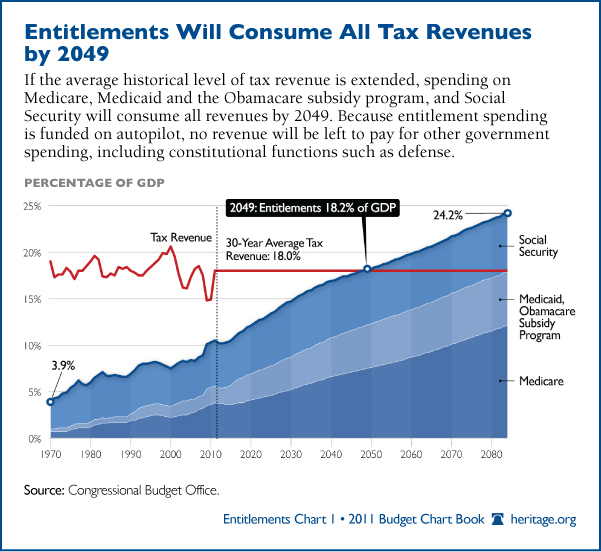
Don’t be fooled, though, by thinking that tackling waste alone or combining a handful of programs will solve the country’s twin crises of spending and debt. Waste is deplorable and unacceptable, yet it is small in comparison to the trillion-dollar-plus deficits recorded in recent years. More importantly, it is not the main contributor to Washington’s spending problem. The three major entitlement programs—Medicare, Medicaid, and Social Security—constitute the lion’s share of current spending.

The future portends an even more oppressive burden from entitlement spending. The first baby boomers have reached retirement already, and millions more will become eligible for Medicare and Social Security benefits. Entitlement spending is on track to eclipse all tax revenues, meaning at that point the federal government would have to tax or borrow money to fund all other programs.

Congress and the President are expected to spend today’s taxpayer dollars wisely. They can accomplish this by rooting out waste, eliminating duplicative programs, and returning to a more limited government at the federal level. All of this will help restore Americans’ trust in their government. But to assure Americans that their children can have an even more prosperous future than they had, Congress should do the hard work of proposing entitlement program reforms—reforms that will get spending under control and unshackle future generations from crushing levels of taxes and debt.

____________

Thank you so much for your time. I know how valuable it is. I also appreciate the fine family that you have and your commitment as a father and a husband.

Sincerely,

Everette Hatcher III, 13900 Cottontail Lane, Alexander, AR 72002, ph 501-920-5733, lowcostsqueegees@yahoo.com

Hogs benefit by trading Kentucky for Tennessee in 2012 football schedule?

Tennessee head coach Derek Dooley wears the trophy helmet while celebrating with his players at the conclusion of winning the Chick-fil-A Kickoff Game Friday, Aug. 31, 2012 at the Georgia Dome in Atlanta. (MICHAEL PATRICK/NEWS SENTINEL)<br /><br /><br />

Photo by Michael Patrick, copyright © 2012

Tennessee head coach Derek Dooley wears the trophy helmet while celebrating with his players at the conclusion of winning the Chick-fil-A Kickoff Game Friday, Aug. 31, 2012 at the Georgia Dome in Atlanta. (MICHAEL PATRICK/NEWS SENTINEL)

____________

I have written before that I was disappointed in the 2012 SEC schedule for Arkansas because it dropped our game at Knoxville against Tennessee. However, after watching Tennessee destroy NC State on Friday night I think it is a good trade that we get to replace Tennessee on our schedule with Kentucky from the East.  Kentucky looked pretty weak today at Louisville. (Of course, our 49-24 victory over Jacksonville St did not look too impressive either.)

The 35-21 victory over NC State should have been even bigger. Tennessee’s Tyler Bray stuck his hand over the goal line with the ball with 11 seconds left in the first half and then he fumbled afterwards. (This was clearly seen on the replay.) However, NC State was granted the fumble recovery.

I also fear the receivers that Tennessee has. Mark May mentioned that too in his talk August 20th in Little Rock that I attended and he said that the Vols may surprise people with a run at the SEC East Championship.

Here is an article from David Climer about the Vols’ receivers:

Tennessee wide receiver Justin Hunter (11) reaches for a catch under pressure from North Carolina State defensive back Juston Burris (11) during the Chick-Fil-A Kick Off Game at the Georgia Dome in Atlanta on Friday, Aug. 31, 2012. Tennessee won the game 35-21. (AMY SMOTHERMAN BURGESS/NEWS SENTINEL STAFF)

Photo by Amy Smotherman Burgess

Tennessee wide receiver Justin Hunter (11) reaches for a catch under pressure from North Carolina State defensive back Juston Burris (11) during the Chick-Fil-A Kick Off Game at the Georgia Dome in Atlanta on Friday, Aug. 31, 2012. Tennessee won the game 35-21. (AMY SMOTHERMAN BURGESS/NEWS SENTINEL STAFF)

____________

Tennessee Vols start to restore receiver tradition

A college football program that once fancied itself as Wide Receiver U. has looked more like Wide Receiver Who? in recent years.

In the last 10 NFL drafts, Tennessee has had only four wide receivers selected. Just one of them, Robert Meachem in 2007, was picked in the first round. Only one other was drafted in the first four rounds.

Based on what transpired at the Georgia Dome in UT’s 35-21 conquest of North Carolina State on Friday night, the Vols are getting back up to speed at wide receiver.

The injection of junior-college transfer Cordarrelle Patterson into a talented rotation at wideout makes the Vols particularly dangerous on the perimeter, especially with Tyler Bray directing things at quarterback.

It’s too early to compare these Vols with some of the top receiver classes in school history (the 1980 and ’90 groups were exceptional in terms of top-tier talent and depth), but this is a collection capable of making serious inroads against SEC defenses.

“I think we can be really, really good, and we’re just getting started,” said UT’s Justin Hunter, who had nine receptions for 73 yards in his first game back from major knee surgery.

Patterson hit the ground running with a 41-yard touchdown reception and a 67-yard scoring run on a reverse. Even he was surprised by his immediate impact on the big stage.

“I didn’t think it would go like this,” he said. “There was a lot of stuff thrown at me but I think I handled it pretty good.”

And he’s just getting started. Imagine what he’ll be like once he gets his helmet around the playbook.

“I need to get the routes better and continue to learn the offense,” he said.

Indeed, Patterson’s knowledge — or lack of same — of the UT offense is an issue. According to coach Derek Dooley, he may have run the wrong route on the long TD pass that opened the scoring.

“That’s the beauty of Bray,” Dooley said, shaking his head. “You run the wrong route and he rewards you by throwing you the ball.”

On the play in question, Patterson blew past All-America cornerback David Amerson and caught Bray’s pass in stride.

Asked if Patterson had ad libbed on the play, Bray shrugged his shoulders and said: “I don’t remember.”

Although Patterson said he ran the play as it was drawn up (“Coach is tripping. Of course it was the right route,” he said with a smile), it’s pretty clear he’s finding his way.

“He came to me before the play even started, asking me what to do,” Hunter said. “I was like, ‘Man, you’ve got to get better than that.’

“It was a real ugly route. … It happens more than you’d think, guys running the wrong routes and stuff like that. You’d be surprised.”

As good as UT’s wide receiver corps looked against N.C. State, it could have been better. Much better. Da’Rick Rogers, who led the SEC in receptions last season, was dismissed from the team one week earlier after failing a drug test. Slot receiver DeAnthony Arnett, who caught 24 passes as a freshman in 2011, transferred to Michigan State.

N.C. State Coach Tom O’Brien noted that Rogers would have given the Vols a third big, strong, fast threat on the perimeter if he had stuck around.

“Holy cow if they would’ve had him out there,” O’Brien said.

But even without Rogers, it looks like Wide Receiver U. is back in session.

David Climer’s columns appear on Sunday, Monday, Wednesday and Friday. Contact him at 615-259-8020 or dclimer@ tennessean.com.

Tennessee defensive back Prentiss Waggner (23) intercepts a pass by North Carolina State quarterback Mike Glennon (8) during the Chick-Fil-A Kick Off Game at the Georgia Dome in Atlanta on Friday, Aug. 31, 2012. (AMY SMOTHERMAN BURGESS/NEWS SENTINEL STAFF)<br />

Photo by Amy Smotherman Burgess

Tennessee defensive back Prentiss Waggner (23) intercepts a pass by North Carolina State quarterback Mike Glennon (8) during the Chick-Fil-A Kick Off Game at the Georgia Dome in Atlanta on Friday, Aug. 31, 2012. (AMY SMOTHERMAN BURGESS/NEWS SENTINEL STAFF)