Monthly Archives: August 2012

Nellie Gray founder of March for life dies

I have been involved with the March for Life for almost 30 years here in Little Rock. My four kids and I  have walked in it on a regular basis in Little Rock and I have posted about it before on my blog www.thedailyhatch.org . When I first marched in it Ronald Reagan was the president and he wrote one of the best articles on the pro-life movement that I ever read. I have included below.

Nelly Gray passed away on August 13, 2012 and she started the March almost 40 years ago. I wanted to honor her today with this post. Please stand on the side of life!!!!!

Nellie Gray, Founder Of ‘March For Life,’ Dies

EnlargeRoger L. Wollenberg /UPI /LandovNellie Gray, president of the March for Life Fund, at the March for Life rally near the White House in 2004.

Nellie Gray, president of the  March for Life Fund, at the March for Life rally near the White House in 2004.

Roger L. Wollenberg /UPI /LandovNellie Gray, president of the March for Life Fund, at the March for Life rally near the White House in 2004.

Nellie Gray, who in 1974 helped start the annual antiabortion demonstration in Washington called March for Life that attracts thousands to the nation’s capital, has died. She was 88.

According to The Washington Post, “Gene Ruane, a colleague, said that he found Miss Gray dead Monday in her Capitol Hill home and that the chief medical examiner will determine the cause and date of her death.”

National Review’s The Corner blog writes that:

“The March for Life is Nellie Gray’s main legacy. Many pro-lifers sometimes seem to take the annual March for granted, but the longevity of the March is actually a remarkable achievement. Some 39 years ago, pro-life activists felt a need to properly commemorate the first anniversary of the tragic Roe v. Wade decision. That is when the idea for the March for Life was born. Interestingly, there was no plan to repeat the first March, but when deciding what to do with the leftover funds, someone suggested hosting a March the next year. Before long, the March for Life was incorporated with Nellie Gray as president and became an annual tradition.

“Since then, the March has been a key contribution to the pro-life cause.”

The Associated Press says “Gray was a lawyer and former federal employee who devoted herself full-time to the anti-abortion movement after the Supreme Court’s 1973 Roe v. Wade decision. … [She] was the primary organizer of the march throughout its 38-year history. She used the phrase ‘no exceptions, no compromise’ to sum up her belief that life begins at conception and abortion should be illegal. At this year’s march, she referred to abortion as genocide and the Roe v. Wade decision as ‘an evil imposed upon our country.’ ”

The next March for Life is scheduled for Jan. 25, 2013.


Nellie Gray: ‘No one … can legalize even a little bit of abortion’

June 10, 2004, 10:30 a.m.
Abortion and the Conscience of the Nation
Ronald Reagan’s pro-life tract.

EDITOR’S NOTE: While president, Ronald Reagan penned this article for The Human Life Review, unsolicited. It ran in the Review‘s Spring 1983, issue and is reprinted here with permission.

The 10th anniversary of the Supreme Court decision in Roe v. Wade. Our nationwide policy of abortion-on-demand through all nine months of pregnancy was neither voted for by our people nor enacted by our legislators — not a single state had such unrestricted abortion before the Supreme Court decreed it to be national policy in 1973 is a good time for us to pause and reflect. But the consequences of this judicial decision are now obvious: since 1973, more than 15 million unborn children have had their lives snuffed out by legalized abortions. That is over ten times the number of Americans lost in all our nation’s wars.

Make no mistake, abortion-on-demand is not a right granted by the Constitution. No serious scholar, including one disposed to agree with the Court’s result, has argued that the framers of the Constitution intended to create such a right. Shortly after the Roe v. Wade decision, Professor John Hart Ely, now Dean of Stanford Law School, wrote that the opinion “is not constitutional law and gives almost no sense of an obligation to try to be.” Nowhere do the plain words of the Constitution even hint at a “right” so sweeping as to permit abortion up to the time the child is ready to be born. Yet that is what the Court ruled.

As an act of “raw judicial power” (to use Justice White’s biting phrase), the decision by the seven-man majority inRoev. Wade has so far been made to stick. But the Court’s decision has by no means settled the debate. Instead,Roe v. Wadehas become a continuing prod to the conscience of the nation.

Abortion concerns not just the unborn child, it concerns every one of us. The English poet, John Donne, wrote: “. . . any man’s death diminishes me, because I am involved in mankind; and therefore never send to know for whom the bell tolls; it tolls for thee.”

We cannot diminish the value of one category of human life — the unborn — without diminishing the value of all human life. We saw tragic proof of this truism last year when the Indiana courts allowed the starvation death of “Baby Doe” in Bloomington because the child had Down’s Syndrome.

Many of our fellow citizens grieve over the loss of life that has followed Roe v. Wade. Margaret Heckler, soon after being nominated to head the largest department of our government, Health and Human Services, told an audience that she believed abortion to be the greatest moral crisis facing our country today. And the revered Mother Teresa, who works in the streets of Calcutta ministering to dying people in her world-famous mission of mercy, has said that “the greatest misery of our time is the generalized abortion of children.”

Over the first two years of my Administration I have closely followed and assisted efforts in Congress to reverse the tide of abortion — efforts of Congressmen, Senators and citizens responding to an urgent moral crisis. Regrettably, I have also seen the massive efforts of those who, under the banner of “freedom of choice,” have so far blocked every effort to reverse nationwide abortion-on-demand.

Despite the formidable obstacles before us, we must not lose heart. This is not the first time our country has been divided by a Supreme Court decision that denied the value of certain human lives. The Dred Scott decision of 1857 was not overturned in a day, or a year, or even a decade. At first, only a minority of Americans recognized and deplored the moral crisis brought about by denying the full humanity of our black brothers and sisters; but that minority persisted in their vision and finally prevailed. They did it by appealing to the hearts and minds of their countrymen, to the truth of human dignity under God. From their example, we know that respect for the sacred value of human life is too deeply engrained in the hearts of our people to remain forever suppressed. But the great majority of the American people have not yet made their voices heard, and we cannot expect them to — any more than the public voice arose against slavery — until the issue is clearly framed and presented.

What, then, is the real issue? I have often said that when we talk about abortion, we are talking about two lives — the life of the mother and the life of the unborn child. Why else do we call a pregnant woman a mother? I have also said that anyone who doesn’t feel sure whether we are talking about a second human life should clearly give life the benefit of the doubt. If you don’t know whether a body is alive or dead, you would never bury it. I think this consideration itself should be enough for all of us to insist on protecting the unborn.

________________________________________________

I remember when President Carter and candidate Reagan debated in 1980 and the subject of abortion came up. Reagan said that if you were on a dusty area and you found someone laying down would you bury him without knowing for sure if he is alive or not? It is the same with the case of abortion.

Related posts:

Pro-life posts can be seen on the www.thedailyhatch.org

Uploaded by ProLifeOnCampus on Jan 29, 2011 The Miracle of Life by Valley Baptist Church of Bakersfield, California. _________ If you want to see some more great pro-life videos and articles then check out these links below: Kathy Ireland’s argument with Planned Parenthood over abortion February 24, 2012 – 6:54 am   Science Matters #2: Former […]

Ronald Reagan’s videos and pictures displayed here on the www.thedailyhatch.org

President Reagan, Nancy Reagan, Bill Clinton and Hillary Clinton attending the Dinner Honoring the Nation’s Governors. 2/22/87. Ronald Reagan is my favorite president and I have devoted several hundred looking at his ideas. Take a look at these links below: President Reagan and Nancy Reagan attending “All Star Tribute to Dutch Reagan” at NBC Studios(from […]

“Feedback Friday” Letter to White House generated form letter response (on abortion) April 16, 2012 (part 5)

I have been writing President Obama letters and have not received a personal response yet.  (He reads 10 letters a day personally and responds to each of them.) However, I did receive a form letter in the form of an email on April 16, 2011. First you will see my letter to him which was mailed around April 9th. […]


Hank Hanegraaff on the issue of abortion (Part 2)

Two Minute Warning: How Then Should We Live?: Francis Schaeffer at 100 Uploaded by ColsonCenter on Jan 31, 2012 Under Francis Schaeffer’s tutelage, Evangelicals like Chuck Colson learned to see life through the lens of a Christian worldview. Join Chuck as he celebrates a life well lived. ______________ Despite what the liberals like Max Brantley […]

Unborn babies lose out:Susan G. Komen reverses decison on Planned Parenthood

Richard Dawkins comments on Tim Tebow pro-life commercial. I am sad today because Susan G. Komen reversed their decision and will continue to supports Planned Parenthood which the USA’s largest abortion provider. The Arkansas Times Blog reported that the leader of Susan G. Komen apologized and explained that Planned Parenthood would be receiving funds from […]

Ron Paul’s Pro-life view

Ron Paul’s Pro-life view Ron Paul’s Pro-Life Speech in Ames, Iowa Uploaded by RonPaul2008dotcom on Aug 13, 2011 Free email updates: http://www.RonPaul.com/welcome.php Please like, share, subscribe & comment! http://www.RonPaul.com 08/13/2011– Ron Paul is America’s leading voice for limited, constitutional government, low taxes, free markets, sound money, and a pro-America foreign policy. ___________________________________ Related posts: Crowd […]

Prolife March in Little Rock has 20 to 1 ratio more than abortion march of previous day

PHOTO BY STATON BREIDENTHAL Marchers arrive at the state Capitol on Sunday after beginning the Arkansas March for Life in downtown Little Rock As in the past, the pr0-life March in Little Rock had at least twenty times the people in attendance that the pr0-abortion march did the previous day. In fact, last year Channel […]

March for Life in Little Rock 2pm Jan 22, 2012

34th Annual March For Life Sunday, January 22, 2012 2:00 PM Capitol and Louisiana Downtown Little Rock Will your face appear in pictures at the next March for Life? We certainly hope that you will consider joining us each January for this important pro-life event. Hundreds of people from across the state make the annual […]

Woody Allen films and the issue of guilt (Woody Wednesday)

Woody Allen and the Abandonment of Guilt

Dr. Marc T. Newman : AgapePress

In considering filmmaking as a pure visual art form, Woody Allen would have to be considered a master of the medium. From his humble beginnings as a comedy writer and filmmaker, he has emerged as a major influential force in Hollywood. Actors flock to his projects just to have a chance to work with him. He is funny, creative, and philosophical in his musings about love, life, and death.

Woody Allen is an Oscar award-winning director and screenwriter. His latest film, “Match Point,” has garnered another screenwriting nomination for Allen from the Academy. And while industry buzz is growing behind “Crash” screenwriters Paul Haggis and Bobby Moresco to win, Allen’s nomination is not a courtesy nod to an aging dinosaur. Most critics have hailed “Match Point” as Allen’s comeback film – a movie that demonstrates that Allen is still performing at the height of his powers. “Match Point” most closely resembles another of Allen’s Oscar-nominated films – 1990’s “Crimes and Misdemeanors.” Comparing these two critically-acclaimed films shines a light not only on Woody Allen’s dark and cynical writer’s journey, but also on a culture that consistently chooses to honor his work.

Crimes and Misdemeanors – Sin and Struggle

“Crimes and Misdemeanors” is an odd morality tale. Judah Rosenthal is an ophthalmologist who has been carrying on an affair for over two years. When his mistress threatens to call his wife, he contracts to have her killed. Throughout the film, characters attempt to make sense of their moral universe. Judah struggles with his guilt and at one point seems so driven by his belief that he must be punished for his sin that he nearly decides to call the police to turn himself in. He is dissuaded by a veiled threat from his mob-connected brother Jack (who arranged the murder at Judah’s request). As time goes by, Judah finds that he is not punished – not by the secular authorities or by God. After a while, even the guilty feelings fade away. He decides that the idea that evil is always punished is only true in the movies. In real life, people get away with it. Judah pushes aside his guilt, returns to his privileged life and walks off, with his wife, into the sunset.

Allen comes down on the wrong side of the moral equation in “Crimes and Misdemeanors” because he is unwilling, or unable, to take into account the judgment of God in the world to come. His materialist-informed worldview discounts or denies that the reality of eternity is more significant than what happens in this life. What made the film noteworthy was its depiction of the moral struggle that people go through when they sin. What made the film chilling is the knowledge that the rationalism engaged in by Judah in the movie represents more than fiction. Psalms and Proverbs are full of pleas from weary saints who complain to God about the prosperous wicked. We cannot know the mind of God. Some sins are punished swiftly; others apparently are not punished at all in this life. But God declares that one day everything done is darkness will be revealed in the light (1 Corinthians 4-5).

Match Point – No Sin, Just Luck

Fifteen years later, Allen gives audiences “Match Point,” the story of Chris Wilton, a British social-climbing tennis pro who marries for money and prestige, but continues to lust after a poor American actress, Nola Rice, who is dating his future brother-in-law. The affair with Nola begins and ends before Chris’ marriage, but picks up again when Nola returns to England. What begins as animal attraction turns complicated as Nola begins pressuring Chris to leave his wife. Chris is torn between his feelings for Nola and the wealth, power, and privilege that he enjoys by being married to his wife, Chloe. Ultimately he determines that he must be rid of one of them. How best to do it while risking the least for himself? Kill one – but make it look like someone else did it. The audience is left guessing whether he will kill Nola, thereby covering his tracks and keeping his wife, or kill Chloe, inheriting her wealth and gaining the sympathy of her family, and then take up again with Nola. Once the deed is done, there is the crying and terror over the prospect of being found out and punished that must accompany any such act. But when word of the homicide appears in the paper, and the fictional motives that Chris hoped to plant are printed as if they are fact, Chris discovers that he has gotten away with it.

The theme of “Match Point” is hammered into the audience over and over again – the world runs on luck. From Chris’ tennis career, to his marriage to a rich and beautiful woman and into a paternalistic and helpful family, to plot twists involving incriminating evidence, everything just falls his way at crucial moments. And while some characters continue to extol the virtues of hard work and perseverance, Chris recognizes and, in the end, vocalizes that the best attribute to possess is good fortune. There is no justice; there is only the slim divide between being caught and getting away with it. No one is smart enough to cover all the bases, so in the end much of it comes down to luck. Chris has it; his victim did not.

Unlike “Crimes and Misdemeanors,” no great struggle over guilt and sin is played out on the screen. The only scene that looks remotely like remorse occurs right after the act. Beyond that, Chris merely lies to those he knows and stonewalls the police. He is like the boy who kills his parents and then begs the judge for leniency because he is an orphan
– only in this case, he gets off.

“Crimes and Misdemeanors” could be rationalized as a depiction of one side of the sin debate – that sometimes the wicked prosper. The struggle for Judah’s soul is represented by his brothers: the mafia-connected Jack and Judah’s rabbi brother Ben. In this case, Ben loses, but there is, haunting the background, the idea that it could be otherwise. No such spiritual subtext exists in “Match Point.” Audience members can only get out of the film what they bring to it – it is a case brought before us for judgment.. Those who believe in a just God will find Chris to be a calculating killer who rightly needs to be punished. For those who enter the film believing that humans are merely animals seeking to satisfy drives with no true spiritual component; who believe that guilt only exists if you get caught; who believe (whether they know the source or not) that Nietzsche was right when he said that the hallmark of human existence is the will to power – Chris is a kind of hero. He got everything he wanted, succeeded in destroying those who stood in his way, and emerged unscathed because he was favored by a series of uncalculated quirks in the universe. No objection to such assessment is placed in anyone’s way.

The Weaving of Cultural Threads

Thomas Frentz, noted rhetorical critic, argues that by comparing products of our culture over time, we can begin to discern emerging moral patterns. Cultures, Frentz claims, are always moving toward, or away from, some optimal moral end state. If Frentz is right, then looking at these two similar films from Woody Allen can tell us a little about the state of moral struggle. I do not know whether Allen’s film intends to move us, or if it is merely a reflection of the culture as he sees it. Either way, what Allen appears to be saying is that we have moved beyond morals and simply must deal with what is. In his earlier film, Allen asserts that there is no objective moral lens through which to view the world – ignore morality and it will go away. Now he is saying that if you happen to share the world with people who still hold to the “myth” of morality, “hope you are lucky and then you can get away with it.”

But there is yet a ray of hope.

Anyone watching “Match Point” will come to the conclusion that Chris “got away with it.” The concept of “getting away with something” could not exist in a truly amoral world, because the term itself presupposes punishment. If no punishment is objectively due, then there is nothing from which to “get away.” The concept of escape only exists in a world in which something is pursuing. Even conventional laws implicate an overarching moral sensibility of right and wrong. My fear is not that Allen is predicting some evolutionary leap in moral thinking where all codes are abandoned, but that he is rightly illustrating a growing trend – the searing of the western conscience.
Marc T. Newman, PhD (marc@movieministry.com) is the president of MovieMinistry.com – an organization that provides sermon and teaching illustrations from popular film, and helps the Church use movies to reach out to others and connect with people.

Other posts concerning Woody Allen’s latest movie “Midnight in Paris”

What can we learn from Woody Allen Films?August 1, 2011 – 6:30 am

Movie Review of “Midnight in Paris” lastest movie by Woody AllenJuly 30, 2011 – 6:52 am

Leo Stein and sister Gertrude Stein’s salon is in the Woody Allen film “Midnight in Paris”July 28, 2011 – 6:22 am

Great review on Midnight in Paris with talk about artists being disatisfied,July 27, 2011 – 6:20 am

Critical review of Woody Allen’s latest movie “Midnight in Paris”July 24, 2011 – 5:56 am

Not everyone liked “Midnight in Paris”July 22, 2011 – 5:38 am

“Midnight in Paris” one of Woody Allen’s biggest movie hits in recent years,July 18, 2011 – 6:00 am

(Part 32, Jean-Paul Sartre)July 10, 2011 – 5:53 am

 (Part 29, Pablo Picasso) July 7, 2011 – 4:33 am

(Part 28,Van Gogh) July 6, 2011 – 4:03 am

(Part 27, Man Ray) July 5, 2011 – 4:49 am

(Part 26,James Joyce) July 4, 2011 – 5:55 am

(Part 25, T.S.Elliot) July 3, 2011 – 4:46 am

(Part 24, Djuna Barnes) July 2, 2011 – 7:28 am

(Part 23,Adriana, fictional mistress of Picasso) July 1, 2011 – 12:28 am

(Part 22, Silvia Beach and the Shakespeare and Company Bookstore) June 30, 2011 – 12:58 am

(Part 21,Versailles and the French Revolution) June 29, 2011 – 5:34 am

(Part 16, Josephine Baker) June 24, 2011 – 5:18 am

(Part 15, Luis Bunuel) June 23, 2011 – 5:37 am

Open letter to President Obama (Part 124 B)

DEBT LIMIT – A GUIDE TO AMERICAN FEDERAL DEBT MADE EASY.

Uploaded by on Nov 4, 2011

A satirical short film taking a look at the national debt and how it applies to just one family. Watch the guy from the Ferris Bueller Superbowl Spot! Produced by Seth William Meier, DP/Edited by Craig Evans, 1st AC Brian Andrews, Sound Mixer Gus Salazar, Written and Directed by Brian Stepanek. Help us spread the word by clicking ads or at www.debtlimitusa.org

_________________

President Obama c/o The White House
1600 Pennsylvania Avenue NW
Washington, DC 20500

Dear Mr. President,

I know that you receive 20,000 letters a day and that you actually read 10 of them every day. I really do respect you for trying to get a pulse on what is going on out here.

You are the President of the United States and you need to take the bull by the horns and cut some spending now!!!! I read some wise words by Rep. Justin Amash (R-MI) and I wanted to pass them on. He sees how dangerous it is to keep kicking the can down the street: “The Budget Control Act trades $21 billion in cuts next year for a debt ceiling increase of $2.1 trillion. That’s one penny in cuts for each dollar of new debt. The bill does not seriously address the drivers of the federal government’s fiscal crisis. It does not improve entitlement programs. It does not include a balanced budget amendment to the Constitution.”

Michael Tanner of the Cato Institute in his article, “Hitting the Ceiling,” National Review Online, March 7, 2012 noted:

After all, despite all the sturm und drang about spending cuts as part of last year’s debt-ceiling deal, federal spending not only increased from 2011 to 2012, it rose faster than inflation and population growth combined.

We need some national statesmen (and ladies) who are willing to stop running up the nation’s credit card.

Ted DeHaven noted his his article, “Freshman Republicans switch from Tea to Kool-Aid,”  Cato Institute Blog, May 17, 2012:

This week the Club for Growth released a study of votes cast in 2011 by the 87 Republicans elected to the House in November 2010. The Club found that “In many cases, the rhetoric of the so-called “Tea Party” freshmen simply didn’t match their records.” Particularly disconcerting is the fact that so many GOP newcomers cast votes against spending cuts.

The study comes on the heels of three telling votes taken last week in the House that should have been slam-dunks for members who possess the slightest regard for limited government and free markets. Alas, only 26 of the 87 members of the “Tea Party class” voted to defund both the Economic Development Administration and the president’s new Advanced Manufacturing Technology Consortia program (see my previous discussion of these votes here) and against reauthorizing the Export-Import Bank (see my colleague Sallie James’s excoriation of that vote here).

One of those Tea Party heroes was Justin Amash of Michigan. Last year I posted this below concerning his conservative views and his willingness to vote against the debt ceiling increase:

Amash Issues Statement After Debt Ceiling Vote

Representative Votes Against Budget Control Act
Aug 1, 2011 Issues: Spending and Debt
FOR IMMEDIATE RELEASE
August 1, 2011
CONTACT
Will Adams
202.731.2294
will.adams@mail.house.gov

Amash Issues Statement After Debt Ceiling Vote

Representative Votes Against Budget Control Act

Washington, D.C. – Rep. Justin Amash (R-MI) issued the following statement after the vote on the Budget Control Act of 2011:

“The Budget Control Act trades $21 billion in cuts next year for a debt ceiling increase of $2.1 trillion. That’s one penny in cuts for each dollar of new debt. The bill does not seriously address the drivers of the federal government’s fiscal crisis. It does not improve entitlement programs. It does not include a balanced budget amendment to the Constitution. I cannot in good conscience vote for so little reform when so much is at stake.

“I had hoped that Democrats and Republicans would work together to develop a reasonable compromise that is fiscally responsible. I would favor a package that combines eliminating special tax breaks and subsidies with a well-structured balanced budget amendment. I believe that type of package would have broad-based support from the American people. Instead, Congress continues to kick the can down the road.

“We can do better. I look forward to working with my colleagues on both sides of the aisle over the next several months to adopt structural reforms that will put the government back on a sustainable path.”

Thank you so much for your time. I know how valuable it is. I also appreciate the fine family that you have and your commitment as a father and a husband.

Sincerely,

Everette Hatcher III, 13900 Cottontail Lane, Alexander, AR 72002, ph 501-920-5733, lowcostsqueegees@yahoo.com

Social Security time bomb


Liberals that say that Social Security is running fine don’t want to live in the real world but in a make-believe liberal world that doesn’t exist.


I don’t give the issue much attention on this blog, but I’m very interested in Social Security reform. I wrote my dissertation on Australia’s very successful system of personal retirement accounts, for instance, and I narrated this video on Social Security reform in the United States.

So I was very interested to see that the Associated Press put out a story warning about the dismal state of the program’s finances.

Here’s some of what the AP reported.

For nearly three decades Social Security produced big surpluses, collecting more in taxes from workers than it paid in benefits to retirees, disabled workers, spouses and children. The surpluses also helped mask the size of the budget deficit being generated by the rest of the federal government. Those days are over. Since 2010, Social Security has been paying out more in benefits than it collects in taxes… The projected shortfall in 2033 is $623 billion, according to the trustees’ latest report. It reaches $1 trillion in 2045 and nearly $7 trillion in 2086, the end of a 75-year period used by Social Security’s number crunchers because it covers the retirement years of just about everyone working today. Add up 75 years’ worth of shortfalls and you get an astonishing figure: $134 trillion. Adjusted for inflation, that’s $30.5 trillion in 2012 dollars, or eight times the size of this year’s entire federal budget.

First of all, kudos to the AP. I criticized them for a sloppy and biased report on poverty last month, so it behooves me to mention that their story on Social Security is mostly fair and accurate.

My only complaint is that the story does include some analysis of the Social Security Trust Fund, even though that supposed Fund is nothing but a pile of IOUs – money that one part of the government promises to give to another part of the government.

But let’s set that aside. Another interesting tidbit from the story is this quote from one of the kleptocrats at the American Association of Retired Persons. Note that he implicitly rules out any changes other than those that enable the government to “pay the benefits we promised.”  But that shouldn’t be a surprise. AARP is part of the left-wing coalition.

“I’m not suggesting we need to wait 20 years but we do have time to make changes to Social Security so that we can pay the benefits we promised,” said David Certner, AARP’s legislative policy director. “Let’s face it. Relative to a lot of other things right now, Social Security is in pretty good shape.”

But I will say that Mr. Certner is sort of correct about Social Security being in better shape than Medicare and Medicaid. But that’s like saying the guy with lung cancer who is 75 lbs overweight is in better shape than the two guys with brain tumors who are both 150 lbs overweight.

If you have to engage in fiscal triage, it would be smart to first address Medicare and Medicaid, but Social Security also needs reform. And not the kind of statist reform the folks at AARP would like to see.

By the way, you probably won’t be surprised to learn that President Obama’s approach is similar to the left-wingers at AARP. Here’s a video I narrated about his preferred policy.

It seems that the question doesn’t matter with this administration. The answer is always to impose more class-warfare tax policy.

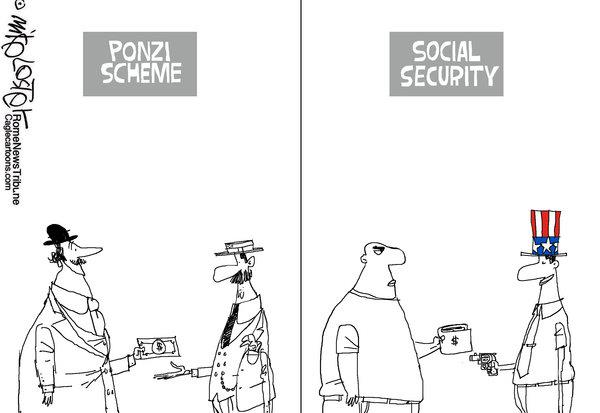
P.S. If you need to be cheered up after reading this post, here’s a good cartoon showing the difference between Social Security and a Ponzi scheme, and here’s another cartoon showing what inspired Bernie Madoff to steal so much money.

.


New Video shows how Obama has run up the national debt

We got to stop all the red ink.

The burden of federal spending in the United States was down to 18.2 percent of gross domestic product when Bill Clinton left office.

But this progress didn’t last long. Thanks to George Bush’s reckless spending policies, the federal budget grew about twice as fast as the economy, jumping by nearly 90 percent in just eight years This pushed federal spending up to about 25 percent of GDP.

President Obama promised hope and change, but he has kept spending at this high level rather than undoing the mistakes of his predecessor.

This new video from the Center for Freedom and Prosperity Foundation uses examples of waste, fraud, and abuse to highlight President Obama’s failed fiscal policy.

Published on Aug 12, 2012 by

This mini-documentary from the Center for Freedom and Prosperity Foundation highlights egregious examples of wasteful spending from the so-called stimulus legislation and explains why government spending hurts economic performance.

____________________

Good stuff, though the video actually understates the indictment against Obama. There is no mention, for instance, about all the new spending for Obamacare that will begin to take effect over the next few years.

But not everything can be covered in a 5-minute video. And I suspect the video is more effective because it closes instead with some discussion of the corrupt insider dealing of Obama’s so-called green energy programs.

Free or equal? 30 years after Milton Friedman’s Free to Choose (Part 4)

Johan Norberg – Free or Equal – Free to Choose 30 years later 4/5

Published on Jun 10, 2012 by

In 1980 economist and Nobel laureate Milton Friedman inspired market reform in the West and revolutions in the East with his celebrated television series “Free To Choose.”
Thirty years later, in this one-hour documentary, the young Swedish writer, analyst and Cato Institute Fellow Johan Norberg travels in Friedman’s footsteps to see what has
actually happened in the places Friedman’s ideas helped transform. In location after location Norberg examines the contemporary relevance of Friedman’s ideas in the 2011 world of globalization and financial crisis. Central to his examination are the perennial questions concerning power and prosperity, and the trade-offs between individual liberty and income equality.

___________

I have enjoyed reading this series of reviews by T. Kurt Jaros on Milton and Rose Friedman’s book “Free to Choose.” I hope you enjoy it as much as I did.

I have posted several transcripts and videos of the FREE TO CHOOSE film series on my blog. My favorite episodes are the “Failure of Socialism” and  “Power of the Market.” (This is the 1990 version but the 1980 version is good too.) Today with the increase of the welfare state maybe people should take a long look again at the episode “From Cradle to Grave.” 

Milton Friedman’s  view on vouchers for the schools needs to be heeded now more than ever too. “Created Equal” is probably the episode that I wanted President Obama to see the most and I wrote several letters to him suggesting that.

T. Kurt Jaros is currently a Master’s student studying Systematic Theology at King’s College in London.  He holds a B.A. in Philosophy and Political Science cum laude and an M.A. in Christian Apologetics high honors from Biola University, an evangelical Christian university outside of Los Angeles.

He enjoys learning and thinking about theology, specifically historical theology, philosophical theology and philosophy of religion, and issues pertaining to monergism and synergism.  Additionally, he enjoys learning and thinking about political philosophy, economics, American political history, and campaigns.

The Tyranny of Controls

T. Kurt Jaros on Economics

This is part of a series on Milton Friedman’s “Free to Choose.”

In my previous post I explained the role of government in the marketplace. This is part four of a book series on Free to Choose by Milton Friedman.         

In the second chapter, Friedman writes on the role of government as it relates to trade. He makes a strong case for free trade, and specifically focuses on international trade. However, the same principles ought to be applied to domestic trade.

Friedman believes that the restrictions on economic freedom have “also affected our freedom of speech, of press, and of religion.” This is evident through the examples he uses throughout the chapter and even in instances we can think of right now. Consider the hated Stamp Act that the British imposed upon the American colonies. This was a tax placed upon legal documents, contracts, newspapers and even play cards. Also consider the more recent example of how economic regulations have affected our freedom of religion (in four words): Sandra Fluke, birth control.

Bureaucrats like to think that economic regulations are helpful to the American people. But in reality, protectionism exploits consumers. Friedman even sites consumers as “major victims of such measures.” In the attempt to secure American jobs, bureaucrats hold off consumers from saving money because the nation is, as Adam Smith pointed out, unable to get the largest volume of imports as possible for as little as it can pay.

Friedman recognizes that without tariffs, workers may be harmed through a cut in wages or even laid off, if a foreign nation can produce products more cheaply. But this happens anyway in the domestic marketplace. Yet this would allow workers to look for work in industries where there might be a need for innovation. Put another way: why do we want to support inefficient businesses when we can save consumers money? Without the tariffs, we “might very well produce a stronger and more efficient” industry.

There are four arguments in favor of tariffs that Friedman rejects (two of which are explained here). First, the government should protect against foreign trade because of national security. Consider the steel industry. Friedman thinks this is foolish because we could just stockpile steel. And even still, the U.S. steel industry would not be completely destroyed because of the low transportation costs. Second, the “infant industry” argument is used to defend baby companies who would fail unless otherwise protected. But this happens anyway; “most firms experience losses in their early years.” In reality, this is just a smokescreen for more government regulation and serving the special interests. This argument is hardly ever used to support companies that have yet to come into existence. After all, such hypothetical companies have no spokesmen or lobbyists.

We need to follow the suggestions of Friedman and take certain measures to promote freedom. Instead of giving foreign aid and then imposing restrictions on trade,

“We could say to the rest of the world: we believe in freedom and intend to practice it. We cannot force you to be free. But we can offer full cooperation on equal terms to all. Our market is open to you without tariffs or other restrictions. Sell here what you can and wish to. Buy whatever you can and wish to. In that way cooperation among individuals can be worldwide and free.”

Related posts:

Reason Magazine’s rightly praises Milton Friedman but makes foolish claim along the way

I must say that I have lots of respect for Reason Magazine and for their admiration of Milton Friedman. However, I do disagree with one phrase below. At the end of this post I will tell you what sentence it is. Uploaded by ReasonTV on Jul 28, 2011 There’s no way to appreciate fully the […]

Video clip:Milton Friedman discusses his view of numerous political figures and policy issues in (Part 1)

Milton Friedman on Hayek’s “Road to Serfdom” 1994 Interview 1 of 2 Uploaded by PenguinProseMedia on Oct 25, 2011 Says Federal Reserve should be abolished, criticizes Keynes. One of Friedman’s best interviews, discussion spans Friedman’s career and his view of numerous political figures and public policy issues. ___________________ Two Lucky People by Milton and Rose Friedman […]

Milton Friedman remembered at 100 years from his birth (Part 1)

What a great man Milton Friedman was. The Legacy of Milton Friedman November 18, 2006 Alexander Tabarrok Great economist by day and crusading public intellectual by night, Milton Friedman was my hero. Friedman’s contributions to economics are profound, the permanent income hypothesis, the resurrection of the quantity theory of money, and his magnum opus with […]

Milton Friedman videos and transcripts Part 7

Milton Friedman videos and transcripts Part 7 On my blog http://www.thedailyhatch.org I have an extensive list of posts that have both videos and transcripts of MiltonFriedman’s interviews and speeches. Here below is just small list of those and more can be accessed by clicking on “Milton Friedman” on the side of this page or searching […]

Milton Friedman at Hillsdale College 2006 (part 1)

Milton Friedman at Hillsdale College 2006 July 2006 Free to Choose: A Conversation with Milton Friedman Milton Friedman Economist Milton Friedman is a senior research fellow at the Hoover Institution at Stanford University and a professor emeritus of economics at the University of Chicago, where he taught from 1946-1976. Dr. Friedman received the Nobel Memorial […]

Open letter to President Obama (Part 116.6)

Milton Friedman said that getting George Bush I to be his vice president was his biggest mistake because he knew that Bush was not a true conservative and sure enough George Bush did raise taxes when he later became President. Below is a speech by George W. Bush honoring Milton Friedman: Milton Friedman Honored for […]

Transcript and video of Milton Friedman on Bill Clinton and Ronald Reagan (Part 1)

Below is a discussion from Milton Friedman on Bill Clinton and Ronald Reagan. February 10, 1999 | Recorded on February 10, 1999 audio, video, and blogs » uncommon knowledge PRESIDENTIAL REPORT CARD: Milton Friedman on the State of the Union with guest Milton Friedman Milton Friedman, Senior Research Fellow, Hoover Institution and Nobel Laureate in […]

Dan Mitchell’s article on Chili and video clip on Milton Friedman’s influence

Milton Friedman and Chile – The Power of Choice Uploaded by FreeToChooseNetwork on May 13, 2011 In this excerpt from Free To Choose Network’s “The Power of Choice (2006)”, we set the record straight on Milton Friedman’s dealings with Chile — including training the Chicago Boys and his meeting with Augusto Pinochet. Was the tremendous […]

Open letter to President Obama (Part 116.5)

Milton Friedman’s negative income tax explained by Friedman in 1968: President Obama c/o The White House 1600 Pennsylvania Avenue NW Washington, DC 20500 Dear Mr. President, I know that you receive 20,000 letters a day and that you actually read 10 of them every day. I really do respect you for trying to get a […]

“Friedman Friday” :“A Nobel Laureate on the American Economy” VTR: 5/31/77 Transcript and video clip (Part 5)

Milton Friedman on the American Economy (5 of 6)   Uploaded by donotswallow on Aug 9, 2009 THE OPEN MIND Host: Richard D. Heffner Guest: Milton Friedman Title: A Nobel Laureate on the American Economy VTR: 5/31/77 _____________________________________ Below is a transcipt from a portion of an interview that Milton Friedman gave on 5-31-77: Friedman: […]

Open letter to President Obama (Part 124)

President Obama c/o The White House
1600 Pennsylvania Avenue NW
Washington, DC 20500

Dear Mr. President,

I know that you receive 20,000 letters a day and that you actually read 10 of them every day. I really do respect you for trying to get a pulse on what is going on out here.

Why raise taxes when we have not made real cuts yet? By the way we are about to run out of money!!!!

Question for Leftists: What Happens When There’s Nothing Left to Steal?

December 4, 2011 by Dan Mitchell

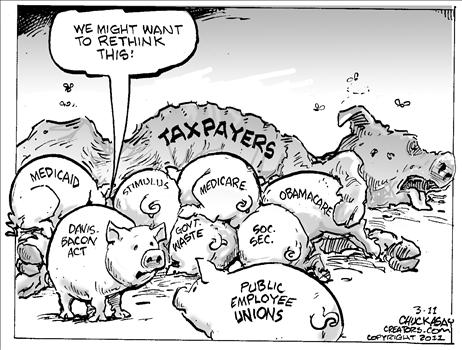
More than two years ago, I explained in a TV interview that the looters and moochers should be careful that they don’t kill the geese that lay the golden eggs. After all, parasites need a healthy host.

The collapse of Europe’s welfare states should be a wake-up call for these people, but that hasn’t stopped the demands for more redistribution in Washington. As Michael Barone noted, the folks on the left assume that there will always be someone to plunder.

But at least the piglets in this Chuck Asay cartoon are finally waking up to reality.

Unfortunately, I don’t expect the crowd in Washington to change. Most politicians don’t think more than a couple of years into the future, so they will continue to lure more people into riding in the wagon and continue to penalize those who pull the wagon.

This won’t end well.

_______________

Thank you so much for your time. I know how valuable it is. I also appreciate the fine family that you have and your commitment as a father and a husband.

Sincerely,

Everette Hatcher III, 13900 Cottontail Lane, Alexander, AR 72002, ph 501-920-5733, lowcostsqueegees@yahoo.com

Evangelical review of the question: “Was Ayn Rand right?” (Part 4)

Ayn Rand on the Purpose of Life

In this short clip below you will hear that Rand Paul read several books by Ayn Rand and later read several books that she liked. Take a look below as Ayn Rand answers a religious question about meaning in life. I have written on Milton Friedman’s religious views earlier too. 

Was Ayn Rand Right?

Article ID: JAF1324

By: Jay W. Richards

Synopsis

In response to the critics of capitalism, many conservative Christians turn to philosopher Ayn Rand for ammunition. Rand was a staunch defender of capitalism, but also an anti-Christian atheist who argued that capitalism was based on greed. Greed, for Rand, is good. But if Rand is right, then Christians can’t be capitalists, because greed is a sin. Fortunately, Rand was wrong. She missed the subtleties of capitalism. First, we should distinguish self-interest from selfishness. Adam Smith, the father of capitalism, famously wrote, “It is not from the benevolence of the butcher, the brewer, or the baker, that we expect our dinner, but from their regard to their own interest.” True enough; but that alone isn’t a problem. Every time you wash your hands or look both ways before you cross the street, you’re pursuing your self-interest—but neither activity is selfish. Second, Smith never argued that the more selfish we are, the better a market works. His point, rather, is that in a free market, each of us can pursue ends within our narrow sphere of competence and concern—our “self-interest”—and yet an order will emerge that vastly exceeds anyone’s deliberations. Finally, Smith argued that capitalism channels greed, which is a good thing. The point is that even if the butcher is selfish, he can’t make you buy his meat. He has to offer you meat at a price you’ll willingly buy. So capitalism doesn’t need greed. What it does need is rule of law, freedom, and human creativity and initiative. And we can point that out without any help from Ayn Rand.

_________

THE GIFT GIVERS

Think of a stereotypical miser like Ebenezer Scrooge (as opposed to the ordinary greedy person). Misers hoard their wealth. They hole up in their bedrooms, counting their gold bullion and hiding it in their mattresses. “Do not store up for yourselves treasures on earth, where moth and rust destroy, and where thieves break in and steal,” Jesus commanded His disciples, “but store up for yourselves treasures in heaven….For where your treasure is, there your heart will be also.” Jesus is talking about the person who hoards, who trusts his possessions rather than God. “You cannot serve both God and money” (Matt. 6:19–21, 24 NIV). The Apostle Paul said that greed is idolatry (Eph. 5:5). If religion involves our “ultimate concern,” as Paul Tillich said, then the miser is an idolater. He worships his money. That’s because you can only have one ultimate concern.

Many of the biblical warnings seem to apply to misers, but how many misers have you met? Do you know anyone who keeps a bag of money in his mattress, where he can count it? Probably not. We see misers on TV, read about them in children’s books and in Dickens. In capitalist societies, however, misers are in very short supply. That’s because capitalism discourages miserliness, and encourages its near-opposite: enterprise.

“The grasping or hoarding rich man is the antithesis of capitalism, not its epitome,” writes George Gilder, “more a feudal figure than a bourgeois one.”20 The miser prefers the certainty and security of his booty. Entrepreneurs, in contrast, assume risk. They cast their bread on the waters of uncertainty, hoping that the bread will return with fish. They delay whatever gratification their wealth might provide now for the hope of future gain. The miser treats his bullion as an end in itself. The entrepreneur, whatever his motives—including the desire for more money—uses money as a tool. The carpenter uses hammer and saw; the doctor, scalpel and stethoscope; the entrepreneur, cash and credit.

Only by the constant din of stereotype could we come to mistake the entrepreneur for the miser. In his modern classic, Wealth and Poverty, George Gilder explores a surprising feature of enterprise: supply precedes demand. After all, before you can exchange, you must first have something to exchange. I must have a good or service, a coconut or a potholder or an iPod that someone wants in order for trade to ever get started. Right off the bat, if I’m an entrepreneur, I have to think about the wants and needs of others. In a free economy, great entrepreneurs, including greedy ones, succeed by anticipating and meeting the desires of others. In that sense, Gilder argues, they are altruistic—alter in Latin means “other.” Entrepreneurial investments, he argues, are like gifts, since they are made without a predetermined return.21 Competition between entrepreneurs in a free economy thus becomes an altruistic competition, not because the entrepreneurs have warm fuzzies in their hearts, or are unconcerned with personal wealth, but because they seek to meet the desires of others better than their competitors do.22

Not for nothing did Ayn Rand dedicate her final lecture to a tirade against Gilder. But her view of the capitalist, in the end, was skewed by the Marxist stereotype she had officially rejected. Gilder’s view captures much better the nature and subtlety of entrepreneurial capitalism.

Far from requiring vice, entrepreneurial capitalism requires a whole host of virtues. Before entrepreneurs can invest capital, for instance, they must first accumulate it. So unlike gluttons and hedonists, entrepreneurs set aside rather than consume much of their wealth. Unlike misers and cowards, they risk rather than hoard what they have saved, providing stability for those employed by their endeavors. Unlike skeptics, they have faith in their neighbors, their partners, their society, their employees, “in the compensatory logic of the cosmos.”23 Unlike the self-absorbed, they anticipate the needs of others, even needs that no one else may have imagined. Unlike the impetuous, they make disciplined choices. Unlike the automaton, they freely discover new ways of creating and combining resources to meet the needs of others. This cluster of virtues, not the vice of greed, is the essence of what Rev. Robert Sirico calls the “entrepreneurial vocation.”24

I’m convinced that Ayn Rand continues to be popular, in part, because she dared to make entrepreneurs the heroes of her novels. Whatever her other failings, this was a keen insight. Without entrepreneurs, very little of what we take for granted in our economy and our everyday lives would exist. Here in my office, the concrete forms of entrepreneurial imagination are everywhere: paper, scissors, pens, highlighters, ink, CDs, an empty Tupperware container that held the pork loin I ate for lunch, a flat-screen monitor, fonts, lamps, light bulbs, Post-it notes, windows, sheet rock, speakers, a laptop computer, and an optical mouse. Behind all these visible objects lay real but less visible innovations in finance, manufacturing, and transport that I scarcely comprehend. All of these things are gifts of entrepreneurs. Only the most miserly moralizer could look at this mysterious efflorescence of cooperation, competition, and creativity—of entrepreneurial capitalism—and see only the dead hand of greed.

Does this mean that if you’re a Christian, you must embrace capitalism? No. But it does mean that Christians don’t need to adopt Ayn Rand’s anti-Christian philosophy to defend the morality of capitalism. Once we comprehend the nature of entrepreneurial capitalism, we see that it has fit within the Christian worldview all along.

Jay W. Richards is the author of Money, Greed, and God: Why Capitalism Is the Solution and Not the Problem (HarperOne, 2009). He has held leadership positions at Discovery Institute and the Acton Institute for the Study of Religion & Liberty, and is currently a Visiting Fellow at the Heritage Foundation and a Senior Fellow at Discovery Institute.

notes:

20 George Gilder, Wealth and Poverty (San Francisco: ICS Press, 1993), 30.

21 Ibid., 27.

22 Ibid., 20–24.

23 Ibid., 37.

24 Robert A. Sirico, The Entrepreneurial Vocation (Grand Rapids: Acton Institute, 2001).

Related posts:

Christian view versus Ayn Rand on altruism (Part 4)

Ayn Rand on the Purpose of Life Uploaded by prosumption on Apr 27, 2010 Ayn Rand on the Purpose of Life _________________ I ran across a fine article that takes a look at Ayn Rand’s view of capitalism and selfishness and compares it to the Christian view found in the Bible. I have decided to […]

Christians welcome nonbelievers like Dan Mitchell in their criticism of Ayn Rand’s view of altruism

Nonbelievers like Rand really do not have an answer to the question “What is the meaning of life?” Ayn Rand on the Purpose of Life Christians are commanded to help others by Christ. However, many Christians do believe in the free market and think that system best suits the ideas that flow from Christianity. (Doug […]

Christian view versus Ayn Rand on altruism (Part 3)

Uploaded by MetrazolElectricity on Oct 30, 2010 Talking to Rose, patron-saint of the conservative movement , Bill buckley chats about ayn and her magnum opus atlas shrugged. On atlas shrugged, WFB:”I had to flog myself to read it.” On ayn, WFB : “Her scorn for charity,for altruism was such as to build up an unfeeling […]

Christian view versus Ayn Rand on altruism (Part 2)

Uploaded by LibertyPen on Jul 17, 2009 Questioned by Mike Wallace, Ayn Rand explains her philosophy of objective reality and contrasts it with altruism. _________________ I ran across a fine article that takes a look at Ayn Rand’s view of capitalism and selfishness and compares it to the Christian view found in the Bible. I […]

Christian view versus Ayn Rand on altruism (Part 1)

Uploaded by LibertyPen on Oct 26, 2009 Ayn Rand makes the case that altruism is evil. ___________________  I ran across a fine article that takes a look at Ayn Rand’s view of capitalism and selfishness and compares it to the Christian view found in the Bible. I have decided to start a series on this […]

By Everette Hatcher III | Posted in Current Events | Edit | Comments (0)

“Tennis Tuesday” John McEnroe part 1 (Greatest tennis match of all time, versus Borg)

From Wikipedia:

McEnroe won a total of 148 ATP titles (a record for a male professional) during his career — 77 in singles, 71 in men’s doubles, and 1 in mixed doubles (not counted as ATP title).He won seven Grand Slam singles titles. He also won a record eight year end championship titles overall, the Masters championships three times, and the WCT Finals,a record five times.His career singles match record was 875–198 (81.55%_. He posted the best single season match record (for a male player) in the Open Era with win-loss record: 82–3 (96.5%) set in 1984 and has the best Carpet Court career match winning percentage: 84.18% (411–346) of any player.

According to the ATP website, McEnroe had the edge in career matches on Jimmy Connors (20–14), Stefan Edberg (7–6), Mats Wilander (7–6), Michael Chang (4–1), Ilie Năstase (4–2), and Pat Cash (3–1). McEnroe was even with Björn Borg (7–7), Andre Agassi (2–2), and Michael Stich (1–1). He trailed against Pete Sampras (0–3), Goran Ivanišević (2–4), Boris Becker (2–8), Guillermo Vilas (5–6), Jim Courier (1–2), and Ivan Lendl (15–21). McEnroe won 12 of the last 14 matches with Connors, beginning with the 1983 Cincinnati tournament. Edberg won the last 5 matches with McEnroe, beginning with the 1989 tournament in Tokyo. McEnroe won 4 of the last 5 matches with Vilas, beginning with the 1981 tournament in Boca Raton, Florida. And Lendl won 11 of the last 12 matches with McEnroe, beginning with the 1985 US Open.

McEnroe, however, played in numerous events, including invitational tournaments, that are not covered by the ATP website. McEnroe won eight of those events and had wins and losses against the players listed in the preceding paragraph that are not reflected on the ATP website.

Grand Slam finals (11)

[edit] Singles: (7–4)

Wins (7)
Year Championship Surface Opponent in final Score in final
1979 US Open Hard United States Vitas Gerulaitis 7–5, 6–3, 6–3
1980 US Open (2) Hard Sweden Björn Borg 7–6(7–4), 6–1, 6–7(5–7), 5–7, 6–4
1981 Wimbledon Grass Sweden Björn Borg 4–6, 7–6(7–1), 7–6(7–4), 6–4
1981 US Open (3) Hard Sweden Björn Borg 4–6, 6–2, 6–4, 6–3
1983 Wimbledon (2) Grass New Zealand Chris Lewis 6–2, 6–2, 6–2
1984 Wimbledon (3) Grass United States Jimmy Connors 6–1, 6–1, 6–2
1984 US Open (4) Hard Czechoslovakia Ivan Lendl 6–3, 6–4, 6–1
Runner-up (4)
Year Championship Surface Opponent in final Score in final
1980 Wimbledon Grass Sweden Björn Borg 6–1, 5–7, 3–6, 7–6(18–16), 6–8
1982 Wimbledon (2) Grass United States Jimmy Connors 6–3, 3–6, 7–6(7–2), 6–7(5–7), 4–6
1984 French Open Clay Czechoslovakia Ivan Lendl 6–3, 6–2, 4–6, 5–7, 5–7
1985 US Open Hard Czechoslovakia Ivan Lendl 6–7(1–7), 3–6, 4–6

President Obama:“do not consider ourselves a Christian nation” (Part 3 of David Barton’s response)

America’s Founding Fathers Deist or Christian? – DavidBarton 3/6

David Barton provided an excellent response to President Obama’s assertion: “We do not consider ourselves a Christian nation.” Here it is:

Is President Obama Correct: Is America No Longer a Christian Nation?

Over the past several years, President Barack Obama has repeatedly claimed that America is not a Christian nation. He asserted that while a U. S. Senator, 1 repeated it as a presidential candidate, 2 and on a recent presidential trip to Turkey announced to the world that Americans “do not consider ourselves a Christian nation.” 3 (He made that announcement in Turkey because he said it was “a location he said he chose to send a clear message.” 4 ) Then preceding a subsequent trip to Egypt, he declared that America was “one of the largest Muslim countries in the world” 5 (even though the federal government’s own statistics show that less than one-percent of Americans are Muslims. 6

The President’s statements were publicized across the world but received little attention in the American media. Had they been carried here, the President might have been surprised to learn that nearly two-thirds of Americans currently consider America to be a Christian nation 7 and therefore certainly might have taken exception with his remarks. But regardless of what today’s Americans might think, it is unquestionable that four previous centuries of American leaders would definitely take umbrage with the President’s statements.

Modern claims that America is not a Christian nation are rarely noticed or refuted today because of the nation’s widespread lack of knowledge about America’s history and foundation. To help provide the missing historical knowledge necessary to combat today’s post-modern revisionism, presented below will be some statements by previous presidents, legislatures, and courts (as well as by current national Jewish spokesmen) about America being a Christian nation. These declarations from all three branches of government are representative of scores of others and therefore comprise only the proverbial “tip of the iceberg.”


The U. S. Congress Affirms that America is a Christian Nation

Declarations from the Legislative Branch affirming America as a Christian nation are abundant. For example, in 1852-1853 when some citizens sought a complete secularization of the public square and a cessation of all religious activities by the government, Congress responded with unambiguous declarations about America as a Christian nation:

HOUSE JUDICIARY COMMITTEE: Had the people, during the Revolution, had a suspicion of any attempt to war against Christianity, that Revolution would have been strangled in its cradle. At the time of the adoption of the Constitution and the amendments, the universal sentiment was that Christianity should be encouraged, not any one sect [denomination]. Any attempt to level and discard all religion would have been viewed with universal indignation. . . . In this age there can be no substitute for Christianity; that, in its general principles, is the great conservative element on which we must rely for the purity and permanence of free institutions. 24

SENATE JUDICIARY COMMITTEE: We are Christians, not because the law demands it, not to gain exclusive benefits or to avoid legal disabilities, but from choice and education; and in a land thus universally Christian, what is to be expected, what desired, but that we shall pay a due regard to Christianity? 25

In 1856, the House of Representatives also declared:

[T]he great vital and conservative element in our system is the belief of our people in the pure doctrines and divine truths of the Gospel of Jesus Christ. 26

On March 3, 1863 while in the midst of the Civil War, the U. S. Senate requested President Abraham Lincoln to “designate and set apart a day for national prayer and humiliation” 27 because:

[S]incerely believing that no people, however great in numbers and resources or however strong in the justice of their cause, can prosper without His favor; and at the same time deploring the national offences which have provoked His righteous judgment, yet encouraged in this day of trouble by the assurances of His word to seek Him for succor according to His appointed way through Jesus Christ, the Senate of the United States do hereby request the President of the United States, by his proclamation, to designate and set apart a day for national prayer and humiliation. 28(emphasis added)

President Lincoln quickly complied with that request, 29 and issued what today has become one of the most famous and quoted proclamations in America’s history. 30

Across the generations, our national reliance on God, the Bible, and Christianity has been repeatedly reaffirmed. In fact, consider five representative images produced by the U. S. Government. The first three are from World War II: one shows the Nazis as the enemy because they want to attack the Bible, and the other two encourage Americans to buy War Bonds by pointing to Christian images. The fourth and fifth images are from the Department of Agriculture in the 1960s, using the Bible and even Smokey Bear in prayer as symbols to encourage Americans to be conscious of fire safety and to help preserve and conserve nature.

There are scores of other official actions by the U. S. Congress over the past two centuries affirming that America is a Christian nation

24. Reports of Committees of the House of Representatives Made During the First Session of the Thirty-Third Congress (Washington: A. O. P. Nicholson, 1854), pp. 6, 8. (Return)

25. The Reports of Committees of the Senate of the United States for the Second Session of the Thirty-Second Congress, 1852-53 (Washington: Robert Armstrong, 1853), p. 3. (Return)

26. Journal of the House of Representatives of the United States: Being the First Session of the Thirty-Fourth Congress (Washington: Cornelius Wendell, 1855), p. 354, January 23, 1856. See also Lorenzo D. Johnson, Chaplains of the General Government With Objections to their Employment Considered (New York: Sheldon, Blakeman & Co., 1856), p. 35. (Return)

27. Journal of the Senate of the United States of America Being the Third Session of the Thirty-Seventh Congress (Washington, D.C.: Government Printing Office, 1863), p. 379, March 2, 1863. (Return)

28. Journal of the Senate of the United States of America, Being the Third Session of the Thirty-Seventh Congress (Washington, D.C.: Government Printing Office, 1863), pp. 378-379, March 2, 1863. (Return)

29. Abraham Lincoln, The Collected Works of Abraham Lincoln, Roy P. Basler, editor (New Jersey: Rutgers University Press, 1953), Vol. VI, pp. 155-157, “Proclamation Appointing a National Fast Day,” March 30, 1863.(Return)

30. A May 2009 Google search for this proclamation resulted in 18,000+ hits.(Return)