In an exclusive interview at The Heritage Foundation, Senate Minority Leader Mitch McConnell (R-KY) sharply criticized President Obama for engaging in class warfare and accused him of shifting the focus away from his own failed policies in advance of next year’s election.
“My view is he’ll have a hard time convincing Americans he deserves four more years of this,” McConnell said. “There’s nothing he’s done the American people approve of, so of course, he’s trying to change the subject.”
__________
I love these videos from the Heritage Foundation. They include great interviews and very good illustrations. Below are some links.
School choice offers families the opportunity to select schools that meet their child’s needs. Watch the video from Heritage Foundation explaining school choice, how it benefits parents and children and why school choice is needed.
What is School Choice? Uploaded by HeritageFoundation on Aug 2, 2011 School choice offers families the opportunity to select schools that meet their child’s needs. Watch the video from Heritage Foundation explaining school choice, how it benefits parents and children and why school choice is needed.
1,000 Days Without A Budget Uploaded by HeritageFoundation on Jan 24, 2012 http://blog.heritage.org | Today marks the 1,000th day since the United States Senate has passed a budget. While the House has put forth (and passed) its own budget, the Senate has failed to do the same. To help illustrate how extraordinary this failure has […]
Sen. Mitch McConnell: Americans Don’t Approve of Anything Obama Has Done Uploaded by HeritageFoundation on Dec 8, 2011 In an exclusive interview at The Heritage Foundation, Senate Minority Leader Mitch McConnell (R-KY) sharply criticized President Obama for engaging in class warfare and accused him of shifting the focus away from his own failed policies in […]
Senator Blunt Vows to Keep Pressure on President Obama Over Contraceptive Mandate Uploaded by HeritageFoundation on Feb 13, 2012 http://blog.heritage.org/2012/02/13/sen-blunt-vows-to-keep-pressure-on-obama-… | Sen. Roy Blunt (R-MO) introduced legislation to protect religious organizations from Obamacare’s overreach last summer. Now, as President Obama presses forward with his anti-conscience mandate, Blunt is prepared to keep the pressure on the […]
Senator Lee Fights Back Against Obama’s Unconstitutional “Recess” Appointments Uploaded by HeritageFoundation on Feb 13, 2012 Few lawmakers have expressed as much outrage over President Obama’s unconstitutional “recess” appointments as Sen. Mike Lee (R-UT). He was among the first to warn about the consequences of the president’s unilateral action on Jan. 4. More than a […]
Senator John Barrasso On the Fight Against Obamacare Uploaded by HeritageFoundation on Mar 26, 2012 Sen. John Barrasso earned the nickname “Wyoming’s Doctor” after working for 24 years as an orthopedic surgeon in Casper. Today he represents the state in the U.S. Senate and is one of the leading critics of Obamacare. More than two […]
David Barton on Glenn Beck – Part 3 of 5 Uploaded by ToRenewAmerica on Apr 9, 2010 Wallbuilders’ Founder and President David Barton joins Glenn Beck on the Fox News Channel for the full hour to discuss our Godly heritage and how faith was the foundational principle upon which America was built. _____________ David Barton is a historian […]
Rep. Paul Ryan Blames Obama for Dividing America Uploaded by HeritageFoundation on Oct 28, 2011 Rep. Paul Ryan (R-WI) is mighty disappointed with President Obama. The chairman of the House Budget Committee, who has bested Obama in head-to-head policy showdowns, blames the president for failing to outline a solution to the debt crisis while dividing […]
The Role of Economic Freedom Uploaded by HeritageFoundation on Jan 6, 2012 According to the 2012 Index of Economic Freedom, a joint publication of The Heritage Foundation and The Wall Street Journal, global economic freedom has declined over the past year. But what does this mean for America and the world? Economic freedom empowers ordinary […]
President Obama and Republicans in Congress continue to wage war over an extension of the payroll tax cut. But missing from the debate is any discussion of comprehensive tax reform that would eliminate payroll taxes altogether.
Social Security and Medicare payroll taxes are the second-largest source of federal revenue, surpassed only by personal income taxes. This week’s chart from Heritage’s 2011 Budget Chart Book depicts federal revenue by source.
That chart would look quite different if Heritage’s tax-reform plan were enacted into law. That plan, part of the Saving the American Dream proposal, prescribes a single, low rate for individuals, replacing all federal income taxes, payroll taxes, the death tax, and most excises.
The business tax code will also be replaced by a new flat business tax, thereby giving all businesses equal treatment and providing the framework for them to compete better in global markets.
This simplified system enables taxpayers to anticipate their tax burden and plan accordingly. The Heritage tax plan encourages economic growth through a lower rate and by removing multiple taxation on the same income. Because the plan taxes income spent on consumption, it eliminates the disincentives families currently face to build savings. Enacting the plan would result in greater economic freedom and opportunity, and it would encourage Americans to be proactive in building financial security for themselves and their families.
Arkansas wide receiver Joe Adams (3) is held by guard Grant Cook (72) as they celebrate Adams’ touchdown with offensive tackle Grant Freeman, right, during the second half of the NCAA college football game in Fayetteville, Ark., Saturday, Nov. 12, 2011. Arkansas defeated Tennessee 49-7. (AP Photo/Danny Johnston)
_________
I have always been a firm believer in putting your best players on the defensive side of the ball because defense wins championships. The main reason I have always believed that is very simple. Offensive players seem to have off days more often than defensive players. How often have you seen a quarterback have an off day passing the ball?
However, I will be the first to admit that Arkansas last year was able to finish ranked in the top 5 with a subpar defensive team and an explosive passing game. Could Tennessee experience the same type of success this year?
The offense ranked 81st nationally in rushing. The defense was ninth in the SEC.
That’s no way to win a championship, right?
No. But Arkansas did OK for itself with a below-average running game and a pedestrian defense last season.
The Razorbacks passed their way to an 11-2 record and a fifth-place finish in both top-25 polls. Tennessee fans couldn’t ask for a better role model.
Arkansas had an accomplished passer in Tyler Wilson. UT has an accomplished passer in Tyler Bray.
The strength of Arkansas’ team was its receiving corps. The strength of UT’s team is its receiving corps.
So far, so good for the Vols. There’s a catch, though.
Although Arkansas proved you can pass your way to national prominence without honoring such traditional SEC virtues as running and defense, its special teams played a huge complementary role in its success.
You might remember Joe Adams, who seemingly became invisible in the face of five UT defenders on a touchdown punt return.
He led the SEC in punt returns last season, and two other Razorbacks ranked third and fourth in the conference in kickoff returns.
Arkansas’ Dylan Breeding led the SEC in punting average, and placekicker Zach Hocker ranked second in field goals made.
UT has a potentially explosive passing game like Arkansas’. Its defense could be just as good or better than the Razorbacks’ was last season. And its running game can’t help but be improved after outrushing only four other FBS teams.
But imagine if the Vols had special teams comparable to the 2011 Razorbacks. If that’s too much to ask, imagine what improvement top-40 special teams could provide.
The Vols ranked 61st last season in punt returns, 41st in kickoff returns, and 104th in net punting. They didn’t have any Lou Groza
candidates, either.
Maybe experience will help. Punter Matt Darr and placekicker/punter Michael Palardy, who wowed no one last season, return. Palardy needed only one scrimmage to boost special-teams optimism. He made all four of his field-goal attempts in Saturday’s first preseason scrimmage.
Punt/kick returner Devrin Young also returns. Though not in Adams’ class, he qualified as an upgrade for UT last season.
Recruiting could be a factor, too. Much has been made of the impact wide receiver Cordarrelle Patterson could have on the passing game. He also could impact the return game.
“It’s hard to find better than Devrin from what I saw,” UT special-teams coach Charlie Coiner said. “But CP brings something to the table.”
He brings track speed. That was evident last season at Hutchinson Community College, where he returned 10 kicks for 482 yards and three touchdowns.
“CP is one of those guys,” Coiner said. “How good is he? I can tell you he’s fast and we’re glad we have him.”
Adams repeatedly showed the difference a big-play return man could make, But you don’t need last season’s Razorbacks to appreciate the impact of special teams. Just check out the last two college games played in the Georgia Dome.
Auburn recovered an onside kick, blocked two punts and had a 62-yard kick return in beating Virginia 43-24 in last December’s Chick-fil-A Bowl. A few weeks earlier, LSU defeated Georgia 42-10 in the SEC championship game, thanks in part, to special-teams play.
LSU’s Tyrann Mathieu had a 62-yard return for a touchdown and averaged 29.8 yards on four punt returns. Tigers punter Brad Wing averaged 50.8 yards on eight punts.
Those are other examples worth following when the Vols open their 2012 season in the Georgia Dome.
Tenn Football Coach Derek Dooley’s Mom on the Radio Uploaded by jebusfubar4 on Oct 7, 2011 I really enjoyed hearing Vince Dooley speak a couple of years ago at the Little Rock Touchdown Club and he said that his son Derek would do a good job at Tennessee if given enough time. Evidently Derek’s mom […]
Photo by HEATHER STONE/KNOXVILLE NEWS SENTINEL University of tennessee football Coach Phillip Fulmer signals for a time out during an October 9, 1993 game against Arkansas. Here are the records for the first 11 eleven years in SEC: OpponentsW-L929394959697989900010203Alabama4-7LLLWLWWLWLL Auburn5-1-5TLLWLLWWLWW Florida0-3 LLL Georgia1-4LW LLL Kentucky1-2 WL L LSU5-6WWLLLLWLWLW Mississippi6-5LLWWWLWLLWW Mississippi State7-1-3LTLWWWLWWWW South Carolina7-4WWLWLLWWLWW Tennessee2-9WLLLLLLWLLL Vanderbilt2-0 WW Summary40-2-483-1-43-1-42-66-32-62-66-24-43-54-45-4 I hate to reveal this but Arkansas’ worst record against a SEC football foe […]
Third Saturday in October Uploaded by GrossE254 on Oct 24, 2006 The 2006 matchup proved to be another classic in the Tennessee Alabama rivalry. ____________ I like the new SEC schedule plan. Of course, the one permanent between divisions were hard to come up with although the Tennessee-Alabama game has a longtime history as does […]
Photo by BYRON SMALL/KNOXVILLE NEWS SENTINEL Septermber 2, 1997 – University of tennessee football Coach Phillip Fulmer announced Monday, Nov, 3, 2008, his plans to step down. Here’s Fulmer talks with then UT quarterback Peyton Manning on the sidelines. The hogs made the list twice: Tennessee Football’s 10 Most Heartbreaking Losses, 1989-2007 By Will Shelton […]
Vanderbilt Highlights vs. Arkansas – Oct. 29, 2011 Memphis 21 Tennessee 17 excerpt from “1996 Tiger Football Here is a list of the top football stadiums in the country. Power Ranking All 124 College Football Stadiums By Alex Callos (Featured Columnist) on April 19, 2012 When it comes to college football stadiums, for some teams, […]
Photo by HEATHER STONE/KNOXVILLE NEWS SENTINEL University of tennessee football Coach Phillip Fulmer signals for a time out during an October 9, 1993 game against Arkansas. I will never forget this game as long as I live. What a sad way for a great game to end for my razorbacks. Tennessee Volunteers’ 1998 National Championship: […]
Tennessee defensive back Izauea Lanier is unable to stop a touchdown run by Arkansas running back De’Anthony Curtis at Donald W. Reynolds Razorback Stadium in Fayetteville on Nov. 12, 2011. UT lost the game 49-7. (AMY SMOTHERMAN BURGESS/NEWS SENTINEL)
Tennessee quarterbacks coach Darrin Hinshaw sends in Matt Simms in the fourth quarter against Arkansas at Donald W. Reynolds Razorback Stadium in Fayetteville on Nov. 12, 2011. UT lost the game 49-7. (AMY SMOTHERMAN BURGESS/NEWS SENTINEL)
In the article “Where the Tax Money Is: Obama targets the middle class while pretending to tax only the rich,” Wall Street Journal, April 17, 2011 the truth comes out. Here is a portion of the article:
A dominant theme of President Obama’s budget speech last Wednesday was that our fiscal problems would vanish if only the wealthiest Americans were asked “to pay a little more.” Since he’s asking, imagine that instead of proposing to raise the top income tax rate well north of 40%, the President decided to go all the way to 100%.
Let’s stipulate that this is a thought experiment, because Democrats don’t need any more ideas. But it’s still a useful experiment because it exposes the fiscal futility of raising rates on the top 2%, or even the top 5% or 10%, of taxpayers to close the deficit. The mathematical reality is that in the absence of entitlement reform on the Paul Ryan model, Washington will need to soak the middle class—because that’s where the big money is.
***
Consider the Internal Revenue Service’s income tax statistics for 2008, the latest year for which data are available. The top 1% of taxpayers—those with salaries, dividends and capital gains roughly above about $380,000—paid 38% of taxes. But assume that tax policy confiscated all the taxable income of all the “millionaires and billionaires” Mr. Obama singled out. That yields merely about $938 billion, which is sand on the beach amid the $4 trillion White House budget, a $1.65 trillion deficit, and spending at 25% as a share of the economy, a post-World War II record.
Say we take it up to the top 10%, or everyone with income over $114,000, including joint filers. That’s five times Mr. Obama’s 2% promise. The IRS data are broken down at $100,000, yet taxing all income above that level throws up only $3.4 trillion. And remember, the top 10% already pay 69% of all total income taxes, while the top 5% pay more than all of the other 95%.
We recognize that 2008 was a bad year for the economy and thus for tax receipts, as payments by the rich fell along with their income. So let’s perform the same exercise in 2005, a boom year and among the best ever for federal revenue. (Ahem, 2005 comes after the Bush tax cuts that Mr. Obama holds responsible for all the world’s problems.)
In 2005 the top 5% earned over $145,000. If you took all the income of people over $200,000, it would yield about $1.89 trillion, enough revenue to cover the 2012 bill for Medicare, Medicaid and Social Security—but not the same bill in 2016, as the costs of those entitlements are expected to grow rapidly. The rich, in short, aren’t nearly rich enough to finance Mr. Obama’s entitlement state ambitions—even before his health-care plan kicks in.
So who else is there to tax? Well, in 2008, there was about $5.65 trillion in total taxable income from all individual taxpayers, and most of that came from middle income earners. The nearby chart shows the distribution, and the big hump in the center is where Democrats are inevitably headed for the same reason that Willie Sutton robbed banks.
This is politically risky, however, so Mr. Obama’s game has always been to pretend not to increase taxes for middle class voters while looking for sneaky ways to do it. His first budget in 2009 included a “climate revenues” section from the indirect carbon tax of cap and trade, which of course would be passed down to all consumers. Such Democratic luminaries as Nancy Pelosi have often chattered about a European-style value-added tax, or VAT, which from a liberal perspective has the virtue of applying to every level of production or service and therefore is largely hidden from the people who pay it.
Now that those two ideas have failed politically, Mr. Obama is turning as he did last week to limiting tax deductions and other “loopholes,” such as for mortgage interest payments. We support doing away with these distortions too, and so does Mr. Ryan, but in return for lower tax rates. Mr. Obama just wants the extra money, which he says will reduce the deficit but in practice will merely enable more spending.
Keep in mind that the most expensive tax deductions, in terms of lost tax revenue, go mainly to the middle class. These include the deductions for state and local tax payments (especially property taxes), mortgage interest, employer-sponsored health insurance, 401(k) contributions and charitable donations. The irony is that even as Mr. Obama says he merely wants the rich to pay a little bit more, his proposals would make the tax code less progressive than it is today.
Mr. Ryan isn’t proposing controversial entitlement reforms because he likes pointless political risk, or because he likes being berated to his face from a front row seat, as he was on Wednesday. Medicare and Medicaid spending are consistently growing two to three times faster than the rest of the economy, while Medicare’s cash-in-cash-out financing model means that seniors collect far more in benefits than they paid in taxes over their working lifetime. The entitlement state was designed for another era.
***
Mr. Obama’s speech was disgraceful for its demagoguery but also because it contained nothing remotely commensurate to the scale of the problem. If the President had come out for a large tax on the middle class, like a VAT, then at least the country could have debated the choice of paying for the government we have or modernizing it a la Mr. Ryan so it is affordable.
Instead the President will continue targeting the middle class for tax increases to pay for an entitlement state on autopilot, while claiming he only wants to tax the rich. Oh, and we almost forgot: Happy Tax Day.
In this article below you will see that the American people do not want Obamacare but yet it is being crammed down their throats and all the regulations that go with that too. Sickening Regulation by Michael D. Tanner Michael Tanner is a senior fellow at the Cato Institute and author of Leviathan on the […]
Gerard Matthews wrote on March 21, 2012 in the Arkansas Times: Children cannot be denied coverage because of a pre-existing condition. Young people can stay on their parents’ health insurance plan until they are 26 years old. Preventive services, which will ultimately help control health care costs, have been added to some plans at no […]
Michael Cannon on Medicare and Healthcare In his article, “Medicaid and the consequences,” Arkansas Democrat-Gazette, March 20, 2012, (paywall), Brummett admits, “Medicaid will break the bank of state government if we don’t do something.” However, he never gets around to saying that Obamacare is going to ruin the state financially. It will expand this failing […]
On March 19, 2012 Jason Tolbert pointed out that the Democrats in Little Rock were using Obama’s talking points concerning Obamacare, but it appears to me that they go down with the ship according to the mood in the country. Take a look at this fine article from the Cato Institute. In this article below […]
Setting Biden Straight on Obamacare’s Anti-Conscience Mandate Uploaded by HeritageFoundation on Mar 3, 2012 Vice President Biden didn’t get the story quite straight. As the Obama Administration reels from the backlash for Obamacare’s anti-conscience mandate that forces religious employers to provide coverage and pay for abortion-inducing drugs, Biden yesterday set out to convince America that […]
It seems that government was in control of the desert then we would have a shortage of sand as Milton Friedman used to quip. You Keep Using the Word ‘Affordable.’ I Do Not Think It Means What You Think It Means. Posted by Michael F. Cannon The federal government gave a $10 million “affordability” prize […]
Uploaded by HarrysRetroArchive on Aug 7, 2010 The stooges join the “Women Haters” club and vow to have nothing to do with the fair sex. Larry marries a girl anyway and attempts to hide the fact from Moe and Curly as they take a train trip. Director: Archie Gottler Cast: Marjorie White, A.R. Haysel, Monte […]
Religious Liberty: Obamacare’s First Casualty Uploaded by HeritageFoundation on Feb 22, 2012 http://blog.heritage.org/2012/02/22/morning-bell-religious-liberty-under-attack/ | The controversy over the Obama Administration’s anti-conscience mandate and the fight for religious liberty only serves to highlight the inherent flaws in Obamacare. This conflict is a natural result of the centralization laid out under Obamacare and will only continue until […]
Religious Liberty: Obamacare’s First Casualty Uploaded by HeritageFoundation on Feb 22, 2012 http://blog.heritage.org/2012/02/22/morning-bell-religious-liberty-under-attack/ | The controversy over the Obama Administration’s anti-conscience mandate and the fight for religious liberty only serves to highlight the inherent flaws in Obamacare. This conflict is a natural result of the centralization laid out under Obamacare and will only continue until […]
Somebody will pay. You can bet on that. Obama’s Political Prophylactic Posted by Roger Pilon “White House compromise still guarantees contraceptive coverage for women,” reads theWashington Post headline coming out of President Obama’s press conference this afternoon. Trying to tamp down the escalating political storm his administration created three weeks ago when it ruled that, under Obamacare, employers with […]
_____________________________________________________ I would like to respond the idea of a single payer healthcare system by quoting from David Hogberg’s article “Free Market Cure – The Myths of Single-Payer Health Care.” He notes: A single-payer health care system is one in which a single-entity — the government — collects almost all of the revenue for and pays almost all of […]
The federal government screws up so many things it is truly amazing. I have been ranting and raving about the U.S. Postal Service on here over and over and over. Now it is time to move on to some other areas where the federal government is involved when they have no business being. (Read below how the Soviets were very impressed when Reagan put the Air Traffic Controllers union in their place. They looked at each other and said that their days were numbered if Reagan was that direct with them.)
The Washington Post today describes the latest near-miss disaster at National Airport, apparently the result of screw-ups by our government-run air traffic control (ATC) system. The Post notes that this near-accident is one of many troubling incidents in recent years:
…the near-collision was another among several thousand recorded errors by air traffic controllers nationwide in recent years. National has been the site of some of the most notable incidents, including one revealed last year in which the lone controller supervisor on duty was asleep and didn’t respond when regional controllers sought to hand off planes to National for the final approach.
News of the sleeping controller at National last year led to the revelation that controllers on overnight shifts at several other airports were napping on the job.
Is our ATC system is so troubled because it is
a government bureaucracy,
a monopoly that doesn’t face competitive pressures to improve quality, or
a union-dominated organization?
I don’t know the answer; maybe it’s all three. But news stories like the one today usually don’t mention the role of the unions, and newspaper readers may just conclude that the fault is simply one of a bumbling Federal Aviation Administration (FAA) bureaucracy.
However, I coincidentally received a letter in the mail today from an anonymous FAA official who points to some of the problems caused by the militant National Air Traffic Controllers Association (NATCA). He or she says that the “NATCA union holds the FAA management hostage and little is done to correct the problems … The NATCA union is too powerful and management is too intimidated to do their jobs.”
The letter writer may or may not have all his or her facts straight–the letter is here [PDF] so you can judge for yourself. However, I do think that the media could do a better job probing the role of unionization in the FAA’s substandard performance. People remember Ronald Reagan’s battle with the air traffic controllers, but that was just a blip in a much longer story. Unions have been creating problems for the ATC system since the 1960s, as I mention in this essay.
His most underestimated political achievement? In the spring of 1981 the Professional Air Traffic Controllers Organization called an illegal strike. It was early in Reagan’s presidency. He’d been a union president. He didn’t want to come across as an anti-union Republican. And Patco had been one of the few unions to support him in 1980. But the strike was illegal. He would not accept it. He gave them a grace period, two days, to come back. If they didn’t, they’d be fired. They didn’t believe him. Most didn’t come back. So he fired them. It broke the union. Federal workers got the system back up. The Soviet Union, and others, were watching. They thought: This guy means business. It had deeply positive implications for U.S. foreign policy. But here’s the thing: Reagan didn’t know that would happen, didn’t know the bounty he’d reap. He was just trying to do what was right.
President and Nancy Reagan with Ray Charles after acceptance speech at the Republican National Convention, Dallas, Texas. 8/23/84.
Uploaded by YAFTV on Aug 19, 2009 Nobel Laureate Dr. Milton Friedman discusses the principles of Ronald Reagan during this talk for students at Young America’s Foundation’s 25th annual National Conservative Student Conference MILTON FRIEDMAN ON RONALD REAGAN In Friday’s WSJ, Milton Friedman reflectedon Ronald Reagan’s legacy. (The link should work for a few more […]
Ronald Reagan was my favorite president. Read this excellent article on his accomplishments from the Heritage Foundation: What Were Ronald Reagan’s Achievements? Julia Shaw February 3, 2012 at 1:00 pm February 6 is Ronald Reagan’s birthday. While the right has long looked to Reagan as the standard-bearer of conservative leadership, over the past few years, even […]
Unfortunately Hollywood has their own agenda many times. Great article from the Heritage Foundation. Morning Bell: The Real ‘Iron Lady’ Theodore Bromund January 11, 2012 at 9:24 am Streep referred to the challenge of portraying Lady Thatcher as “daunting and exciting,” and as requiring “as much zeal, fervour and attention to detail as the real […]
Uploaded by HeritageFoundation on Dec 16, 2010 http://blog.heritage.org/2010/12/16/new-video-pork-filled-spending-bill-just-… Despite promises from President Obama last year and again last month that he opposed reckless omnibus spending bills and earmarks, the White House and members of Congress are now supporting a reckless $1.1 trillion spending bill reportedly stuffed with roughly 6,500 earmarks. ________________________ Below you see an […]
I have a son named Wilson Daniel Hatcher and he is named after two of the most respected men I have ever read about : Daniel from the Old Testament and Ronald Wilson Reagan. One of the thrills of my life was getting to hear President Reagan speak in the beginning of November of […]
President Reagan, Nancy Reagan, Bill Clinton and Hillary Clinton attending the Dinner Honoring the Nation’s Governors. 2/22/87. Ronald Reagan is my favorite president and I have devoted several hundred looking at his ideas. Take a look at these links below: President Reagan and Nancy Reagan attending “All Star Tribute to Dutch Reagan” at NBC Studios(from […]
My favorite president is Ronald Wilson Reagan. President Reagan with Nancy Reagan, William Wilson, Betty Wilson, Walter Annenberg, Leonore Annenberg, Earle Jorgensen, Marion Jorgensen, Harriet Deutsch and Armand Deutschat at a private birthday party in honor of President Reagan’s 75th Birthday in the White House Residence. 2/7/86. Milton Friedman’s book “Free to Choose” did influence […]
Government Spending Doesn’t Create Jobs Uploaded by catoinstitutevideo on Sep 7, 2011 Share this on Facebook: http://on.fb.me/qnjkn9 Tweet it: http://tiny.cc/o9v9t In the debate of job creation and how best to pursue it as a policy goal, one point is forgotten: Government doesn’t create jobs. Government only diverts resources from one use to another, which doesn’t […]
I really wish that President Obama would have not had the federal government buy up General Motors. We need to keep the federal government out of the private market as much as possible. This goes for the post office too. It should be in private hands. Senators voted recently to hold off closing some post […]
President Obama c/o The White House 1600 Pennsylvania Avenue NW Washington, DC 20500 Dear Mr. President, I know that you receive 20,000 letters a day and that you actually read 10 of them every day. I really do respect you for trying to get a pulse on what is going on out here. When you […]
When you look at how good the private enterprise does with deliveries and then compare it to how bad the federal government does with the same duties it is laughable. The answer to the federal post office problem is to encourage private entrepreneurs to fill the gap and provide competition for the post office in […]
Senator Mark Pryor wants our ideas on how to cut federal spending. Take a look at this video clip below: Senator Pryor has asked us to send our ideas to him at cutspending@pryor.senate.gov and I have done so in the past and will continue to do so in the future. On May 11, 2011, I emailed to […]
The Arkansas Times rightly jumped on Republicans for whining about the local post office branches that were closing. (It is sad to me that Republican Presidential Candidates are not very brave about offering any spending cuts.) The real answer is privatizing the post office. Here is a good article from the Cato Institute: The USPS […]
We need to close U.S.Post Office There is only one option in my view. We can not keep on losing money every year like the U.S.Postal Service (7 billion this year). Closing Post Offices PrintThe U.S. Postal Service just posted a $3.1 billion loss for the third quarter and the outlook for the rest […]
I have been writing President Obama letters and have not received a personal response yet. (He reads 10 letters a day personally and responds to each of them.) However, I did receive a form letter in the form of an email on July 10, 2012. I don’t know which letter of mine generated this response so I have linked several of the letters I sent to him below with the email that I received. All these letters listed below include articles by Dan Mitchell of the Cato Institute. However, I think it was probably this one below:
The Rahn Curve and the Growth-Maximizing Level of Government
Government spending can promote economic growth if money is used for core “public goods” such as rule of law and property rights. But the burden of government spending in the United States and other industrialized nations is far higher than needed to finance such activities. Citing scholarly studies, this CF&P Foundation video examines the Rahn Curve, which graphically illustrates the negative impact of excessive government spending. www.freedomandprosperity.org
___________
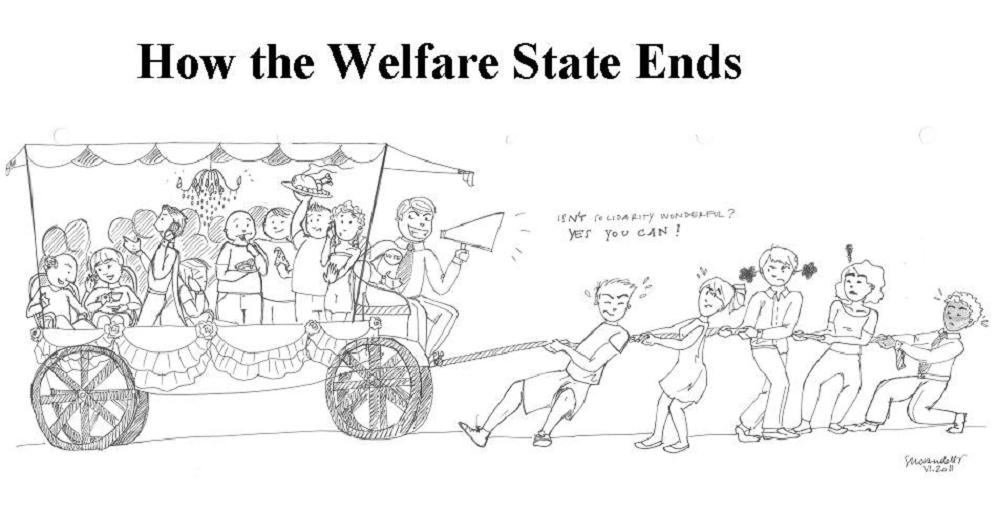
These images are remarkably accurate. The welfare state starts with small programs targeted at a handful of genuinely needy people. But as politicians figure out the electoral benefits of expanding programs and people figure out the that they can let others work on their behalf, the ratio of producers to consumers begins to worsen.
_________
President Obama c/o The White House
1600 Pennsylvania Avenue NW
Washington, DC 20500
When the government gets so big that it distorts the behavior of the private market then it is too big. The federal government is now spending 24.8% of GDP and traditionally for the first 150 years of our nation’s history we spent under 5% unless in wartime. This massive spending now by the federal encourages people to lie in order to get money for the government too instead of trying to work hard to earn money in the private market.
Why is big government bad for an economy? The easy answer is that big government usually means high tax rates, and this penalizes work, saving, investment, and entrepreneurship. And perhaps some of the spending is financed by borrowing, and this diverts money from private investment.
That’s a correct answer, but it’s only part of the story. In most cases, there is added damage because politicians spend money in ways that further undermine incentives to produce.
For instance, let’s assume a government spends $1 billion on some sort of redistribution program. Extracting that money from the productive sector of the economy obviously will cause some damage, but it’s also important to estimate how the supposed beneficiaries of the money will react. What if they decide to earn less income in order to be eligible for the handouts, as even the statists at the OECD have recognized?
In other words, it hurts the economy when government collects money, and it often hurts the economy when government spends money. Sort of a perverse 2-for-1 special (though “Rahn Curve” analysis does show that some types of spending – on core public goods – is correlated with better economic performance)
Let’s look at an example from Greece, showing how handouts distort behavior and corrupt people. Here are some remarkable tidbits from a Wall Street Journal story.
The Greek health ministry is investigating on Zakynthos after local officials flagged records showing what they said is an implausibly high number of disability claims for blindness. About 1.8% of the island’s population of 39,000 claimed the benefit last year, according to the health ministry. That is around nine times the prevalence of blindness estimated for many European countries in a 2004 study published in a World Health Organization journal. Among those who put in for the blindness benefit on Zakynthos, a local official said, were a taxi driver and a bird hunter. …But the island is hardly alone, according to health ministry officials, who say fraudulent disability claims are a problem across the nation… Zakynthos Mayor Stelios Bozikis on a Greek television talk show said residents angry about the benefits crackdown and other financial overhauls pelted him with yogurt at a recent event.
Let’s go back to the story and look at a rough estimate of how much fraud exists.
In an attempt to root out fraud, the Greek health ministry recently required disability claimants nationwide to register in a centralized database, appearing in person or sending a representative. The registration resulted in 36,000 fewer disability claims than in 2011, the health ministry said. The ministry alleges these dropped claims were fraudulent, in many cases reflecting multiple claims for the same disability or payments in the name of dead beneficiaries. It also alleges that some doctors accepted money for false diagnoses and some local politicians signed off on the benefits to win support, and said it is giving public prosecutors information about areas where it suspects a high level of fraud. Only 190 of the nearly 700 people it says had been collecting the blindness benefit on Zakynthos participated in the registration, the ministry said.
I have no idea if Zakynthos is representative, but that’s an incredibly high fraud rate. And this is just a glimpse at the workings of one government program. Now multiply that by some large number and you’ll begin to understand the damage caused by government.
And America is not immune. When politicians make it easier to ride in the wagon than to pull the wagon (as this cartoon illustrates), society sooner or later gets in trouble.
____________
Thank you so much for your time. I know how valuable it is. I also appreciate the fine family that you have and your commitment as a father and a husband.
Sincerely,
Everette Hatcher III, 13900 Cottontail Lane, Alexander, AR 72002, ph 501-920-5733, lowcostsqueegees@yahoo.com
July 10, 2012
Dear Everette:
Thank you for writing. As President, it is my privilege to hear from Americans like you who take time to offer their perspective on the serious issues facing our Nation. I appreciate your message and value your input.
From putting Americans back to work to expanding access to medical care, my Administration continues to take bold action to do what is right for our Nation. We have enacted the most comprehensive financial reforms in decades, rescued and helped retool our auto industry, expanded student aid to millions of young people, helped level the playing field for working women, and made the largest investment in clean energy in our history. Because of the courageous acts of our service members, we have been able to end the war in Iraq and take down Osama bin Laden. We have also made historic commitments to provide for our troops as they return home. Securing our country’s future will take time, but I will not stop working to rebuild the kind of America where everyone gets a fair shot, everyone does their fair share, and everyone plays by the same rules.
I am always eager to hear ideas that will help our country adapt to changing times and lead us toward a brighter day. The enduring American spirit is revealed in the letters I receive, and I remain dedicated to ensuring it is reflected in our efforts to improve the lives of all Americans.
Thank you, again, for sharing your views. I encourage you to explore www.WhiteHouse.gov to learn more about the ways we are moving America forward.
Dan Mitchell on Austerity in Europe 2012 President Obama c/o The White House 1600 Pennsylvania Avenue NW Washington, DC 20500 Dear Mr. President, I know that you receive 20,000 letters a day and that you actually read 10 of them every day. I really do respect you for trying to get a pulse on what […]
I got this off the internet. U.S. Tax revenue: $2,170,000,000,000 Fed budget: $3,820,000,000,000 New debt: $1,650,000,000,000 National debt: $14,271,000,000,000 Recent budget cut: $38,500,000,000 Now, remove 8 zeros and pretend it’s a household budget Annual family income: $21,700 Money the family spent: $38,200 New debt on the credit card: $16,500 Outstanding balance on credit card: $142,710 […]
President Obama c/o The White House 1600 Pennsylvania Avenue NW Washington, DC 20500 Dear Mr. President, I know that you receive 20,000 letters a day and that you actually read 10 of them every day. I really do respect you for trying to get a pulse on what is going on out here. If our […]
The Rahn Curve and the Growth-Maximizing Level of Government Uploaded by afq2007 on Jun 29, 2010 Government spending can promote economic growth if money is used for core “public goods” such as rule of law and property rights. But the burden of government spending in the United States and other industrialized nations is far higher […]
Government Spending Doesn’t Create Jobs Uploaded by catoinstitutevideo on Sep 7, 2011 Share this on Facebook: http://on.fb.me/qnjkn9 Tweet it: http://tiny.cc/o9v9t In the debate of job creation and how best to pursue it as a policy goal, one point is forgotten: Government doesn’t create jobs. Government only diverts resources from one use to another, which doesn’t […]
The Economic Case for Tax Havens Uploaded by afq2007 on Sep 10, 2008 Statist politicians and international bureaucracies such as the OECD and UN routinely attack tax havens, claiming that they lead to “harmful tax competition.” Yet at no point do critics bother to provide any evidence for this claim. This mini-documentary from the Center […]
Sweden produced ABBA in the 1970′s, but now they are producing some pretty good economic policies. One of my favorite groups growing up was ABBA. Here are some of my favorite songs: _______________ President Obama c/o The White House 1600 Pennsylvania Avenue NW Washington, DC 20500 Dear Mr. President, I know that you receive 20,000 letters a […]
President Obama c/o The White House 1600 Pennsylvania Avenue NW Washington, DC 20500 Dear Mr. President, I know that you receive 20,000 letters a day and that you actually read 10 of them every day. I really do respect you for trying to get a pulse on what is going on out here. You want […]
Six years ago, President Bill Clinton signed legislation overhauling part of the nation’s welfare system. The Personal Responsibility and Work Opportunity Reconciliation Act of 1996 (P.L. 104-193) replaced the failed social program known as Aid to Families with Dependent Children (AFDC) with a new program called Temporary Assistance to Needy Families (TANF). The reform legislation had three goals: (1) to reduce welfare dependence and increase employment; (2) to reduce child poverty; and (3) to reduce illegitimacy and strengthen marriage.
At the time of its enactment, liberal groups passionately denounced the welfare reform legislation, predicting that it would result in substantial increases in poverty, Hunger, and other social ills. Contrary to these alarming forecasts, welfare reform has been effective in meeting each of its goals.
Overall poverty, child poverty, and black child poverty have all dropped substantially Although liberals predicted that welfare reform would push an additional 2.6 million persons into poverty, the U.S. Bureau of the Census reports there are 3.5 million fewer people living in poverty today than there were in 1995 (the last year before the reform).
Some 2.9 million fewer children live in poverty today than in 1995
Decreases in poverty have been greatest among black children In fact, the poverty rate for black children is now at the lowest point in U.S. history. There are 1.2 million fewer black children in poverty today than there were in the mid-1990s.
Hunger among children has been cut roughly in half According to the U.S. Department of Agriculture (USDA), there are 420,000 fewer hungry children today than at the time welfare reform was enacted.
welfare caseloads have been cut nearly in half and employment of the most disadvantaged single mothers has increased from 50 percent to 100 percent.
The explosive growth of out-of-wedlock childbearing has come to a virtual halt The share of children living in single-mother families has fallen, and the share living in married-couple families has increased, especially among black families.
Some attribute these positive trends to the strong economy in the late 1990s. Although a strong economy contributed to some of these trends, most of the positive changes greatly exceed similar trends that occurred in prior economic expansions. The difference this time is welfare reform.
welfare reform has substantially reduced welfare’s rewards for non-work, but much more remains to be done. When TANF is reauthorized next year, federal work requirements should be strengthened to ensure that states require all able-bodied parents to engage in a supervised job search, community service work, or skills training as a condition of receiving aid. Even more important, Congress must recognize that the most effective way to reduce child poverty and increase child well-being is to increase the number of stable, productive marriages. In the future, Congress must take active steps to reduce welfare dependence by rebuilding and strengthening marriage.
PREDICTIONS OF SOCIAL DISASTER DUE TO WELFARE REFORM
Six years ago, when the welfare reform legislation was signed into law, Senator Daniel Patrick Moynihan (D-NY) proclaimed the new law to be “the most brutal act of social policy since reconstruction.”1 He predicted, “Those involved will take this disgrace to their graves.”2
Marian Wright Edelman, president of the Children’s Defense Fund, declared the new reform law an “outrage…that will hurt and impoverish millions of American children.” The reform, she said, “will leave a moral blot on [Clinton’s] presidency and on our nation that will never be forgotten.”3
The Children’s Defense Fund predicted that the reform law would increase
child poverty nationwide by 12 percent…make children hungrier…[and] reduce the incomes of one-fifth of all families with children in the nation.4
The Urban Institute issued a widely cited report predicting that the new law would push 2.6 million people, including 1.1 million children, into poverty. In addition, the study announced the new law would cause one-tenth of all American families, including 8 million families with children, to lose income.5
The Center on Budget and Policy Priorities asserted the new law would increase the number of children who are poor and “make many children who are already poor poorer still…. No piece of legislation in U.S. history has increased the severity of poverty so sharply [as the welfare reform will].”6
Patricia Ireland, president of the National Organization for Women, stated that the new welfare law “places 12.8 million people on welfare at risk of sinking further into poverty and homelessness.”7
Peter Edelman, husband of Marian Wright Edelman and then Assistant Secretary for Planning and Evaluation at the Department of Health and Human Services, resigned from the Clinton Administration in protest over the signing of the new welfare law. In an article entitled “The Worst Thing Bill Clinton Has Done,” Edelman dubbed the new law “awful” policy that would do “serious injury to American children.”8
Peter Edelman believed the reform law would not merely throw millions into poverty, but also would actively worsen virtually every existing social problem. “There will be more malnutrition and more crime, increased infant mortality, and increased drug and alcohol abuse,” claimed Edelman. “There will be increased family violence and abuse against children and women.” Moreover, the bill would fail even in the simple task of “effectively” promoting work because “there simply are not enough jobs now.”9
WHAT ACTUALLY HAPPENED
In the six years since the welfare reform law was enacted, social conditions have changed in exactly the opposite direction from that predicted by liberal policy organizations. As noted above, overall poverty, child poverty, black child poverty, poverty of single mothers, and child Hunger have declined substantially. Employment of single mothers increased dramatically, and welfare rolls plummeted. The share of children living in single-mother families fell, and — more important — the share of children living in married-couple families grew, especially among black families.10
Opponents of reform would like to credit many of these positive changes to a “good economy.” However, according to their predictions in 1996 and 1997, liberals expected the welfare reform law to have disastrous results during good economic times. They expected reform to increase poverty substantially even during periods of economic growth; if a recession did occur, they expected that far greater increases in poverty than those mentioned above would follow. Thus, it is disingenuous for opponents to argue in retrospect that the good economy was responsible for the frustration of pessimistic forecasts since the predicted dire outcomes were expected to occur even in a strong economy.
Less Poverty Since the enactment of welfare reform in 1996, the poverty rate has fallen from 13.8 percent in 1995 to 11.7 percent in 2001. Liberals predicted that welfare reform would push an additional 2.6 million people into poverty, but there are actually 3.5 million fewer people living in poverty today than there were when the welfare reform law was enacted.11
Less Child poverty The child poverty rate has fallen from 20.8 percent in 1995 to 16.3 percent in 2001. In 1995, there were 14.6 million children in poverty compared with 11.7 million in 2001. Though liberals predicted that welfare reform would throw more than 1 million additional children into poverty, there are some 2.9 million fewer children living in poverty today than there were when welfare reform was enacted.12
Less Black Child poverty The decline in poverty since welfare reform has been particularly dramatic among black children. As Chart 1 shows, for a quarter-century prior to welfare reform, there was little change in black child poverty. Black child poverty was actually higher in 1995 (41.5 percent) than in 1971 (40.4 percent).
With the enactment of welfare reform in 1996, black child poverty plummeted at an unprecedented rate, falling by more than a quarter to 30.0 percent in 2001. Over a six-year period after welfare reform, 1.2 million black children were lifted out of poverty. In 2001, despite the recession, the poverty rate for black children was at the lowest point in national history.13
Less Poverty Among Children of Single Mothers Since the enactment of welfare reform, the drop in child poverty among children in single-mother families has been equally dramatic. For a quarter-century before welfare reform, there was little net decline in poverty in this group. poverty was only slightly lower in 1995 (50.3 percent) than it had been in 1971 (53.1 percent). After the enactment of welfare reform, the poverty rate for children of single mothers fell at a dramatic rate, from 50.3 percent in 1995 to 39.8 percent in 2001. In 2001, despite the recession, the poverty rate for children in single-mother families was at the lowest point in U.S. history.14
Dramatic Reduction in Child Hunger The number of children who are “hungry” has been cut roughly in half since the enactment of welfare reform, according to the U.S. Department of Agriculture. The USDA reports that in 1995, the year before welfare reform was enacted, 887,000 children were hungry; by 2001, the number had fallen to 467,000.15 In percentage terms, the numbers fell from 1.3 percent of children in 1995 to 0.6 percent in 2001. Overall, there are more than 400,000 fewer hungry children today than at the time welfare reform was enacted. (See Chart 2.)
Decrease in “Severe poverty” Liberals predicted that welfare reform would increase “the severity of poverty.” However, the number of children living in “deep poverty” has declined appreciably. (Families in “deep poverty” have incomes that are less than half the poverty income level.) In 1995, there were 5.9 million children living in deep poverty; by 2001, the number had fallen to 5.1 million.16
With the national debt increasing faster than ever we must make the hard decisions to balance the budget now. If we wait another decade to balance the budget then we will surely risk our economic collapse.
The first step is to remove all welfare programs and replace them with the negative income tax program that Milton Friedman first suggested.
Milton Friedman points out that though many government welfare programs are well intentioned, they tend to have pernicious side effects. In Dr. Friedman’s view, perhaps the most serious shortcoming of governmental welfare activities is their tendency to strip away individual independence and dignity. This is because bureaucrats in welfare agencies are placed in positions of tremendous power over welfare recipients, exercising great influence over their lives. In addition, welfare programs tend to be self-perpetuating because they destroy work incentives. Dr. Friedman suggests a negative income tax as a way of helping the poor. The government would pay money to people falling below a certain income level. As they obtained jobs and earned money, they would continue to receive some payments from the government until their outside income reached a certain ceiling. This system would make people better off who sought work and earned income.
Friedman: Joe Gardner helped to set up an organization of local black people to protect their own interests. Previously, the blacks had rioted in the streets to try to get their way. Now it was to be done peacefully using government money.
When government funds became available, the Woodlawn Organization got control. They used them to build the kind of houses they wanted. Low rise apartments like these.
The bureaucrats, planners and architects told them that it was uneconomical. That only high-rise blocks would work. They were wrong.
Joe Gardner: A lot of people have this view that, the disadvantaged if you will, have no ideas what their problems are and how to resolve them, that it takes outside professionals to do that. And we say that’s baloney because the outside professional does not feel in his gut what a woman on welfare with six kids living off of a $100 a month in a deteriorated building feels. She can come up with solutions much better than a bureaucrat.
Friedman: The intentions of this local community group are good. They want to rebuild the community as the community wants.
Joe Gardner talking to an elderly woman: I can’t hear you. I said are you pretty pleased with the work we are doing? Yes I am very pleased with it.
Friedman: But government money always corrupts. Look at the number of people rebuilding this garage. It doesn’t make sense except that these are CETA workers paid for by taxpayers money.
Government funds have allowed the organization to take over a whole area of Chicago. They now have their own supermarket.
They’ve built splendid houses for middle class occupiers. Very expensive, protected by the latest security systems. All at the taxpayers expense.
Joe Gardner: In a sense TWA is rapidly becoming a mini-government. At this particular point we have approximately 400 employees. We have an operating budget of, in excess of $5 million per year. So we are large.
Friedman: Large and expanding. Their next project is to redevelop this site. And that’s only the first step in a 20 year plan that will cost $220 million. Most of it coming from the taxpayers.
In the South Bronx, they are very familiar with government protection. Like the rent controls have made it uneconomic for landlords to maintain their buildings. They’ve moved out and the vandals have moved in. The South Bronx is an area where many of the people are on welfare, and where the crime rate is high. But all this could change. A group of local people has begun to renovate these buildings to build new homes. They call themselves “Sweat Equity.” Because at first sweat and effort was all they could put into the project. Only later did they accept a small government grant.
Friedman and Robert Foster: How long ago did you start working on this building? Four months ago for this building right here. And I take it what you are going…to gut the whole thing from beginning to end. Totally gut it. And you’ll have to rewire, right, roof, put new walls up, new floors, new ceilings, new everything in winter and summer whenever there was a chance to work. How many people do you have working here? A good 40 people. How do you keep them working? You know, some of them must want to, get tired of it. We show them what can be done in the future and what will be done in the future. And they get, at first, it’s kind of hard to prove to somebody that in the next three or four years what will come out of it. They can’t see it in long range terms. They only see it in short, they need money right now, not in two years. So we try to show them that it will happen.
Friedman: It’s true they now accept some government money. But so far they’ve managed to retain their original philosophy. That the best way to get something done well is to do it yourself.
Robert Foster: Like what we’re doing. We’re bringing people out of the street and giving them something to look forward to. They have their own apartment, they’ll be taken care of, the area around it, they have a garden, they have something to look forward to. They even get off welfare, you even give them a job. They can drop the welfare and have some self pride. That’s the only thing about it, self pride. The longer you take from the government and sitting back, you’ve got no worries. We’re not sitting back, we’re working. We’re making our money come in. And we are putting it into our building, we’re building ourselves up as well as the buildings.
Friedman: Some of these people are CETA workers. Paid for by the taxpayer. But this isn’t as useful as it might appear.
You ask these fellows which would they rather have, the CETA workers or the money that’s being paid to the CETA workers? Laughter. Which would you rather have?
Robert Foster: The money paid to the workers. Friedman: That’s your answer. That’s very expensive help. In terms of what these people could use with the money. You give these people the amount of money you’re paying to that CETA worker and I’ll bet they’ll have twice as much, three times as much, work. Am I wrong?
Robert Foster: Your right.
Friedman: So it’s a very inefficient way to use their money. The problem is you’ve got bureaucracy and the government bureaucrats, they want to decide what to do. They don’t want to let you decide what to do.
Robert Foster: Exactly.
Friedman: Ask yourself, how does this place get built up in the first place. After all, this was a pretty respectable, solid, substantial region when it was first developed. It wasn’t done through a government project. It was done by people individually having an incentive to put up these buildings and occupying them. What these people we’ve been seeing here are doing is they are trying to restore that feeling and that attitude. You’ll have a far healthier community here that grows out of the self-help of people like the people we’ve been talking to. That it is a paternalistic venture undertaken by governmental civil servants and bureaucrats who have to plan on a large scale for other people.
We must find a way to give everyone caught in the welfare trap the kind of initiative these people have.
The best, or should I say the least bad, solution I have even been able to devise was something called the negative income tax. This is the idea that we should get rid of a large part of the welfare bureaucracy, and for demeaning rules, and we should help people who are poor fundamentally by giving them money.
With a positive income tax, you’re entitled to a certain amount of personal exemptions and deductions. And above that amount you pay tax. But suppose you have no income. Under a negative income tax a fraction of your unused exemptions would be paid to you by the government. Guaranteeing at least a minimum income.
If you earned something, you’d still get a fraction of your unused exemptions. And you’d end up better off.
As your earnings rose, the supplement to your income would become smaller and smaller until your earnings equaled your exemptions. At that point, you’d break even. Neither paying tax nor receiving a subsidy.
It’s not an ideal system. It’s not the system we might have liked to get into, but it’s a system which would have the effect of eliminating the separation of a society into those to receive and those who pay. A separation that tends to destroy the whole social fabric. It would mean that we could each of us take advantage of opportunities that opened up without fearing that if by some chance we lost our jobs, it would be a long time before we could get back on assistance. It would be a system that would give all of us an incentive gradually to improve our lives would perhaps enable us, over time, to work ourselves out of the kind of mess we’ve gotten ourselves into. A mess we’ve gotten ourselves into for the very best of motives but with the very worst of results.
We’ve become increasing dependent on government. We’ve surrendered power to government, nobody has taken it from us. It’s our doing. The results, monumental government spending. Much of it wasted, little of it going to the people whom we would like to see helped. Burdensome taxes, high inflation, a welfare system under which neither those who receive help nor those who pay for it are satisfied. Trying to do good with other people’s money simply has not worked.
_______________
Thank you so much for your time. I know how valuable it is. I also appreciate the fine family that you have and your commitment as a father and a husband.
Sincerely,
Everette Hatcher III, 13900 Cottontail Lane, Alexander, AR 72002, ph 501-920-5733, lowcostsqueegees@yahoo.com
Arkansas wide receiver Joe Adams runs back a punt for a touchdown against Tennessee at Donald W. Reynolds Razorback Stadium in Fayetteville on Nov. 12, 2011. (AMY SMOTHERMAN BURGESS/NEWS SENTINEL)
It appears the Tennessee Vols are very happy about one thing this coming season: THEY DON’T HAVE TO PLAY THE HOGS!!!!
John Adams noted:
Thanks to SEC expansion, the Vols won’t have to play Arkansas, which won 49-7 last season in Fayetteville and still has plenty of talent. Replacing the Razorbacks with Missouri is another plus for UT.
I totally agree with that point. Last year Tennessee is the only team in college football history besides Iowa St back in 1971 who had to play the top 3 ranked teams in the nation in one season as far as I know. (The only reason I knew about Iowa St was because Johnny Majors was the coach at Iowa St back then and he told that to the Little Rock Touchdown Club when he spoke here.)
Last year the Vols played 1. LSU, 2. Alabama and 3. Arkansas by the time they came to Fayetteville last year to play the third ranked Hogs.
The SEC caught itsbasketballcoaches off guard recently when it emailed them changes to the conference schedule that was supposedly set at June’s spring meetings. Imagine if it did the same thing infootball.
SEC commissioner Mike Slive would have to spend the rest of the day on the phone with football coaches, some of whom would have to be talked down from ledges.
The conference schedule matters in basketball. It matters so much more in football.
It’s not just whom you play outside your division. It’s when you play them.
Even open dates can be a source of anguish in football. Just a couple of years ago, Alabama officials spent the offseason whining about a conference schedule that gave so many of its opponents the week off before Alabama.
South Carolina coach Steve Spurrier has spent this offseason throwing darts at both the last conference schedule and the one to come. His point: Georgia won the East through scheduling and could win it again the same way.
Tennessee has no such complaints. The scheduling advantage gained from last season to this one is significant.
The Vols didn’t finish 5-7 last season solely through inept play. They played three of the top five teams in the country — all from the SEC West. And the open date, just three games into the season, provided no cushion.
Never mind how much UT might have improved from last season to this one through experience and recruiting. Its acquired advantage in scheduling could be just as much of a factor in what should be a much-improved record.
The only disadvantage might come against its one non-conference BCS opponent. Playing N.C. State in the season opener in the Georgia Dome is more challenging than playing
Cincinnati in the second game last season at Neyland Stadium. The rest of the non-conference fare is comparable to last season’s threesome, which Tennessee outscored 107-26.
But look how much the Vols will benefit elsewhere.
Thanks to SEC expansion, the Vols won’t have to play Arkansas, which won 49-7 last season in Fayetteville and still has plenty of talent. Replacing the Razorbacks with Missouri is another plus for UT.
The natural rotation of the conference schedule will offer another advantage. National championship contender LSU is off; middle-of-the road Mississippi State is on.
The open date also will work in UT’s favor. Last season, the Vols had to play four consecutive games against nationally ranked opponents — Georgia, LSU, Alabama and South Carolina — without a break. The 2012 schedule includes well-timed breaks.
The Vols will play Georgia State before Florida, and Akron afterward. The Georgia game is sandwiched between Akron and an open date. Troy will break up games against South Carolina and Missouri.
That leaves the last three weeks of October as the toughest stretch of the season. But at least the Vols will have an open date the Saturday before they play Mississippi State, Alabama and South Carolina in succession.
One more advantage: Tennessee won’t have to play Kentucky at Commonwealth Stadium this season.
Tenn Football Coach Derek Dooley’s Mom on the Radio Uploaded by jebusfubar4 on Oct 7, 2011 I really enjoyed hearing Vince Dooley speak a couple of years ago at the Little Rock Touchdown Club and he said that his son Derek would do a good job at Tennessee if given enough time. Evidently Derek’s mom […]
Bobby Petrino and Jessica Dorrell I was so happy a few months ago with the Razorbacks’ football future firmly in Bobby Petrino’s hands. Things were going so well. I mentioned to a friend that I was 16 back in 1977 when Lou Holtz led the Razorbacks that season to a 11-1 record and a third […]
I think that Derek Dooley has the biggest rebuilding of the coaches mentioned below. I heard Vince Dooley speak at the Little Rock Touchdown Club meeting in October of 2010 and he said that his son inherited a program that had been set back by defections. In fact, I read recently that the great recruiting […]
My son Wilson and I went to the Tennessee Vols at Arkansas Razorback game in Fayetteville last year. During a restroom stop in Ozark, Arkansas I got to hear a lot of Tennessee fans talking. One said that Dooley will be gone at the end of 2011 and the other said that they have to […]
Photo by Saul Young The fears surrounding the week after Alabama were realized in 2005 when the Vols lost to South Carolina on a night when the jersey of former Tennessee quarterback Peyton Manning, center, was retired. _________________ “It wasn’t his decision. It wasn’t my decision. Circumstances kind of dictated it,” Manning said. Manning did […]
I am glad that Petrino got more defensive players than offensive players but time will tell if he can develop these three star players like he did in 2008 when that class later turned the hogs into a national contender in 2011. Below is an article from http://www.ajc.com Alabama (26): The national champs added to their […]
I have noticed that Arkansas never seems to have great recruiting years like Tennessee and Florida and Alabama do. However, the 2008 class that will graduate in 2012 for Arkansas included some great players like Joe Adams and has been re-ranked as the 5th best performing class. That class led Arkansas to a final ranking […]


 Amy Smotherman Burgess, ©KNS/2011
 Amy Smotherman Burgess, ©KNS/2011




 The Daily Hatch
