Monthly Archives: July 2012

Milton Friedman remembered at 100 years from his birth (Part 4)

I ran across this very interesting article about Milton Friedman from 2002:

Friedman: Market offers poor better learningBy Tamara Henry, USA TODAY

By Doug Mills, AP
President Bush honors influential economist Milton Friedman for his 90th birthday earlier this month.
About an economist
Name:Milton FriedmanAge: 90Background: Winner of the 1976 Nobel Prize for economic science; senior research fellow, Hoover Institution at Stanford University since 1977; adviser to presidents Richard Nixon and Ronald Reagan; awarded the Presidential Medal of Freedom and the National Medal of Science in 1988.He’s in the news because an idea Friedman proposed in 1955 is the subject of a pending U.S. Supreme Court ruling. Friedman’s idea: to give low-income parents tax money, in the form of vouchers, so they have the option of sending their children to private or religious schools.Education: B.A. in 1932, Rutgers University; M.A. in 1933, University of Chicago; Ph.D. in 1946, Columbia University.

WASHINGTON — Milton Friedman is a Nobel Prize-winning economist who rubs elbows with the rich and powerful and was recently feted on his 90th birthday by President Bush. But few people know that Friedman is also a champion of poor families who want a better education for their kids.

Friedman is considered “the father of vouchers,” the controversial idea that low-income parents should get tax-supported vouchers to send their kids to private and religious schools.

“Look, what is this all about? Who is it that suffers most from our present school system?” he asks. “It’s the low-income, particularly the blacks. There’s no doubt they’re the great victims. Here’s a program that will help them tremendously.”

Friedman proposed the idea 47 years ago and says he never imagined that the debate would become so intense that the U.S. Supreme Court would have to offer a definitive ruling on the issue. A high court decision is expected soon on the constitutionality of a program in Cleveland, where the majority of the students getting $2,250 a year in vouchers use the funds to attend religious schools. Opponents say this violates the constitutionally mandated separation of church and state. But Friedman says most parents will have limited school choices as long as the government controls public education.

Private-school vouchers were “such a profoundly insightful idea that it stunned me with its clarity and how sensible it was, but yet how radical it was,” says William “Chip” Mellor, president of the Institute for Justice, a libertarian public-interest law firm that favors vouchers. He first read about the idea while in law school and says he’s known Friedman more than 15 years and considers him “a hero.”

Friedman’s slight, 5-foot frame belies his stature. He was a member of President Reagan’s Economic Policy Advisory board, and even now, when his pal Alan Greenspan and the U.S. Federal Reserve Board adjust interest rates, experts look for Friedman’s reaction. His memoirs, written with his wife, Rose, in 1998, recall how in Europe in 1950, he wrote the draft for his classic essay, “The Case for Flexible Exchange Rates,” as part of his contribution to the rehabilitation of Germany after World War II.

Five years later, education hit Friedman’s radar screen.

In 1955, he wrote a paper on the role the federal government should play in various areas: monetary matters, international trade and education. A professor at the University of Chicago at the time, Friedman published a separate article questioning why government wanted to run schools. He proposed vouchers as a way to separate government financing of education from government administration of schools.

Now, nearly a half-century later, he remains just as energetic about his idea — although no program has come close to what he first proposed.

Vouchers are not just an academic interest. Friedman and his wife, a constant companion for 63 years, created the Milton & Rose D. Friedman Foundation to fund research and support the voucher issue. “We set up the foundation because we were getting to an age in which we weren’t going to be able to do very much ourselves,” he says.

The spry nonagenarian lives in San Francisco and still works as a senior researcher at the conservative Hoover Institution, a position he has held since 1977.

Why would a wealthy economist focus so much effort on black kids from the inner city? Friedman bows his head and knits his fingers together. “What are we here for?” he asks. “We’re here to try to make the world a little better than we found it.”

He appears ill at ease with any compliment. Asked about the “father of vouchers” title, he flicks his hand and says, “Movements have lots of fathers.” He cites writings of Adam Smith and Thomas Paine in 1776 as hinting at the idea of competition and choice in education.

“Yes, it was a radical idea in its day,” Friedman says. But he frowns at today’s view of radicals as rabble-rousers who lead marches and protests. Friedman’s radicalism focuses mainly on voicing unorthodox views.

“I was not unaccustomed to having people disagree with me. To begin with, (the voucher idea) took up very rapidly. But every time people would gather strongly in favor of it, they would come up against the teachers’ unions and the educational bureaucracy, the government civil service.”

New Hampshire was the first state to express an interest in the 1970s, and five of its cities were willing to try an experiment drafted by a group at Dartmouth College, Friedman says. But he notes the teachers unions worked diligently to kill the plan before it got off the ground. A similar situation occurred in Connecticut. Milwaukee was the first city to try a voucher experiment in 1990, followed by Cleveland in 1995. Florida has the nation’s first statewide program, enacted in 1999.

Friedman says the key flaw with all the programs is that government continues to call the shots. Also, he says, voucher amounts are too low to interest entrepreneurs in opening new schools.

Friedman gives unfavorable reviews even to President Bush’s new, highly touted education law, allowing children in failing schools to receive vouchers. The problem: The bureaucracy is allowed to set the definition of a failing school.

Refundable tax credits, viewed by many as a back-door voucher, are not popular with Friedman, either. He sees them as a political game.

“Why fool around? I’d prefer to do it straightforwardly, as a voucher. We want competition. We want diversity, variety. But we want it free, not controlled or directed by any third party.”

However, Bob Chase, president of the National Education Association, the nation’s largest teachers’ union, says Friedman’s theories counter America’s concept of public education.

“When Americans first developed the concept of public education, it was conceived as a community effort — supported by taxpayers, governed by local citizens, and involving parents and others in nurturing children.

“Milton Friedman would turn this long-standing American success story on its head, creating a system that is essentially ‘every man for himself.’ ”

Chase says the “most significant obstacle” to vouchers is “parents who have clearly said, in polls and at the ballot box, that they would prefer to see improvements in existing schools.”

Friedman, who attended public schools in Rahway, N.J., remains undaunted in his mission and only chuckles when asked why his influence in economics doesn’t extend to education. “It’s hard to sell any idea. That’s not a bad thing. It’s a good thing that it’s hard to sell ideas. The government does enough harm as it is.”

True market-driven education will come, he says. “It will be by accident, absolutely. Somewhere everything will fit together. It will be a place where teachers unions aren’t very strong or have fallen out of favor, where both the governor and legislature are in sync.”

Will Friedman, who admits he’s a quintessential optimist, live to see the day? “I would hope so, but I don’t have that much optimism, no.”

Related posts:

“Friedman Friday” :“A Nobel Laureate on the American Economy” VTR: 5/31/77 Transcript and video clip (Part 4)

Milton Friedman on the American Economy (4 of 6)   Uploaded by donotswallow on Aug 9, 2009 THE OPEN MIND Host: Richard D. Heffner Guest: Milton Friedman Title: A Nobel Laureate on the American Economy VTR: 5/31/77 _____________________________________ Below is a transcipt from a portion of an interview that Milton Friedman gave on 5-31-77: Friedman: […]

Obama promotes food stamps but Milton Friedman had a better suggestion

Milton Friedman’s negative income tax explained by Friedman in 1968: We need to cut back on the Food Stamp program and not try to increase it. What really upsets me is that when the government gets involved in welfare there is a welfare trap created for those who become dependent on the program. Once they […]

“Friedman Friday” :“A Nobel Laureate on the American Economy” VTR: 5/31/77 Transcript and video clip (Part 3)

Milton Friedman on the American Economy (3 of 6) Uploaded by donotswallow on Aug 9, 2009 THE OPEN MIND Host: Richard D. Heffner Guest: Milton Friedman Title: A Nobel Laureate on the American Economy VTR: 5/31/77 _____________________________________ Below is a transcipt from a portion of an interview that Milton Friedman gave on 5-31-77: Friedman: Now […]

“The Power of the Market” episode of Free to Choose in 1990 by Milton Friedman (Part 5)

Milton Friedman The Power of the Market 5-5 How can we have personal freedom without economic freedom? That is why I don’t understand why socialists who value individual freedoms want to take away our economic freedoms.  I wanted to share this info below with you from Milton Friedman who has influenced me greatly over the […]

“The Power of the Market” episode of Free to Choose in 1990 by Milton Friedman (Part 4)

Milton Friedman The Power of the Market 4-5 How can we have personal freedom without economic freedom? That is why I don’t understand why socialists who value individual freedoms want to take away our economic freedoms.  I wanted to share this info below with you from Milton Friedman who has influenced me greatly over the […]

Obama’s solution to our healthcare problems: MORE FEDERAL OVERSIGHT!!!

A Taxing Distinction for ObamaCare Published on Jun 28, 2012 by catoinstitutevideo http://www.cato.org/publications/commentary/it-now-falls-congress http://www.cato.org/publications/commentary/taxing-decision http://www.cato-at-liberty.org/supreme-court-unlawfully-rewrites-obamacare-to… http://www.cato-at-liberty.org/congress-its-not-a-tax-scotus-yes-it-is/ The Cato Institute’s Roger Pilon, Ilya Shapiro, Michael F. Cannon, Michael D. Tanner and Trevor Burrus evaluate today’s ruling on ObamaCare at the Supreme Court. Video produced by Caleb O. Brown and Austin Bragg. ____________ When I think about […]

“Friedman Friday”:“A Nobel Laureate on the American Economy” VTR: 5/31/77 Transcript and video clip (Part 2)

Milton Friedman on the American Economy (2 of 6) Uploaded by donotswallow on Aug 9, 2009 THE OPEN MIND Host: Richard D. Heffner Guest: Milton Friedman Title: A Nobel Laureate on the American Economy VTR: 5/31/77 _____________________________________ Below is a transcipt from a portion of an interview that Milton Friedman gave on 5-31-77: Friedman: General […]

“The Power of the Market” episode of Free to Choose in 1990 by Milton Friedman (Part 3)

Milton Friedman The Power of the Market 3-5 How can we have personal freedom without economic freedom? That is why I don’t understand why socialists who value individual freedoms want to take away our economic freedoms.  I wanted to share this info below with you from Milton Friedman who has influenced me greatly over the […]

“The Power of the Market” episode of Free to Choose in 1990 by Milton Friedman (Part 2)

Milton Friedman The Power of the Market 2-5 How can we have personal freedom without economic freedom? That is why I don’t understand why socialists who value individual freedoms want to take away our economic freedoms.  I wanted to share this info below with you from Milton Friedman who has influenced me greatly over the […]

“Friedman Friday” :“A Nobel Laureate on the American Economy” VTR: 5/31/77 Transcript and video clip (Part 1)

Milton Friedman on the American Economy (1 of 6) Uploaded by donotswallow on Aug 9, 2009 THE OPEN MIND Host: Richard D. Heffner Guest: Milton Friedman Title: A Nobel Laureate on the American Economy VTR: 5/31/77 _____________________________________ Below is a transcipt from a portion of an interview that Milton Friedman gave on 5-31-77: THE OPEN […]

“The Power of the Market” episode of Free to Choose in 1990 by Milton Friedman (Part 1)

Milton Friedman The Power of the Market 1-5 How can we have personal freedom without economic freedom? That is why I don’t understand why socialists who value individual freedoms want to take away our economic freedoms.  I wanted to share this info below with you from Milton Friedman who has influenced me greatly over the […]

Milton Friedman’s best 10 quotes

Milton Friedman – Public Housing Uploaded by LibertyPen on May 6, 2011 Professor Friedman looks at the destination of another road paved with good intentions. _______________ 10 great quotes from Milton Friedman below: Nov 29, 2011 10 Of The Best Economics Quotes From Milton Friedman John Hawkins John Hawkins is a professional blogger who runs […]

Myth:Conservative Herbert Hoover responsible for Depression?

Myth:Conservative Herbert Hoover responsible for Depression When I grew up I always heard that the conservative Herbert Hoover was responsible for the depression. Is that true? The Hoover Myth Marches On Posted by David Boaz In the New York Times today,  columnist Joseph Nocera quotes a book published in 1940 on Herbert Hoover and the Great Depression: […]

“The Failure of Socialism” episode of Free to Choose in 1990 by Milton Friedman (Part 5)

Milton Friedman: Free To Choose – The Failure Of Socialism With Ronald Reagan (Full) Published on Mar 19, 2012 by NoNationalityNeeded Milton Friedman’s writings affected me greatly when I first discovered them and I wanted to share with you. Abstract: Ronald Reagan introduces this program, and traces a line from Adam Smith’s “The Wealth of […]

Case Study on Chelsea Clinton:Can equality of results be acheived best by punishing those who were born rich? “Friedman Friday”

Milton Friedman – Redistribution of Wealth Uploaded by LibertyPen on Feb 12, 2010 Milton Friedman clears up misconceptions about wealth redistribution, in general, and inheritance tax, in particular. http://www.LibertyPen.com _______________________________ Many times in the past our government has tried to even the playing field but the rich and poor will always be with us as […]


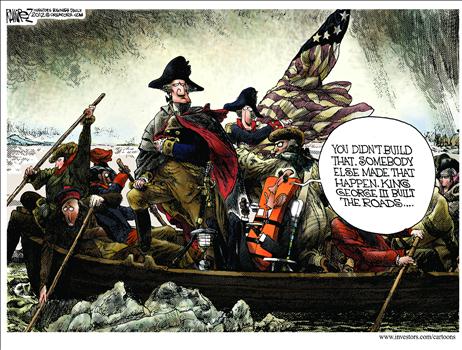
“You-Didn’t-Build-That” comment pictured in cartoons!!!

watch?v=llQUrko0Gqw]

The federal government spends about 10% on roads and public goods but with the other money in the budget a lot of harm is done including excessive regulations on business. That makes Obama’s comment the other day look very silly.

I made a serious point the other day about how government plays a very important role in the lives of entrepreneurs.

But since I was talking about the staggering burden of red tape and regulation, I wasn’t being very supportive of the President’s assertion that government deserves a big chunk of the credit when a business is successful.

This cartoon makes the same point, but adds taxation to the mix.

As far as I recall (I sound like a politician under oath when I write something like that), this is the first Branco cartoon I’ve used, but I think it’s the best one in this post, so I’m looking forward to more of his (her?) work.

Regular readers know about Michael Ramirez, of course, and he has an amusing take on the you-didn’t-build-that controversy.

I’ve used lots of Ramirez cartoons over the past few years, and you can enjoy some of his work here, here, here, here, here, here, here, here, herehereherehereherehere, and here.

The Obama campaign has been complaining that the President’s words were misinterpreted, so this Eric Allie cartoon is quite amusing and appropriate.

You can laugh at more Allie cartoons here, here, here, and here.

Fortunately for Obama, he has some allies to help him out, as Lisa Benson reminds us.

More funny Lisa Benson cartoons can be seen here, here, herehere, here, here, herehere, and here.

Last but not least, we have another Allie cartoon. I think this is the first time I’ve used two cartoons by the same person, but I think you’ll agree they’re worth sharing.

This gives me an opportunity to end on a serious note. The Obama campaign is asserting that the President was simply stating that private sector prosperity is made possible by the provision of “public goods” such as roads and bridges.

This is a perfectly fair point, as I explain in this video about the Rahn Curve.

But what Obama conveniently overlooks is that spending on so-called public goods is only about 10 percent of the federal budget. The vast majority of government spending is for unambiguously harmful outlays on transfers, consumption, and entitlements.

Which is why the second Allie cartoon is so good. Even when government does something that is theoretically good, it causes a lot of collateral damage because of the excessive size and scope of the welfare state.

Open letter to President Obama (Part 117.5)

6/6/12 Republican Leadership Press Conference

Published on Jun 6, 2012 by

Today House Republican leaders, joined by Senate Republican Leader Mitch McConnell, discussed the importance of preventing any tax increase to provide certainty to America’s job creators. Even President Bill Clinton and Larry Summers agree — taxes should not be raised on anyone in the Obama economy. House Republicans continue to work to cut spending, reduce regulations, and provide an environment for small businesses to hire and grow.

__________

President Obama c/o The White House
1600 Pennsylvania Avenue NW
Washington, DC 20500

Dear Mr. President,

I know that you receive 20,000 letters a day and that you actually read 10 of them every day. I really do respect you for trying to get a pulse on what is going on out here.

In the USA we need to learn some lessons from the European financial crisis and avoid their fate. We must rein in our entitlement spending and cut welfare programs and balance our budget or we too will have a financial crisis.

Crisis in Europe: Time for a Tough U.S. Response

By and
June 15, 2012


Three years on, through half measures and a fantastical faith in their own abilities, Europe’s leaders have led the continent into an extended economic crisis. Indeed, by delaying decisive action for so long, Europe has managed to make matters substantially worse for the continent first, and for the rest of the global economy.

While the U.S. economy could never entirely avoid the distresses emanating from Europe, the magnitude of the domestic injury early on appeared modest. The U.S. response was correspondingly muted, with expressions of concern, sympathy, and a desire to help except by contributing to further bailouts. As the European crisis deepens, the U.S. should acknowledge the growing threat and respond accordingly.

First, America’s national leaders, beginning with President Obama, need to set aside their political agendas and act to strengthen America’s economy for whatever shocks come from Europe. Second, it is time the U.S. demanded that Europe cease temporizing and take decisive, conclusive action to restore Europe’s economy and finances. This will likely require that Europe take painful and unpleasant steps.

Europe Goes from Bad to Worse

With roots going back to the adoption of the euro in 1999, the European crisis first broke into the open some 10 years later. In April 2009, the European Union told France, Spain, Ireland, and Greece to reduce their budget deficits in the wake of the credit crisis. What has since followed has been a steady stream of summits, conferences, grand announcements, protests, denials, finance mechanisms, and bailouts.

In short, what has followed has been damage control. The latest example is the drama surrounding the Spanish banking system. The cycle was a familiar one. First, the Spanish government insisted that its banks were fine and that it would never ask for nor accept a bailout. Then, the government acknowledged that some banks might need just a little help for a little while and tried to arrange to provide capital to Spanish banks through Spanish government borrowing.

That flopped. Then the government acknowledged that it would need a real bailout, and Europe responded with about 100 billion euros ($125 billion) cash. But some reports suggest that this is less than half of what will be needed to stabilize the Spanish banking system.[1]

Nor was the drama over with the announcement of the bailout. No doubt worried about Spanish sensibilities, Spanish Prime Minister Mariano Rajoy insisted that the bailout had “nothing to do” with the procedures imposed on Greece, Ireland, and Portugal when they were bailed out.

“Nicht wahr,” insisted Germany and the European Union (EU), who confirmed that the “troika” of the International Monetary Fund, the European Commission, and the European Central Bank would oversee the funds. “Of course there will be conditions” was the EU response. German Finance Minister Wolfgang Schaeuble pointed out, “The Spanish state is taking the loans, Spain will be responsible for them.… There will likewise be a troika.”[2]

The Spanish example of too-late half measures is, unfortunately, not unique. Consequently, since the crisis began Europe has clearly and substantially weakened its banking system, which is propped up only by the ephemeral elixirs of central bank cash and shaky bailouts. The periphery has sent their economies into a deflationary spiral. Many have paved a fiscal path of ever-higher debt to the point where default on sovereigns is a distinct possibility. And having long dismissed the need for fast growth in favor of public-sector intervention and distribution, governments have now discovered the need for fast growth, but they conveniently again see public-sector spending as the means.

The Threat to the U.S. from Europe

The obvious threat to the U.S. from Europe’s many crises is from a reduction in U.S. exports. According to the Department of Commerce, U.S. exports to Europe may have begun to slide as early as October 2011, as the widespread slowdown in Europe was only beginning to take hold.[3] In 2011, U.S. exports to Europe totaled $329 billion, representing about 22 percent of all U.S. exports.[4] While substantial, in a $15 trillion economy even a collapse in U.S. exports to Europe would have limited direct consequences.

The greater issue involves the effect of a deep recession and financial crisis in Europe on U.S. financial firms and markets. The 2008–2009 global financial crisis taught many important lessons about the state of modern finance. One lesson is that the global and interconnected nature of financial markets and firms means that financial shocks of a critical mass will spread far and wide.

This interconnectedness is made even more relevant because of a second lesson: No one—not the regulators, not the policymakers, and not those who run the firms themselves—fully knows the extent of the exposures and especially the structural weaknesses until the shockwave hits. In short, no one knows what no one knows—or how expensive that lack of knowledge will prove to be. Given the magnitude of the crisis in Europe, the potential threat to the U.S. is cause for real concern.

The U.S. Domestic Response: Politics Must Give Way to Growth

The U.S. domestic policy response to the building threat from Europe should be to make every possible effort to strengthen the U.S. economy and financial system in anticipation of whatever shockwaves may come from across the Atlantic.

To strengthen the economy, Congress and the President should immediately stop their posturing and politicking and disarm Taxmageddon. The threat of massively higher taxes in 2013 is already depressing economic activity and job growth. Facing the greater uncertainty about their own tax liability and about the state of the economy in 2013 if Taxmageddon strikes, firms are prudently holding back on the investments and other actions needed to propel the economy forward.[5]

The U.S. budget deficit is projected to exceed $1 trillion for the fourth straight year, adding to economic uncertainty. Congress and President Obama should defy conventional wisdom, set aside their political differences, and rein in federal spending immediately by choice rather than being eventually forced to do so, as countries across Europe have been.

Even more important, policymakers should adopt some common-sense steps that are necessary to rein in entitlement spending for the medium to long term.[6] The basic policies needed to stabilize the finances in the Medicare and Social Security programs in particular are well-understood, in many cases already tested in law, and entirely evolutionary.[7]

Finally, the uncertainty plaguing the U.S. economy is also due in part to the flood of regulations pouring or about to pour out of Washington from, among other causes, Obamacare and the Dodd–Frank financial market reforms. Even the threat of new regulations causes businesses to hesitate to make new investments, because those investments may be made obsolete or unprofitable by an unfavorable regulation.[8] Congress and President Obama should declare a regulatory cease-fire, at least until the European crisis passes and the U.S. unemployment rate approaches full employment.

The U.S. External Response: Europe Needs Credible Reform Now

Externally, the U.S. needs to change the tone and content of its message to Europe. President Obama has been urging European governments to spend more now, even as their borrowing costs and debt far exceed sustainable levels. That might save one of the continent’s tottering governments in the short run, but it would only exacerbate the economic crisis.

Europe needs structural reforms—most acutely in its labor markets—and credible plans to restore fiscal discipline. Past U.S. expressions of sympathy and goodwill should, in light of the continued, unaddressed economic threat, grow into strong urgings and demands that Europe undertake the fundamental reforms needed to restore confidence that growth can again be sustained.

Europe faces choices that are economically complex and politically difficult. It has for a decade operated under an unstable hybrid system whereby some economic and political elements have been unified across the continent, such as the euro, while others have not, such as fiscal and banking policy in addition to a patchwork political structure. This cannot continue, as European officials have come to recognize. As Europe considers its options, it is important for the U.S. to support national sovereignty and economic freedom in Europe, as these principles are ultimately in the best interests of Europe and the U.S.[9]

It is not for the U.S. to tell Europe what path to take. The people of Europe themselves, and not unelected technocrats, must decide their future. However, it is incumbent on America’s leaders to take the steps at home that are necessary to ensure that America is in as strong a position as possible to withstand any coming storm and to demand that Europe act decisively to put itself back on a path of sustainable economic growth.

J. D. Foster, PhD , is Norman B. Ture Senior Fellow in the Economics of Fiscal Policy in the Thomas A. Roe Institute for Economic Policy Studies, and Derek Scissors, PhD, is Senior Research Fellow in Asia Economic Policy in the Asian Studies Center at The Heritage Foundation.


Send this report to a friend

Your Information Yes, I’d like to receive news about Heritage via email Your Friend’s Information
Your Message

Show references in this report


[1]See Nouriel Roubini and Megan Greene, “Get Ready for the Spanish Bailout,” EconomistMeg.com, May 14, 2012, http://economistmeg.com/2012/05/14/get-ready-for-the-spanish-bailout/#more-1841 (accessed June 15, 2012).

[2]See Sonya Dowsett and Gareth Jones, “Market Euphoria over Spanish Bank Bailout Fizzles,” Reuters, May 11, 2012, http://www.reuters.com/article/2012/06/11/us-eurozone-spain-idUSBRE85908Z20120611 (accessed June 15, 2012).

[3]See U.S. Department of Commerce, Economic Statistics Agency, “Economic Indicator: The European Economy and U.S. Exports—A Seasonally Adjusted View,” December 9, 2011, http://www.esa.doc.gov/Blog/2011/12/09/economic-indicator-foreign-trade-european-economy-and-us-exports-seasonally-adjusted (accessed June 15, 2012).

[4]News release, “U.S. International Trade in Goods and Services Annual Revision for 2011,” Exhibit 13, U.S. Department of Commerce, U.S. Census Bureau, June 8, 2012, http://www.esa.doc.gov/sites/default/files/ei/documents/2012/June/usinternationaltradeingoodsandservices28annualrevisionfor201129.pdf (accessed June 15, 2012).

[5]See Curtis S. Dubay, “Taxmageddon: Massive Tax Increase Coming in 2013,” Heritage Foundation Issue Brief No. 3558, April 4, 2012, http://www.heritage.org/research/reports/2012/04/taxmageddon-massive-tax-increase-coming-in-2013.

[6]See David S. Addington, “Federal Budget: What Congress Must Do to Control Spending and Create Jobs,” Heritage Foundation Issue Brief No. 3538, March 14, 2012, http://www.heritage.org/research/reports/2012/03/federal-budget-control-spending-and-create-jobs.

[7]See J. D. Foster, “Premium Support Is Incremental, Not Radical Medicare Reform,” Heritage Foundation Backgrounder No. 2649, February 7, 2012, http://www.heritage.org/research/reports/2012/02/premium-support-is-incremental-not-radical-medicare-reform; and David C. John, “Fix Social Security to Give Better Future for Our Kids,” Heritage Foundation Commentary, July 12, 2011, http://www.heritage.org/research/commentary/2011/07/fix-social-security-to-give-better-future-to-our-kids.

[8]See James L. Gattuso and Diane Katz, “Red Tape Rising: Obama-Era Regulation at the Three-Year Mark,” Heritage Foundation Backgrounder No. 2663, March 13, 2012, http://www.heritage.org/research/reports/2012/03/red-tape-rising-obama-era-regulation-at-the-three-year-mark.

[9]See Nile Gardner and Ted Bromund, “Five Conservative Principles That Should Guide U.S. Policy on Europe,” Heritage Foundation Issue Brief No. 3524, March 1, 2012, http://www.heritage.org/research/reports/2012/03/5-conservative-principles-that-should-guide-us-policy-on-europe.

____________

Thank you so much for your time. I know how valuable it is. I also appreciate the fine family that you have and your commitment as a father and a husband.

Sincerely,

Everette Hatcher III, 13900 Cottontail Lane, Alexander, AR 72002, ph 501-920-5733, lowcostsqueegees@yahoo.com

“Music Monday” Switchfoot is a Christian Band with a great message (Part 1)

Switchfoot is a Christian Band with a great message (Part 1)

My niece Mallory Nail went to see Switchfoot in concert at John Brown University on Oct 14, 2011 and I am very jealous.

969 Switchfoot Interview #2

Interview with Tim Foreman and Chad Butler airing March 13th, 2007.
Discuss: idea of success, fan interaction
________________________________________

Switchfoot is a Christian Band with a great message (Part 1)

One of my favorite bands is Switchfoot. Tim Foreman is the front man and this band has always been very vocal about their Christian faith. I am really enjoying this series on their band.

Switchfoot: Tim Foreman
by Robert Frezza
Static Noise
http://www.staticnoise.net

Rock band Switchfoot took the stage in Buffalo last night with label mates and co-headliners Copeland. I was fortunate not only to watch the show, but to interview both bassist Tim Foreman from Switchfoot and lead singer Bryan Laurenson from Copeland as well. Here is what they had to say:

StaticNoise: Switchfoot was first noticed as Christian band. Is that a stereotype or mold that the band is trying to break now??
Tim Foreman: “We’ve always been pretty honest about our faith. From one sense it is a compliment. To be associated with Christ, in my opinion, it is a really high honor. As an artist, though, it is can be limiting in the scope that what you are trying to do if you are grouped in that genre. If I was not a Christian, I wouldn’t listen to the songs and somehow they would not relate to me. We always tried to write music for everyone. We’ve been labeled a lot of things—Christian, Political, etcetera, but we just want to make music that is outside of the box.”

SN: Tim Palmer, who is noted for his work with U2’s Joshua Tree and Grammy award winning producer Steve Lillywhite worked on your latest album Oh! Gravity. Was this the first time you worked with both producers??
TF:
 “Yes! It seems like you have to be British to work on the track.” Foreman says with a chuckle. “Those guys are our heroes. They have been involved with a lot of our favorite records. What they both brought to the table was a big picture perspective. Lillywhite was big on not soloing tracks. Lillywhite wanted us to hear it when things came together.”

SN: So is the more edgier Switchfoot, then??
TF:
 “It’s a little bit more reckless. More reckless in the way that it’s not taken itself too seriously. When we started recording Oh! Gravity, we weren’t trying to make a record. We just had some free time and some songs and we wanted to record an EP. I think when you are recording when not thinking about it, there’s a lot of freedom there.”

SN: What is the best city you have played in so far on this tour and where do you think Buffalo will rank after tonight??
TF:
 “We had some great shows so far and I expect big things from Buffalo after tonight.”

“Schaeffer Sunday” The Dissatisfaction of Francis Schaeffer Part 4

Church History & Abortion

Uploaded by on Sep 30, 2010

This 10.5 minute Power Point presentation gives statements from Church leaders (early and late) regarding the Christian Church’s opposition to abortion.

________________

I learned so much from the books and films of Francis Schaeffer. He really got me excited about the pro-life movement. In order to understand where I am coming from it is best to take a look at where Schaeffer was coming from and his thought processes. Take a look at this article below that appeared 13 years after his death in Christianity Today.

Looking back it seems now that many of the things that Schaeffer saw coming in the future if secular man continued down this path of humanism have actually happened. Michael Hamilton has commented:

The conceptual centerpiece of Schaeffer’s historical view is the triumph of relativism in the modern post-Christian world: “Modern men, in the absence of absolutes, have polluted all aspects of morality, making standards completely hedonistic and relativistic.” He would not have been surprised by the advent of “postmodern” thought, which has built countless altars to relativism across the intellectual landscape. Nor would he have been surprised by the resultant moral vacuum that characterizes much contemporary academic thinking. In a recent issue of the Chronicle of Higher Education,anthropologist Carolyn Fluehr-Lobban agonized over the fact that her discipline’s prime directive—cultural relativism—left her with no rationale for opposing rape or racial genocide in other cultures. One can almost hear Francis Schaeffer saying, “I told you so.”

In particular, he appears to have been prescient on the issue of human life. In 1976 he observed that “in regard to the fetus, the courts have arbitrarily separated ‘aliveness’ from ‘personhood,’ and if this is so, why not arbitrarily do the same with the aged? So the steps move along, and euthanasia may well become increasingly acceptable. And if so, why not keep alive the bodies of … persons in whom the brain wave is flat to harvest from them body parts and blood?” Schaeffer’s bleak vision is now daily news. “Cadaver Jack” Kevorkian has already killed more people than Ted Bundy, but the state of Michigan cannot muster the political will to stop him. A federal court has forbidden the state of Washington to pass laws preventing doctors from killing their patients, while the University of Washington is permitted to scavenge and sell the body parts of thousands of aborted children every year.

Thirteen years after his death, Schaeffer’s vision and frustrations continue to haunt evangelicalism.
by Michael S. Hamilton | posted 3/03/1997 12:00AM
 

The meaning of Francis Schaeffer
By the end of his life, Francis Schaeffer had come full circle. A ministry born in the ecclesiastical battles of the early twentieth century now completed its course by urging evangelicals on to another round of internecine warfare. And when all was said and done, evangelicals still did not know what to make of him. Commentators struggling to characterize him adequately have tried to attach a number of labels—pastor, evangelist, pre-evangelist, apologist, missionary to intellectuals, guru to fundamentalists, philosopher, prophet.

There is an element of truth in all these labels; each, by itself, reduces him beyond recognition. Clearly he was evangelicalism’s most important public intellectual in the 20 years before his death. Ideas were to him literally matters of life and death. History, thought Schaeffer, taught that the intellectual base on which a people build their society will determine that society’s laws and character: “There is a flow to history and culture. This flow is rooted and has its wellspring in the thoughts of people.” His singular message was that a society cannot hope for righteousness and justice without thinking the thoughts of God from the bottom up.

Despite Schaeffer’s errors of detail, some critics have recently allowed that his big picture has proven durable. The conceptual centerpiece of Schaeffer’s historical view is the triumph of relativism in the modern post-Christian world: “Modern men, in the absence of absolutes, have polluted all aspects of morality, making standards completely hedonistic and relativistic.” He would not have been surprised by the advent of “postmodern” thought, which has built countless altars to relativism across the intellectual landscape. Nor would he have been surprised by the resultant moral vacuum that characterizes much contemporary academic thinking. In a recent issue of the Chronicle of Higher Education, anthropologist Carolyn Fluehr-Lobban agonized over the fact that her discipline’s prime directive—cultural relativism—left her with no rationale for opposing rape or racial genocide in other cultures. One can almost hear Francis Schaeffer saying, “I told you so.”

In particular, he appears to have been prescient on the issue of human life. In 1976 he observed that “in regard to the fetus, the courts have arbitrarily separated ‘aliveness’ from ‘personhood,’ and if this is so, why not arbitrarily do the same with the aged? So the steps move along, and euthanasia may well become increasingly acceptable. And if so, why not keep alive the bodies of … persons in whom the brain wave is flat to harvest from them body parts and blood?” Schaeffer’s bleak vision is now daily news. “Cadaver Jack” Kevorkian has already killed more people than Ted Bundy, but the state of Michigan cannot muster the political will to stop him. A federal court has forbidden the state of Washington to pass laws preventing doctors from killing their patients, while the University of Washington is permitted to scavenge and sell the body parts of thousands of aborted children every year.

In Francis Schaeffer’s later years, he seemed to act as though the social order perhaps could be reformed from the top down, beginning with laws and proceeding toward intellectual foundations. This is almost certainly due to the fact that he was thoroughly radicalized by the merciless killing of millions of unborn children. If his later actions were inconsistent with his philosophy, they were certainly understandable. To echo pro-choice historian Garry Wills, if one really does think that abortion is the taking of innocent human life, surely Schaeffer’s response makes sense.

In trying to assess the meaning of Francis Schaeffer, it is instructive to compare him to Billy Graham. Both reached the peak of their influence at about the same time, and both had an immeasurable impact on American evangelicalism. Graham in many ways represents the moderate middle of evangelicalism—defusing controversy, wishing the best for everyone, friend of both Republicans and Democrats, slow to disturb middle-class conventions, willing to cooperate with anyone who will let him preach the gospel. As historian Grant Wacker once wrote, “When Graham spoke, middle America heard itself.” It was just as natural to see Graham and the President on the fairway together as to see Graham on a platform with a Bible in his hands.

But one can no more imagine Francis Schaeffer playing golf with the rich and famous than one can imagine Mother Teresa shopping for furs in I. Magnin. If Graham represents evangelicalism’s smooth center, Schaeffer represents its crushed-glass edges. Evangelicalism by its nature blurs denominational distinctions, but Schaeffer’s own version of Christianity was tightly sectarian. Graham lent his name widely and welcomed allies from all corners, but Schaeffer refused all alliances. Those who were not his followers but believed in his aims he categorized as cobelligerents in the war against the secularizing and dehumanizing trajectory of modern culture. While Graham appealed to the majority in the middle, Schaeffer attacked the middle for failing to see the direction it was headed. It is no accident that his strongest impact has been among those who have a bone to pick with the middle class—dropouts, intellectuals, and that remarkable recent phenomenon, formerly respectable citizens who have begun to perceive the American judiciary as a refuge for scoundrels.

In short, Francis Schaeffer represents that part of evangelical Christianity that has always been ill at ease with the world in which it finds itself. He once said, “In my teaching, I put a great deal of weight on the fact that we live in an abnormal world. I personally could not stand this world, if I did not understand it is abnormal—that it is not the way God made it.” Perhaps, then, this is his most enduring legacy—his crystalline vision of the vast difference between the world God designed and the world that is the work of our hands.

Michael S. Hamilton is coordinator of the Pew Scholars Programs and concurrent assistant professor of history, University of Notre Dame.

_____________

Francis Schaeffer February 21, 1982 (Part 1)

Uploaded by on Feb 21, 2008

READ THIS FIRST: In decline of all civilizations we first see a war against the freedom of ideas. Discussion is limited or prohibited. Speakers at universities are shouted down. Corruption takes over city governments and towns as dishonesty and corruption expands. Small stores have to shut down because none are honest enough to run a cash register. The stock of stores is looted by employees and pilfered and shop owners flee. Stock markets are rife with manipulation and the plague of dishonesty. We have learned that sound and lasting civilized ideas are built upon very rare and special foundations. Frances Schaeffer is one guy who has sparked my own thinking and study. He has influenced my writing and prison ministry greatly. Humans must be convinced intellectually, historically and reasonably as well as through the Biblical teachings. Francis Shaeffer has helped all of us wade through this vast propaganda sewer to approach fundamental questions, one of which is: “Why do nations and empires decline?”

_______________

Francis Schaeffer February 21, 1982 (Part 2)

Jeffrey Miron of Cato Institute tells how to grow economy fast

The Rahn Curve and the Growth-Maximizing Level of Government

This is how we need to act in order to get the economy to grow.

How to Get Economy Growing Fast

by Jeffrey A. Miron

Jeffrey Miron is senior lecturer and director of undergraduate studies at Harvard University and Senior Fellow at the Cato Institute. Miron is the author of Libertarianism, from A to Z and a member of Expert Insight.

Added to cato.org on May 26, 2012

This article appeared in CNN.com on May 26, 2012.

In a recent discussion of what his administration might accomplish, Mitt Romney claimed that “by virtue of the policies that we put in place, we’d get the unemployment rate down to 6%, and perhaps a little lower,” over a period of four years.

Is this goal attainable?

It is. Indeed, it is not that tough a task. If the United States avoids new growth-retarding policies, such as the tax hikes scheduled for January 1, the economy’s natural adjustments will lower unemployment substantially. These include downward adjustments in wages, reallocation of job-seekers from slower to faster growing sectors and regions, reduced in-migration plus increased out-migration, and withdrawals from the labor force.

Jeffrey Miron is senior lecturer and director of undergraduate studies at Harvard University and Senior Fellow at the Cato Institute. Miron is the author of Libertarianism, from A to Z and a member of Expert Insight.


More by Jeffrey A. Miron

These adjustments do not always work quickly or for everyone (not every former construction worker can become a computer technician). But history suggests the adjustments do occur, as they have since the recession began. Over the next four years, they will continue to lower the unemployment rate, if not to 6%, at least near that territory.

The more important task for either presidential candidate is restoring the economy to its prerecession growth path. Real GDP has historically grown about 3% per year, and major downturns have been followed by strong recoveries. Within two to three years, therefore, output is typically “back where it would have been.”

In this recession, the rapid recovery phase has so far been absent; real GDP is still well below where one would have predicted pre-2008, and with average growth under 3% since the recession ended, the gap grows larger every quarter.

So can Romney, or anyone, get us back to a higher growth rate? Yes. Here is a program that will restore U.S. economic performance:

  • Cancel all the tax increases scheduled to take effect at the end of 2012 and provide tax stability going forward. Make (all) the Bush tax cuts permanent. Repeal the alternative minimum tax. Eliminate the health care law’s increases in the hospital insurance tax. All this will stimulate in the short term and set the stage for long-term growth.
  • Reform the tax code by eliminating the misguided deductions, exemptions, credits and loopholes that distort incentives and reward special interests. These features include big-ticket items like the deductibility of mortgage interest and employer-paid health insurance premiums, plus myriad small but senseless other provisions.
  • Lower the corporate income tax rate. The U.S. corporate tax environment is one of the least business-friendly in the world. Driving investment overseas cannot be good policy.
  • Slow the growth of entitlements. The U.S. can afford a social safety net, but our current programs are not sustainable, even in a robustly growing economy. Everyone should agree, at a minimum, to cuts that are sufficient to prevent these programs — Medicaid, Medicare, and Social Security — from bankrupting the country.
  • Embrace immigration. Despite recent difficulties, the United States is still an attractive destination for those seeking a better life. By expanding immigration for low-skill workers, we restrain labor costs and reduce out-migration of manufacturing and other business. By easing immigration for high-skill workers — many of them trained in the United States at taxpayer expense — we get a return on our investment and retain industrious and innovative people.
  • Scale back military involvements around the world. A strong national defense makes sense, but it must focus on protecting the United States, not paying for Europe’s defense or trying to force democracy down the throats of countries that are not receptive.
  • Cease the campaign against carbon-based fuels. Green energy may have its day, but only when coal, oil and gas become truly scarce. In the foreseeable future, traditional energy is much cheaper, and subsidies for alternative energy are a waste.
  • Stop scapegoating the rich and pretending that tax-hikes on the 1% can balance the budget. Everyone knows the numbers do not add up.
  • Respect capitalism. Anti-business rhetoric, which casts all success as undeserved, and which fails to recognize the improvements in material well-being that result from entrepreneurial success, just drive away talented people and guarantee our economic demise.

If the United States adopts these policies, it will not only attain Romney’s 6% unemployment goal, it will once again be the economic beacon of the world.

What’s wrong with that?

The real truth about the financial condition of Social Security can be seen on the www.thedailyhatch.org

Uploaded by on Jan 8, 2009

Professor Williams explains what’s ahead for Social Security

If you want to know the real truth about the financial condition of Social Security then check out these links below:

Ark Times reader says Social Security is not Ponzi Scheme

Social Security is a Ponzi Scheme but Blake who is a blogger said I was off base. Ark Times reader says Social Security is not Ponzi Scheme Social Security Disaster Walter E. Williams Columnist, Townhall.com Politicians who are principled enough to point out the fraud of Social Security, referring to it as a lie and […]

Social Security is a Ponzi scheme that needs to be reformed

We got to do something soon about Social Security. The Case for Social Security Personal Accounts Posted by Daniel J. Mitchell There are two crises facing Social Security. First the program has a gigantic unfunded liability, largely caused by demographics. Second, the program is a very bad deal for younger workers, making them pay record […]

Senator Obama’s ideas on Social Security

Senator Obama’s Social Security Tax Plan Uploaded by afq2007 on Jul 23, 2008 In addition to several other tax increases, Senator Barack Obama wants to increase the Social Security payroll tax burden by imposing the tax on income above $250,000. This would be a sharp departure from current law, which only requires that the tax […]

Social Security is a Ponzi scheme (part 13)

Saving Social Security with Personal Retirement Accounts Uploaded by afq2007 on Jan 10, 2011 There are two crises facing Social Security. First the program has a gigantic unfunded liability, largely thanks to demographics. Second, the program is a very bad deal for younger workers, making them pay record amounts of tax in exchange for comparatively meager benefits. This […]

What does the Heritage Foundation have to say about saving Social Security:Study released May 10, 2011 (Part 7)

“Saving the American Dream: The Heritage Plan to Fix the Debt, Cut Spending, and Restore Prosperity,” Heritage Foundation, May 10, 2011 by  Stuart Butler, Ph.D. , Alison Acosta Fraser and William Beach is one of the finest papers I have ever read. Over the next few days I will post portions of this paper, but […]

Only difference between Ponzi scheme and Social Security is you can say no to Ponzi Scheme jh2d

Is Social Security  a Ponzi Scheme? I just started a series on this subject. In this article below you will see where the name “Ponzi scheme” came from and if it should be applied to the Social Security System. Ponzi! Ponzi! Ponzi! 9/14/2011 | Email John Stossel | Columnist’s Archive Ponzi! Ponzi! Ponzi! There, I […]

Social Security a Ponzi scheme?

Uploaded by LibertyPen on Jan 8, 2009 Professor Williams explains what’s ahead for Social Security Dan Mitchell on Social Security I have said that Social Security is a Ponzi scheme and sometimes you will hear someone in the public say the same thing. Yes, It Is a Ponzi Scheme by Michael D. Tanner Michael Tanner […]

Dan Mitchell on Social Security


Every Friday you need to click on www.theDailyHatch.org for “Friedman Friday”

Every Friday you need to click on www.theDailyHatch.org if you would like to see a video clip of Milton Friedman as he shares his common sense conservative economic views. Many of his articles are posted too. I remember growing up and reading those great articles every week in Newsweek. They are just as relevant today as they were then.

So many points brought up by liberals sound so good at first but really are easy to answer logically. Take the example below.

I remember like yesterday when I saw Milton Friedman on the Phil Donahue Show. Donahue had thrown up one of those liberal accusations against the free enterprise system. Below is the exchange that I saw that day:

Phil Donahue: When you see around the globe, the mal-distribution of wealth, a desperate plight of millions of people in underdeveloped countries. When you see so few “haves” and so many “have-nots.” When you see the greed and the concentration of power. Did you ever have a moment of doubt about capitalism and whether greed is a good idea to run on?

Milton Friedman: Well first of all tell me is there some society you know that doesn’t run on Greed? You think Russia doesn’t run on greed? You think China doesn’t run on greed? What is greed? Of course none of us are greedy, it’s only the other fellow who is greedy. The world runs on individuals pursuing their separate interests.

The great achievements of civilization have not come from government bureaus. Einstein didn’t construct his theory under order from a bureaucrat. Henry Ford didn’t revolutionize the automobile industry that way.

In the only cases in which the masses have escaped from the kind of grinding poverty you’re talking about – the only cases in recorded history – are where they have had capitalism and largely free trade.

If you want to know where the masses are worst off, it’s exactly in the kinds of societies that depart from that. So that the record of history is absolutely crystal clear that there is no alternative way so far discovered of improving the lot of the ordinary people that can hold a candle to the productive activities that are unleashed by a free enterprise system.

Donahue: But it seems to reward not virtue as much as ability to manipulate the system…

Friedman: And what does reward virtue? You think the Communist commissar rewarded virtue? You think a Hitler rewarded virtue? You think – excuse me – if you’ll pardon me – do you think American Presidents reward virtue ?

Do they choose their appointees on the basis of the virtue of the people appointed or on the basis of their political clout ?

Is it really true that political self-interest is nobler somehow than economic self-interest ? You know, I think you’re taking a lot of things for granted. Just tell me where in the world you find these angels who are going to organize society for us ? Well, I don’t even trust you to do that.

Below are links to some of the past posts:

Discussion on Equality from Milton Friedman and Bradley Gitz

Milton Friedman – Redistribution of Wealth Uploaded by LibertyPen on Feb 12, 2010 Milton Friedman clears up misconceptions about wealth redistribution, in general, and inheritance tax, in particular. http://www.LibertyPen.com __________________ Check out this excellent article below on equality from today’s Arkansas Democrat-Gazette (paywall): What is equality? By Bradley Gitz This article was published today at 3:00 […]

“Friedman Friday” Tribute to Milton Friedman (Part 5)

 Milton Friedman: Life and ideas – Part 05 99th anniversary of Milton Friedman’s birth (Part 13) Milton Friedman was born on July 31, 1912 and he died November 16, 2006. I started posting tributes of him on July 31 and I hope to continue them until his 100th birthday. Here is another tribute below: Sheldon […]

Famous Milton Friedman Quotes(“Friedman Friday” Part 4)

Milton Friedman on the Causes of Inflation (“Friedman Friday” Part 4) FRIEDMAN FRIDAY APPEARS EVERY FRIDAY AND IS HONOR OF THE NOBEL PRIZE WINNING ECONOMIST MILTON FRIEDMAN Famous Friedman Quotes By John Beagle Milton Friedman – University of Chicago School of Economics Professor As I read the comments by Milton Friedman, I can’t help but think […]

Milton Friedman on the power of choice (“Friedman Friday” Part 3)

FRIEDMAN FRIDAY APPEARS EVERY FRIDAY AND IS HONOR OF THE NOBEL PRIZE WINNING ECONOMIST MILTON FRIEDMAN. The Power Of Choice By John Beagle An interesting compilation of Milton Freeman as an economic freedom philosopher. Milton makes the case for economic freedom as a precondition for political freedom. The title of this video, The Power of Choice […]

The stimulus did not work, Milton Friedman knew that 40 yrs ago (“Friedman Friday” Part 2)

Happy Birthday, Milton Friedman! Author: Jonathan Wood Milton Friedman, one of the greatest minds of the 20th century, would have turned 99 on Sunday.  Though few individuals have been as deserving of praise, Milton Friedman was “much more interested in having people thinking about the ideas” than the person having them.  In that spirit, we […]

John Fund’s talk in Little Rock 4-27-11(Part 2):Arkansas is a right to work state and gets new businesses because of it, Obama does not get that, but Milton Friedman does!!!(Royal Wedding Part 18)

Ep. 8 – Who Protects the Worker [1/7]. Milton Friedman’s Free to Choose (1980) Speakers at the First Richmond Tea Party, October 8-9, 2010 John Fund   John Fund is a columnist for The Wall Street Journal and its OpinionJournal.com and an on-air contributor to 24-hour cable news networks CNBC and MSNBC. He is the […]

Balanced Budget Amendment the answer? Boozman says yes, Pryor no (Part 13, Milton Friedman’s view is yes)(The Conspirator Part 18, Lewis Powell Part A)

Dallas Fed president and CEO Richard W. Fisher sat down with economist Milton Friedman on October 19, 2005, as part of ongoing discussions with the Nobel Prize winner. In this clip, Friedman argues for a reduction in government spending. I really wish that Senator Pryor would see the wisdom of supporting the Balanced Budget amendment. […]

Senator Pryor asks for Spending Cut Suggestions! Here are a few!(Part 14)(“The Conspirator” movie, part 1)

  Senator Mark Pryor wants our ideas on how to cut federal spending. Take a look at this video clip below: Senator Pryor has asked us to send our ideas to him at cutspending@pryor.senate.gov and I have done so in the past and will continue to do so in the future. Here are a few […]


Mike Huckabee and Chick Fil-A

I will be eating there on August 1, 2012. Yesterday I was in Memphis on a business trip and I heard Mike Huckabee’s radio show. On the show he quoted his good friend “Houston Nutt” who told his players not to stoop to antics when they score but to act like they have been there before when they get to the endzone. Likewise Mike urged his radio listeners to go to ChickFila and buy something on August 1 but they don’t have to stand out front and hold signs, but instead just act like you have been there before.

John G. Malcolm

July 27, 2012 at 10:13 am

Same-sex marriage is a hot-button issue that divides the country and arouses passions on both sides. Dan Cathy, the president of Chick-fil-A, in a recent interview with the Baptist Press responded to a question about opposition toward his support of the traditional family that he was “guilty as charged.” Cathy continued, “We are very much supportive of the family—the biblical definition of the family unit. We are a family-owned business, a family-led business, and we are married to our first wives. We give God thanks for that.”

This was too much for Boston’s Mayor Thomas Menino, who announced that Chick-fil-A was not welcome in his fair city and that, “If they need licenses in the city, it will be very difficult – unless they open up their policies.” In a letter to Mr. Cathy, Menino wrote, “[t]here is no place for discrimination on Boston’s Freedom Trail and no place for your company alongside it.” When subsequently pressed by a reporter, he stated, “I think businesses should be neutral on [the same-sex marriage issue]. They should be selling chicken.” Does anybody believe that if a prospective store owner had publicly announced that he favored same-sex marriage, Mayor Menino would have said, “Shut up and sell chicken”?

Not to be outdone, Chicago Alderman Proco “Joe” Moreno announced: “Because of [Cathy’s] ignorance, I will now be denying Chick-fil-A’s permit to open a restaurant in the 1st Ward.” In the Windy City, they have a quaint little tradition called the aldermanic privilege in which City Council members defer to the opinion of the ward alderman on local issues.Moreno said he would not change his view until Chick-fil-A does “a complete 180,” including issuing a public apology from Cathy.

Shortly thereafter, Mayor Rahm Emanuel chimed in that “Chick-fil-A’s values are not Chicago values.…And if you’re gonna be part of the Chicago community, you should reflect Chicago values.” A spokeswoman later clarified, though, that Emanuel “did not say that he would block or play any role in the company opening a new business” in Chicago.

While a government official may deny a business permit (or take any number of other official actions) for non-discriminatory, relevant reasons, he may not do so because he doesn’t like things that the applicant has said. In Board of County Commissioners v. Umbehr (1996), the Supreme Court held that the First Amendment’s guarantee of freedom of speech prevented the Board from terminating its contract with Umbehr solely because he had said critical things about the Board. Speaking for the majority, Justice O’Connor stated:

Recognizing that constitutional violations may arise from the deterrent, or “chilling,” effect of governmental efforts that fall short of a direct prohibition against the exercise of First Amendment rights, our modern “unconstitutional conditions” doctrine holds that the government may not deny a benefit to a person on a basis that infringes his constitutionally protected freedom of speech even if he has no entitlement to that benefit.

If individuals choose to boycott Chick-fil-A or express their outrage, that is their right. Private individuals, unlike government officials acting in their official capacity, can engage in all sorts of viewpoint discrimination. Similarly, if Chick-fil-A violates any federal or state anti-discrimination laws in its hiring or serving decisions, it can expect to suffer the consequences.

However, unless and until that happens, the owners of Chick-fil-A are well within their rights to say what they want and to put into effect their professed desire to operate Chick-fil-A based “on biblical principles.” Fortunately, Mayor Menino now appears to have backed off his initial stance, thereby indicating that perhaps there is a place for freedom of speech on Freedom Trail. Let’s hope that Chicago follows suit soon.

As Sir Winston Churchill once stated, “Everyone is in favor of free speech. Hardly a day passes without its being extolled, but some people’s idea of it is that they are free to say what they like, but if anyone else says anything back, that is an outrage.”

The power that government officials have when it comes to regulating businesses (and individuals, for that matter) is great, and the danger that those officials will pick winners and losers of the government’s largesse based on who the applicant supports or what the applicant believes, rather than on the merits of the application itself, is high. Let’s hope that cooler heads, and the First Amendment values that we all hold dear, prevail.

Related posts:

Washington Times article supports Chick-fil-A day of Appreciation

Washington Times article supports Chick-fil-A day of Appreciation NANCE AND DIAZ: Happy Chick-fil-A Day of Appreciation Americans fight anti-Christian bigotry By Penny Young Nance and Mario Diaz Chick-fil-A may not represent Chicago Mayor Rahm Emanuel’s perception of “Chicago values,” but it sure represents the values of “We the People.” Today, millions of Americans, including the […]

Anger from Max Brantley concerning Huckabee’s Chick-Fil-A August 1 push!!!!!

This July 19, 2012, photo shows a Chick-fil-A fast food restaurant in Atlanta. (AP)____________ A friend of mine is involved in a Russian Baptist Church in California and he told me that there are 52 Chick-Fil-As in California and none of the 30 in attendence had ever been to one or even heard of them. Since […]

Mike Huckabee and Chick Fil-A

  I will be eating there on August 1, 2012. Yesterday I was in Memphis on a business trip and I heard Mike Huckabee’s radio show. On the show he quoted his good friend “Houston Nutt” who told his players not to stoop to antics when they score but to act like they have been there […]

Open letter to President Obama (Part 117.4)

President Obama c/o The White House
1600 Pennsylvania Avenue NW
Washington, DC 20500

Dear Mr. President,

I know that you receive 20,000 letters a day and that you actually read 10 of them every day. I really do respect you for trying to get a pulse on what is going on out here.

We need to cut Food Stamp program and not extend it. However, it seems that people tell the taxpayers back home they are going to Washington and cut government spending but once they get up there they just fall in line with  everyone else that keeps spending our money. I am glad that at least these 16 brave Senators voted against doing that. I wish we had some more brave Senators and Representatives up there in Washington.

Final Senate Vote on Farm Bill

Posted by Tad DeHaven

The Senate passed a nearly $1 trillion farm bill last week that would maintain the farming industry’s dependency on taxpayers and  keep food stamp spending at permanently elevated levels. Although the bill’s supporters claim that it amounts to major “reform,” the reality is that it’s just bipartisan big government business-as-usual.

The vote count was 64 to 35. All but five Democrats joined 16 Republicans in voting to pass the bill. However, it appears that many of the no votes had nothing to do with concerns about the legislation’s burden on taxpayers. Republican Senators John Boozman (AR), Saxby Chambliss (GA), Thad Cochran (MS), Johnny Isakson (GA), and Roger Wicker (MS) and Democratic Senator Mary Landrieu (LA) all issued a press release stating that they voted against the bill because it didn’t sufficiently benefit farmers in their state. It’s possible that others voted against it on grounds that the bill wasn’t big government enough.

Here are the 16 Senate Republicans (members of the so-called “Party of Limited Government”) who voted for the monstrosity:

Lamar Alexander (TN)

John Barrasso (WY)

Roy Blunt (MO)

Scott Brown (MA)

Dan Coats (IN)

Susan Collins (ME)

Mike Enzi (WY)

Chuck Grassley (IA)

John Hoeven (ND)

Kay Bailey Hutchison (TX)

Mike Johanns (NE)

Richard Lugar (IN)

Jerry Moran (KS)

Pat Roberts (KS)

Olympia Snowe (ME)

John Thune (SD)

A final note:

Farm subsidies are the quintessential example of special-interest spending. But a Washington Times article shows that even programs like food stamps have moneyed interests working behind the scenes to increase spending:

Coinciding with lobbying by convenience stores, the U.S. Department of Agriculture, which administers the program in conjunction with states, contends that disclosing how much each store authorized to accept benefits, known as the Supplemental Nutritional Assistance Program (SNAP), receives in taxpayer funds would amount to revealing trade secrets. As a result, fraud is hard to track and the efficacy of the massive program is impossible to evaluate…

Profiting from the poor’s taxpayer-funded purchases has become big business for a mix of major companies and corner bodegas, which have spent millions of dollars lobbying Congress and the USDA to keep the money flowing freely. The National Association of Convenience Store Operators alone spends millions of dollars on lobbying yearly, including $1 million in the first quarter of this year. In February, 7-Eleven hired a former aide to House Speaker John A. Boehner, Ohio Republican, to lobby on “issues related to the general application and approval process for qualified establishments serving SNAP-eligible recipients.”

My friend Steve Ellis from Taxpayers for Common Sense nails it:

“USDA hides behind a specious proprietary data argument: The public doesn’t want to know internal business decisions or information about specific individuals’ finances,” he said. “The USDA sees retailers, junk food manufacturers and the big ag lobby as their customers, rather than the taxpayer.”

Ditto the United States Senate.

_____________

Thank you so much for your time. I know how valuable it is. I also appreciate the fine family that you have and your commitment as a father and a husband.

Sincerely,

Everette Hatcher III, 13900 Cottontail Lane, Alexander, AR 72002, ph 501-920-5733, lowcostsqueegees@yahoo.com