Monthly Archives: July 2012

Top football stadiums in the country (Part 19)

End of the First Half of Arkansas Razorbacks versus LSU 2010

Here is a list of the top football stadiums in the country.

Power Ranking All 124 College Football Stadiums  

By Alex Callos

(Featured Columnist) on April 19, 2012 

When it comes to college football stadiums, for some teams, it is simply not fair. Home-field advantage is a big thing in college football, and some teams have it way more than others.

There are 124 FBS college football teams, and when it comes to the stadiums they play in, they are obviously not all created equal.

There is a monumental difference from the top teams on the list to the bottom teams on the list. Either way, here it is: a complete ranking of the college football stadiums 1-124.

_________________

I have been to a lot of LSU v Arkansas games and this series has grown into a great rivalry. I hope it continues to grow and one day the battle of the boot will be the last step to getting into the SEC Championship game. Everyone knows when you are there it is only one win more to the national championship game.

6. Tiger Stadium: LSU Tigers

Gkgawctwhbdlavn

Also known as “Death Valley” because of how loud it can get, Tiger Stadium has been around since 1924 and is home to 92,400 screaming fans.

As far as the atmosphere during the game, there is no place better than Tiger Stadium in Baton Rouge.

The game seems like one big party from start to finish as the fans yell and scream throughout without a care in the world except what it happening on the field.

This may not be the overall best college football stadium, but it is as loud as they come.


5. Ohio Stadium: Ohio State Buckeyes

Ohio_stadium1_display_image

Ohio Stadium is the third-largest in the country with a capacity of 102,329.

The scarlet and gray-clad fans always sell out the place, and even with multiple levels and the feeling of being crammed in, there is nothing like this place on a Saturday afternoon in the fall.

Chants of “O-H-I-O” can be heard throughout the game, with each side of the stadium taking on a letter.

Be sure to stay after the game for the playing of “Carmen Ohio,” the Buckeyes alma mater.

Did we mention how loud this place can get?

Related posts:

Top football stadiums in the country (Part 10)

Tennessee Football – Johnny Majors – GREAT – Joining the VOLS in 1952 Uploaded by TheMemphisSlim on Sep 3, 2010 Johnny Majors from Huntland, TN tried out for the UT Football team weighing 150 pounds. His Father, Shirley Majors his HS Coach,encourage him and then 4 younger brothers all to be Vols. Johnny Majors was […]

Top football stadiums in the country (Part 9)

South Carolina D vs Arkansas O 2011 Tennessee ’86 Sugar Bowl Memories by Russ Finley Uploaded by yankeefanintenn on Dec 12, 2009 All video footage is copyright of WATE-TV6 and the University of Tennessee, but legally reproduced here in conjunction with Fair Use laws. Vols feature (1986 win over Miami 35-7 in the USF&G Sugar […]

Top football stadiums in the country (Part 8)

Vanderbilt Highlights vs. Arkansas – Oct. 29, 2011 Memphis 21 Tennessee 17 excerpt from “1996 Tiger Football Here is a list of the top football stadiums in the country. Power Ranking All 124 College Football Stadiums   By Alex Callos (Featured Columnist) on April 19, 2012  When it comes to college football stadiums, for some teams, […]

Top football stadiums in the country (Part 7)

Final Moments of Kentucky vs. Tennessee Football Game 2011 Uploaded by videorocker112 on Nov 27, 2011 Kentucky wins 10-7 and ends the 26 year losing streak!! Here is a list of the top football stadiums in the country. Power Ranking All 124 College Football Stadiums   By Alex Callos (Featured Columnist) on April 19, 2012  When […]

Top football stadiums in the country (Part 6)

THE FLEA KICKER – Nebraska vs. Missouri 1997 Here is a list of the top football stadiums in the country. Power Ranking All 124 College Football Stadiums   By Alex Callos (Featured Columnist) on April 19, 2012  When it comes to college football stadiums, for some teams, it is simply not fair. Home-field advantage is a […]

Top football stadiums in the country (Part 5)

Arkansas vs. Troy (2007 Football) 2010 Music City Bowl North Carolina vs Tennessee Uploaded by piotrkol1 on Jan 1, 2011 Highlights of North Carolina’s win over Tennessee in the 2010 Music City Bowl. Tennessee had the home-field advantage with the game being played at LP Field in Nashville, and the Volunteers thought they had won […]

Top football stadiums in the country (Part 4)

Rice 27 BYU 14 (1997 2nd half) Here is a list of the top football stadiums in the country. Power Ranking All 124 College Football Stadiums   By Alex Callos (Featured Columnist) on April 19, 2012  When it comes to college football stadiums, for some teams, it is simply not fair. Home-field advantage is a big […]

Top football stadiums in the country (Part 3)

Kansas Football 2007 Here is a list of the top football stadiums in the country. Power Ranking All 124 College Football Stadiums   By Alex Callos (Featured Columnist) on April 19, 2012  When it comes to college football stadiums, for some teams, it is simply not fair. Home-field advantage is a big thing in college football, […]

Top football stadiums in the country (Part 2)

2011 Arkansas State Football Highlights Here is a list of the top football stadiums in the country. Power Ranking All 124 College Football Stadiums   By Alex Callos (Featured Columnist) on April 19, 2012  When it comes to college football stadiums, for some teams, it is simply not fair. Home-field advantage is a big thing in […]

Top football stadiums in the country (Part 1)

Arkansas VS Tulsa 2008 Uploaded by jonesark on Nov 2, 2008 Arkansas entering the field to play #19 Tulsa. Here is a list of the top football stadiums in the country. Power Ranking All 124 College Football Stadiums   By Alex Callos (Featured Columnist) on April 19, 2012  When it comes to college football stadiums, for […]


In One Year, Spending on Interest on the National Debt Is Greater Than Funding for Most Programs

In One Year, Spending on Interest on the National Debt Is Greater Than Funding for Most Programs

Everyone wants to know more about the budget and here is some key information with a chart from the Heritage Foundation and a video from the Cato Institute.

In 2010, the U.S. spent more on interest on the national debt than it spent on many federal departments, including Education and Veterans Affairs.

BILLIONS OF DOLLARS (2010)

Download

In One Year, Spending on Interest on the National Debt Is Greater Than Funding for Most Programs

Source: White House Office of Management and Budget.

Chart 29 of 42

In Depth

  • Policy Papers for Researchers

  • Technical Notes

    The charts in this book are based primarily on data available as of March 2011 from the Office of Management and Budget (OMB) and the Congressional Budget Office (CBO). The charts using OMB data display the historical growth of the federal government to 2010 while the charts using CBO data display both historical and projected growth from as early as 1940 to 2084. Projections based on OMB data are taken from the White House Fiscal Year 2012 budget. The charts provide data on an annual basis except… Read More

  • Authors

    Emily GoffResearch Assistant
    Thomas A. Roe Institute for Economic Policy StudiesKathryn NixPolicy Analyst
    Center for Health Policy StudiesJohn FlemingSenior Data Graphics Editor

“Feedback Friday” Letter to White House generated form letter response July 18, 2012 on Social Security (part 12)

I have been writing President Obama letters and have not received a personal response yet.  (He reads 10 letters a day personally and responds to each of them.) However, I did receive a form letter in the form of an email on July 18, 2012. I don’t know which letter of mine generated this response so I have linked several of the letters I sent to him below with the email that I received. However, I think it was probably this one below:

Sweden produced ABBA in the 1970’s, but now they are producing some pretty good economic policies.

One of my favorite groups growing up was ABBA. Here are some of my favorite songs:

_______________

President Obama c/o The White House
1600 Pennsylvania Avenue NW
Washington, DC 20500

Dear Mr. President,

I know that you receive 20,000 letters a day and that you actually read 10 of them every day. I really do respect you for trying to get a pulse on what is going on out here.

I have been impressed recently with Sweden’s resolve to cut taxes and how that has caused growth.

Sweden has a very large and expensive welfare state, but it’s actually becoming a bit of a role model for economic reform. I’ve already commented on the country’s impressive school choice system and noted that the Swedes have partially privatized their Social Security system.

I even wrote a Cato study looking at the good and bad features of economic policy in the Nordic nations, and cited a Swedish parliamentarian who explained that his nation became rich because of small government and free markets and how he is hopeful his country is returning to its libertarian roots.

Notwithstanding the many admirable features of Sweden, I never thought they would be moving in the right direction on fiscal policy while the United States was heading in the opposite direction.

Yet that’s the case. We all know that America has had made many mistakes during the Bush-Obama years, particularly with failed stimulus schemes in 2008 and 2009.

Sweden, by contrast, has put in place pro-growth reforms. Here’s what Fraser Nelson wrote for the UK-based Spectator.

Can we trade Geithner for Borg?

When Europe’s finance ministers meet for a group photo, it’s easy to spot the rebel — Anders Borg has a ponytail and earring. What actually marks him out, though, is how he responded to the crash. While most countries in Europe borrowed massively, Borg did not. Since becoming Sweden’s finance minister, his mission has been to pare back government. His ‘stimulus’ was a permanent tax cut. …Three years on, it’s pretty clear who was right. ‘Look at Spain, Portugal or the UK, whose governments were arguing for large temporary stimulus,’ he says. ‘Well, we can see that very little of the stimulus went to the economy. But they are stuck with the debt.’ Tax-cutting Sweden, by contrast, had the fastest growth in Europe last year, when it also celebrated the abolition of its deficit. …‘Everybody was told “stimulus, stimulus, stimulus”,’ he says — referring to the EU, IMF and the alphabet soup of agencies urging a global, debt-fuelled spending splurge. Borg, an economist, couldn’t work out how this would help. ‘It was surprising that Europe, given what we experienced in the 1970s and 80s with structural unemployment, believed that short-term Keynesianism could solve the problem.’ …He continued to cut taxes and cut welfare-spending to pay for it; he even cut property taxes for the rich to lure entrepreneurs back to Sweden. The last bit was the most unpopular, but for Borg, economic recovery starts with entrepreneurs. If cutting taxes for the rich encouraged risk-taking, then it had to be done.

The article notes that government is still far too large in Sweden, but it’s also clear that moving in the right direction generates immediate benefits.

I posted a video back in 2010, narrated by a Swedish economics student, and asked a rhetorical question of why Obama wants to make America more like Sweden when the Swedes are moving in the other direction.

Unfortunately, there was no good answer then and there’s no good answer now.

Let’s close with some irony. Last year, I cited a study showing how large public sectors undermine economic performance. The study was written by two Swedish economists. In addition to trading Geithner for Borg, perhaps we can ship Krugman to Stockholm and bring those economists to America.

______________________

Thank you so much for your time. I know how valuable it is. I also appreciate the fine family that you have and your commitment as a father and a husband.

Sincerely,

Everette Hatcher III, 13900 Cottontail Lane, Alexander, AR 72002, ph 501-920-5733, lowcostsqueegees@yahoo.com

The White House, Washington


July 18, 2012

Dear Everette:

Thank you for writing.  I have heard from many Americans about issues affecting seniors.  Today’s economic climate further intensifies the unique challenges they face, and I appreciate your perspective.

My Administration continues to support older Americans encountering unfair treatment, financial hardship, or difficulty obtaining health care.  The historic Affordable Care Act strengthens Medicare by not only preserving, but also expanding benefits for Americans who depend on Medicare every day.  In 2010 and 2011, over 5.1 million seniors and people with disabilities on Medicare saved over $3.2 billion on prescription drugs thanks to the law.  These savings include a one-time $250 rebate check to eligible seniors who fell into the prescription drug coverage gap known as the “donut hole” in 2010.  And more than 32 million seniors have already received one or more free preventive services, including the new Annual Wellness Visit.  To learn about help available through the Center for Medicare and Medicaid Services, visit www.CMS.gov.

The Affordable Care Act also helps prevent and eliminate elder abuse, neglect, and exploitation.  Additionally, this law implements unprecedented measures to fight waste and fraud, and to improve the quality and outcomes of care for Medicare beneficiaries.  It ends unwarranted subsidies to private insurance companies, and takes important steps to reduce unnecessary hospital admissions, improve patient safety, modernize payment systems, and streamline record-keeping.  It also realigns incentives to reward medical providers for the value, not the volume, of their care.  For resources and information on how to prevent, report, and stop Medicare fraud, visit www.StopMedicareFraud.gov.  To learn more about the Affordable Care Act, please visit www.HealthCare.gov.

By protecting Social Security from risky privatization plans, we are preserving its solvency and maintaining it as a reliable income source for seniors.  The American Recovery and Reinvestment Act included an additional payment to supplement Social Security benefits for seniors struggling to make ends meet, and I have called on Congress to extend this relief again.  Together, we will ensure all our citizens—not just a privileged few—can retire with dignity and security.

Finally, as we work to keep America’s promises to senior citizens, we are helping make sure older Americans can continue to enrich communities across our Nation through service and community involvement.  By expanding the Senior Corps and implementing the Edward M. Kennedy Serve America Act, we are creating more opportunities for seniors to share their knowledge and experience with younger generations.  For more information regarding service opportunities in your area, or to share your story of service, please visit www.Serve.gov.

To find assistance for senior citizens and their families, visit www.Eldercare.gov or call 1-800-677-1116.  For help with Medicare, visit www.Medicare.gov or call 1-800-MEDICARE.  Additional information and resources are available at www.USA.gov/Topics/Seniors.shtml.  For assistance using internet resources, I encourage you to visit your local library or community center.

Thank you, again, for being in touch.

Sincerely,

Barack Obama

Related posts:

Open letter to President Obama (Part 97)

Michael Cannon on Medicare and Healthcare President Obama c/o The White House 1600 Pennsylvania Avenue NW Washington, DC 20500 Dear Mr. President, I know that you receive 20,000 letters a day and that you actually read 10 of them every day. I really do respect you for trying to get a pulse on what is […]

Open letter to President Obama (Part 96)

Government Spending Doesn’t Create Jobs Uploaded by catoinstitutevideo on Sep 7, 2011 Share this on Facebook: http://on.fb.me/qnjkn9 Tweet it: http://tiny.cc/o9v9t In the debate of job creation and how best to pursue it as a policy goal, one point is forgotten: Government doesn’t create jobs. Government only diverts resources from one use to another, which doesn’t […]

Videos by Cato Institute on failed stimulus plans

In this post I have gathered several videos from the Cato Institute concerning the subject of failed stimulus plans. _____ Government Spending Doesn’t Create Jobs Uploaded by catoinstitutevideo on Sep 7, 2011 Share this on Facebook: http://on.fb.me/qnjkn9 Tweet it: http://tiny.cc/o9v9t In the debate of job creation and how best to pursue it as a policy […]

“Feedback Friday” Letter to White House generated form letter response June 22, 2012 (part 9)

I have been writing President Obama letters and have not received a personal response yet.  (He reads 10 letters a day personally and responds to each of them.) However, I did receive a form letter in the form of an email on June 22, 2012. I don’t know which letter of mine generated this response so I have […]

An open letter to President Obama jh100

 January 25, 2012 President Obama c/o The White House 1600 Pennsylvania Avenue NW Washington, DC 20500 Dear Mr. President, I know that you receive 20,000 letters a day and that you actually read 10 of them every day. I really do respect you for trying to get a pulse on what is going on out […]

Recent posts on Obamacare (including letters to the president and his responses)

Anyone who has followed this blog knows I have been writing letters to President Obama and he has actually responded 12 times now. Below are some videos and past posts about Obamacare and some of the open letters to the President are included with some of his responses: Dear Senator Pryor, why not pass the […]

Dear Senator Pryor, why not pass the Balanced Budget Amendment? (“Thirsty Thursday”, Open letter to Senator Pryor)

Sadly Senator Pryor has voted against the Balanced Budget Amendment over and over in his long time in the Senate. Senator Pryor: “There are a lot of people who think a balanced-budget amendment solves all the fiscal problems. I completely disagree.” (Peter Urban, Pryor Tilts Balanced Budget, Southwest Times Record, 11/17/11) Dear Senator Pryor, Why […]

Open letter to President Obama (Part 95)

Religious Liberty: Obamacare’s First Casualty Uploaded by HeritageFoundation on Feb 22, 2012 http://blog.heritage.org/2012/02/22/morning-bell-religious-liberty-under-attack/ | The controversy over the Obama Administration’s anti-conscience mandate and the fight for religious liberty only serves to highlight the inherent flaws in Obamacare. This conflict is a natural result of the centralization laid out under Obamacare and will only continue until […]

“Feedback Friday” Letter to White House generated form letter response June 15, 2012 on Healthcare (part 8)

I have been writing President Obama letters and have not received a personal response yet.  (He reads 10 letters a day personally and responds to each of them.) However, I did receive a form letter in the form of an email on June 15, 2012. I don’t know which letter of mine generated this response so I have […]


Open letter to President Obama (Part 116.5)

Milton Friedman’s negative income tax explained by Friedman in 1968:

President Obama c/o The White House
1600 Pennsylvania Avenue NW
Washington, DC 20500

Dear Mr. President,

I know that you receive 20,000 letters a day and that you actually read 10 of them every day. I really do respect you for trying to get a pulse on what is going on out here.

We need to cut back on the Food Stamp program and not try to increase it. What really upsets me is that when the government gets involved in welfare there is a welfare trap created for those who become dependent on the program. Once they go out and get a job then they are stripped away from the welfare program and that encourages them to avoid working and sit on the couch. (Milton Friedman’s negative income tax is a good solution.)

Now we have the government running ads trying to get people to join this type of lifestyle. I think it is the most cruel thing you can do to a struggling poor person. Working is the only way a person can climb up the ladder and falling in the welfare trap hurts the poor’s chance of succeeding in the future.

Obama’s Using Our Tax Dollars to Leverage More Food Stamp Dependency

June 26, 2012 by Dan Mitchell

In past posts, I’ve groused about food stamp abuse, including people using them to buy luxury coffee at Starbucks and to purchase steaks and lobster. I’ve complained about college kids scamming the program, the “Octo-Mom” mooching off the program, and the Obama Administration rewarding states that sign up more food stamp recipients.

Well, the Obama White House is doubling down on creating more dependency, spending tax dollars to increase the number of people on food stamps.

Here are some of disturbing details from a CNN report.

More than one in seven Americans are on food stamps, but the federal government wants even more people to sign up for the safety net program. The U.S. Department of Agriculture has been running radio ads for the past four months encouraging those eligible to enroll. …The department is spending between $2.5 million and $3 million on paid spots, and free public service announcements are also airing. The campaign can be heard in California, Texas, North Carolina, South Carolina, Ohio, and the New York metro area. …President Bush launched a recruitment campaign, which pushed average participation up by 63% during his eight years in office. The USDA began airing paid radio spots in 2004. President Obama’s stimulus act made it easier for childless, jobless adults to qualify for the program and increased the monthly benefit by about 15% through 2013.

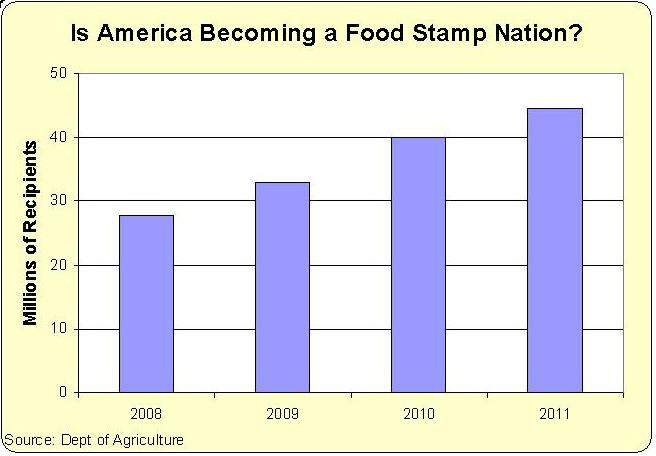
Last year, I semi-defended Newt Gingrich when he was attacked for calling Obama the “Food Stamp” President. Citing this chart, I wrote that, “It certainly looks like America is becoming a food stamp nation.”

But my bigger point is that welfare is bad for both taxpayers and the people who get trapped into relying on big government.

The ideal approach, as explained in this video, is to get the federal government out of the business of redistributing income. We are far more likely to get better results if we let states experiment with different approaches.

House Republicans, to their credit, already want to do this with Medicaid. So why not block grant all social welfare programs?

The icing on the cake is that no longer would the federal government be running ads to lure people into dependency.

_____________

Thank you so much for your time. I know how valuable it is. I also appreciate the fine family that you have and your commitment as a father and a husband.

Sincerely,

Everette Hatcher III, 13900 Cottontail Lane, Alexander, AR 72002, ph 501-920-5733, lowcostsqueegees@yahoo.com

Related posts:

We can no longer afford the welfare state (Part 7)

Ep. 4 – From Cradle to Grave [7/7]. Milton Friedman’s Free to Choose (1980) With the national debt increasing faster than ever we must make the hard decisions to balance the budget now. If we wait another decade to balance the budget then we will surely risk our economic collapse. The first step is to […]

We can no longer afford the welfare state (Part 6)

Ep. 4 – From Cradle to Grave [6/7]. Milton Friedman’s Free to Choose (1980) With the national debt increasing faster than ever we must make the hard decisions to balance the budget now. If we wait another decade to balance the budget then we will surely risk our economic collapse. The first step is to […]

We can no longer afford the welfare state (Part 5)

Ep. 4 – From Cradle to Grave [5/7]. Milton Friedman’s Free to Choose (1980) With the national debt increasing faster than ever we must make the hard decisions to balance the budget now. If we wait another decade to balance the budget then we will surely risk our economic collapse. The first step is to […]

We can no longer afford the welfare state (Part 4)

 Ep. 4 – From Cradle to Grave [4/7]. Milton Friedman’s Free to Choose (1980) With the national debt increasing faster than ever we must make the hard decisions to balance the budget now. If we wait another decade to balance the budget then we will surely risk our economic collapse. The first step is to […]

We can no longer afford the welfare state (Part 3)

Ep. 4 – From Cradle to Grave [3/7]. Milton Friedman’s Free to Choose (1980) With the national debt increasing faster than ever we must make the hard decisions to balance the budget now. If we wait another decade to balance the budget then we will surely risk our economic collapse. The first step is to […]

We can no longer afford the welfare state (Part 2)

With the national debt increasing faster than ever we must make the hard decisions to balance the budget now. If we wait another decade to balance the budget then we will surely risk our economic collapse. The first step is to remove all welfare programs and replace them with the negative income tax program that […]

We can no longer afford the welfare state (Part 1)

Milton Friedman – The Negative Income Tax Published on May 11, 2012 by LibertyPen In this 1968 interview, Milton Friedman explained the negative income tax, a proposal that at minimum would save taxpayers the 72 percent of our current welfare budget spent on administration. http://www.LibertyPen.com Source: Firing Line with William F Buckley Jr. ________________ Milton […]


Ringo Starr on tour 2012 (Part 6)

I went  to a Ringo Starr concert on July 4, 2012 at Orange Beach, AL and enjoyed it very much and here are some of the songs I heard that night:Ringo Starr – Octopus’s Garden

Ringo did not play this at the July 4, 2012 concert although it is one of my favorites.

Ringo Starr and Barbara Bach«

___________________

Last concert of Beatles:

The Beatles – Rooftop Concert (Full Version)

Uploaded by     on Jan 18, 2012

Last Concert Of The Beatles On The APPLE RECORDS on Abbey Road
Get Back – 01:03 Don’t let Me Down – 04:18 I’ve Got a Feeling – 07:53 One After 909 – 11:35 Dig a Pony – 14:38 Get Back 18:30

__________________________–

Ringo Starr and Barbara Bach«

Video interviews of Gwyneth Paltrow and Chris Martin (Part 2)

As far as I know they have never done an interview together. Therefore, I have included separate interviews that they have done below and I have some links to past posts I have done on them too.

Gwyneth Paltrow & Robert Downey Jr. on Jonathan Ross 2010.04.23 (Part 1)

Coldplay: Chris Martin and Jonny Buckland talk about Mylo Xyloto

Published on Oct 18, 2011 by

Chris Martin and Jonny Buckland from Coldplay talk about Mylo Xyloto, their 5th studio album. Questions in English below.

The interview was conducted by Kirsten Lemaire for Belgian television channel Canvas, and it took place in The Bakery, Coldplay’s very own studio. On the day of the interview they were still working on Xylo Myloto, in that same studio.

0:22 What was the very first plan for this 5th record?

2:25 We were at The Bakery, Coldplay’s main studio. But they also have another studio, The Beehive, just across the street. I wondered if they recorded everything in those two studios.

3:21 I did hear 6 new tracks from Xylo Myloto in advance. Some songs were about love, some songs were about addiction. But I also read that another theme was obsessive-compulsive behaviour. So I asked Chris Martin: is that true?

5:26 The current Coldplay single is Paradise, which definitely has some R’n’B influences. Hence my next question: did they listen to a lot of R’n’B during the making of the new record?

6:40 Last summer, Coldplay premiered some new songs on really big festivals like Rock Werchter. How nervous are they when they’re roadtesting unreleased music in front of 60.000 people or more?

8:37 The interview took place on the day they were actually finishing Mylo Xyloto. Last day in the studio. Must be quite thrilling, because fans have extremely high expectations. But how do the band members feel at such a moment?

10:41 Coldplay is a great live band. But at a certain moment, you have to introduce the new songs to your audience. Do they make more mistakes on stage when they try out new songs?

Chris Martin of Coldplay unknowingly lives out his childhood Christian beliefs (Part 5 of notes from June 23, 2012 Dallas Coldplay Concert)

Coldplay “paradise” Dallas Texas 6/22/12 ( Floor View ) Published on Jun 23, 2012 by ccam cher Awesome concert Coldplay brought confetti, lights and thousands of fans to the American Airlines Center; see photos from their colorful show Photo Gallery News Sports Lifestyles   Comments (0)   9/11 Chris Martin was brought up as an […]


“Music Monday” Countdown of Coldplay’s best albums (part 1)

I like this CD a lot mainly because of it rhythm and how it is the most relaxing of Coldplay’s albums. “YELLOW” “SHIVER” “DON’T PANIC” “TROUBLE” “SPARKS” are all great songs. I would have to say that Parachutes was a good song but it was too short. Altogether I would give this album a 9/10! However, this […]

Tom Brady , Coldplay, Kansas, Solomon and the search for satisfaction (part 3)

Tom Brady “More than this…” Uploaded by EdenWorshipCenter on Jan 22, 2008 EWC sermon illustration showing a clip from the 2005 Tom Brady 60 minutes interview. _______________________ Tom Brady ESPN Interview Tom Brady has famous wife earned over 76 million dollars last year. However, has Brady found lasting satifaction in his life? It does not […]


Coldplay in Madrid concert October 26, 2011

From today. I wonder if Coldplay will continue to be on a spiritual search. Part one of Madrid Concert Look at their latest song and the lyrics: They got one eye on what you knew And one eye on what you do So be careful who it is you’re talking to They got one eye […]

Coldplay gave NPR interview on Oct 22, 2011

Coldplay – Every Teardrop Is A Waterfall Published on Jun 28, 2011 by ColdplayVEVO The new single, taken from Every Teardrop Is A Waterfall EP (featuring two more new tracks). Download it fromhttp://cldp.ly/itunescp Music video by Coldplay performing Every Teardrop Is A Waterfall. (P) 2011 The copyright in this audiovisual recording is owned by EMI Records Ltd […]

“Friedman Friday” :“A Nobel Laureate on the American Economy” VTR: 5/31/77 Transcript and video clip (Part 5)

Milton Friedman on the American Economy (5 of 6)


Uploaded by on Aug 9, 2009

THE OPEN MIND
Host: Richard D. Heffner
Guest: Milton Friedman
Title: A Nobel Laureate on the American Economy VTR: 5/31/77
_____________________________________

Below is a transcipt from a portion of an interview that Milton Friedman gave on 5-31-77:

Friedman: But as a matter of practical experience, no complicated society can be run solely on the command principle. It’s just impossible. And therefore, in one sense, the market is essential; there’s no way of avoiding it. Now, you don’t mean it in that sense. You mean another sense. In what sense is it written that the free market is desirable?

HEFFNER: Well, desirable, I didn’t really mean that. NO, I meant in the first instance where is it written that this concept, which I thought was comparatively modern, of the free marketplace…

FRIEDMAN: Well, in the modern version of it it really dates back to Adam Smith in 1776, which is just 200 years. There are precursors to that of course. But as…

HEFFNER: How did we survive? How did we get there?

FRIEDMAN: Well, but you know, ideas, you know about the Frenchman who discovered at the age of 70 that he had been talking prose all his life. Because we can give words to things doesn’t mean that those things didn’t exist before we gave words to them. The free market has been around for thousands and thousands of years. The theory of a free market in a systematic organized way dates back to Adam Smith in 1776. But the free market doesn’t.

HEFFNER: so the answer to the question of where it is written is really in Adam Smith, The Wealth of Nations?

FRIEDMAN: Yes, that’s the first major source. There have been lots since. But that’s still a book worth reading.

HEFFNER: Indeed. You know, I was thinking about, before we began to do this program, I was thinking about where is it written. And I was considering going back to a very ancient civilization, mostly in terms of the reports that we have that you may in your visits to Israel advise the new Israeli government in terms of its economic problems. And I wanted to ask you a question. I wanted to ask you a question about a remark that I had heard you make in connection with this story about the role you might play in relation to the new Israeli government. You said something like this – and to the degree that I’m distorting your words or your thoughts, please correct me – “It is somewhat strange that socialism is supposed to find so many friends, and capitalism so many enemies among Jews when perhaps some people might think that the essence of the Jewish tradition is so alien to socialism and so akin to capitalism.” And I wondered, to the extent that you meant much of that, what you meant by it?

FRIEDMAN: Well, I think I mean, I would endorse certainly that statement as you put it, while going onto say it needs some elaboration in some respects. Let me see if I can put it to you in a sort of a different way. My first visit to Israel was made about 15 years ago. I was there for about three months as a visitor at the Hebrew University in Jerusalem. And after I left Israel, I summarized my impressions by saying that I thought that the best way to understand Israel was to recognize that two Jewish traditions were at war with one another in Israel. One of them was a very recent tradition, a tradition of 100, 150 years old. That’s the tradition of socialism. That’s the tradition you referred to in your initial comments, that it is true that on the whole the Jewish intellectuals have been strongly pro-socialist. And that’s contributed disproportionately to the socialist literature. That was the one tradition. The other tradition, I said, was a tradition that was at least 2,000 years old. It was a tradition that had arisen during the Diaspora and as a result of the Diaspora. It was a tradition of how you get around government regulations, how you find chinks in controls, how you find those areas in which the free market operates and make the most of them. It was that tradition which had enabled the Jews to survive during centuries of persecution by the constituted authorities. Once in a while there would be a monarch who would intervene in favor of the Jews. But almost always that was because there had been a Jew who had accumulated enough money through the free market, through capitalism, to have loaned money to the monarch and have him in his debt. The story in the Bible of Esther is not a very usual story. That isn’t usually the way it occurs. Most of the time the Jews have survived despite the opposition of the powers that be, not because of them. And this ancient tradition of 2,000 years is still very much alive in Israel. And what I said at that time was that fortunately for Israel the ancient tradition is strongly renewable.

Now, let me go back to that in a modern context. I believe that there are few people in the world who have benefitted as much from capitalism and free enterprise as the Jews. Suppose you ask yourself in what countries it is that the Jews have been able to survive and thrive. They’ve been able to survive and thrive primarily in those countries that have had capitalism and free enterprise. They haven’t been able to survive and thrive in the socialist utopias of Russia or of Poland. They haven’t been able to, they weren’t able to survive and thrive in the national socialist state of Nazi Germany. They have been able to survive and thrive in places like Great Britain, in Germany when it was capitalist before Hitler, in France which is largely capitalist, and the United States. And more important, in what parts of those economies have they done best? In those parts where government has had the least role to play. You do not find in the United states that the Jews have done very well in large-scale manufacturing or in commercial banking, because those are areas which are very closely intertwined with government. In banking you need a governmental franchise. And there is probably no industry in the United States in which there are fewer Jews, surprising as it may seem, in major positions of responsibility than in the commercial banking industry. Where have they thrived? In the industries which have been most competitive, where there’s been the least monopoly, private or public: retaining, which was open to all; in new industries, in Hollywood. Why? Because it was a new, brand new industry. There were no settled positions of privilege or of power, no government involvement.

So, Jews have done best – and other minorities. I’m not only speaking of Jews. If you look at the Japanese in the United States, if you look at the blacks in the United States, in every case they have done best in those areas where you have had the greatest degree of competition; and they have done worst in those areas where you have had the most monopoly and the most governmental link to government. So on the one hand, there are no people in the world who have benefitted so much from capitalism as the Jews. Look at Israel. Suppose socialism had triumphed in the world. How would Israel have gotten support? Did Israel get support in its early and difficult days from the governments of the world? Or from people? And from what people? From the Jews who had managed to make a little bit of a competence for themselves and accumulated a little funds in the capitalist bastions of the world.

So, the Jews have benefitted enormously from capitalism. And yet on the other side – and that’s the issue you raise – here you have the paradox that the Jews have been among those who have contributed much to undermine the intellectual foundations of capitalism.

HEFFNER: Is this a dichotomy that exists in contemporary Israel too?

FRIEDMAN: Of course. Of course. It has existed.

HEFFNER: Then how will you make a contribution?

FRIEDMAN: Oh, well, you know how it is. I will make a contribution. I would be delighted to if I could. But you know, people ask for advice from people who they know will give them the advice they want to hear. Well, there’s no shortage of good economists in Israel. They are very good economists. They know what to do. And in fact, the economists in Israel have not been in favor of governmental policies in Israel. It’s like it has been in the United States, where the economists have been opposed uniformly to many governmental policies, such as the price-fixing policies I was talking about, such as rent control. Similarly, the economists in Israel have been almost unanimously opposed to some, many governmental controls and regulations. What’s happened in Israel is that you now have a new party that came into power. … It’s a party that proclaims it’s belief in private enterprise. It proclaims its desire to reduce the size of government and to give greater opportunities to individuals. Their objectives are excellent. I hope they achieve them. I’m not wholly confident that they will, in fact. I have many doubts about whether they will succeed. And a reason why they have asked me if I would advise them is because they know that I believe in a free economy and that their policy is my policy. And insofar as I can give any assistance, I am delighted to, both because of my general desire to see freedom prosper, and also because I have a very strong personal sympathy and interest in Israel. I am Jewish by origin and culture. I share their values and their belief. I share the admiration which many have had for the miracles that have occurred in Israel. So if I can make any contribution to a more effective policy for preserving Israel, Israel’s freedom and strength, I would certainly be delighted to do so.

37 Tweets from www.thedailyhatch.org so far @everettehatcher

www.thedailyhatch.org@everettehatcher

Milton Friedman in 1999″The source of our prosperity in my opinion dates back to Mr. Reagan’s reductions in tax rates” https://thedailyhatch.org/2012/07/20/transcript-and-video-of-milton-friedman-on-bill-clinton-and-ronald-reagan-part-1/ …


Chris Martin of Coldplay says best song ever written was “Bitter Sweet Symphony” Why? It comes down to the meaning. https://thedailyhatch.org/2012/07/18/chris-martins-favorite-song-has-a-deep-meaning/ …


Brummett disagrees with Raport, Collins and wants Obamacare to come to Ark but it will lose money like the post office https://thedailyhatch.org/2012/07/17/cartoons-about-obamacare-from-dan-mitchells-blog/ …


Milton Friedman videos and transcripts Part 6

Milton Friedman videos and transcripts Part 6

On my blog www.thedailyhatch.org I have an extensive list of posts that have both videos and transcripts of MiltonFriedman’s interviews and speeches. Here below is just small list of those and more can be accessed by clicking on “Milton Friedman” on the side of this page or searching for Milton Friedman also.

Related posts:

Milton Friedman videos and transcripts Part 3

Milton Friedman videos and transcripts Part 3 On my blog http://www.thedailyhatch.org I have an extensive list of posts that have both videos and transcripts of MiltonFriedman’s interviews and speeches. Here below is just small list of those and more can be accessed by clicking on “Milton Friedman” on the side of this page or searching […]

Milton Friedman videos and transcripts Part 2

Milton Friedman videos and transcripts Part 2 On my blog http://www.thedailyhatch.org I have an extensive list of posts that have both videos and transcripts of MiltonFriedman’s interviews and speeches. Here below is just small list of those and more can be accessed by clicking on “Milton Friedman” on the side of this page or searching […]

Milton Friedman videos and transcripts Part 1

Milton Friedman videos and transcripts Part 1 On my blog http://www.thedailyhatch.org I have an extensive list of posts that have both videos and transcripts of MiltonFriedman’s interviews and speeches. Here below is just small list of those and more can be accessed by clicking on “Milton Friedman” on the side of this page or searching […]

“Friedman Friday” (“Free to Choose” episode 1 – Power of the Market. part 4 of 7)

The fundamental principal of the free society is voluntary cooperation. The economic market, buying and selling, is one example. But it’s only one example. Voluntary cooperation is far broader than that. To take an example that at first sight seems about as far away as you can get __ the language we speak; the words […]

Milton Friedman: GM and other failing businesses should have been allowed to fail

Businesses should be allowed to fail if they lose money. It is amazing to me that GM was not allowed to go out of business and the same is true for any other business that is losing money.   Uploaded by PenguinProseMedia on Dec 28, 2009. I got this following part off of youtube: In […]

“Friedman Friday” (“Free to Choose” episode 1 – Power of the Market. part 3 of 7)

  _________________________   Pt3  Nowadays there’s a considerable amount of traffic at this border. People cross a little more freely than they use to. Many people from Hong Kong trade in China and the market has helped bring the two countries closer together, but the barriers between them are still very real. On this side […]

“Friedman Friday” (“Free to Choose” episode 1 – Power of the Market. part 2 of 7)

  Aside from its harbor, the only other important resource of Hong Kong is people __ over 4_ million of them. Like America a century ago, Hong Kong in the past few decades has been a haven for people who sought the freedom to make the most of their own abilities. Many of them are […]

Should Steve Jobs been ashamed of the sweat shops he used in China? (Part 1)

This is a very easy issue for me. Milton Friedman noted in 1973:  Sweatshops and child labor were conditions that resulted more from poverty than from laissez-faire economics. Wretched working conditions still exist in nations with all sorts of enlightened social legislation but where poverty is still extreme. We in the United States no longer […]

“Friedman Friday” (“Free to Choose” episode 1 – Power of the Market. part 1of 7)

“FREE TO CHOOSE” 1: The Power of the Market (Milton Friedman) Free to Choose ^ | 1980 | Milton Friedman Posted on Monday, July 17, 2006 4:20:46 PM by Choose Ye This Day FREE TO CHOOSE: The Power of the Market Friedman: Once all of this was a swamp, covered with forest. The Canarce Indians […]

An open letter to President Obama

 Milton Friedman’s Free to Choose (1980), episode 1 – Power of the Market. part 1 January 29, 2012 President Obama c/o The White House 1600 Pennsylvania Avenue NW Washington, DC 20500 Dear Mr. President, I know that you receive 20,000 letters a day and that you actually read 10 of them every day. I really […]

“Friedman Friday” (“Free to Choose” episode 3 – Anatomy of a Crisis. part 7of 7)

TEMIN: We don’t think the big capital arose before the government did? VON HOFFMAN: Listen, what are we doing here? I mean __ defending big government is like defending death and taxes. When was the last time you met anybody that was in favor of big government? FRIEDMAN: Today, today I met Bob Lekachman, I […]

“Friedman Friday” (“Free to Choose” episode 3 – Anatomy of a Crisis. part 6of 7)

worked pretty well for a whole generation. Now anything that works well for a whole generation isn’t entirely bad. From the fact __ from that fact, and the undeniable fact that things are working poorly now, are we to conclude that the Keynesian sort of mixed regulation was wrong __ FRIEDMAN: Yes. LEKACHMAN: __ or […]

“Friedman Friday” (“Free to Choose” episode 3 – Anatomy of a Crisis. part 5 of 7)

MCKENZIE: Ah, well, that’s not on our agenda actually. (Laughter) VOICE OFF SCREEN: Why not? MCKENZIE: I boldly repeat the question, though, the expectation having been __ having been raised in the public mind, can you reverse this process where government is expected to produce the happy result? LEKACHMAN: Oh, no way. And it would […]

Dan Mitchell of Cato Institute taking up for Romney


Why not be wise with your money like Romney has done? Why is that a bad thing?

Since Mitt Romney Won’t Defend Himself, I Guess It’s Up to Me to Debunk the Left’s Tax Haven Demagoguery

July 14, 2012 by Dan Mitchell

Earlier this year, I defended Mitt Romney and Bain Capital from the absurd accusation that they did something wrong by utilizing low-tax jurisdictions.

So-called tax havens, as I’ve explained on many occasions, play a valuable role in the world economy. Indeed, they should be emulated rather than persecuted.

In a follow-up post, I mocked ABC News for a ridiculous non-story as they tried to make Romney appear guilty for following good business practices.

The issue has become hot again, so I talked about Romney and tax havens with Jason Riley at the Wall Street Journal.

Dan Mitchell Defending Tax Havens (and Mitt Romney) on Wall Street Journal Online TV

Published on Jul 13, 2012 by

No description available.

_____________

Since nobody has claimed that Romney violated U.S. tax law, this kerfuffle only exists because the left wants to create the impression that tax havens are bad and then tar the GOP’s presumptive nominee with guilt by association.

Brian Garst of the Center for Freedom and Prosperity nails the issue in his column for the Daily Caller.

People who invest or bank overseas do not hate America. Oftentimes, they are simply banking where their money is earned to avoid the hassle of exchange rate and wire transfer fees. …It’s also smart practice to diversify. …Mitt Romney should not be cowed into shame over his banking practices just because he doesn’t strictly park his after-tax earnings in American banks, but should instead seize the opportunity to more aggressively defend against populist attacks on financial privacy and explain the benefits of jurisdictional tax competition.

That’s good advice, but I’m not holding my breath waiting for Romney to defend Switzerland and other jurisdictions with good policy. That would require an underlying belief in freedom and liberty, which seems to be lacking.

But you would think that he might respond by noting that many top Democrats directly invest in tax havens, and that presumably all of them – as I noted in my WSJ interview – are indirectly invested in these financial centers.

P.S. It’s probably a lost cause, but I’m an old-fashioned guy who thinks that people shouldn’t blatantly lie, so here’s my obligatory complaint that many politicians, journalists, and policy folks are repeating the debunked assertion that so-called tax havens deprive the U.S. Treasury of $100 billion per year. Obama threw around that make-believe number in the 2008 campaign, as seen in this video. But as shown in the final video of this post, the $100 billion figure was concocted out of thin air by a former John Kerry staffer, who confessed he made up the number when the Congressional Research Service asked for his methodology.