Monthly Archives: May 2012

Julia is a scumbag

Real Time with Bill Maher March 16 2012 – Alexandra Pelosi Interviews Welfare Recipients in NYC

Published on Mar 18, 2012 by

Real Time with Bill Maher March 16 2012 – Alexandra Pelosi Interviews Welfare Recipients

It is truly sad to me that we have got to such a low point in our country that our president has attempted to get votes by giving away things for votes.

________________

The Arkansas Democrat-Gazette had an excellent aricle on this on May 20, 2012:

Government takes care of us

By Bradley R. Gitz

This article was published May 20, 2012 at 3:09 a.m

LITTLE ROCK — The Democratic Party campaign video “The Life of Julia” performs a public service by informing the public of the Obama administration’s vision of the ideal society.

It is not a pretty picture.

For those who haven’t seen it yet, the video traces the life of a fictional “Julia” from birth all the way into retirement, with government providing for her care and comfort (even her contraceptives) each step along the way.

As National Review’s Rich Lowry puts it, “Julia’s central relationship is to the state. It is her educator, banker, health-care provider, venture capitalist and retirement fund. And she is, fundamentally, a taker. Every benefit she gets is cut-rate or free. She apparently doesn’t worry about paying taxes.” The end result is a pathetic creature more closely resembling a whining infant in its cradle than a free, adult human being.

Implicit in this “cradle to grave” view of government is the goal of creating, in Lowry’s words, “a nation of Julias,” dependent, needy and forever being succored by the nanny state. The more people depend upon government for their sustenance, and the more extreme the level of typical dependence, the closer we will have moved toward the ideal political order.

Charles Krauthammer calls this “free-lunch egalitarianism.” Mitt Romney has referred to it as “the entitlement society.” By whatever term, it represents a radical shift in Americans’ understanding of the role of government in their lives.

Barack Obama may claim that these are “American values,” but they most certainly aren’t the values of our Founding Fathers; indeed, it might be difficult to identify any ideas further removed from those that influenced the delegates at Philadelphia back in1787.

Perhaps never before has an American political party more nakedly offered up a life on the dole as a morally desirable condition for able-bodied citizens.

Implicit in the “Julia Nation” is a number of sub-themes-that Americans have lost any sense of self reliance and can’t fend for themselves in even the most trivial ways; that government should always grow bigger because of this incapacity; and that there are no adverse social or fiscal consequences flowing from, or even logical limits to, the growth of government spending.

For those of us with an interest in political ideology, the cradle-to grave concept explicit in Julia’s life also represents the final extinguishing of any remaining differences between American “progressivism” and European social democracy.

Cradle-to-grave security has, of course, been the abiding promise of European social democratic parties since at least the end of World War II. A term first coined by British Labor Party leader Clement Attlee, “cradle to grave” would represent the fulfillment of the European socialist movement without all of the nasty “dictatorship of the proletariat” and violent revolutionary stuff. It was the logical ideological descendent of Eduard Bernstein and the Fabians, if not Vladimir Lenin and Joseph Stalin.

By so openly embracing this concept, American Democrats have now removed any doubt that they have become and have actually long been such a party.

Those who take umbrage at such claims are free to identify for the rest of us any fundamental differences between the program and aspirations of American Democrats and those of the British Labor Party, the German Social Democratic Party, or Francois Hollande’s Socialist Party in France.

Irrefutable logic tells us that, if the American Democratic Party is a social democratic party, and social democracy has long been understood as a strain of socialism, then the American Democratic Party, and its titular leader, President Obama, are clearly socialists of at least some sort, too.

They just won’t, until now-until “Julia”-admit it.

What this also means is that what we call American liberalism has come to have scant relation to the classical liberalism of America’s founding. The central tenet of liberalism historically is restraints upon the size and power of the state for the sake of individual liberty; the central tenet of both American progressivism and European social democracy is the creation of a huge and powerful state for the purpose of providing cradle-to-grave security. Understood properly, liberalism and socialism are antithetical, not complementary, propositions.

So we should thank Democrats for the “Life of Julia.” They might not have intended to be, but they are now finally being honest with the American people about what ideology they subscribe to and where they wish to take the nation under the slogan “forward.”

Thus, the central question that Obama’s re-election bid poses is whether we want the transformation of America into a full-fledged European-style social democracy to continue. It is that issue, not the Romney family dog, women’s contraceptive tab, or Obama’s “evolution” on gay marriage that matters most.

There was, once upon a time, not even all that long ago, something disgraceful about able-bodied citizens living off the labor of others (“going on the dole”). Obama and his party now unapologetically and enthusiastically invite all of us to do so.

———◊-

———

Freelance columnist Bradley R. Gitz, who lives and teaches in Batesville, received his Ph.D. in political science from the University of Illinois.
Government shutdown coming, will there be any tea party heroes available to stand up to Obama?

DEBT LIMIT – A GUIDE TO AMERICAN FEDERAL DEBT MADE EASY.

Uploaded by on Nov 4, 2011

A satirical short film taking a look at the national debt and how it applies to just one family. Watch the guy from the Ferris Bueller Superbowl Spot! Produced by Seth William Meier, DP/Edited by Craig Evans, 1st AC Brian Andrews, Sound Mixer Gus Salazar, Written and Directed by Brian Stepanek. Help us spread the word by clicking ads or at www.debtlimitusa.org

_________________

I was so proud of the 66 brave Republicans who stood up to President Obama and voted against his deal that raised the debt limit. I hope we can find more brave souls this tme around.

One of the big stories from Washington is that there may be another fight over the debt limit, which could mean…gasp, hide the women and children…gridlock, downgrades, government shutdown, default, and tooth decay.

Okay, perhaps not tooth decay, but the DC establishment nonetheless is aghast.

Last year, there were actually two big confrontations between House Republicans and President Obama.

The first fight occurred early in the year and revolved around spending levels for the remainder of the 2011 fiscal year. I explained in February of that year how advocates of smaller government could prevail in a government shutdown fight, especially since the “essential” parts of the government wouldn’t be affected.

But I wasn’t surprised when GOPers buckled under pressure and accepted a deal that – at best – could be categorized as a kiss-your-sister compromise (and, as I noted elsewhere, our sister wasn’t Claudia Schiffer).

Then we had the big debt limit fight later in the year, which led to absurd claims that failure to increase the debt limit would lead to default – even though the federal government was collecting ten times as much revenue as was needed to pay interest on the debt.

Once again, Republicans were unable to withstand the demagoguery and they basically gave Obama what he wanted after agreeing to a “supercommittee” that was designed to seduce them into a tax increase.

Now the game is about to start over. It’s deja vu all over again, as Yogi Berra might say.

Here’s some of what the L.A. Times reported.

Republicans in Congress are heading into summer much the way they did last year — instigating a showdown with the White House by demanding massive federal budget cuts in exchange for what used to be the routine task of raising the nation’s debt limit to pay the government’s bills. House Speaker John A. Boehner (R-Ohio) is doubling down on the strategy that ended in mixed results last year after the country came to the brink of a federal default before a deal was struck with President Obama. In that go-round, both sides saw their approval ratings with voters plummet and the nation’s credit was downgraded. …The risk for Republicans is not only in presenting another high-stakes showdown at a time when voters have grown weary of the gridlock in Washington.

The reporter’s assertion that the debt limit fight led to the downgrade is a bit silly, as I explain here, but that’s now part of the official narrative.

On a separate matter, I can’t help but shake my head with frustration that GOPers still haven’t learned that America’s fiscal problem is too much spending, and that deficits and debt are symptoms of that problem. Here’s another passage from the L.A. Times story.

“The issue is the debt,” Boehner said Sunday on ABC’s ”This Week With George Stephanopoulos.” “Dealing with our deficit and our debt would help create more economic growth in the United States and it would lift this cloud of uncertainty that’s causing employers to wonder what’s next.”

No, Mr. Speaker. The problem is spending, spending, spending.

Returning to the main issue, the debt limit isn’t the only big fiscal fight that may happen this year. There will also be the spending bills for the 2013 fiscal year, which starts on October 1 of this year. That will mean another fight, particularly since the left has no intention of abiding by the spending limit that was part of last year’s debt limit deal.

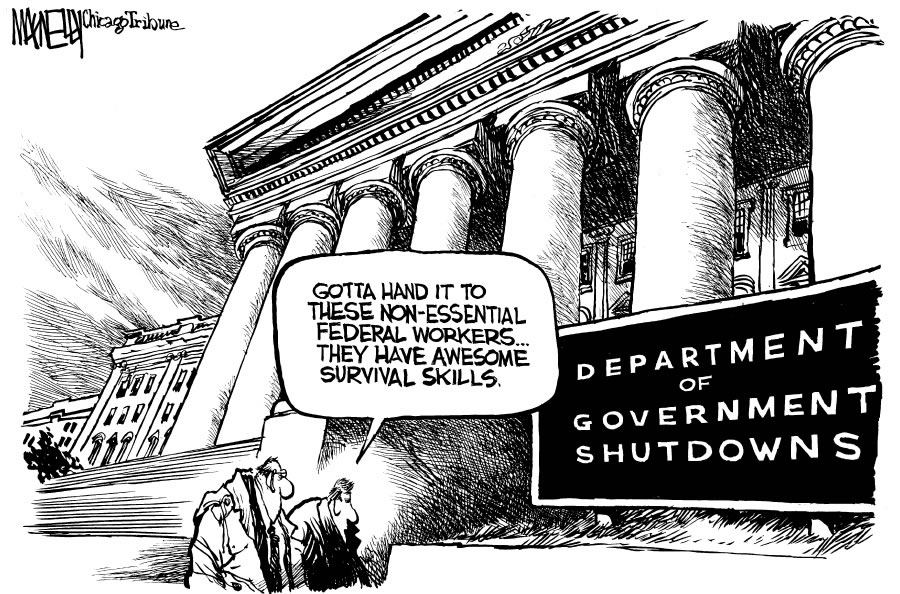
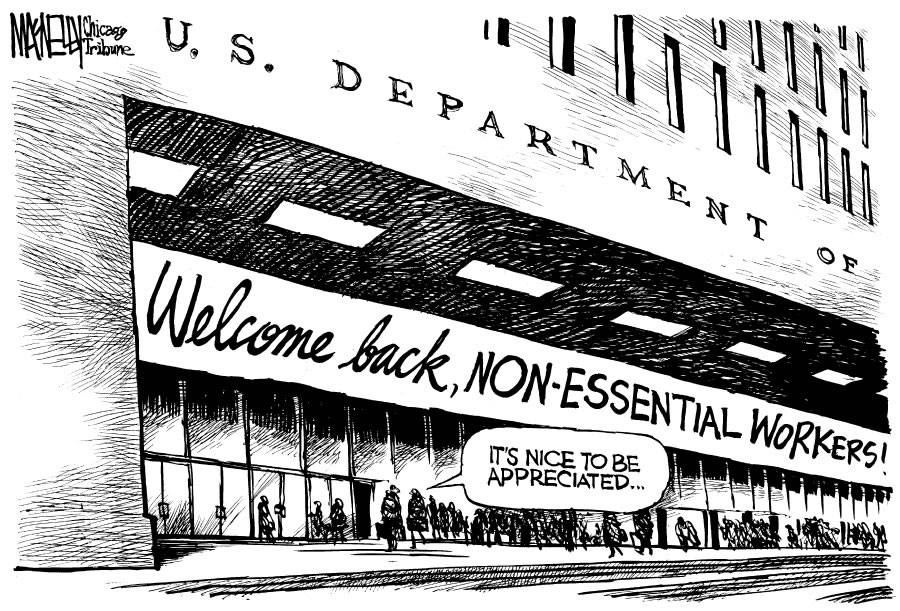
And if Republicans hold firm, that means another “government shutdown.” Though it really should be called a “government slowdown” since it’s only the non-essential bureaucrats who get sent home.

In any event, since I’m glum about the likelihood of anything good happening, let’s at least enjoy some good cartoons from Jeff MacNelly. He passed away a number of years ago, but these cartoons from the mid-1990s are just as applicable today as they were then.

These are amusing cartoons, so long as you don’t actually think about the fact that government is bloated in part because Washington is littered with programs, departments, and agencies that are filled with non-essential bureaucrats. And don’t forget that these bureaucrats are overpaid, getting, on average, twice the compensation of workers in the productive sector of the economy.

But I don’t want to end this post on a sour note, so here are some good jokes from the late-night comics about government shutdowns.

________

Related post:

Some Tea Party heroes (Part 1)

DEBT LIMIT – A GUIDE TO AMERICAN FEDERAL DEBT MADE EASY. Uploaded by debtlimitusa on Nov 4, 2011 A satirical short film taking a look at the national debt and how it applies to just one family. Watch the guy from the Ferris Bueller Superbowl Spot! Produced by Seth William Meier, DP/Edited by Craig Evans, […]


If Europe follows Obama’s plan it would go broke even faster

U.S. President Barack Obama waves as French President Francois Hollande looks on following their bilateral meeting at the  White House in Washington
U.S. President Barack Obama (R) waves as French President Francois Hollande looks on following their bilateral meeting in the Oval Office of the White House in Washington May 18, 2012. Hollande is in the United States to join other leaders of the major industrial economies and meet for a G8 Summit at Camp David this weekend to try to head off a full-blown financial crisis in Europe. REUTERS/Eric Feferberg/Pool(UNITED STATES – Tags: POLITICS BUSINESS)

President Obama does not want to cut spending and he only wants more stimulus even though it has resulted in failure in the last three years in the USA. Now he is bragging about the results and telling his socialist friends in Europe to do the same.

Obama’s Pro-Growth Illusion

Barack Obama claims to be pro-growth. So does Greece, Spain, and almost everyone else. Why? Because admitting preference for the alternative—crushing, heavy-handed government interference that kills initiative and destroys wealth—is not attractive to any citizen of any country.

The problem lies in the meaning of “pro-growth”. As an unabashed capitalist, and as a supporter of free markets, I believe “pro-growth” means less government interference and more individual accountability where private sector businesses create the jobs and government pretty much stays out of the equation. But it’s increasingly clear that our president has a much different idea and defines “pro-growth” far differently.

Of course, Barack Obama often says he is “pro-growth”—but the question to ask is: growth of what?

After three years in office, it seems rather clear that Obama believes in the growth of government. At the core of all of his policies is a belief that government can allocate resources more efficiently than can the private sector.

According to Obama, only the government can make wise “investments”. According to Obama’s view, private money and private investors are simply not as capable or as wise as is government in choosing the kinds of investments that will lead to growth and job expansion.

Not too surprisingly, Obama’s strange definition of “growth” is actually a call for a growth of government, growth of debt, growth of bureaucracy, growth of taxes and growth of government regulations. Barack Obama simply believes that taxpayers should be required (or compelled) to send more money to Washington where the political class can then decide how best to “invest” the money.

The “growth” that Barack Obama seeks, ultimately, is growth in government’s control over the lives of all Americans. As we have already learned from three years of watching our president try to apply this tragic economic theory, we have seen our economy stagnate as entrepreneurs and small businesses get squeezed. The only “growth” in Obama’s economy has been the growth of economically harmful and dangerous trends.

Obama has overseen a growth in the price of gas at the pump, growth in the nation’s dependency on foreign oil, growth in unemployment, growth in the number of people receiving and the amount of dollars allocated to entitlements, growth in the number of Czars designed to evade oversight from congress, even growth in the number of foreclosures.

In general, after three and a half years of the Obama administration’s “pro-growth” efforts, Americans are poorer and more dependent on the federal government.

Is this really what Americans are endorsing when they hear the term “pro-growth”? This is certainly not what the Founding Fathers envisioned.

Under Obama federal spending has grown from $1 trillion dollars in 2008 to almost $4 trillion dollars in just three years, without any growth in the economy, without any reduction in unemployment and without any significant improvement in the quality of life or opportunities for the future of Americans.

Under Obama, the public debt has grown to the point where it exceeds our nation’s annual GDP. Nowhere and at no time has this kind of equation ever been a recipe for economic growth.

LUnder Obama, the number of regulations affecting all aspects of American lives has grown. In 2011, the Obama administration put into place over 2000 different rules, statues or regulations affecting everything from the environment to the kinds of paper used for filing federal reports.

Under Obama, the number of czars has increased, even as the number of senate-confirmed leaders has dwindled. Coinciding with the increase in czars comes an increase in the bureaucracy, and an increase in the staff to support the czars, all paid for with taxpayer dollars.

Under Obama there has been growth in the number of unemployed, with minorities and teens hit the hardest.

Under Obama, the regulations affecting small businesses has created an environment of uncertainty and increased cost which discourages, rather than encourages, job creation.

Under Obama, Americans have seen an increase in the frequency of fear-mongering and race-baiting as a Democrat political strategy, designed to intimidate anyone who questions or criticizes Democrats’ flawed policies.

There has been growth under Obama—it’s just the wrong kind of growth. Lots of fine sounding rhetoric that fosters the illusion of growth. One thing seems clear–while we all seem to be speaking the same language the meaning varies greatly between what Obama says and what Americans understand.

When Barack Obama talks about his “pro-growth” agenda, Americans should start to ask just exactly what Obama hopes to “grow”.

Related posts:

France today: government spending is at 55 percent of GDP

The liberals in France do not want austerity but more spending but who will pay for their party? Morning Bell: Socialism Rises Again Mike Brownfield May 8, 2012 at 8:55 am Last weekend, the people of France took a sharp turn to the left, and the rest of Europe may be on the brink of […]

Europe has a bleak future because they don’t want austerity

The medicine for the sickness of spending is real budget cuts but no one in liberal europe wants to hear that. Sadly we are on the same road in the USA. Liberals (like my blogger opponent “the Outlier” and others) love to say that austerity has been tried in Europe and it doesn’t work but the truth […]

Brantley and his liberal friends don’t want budget cuts but taxes raised on rich!!!!

Over and over in the past Max Brantley and his liberal friends have said that they don’t want budget cuts but they want taxes raised on the rich. In France their recipe for success is about to be tried and we will see how it works out. The Arkansas Times blogger going by the username […]

Stimulus programs never work

The stimulus did not work for the USA and it has never worked. Doubling Down on Failure: Former Obama Official Calls for U.S.-Financed Keynesian Spending Binge in Europe April 30, 2012 by Dan Mitchell There’s an old saying that insanity is doing the same thing over and over again while expecting different results. This certainly is a […]

Balancing the budget possible with socialist solutions?

I got this cartoon below from Dan Mitchell’s blog. Where can our government turn to get out of this socialist mess they have got themselves in? They have to realize what really creates wealth. Over in France they are facing the same problems we are because of the welfare state and they are about to […]

Obama’s stimulus was a failure like Dan Mitchell of the Cato Institute predicted

The stimulus was a huge failure and I hope everyone who voted for it will be defeated in their re-election attempts. Dan Mitchell of the Cato Institute predicted it would be a failure back in January of 2009!!!! Portuguese Finance Minister Admits Keynesian Stimulus Was a Flop, but Don’t Hold Your Breath Waiting for Obama […]

“My Life” is one of the best Beatle songs of all-time

Yesterday I attended the St. George’s Independent School commencement exercises in Collierville, Tennessee. School President William W. Taylor used the Beatles as an example of a group of people that brought different talents together to accomplish much.

He also quoted from the song “My Life” which happens to be one of my favorite songs. It goes like this:

There are places I’ll remember
All my life though some have changed
Some forever not for better
Some have gone and some remain
All these places have their moments
With lovers and friends I still can recall
Some are dead and some are living
In my life I’ve loved them all

But of all these friends and lovers
There is no one compares with you
And these memories lose their meaning
When I think of love as something new
Though I know I’ll never lose affection
For people and things that went before
I know I’ll often stop and think about them
In my life I love you more

Though I know I’ll never lose affection
For people and things that went before
I know I’ll often stop and think about them
In my life I love you more

_________

‘In My Life’

Hulton Archive/Getty Images
prev 5/100 next

Writers: Lennon-McCartney
Recorded: October 18 and 22, 1965
Released: December 6, 1965
Not released as a single

‘In My Life” represented a crucial breakthrough for John Lennon — as well as a creative struggle. The song began with a question: During a March 1964 interview with Lennon, journalist Kenneth Allsop asked why he hadn’t written more lyrics about his life and experiences. “I had a sort of professional songwriter’s attitude to writing pop songs,” Lennon said to Rolling Stone in 1970. “I would write [books like] In His Own Write, to express my personal emotions. I’d have a separate songwriting John Lennon who wrote songs for the meat market. I didn’t consider them to have any depth at all. They were just a joke.”

Taking Allsop’s critique to heart, Lennon wrote a long poem about people and places from his past, touching on Liverpool landmarks like Penny Lane, Strawberry Field and Menlove Avenue. “I had a complete set of lyrics after struggling with a journalistic version of a trip downtown on a bus, naming every sight,” he said. When he read the poem later, though, “it was the most boring ‘What I Did on My Holidays’ song, and it wasn’t working. But then I laid back, and these lyrics started coming to me about the places I remember.”

What happened next is a dispute that will never be resolved. “In My Life” is one of only a handful of Lennon-McCartney songs where the two strongly disagreed over who wrote what: According to Lennon, “The whole lyrics were already written before Paul even heard it. His contribution melodically was the harmony and the middle eight.” According to McCartney, Lennon basically had the first verse done. At one of their writing sessions at Lennon’s Weybridge estate, the two painstakingly rewrote the lyrics, making them less specific and more universal. (Some of Lennon’s lines, like his reference to the late Stu Sutcliffe, the Beatles’ former bassist, in “some are dead and some are living,” remained.) McCartney also says he wrote the melody on Lennon’s Mellotron, inspired by Smokey Robinson, as well as the gentle opening guitar figure.

Regardless of its true authorship, “In My Life” represented Lennon’s evolution as an artist. “I started being me about the songs, not writing them objectively, but subjectively,” Lennon said. “I think it was Dylan who helped me realize that — not by any discussion or anything, but by hearing his work.” The Beatles were huge Dylan fans by early 1964, playing The Freewheelin’ Bob Dylan nonstop in between gigs. When Dylan visited the Beatles in New York that August, he famously introduced them to marijuana. (He thought the Beatles were already pot smokers, having misheard the lyrics “I can’t hide” in “I Want to Hold Your Hand” as “I get high.”) Dylan and pot would be the great twin influences that led the Beatles out of their moptop period and on to their first masterpiece, Rubber Soul.

Before that album, “We were just writing songs à la the Everly Brothers and Buddy Holly,” Lennon said, “pop songs with no more thought to them than that.” He rightly called “In My Life” “my first real, major piece of work. Up until then, it had all been glib and throwaway.”

Appears On: Rubber Soul


Top football stadiums in the country (Part 6)

THE FLEA KICKER – Nebraska vs. Missouri 1997

Here is a list of the top football stadiums in the country.

Power Ranking All 124 College Football Stadiums  

By Alex Callos

(Featured Columnist) on April 19, 2012 

When it comes to college football stadiums, for some teams, it is simply not fair. Home-field advantage is a big thing in college football, and some teams have it way more than others.

There are 124 FBS college football teams, and when it comes to the stadiums they play in, they are obviously not all created equal.

There is a monumental difference from the top teams on the list to the bottom teams on the list. Either way, here it is: a complete ranking of the college football stadiums 1-124.

_________________

Missouri is a SEC East team now. I got to see them play against Arkansas when the Razorbacks beat them in 2004 or so. I think they will be a good member of the SEC.

90. Malone Stadium: Louisiana-Monroe Warhawks
Images_display_image

The state of Louisiana actually has more college football teams than many people could imagine.

Louisiana-Monroe is another in that long list. This stadium was built in 1978, so it is actually relatively new when it comes to college football stadiums. It has a capacity of 30,427 and hardly ever fills up.

The overall atmosphere here is pretty good, and the stadium is extremely easy to get to.


89. Joe Aillet Stadium: Louisiana Tech Bulldogs

Louisianatechfootballpractice071509-1_display_image

For some surprisingly good tailgating and a WAC game that has a lot to offer, this is the place to go.

Built in 1968, Joe Aillet Stadium seats 30,600, and while it is not always full, there is a loyal fanbase here who comes out to support their Bulldogs.

This is not a bad place to watch a game.


88. FIU Stadium: Florida International Golden Panthers

Fqshobeudbhtggj

This tiny stadium is almost completely enclosed, which makes it that much better to watch a college football game.

Built in 1995, it is one of the newest stadiums around, and even though it only holds 23,500, it can get louder than a lot of other stadiums in the Sun Belt Conference.

The Golden Panthers may just have the biggest home-field advantage around.


87. Dix Stadium: Kent State Golden Flashes

Facility_foot_001_display_image

Kent State has one of the best stadiums the MAC has to offer.

With a seating capacity of only 20,500, Dix Stadium is not that big, but is updated.

While it was originally built in 1969, this stadium has been well-kept, and the Golden Flashes certainly have a home field advantage in here.

All of the amenities are average at best.


86. Bulldog Stadium: Fresno State Bulldogs

Bulldog-stadium-1_display_image

Bulldog Stadium looks much larger than the 41,031 it seats.

That is possibly because there is no upper bowl. Everything is from one basic level.

It was built in 1980, and with a relatively large population in Fresno, people often fill the stadium. The atmosphere here is excellent and one of the best of any stadium so far on the list.


85. Martin Stadium: Washington State Cougars

Stadium1978_display_image

Martin Stadium is extremely small in comparison to a lot of other Pac-12 schools.

It only seats 35,117 and was built in 1972. The atmosphere here, especially when one of the Pac-12 rivals comes to town, is excellent.

There is not much around the stadium, however, but once inside, there is no bad seat in the house.


84. Aloha Stadium: Hawaii Warriors

300px-aloha_stadium_hawaii_display_image

Aloha Stadium is home to a lot of different things, and one of them is the Hawaii Warriors.

This team loves to throw the ball around, and the fans enjoy that.

The 50,000-seat stadium was built in 1975. It can get a little loud when points are scored and is not a place that is easy for a road team to win.

The area around it is beautiful. It is Hawaii after all.


83. M.M. Roberts Stadium: Southern Mississippi Golden Eagles

Roberts-stadium-900w_display_image

Even though the stadium is very old and the seats may not be the most comfortable, this place does offer a little bit of luxury and a good place to watch a football game.

There are 33 luxury boxes located in the south end zone of this 36,000-seat stadium that was built 80 years ago in 1932 and is affectionately known as “The Rock.”

A newer version of this place would be ideal, but overall, a unique college football experience can be had here.


82. Ryan Field: Northwestern Wildcats

Ryan-field_display_image

Ryan Field is the first school from the Big Ten on the list, but that does not mean it is a bad place to enjoy a Big Ten battle.

It was built in 1926, which could have a little something to do with why it is so low on the list.

With a seating capacity of 47,130, it is the smallest stadium in the conference as well.

The views are great, but the atmosphere here is just not the same as some other schools in the conference.


81. Rentschler Field: Connecticut Huskies

Uconnfootball-731389_display_image

With a seating capacity of 40,000, Rentschler Field is a mid-size field and is the second Big East field on the list.

It is extremely new, having just opened in 2003, as the Huskies were making the jump to an FBS program shortly before that.

The fans here love the team, even though the area around the stadium has absolutely nothing to offer. A few more winning seasons, and this stadium, along with its fans, could be climbing up the list. 


80. Cajun Field: Louisiana-Lafayette Rajin’ Cajuns

Cajun-field-ragincajuns

Another of the tiny Louisiana schools is next on the list.

Cajun Field has been around since 1971 and houses 31,000. There are not many teams in the Sun Belt Conference who can brag more about their field than the Rajun’ Cajuns.

It is a college town, with most of the people around having graduated from the university. This can help make for quite a Saturday football experience.


79. Faurot Field: Missouri Tigers

Faurot_display_image

This is the first SEC stadium on the list, and they are a newcomer to the conference.

Faurot Field houses 68,349 people and has been around forever, originally opening up in 1926.

Everything here is just average when it comes to the food and atmosphere. It will likely be a relatively easy road trip for a lot of SEC teams compared to what some of the other stadiums in the conference have to offer.

Senator Pryor asks for Spending Cut Suggestions! Here are a few!(Part 148)

Senator Mark Pryor wants our ideas on how to cut federal spending. Take a look at this video clip below:

Senator Pryor has asked us to send our ideas to him at cutspending@pryor.senate.gov and I have done so in the past and will continue to do so in the future.

On May 11, 2011,  I emailed to this above address and I got this email back from Senator Pryor’s office:

Please note, this is not a monitored email account. Due to the sheer volume of correspondence I receive, I ask that constituents please contact me via my website with any responses or additional concerns. If you would like a specific reply to your message, please visit http://pryor.senate.gov/contact. This system ensures that I will continue to keep Arkansas First by allowing me to better organize the thousands of emails I get from Arkansans each week and ensuring that I have all the information I need to respond to your particular communication in timely manner.  I appreciate you writing. I always welcome your input and suggestions. Please do not hesitate to contact me on any issue of concern to you in the future.

Here are a few more I just emailed to Senator Pryor myself:

Government auditors spent the past five years examining all federal programs and found that 22 percent of them—costing taxpayers a total of $123 billion annually—fail to show any positive impact on the populations they serve.

  • Examples from multiple Government Accountability Office (GAO) reports of wasteful duplication include 342 economic development programs; 130 programs serving the disabled; 130 programs serving at-risk youth; 90 early childhood development programs; 75 programs funding international education, cultural, and training exchange activities; and 72safe water programs.
  • A GAO audit classified nearly half of all purchases on government credit cards as improper, fraudulent, or embezzled. Examples include gambling, mortgage payments, liquor, lingerie, iPods, Xboxes, jewelry, Internet dating services, and Hawaiian vacations. In one extraordinary example, the Postal Service spent $13,500on one dinner at a Ruth’s Chris Steakhouse, including “over 200 appetizers and over $3,000 of alcohol, including more than 40 bottles of wine costing more than $50 each and brand-name liquor such as Courvoisier, Belvedere and Johnny Walker Gold.” The 81 guests consumed an average of $167 worth of food and drink apiece.

MUSIC MONDAY : Lecrae

My son Wilson put together this post.

Lecrae is a BEAST. This song has an awesome beat and the lyrics are heavy with alot of meaning!

An open letter to President Obama (Part 83)

Congressman Rick Crawford State of the Union Response 2012

Uploaded by on Jan 24, 2012

Rep. Rick Crawford responds to the State of the Union address January 24, 2012

__________

President Obama c/o The White House
1600 Pennsylvania Avenue NW
Washington, DC 20500

Dear Mr. President,

I know that you receive 20,000 letters a day and that you actually read 10 of them every day. I really do respect you for trying to get a pulse on what is going on out here.

We got to start cutting now or the government will control everything and there will be no incentive to work anymore. They are trying to get more federal intervention in local schools even now.

Here is an excellent piece from the Heritage Foundation with a reaction to the president’s proposed budget:

Budget Further Grows Bureaucracy at Department of Education– Lindsey Burke

The President’s budget request includes a 3.5 percent increase (over 2012 levels) for the Department of Education – the largest increase of any domestic agency. The Department of Education, a 4,200-person agency, has enjoyed dramatic funding increases year after year in the past three decades since its creation. Unfortunately, schools and families have not enjoyed commensurate increases in student achievement. The bloated bureaucracy has layered red tape on states and school districts, and served as little more than a filing cabinet for the reams of paperwork local schools must complete to demonstrate compliance with the Department’s 151 education programs. With the release of his 2013 budget request, President Obama is proposing to further grow this “bureaucratic boondoggle” at a time when American taxpayers are calling for fiscal restraint in Washington, including restraint at the Department of Education. The budget includes a $1.7 billion increase over 2012 levels, increasing spending on programs such as Race to the Top ($850 million in new grants), and providing $80 million in federal funding for STEM (Science, Technology, Engineering, and Mathematics) teacher training. On the higher education front, the proposal includes $8 billion in new spending for the Community College Career Fund, a program designed to expand certification programs and job training at community colleges. The spending will be divided among the Education and Labor Departments over the next three years. Consistent with the Obama administration’s disdain for the sector, for-profit colleges will be prohibited from receiving any of the new grant money. The President’s proposal also increases the maximum Pell Grant award, and includes a significant increase in the Perkins loan program (from $1 billion to $8 billion) if the loans are reauthorized. It includes a $1 billion higher education “Race to the Top” grant to provide more federal money to traditional universities that keep costs low – a proposal outlined in the President’s State of the Union address. The move, however, will provide zero incentive for colleges to reduce costs in the long-run since, on net, federal spending on college subsidies, grants, and loans will continue to increase. In all, President Obama’s budget request increases spending at the Department of Education to $69.8 billion. It’s a continuation of the failed policies of the past, and a perennial liberal agenda that claims spending more taxpayer dollars through more and more federal programs will improve education. It hasn’t and it won’t, and this latest increase once again puts taxpayers on the hook for profligate Washington spending that grows bureaucracy while further removing parents from the education decision-making process.

________________

Getting parents more control in schooling involves getting Washington out of the way. Voucher programs give the parents the ultimate control and would cause public schools to put up or shut up. Instead of giving parents more control it appears this next year’s budget proposal would increase the Dept of Education in Washington and give more control to Washington. In a time that we need massive cuts in our budget at the federal budget, I can think of no other place better to cut than eliminating the Dept of Education. That is almost 70 billion dollars saved at one time!!!!

Thank you so much for your time. I know how valuable it is. I also appreciate the fine family that you have and your committment as a father and a husband.

Sincerely,

Everette Hatcher III, 13900 Cottontail Lane, Alexander, AR 72002, ph 501-920-5733, lowcostsqueegees@yahoo.com

We can no longer afford the welfare state (Part 6)

Ep. 4 – From Cradle to Grave [6/7]. Milton Friedman’s Free to Choose (1980)

With the national debt increasing faster than ever we must make the hard decisions to balance the budget now. If we wait another decade to balance the budget then we will surely risk our economic collapse.

The first step is to remove all welfare programs and replace them with the negative income tax program that Milton Friedman first suggested.

Milton Friedman points out that though many government welfare programs are well intentioned, they tend to have pernicious side effects. In Dr. Friedman’s view, perhaps the most serious shortcoming of governmental welfare activities is their tendency to strip away individual independence and dignity. This is because bureaucrats in welfare agencies are placed in positions of tremendous power over welfare recipients, exercising great influence over their lives. In addition, welfare programs tend to be self-perpetuating because they destroy work incentives. Dr. Friedman suggests a negative income tax as a way of helping the poor. The government would pay money to people falling below a certain income level. As they obtained jobs and earned money, they would continue to receive some payments from the government until their outside income reached a certain ceiling. This system would make people better off who sought work and earned income.

Here is a  portion of the trancript of the “Free to Choose” program called “From Cradle to Grave” (program #4 in the 10 part series):

DISCUSSION

Participants: Robert McKenzie, Moderator; Milton Friedman; James R. Dumpson, Chief Administrator, Human Resources Admin., NYC; Thomas Sowell, Professor of Economics, UCLA; Robert Lampman, Professor of Economics, Institute of Poverty; Helen Bohen O’Bannon, Secretary of Welfare, State of Pennsylvania

LAMPMAN: I think it’s a viable approach to some part of the problems of poverty. It involves, first of all, cash payments rather than in kind payments as I understand it? It involves payments on a non-categorical basis.

MCKENZIE: What do you mean non-categorical?

LAMPMAN: That is to say, it doesn’t matter whether you’re a female-headed family or a male-headed family or whether you’re young or old, you’re sick or well.

MCKENZIE: If your income falls below a certain level you __

LAMPMAN: Pay some guaranteed income level for people based on family size and then it has a take-back rate which is modest, I suppose, by definition. Now, the question is: How many things you want to use that program to replace? How many things you want to replace with such a negative income tax program.

MCKENZIE: Would you replace everything with it __ just __ we clear that point up. Would you virtually wipe out the remaining forms of welfare if you got this program going?

FRIEDMAN: Yes, I would not __ I think its purpose is precisely to provide a transition between where we are now and where we would like to go because while __ because I agree with you, that given that we’ve corrupted the people on welfare and gotten them on there. We do have an obligation not to throw them out in the street and put them in the difficult adjustment you’ve made. We’ve got to ease the __

MCKENZIE: Yeah. Okay. Right.

FRIEDMAN: __ ease it off __

MCKENZIE: Sure. Yeah.

FRIEDMAN: __ and so __ but I would want to replace all __

MCKENZIE: Yeah. Okay.

FRIEDMAN: __ present welfare programs.

MCKENZIE: Let’s get reactions to this and then we’ll come back to you.

SOWELL: Well, I saw some figures recently which said that if you took all the money spent on poverty in the United States and divided it by all the poverty families you’d come out with a figure of $32,000 per family. Now, the average poverty family is apparently not getting the $32,000 and so clearly someone in between the treasury and those families is getting an awful lot of that money and I think if you simply eliminated the middle man, as they say in the commercials, that there’d be an awful lot of benefit both to the poor and to the taxpayers.

DUMPSON: I’m supportive of the negative income tax concept and the objective of it. I’d like to point out, however, that administratively we have another bureaucracy set up. Somebody has to take into account earnings. Someone has to decide when to pay back that which they’re entitled to. There’s a time lag between the paying back __ the earning and the paying back. There are a variety of problems in there that I will be prepared to accept but I want you to know that government intervention is not going to be eliminated.

O’BANNON: The issue that I have is: Where do children come in? What are their rights under a negative income tax? And are we, by building in a negative income tax, in fact subsidizing the illegitimacy that Tom Sowell is so concerned about?

FRIEDMAN: The major reason it is not feasible today to have a negative income tax is because the present welfare bureaucracy would be out of work. They are the major objectors and as Senator Pat __ he’s now a senator, Pat Moynihan demonstrated in his book on the Nixon program, the chief obstacle to getting it enacted was the welfare bureaucracy. So that I don’t believe these administrative problems, if you got it enacted, would be at all serious.

O’BANNON: I think the other assumption under the negative income tax, and it’s one that I’m not sure I can buy, is that everybody has a minimum level of understanding about how to spend money. In other words, how to use the marketplace to satisfy wishes. And I, as an economist, would say, yes, we do. We __ everybody from age four to a hundred knows how to use money to satisfy wants and that’s the __

FRIEDMAN: But they don’t. They don’t. There are all sorts of problems of people who are not going to be able to. But that’s a minority problem. That’s a problem for private activity and private charity. One thing is sure: They’re spending __ they would be spending their own money and that however knowledgeable you are about money __

O’BANNON: They would be spending my money.

FRIEDMAN: They would be spending my money, but it would be one stage less then. Right now, the welfare worker is spending Mr. A’s money to help Mr. C. And there’s a big takeoff in the middle as Tom Sowell said.

SOWELL: The question is not whether the people on welfare or low incomes can all spend their money effectively; the question is: How effectively do they spend it as compared to how effectively the bureaucrats spend it for them. Comparing anything to perfection or to some arbitrary standard settles nothing. The same thing is true in the education area. They’re saying “Would families be able to spend their __ select schools for their kids under a voucher system,” for example. Well, the question is: Could they possibly do much worse than the current bureaucrats are doing in the public school system.

O’BANNON: Oh __

MCKENZIE: We’ve run on education on another program. Bob Lampman.

(Laughing)

LAMPMAN: I want to quibble with something you said, Tom, about half of the money not going to the poor or something. That doesn’t __ shouldn’t leave the viewer to think that all the money is going to the administrators of programs. A lot of what you are talking about goes to non-poor recipients. For example, social security, as a program, pays a roughly half of its benefits to people who otherwise would not be poor. Unemployment insurance pays about two-thirds of its benefits or so to non-poor persons. And those are, in some definitions, welfare or anti-poverty programs and that’s how statisticians come up with this horrendous sounding discrepancy between the total amount of money spent and the total cash benefits that go to the poor.

SOWELL: Well, I think, I think it’s a perfectly valid point though, because supposedly we were not setting up unemployment benefits and social security in order to keep the affluent.

LAMPMAN: Well, this goes back to its big philosophy, debate we might have. I think that it’s easy to oversimplify things and say that all these programs, including the public schools are there to be a help to the poor and poor only.

FRIEDMAN: Yeah, but I was saying __

LAMPMAN: But let me mention that the negative income tax has some of its impetus in that it would be a way of confining benefit payments to people who are __

SOWELL: Yes. Yes.

LAMPMAN: __ and it would cut out benefits for an awful lot of people who now have expectations that they’re going to get them, not in the form of public assistance, but in the form of social insurance as we use the term.

SOWELL: Well, in order to be made for not disappointing the expectations on which people have built their lives for one generation, but not of continuing for eternity in order to avoid one generation of transition.

MCKENZIE: What are the other hurdles toward getting underway. Now, you said, I don’t know how seriously, the biggest almost the only hurdle is the welfare bureaucracy.

FRIEDMAN: No. Now, there’d be the biggest immediate group of lobbyists that will lobby against it.

MCKENZIE: Yep.

FRIEDMAN: The biggest hurdle in getting it over at the moment is that there is no way of constructing a sensible negative income tax system that will not hurt some people. There will be some people who will get less money than they are now getting under __ particularly those in the upper income groups. Particularly the affluent who are now being subsidized by the welfare and they, will make it politically difficult for the people to put it into effect. The attempt is to put a negative income tax in effect which costs less money, is easier to administer, and yet which doesn’t pay anybody in the society one dollar less than he’s now getting. There’s no way in which you can construct such a program. But, although it’s not politically feasible now, the force of history is on its side, it’s going to become political __

MCKENZIE: Dr. James Dumpson.

DUMPSON: Let’s not say that the __ give the impression that welfare administrators were against negative income tax, the fat program for example, as Moynihan says, because they would lose their jobs, for example. Many of us were opposed to it because of certain features in that program: A $24 __ $2,400 level for a family of four. We were opposed to that. And if one goes down the Congressional record, those who testified, will be shown to be saying, “Yes, we’re for it conceptually. But we’re against this piece and this piece, if you change that you’ll have our support.”

FRIEDMAN: I was in the same position. I first proposed the negative income tax twenty-five years ago but I testified against the final version of the Nixon plan. Why? Because the welfare bureaucrats had led them to introduce changes in it which converted it from a decent satisfactory negative income tax to one which would have been just as bad as what you have now. Would have been added on top of everything else.

O’BANNON: Cold reality.

FRIEDMAN: It’s political reality __

O’BANNON: That’s right.

Dr. Bergman: “Evolution teaches that the living world has no plan or purpose except survival”(Section A of Part 2 of series on Evolution)

Dr. Bergman: “Evolution teaches that the living world has no plan or purpose except survival”(Section A of Part 2 of series on Evolution)

The Long War against God-Henry Morris, part 2 of 6

Uploaded by  on Aug 30, 2010

http://www.icr.org/
http://store.icr.org/prodinfo.asp?number=BLOWA2
http://store.icr.org/prodinfo.asp?number=BLOWASG
http://www.fliptheworldupsidedown.com/blog

____________

I got this from a blogger in April of 2008 concerning candidate Obama’s view on evolution:

Q: York County was recently in the news for a lawsuit involving the teaching of intelligent design. What’s your attitude regarding the teaching of evolution in public schools?

A: “I’m a Christian, and I believe in parents being able to provide children with religious instruction without interference from the state. But I also believe our schools are there to teach worldly knowledge and science. I believe in evolution, and I believe there’s a difference between science and faith. That doesn’t make faith any less important than science. It just means they’re two different things. And I think it’s a mistake to try to cloud the teaching of science with theories that frankly don’t hold up to scientific inquiry.”

Is there any purpose in life? Evolution is clear on this point. I have included the first portion of the article by Dr. Jerry Bergman who I have corresponded with in the past.

Darwinism: Survival without Purpose

by Jerry Bergman, Ph.D. *

Humans have always wondered about the meaning of life…life has no higher purpose than to perpetuate the survival of DNA…life has no design, no purpose, no evil and no good, nothing but blind pitiless indifference.1 –Richard Dawkins

Evolution is “deceptively simple yet utterly profound in its implications,”2 the first of which is that living creatures “differ from one another, and those variations arise at random, without a plan or purpose.”3 Evolution must be without plan or purpose because its core tenet is the natural selection of the fittest, produced by random copying errors called mutations. Darwin “was keenly aware that admitting any purposefulness whatsoever to the question of the origin of species would put his theory of natural selection on a very slippery slope.”4 Pulitzer Prize author Edward Humes wrote that the fact of evolution was obvious but “few could see it, so trapped were they by the human…desire to find design and purpose in the world.” He concluded:

Darwin’s brilliance was in seeing beyond the appearance of design, and understanding the purposeless, merciless process of natural selection, of life and death in the wild, and how it culled all but the most successful organisms from the tree of life, thereby creating the illusion that a master intellect had designed the world. But close inspection of the watchlike “perfection” of honeybees’ combs or ant trails…reveals that they are a product of random, repetitive, unconscious behaviors, not conscious design.5

The fact that evolution teaches that life has no purpose beyond perpetuating its own survival is not lost on teachers. One testified that teaching evolution “impacted their consciences” because it moved teachers away from the “idea that they were born for a purpose… something completely counter to their mindset and beliefs.”6

In a study on why children resist accepting evolution, Yale psychologists Bloom and Weisberg concluded that the evolutionary way of viewing the world, which the authors call “promiscuous teleology,” makes it difficult for them to accept evolution. Children “naturally see the world in terms of design and purpose.”7 The ultimate purposelessness of evolution, and thus of the life that it produces, was eloquently expressed by Professor Lawrence Krauss as follows: “We’re just a bit of pollution…. If you got rid of us…the universe would be largely the same. We’re completely irrelevant.”8

The Textbooks

To determine what schools are teaching about religious questions such as the purpose of life, I surveyed current science textbooks and found that they tend to teach the view that evolution is both nihilistic and atheistic. One of today’s most widely-used textbooks stated that “evolution works without either plan or purpose…. Evolution is random and undirected.”9 Another text by the same authors added that Darwin knew his theory “required believing in philosophical materialism, the conviction that matter is the stuff of all existence and that all mental and spiritual phenomena are its byproducts.” The authors continued:

Darwinian evolution was not only purposeless but also heartless–a process in which…nature ruthlessly eliminates the unfit. Suddenly, humanity was reduced to just one more species in a world that cared nothing for us. The great human mind was no more than a mass of evolving neurons. Worst of all, there was no divine plan to guide us.10

Another text taught that humans are just “a tiny, largely fortuitous, and late-arising twig on the enormously arborescent bush of life” and the belief that a “progressive, guiding force, consistently pushing evolution to move in a single direction” is now known to be “misguided.”11 Many texts teach that evolution is purposeless and has no goal except to achieve brute survival: the “idea that evolution is not directed towards a final goal or state has been more difficult for many people to accept than the process of evolution itself.”12 One major text openly teaches that humans were created by a blind, deaf, and dumb watchmaker–namely natural selection, which is “totally blind to the future.”

Humans…came from the same evolutionary source as every other species. It is natural selection of selfish genes that has given us our bodies and our brains…. Natural selection…explains…the whole of life, the diversity of life, the complexity of life, |and| the apparent design in life.”13

The Implications

Many texts are very open about the implications of Darwinism for theism. One teaches that Darwin’s immeasurably important contribution to science was to show that, despite life’s apparent evidence of design and purpose, mechanistic causes explain all biological phenomena. The text adds that by coupling “undirected, purposeless variation to the blind, uncaring process of natural selection, Darwin made theological or spiritual explanations of the life processes superfluous.”14 The author concludes by noting that “it was Darwin’s theory of Evolution that provided a crucial plank to the platform of mechanisms and materialism…that has been the stage of most western thought.”15 Another text even stated directly that humans were created by a random process, not a loving, purposeful God, and:

The real difficulty in accepting Darwin’s theory has always been that it seems to diminish our significance…. |Evolution| asked us to accept the proposition that, like all other organisms, we too are the products of a random process that, as far as science can show, we are not created for any special purpose or as part of any universal design.16

These texts are all clearly teaching religious ideas, not science. An excellent example is a text that openly ruled out not only theistic evolution, but any role for God in nature, and demonstrated that Darwinism threatened theism by showing that humans and all life “could be explained by natural selection without the intervention of a god.” Evolutionary “randomness and uncertainty had replaced a deity having conscious, purposeful, human characteristics.”

The Darwinian view that… present-type organisms were not created spontaneously but formed in a succession of selective events that occurred in the past, contradicted the common religious view that there could be no design, biological or otherwise, without an intelligent designer…. In this scheme a god of design and purpose is not necessary…. Religion has been bolstered by… the comforting idea that humanity was created in the image of a god to rule over the world and its creatures. Religion provided emotional solace, a set of ethical and moral values…. Nevertheless, faith in religious dogma has been eroded by natural explanations of its mysteries…. The positions of the creationists and the scientific world appear irreconcilable.”17

Darwin himself taught a totally atheistic, naturalistic view of origins. He even once said, “I would give nothing for the theory of natural selection if it requires miraculous additions at any one stage of descent.”18 John Alcock, an evolutionary biologist, therefore concluded that “we exist solely to propagate the genes within us.”19

Leading Darwin scholar Janet Browne makes it very clear that Darwin’s goal was the “arduous task of reorienting the way Victorians looked at nature.” To do this Darwin had to convince the world that “ideas about a benevolent, nearly perfect natural world” and those that believe “beauty was given to things for a purpose, were wrong–that the idea of a loving God who created all living things and brought men and women into existence was…a fable.”

The world…steeped in moral meaning which helped mankind seek out higher goals in life, was not Darwin’s. Darwin’s view of nature was dark–black…. Where most men and women generally believed in some kind of design in nature–some kind of plan and order–and felt a deep-seated, mostly inexpressible belief that their existence had meaning, Darwin wanted them to see all life as empty of any divine purpose.20

Darwin knew how difficult it was to abandon such a view, but realized that for evolution to work, nature must ultimately be “governed entirely by chance.” Browne concludes:

The pleasant outward face of nature was precisely that–only an outward face. Underneath was perpetual struggle, species against species, individual against individual. Life was ruled by death…destruction was the key to reproductive success. All the theological meaning was thus stripped out by Darwin and replaced by the concept of competition. All the telos, the purpose, on which natural theologians based their ideas of perfect adaptation was redirected into Malthusian–Darwinian–struggle. What most people saw as God-given design he saw as mere adaptations to circumstance, adaptations that were meaningless except for the way in which they helped an animal or plant to survive.21

Neo-Darwinist Richard Dawkins recognized the purposelessness of such a system:

In a universe of blind physical forces and genetic replication some people are going to get hurt, other people are going to get lucky, and you won’t find any rhyme or reason in it, nor any justice. The universe we observe has precisely the properties we should expect if there is, at bottom, no design, no purpose, no evil and no good, nothing but blind, pitiless indifference.22

How widely is this view held by scientists? One study of 149 leading biologists found that 89.9 percent believed that evolution has no ultimate purpose or goal except survival, and we are just a cosmic accident existing at the whim of time and chance. A mere six percent believed that evolution has a purpose.23 Almost all of those who believed that evolution had no purpose were atheists. This is only one example that Sommers and Rosenberg call the “destructive power of Darwinian theory.”24

References

  1. Scheff, Liam. 2007. The Dawkins Delusion. Salvo, 2:94.
  2. Humes, Edward. 2007. Monkey Girl: Evolution, Education, Religion, and the Battle for America’s Soul. New York: Ecco, 119.
  3. Ibid, 119.
  4. Turner, J. Scott. 2007. The Tinkerer’s Accomplice: How Design Emerges from Life Itself. Cambridge, MA: Harvard University Press, 206.
  5. Humes, Monkey Girl, 119.
  6. Ibid, 172.
  7. Bloom, Paul and Deena Skolnick Weisberg. 2007. Childhood Origins to Adult Resistance to Science. Science, 316:996.
  8. Panek, Richard. 2007. Out There. New York Times Magazine, 56.
  9. Miller, Kenneth R. and Joseph S. Levine. Biology. 1998. Fourth Edition, Englewood Cliffs, NJ: Prentice Hall, 658, emphasis in original.
  10. Levine, Joseph S. and Kenneth R. Miller 1994. Biology: Discovering Life. Second Edition, Lexington, MA: D.C. Heath, 161, emphasis in original.
  11. Raven, Peter H. and George B. Johnson. 2002. Biology. Sixth Edition, Boston, MA: McGraw Hill, 16, 443.
  12. Purves, William K., David Sadava, Gordon H. Orians, and H. Craig Keller. 2001. Life: The Science of Biology. Sixth Edition, Sunderland, MA: Sinauer Associates; W.H. Freeman, 3.
  13. Interview with Richard Dawkins in Campbell, Neil A., Jane B. Reece, and Lawrence G. Mitchell. 1999. Biology. Fifth Edition, Menlo Park, CA: Addison Wesley Longman, 412-413.
  14. Futuyma, Douglas J. 1998. Evolutionary Biology. Third Edition, Sunderland, MA: Sinauer Associates, 5.
  15. Ibid, 5.
  16. Curtis, Helena and N. Sue Barnes. 1981. Invitation to Biology. Third Edition, New York, NY: Worth, 475.
  17. Strickberger, Monroe. 2000. Evolution. Third Edition, Sudbury, MA: Jones & Bartlett, 70-71.
  18. Darwin, Francis (editor). 1888. The Life and Letters of Charles Darwin. London: John Murray, 210.
  19. Alcock, John. 1998. Animal Behavior: An Evolutionary Approach. Sunderland, MA: Sinauer Associates, 16, 609.
  20. Browne, Janet. 1995. Charles Darwin: Voyaging, A Biography. Princeton, New Jersey: Princeton University Press, 542.
  21. Ibid, 542.
  22. Dawkins, Richard. 1995. River Out of Eden. New York: Basic Books, 133.
  23. Graffin, Gregory W. 2004. Evolution, Monism, Atheism, and the Naturalist World-View. Ithaca, NY: Polypterus Press, 42.
  24. Sommers, Tamler and Alex Rosenberg. 2003. Darwin’s Nihilistic Idea: Evolution and the Meaningless of Life.Biology and Philosophy, 18:653.

* Dr. Bergman is Professor of Biology at Northwest State College in Ohio.

Cite this article: Bergman, J. 2007. Darwinism: Survival without Purpose. Acts & Facts. 36 (11): 10.