Monthly Archives: May 2012

Open letter to President Obama (Part 84.2)

__________

Milton Friedman – Socialized Medicine at Mayo Clinic in 1978

President Obama c/o The White House
1600 Pennsylvania Avenue NW
Washington, DC 20500

Dear Mr. President,

I know that you receive 20,000 letters a day and that you actually read 10 of them every day. I really do respect you for trying to get a pulse on what is going on out here.

It seems that government was in control of the desert then we would have a shortage of sand as Milton Friedman used to quip and that is why I am so against Obamacare.

Alyene Senger

March 28, 2012 at 5:15 pm

It has been two years since Obamacare was signed into law, and although the major provisions don’t begin until 2014, some have already been implemented. The parts of the law already in effect were thought by its proponents to be its most popular, but as detailed in Heritage’s “The Obamacare Two-Year Checkup: More Reasons for Repeal,” the law is already proving ineffective in some cases and harmful in others. Here are some of the biggest failures of Obamacare highlighted by the paper:

  • The disappearance of child-only policies. Obamacare requires insurers who sell child-only plans to accept all applicants regardless of health condition. This allows parents to wait until their children are sick to enroll them in health plans. Two years later, one survey found that “17 states indicated that no insurers were selling child-only policies to new enrollees, and 39 states responded that at least one insurer exited the child-only market since the new law took effect.”
  • “Free” preventive services cost Americans. Obamacare requires coverage of certain preventive services with no cost-sharing for the individual. Two years later, the list includes abortion-inducing drugs, sterilization, and other contraceptives as mandated coverage—even for many religious organizations. Heritage analysts report, “This created an outcry from members of many faiths who feel this decision is an attack on religious freedom and their ability to serve communities across the country.”
  • A failing small business tax credit. Obamacare provides a temporary tax credit to small employers as an incentive for them to offer health insurance to their employees. Two years later, the IRS reports that only 7 percent of the originally estimated 4.4 million eligible small businesses have claimed the credit.
  • A broke program for early retirees. Obamacare established a temporary reinsurance program from May 2010 to January 2014 to pay a portion of companies’ costs to insure early retirees between the ages of 55 and 65. Two years later, the program ran out of money almost three years early and is no longer accepting additional applications. As Heritage analysts explain, the program “clearly shifts the costs of paying for unsustainable promises made to public and private employees to federal taxpayers and further underscores how the true cost of implementing the health care law exceeds original estimates.”
  • Low enrollment in high-risk pools. Obamacare creates high-risk pools for individuals with pre-existing conditions who have been uninsured for at least six months to purchase insurance. Two years later, using the Administration’s own numbers, enrollment in the high-risk pools remains low: only 13 percent of initial estimates. Heritage analysts point out, “At the same time, medical-claims costs have been 2.5 times higher than initially projected, and the high-risk pools may still exhaust or exceed the available funding, even though they serve such a small portion of those they were intended to help.”
  • A damaging medical loss ratio (MLR). Obamacare requires insurers to spend 80 percent (85 percent for large group plans) of premium revenue on medical claims or quality improvement. Two years later, Heritage analysts point out, “Seventeen states applied for the MLR waivers, arguing that the regulations would destabilize their markets.” The Administration has granted a full waiver to only one state; six received a partial waiver, and 10 requests were rejected. Some insurers have already left the market because of the requirement, and the strict medical loss ratio threatens the existence of health savings accounts, which are used by 11 million Americans.
  • An unsustainable new entitlement. Obamacare created the CLASS Act, a government-run long-term care insurance program. Two years later, the Administration has declared the CLASS program unsustainable and halted its implementation. Heritage analysts report, “On February 1, 2012, the House of Representatives voted 267 (including 28 Democrats) to 159 to repeal the troubled CLASS program, and it now awaits consideration by the U.S. Senate.”

To read about all of the consequences of Obamacare chronicled in “The Obamacare Two-Year Checkup: More Reasons for Repeal,” click here.

______________

Thank you so much for your time. I know how valuable it is. I also appreciate the fine family that you have and your commitment as a father and a husband.

Sincerely,

Everette Hatcher III, 13900 Cottontail Lane, Alexander, AR 72002, ph 501-920-5733, lowcostsqueegees@yahoo.com

Dear Senator Pryor, why not pass the Balanced Budget Amendment? ( Thirsty Thursday, Open letter to Senator Pryor)

Dear Senator Pryor,

Why not pass the Balanced  Budget Amendment? As you know that federal deficit is at all time high (1.6 trillion deficit with revenues of 2.2 trillion and spending at 3.8 trillion).

On my blog www.HaltingArkansasLiberalswithTruth.com I took you at your word and sent you over 100 emails with specific spending cut ideas. However, I did not see any of them in the recent debt deal that Congress adopted. Now I am trying another approach. Every week from now on I will send you an email explaining different reasons why we need the Balanced Budget Amendment. It will appear on my blog on “Thirsty Thursday” because the government is always thirsty for more money to spend.

You asked for ideas to cut spending, but you voted for the 800 billion dollar stimulus that did not help the economy at all. I have included an article below that makes a very good point about the Balanced Budget Amendment and the stimulus:

Lee believes there are several key components to a balanced budget amendment which he outlines in his book, including making tax increases contingent on a two-thirds vote in Congress so that the option to increase taxes is not the default maneuver to balance a budget. He believes the amendment should require Congress spends no more than it takes in, and in fact should cap the spending at a fixed percent of GDP (the proposal submitted in the Senate caps it at 18 percent of GDP, just about the historical average). There would also be a supermajority vote required to raise the debt ceiling.

And for those who argue that stimulus packages wouldn’t have been possible under the amendment, Lee sees little difficulty responding.

“That’s exibit A for why we ought to have it,” Lee said of the Obama stimulus package.

That is a very good point in favor of having a balanced budget amendment in my view. I have been critical of you for supporting the stimulus in the past.

Thank you again for your time and for this opportunity to share my ideas with you.

Sincerely,

Everette Hatcher

Lee Makes His Case for a Balanced Budget Amendment

By Elisabeth Meinecke

7/18/2011

As Washington spends the summer arguing over its spending addiction, GOP Sen. Mike Lee of Utah has a solution to help prevent the same crisis for future generations: a balanced budget amendment.

The House made news last week when, in the heat of negotiations over raising the debt ceiling, they announced a vote on a balanced budget amendment this Wednesday. Though the Senate GOP introduced a one earlier this year, President Obama has stated emphatically otherwise, telling Americans last week during a press conference that the country does not need a balanced budget amendment.

“Yes, we do,” Lee told Townhall when asked to respond to the president, adding later when talking about simultaneously raising the debt ceiling and cutting spending, “We can’t bind what a future Congress will do. We can pass laws that will affect this year, but there will be a new Congress that takes power in January of 2013, and then another new one that will take power in January 2015. And they will make their own spending decisions then — we can’t bind them unless we amend the Constitution to do so.”

Lee points out that the American people support the idea of a balanced budget – 65 percent, according to a Sachs/Mason Dixon poll from this year – but politicians have been reluctant to wade into the debate.

“The fact that we’re in this debate, the fact that we’re sort of deadlocked, or we’ve reached a point of gridlock in the discussions, is indicative of the problem that we have,” Lee said.

In fact, Lee thinks a balanced budget amendment is so important to the future of the country that he’s written a book on it: The Freedom Agenda: Why a Balanced Budget Amendment Is Necessary to Restore Constitutional Government.

Lee even takes the argument a step beyond fiscal issues, saying a balanced budget amendment safeguards individual liberties.

““The more money it [Congress] has access to, whether it’s through borrowing or through taxation, either way, that’s going to fuel Congress’ expansion, and whenever government acts, it does so at the expanse of individual liberty,” Lee said. “We become less free every time government expands.”

Lee believes there are several key components to a balanced budget amendment which he outlines in his book, including making tax increases contingent on a two-thirds vote in Congress so that the option to increase taxes is not the default maneuver to balance a budget. He believes the amendment should require Congress spends no more than it takes in, and in fact should cap the spending at a fixed percent of GDP (the proposal submitted in the Senate caps it at 18 percent of GDP, just about the historical average). There would also be a supermajority vote required to raise the debt ceiling.

And for those who argue that stimulus packages wouldn’t have been possible under the amendment, Lee sees little difficulty responding.

“That’s exibit A for why we ought to have it,” Lee said of the Obama stimulus package.

Lee also pointed out that his balanced budget amendment includes an exception to the spending restriction in time of war – “not a blank check, but to the extent necessary.” Congress would also be able to supersede the amendment with a two-thirds vote.

“We wanted to make it difficult, but not impossible, for Congress to spend more than it had access to,” Lee said, citing as an example a massive or immediate crisis created by a national emergency or natural disaster. “What this is designed to do is to make it more difficult – to make it impossible – for Congress to just do this as a matter of course.”

Elisabeth Meinecke

Elisabeth Meinecke is Associate Editor with Townhall.com

Review of Carl Sagan book (Part 4 of series on Evolution)

Review of Carl Sagan book (Part 4 of series on Evolution)

The Long War against God-Henry Morris, part 5 of 6

Uploaded by  on Aug 30, 2010

I got this from a blogger in April of 2008 concerning candidate Obama’s view on evolution:

Q: York County was recently in the news for a lawsuit involving the teaching of intelligent design. What’s your attitude regarding the teaching of evolution in public schools?

A: “I’m a Christian, and I believe in parents being able to provide children with religious instruction without interference from the state. But I also believe our schools are there to teach worldly knowledge and science. I believe in evolution, and I believe there’s a difference between science and faith. That doesn’t make faith any less important than science. It just means they’re two different things. And I think it’s a mistake to try to cloud the teaching of science with theories that frankly don’t hold up to scientific inquiry.”

This is a review I did a few years ago.

THE DEMON-HAUNTED WORLD: Science as a Candle in the Dark by Carl Sagan. New York: Random House, 1995. 457 pages, extensive references, index. Hardcover; $25.95.
PSCF 48 (December 1996): 263.
Sagan is the David Duncan Professor of Astronomy and Space Sciences at Cornell University. He is author of many best sellers, including Cosmos, which became the most widely read science book ever published in the English language.
In this book Sagan discusses the claims of the paranormal and fringe-science. For instance, he examines closely such issues as astrology (p. 303), crop circles (p. 75), channelers (pp. 203-206), UFO abductees (pp. 185-186), faith-healing fakes (p. 229), and witch-hunting (p. 119). Readers of The Skeptical Inquirer will notice that Sagan’s approach is very similar.
Sagan writes:
The Committee for the Scientific Investigation of Claims of the Paranormal is an organization of scientists, academics, magicians, and others dedicated to skeptical scrutiny of emerging or full-blown pseudo-sciences. It was founded by the University of Buffalo philosopher Paul Kurtz in 1976. I’ve been affiliated with it since its beginning. Its acronym, CSICOP, is pronounced Asci-cop C as if it’s an organization of scientists performing a police function Y CSICOP publishes a bimonthly periodical called AThe Skeptical Inquirer. On the day it arrives, I take it home from the office and pore through its pages, wondering what new misunderstandings will be revealed (p. 299).
Sagan points out that in 1991 two pranksters in England admitted that they had been making crop figures for 15 years. They flattened the wheat with a heavy steel bar. Later on they used planks and ropes, but the media paid brief attention to the confession of these hoaxers. Why? Sagan concludes, ‘Demons sell; hoaxers are boring and in bad taste’ (p. 76).
Christians must admire Sagan’s commitment to critical thinking, logic, and freedom of thought. He takes on many subjects in this book, and the vast majority of his analysis is exceptional. However, his opinions on religious matters are affected by his devotion to scientism. Sagan believes only that which can be proved by science is true. He disputes psychologist Charles Tart’s assertion that scientism is ‘dehumanizing, despiritualizing’ (p. 267). Sagan comments, ‘There is very little doubt that, in the everyday world, matter (and energy) exist. The evidence is all around us. In contrast, as I’ve mentioned earlier the evidence for something non-material called `spirit’ or `soul’ is very much in doubt’ (p. 267).
Science can only prove things about the physical world, and it cannot prove anything about the spiritual world. Does that mean that the mind and soul don’t exist? Of course not! First, we must realize that science is not the only way to truth. Even Sagan must admit that he must justify values like ‘be objective’ or ‘report data honestly’. Where do those values come from? They came from outside science, but they must be in place for science to work.
Sagan gives an illustration that contrasts physics and metaphysics. He shows that the physicist’s idea will have to be discarded if tests fail in the laboratory. Therefore, the main difference between physics and metaphysics is that the metaphysicist has no laboratory. This is a cute story, but can science answer the basic questions that underline all knowledge? Metaphysics is necessary for science to take place. It is not true that science is superior to metaphysics like Sagan would have us believe. The presuppositions of science can only be validated by philosophy. J. P. Moreland has correctly said, ‘The validation of science is a philosophical issue, not a scientific one, and any claim to the contrary will be a self-refuting philosophical claim’ (Scaling the Secular City, p. 197).
Second, the absence of scientific evidence for the soul does not mean the soul does not exist. Sagan himself states,’Absence of evidence is not evidence of absence’ (p. 213).
I was impressed with the way Sagan put his inner thoughts on the table. For instance, he comments, ‘Plainly, there’s something within me that’s ready to believe in life after death…If some good evidence for life after death was announced, I’d be eager to examine it; but it would have to be real scientific data, not mere anecdote’ (pp. 203-204). What kind of evidence is Sagan looking for? It certainly is not vague prophecies. He states, ‘Think of how many religions attempt to validate themselves with prophecy…Think of how many people rely on these prophecies, however vague, however unfulfilled, to support or prop up their beliefs…Yet has there ever been a religion with the prophetic accuracy and reliability of science? (p. 30). The answer to that question is yes. Christianity can point to very clear passages such as Isaiah 53 and Daniel 11 written hundreds of years before the events occurred.
While comparing science to religion, Sagan comments, ‘Science is far from a perfect instrument of knowledge. It’s just the best we have (pp. 27-28). Here Sagan is only half right. Science is imperfect, but it is not better than the Bible.’
The Demon-Haunted Worldis a thought-provoking book that I thoroughly enjoyed. Some of Sagan’s anti-Christian views come through, but on the whole, this book uses critical thinking and logic and applies them to the claims of the paranormal and fringe-science of our day.
Reviewed by Everette Hatcher III, P.O. Box 23416, Little Rock, AR 72221.

Other posts that relate to Carl Sagan:

Atheist says “It’s not about having a purpose in life..” (Arkansas Atheist, Part 1)

The Bible and Archaeology (1/5) The Bible maintains several characteristics that prove it is from God. One of those is the fact that the Bible is accurate in every one of its details. The field of archaeology brings to light this amazing accuracy. _________________________- I want to make two points today. 1. There is no […]

Ancient Sea Monsters (A Creationist point of view Part 3)

Leviathan: the Fire-Breathing Dragon: Kent Hovind [6 of 7] Everybody is trying to get info on this subject. Here is what the Bible has to say about it. Mace Baker wrote the aritcle, “Sea Dragons – The Institute for Creation Research,” and here is the third portion of that article:  Pterosaurs were the flying reptiles of the ancient world. Why […]

By Everette Hatcher III | Posted in Current Events | Edit | Comments (0)Other posts concerning Carl Sagan:

Atheists confronted: How I confronted Carl Sagan the year before he died

In today’s news you will read about Kirk Cameron taking on the atheist Stephen Hawking over some recent assertions he made concerning the existence of heaven. Back in December of 1995 I had the opportunity to correspond with Carl Sagan about a year before his untimely death. Sarah Anne Hughes in her article,”Kirk Cameron criticizes […]

Dan Mitchell demonstrates again that spending is our problem but it can be solved

Sometimes it appears that our problems are impossible to solve. Take a look at a good solution:

New Congressional Budget Office Numbers Once Again Show that Modest Spending Restraint Would Eliminate Red Ink

Posted by Daniel J. Mitchell

Back in 2010, I crunched the numbers from the Congressional Budget Office and reported that the budget could be balanced in just 10 years if politicians exercised a modicum of fiscal discipline and limited annual spending increases to about two percent yearly.

When CBO issued new numbers early last year, I repeated the exercise and again found that the same modest level of budgetary restraint would eliminate red ink in about 10 years.

And when CBO issued their update last summer, I did the same thing and once again confirmed that deficits would disappear in a decade if politicians didn’t let the overall budget rise by faster than two percent each year.

Well, the new CBO 10-year forecast was released this morning. I’m going to give you three guesses about what I discovered when I looked at the numbers, and the first two don’t count.

Yes, you guessed it. As the chart illustrates (click to enlarge), balancing the budget doesn’t require any tax increases. Nor does it require big spending cuts (though that would be a very good idea).

Even if we assume that the 2001 and 2003 tax cuts are made permanent, all that is needed is for politicians to put government on a modest diet so that overall spending grows by about two percent each year. In other words, make sure the budget doesn’t grow faster than inflation.

Tens of millions of households and businesses manage to meet this simple test every year. Surely it’s not asking too much to get the same minimum level of fiscal restraint from the crowd in Washington, right?

At this point, you may be asking yourself whether it’s really this simple. After all, you’ve probably heard politicians and journalists say that deficits are so big that we have no choice but to accept big tax increases and “draconian” spending cuts.

But that’s because politicians use dishonest Washington budget math. They begin each fiscal year by assuming that spending automatically will increase based on factors such as inflation, demographics, and previously legislated program changes.

This creates a “baseline,” and if they enact a budget that increases spending by less than the baseline, that increase magically becomes a cut. This is what allowed some politicians to say that last year’s Ryan budget cut spending by trillions of dollars even though spending actually would have increased by an average of 2.8 percent each year.

Needless to say, proponents of big government deliberately use dishonest budget math because it tilts the playing field in favor of bigger government and higher taxes.

There are two important caveats about these calculations.

1. We should be dramatically downsizing the federal government, not just restraining its growth. Even if he’s not your preferred presidential candidate, Ron Paul’s proposal for an immediate $1 trillion reduction in the burden of federal spending is a very good idea. Merely limiting the growth of spending is a tiny and timid step in the right direction.

2. We should be focusing on the underlying problem of excessive government, not the symptom of too much red ink. By pointing out the amount of spending restraint that would balance the budget, some people will incorrectly conclude that getting rid of deficits is the goal.

Last but not least, here is the video I narrated in 2010 showing how red ink would quickly disappear if politicians curtailed their profligacy and restrained spending growth.

___________________________

Other than updating the numbers, the video is just as accurate today as it was back in 2010. And the concluding message—that there is no good argument for tax increases—also is equally relevant today.

P.S. Some people will argue that it’s impossible to restrain spending because of entitlement programs, but this set of videos shows how to reform Social Security, Medicare, and Medicaid.

P.P.S. Some people will say that the CBO baseline is unrealistic because it assumes the sequester will take place. They may be right if they’re predicting politicians are too irresponsible and profligate to accept about $100 billion of annual reductions from a $4,000 billion-plus budget, but that underscores the core message that there needs to be a cap on total spending so that the crowd in Washington isn’t allowed to turn America into Greece.

National Championship denied: Tennessee Vols miracle comeback in 1998 killed Razorbacks chance in November to pursue title

University of tennessee football Coach Phillip Fulmer signals for a time out during an October 9, 1993 game against Arkansas.

Photo by HEATHER STONE/KNOXVILLE NEWS SENTINEL

University of tennessee football Coach Phillip Fulmer signals for a time out during an October 9, 1993 game against Arkansas.

I will never forget this game as long as I live. What a sad way for a great game to end for my razorbacks.

Tennessee Volunteers’ 1998 National Championship: Part VII

By

(Senior Analyst) on July 10, 2008

904 reads

6

Use your ← → (arrow) keys to browse more storiesNext

Clint_stoerner_3_crop_340x234


(Note: Updated from an original piece on The 50 Best Vol Games 1989-2005 at SouthEastern Sports Blog, September 7, 2006)

“Oh my goodness, he stumbled and fumbled!”

On November 7, 1998, No. 2 Tennessee was finishing off UAB 37-13 in the fourth quarter when one of those special moments happened in Neyland Stadium.

Those on hand that day with radios or portable TVs were tuned in to the waning moments of No. 1 Ohio State and Michigan State.  As Tennessee’s game ended with around two minutes to play in the Big Ten showdown, no one left their seats as Neyland Stadium PA announcer Bobby Denton began to relay the events from up north.

And when Ohio State was intercepted on their final drive, the celebration began:

The Vols would be the new No. 1 team in the nation. 

Tennessee, after a season of memorable performances against Syracuse, Florida, Georgia, and Alabama, had arrived.

Several hundred miles west in Fayetteville, a young head coach named Houston Nutt was in the midst of his first season.  Danny Ford had been to one bowl game in five years, and the Hogs were coming off consecutive 4-7 seasons when Nutt took over.  Expectations were moderate, but that all changed on September 26.

No. 22 Alabama came into Fayetteville and left on the business end of a 42-6 beatdown.  From that point, Arkansas kept grinding it out and slowly rising in the polls.

They beat Kentucky and Tim Couch 27-20.  On October 31 they went to Auburn and won 24-21.  And after beating Ole Miss the next week, Arkansas was 8-0.

They were disrespected: Only four undefeated teams remained on November 14, but Arkansas was still ranked only 10th.  But a chance for instant credibility was coming in a trip to Knoxville.

Tennessee was not worried—the Vols had seen their share of great teams already in 1998, and the thought was that Arkansas was simply untested.

On a rainy, misty fall afternoon from Neyland Stadium, the Vols ran through the T for the first time as the No. 1 team in the nation since the 1950s.  All was right on Rocky Top.

Arkansas brought their faithful en masse, as a crowd of 106,000-plus was on hand.  The Hogs were very much alive and well in the BCS hunt, and this was a rare SEC showdown—the latest two undefeated SEC teams had met in the season in almost 30 years. 

But we weren’t worried.

Legendary Vol Network radio man John Ward had it right in the pregame:

“Everything…everything…is riding on this football game.”

In the last fifteen years, there have been some incredible individual performances put up against the Tennessee defense.  There have been quarterbacks—most notably Danny Wuerffel—who have lit up the Vol secondary.

There have been running backs—most notably Georgia’s Robert Edwards in 1995 (15 carries for 155 yards when he broke his leg in the third quarter)—who have torched the Vol defense.

And Tennessee has played against some great wide receivers—David Palmer, Hines Ward, any Florida Gator you want to name from the mid-’90s, Terry Glenn, Eric Moulds, and yes, Peter Warrick.

But on this afternoon, Arkansas WR Anthony Lucas would stand alone.  And it’s not close.

It started with a long bomb to Lucas on the game’s opening drive, which Arkansas would convert into a touchdown.  But where it got real was on the first play of the second quarter, when Arkansas QB Clint Stoerner went down the sideline, and Lucas made Vol corner Dwayne Goodrich look bad.  Real bad.

62 yards later, the Hogs were up 14-0—and Lucas looked unstoppable.

Tennessee battled their way to a field goal to cut the lead to 14-3 midway through the second quarter.  But here came Arkansas again.  When Stoerner found Lucas in the end zone again, Arkansas led 21-3 with 3:15 left in the first half.

We all know about the end of this game, and we’ll get to that.  But let’s not forget everything else that happened before it.

The Vols were in deep, deep trouble at this point, because it looked like we had no answers.

You’ve got to understand—after the Vols gave up 33 points to Donovan McNabb and Syracuse, the defense was unrelenting.  Florida’s high-powered offense got 17.  Auburn got nine.  Georgia got three.  Alabama and Shaun Alexander got 18.

Arkansas had 21 before halftime, and they made it look insanely easy.  The fans who weren’t worried were now full of fear.

It’s interesting to note that those who were buying into the “team of destiny” deal at this point may not have been worried in the fourth quarter…but they were chewing fingernails and taking smoke breaks late in the second.  Everybody was.

So one of the biggest plays in the game and the season was when Tee Martin—who struggled all day and finished 10 of 27 for 155 yards—gave the Vols something to think about by rolling out, barely escaping pressure, and firing a teardrop to Peerless Price from 36 yards away for the score just before the half to make it 21-10 going into the locker room.

All the thoughts of “We’ll come out of the locker room and kill them” were answered by more Anthony Lucas and a 33-yard field goal on Arkansas’ first drive of the second half.  Anthony Lucas would finish the day with eight catches for 172 yards and two TDs.  Against the No. 1 team in the country.

Those stats, against the ’98 Vol defense on that stage, make it the most impressive performance by a wide receiver against the Vols that I’ve ever seen, no debate.

Down 24-10 with 11:43 still to play in the third quarter, the march began.

Travis Henry and the offensive line began to push the Arkansas defense back.  When Tee Martin rolled out and kept it himself for a four-yard touchdown, the game was back within reach at 24-17 with half of the third quarter left to play.

Jeff Hall would add to the score, and as the game went to the fourth quarter, Arkansas’ lead was down to 24-20.  We had ourselves a real ballgame now.

But then Arkansas came to life again.  After a series of punts, the Hogs drove to the Tennessee 16 with under six minutes to play.  If Arkansas found the end zone again, it would build a two-possession lead, and with more than half of the fourth quarter gone, it seemed unlikely the Vols would dig out of such a hole. 

But the defense held, setting up a field goal attempt.  Then a rare moment unfolded, where the orange representatives of the 106,000-plus were all screaming, “BLOCK THAT KICK! BLOCK THAT KICK!”…and it actually happened.

The Vols got all of it, rejecting the ball back and allowing Al Wilson to return it 50 yards to the Arkansas 28. 

From this point on, sitting there dry under the overhang in section Z11, I felt like we would win.  Even with what happened later, after seeing all I’d seen so far in ’98, and seeing us keep them out of the end zone on that drive and then block that kick on command from the crowd, I wasn’t worried—even when I should have been.  I think lots of Vol fans reacted that way.

But the realists among us would’ve been uncomfortable to see the Vols unable to score any points off the blocked kick, getting pushed back and choosing to punt.

David Leaverton, however, pinned the Hogs at the one-yard line.  Arkansas avoided a safety for three plays, then lined up to punt.  The snap went sailing over the punter’s head, who kicked the ball (which is illegal) out of the end zone for a safety.

24-22, 2:56 to play, and Tennessee had the ball.  A field goal would win.

Tennessee got one first down to move into Arkansas territory following the free kick, and after Travis Henry ran for one yard on first down, Tee Martin threw an incomplete pass.

Then he threw another incomplete pass.  And suddenly it was 4th-and-9.

Ward: “Last chance, probably.”

And you knew—with under 2:00 to play—that this was crucial.

So when Martin’s pass to Peerless Price was broken up over the middle, the Arkansas faithful went berserk, and the Vols were left with a horribly empty feeling.

Because it wasn’t supposed to be like this.

Maybe the reason I wasn’t worried is because I didn’t have enough time to process it.

The Vols had two timeouts, and thus Arkansas needed one first down to seal it.

Even if Tennessee stopped Arkansas three-and-out, they’d get the ball with just under a minute to play, with no timeouts, in terrible field position.

But we were still in it.  Remember, Arkansas wasn’t trying to take a knee—they needed the first down.

Tennessee called a timeout after a first down run for a short gain, and on second down Arkansas lined up under center.

Ward: “This will be a major upset victory for Arkansas.”

Now, I love me some John Ward.  But if you really want to appreciate what comes next, you need to find the CBS feed and get Sean McDonough’s call:

“Stoerner LOST THE FOOTBALL!!!  Oh my goodness, he stumbled and fumbled!!  And Billy Ratliff recovers!”

Some call it luck.  Some like destiny.  Some say Stoerner was careless.  Others say Ratliff and Darwin Walker got such a push that they drove the center’s leg into Stoerner and created disaster.

Either way, Stoerner lost his balance off the snap and reached down to try and brace himself.  And he left the ball behind.

No matter how you slice it, Tennessee came up with it—and the 1998 season had its lasting image.

Stoerner would later say, “I just lost it.  I don’t know what happened.”

Houston Nutt: “I hate to lose one like that.  I’ve never lost one like that.”

The opening line on the AP story from the game reads, “The name Clint Stoerner will live forever in Tennessee lore and Arkansas infamy.”

And though Stoerner would clear his name the following season by beating the then-No. 2 Vols 365 days later, on this night, he played a definitive role in the National Championship.

Still…the deed wasn’t done.

I’ve heard all kinds of stories from my friends and other Vol fans about fights breaking out in the Neyland Stadium concourse because so many people tried to leave after Martin’s incompletion, but they didn’t get out of the stadium before Stoerner’s fumble, and everyone was trying to get back to their seats in violent fashion.  This is why you never leave early.

While anger and emotion swelled on the concourse, the look on the faces of the Arkansas faithful in the stands was more subdued.  Our season tickets are just above the visiting team allotment, and you could see it in their eyes: “Uh-oh.”

And the Arkansas defense was wearing the same expression when they came back on the field.  And that, combined with the Vol offensive line and Travis Henry, was trouble.

From the 43-yard line—still looking at a 60-yard field goal—Tennessee decided they’d had enough of passing.  They were coming right at you.  And so first it was Henry, breaking four tackles and getting 15 yards on first down.  Ball at the 28.

Then it was Henry again, 15 more yards on the very next play through one of the biggest holes I’ve ever seen.  In three plays, Arkansas had gone from sure victory on offense to having to play red zone defense.

And suddenly, we weren’t thinking about kicking field goals.

Third time’s the charm, right?  Well, this time Henry went for only 11 yards, down to the two.  

43 yards away with only a minute and a half on the clock, down four with only one timeout remaining—and who runs the ball up the middle three straight times?  Travis Henry, to the tune of three carries for 41 yards.  Unbelievable.

They did stop him on the next play at the one, but with the clock at :31 and only on second down, you knew what was coming.  Now you can switch the audio back to John Ward:

“They need to go to Henry…this will be Henry, he dives…GIVE…HIM…SIX!!!!”

Tennessee 28 – Arkansas 24.

That look on the Arkansas fans’ faces after the game?  I’ve seen it before.  Not at that time, but I’ve worn it myself since. 

It has many names in the SEC.  Tennessee fans call it The Jabar Gaffney Face, from his catch/no catch in the final seconds against Florida in 2000.  Or The David Greene Face from his final drive in Knoxville the following year.

Florida fans had broken in The Collins Cooper Face earlier in the 1998 season, but we were all too busy to notice because we hated them so much.

And on this night, Arkansas was introducing themselves to The Clint Stoerner Face.

It’s that look of nothingness.  When you were so sure you had the game won, beyond any shadow of a doubt, and you were in massive celebration mode…and then somehow, inexplicably, it was all taken away from you in rapid, heartbreaking fashion.

If you ever see an aerial shot of a stadium when a team is kicking a game-winning field goal, watch both sets of fans.  If the kick is good, those thousands of people on the winning side look like ants marching, an ocean of movement and sound and joy.

But it’s always the exact opposite from the other side—no movement, no sound, no anger…they just stand there and stare off into the distance, in search of answers, because what they just saw couldn’t really be true.

I’m always a fan of that face when I’m not wearing it.

Arkansas wore that face for a full 90 seconds of game action, between Stoerner’s fumble and Henry’s eventual touchdown to win it, and then for several more minutes before they could walk away. 

The one thing that made you not feel sorry for them was that we thought we’d see these guys again in the SEC Championship Game in three weeks.

When you win a game in such once-in-a-lifetime fashion, you really don’t want to see the same team again on a neutral field with even more on the line only three weeks after you got away with one. 

But then Arkansas was still feeling this one the very next week, and Mississippi State got the best of them.  Suddenly Arkansas had gone from BCS contender to second in the SEC West—and the Pigs would have to wait ’til next year. 

So this game, this night, lives on…. I didn’t appreciate this game in the moment or walking out of the stadium—it felt like it was our year, and as such sometimes you take things for granted.

It wasn’t until the next day or so.  You had to really step away from it, to see that this wasn’t just another “we pulled it out late” game.  This was a classic in its own right that became the resonating moment from the 1998 season.

And for me, considering what was on the line?  I like destiny.

Our founding fathers knew a lot about the dangers of our sin nature

1 Of 5 / The Bible’s Influence In America / American Heritage Series / David Barton

_________________

Our founding fathers had some wise things to say about government. They realized that angels don’t govern us.

Because Angels Don’t Govern Us

by Michael D. Tanner

Michael Tanner is a senior fellow at the Cato Institute and author of Leviathan on the Right: How Big-Government Conservatism Brought Down the Republican Revolution.

Added to cato.org on May 2, 2012

This article appeared in National Review (Online) on May 2, 2012.

Now that the first round of spin has passed, we can take a second look at the lessons to be learned from the recent GSA and Secret Service scandals.

First, it really is a bit unfair to blame them on President Obama. The president is not directly involved in the day-to-day management of these agencies. Nor should he be. Moreover, misbehavior by government employees predates the Obama administration by quite a bit. In 460b.c., for example, the Greek Delian League put nine government administrators to death for misusing public funds.

However, none of that lets President Obama entirely off the hook.

Too many on both the left and the right believe that government intervention in the economy or in the lives of individual citizens is necessary because only government can see the larger picture and act in a disinterested way for the benefit of the greater good. Businesses can be corrupt or self-seeking, and individuals may be myopic or make choices that others see as either morally or economically wrong. No doubt this view is correct, at least in some cases. In one way or another, we are all imperfect.

The Obama administration persists in believing that government is wiser than and morally superior to the average American.

President Obama believes that government is different.

Given our flaws as individuals, the Obama administration believes that government should run our health-care system. Left to our own devices, we might fail to buy health insurance or buy insurance that doesn’t include the right package of benefits. Government needs to subsidize “green energy,” because we might decide to buy fuel-inefficient cars. Government needs to oversee the banking industry and housing markets, because banks made loans to people who couldn’t afford to pay them back.

People are prejudiced and selfish. Government is altruistic and “fair.” Markets fail, but not government. As President Obama sees it, government can make us better and lead us to the promised land.

But, as the GSA and Secret Service scandals should remind us, government is made up not of philosopher-economist-saints but of men and women like the rest of us — afflicted by failures, corruption, short-sightedness, and self-interest. The difference is that government gives those imperfect individuals the power to impose their views and desires on the rest of us.

The Founding Fathers understood this. They knew that some government is necessary to protect our rights to “life, liberty, and the pursuit of happiness.” For this reason, they noted in the Declaration of Independence, “governments are instituted among men.” But they also understood that government needs to be carefully limited in its scope and power.

As James Madison wrote in Federalist 51:

If men were angels, no government would be necessary. If angels were to govern men, neither external nor internal controls on government would be necessary. In framing a government which is to be administered by men over men, the great difficulty lies in this: you must first enable the government to control the governed; and in the next place oblige it to control itself.

Indeed, the damage that government can do is far greater than the damage that can be done by business or individuals, because ultimately the state holds a monopoly on the use of force. If I make a mistake, it affects my life and perhaps the lives of my family and a few others. If a business makes a mistake, it can affect thousands more. But if government makes a mistake, it can affect everyone. That is what makes the growing reach of government so dangerous.

That means that, necessary though some restraint on the freedom of individuals and businesses may be, it is even more important to have internal and external controls on the power of government.

The Obama administration’s failure, therefore, is not that it neglected to micromanage the GSA’s expenses or that it couldn’t keep Secret Service agents out of brothels. It is that it wants the practical equivalent of GSA employees and Secret Service agents to run our lives. The Obama administration persists in believing that government is wiser than and morally superior to the average American.

That is a real scandal.

Should Christians support Obama’s re-election?

1 Of 5 / The Bible’s Influence In America / American Heritage Series / David Barton

2 Of 5 / The Bible’s Influence In America / American Heritage Series / David Barton

We need to see more Christian values in our government.

SBC leader questions judgment of Christians who support Obama

By Bob Allen

1-30-12

NASHVILLE, Tenn. (ABP) – The Southern Baptist Convention’s top public-policy expert says that Christians who still support President Obama are not using their heads.

Richard Land, president of the SBC Ethics and Religious Liberty Commission, said on the Jan. 28 broadcast of Richard Land Live that while he believes Obama faces an uphill battle for re-election, he is surprised that so many Christians still back the president.

“I know Christians who support Obama,” Land said. “I don’t question their faith, but I do question their judgment.”

Land said the Obama administration has waged a “full-fledged war to move us from freedom of religion to merely freedom of worship, implying that one’s faith is only a private matter and that exercising that faith in public is not a protected right.”

Land called a new rule requiring insurance plans to cover birth control — including those paid for by religious employers that believe artificial birth control is a sin — a “horrible decision” that poses a problem not just for faiths that object to birth control.

“Will our religious affiliated groups be forced to hire people who oppose our faith?” he asked. “Will the government force a curriculum on our schools and our homeschoolers? Just a few years ago these possibilities seemed beyond the realm of possibility. Now they seem very real.”

Land said people who claim to be conservative, evangelical Christians “are exercising very poor judgment” if “they continue to support a president who is squelching their religious freedoms.” The reason it happens, he said, is that “people are not terribly rational.”

“We have what are called compartmentalized attitude structures,” Land said. “Jimmy Carter is a good example. Jimmy Carter went around campaigning for president in 1976 and said ‘I believe in the basic goodness of the American people,’ and ‘I’m a born-again Christian.’ Well, if you’re a born-again Christian you don’t believe in the basic goodness of anybody, because you believe in original sin. But, you see, he was holding these two contradictory attitudes in the same brain.”

“Many of us of a certain age know people — who when we were children they were adults — who gave every evidence of being really pious Christians but who were racists, and didn’t see any contradiction between their racism and their Christian faith,” he continued.

Land said those people supported candidates like four-time presidential candidate George Wallace and segregationist Mississippi Gov. Ross Barnett “because they failed to see the contradiction between what they were voting and what they believed.”

“I don’t question those people’s faith,” Land said. “I knew some of them. Some of them were older men when I was younger, when I was a boy, and they gave every evidence of being Christians, but they had a huge blind spot on race. So I question their judgment, and I would in fact say that their racism was a sin, but that doesn’t mean they weren’t Christian. So I don’t question their faith; I question their faith understanding when it came to certain issues.”

Land said the Obama administration “has shown from the very beginning that it is hostile to free religious expression.”

“There’s no question about that,” he said. “They have done thing after thing after thing after thing.”

“This is really serious,” Land said. “You’ll hear the Obama administration; they are disciplined in their talking about this. They talk about freedom of worship. They talk about freedom of worship overseas and they talk about freedom of worship at home. We do not have a guarantee of freedom of worship. We have a guarantee to freedom of religion.”

Land said the free-exercise of religion protected by the Constitution “will involve us in much more than just worship.”

“And the government under the Obama administration wants to curtail that and to restrict it to the private sector only,” Land said. “There can be no other explanation for what they have done the last three and a half years.”

Land urged Christians concerned about religious liberty to sign the Manhattan Declaration, a 4,700-word manifesto that has garnered nearly 500,000 online signatures. The document, drafted by Catholic scholar Robert George and Southern Baptists Chuck Colson and Timothy George, says Christians are to respect and obey those who are in authority but not required to obey laws that are “gravely unjust or require those subject to them to do something unjust or otherwise immoral.”

Land said a prime example of effective civil disobedience was Martin Luther King Jr.’s famous letter written from the Birmingham, Ala., jail. “That’s what gave it moral stature,” Land said. “If he had written it from an Atlanta hotel room, it wouldn’t have had the impact it had.”

Land said the question of when civil disobedience becomes a moral option hinges on whether other means of protest are available. “The threshold was lower for Dr. King than it is for us, and the reason is that he and most of the people he was seeking to free couldn’t vote,” Land said.

“We have the right to vote. We have the right to file suit in court,” Land said. “I would argue that there are certain means that need to be exhausted before we reach civil disobedience, but that civil disobedience must always remain the ultimate option if the government forces us to choose between obeying God or man.”

“What I’ve argued is that if we all say we’re going to obey God rather than man — we’re going to not allow them to restrict our religious freedom — if we all hang together, then none of us will have to go to jail,” he said. “If we don’t, we may all end up in jail.”

-30-

Bob Allen is managing editor of Associated Baptist Press.

_______________

3 Of 5 / The Bible’s Influence In America / American

Heritage Series / David Barton

Milton Friedman: The free market price system promotes cooperation and harmony among those with no common interest

Milton Friedman’s illustration of a pencil makes the point in a clear way.

Milton Friedman – Lesson of the Pencil

Uploaded by on Nov 13, 2009

Milton Friedman uses a pencil to illustrate how the free market price system promotes cooperation and harmony among those with no common interest.

_____________

November 21, 2006

Milton Friedman 1912-2006

Milton Friedman’s book “Free to Choose”, co-authored with his wife Rose, was among the first tracts I’ve read on the topic. I don’t remember exactly when I read it, probably in college. I would not be able to explain well the intracacies of monetarist policies and its alternatives, but Friedman’s simple message about free markets has always stuck with me.

He summed up the workings and the benefits of free markets with a simple idea: a pencil. Here is Friedman in his own words, taken from a transcript of a TV version of “Free to Choose”:

“Look at this lead pencil, there is not a single person in the world who could make this pencil. Remarkable statement? Not at all. The wood from which it’s made, for all I know, comes from a tree that was cut down in the State of Washington. To cut down that tree, it took a saw. To make the saw, it took steel. To make the steel, it took iron ore.

“This black center, we call it lead but it’s really compressed graphite, I am not sure where it comes from but I think it comes from some mines in South America. This red top up here, the eraser, a bit of rubber, probably comes from Malaya, where the rubber tree isn’t even native. It was imported from South America by some businessman with the help of the British government. This brass feral – I haven’t the slightest idea where it came from or the yellow paint or the paint that made the black lines – or the glue that holds it together.

“Literally thousands of people cooperated to make this pencil. People who don’t speak the same language; who practice different religions; who might hate one another if they ever met. When you go down to the store and buy this pencil, you are, in effect, trading a few minutes of your time for a few seconds of the time of all of those thousands of people. What brought them together and induced them to cooperate to make this pencil? There was no Commissar sending out orders from some central office. It was the magic of the price system – the impersonal operation of prices that brought them together and got them to cooperate to make this pencil so that you could have it for a trifling sum.

“That is why the operation of the free market is so essential. Not only to promote productive efficiency, but even more, to foster harmony and peace among the peoples of the world.”

Johnny Cash a Christian?

I got to see Johnny Cash perform in Memphis in 1978 and I actually knew his nephew very well. He was an outspoken Christian and evangelical. Here is an article that discusses this.

Johnny Cash’s Complicated Faith

Dave Urbanski

<!–

var fbShare = {
google_analytics: ‘true’,
}

tweetmeme_source = ‘RELEVANTMag’;

–>

photograph of Johnny Cash

Unwrapping the enigma of the Man in Black.

Johnny Cash’s musical accomplishments are storied and staggering. He occupies spots in the Rock and Roll Hall of Fame, the Songwriter’s Hall of Fame, and the Country Music Hall of Fame—he, in fact, was the youngest living person ever inducted into the latter. He sold 50 million albums, recorded more than 1,500 songs, boasted fourteen number-one hits, won scads of awards, and is mentioned in the same breath as The Beatles when it comes to musical impact.

His legendary bass-baritone was a force of nature. Equal parts rolling thunder and John the Baptist, when Cash sang or spoke, his voice commanded attention. And respect. And believability.

But more importantly, throughout his magical career that ended just shy of the half-century mark when he died from diabetes complications on September 12, 2003, Cash tore apart the rulebook more than once, paving the way for other artists to do the same; he always stood up for the underdog (the poor, Native Americans, prisoners, and others) and always stood up to the oppressive; and he beat just about every odd that was stacked against him.

And it’s for those reasons that pinning down Johnny Cash in any way, shape, or form is impossible. He made it impossible. He never intended to be categorized or pigeonholed. He recorded with Bob Dylan, then turned around and played for Richard Nixon. He embraced the radical social justice movements of the ’60s and flew high Old Glory. He protested Vietnam and played for the troops.

The revelation is that Cash lived long enough and hard enough to embody a host of personas—and they’re all true. Songwriter. Six-string strummer. Storyteller. Country boy. Rock star. Folk hero. Preacher. Poet. Drug addict. Rebel. Sinner. Saint. Victim. Survivor. Home wrecker. Husband. Father. And more.

As songwriting friend Kris Kristofferson recently said, “He’s as comfortable with the poor and prisoners as he is with presidents. He’s crossed over all age boundaries. I like to think of him as Abraham Lincoln with a wild side.”

Cash’s cluster of enigmas was so impenetrably deep that even those closest to him never got to see every part of him, every thought, every emotion.

“I think Johnny’s as complex as anything God or man put on this earth,” his brother Tommy once noted. “He’s a man of uncommon characteristics, mentally or physically. Even though you’re his brother, or his wife, or his mother, you never know him completely. I’ve felt myself at times trembling because of my inadequacy around him. ”

“Don’t Put Me in Another Box”

A writer once tried to paint Cash into a corner, baiting him to acknowledge a single denominational persuasion at the center of his heart. Finally, Cash laid down the law: “I—as a believer that Jesus of Nazareth, a Jew, the Christ of the Greeks, was the Anointed One of God (born of the seed of David, upon faith as Abraham has faith, and it was accounted to him for righteousness)—am grafted onto the true vine, and am one of the heirs of God’s covenant with Israel.”

“What?” the writer replied.

“I’m a Christian,” Cash shot back. “Don’t put me in another box.”

So, exactly what “kind” of Christian was Cash?

A staunch, conservative, Bible thumper? It sure seems so if you read the introduction to his 1986 novel about the life of the apostle Paul, Man in White: “Please understand that I believe the Bible, the whole Bible, to be the infallible, indisputable Word of God. I have been careful to take no liberties with the timeless Word.”

But based on a passage from his 1997 autobiography, Cash doesn’t seem as steadfast:

“Once I learned what the Bible is the inspired Word of God (most of it anyway) … “(To be fair, he continues this shadow of doubt with a gushing endorsement of Scripture, noting how “truly exciting” it is to discover new interpretations and applications to his own life.)

“Being a Christian Isn’t for Sissies”

Further, it certainly can be argued that Cash was a private man and preferred to keep his faith to himself. “I don’t compromise my religion,” Cash once declared. “If I’m with someone who doesn’t want to talk about it, I don’t talk about it. I don’t impose myself on anybody in any way, including religion. When you’re imposing you’re offending, I feel. Although I am evangelical, and I’ll give the message to anyone that wants to hear it, or anybody that is willing to listen. But if they let me know that they don’t want to hear it, they ain’t never going to hear it from me. If I think they don’t want to hear it, then I will not bring it up. ”

In short, “telling others is part of our faith all right, but the way we live it speaks louder than we can say it,” Cash said. “The gospel of Christ must always be an open door with a welcome sign for all. ”

“There’s nothing hypocritical about it,” Cash told Rolling Stone scribe Anthony DeCurtis. “There is a spiritual side to me that goes real deep, but I confess right up front that I’m the biggest sinner of them all.” To Cash, even his near deadly bout with drug addiction contained a crucial spiritual element. “I used drugs to escape, and they worked pretty well when I was younger. But they devastated me physically and emotionally—and spiritually … [they put me] in such a low state that I couldn’t communicate with God. There’s no lonelier place to be. I was separated from God, and I wasn’t even trying to call on Him. I knew that there was no line of communication. But He came back. And I came back.”

And while his body suffered under the strain wrought by years of abuse, Cash’s mind stayed strong … and his spirit stayed stronger.

“Being a Christian isn’t for sissies,” Cash said once. “It takes a real man to live for God-a lot more man than to live for the devil, you know? If you really want to live right these days, you gotta be tough.” What’s more, he’s intimately aware of the hard truths about living God’s way: “If you’re going to be a Christian, you’re going to change. You’re going to lose some old friends, not because you want to, but because you need to.”

“I Don’t Give Up”

Even after many people had assumed his career was over, Cash headed back into the studio to begin work on more songs with fellow rebel and producer of nearly a decade, Rick Rubin. Today’s release of American VI: Ain’t No Grave marks the last of those albums. 

And in his final days, despite moment-by-moment battles with various debilitating ailments, the Man in Black was anything but in a black mood. In fact, he was celebrating life-sopping up every second he could, while he could.

”I’m thrilled to death with life,” he told Larry King during an interview. “Life is—the way God has given it to me—was just a platter. A golden platter of life laid out there for me. It’s been beautiful.”

“I don’t give up … and it’s not out of frustration and desperation that I say ‘I don’t give up.’ I don’t give up because I don’t give up. I don’t believe in it.”

Amen to that, Brother Cash.

This article is adapted from The Man Comes Around: The Spiritual Journey of Johnny Cash (RELEVANTBooks).


Liberalism’s great question: What do we do when all the money runs out?

Why raise taxes when we have not made real cuts yet? By the way we are about to run out of money!!!!

Question for Leftists: What Happens When There’s Nothing Left to Steal?

December 4, 2011 by Dan Mitchell

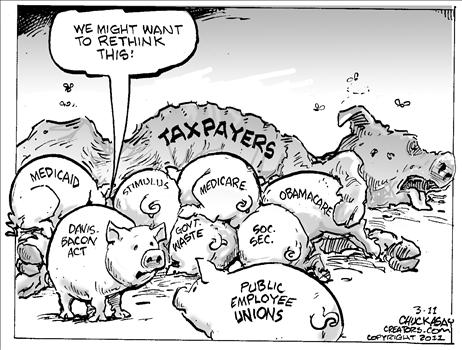
More than two years ago, I explained in a TV interview that the looters and moochers should be careful that they don’t kill the geese that lay the golden eggs. After all, parasites need a healthy host.

The collapse of Europe’s welfare states should be a wake-up call for these people, but that hasn’t stopped the demands for more redistribution in Washington. As Michael Barone noted, the folks on the left assume that there will always be someone to plunder.

But at least the piglets in this Chuck Asay cartoon are finally waking up to reality.

Unfortunately, I don’t expect the crowd in Washington to change. Most politicians don’t think more than a couple of years into the future, so they will continue to lure more people into riding in the wagon and continue to penalize those who pull the wagon.

This won’t end well.