Most people know that Ronald Reagan was an actor before he became a great President.
So I guess it makes sense for Barack Obama to do the same thing, but in reverse. He’s starting as a bad President, but then will become a Hollywood star.
Some clever person already has put together some potential starring roles. Let’s start with the Wizard of Oz, with some updated dialogue that captures the President’s approach to tax policy.
Bonnie and Clyde is another option, though this one is unfair. Obama supports TARP, which means he wants to rob taxpayers to subsidize banks.
Last but not least, we have a new version of “It’s a Wonderful Life.” Though, to be fair, the President seems to want entitlement checks for everybody.
If I was clever enough to manipulate pictures, I would do one from the scene in Braveheart where Mel Gibson is on horseback, motivating the Scots to fight against the English. But instead of Mel Gibson talking about freedom, we could have the President urging “dependency.”
John Brummett (10-26-11, Arkansas Democrat-Gazette online edition) does not want charter schools to put public schools out of business but he wants them to show public schools how to do it. (Paywall)
I seek in these matters a kind of Clintonian third-way finesse: I support charter schools only to the extent that they should be given the opportunity—availed by the KIPP schools, for example—to display effective methods that regular public schools should not resent and resist, but be compelled to emulate.
Yes, I understand that emulation would require that politicians give public educators more money. I’m for that. Longer school days and Saturday classes and summer classes aren’t free. KIPP has corporate backing for those kinds of things.
I don’t want charter schools to last forever and undermine public schools. I want their successful methods to be embraced by the public schools and for regular public schools to succeed to the point that alternatives are no longer so compelling. Charter schools should exist in temporary and ever-changing forms, not to show up public schools, but to show them how—not on everything, but on the latest thing.
That sounds good, but if you want the public school system to improve, it will take giving their captive audience an alternative. Many inner city parents would love to be given vouchers and get the same quality education that private schools are giving parents that have lots of money. How can you get around that logic. Meanwhile our inner city schools are becoming filled with violence.
Here is the video clip and transcript of the film series FREE TO CHOOSE episode “What is wrong with our schools?” Part 1 of 6.
Volume 6 – What’s Wrong with our Schools
Transcript:
Friedman: These youngsters are beginning another day at one of America’s public schools, Hyde Park High School in Boston. What happens when they pass through those doors is a vivid illustration of some of the problems facing America’s schools.
They have to pass through metal detectors. They are faced by security guards looking for hidden weapons. They are watched over by armed police. Isn’t that awful. What a way for kids to have to go to school, through metal detectors and to be searched. What can they conceivably learn under such circumstances. Nobody is happy with this kind of education. The taxpayers surely aren’t. This isn’t cheap education. After all, those uniformed policemen, those metal detectors have to be paid for.
What about the broken windows, the torn school books, and the smashed school equipment. The teachers who teach here don’t like this kind of situation. The students don’t like to come here to go to school, and most of all, the parents __ they are the ones who get the worst deal __ they pay taxes like the rest of us and they are just as concerned about the kind of education that their kids get as the rest of us are. They know their kids are getting a bad education but they feel trapped. Many of them can see no alternative but to continue sending their kids to schools like this.
To go back to the beginning, it all started with the fine idea that every child should have a chance to learn his three R’s. Sometimes in June when it gets hot, the kids come out in the yard to do their lessons, all 15 of them, ages 5 to 13, along with their teacher. This is the last one-room schoolhouse still operating in the state of Vermont. That is the way it used to be. Parental control, parents choosing the teacher, parents monitoring the schooling, parents even getting together and chipping in to paint the schoolhouse as they did here just a few weeks ago. Parental concern is still here as much in the slums of the big cities as in Bucolic, Vermont. But control by parents over the schooling of their children is today the exception, not the rule.
Increasingly, schools have come under the control of centralized administration, professional educators deciding what shall be taught, who shall do the teaching, and even what children shall go to what school. The people who lose most from this system are the poor and the disadvantaged in the large cities. They are simply stuck. They have no alternative.
Of course, if you are well off you do have a choice. You can send your child to a private school or you can move to an area where the public schools are excellent, as the parents of many of these students have done. These students are graduating from Weston High School in one of Boston’s wealthier suburbs. Their parents pay taxes instead of tuition and they certainly get better value for their money than do the parents in Hyde Park. That is partly because they have kept a good deal of control over the local schools, and in the process, they have managed to retain many of the virtues of the one-room schoolhouse.
Students here, like Barbara King, get the equivalent of a private education. They have excellent recreational facilities. They have a teaching staff that is dedicated and responsive to parents and students. There is an atmosphere which encourages learning, yet the cost per pupil here is no higher than in many of our inner city schools. The difference is that at Weston, it all goes for education that the parents still retain a good deal of control.
Unfortunately, most parents have lost control over how their tax money in spent. Avabelle goes to Hyde Park High. Her parents too want her to have a good education, but many of the students here are not interested in schooling, and the teachers, however dedicated, soon lose heart in an atmosphere like this. Avabelle’s parents are certainly not getting value for their tax money.
Caroline Bell, Parent: I think it is a shame, really, that parents are being ripped off like we are. I am talking about parents like me that work every day, scuffle to try to make ends meet. We send our kids to school hoping that they will receive something that will benefit them in the future for when they go out here and compete in the job market. Unfortunately, none of that is taking place at Hyde Park.
Friedman: Children like Ava are being shortchanged by a system that was designed to help. But there are ways to help give parents more say over their children’s schooling.
This is a fundraising evening for a school supported by a voluntary organization, New York’s Inner City Scholarship Fund. The prints that have brought people here have been loaned by wealthy Japanese industrialist. Events like this have helped raise two million dollars to finance Catholic parochial schools in New York. The people here are part of a long American tradition. The results of their private voluntary activities have been remarkable.
This is one of the poorest neighborhoods in New York City: the Bronx. Yet this parochial school, supported by the fund, is a joy to visit. The youngsters here from poor families are at Saint John Christians because their parents have picked this school and their parents are paying some of the costs from their own pockets. The children are well behaved, eager to learn, the teachers are dedicated. The cost per pupil here is far less than in the public schools, yet on the average the children are two grades ahead. That is because teachers and parents are free to choose how the children shall be taught. Private money has replaced the tax money and so control has been taken away from the bureaucrats and put back where it belongs.
This doesn’t work just for younger children. In the 60’s, Harlem was devastated by riots. It was a hot bed of trouble. Many teenagers dropped out of school.
Here is the video clip and transcript of the film series FREE TO CHOOSE episode “What is wrong with our schools?” Part 1 of 6. Volume 6 – What’s Wrong with our Schools Transcript: Friedman: These youngsters are beginning another day at one of America’s public schools, Hyde Park High School in Boston. What happens when […]
Free to Choose by Milton Friedman: Episode “What is wrong with our schools?” (Part 4 of transcript and video) Here is the video clip and transcript of the film series FREE TO CHOOSE episode “What is wrong with our schools?” Part 4 of 6. Volume 6 – What’s Wrong with our Schools Transcript: It seems to me […]
Free to Choose by Milton Friedman: Episode “What is wrong with our schools?” (Part 3 of transcript and video) Here is the video clip and transcript of the film series FREE TO CHOOSE episode “What is wrong with our schools?” Part 3 of 6. Volume 6 – What’s Wrong with our Schools Transcript: If it doesn’t, they […]
Free to Choose by Milton Friedman: Episode “What is wrong with our schools?” (Part 2 of transcript and video) Here is the video clip and transcript of the film series FREE TO CHOOSE episode “What is wrong with our schools?” Part 2 of 6. Volume 6 – What’s Wrong with our Schools Transcript: Groups of concerned parents […]
Here is the video clip and transcript of the film series FREE TO CHOOSE episode “What is wrong with our schools?” Part 6 of 6. Volume 6 – What’s Wrong with our Schools Transcript: FRIEDMAN: But I personally think it’s a good thing. But I don’t see that any reason whatsoever why I shouldn’t have been required […]
Here is the video clip and transcript of the film series FREE TO CHOOSE episode “What is wrong with our schools?” Part 5 of 6. Volume 6 – What’s Wrong with our Schools Transcript: Are your voucher schools going to accept these tough children? COONS: You bet they are. (Several talking at once.) COONS: May I answer […]
Ep. 4 – From Cradle to Grave [5/7]. Milton Friedman’s Free to Choose (1980)
With the national debt increasing faster than ever we must make the hard decisions to balance the budget now. If we wait another decade to balance the budget then we will surely risk our economic collapse.
The first step is to remove all welfare programs and replace them with the negative income tax program that Milton Friedman first suggested.
Milton Friedman points out that though many government welfare programs are well intentioned, they tend to have pernicious side effects. In Dr. Friedman’s view, perhaps the most serious shortcoming of governmental welfare activities is their tendency to strip away individual independence and dignity. This is because bureaucrats in welfare agencies are placed in positions of tremendous power over welfare recipients, exercising great influence over their lives. In addition, welfare programs tend to be self-perpetuating because they destroy work incentives. Dr. Friedman suggests a negative income tax as a way of helping the poor. The government would pay money to people falling below a certain income level. As they obtained jobs and earned money, they would continue to receive some payments from the government until their outside income reached a certain ceiling. This system would make people better off who sought work and earned income.
Participants: Robert McKenzie, Moderator; Milton Friedman; James R. Dumpson, Chief Administrator, Human Resources Admin., NYC; Thomas Sowell, Professor of Economics, UCLA; Robert Lampman, Professor of Economics, Institute of Poverty; Helen Bohen O’Bannon, Secretary of Welfare, State of Pennsylvania
O’BANNON: I think the other __ we have a program in Pennsylvania for essentially all of those who are not taken care of by the AFDC program. It’s called the General Assistance Program. And there less than 15 percent are on more than eighteen months. So we have a great turnover. We have essentially young males moving into the welfare system after unemployment compensation, and then moving out when a job opportunity comes along. This, you know, I think the notion of generations of people on welfare is a very small minority in the whole system. That doesn’t mean that the system as presently defined and as the set of programs that we have put together don’t often contradict each other and I’m the first to agree with Dr. Friedman that some of the programs are conflicting. However, I think it is overly broad to say that we turn people into helpless children.
SOWELL: I don’t remember talking to anyone who’s ever been on welfare who didn’t think they were being treated like children while they were on it.
DUMPSON: Of course, I think, you know, you __ one must make a difference, a distinction between a system that was set up to help people and the people who are employed in that system. Look at any public welfare system around the country and we have no, practically few trained people who to work with people. We employ them ill-trained, people who are not equipped to be helping people. We say they’re social workers. They’re not social workers, they have neither the skills, the attitudes, and some of them not even the concerns; so I think one has to separate how a conceptual framework of a system designed to help people and what the country and community puts into that system to implement those programs.
SOWELL: You mean to separate the hopes from the reality.
DUMPSON: I separate the skills that are available in order to implement what the objectives of the program are. I think we have to separate whether we are talking about program objectives, or we’re talking about how it operates. I would be the first to say that the system that I administered had ill-prepared people to do the job that we were set up to do, and I would not say that the system that we set up __
SOWELL: I talked to some social welfare people who think that in fact they were so hamstrung by the system that there was very little they could do to help people to get off welfare; that is to build up skills at jobs, do whatever was necessary to get off welfare. They felt it was the system.
MCKENZIE: Bob Lampman, your comment.
LAMPMAN: The system that we’re stereotyping is one of a great deal of paternalistic interference in individual family’s lives and in fact isn’t it true, Mr. Dumpson, that case load is so high for an individual welfare worker that they can’t do a lot of interfering in individual family lives. Moreover, in the last decade there’s been a real attempt to ease this welfare trap in AFDC by changing the take-back rate and by administering work expenses and child care expenses in such a way as to facilitate work by those who may want to do it; so it’s not quite as harsh a picture as we sometimes get that there is this omniscient welfare worker who’s right there in the living room with the family making all their decisions for them.
FRIEDMAN: I’ve never heard of a government program which was defective in which the people who ran it didn’t say, “If only we had more money to spend on what we’re not being able to accomplish with the amount we’re spending now.”
MCKENZIE: Milton, we’re going to move along now to some of your prescriptions in that film because I think it’s good ground for discussion. The most drastic one was when you said, speaking of an unemployed man, “Supposing you were cruel and took away welfare from this man, he would find a job at some wage, there’d always be a job he could get; he might need some charity on route, private charity, but he would get a job.” Now, I want you to react, those of you, before we come back to Milton on that. Is that a picture that seems plausible to you?
DUMPSON: He may get a job, and he may get a job in what we refer to as the underground economy, and that’s where a number of our youth are now going to get their jobs. Those activities that are illegal, the only opportunities they have for earning their part of a livelihood.
O’BANNON: I think the other issue is that you have a whole group of people who are the single, female head of the household; and yes, cut off welfare tomorrow: What will they do? What will be their immediate response? At what price to their small children and to their middle-aged children? Yes, they’ll get a job, in fact the statistics show that women, in fact, are the most successful through the employment program. But what has to supplement that typically is the provision of some kind of day care arrangement. Either the individual woman has to earn enough money to be able to pay privately for her day care, or in fact, she is quote “subsidized” through this insidious, corrupting program, set of programs, run by the federal government which, in fact, makes her employable and a taxpayer. It’s an interesting notion of trying to get people in a productive mode.
MCKENZIE: Tom Sowell.
SOWELL: It’s incredible the way you start the story in the middle as if there’s a predestined amount of poverty, a predestined amount of unemployment and that the welfare system is not itself in any way responsible for that __
O’BANNON: There is a predestined 20 percent of the bottom half of the population.
SOWELL: I have never __ well, that’s always been true __
(Everyone speaking at once)
O’BANNON: There’s going to be 20 percent at the bottom.
SOWELL: It’s also true that 20 percent of the bottom population doesn’t have to be living on the government and ruled by the government. You mentioned, for example, a female head of household. Many of those, in addition to the grown woman who has all the kids, are teenage pregnancies. There’s not a predestined amount of teenaged pregnancies. I grew up in an era when people, and particularly blacks, were a lot poorer than today, faced a lot more discrimination than today, and in which teenage pregnancy rate was a lot lower than today. I don’t believe there is a predestined amount of teenage pregnancy. A predestined amount of husband desertion. Gutman has done a study of a black family showing that this whole notion that the black family has always been disintegrating, that is nonsense. His studies go up to 1925, the great bulk of black families were intact two-parent families up to 1925 and going all the way back through the era of slavery, so it is now, only within our own time, that we suddenly see this inevitable tragedy which the welfare system says it’s going to rush in to solve.
O’BANNON: We’re talking to Tom about __
SOWELL: To which it is itself a point __
O’BANNON: We’re talking about a very small group. We’re talking about twelve percent of the families are not intact. Are not two-parent families at any one period __
SOWELL: Do you mean __ among welfare recipients __
O’BANNON: No.
SOWELL: __ or the public at large?
O’BANNON: Among the public at large. We’re talking about twelve percent of the families; twelve percent.
SOWELL: That’s right.
O’BANNON: That’s a small number. But __
SOWELL: We’ve got to build on welfare.
O’BANNON: We’re still talking about a significant component of the bottom twenty percent that are the bottom twenty percent. Whether they are above the poverty line or below the poverty line; they are still the bottom twenty percent. And the issue is: What is the responsibility of the other eighty percent; if any, towards those others?
SOWELL: There’s no program plan to eliminate there being a bottom twenty percent?
O’BANNON: No. But it intends to raise the bottom twenty percent so __
SOWELL: We’re raising them by having more __ by having more illegitimacy, more unemployment, by having __
O’BANNON: I’m not making them be __ have illegitimate children. I hope that’s clear.
SOWELL: Oh, I_I__ you don’t have to do that. You simply subsidize it.
FRIEDMAN: We, as human beings, don’t have a responsibility; but I hope we have a compassion and an interest in the bottom twenty percent. And I only want to say to you that the capitalist system, the private enterprise system in the 19th century did a far better job of expressing that sense of compassion than the governmental welfare programs are today. The 19th century, the period which people denigrate as the high tide of capitalism was the period of the greatest outpouring of Ella Mosner in charitable activity that the world has ever known. And one of the things I hold against the welfare system, most seriously, is that it has destroyed private charitable arrangements which are far more effective, far more compassionate, far more person-to-person in helping people who are really, for no fault of their own, in disadvantaged situations.
O’BANNON: I have to disagree with you though, because I think that the whole notion of private property was excluded, whole segments of society were excluded from the notion of private property in the 19th century; namely, women, idiots and imbeciles. And so, I don’t go back to the 19th century and hold it up as any paragon that we would want to replicate today.
MCKENZIE: Anyway. I want Milton now to come to your major prescription, which I know you don’t say is on the agenda for tomorrow, but it lies ahead; that is, the negative income tax. And I’m not sure people fully understand how it would work. We can’t, I think, go to the details of it, but I’d like to get a reaction around the panel first of all, is this a viable approach to the enduring problems of poverty? Negative income tax.
Q: York County was recently in the news for a lawsuit involving the teaching of intelligent design. What’s your attitude regarding the teaching of evolution in public schools?
A: “I’m a Christian, and I believe in parents being able to provide children with religious instruction without interference from the state. But I also believe our schools are there to teach worldly knowledge and science. I believe in evolution, and I believe there’s a difference between science and faith. That doesn’t make faith any less important than science. It just means they’re two different things. And I think it’s a mistake to try to cloud the teaching of science with theories that frankly don’t hold up to scientific inquiry.”
“O Timothy, keep that which is committed to thy trust, avoiding profane and vain babblings, and oppositions of science falsely so called: which some professing have erred concerning the faith. Grace be with thee. Amen” (1 Tim. 6:20-21).
One of the most important questions to face our generation is this: “Are human beings simply the product of millions of years of mindless, evolutionary mutations and adaptations, or are we the creation of an infinitely wise, powerful, and loving God?”
The answer to that question is critical. Why? Because it determines your attitude toward God in heaven and mankind on earth. The debate over human origin is one of the most critical issues of our times.
THE DAMAGE OF EVOLTION
It’s hard to measure the enormous damage inflicted by Darwinian evolution, the teaching that life arose from a spontaneous spark in a pond of primordial ooze. The amazing thing is that influential scientists themselves are now denying Darwin’s theory as impossible. Yet its destructive effects remain.
For instance, if man is an accident of nature, then there is no fixed standard of right and wrong. So what the Bible calls sexual perversion is now a “lifestyle.” And a human life can be readily destroyed, whether in the womb or partially delivered.
Worst of all, evolution has helped destroy belief in God for millions. Denying biblical creation, evolutionists have “changed the truth of God into a lie” (Romans 1:25).
Should we be surprised that euthanasia is gaining widespread acceptance in our society or that the tide of abortion cannot be turned? Is it any wonder that sexual perversion is received as a valid alternative lifestyle? We have taught our children that they are just another species of animal – and they are finally beginning to act like animals! And our children and grandchildren are still being fed this lie today.
THE DECEIT OF EVOLUTION
What is behind this whole idea of evolution? Why is it such an emotional issue? Why can’t the world simply agree that there is no creation without a Creator, and out of nothing, nothing comes?
Humanist Aldous Huxley expressed the answer to those questions in his book, Ends and Means. Huxley said he and his contemporaries did not want government or morality. So they chose evolution in order to shut the mouths of those who believe in special creation.
For more than 100 years, the evolutionists have succeeded in convincing people that evolution is the only logical, scientific, and intelligent theory of human origin.
But this campaign has been carried out amid deceit and slight of hand on the part of many evolutionists. We’ve all seen the creative drawings of supposed ancestors of mankind, built on a few teeth or a piece of a skull. And the fossil hoaxes perpetrated over the last century are well known.
No wonder in his book Darwinism: The Refutation of a Myth, the Swedish embryologist, Soren Lovtrup, suggests that he believes that some day Darwinism “will be ranked the greatest deceit in the history of science.”
THE DEFEAT OF EVOLUTION
Despite its lack of credible evidence, evolution holds sway in our schools, the courts, and the public mind. What can we do?
We can preach, teach and defend the truth! We can set our children free from the devil’s lies by giving them the Truth of God’s Word (John 8:32) And we can point lost, confused and dying souls to Him who is the Way, the Truth and the Life!
With the steadfast support of friends like you, Love Worth Finding will continue to hold high the banner of Jesus Christ.
THREE TELLING ARGUMENTS AGAINST EVOLUTION
1. The fossil record. Not only is the so-called missing link still missing, all of the transitional life forms so crucial to evolutionary theory are missing from the fossil record. There are thousands of missing links, not one!
2. The second law of thermodynamics. This law states that energy is winding down and that matter left to itself tends toward chaos and randomness, not greater organization and complexity. Evolution demands exactly the opposite process, which is observed nowhere in nature.
3. The origin of life. Evolution offers no answers to the origin of life. It simply pushes the question farther back in time, back to some primordial event in space or an act of spontaneous generation in which life simply sprang from nothing.
But most people don’t seem to care about having the law apply the same to all people, so I make a strictly utilitarian case for low tax rates in today’s New York Post. Here some of what I wrote.
Whether it’s through the Buffett Rule, higher income-tax rates or double taxation of dividends and capital gains, President Obama often demands that “rich” taxpayers and big corporations send more money to Washington. But…trying to get more money from upper-income taxpayers is like playing whack-a-mole. So long as tax rates are high, rich people will figure out ways to protect their income.It doesn’t take a tax genius; any rich person can make a phone call or hit a few computer keys and shift his or her investments to tax-free municipal bonds. It’s not good for the economy when capital gets diverted to help finance the excess spending of Detroit or California, but it’s an effective way of stiff-arming the IRS. Or the rich can play the green-energy scam, getting all sorts of credits to offset their tax liabilities. …Even if lawmakers abolished the various tax-code distortions, they might still be disappointed. The one sure way for rich people to lower their tax bills is by generating less income. …This isn’t some sort of modern-day revelation. Andrew Mellon, a Treasury secretary during the 1920s, noted that “the history of taxation shows that taxes which are inherently excessive are not paid. The high rates inevitably put pressure upon the taxpayer to withdraw his capital from productive business.”
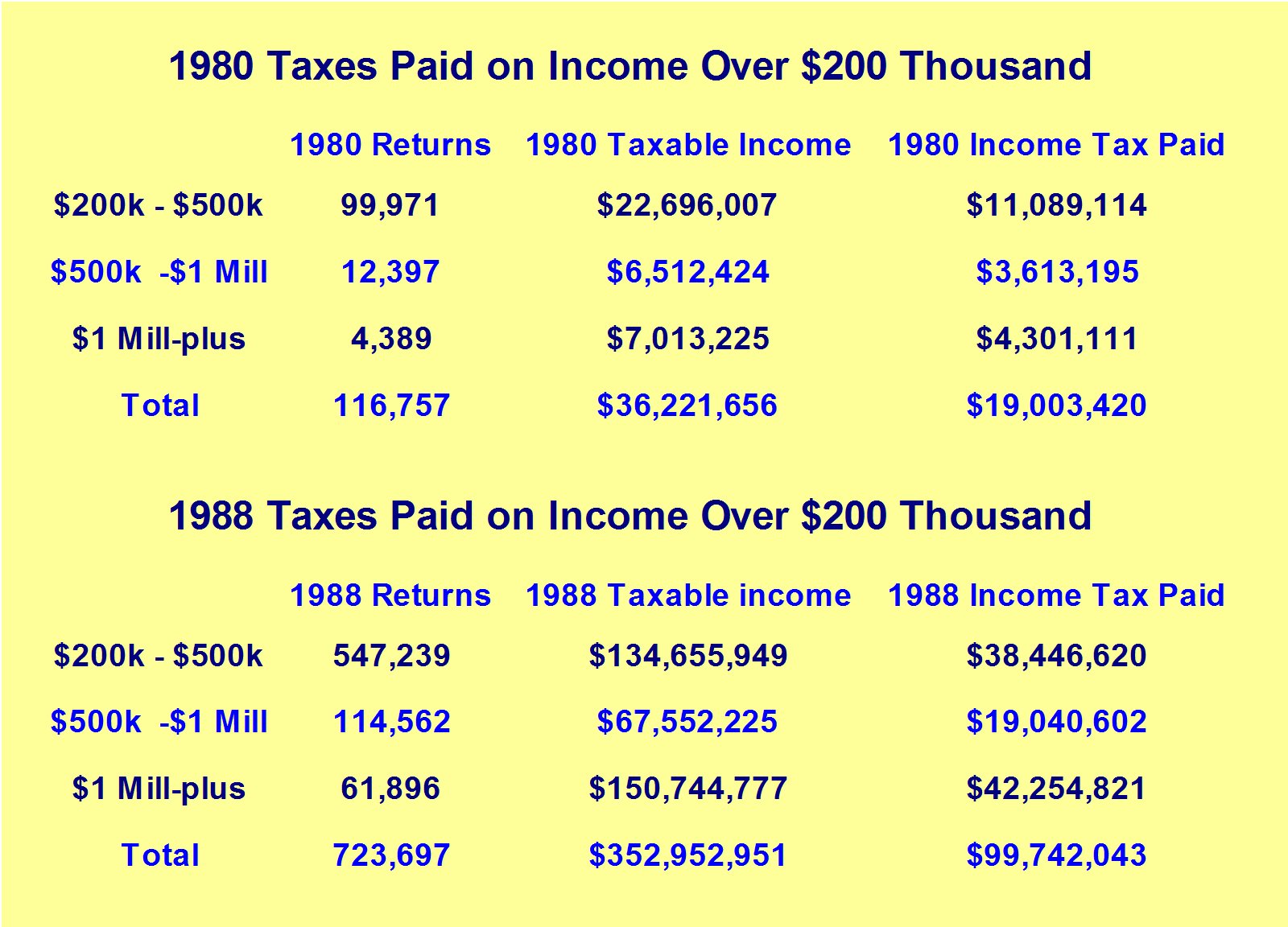
Unlike the rest of us, the rich have a great ability to alter the timing, amount and composition of their income. That’s because, according to IRS data, those with more than $1 million of adjusted gross income get only 33 percent of it from wages and salaries. The super-rich (those with income above $10 million) rely on wages and salaries for only 19 percent of their income. In 1980, when the top tax rate was 70 percent, rich people (those with incomes of more than $200,000) reported about $36 billion of income; the IRS collected about $19 billion of that amount. So what happened when President Ronald Reagan lowered the top tax rate to 28 percent by 1988? Did revenue fall proportionately, to about $8 billion? Folks on the left thought that would happen, complaining that Reagan’s “tax cuts for the rich” would starve the government of revenue and give upper-income taxpayers a free ride. But if we look at the 1988 IRS data, rich people paid more than $99 billion to Uncle Sam. That is, because rich taxpayers were willing to earn and report much more income, the government collected five times as much revenue with a lower rate.
I also included above, for readers of this blog, a table with the raw numbers from the IRS. Feel free to click for a larger image and see how the “rich” responded to better tax policy.
Obama wants to run the experiment in reverse. He hasn’t proposed to push the top tax rate up to 70 percent, thank goodness, but the combined effect of his class-warfare policies would mean a big increase in marginal tax rates. That might be good for workers in China, India or Ireland, because American jobs and investment would migrate to those places. But it’s not the right policy for the United States.
In other words, even if you’re a leftist and your main goal is giving the government more revenue, higher tax rates are a bad idea. The rich will simply figure out ways to protect their earnings while the rest of us suffer because the economy loses some of its dynamism.
This video reviews real-world evidence showing that changes in marginal tax rates can have a significant impact on taxable income, thus leading to substantial amounts of revenue feedback. In a few cases, tax-rate reductions even “pay for themselves,” though the key lesson is the more modest point that pro-growth changes in tax policy will have a positive impact on economic performance and that good tax cuts therefore do not “cost” the government much in terms of foregone tax revenue.
This video is second installment of a three-part series. Part I reviews theoretical relationship between tax rates, taxable income, and tax revenue. Part III discusses how the revenue-estimating process in Washington can be improved. For more information please visit the Center for Freedom and Prosperity’s web site: www.freedomandprosperity.org.
_________________
On the Arkansas Times Blog the person using the username “Couldn’t be better” commented on what I said by responding, “Saline, where are all the jobs that Bush promised in 2001 and 2003. Still waiting for the trinkle down…”
Bush tax cuts work? This is a series of posts aimed at answering that question.
Abstract:Despite evidence to the contrary, President Obama and his supporters insist that a tax increase will not impede economic recovery. They claim that the Clinton tax hikes spurred the boom of the 1990s and that the subsequent Bush tax cuts hurt the economy. Members of Congress must reject this faulty notion—and reject the President’s call for burdening Americans with higher taxes and an even slower economy.
President Barack Obama and his allies in Congress and elsewhere continue to press for tax increases, whether as part of a deal to raise the government’s debt ceiling, or for any other reason. Even though common sense would dictate not raising taxes in the face of a badly weakened economy and almost non-existent job growth, the President and his supporters argue that tax hikes will not imperil the still-nascent recovery because the economy grew during the 1990s after President Bill Clinton raised taxes. The inference being that today’s economy could also absorb the blow of tax hikes and grow despite them. They also argue the converse: that the tax cuts passed during President George W. Bush’s tenure slowed growth and cost jobs.
This cursory and errant analysis of recent history has serious implications for policymaking today. If Congress raises taxes based on the faulty notion that tax hikes have no ill effects on economic growth, it will impede the still-struggling recovery and keep millions of Americans on the unemployment rolls far too long.
Bush Tax Cuts Promoted Strong Growth
Liberals also like to argue that the Bush tax relief hurt the economy and cost jobs. Again, the evidence runs to the contrary.
Unlike President Clinton, who entered office with a strong economic wind at his back, President Bush came into office on the precipice of a recession caused by the bursting of the “dot-com” bubble. President Bush entered office in January 2001; the recession began in March.
In addition to the recession, the peaceful conditions President Clinton enjoyed reversed course. The terrorist attacks of 9/11 brought on the beginning of the war on terrorism. There was no growth-enhancing advancement comparable to the tech boom to further boost the economy; energy prices were creeping up. Instead of swimming with the current, the economy was now fighting squarely against it to achieve even modest growth.
Faced with this new reality, President Bush pushed for tax cuts to revive the economy and set it on a stronger foundation for economic growth.
In June 2001, President Bush signed into law the first wave of tax cuts. The relief included reductions of marginal income tax rates and tax relief for families, for example, doubling the child tax credit from $500 to $1,000. To reduce the budgetary impact, Congress phased in the tax cuts over several years.
Since the tax cuts were slow to go into effect, they were slow to help the economy. In fact, the economy continued to lose jobs after the tax cuts even though the recession officially ended in November 2001.
Realizing the error of its ways, in May 2003 Congress accelerated the tax cuts to make them effective immediately. In addition to reducing marginal income tax rates, Congress also lowered the tax rates on capital gains and dividends.
It was at this point that economic growth took off. From May 2003 until December 2007 (when the recession caused by the global financial meltdown occurred) the economy created 8.1 million jobs, or 145,000 a month. By comparison, after the beginning of the 2001 recession and before the 2003 tax cuts, the economy was losing 103,000 jobs a month.[7]
Those opposed to the tax relief argue that it blew a hole in the budget and dramatically increased deficits. Again, a look at the numbers disproves that argument. While receipts were below the historical level of 18 percent of GDP in 2003 as a result of the sluggish economy, they rebounded to above their historical norm by 2006 and grew further above their historical level in 2007.[8] They clearly would have continued growing thereafter had it not been for the housing bust and global recession.
Tax revenue rebounded quickly because the tax cuts encouraged economic growth by increasing the incentives to work, save, invest, and take on new risk. These are the basic elements of economic growth. When those activities increase, tax revenues increase because more Americans work and earn more money. From 2003 to 2007, the number of tax filers rose by 9.6 percent, and taxable income, by 44 percent. By contrast, in the last four years of the previous expansion, from 1997 to 2001, these numbers grew by 6.4 percent and 23.6 percent, respectively.[9] With income and taxpayers growing at such a fast clip it is not hard to see why tax revenue did not suffer from the tax cuts.
To be clear: The Bush tax cuts did not pay for themselves. Revenues, on balance, are lower as a result of the Bush tax relief. However, the Bush tax cuts did accelerate the recovery markedly, and they did, and still do, create the possibility of a permanently stronger economy which, in turn, means the net revenue cost of the Bush tax cuts is far less than the traditional static score implies.
In 2008, the last full year of the Bush presidency, the economy entered a severe recession brought on by the global financial meltdown. The 2001 and 2003 tax relief packages had made the economy more resilient against economic shocks, but no tax policy can protect an economy against the storm that struck that year. The tax cuts certainly did not contribute in any way to recession, nor can anyone credibly claim that these policies had something to do with the financial implosion that was global in origin and impact.
Even with a recession at the beginning of his presidency and another severe recession at the end, the economy still created more than 1 million net jobs during President Bush’s tenure. The tax cuts he pushed Congress to pass are a major reason for that job growth.
—Curtis S. Dubay is a Senior Analyst in Tax Policy in the Thomas A. Roe Institute for Economic Policy Studies at The Heritage Foundation.
Last weekend, the people of France took a sharp turn to the left, and the rest of Europe may be on the brink of rebuking its recent tack toward fiscal responsibility. With Sunday’s election of French Socialist leader Francois Hollande, France has leapt backward toward the policies that have helped sink the continent in a sovereign debt crisis. Disturbingly, the big government platform Hollande campaigned on is all too familiar to the American people, and if the United States is not careful, it could suffer the same fate as its European allies.
Hollande sailed to victory by appealing to an electorate dissatisfied with having to face necessary cutbacks, proclaiming that he is “proud to have been capable of giving people hope again.” That brand of hope called for a change from President Nicolas Sarkozy’s relatively conservative policies — in his first term, Sarkozy worked to reduce the number of public sector employees, eliminate the 35-hour work week, reform the university system and cut taxes.
Hollande, by contrast, promised to raise taxes on big corporations and wealthy individuals, implement a top rate tax of 75 percent, increase public spending by 20 billion euros, raise the minimum wage, hire 60,000 more teachers, and lower the retirement age from 62 to 60 for some workers. He says he is “president of the youth of France” and believes that government stimulus, not cutting spending, is the right way to achieve economic growth.
If you’ve been a student of President Obama’s presidency, much of this should sound familiar. President Obama came into office on a promise of hope and change, appealed to young Americans and promised renewed prosperity. His solution was more government spending to the tune of a near-trillion-dollar stimulus, a government-run health care plan, a bailout of government unions, and a call for higher taxes on wealthy Americans and corporations.
The difference between the United States and France is that the latter is much further down the path of a social welfare state. Hollande’s proposals are not a new direction, they’re merely a return to form. France is notoriously emblematic of the European way of life. As Daniel Hannan, a member of the European Parliament, describes in Why America Must Not Follow Europe, “Long vacations, paternity leave, a higher minimum wage, a short working week: What’s not to like? The trouble is that eventually the money runs out.”
In France, the money has indeed run out. The country’s public debt now stands at more than 80 percent of GDP, government spending is at 55 percent of GDP, the tax burden is equivalent to 42 percent of total domestic income, and it hasn’t balanced its budget since 1974.
The United States, unfortunately, is headed in much the same direction. As Heritage’s Federal Budget in Pictures shows, U.S. debt stood at 67 percent of GDP in 2011, but unless the United States controls its spending, its debt will surpass that of France, Italy and even Greece, hitting 187 percent of GDP by 2035. Spending on Medicare, Medicaid, the Obamacare subsidies, and Social Security will devour all revenues by 2045, and taxes are soaring past their highest levels ever. And as for the budget, the U.S. Senate hasn’t passed one in three years — let alone brought it to balance.
The world has seen what lies at the end of this road to perdition. Though France is a prime example of a country that is spending itself into crisis, Greece has already gone beyond that tipping point. The country’s debt has exploded, 21.8 percent of its people are unemployed, and among the youth, more are out of work than have jobs. In the face of belt-tightening measures that came as a condition of an EU/IMF bailout — which include public sector pay cuts and pension reductions — the country turned to open political revolt with violent riots in the streets. In elections this week, Greek voters rejected the political parties that support fiscal responsibility and instead turned toward the Radical Left.
If there is any bright spot in Europe’s far left turn, it came Friday in the re-election of Boris Johnson, the Conservative mayor of London. Johnson campaigned for tax cuts and eliminating public sector waste in the hopes of spurring job growth. But alas, France’s return to the deeply entrenched socialist policies could signal an end to the fiscally responsible measures that German Chancellor Angela Merkel has championed, leading to economic disaster.
Though Europe is an ocean away, the policies that are sinking the continent could have the same impact in the United States if replicated here. Endless spending has dire consequences, and if America is not careful, it could follow Europe’s path to economic ruin.
The Laffer Curve, Part I: Understanding the Theory
The Laffer Curve charts a relationship between tax rates and tax revenue. While the theory behind the Laffer Curve is widely accepted, the concept has become very controversial because politicians on both sides of the debate exaggerate. This video shows the middle ground between those who claim “all tax cuts pay for themselves” and those who claim tax policy has no impact on economic performance. This video, focusing on the theory of the Laffer Curve, is Part I of a three-part series. Part II reviews evidence of Laffer-Curve responses. Part III discusses how the revenue-estimating process in Washington can be improved. For more information please visit the Center for Freedom and Prosperity’s web site:www.freedomandprosperity.org
Abstract:Despite evidence to the contrary, President Obama and his supporters insist that a tax increase will not impede economic recovery. They claim that the Clinton tax hikes spurred the boom of the 1990s and that the subsequent Bush tax cuts hurt the economy. Members of Congress must reject this faulty notion—and reject the President’s call for burdening Americans with higher taxes and an even slower economy.
President Barack Obama and his allies in Congress and elsewhere continue to press for tax increases, whether as part of a deal to raise the government’s debt ceiling, or for any other reason. Even though common sense would dictate not raising taxes in the face of a badly weakened economy and almost non-existent job growth, the President and his supporters argue that tax hikes will not imperil the still-nascent recovery because the economy grew during the 1990s after President Bill Clinton raised taxes. The inference being that today’s economy could also absorb the blow of tax hikes and grow despite them. They also argue the converse: that the tax cuts passed during President George W. Bush’s tenure slowed growth and cost jobs.
This cursory and errant analysis of recent history has serious implications for policymaking today. If Congress raises taxes based on the faulty notion that tax hikes have no ill effects on economic growth, it will impede the still-struggling recovery and keep millions of Americans on the unemployment rolls far too long.
Clinton Tax Hikes Slowed Growth
A favorite liberal argument is to attribute the economy’s strong performance during the 1990s to President Clinton’s economic policies, chief among which was a huge tax increase. Clinton signed his tax hike into law in September 1993, the same year he took office. It included an increase of the top marginal tax rate from 31 percent to 39.6 percent; repeal of the cap on the 2.9 percent Medicare tax, applying it to every dollar of income instead of being capped to levels of income like the Social Security tax; a 4.3-cent increase in the gas tax; an increase in the taxable portion of Social Security benefits; and a hike of the corporate income tax rate from 34 percent to 35 percent, among other tax increases.[1]
The economic defense of the Clinton tax hikes does not hold up against the historical facts. The economy did exhibit strong economic growth during the 1990s, but rapid growth did not occur soon after the tax hike—it came much later in the decade, when Congress cut taxes. After the 1993 tax hike, the economy actually slowed to a point below what one would expect, considering the once-in-a-generation favorable economic climate that existed at the time.
As for the overall economic recovery—that started well before President Clinton took office. In January 1993, the economy was in the 22nd month of expansion following the recession from July 1990 to March 1991.
In addition to coming into office in the midst of an economic expansion, Clinton also benefited from a very unusual confluence of events that created a remarkably favorable environment for rapid economic growth:
The end of the Cold War brought a sigh of relief to the world and a powerful dose of growth-enhancing certainty to the global economy.
The price of energy was astoundingly low, with oil prices dropping below $11 per barrel and averaging under $20 per barrel, versus $100 per barrel today.[2]
The Federal Reserve had tamed inflation to an extent previously thought impossible, with inflation averaging 2 percent during the Clinton Administration.[3]
The biggest wind at the economy’s back was, of course, a tremendous set of new productivity-enhancing information technologies and the explosion of the Internet as a powerful tool for commerce and communication, further increasing productivity.
With these factors clearing the way, the economy should have displayed spectacular and accelerating growth in the years immediately after Clinton entered the White House, but growth of that magnitude did not materialize until later in the decade.
From 1993 until 1997, the economy grew at a pedestrian 3.3 percent per year.[4] While solid, this growth was certainly not exceptional. During that same time, real wages declined, despite the perception that the 1990s were an era of unmitigated abundance.[5]
It was not until after a 1997 tax cut, passed by the Republican-led Congress—a tax cut President Clinton resisted but ultimately signed—that the spectacular growth kicked in. While small in revenue impact, the 1997 cuts included a reduction of the capital gains rate from 28 percent to 20 percent. This opened the capital floodgates necessary for entrepreneurs to develop, harness, and bring to market the wonders of the new information technologies.
Business investment skyrocketed after the tax cut,[6] and the economy grew at an annualized rate of 4.4 percent (33 percent faster than after the Clinton tax hike) from 1997 through the end of the Clinton presidency. Real wages reversed their downward trend and grew 1.7 percent per year during the same time.
Altogether, how much worse did the economy perform because of the Clinton tax hike? The data from the period do not provide a clear answer. What is clear is that the economy performed well below reasonable expectations given the favorable conditions existing in the years after the tax hike—and took off after the often-forgotten tax cut.
—Curtis S. Dubay is a Senior Analyst in Tax Policy in the Thomas A. Roe Institute for Economic Policy Studies at The Heritage Foundation.
When it comes to college football stadiums, for some teams, it is simply not fair. Home-field advantage is a big thing in college football, and some teams have it way more than others.
There are 124 FBS college football teams, and when it comes to the stadiums they play in, they are obviously not all created equal.
There is a monumental difference from the top teams on the list to the bottom teams on the list. Either way, here it is: a complete ranking of the college football stadiums 1-124.
_________________
I got to hear Kenny Hatfield speak at First Baptist in Little Rock and he did a great job. His teams at Rice were very good. Here a portion from that earlier post:
Coach Hatfield said so many inspiring things in his talk that I am starting a new series of posts that will go through many of the points he made in his talk.
In a quiet chapel where no one could see, Don kneeled and asked the Lord into his heart. In Don’s words, “that was the conversion of this cantankerous soul.”
Over the years, Don collected articles that mentioned sports personalities willing to talk about their faith. These courageous athletes were his heroes. One by one, Don wrote to each of them. He never gave up. He wanted the inspiration and strength of hearing their stories, personally and professionally. A new dream was nudging him.
Finally he got a response from Pittsburgh Pirate General Manager, Branch Rickey. Don was told that he could have a five minute appointment. The five minutes stretched into five hours. Together they imagined Don’s dream, “The Fellowship of Christian Athletes.” Rickey found some start-up funds, and Don did the footwork. Don made the contacts, shared the vision, and did more fund-raising and organizing. It took so much time that Don had to leave his coaching job. He and his wife and (by then) three children lived on very little. But step-by-step the dream became a reality.
The Fellowship of Christian Athletes is over fifty years old now, and is the largest inter-denominational, school-based, Christian organization in America. It even reaches athletes internationally. The FCA encourages coaches and athletes on the professional, college, high school, middle school, and youth levels to use athletics to “impact the world through their faith and example.”
The Fellowship of Christian Athletes was his first big dream. It joined his hungry spirit with his love of sports. Step by step, his vision grew, far beyond where he ever dreamed. But he was still bothered by racial differences, and the uneven distribution of wealth.
His longtime questions about money and race and faith have led him all over the globe. After he created the FCA, Don founded Washington Lift, Inc. (an inner-city youth ministry), the Ministry of Money, Inc., and Harvest Time, Inc. When I asked him why he started these organizations, Don’s words were simple. “I thought somebody else would take it and run with it. When no one did, I did.”
Although Don doesn’t play sports anymore (except golf), he still dreams dreams and works to make them come true. Don’s playing field has changed, but at 81 years old, he’s still in the action. Like the mower that splash-landed in the mayor’s pond, Don’s dreams have rippled out all around the world. He hopes that by one strategy or another, he has helped kids around the world to climb mountains.
That story is very inspiring, but I just want you to know that the things you do today may continue to have influence on others many years later.
Let me give you one example. Recently I talked to Melvin Pickens who has been selling brooms in Little Rock for over 60 years. I have known Melvin for almost 30 years and I have always known that he is a big Los Angeles Dodgers fan. Then just the other day I asked him how he came around to pulling for the Dodgers. He told me that in 1947 when he was at Henry Clay Yerger High School in Hope, Arkansas, Branch Rickey (the general manager of the Brooklyn Dodgers) stood up for Jackie Robinson and made him the first black baseball player to play professional baseball with the whites.
Every person he knew at Henry Clay Yerger High School became a Dodger fan that year, and he has been a faithful fan ever since!!!
In the history of Razorback football, few figures loom larger than Ken Hatfield. Not only does he have the highest winning percentage of any head coach in the program’s history, he also was a star punt returner and defensive back for the Razorbacks’ one and only national championship team. After a six-year coaching tenure in Fayetteville, he left for Clemson in 1990 and was later the head coach at Rice for 12 seasons.
Now retired from football, Hatfield lives in northwest Arkansas, where he serves on the board of the local chapter of the Fellowship of Christian Athletes; is involved with Horses for Healing, non-profit therapeutic horseback riding center for individuals with special needs; and is state director for Arkansas Drug Card.com, which provides free discount prescription cards to uninsured and underinsured residents of Arkansas.
In the first part of a three-part Q&A, Hatfield discusses his unforgettable 81-yard punt return for a touchdown in an upset of Texas in 1964 and the start of his coaching career. (And before we started, a quick note of thanks to the invaluable Hogdb.com for several of the photos in today’s installment.)
A touching story about when Adrian Rogers accepted Jesus Christ as his Savior
104. Superdome: Tulane Green Wave
The New Orleans Superdome is great, but for a college team like Tulane playing there, it can seem relatively empty when the game is going on.
Even if it is New Orleans, the atmosphere here is not good when the Green Wave are on the field.
Built in 1975 with a seating capacity of 72,968, this stadium is great for big games, but just not for Tulane football.
Tulane is in the process of building a 30,000-seat stadium on campus right now.
103. Qualcomm Stadium: San Diego State Aztecs
Qualcomm Stadium plays host to a number of different sporting events, including the San Diego Chargers as well as the San Diego State Aztecs.
Like a lot of the other larger stadiums that are used for professional sports, this stadium does not have that college atmosphere.
Built in 1967, this stadium has a seating capacity of 71,294.
102. Alumni Stadium: Boston College Eagles
Boston College has a beautiful campus and an excellent atmosphere. That atmosphere, however, does not translate over to the football field.
Built in 1957, Alumni Stadium has a seating capacity of 44,500 people and has a decent following.
Lack of success on the football field in recent years has probably not helped, but either way, this stadium leaves something to be desired.
101. Rynearson Stadium: Eastern Michigan Eagles
Rynearson Stadium is one of the larger stadiums when it comes to the MAC.
Built in 1969, it has a seating capacity of 30,200 and is home to the Eastern Michigan Eagles.
This stadium is strictly average across the board, but that is good enough to be in the middle of the pack as far as the MAC is concerned.
100. Lincoln Financial Field: Temple Owls
Most people know Lincoln Financial Field as the home of the Philadelphia Eagles. Well, it also plays host to the Temple Owls.
Built in 2003, this stadium is brand new as far as college fields are concerned.
It seats 68,532, but obviously does not have that college feel that many of the other stadiums have.
99. Scott Stadium: Virginia Cavaliers
The ACC seemingly lags behind other major college conferences when it comes to football stadiums.
Virginia is no different. The stadium seats 61,500 people and is a little old. It was built in 1931, and the neighborhood around it is great.
The fans are not bad, but the stadium leaves something to be desired.
98. War Memorial Stadium: Wyoming Cowboys
War Memorial Stadium is actually not a bad place to watch a college football game.
Laramie, Wyoming is a nice college town, and although the stadium is over 60 years old, having been built in 1950, it is not bad scenery on a nice day.
The seating capacity here is 32,580, and it makes for a small, compact crowd in this wide open stadium.
97. Sam Boyd Stadium: UNLV Rebels
Sam Boyd Stadium actually looks a little bigger than it really is.
It was built in 1971 and seats 36,800. It is completely enclosed with the exception of one end zone being open.
Las Vegas is not a city known to support their teams too much, but the Rebels do get what support they have to offer, making this a decent place to watch a college football game.
96. Rice-Eccles Stadium: Utah Utes
Utah is the first Pac-12 team on the list with a stadium that is almost completely enclosed.
Rice-Eccles Stadium was built in 1998, making it one of the newest college football stadiums in the country.
It holds 45,017, meaning it is on the larger side when it comes to stadiums.
Everything here is middle of the line, but not up to the standards of other Pac-12 schools.
95. Rice Stadium: Rice Owls
This stadium was built in 1950 and has been the home of the Rice Owls ever since.
It seats 47,000 people, but can be expanded to 70,000 when necessary and is one of the larger venues in Conference USA.
The stadium overall is a nice place to watch a college football game, although they are usually never near capacity and the extra seats seem unnecessary.
Debating whether the United States has gone too far in accumulating debt, with Dan Mitchell, Cato Institute; Christian Weller, Center for American Progress; and CNBC’s Erin Burnett.
_______________
Does anyone care about growing the economy anymore?
Economists often do a crummy job of teaching people about the impact of fiscal policy on the labor force, largely because we put people to sleep with boring discussions about “labor supply” decisions (my blog post from last year perhaps being an example of this tendency).
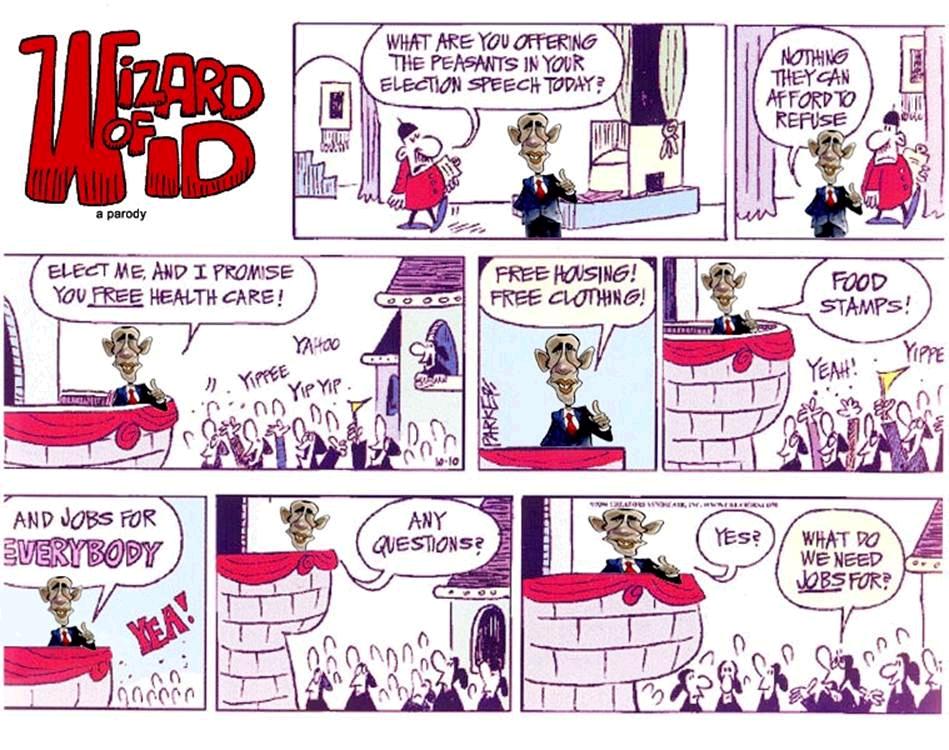
From now on, I will try to remember to use this cartoon. It’s a parody of Obama’s policies, but the last slide (or is it a panel?) is a great teaching tool about what happens when politicians turn the safety net into a hammock.









 The Daily Hatch