Monthly Archives: April 2012

How can the Federal Reserve buy trillions dollars of our national debt without any money?

Uploaded by on Jan 4, 2008

Thousands of media outlets descended on Iowa, erecting a powerful wall of TV cameras and reporters between the voters and candidates. Bill Moyers talks with Ron Paul who knows well the power of the press to set expectations and transform the agenda.

____________________________

We should not be running up our debt and I thought we would have to stop running up our debt if countries like China decided to stop buying most of our treasury bonds, but when that happened then the Federal Reserve stepped in.

I don’t understand how the Federal Reserve can buy trillion of dollars of our national debt but they don’t have any money in the budget to do so?

This article below does offer  a  few ideas on this.  Ron Paul’s Surprisingly Lucid Solution to the Debt Ceiling Impasse

 Representative Ron Paul has hit upon a remarkably creative way to deal with the impasse over the debt ceiling: have the Federal Reserve Board destroy the $1.6 trillion in government bonds it now holds. While at first blush this idea may seem crazy, on more careful thought it is actually a very reasonable way to deal with the crisis. Furthermore, it provides a way to have lasting savings to the budget.

The basic story is that the Fed has bought roughly $1.6 trillion in government bonds through its various quantitative easing programs over the last two and a half years. This money is part of the $14.3 trillion debt that is subject to the debt ceiling. However, the Fed is an agency of the government. Its assets are in fact assets of the government. Each year, the Fed refunds the interest earned on its assets in excess of the money needed to cover its operating expenses. Last year the Fed refunded almost $80 billion to the Treasury. In this sense, the bonds held by the Fed are literally money that the government owes to itself.

Unlike the debt held by Social Security, the debt held by the Fed is not tied to any specific obligations. The bonds held by the Fed are assets of the Fed. It has no obligations that it must use these assets to meet. There is no one who loses their retirement income if the Fed doesn’t have its bonds. In fact, there is no direct loss of income to anyone associated with the Fed’s destruction of its bonds. This means that if Congress told the Fed to burn the bonds, it would in effect just be destroying a liability that the government had to itself, but it would still reduce the debt subject to the debt ceiling by $1.6 trillion. This would buy the country considerable breathing room before the debt ceiling had to be raised again. President Obama and the Republican congressional leadership could have close to two years to talk about potential spending cuts or tax increases. Maybe they could even talk a little about jobs.

In addition, there’s a second reason why Representative Paul’s plan is such a good idea. As it stands now, the Fed plans to sell off its bond holdings over the next few years. This means that the interest paid on these bonds would go to banks, corporations, pension funds, and individual investors who purchase them from the Fed. In this case, the interest payments would be a burden to the Treasury since the Fed would no longer be collecting (and refunding) the interest.

To be sure, there would be consequences to the Fed destroying these bonds. The Fed had planned to sell off the bonds to absorb reserves that it had pumped into the banking system when it originally purchased the bonds. These reserves can be created by the Fed when it has need to do so, as was the case with the quantitative easing policy. Creating reserves is in effect a way of “printing money.” During a period of high unemployment, this can boost the economy with little fear of inflation, since there are many unemployed workers and excess capacity to keep downward pressure on wages and prices. However, at some point the economy will presumably recover and inflation will be a risk. This is why the Fed intends to sell off its bonds in future years. Doing so would reduce the reserves of the banking system, thereby limiting lending and preventing inflation. If the Fed doesn’t have the bonds, however, then it can’t sell them off to soak up reserves.

But as it turns out, there are other mechanisms for restricting lending, most obviously raising the reserve requirements for banks. If banks are forced to keep a larger share of their deposits on reserve (rather than lend them out), it has the same effect as reducing the amount of reserves. To take a simple arithmetic example, if the reserve requirement is 10 percent and banks have $1 trillion in reserves, the system will support the same amount of lending as when the reserve requirement is 20 percent and the banks have $2 trillion in reserves. In principle, the Fed can reach any target for lending limits by raising reserve requirements rather than reducing reserves.

As a practical matter, the Fed has rarely used changes in the reserve requirement as an instrument for adjusting the amount of lending in the system. Its main tool has been changing the amount of reserves in the system. However, these are not ordinary times. The Fed does not typically buy mortgage backed securities or long-term government bonds either. It has been doing both over the last two years precisely because this downturn is so extraordinary. And in extraordinary times, it is appropriate to take extraordinary measures—like the Fed destroying its $1.6 trillion in government bonds and using increases in reserve requirements to limit lending and prevent inflation.

In short, Representative Paul has produced a very creative plan that has two enormously helpful outcomes. The first one is that the destruction of the Fed’s $1.6 trillion in bond holdings immediately gives us plenty of borrowing capacity under the current debt ceiling. The second benefit is that it will substantially reduce the government’s interest burden over the coming decades. This is a proposal that deserves serious consideration, even from people who may not like its source.

Dean Baker is the co-director of the Center for Economic and Policy Research. His most recent book is False Profits: Recovering from the Bubble Economy.
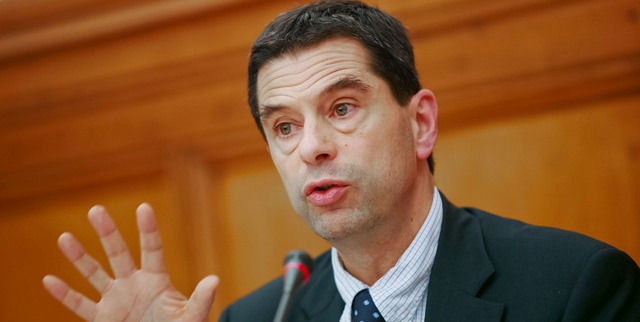
 

Obama’s stimulus was a failure like Dan Mitchell of the Cato Institute predicted

The stimulus was a huge failure and I hope everyone who voted for it will be defeated in their re-election attempts. Dan Mitchell of the Cato Institute predicted it would be a failure back in January of 2009!!!!

President Obama imposed a big-spending faux stimulus program on the economy back in 2009, claiming that the government needed to squander about $800 billion to keep the unemployment rate from rising above 8 percent.

How did that work out? One possible description is that the so-called stimulus became a festering pile of manure. About three years have passed, and the joblessness rate hasn’t dropped below 8 percent. But the White House has been sprinkling perfume on that pile of you-know-what and claiming that the Keynesian spending binge was good policy.

But not every politician is blindly ideological like Obama. Vitor Gaspar, Portugal’s Finance Minister, is willing to admit error. Here are some relevant excerpts from a New York Times report.

Unlike Obama, willing to admit mistakes

Mr. Gaspar, speaking to The New York Times last week, has a message for observers who say Europe needs to substantially relax its austerity approach: We tried stimulus and it backfired. Like some other European countries, Portugal tried what Mr. Gaspar called “a Keynesian style expansion” in 2008, referring to a theory by economist John Maynard Keynes. But it didn’t turn things around, and may have made things worse.

Why does the Portuguese Finance Minister have this view? Well, for the simple reason that the economy got worse and more spending put his country in a deeper fiscal ditch.

The yield on Portuguese government bonds – more than 11 percent on longer-term bonds — is substantially higher than the yields on debt issued by Ireland, Spain or Italy. …The main fear among investors is that Portugal is going to have to ask for a second bailout from the International Monetary Fund and the European Union, which committed $103 billion of financial aid in 2011.

Maybe the big spenders in Portugal should import some of the statist bureaucrats at Congressional Budget Office. The CBO folks could then regurgitate the moving-goalposts argument that they’ve used in the United States and claim that the economy would be even weaker if the government hadn’t wasted more money.

But perhaps the Portuguese left doesn’t think that will pass the laugh test.

Amazingly, the Germans, who have a disturbing affinity for powerful government, decided against Keynesianism and that’s paid dividends for their economy.

In any event, some of us can say we were right from the beginning about this issue.

_________________

Obama’s So-Called Stimulus: Good For Government, Bad For the Economy

Uploaded by on Jan 26, 2009

President Obama wants Congress to dramatically expand the burden of government spending. This CF&P Foundation mini-documentary explains why such a policy, based on the discredited Keynesian theory of economics, will not be successful. Indeed, the video demonstrates that Obama is proposing – for all intents and purposes – to repeat Bush’s mistakes. Government will be bigger, even though global evidence shows that nations with small governments are more prosperous.

_________________

Not that being right required any keen insight. Keynesian policies failed for Hoover and Roosevelt in the 1930s. So-called stimulus policies also failed for Japan in 1990s. And Keynesian proposals failed for Bush in 2001 and 2008.

Just in case any politicians are reading this post, I’ll make a point that normally goes without saying: Borrowing money from one group of people and giving it to another group of people does not increase prosperity.

But since politicians probably aren’t capable of dealing with a substantive argument, let’s keep it simple and offer three very insightful cartoons: here, here, and here.

In 2011 Social Security spent $45 billion more in benefits than it took in from its payroll tax

Uploaded by on Jun 21, 2011

Senator Kay Bailey Hutchison delivered remarks regarding her landmark proposal on entitlement reform, the Defend and Save Social Security Act at the Heritage Foundation’s “Saving Social Security” event. Sen. Hutchison announced that Senator Jon Kyl (R-AZ), member of Biden’s budget working group, has lent his support of her bill as the original cosponsor. At her press conference last week, Sen. Hutchison unveiled her Social Security proposal, and today she reiterated the urgency of putting Social Security on the table in the Biden budget group discussions. Sen. Hutchison sent a letter to Vice President Joe Biden last week urging him to incorporate Social Security reform in the ongoing deficit reduction debates that he is leading.

___________________

If you don’t think that Social Security is in trouble then just consider the fact that the first Baby Boomer just got their first Social Security check at age 65 in 2011 and now we have 19 more years of baby boomers retiring. Also in 2011 Social Security spent $45 billion more in benefits than it took in from its payroll tax.

Social Security Finances Significantly Worse, Says 2012 Trustees Report

By
April 23, 2012

“There are risks and costs to action. But they are far less than the long-range risks of comfortable inaction.”

—John F. Kennedy

“Lawmakers should not delay addressing the long-run financial challenges facing Social Security and Medicare,” the trustees wrote. “If they take action sooner rather than later, more options and more time will be available to phase in changes so that the public has adequate time to prepare.”

—2012 Social Security trustees report

Social Security’s finances significantly worsened last year, according to the new 2012 trustees report,[1] because of a weakened economy and structural problems with the program. The April 23 report shows that all people who receive Social Security benefits face about a 25 percent benefit cut as soon as 2033—three years earlier than predicted in last year’s report. The program’s long-term deficit is now larger than it was before the 1983 reforms. In order to pay all of its promised benefits, Social Security would require massive annual injections of general revenue tax money in addition to what the program receives from payroll taxes. These additional funds would be needed for the next 75 years and beyond.

Factors Dragging Down Social Security

The poor numbers come from a number of factors, including the continued weakness of the U.S. economy, high energy prices holding down wages, and a significant increase in the number of people who receive benefits from Social Security’s disability program (SSDI). SSDI has its own sub-trust fund that will be exhausted in 2016. While some SSDI costs will be paid from money that would have gone to pay retirement and survivors’ benefits, SSDI recipients face across-the-board benefit reductions in just four years. As this year’s report shows, the need to reform SSDI is as great as the need to fix the rest of the program.

Long-Term Financial Picture Worsens

In net-present-value terms, Social Security owes $11.3 trillion more in benefits than it will receive in taxes. This 2012 number consists of $2.7 trillion to repay the special-issue bonds in the trust fund and $6.5 trillion to pay benefits after the trust fund is exhausted in 2033. This is an increase of $2.2 trillion from last year’s report. This is the largest one-year drop in the program’s finances since 1994.

Net present value is the amount of money that would have to be invested today in order to have enough money on hand to pay deficits in the future. In other words, Congress would have to invest $11.3 trillion today in order to have enough money to pay all of Social Security’s promised benefits through 2086. This money would be in addition to what Social Security receives during those years from its payroll taxes.

The trustees report’s perpetual projection extends beyond the usual 75-year planning horizon. In net-present-value terms, the perpetual projection is $20.5 trillion, including money necessary to repay bonds in the trust fund. Last year’s number was $17.9 trillion.

This means that Social Security’s net-present-value deficit after 2086 is $9.2 trillion. These projections show that the program’s total deficit continues to grow well beyond the 75-year projection period. For that reason, a successful reform would need to eliminate the deficits over the 75-year window and address those that come after that period.

In actuarial terms, Social Security’s long-term financing declined sharply from a 75-year deficit of 2.22 percent of taxable payroll in last year’s report to a deficit of 2.67 percent. This 0.44 percent change resulted mainly from the economy’s continued weakness and the effects of high energy costs.

Social Security Ran Another Deficit Last Year

In 2011, the Old-Age and Survivors Trust Fund, which pays for retirement and survivors’ benefits, took in $698.8 billion, which includes $106.5 billion that came from a paper transaction that credited interest to the trust fund. Excluding the interest, the retirement and survivors program had income of $592.3 billion but paid out $603.8 billion in benefits, leaving a deficit for 2011 of $11.5 billion. Additional deficits were suffered by Social Security’s disability program.

Counting both programs together, in 2011, Social Security spent $45 billion more in benefits than it took in from its payroll tax. This deficit is in addition to a $49 billion gap in 2010 and an expected average annual gap of about $66 billion between 2012 and 2018. These deficits will quickly balloon to alarming proportions. After adjusting for inflation, annual deficits will reach $95 billion in 2020 and $318.7 billion in 2030 before the trust fund runs out in 2033. Now is the time to focus on solutions.

The immediate cash-flow deficits are largely due to the effects of the recession on the program’s finances. The recession increased the amount of benefits paid out by Social Security, as older workers who lost their jobs chose to file for benefits earlier than they might have otherwise. Meanwhile, younger unemployed workers did not pay Social Security taxes, while workers who suffered a drop in their incomes paid lower amounts. However, this year’s projections show that these effects will continue. Higher energy prices are expected to dampen income increases, while the longer-term effects of the recession are likely to hold down the number of hours individuals can work.

Moreover, the condition of Social Security continues to deteriorate in future years so that the overall estimate is further worsened in 2012, when the 75-year financial window shifts to include 2086—a year when Social Security is expected to run a very large deficit.

The Trust Fund Does Not Make Social Security Healthy

The existence of a trust fund does not make Social Security healthy. Although those assets are guaranteed by the full faith and credit of the United States, the bonds it contains must be repaid using general revenue that would otherwise go to other programs. Similarly, the interest that Social Security receives on existing trust fund balances is not spendable income. It merely inflates the numbers in the trust fund and increases the amount that Social Security will eventually receive from general revenue. The only part that counts today is the cash that Social Security receives from the Treasury to cover its annual operating losses.

Many opponents of reform claim that raising payroll taxes by about 2.7 percent (the average percentage difference between revenues and outlays over the 75-year period) would permanently solve Social Security’s problems. The reality, however, is that the program’s future deficits are projected to be both large and growing, so this tax increase would still leave a huge shortfall. Modest changes will not fix the current system.

Delay in Fixing Social Security Will Only Make Matters Even Worse

Congress could have fixed Social Security several years ago but delayed because it feared making the difficult decisions. A further delay in addressing Social Security’s financial problems will only make the situation even worse. The new trustees report is not based on conjecture; it is based on a firm understanding of the economy and the U.S. population. Almost every new taxpayer who will begin a career before 2033 is living today and can be counted. Similarly, all the people who will face approximately 25 percent across-the-board benefit cuts starting in the year 2033 if Congress does nothing to fix the program are alive now, and most of them are paying taxes.

Social Security’s problems are based on demographics that do not change from year to year. The people who will be hurt if nothing is done to fix Social Security are not unknown people of the future: They are the nation’s children and grandchildren of today.

David C. John is Senior Research Fellow in Retirement Security and Financial Institutions in the Thomas A. Roe Institute for Economic Policy Studies at The Heritage Foundation.

Dan Mitchell of the Cato Institute: How to balance the budget

It’s Simple to Balance The Budget Without Higher Taxes

Uploaded by on Oct 4, 2010

Politicians and interest groups claim higher taxes are necessary because it would be impossible to cut spending by enough to get rid of red ink. This Center for Freedom and Prosperity video shows that these assertions are nonsense. The budget can be balanced very quickly by simply limiting the annual growth of federal spending.

____________________

People are being told that radical spending cuts are a must if we are to balance the budget, but maybe that is not true.

Even though I favor radical reductions in the burden of government, I’ve made the point that good fiscal policy merely requires that government spending grow slower than the private sector – what I call Mitchell’s Golden Rule.

And if lawmakers simply cap the growth of spending, so that it grows by about 2 percent annually, the budget deficit disappears in a decade.

It’s even better to impose more restraint, of course, which is why I’ve said favorable things about Senator Rand Paul’s plan.

There’s also a “Penny Plan” that would reduce primary spending (non-interest spending) by 1 percent each year. As James Carter and Jason Fichtner explain, this degree of fiscal restraint would reduce the burden of government spending to about 18 percent of economic output.

Any viable solution must cut spending growth. Sen. Mike Enzi of Wyoming and Rep. Connie Mack of Florida have introduced legislation in their respective chambers to do just that. Their “Penny Plan” – recently updated to reflect the latest budget developments – calls for reducing federal spending (excluding interest payments) 1 percent a year for five years, balancing the budget in the fifth year. To maintain balance once it’s reached, Mr. Enzi and Mr. Mack would cap federal spending at 18 percent of GDP. By no small coincidence, 18 percent of GDP roughly matches the U.S. long-run average level of taxation since World War II. Is it realistic to think Congress could limit federal spending to 18 percent of GDP? Actually, there is precedent. Federal spending fell as a share of GDP for nine consecutive years before bottoming out at 18.2 percent of GDP in fiscal 2000 and 2001. The Penny Plan would return federal spending, expressed as a share of GDP, near the level achieved during the last two years of the Clinton administration.

The various interest groups that infest Washington would complain about this degree of spending discipline, but Carter and Fichtner make a good point when they say that this simply means the same size government – as a share of GDP – that we had when Bill Clinton left office.

I realize I’m getting old and my memory may not be what it used to be, but I don’t recall people starving in the streets and grannies being ejected from hospitals during the Clinton years. Am I missing something?

Max Brantley acts as if there is money in Social Security Fund

Max Brantley brags about the Social Security fund lasting till 2033, but here are the cold hard facts:

Sometimes, Governments Lie (6th Anniversary Ed.)

Posted by Michael F. Cannon

(This blog post first appeared at Cato@Liberty following the release of the 2006 Medicare and Social Security trustees’ reports. I repost it, with updated links and “exhaustion dates” because sadly nothing else has changed.)

Sometimes, Governments Lie

Year after year, federal officials speak of the Social Security and Medicare trust funds as if they were real.  Yesterday Today, the government announced that the Social Security trust fund will be exhausted in 2040 2033 and that the Medicare hospital insurance trust fund will be exhausted in 2018 2024— projections that the media dutifully reported.

But those dates are meaningless, because there are no assets for these “trust funds” to exhaust.  The Bush administration wrote in its FY2007 budget proposal:

These balances are available to finance future benefit payments and other trust fund expenditures—but only in a bookkeeping sense. These funds…are not assets…that can be drawn down in the future to fund benefits…When trust fund holdings are redeemed to pay benefits, Treasury will have to finance the expenditure in the same way as any other Federal expenditure: out of current receipts, by borrowing from the public, or by reducing benefits or other expenditures. The existence of large trust fund balances, therefore, does not, by itself, increase the Government’s ability to pay benefits.

This is similar to language in the Clinton administration’s FY2000 budget, which noted that the size of the trust fund “does not…have any impact on the Government’s ability to pay benefits” (emphasis added).

I offer the following proposition:

If the government knows that there are no assets in the Social Security and Medicare “trust funds,” and yet projects the interest earned on those non-assets and the date on which those non-assets will be exhausted, then the government is lying.

If that’s the case, then these annual trustees reports constitute an institutionalized, ritualistic lie.  Also ritualistic is the media’s uncritical repetition of the lie.

Quotes from Milton Friedman (part 1)

Milton Friedman  discusses collectivism

Uploaded by on Aug 20, 2010

Despite its dismal track record, collectivism continues to hold appeal for some. Professor Friedman discusses this dynamic.

____________

People should have more of their own money to spend than they do now. We have gone from the federal government spending less than 5% of our money 80 years ago to spending 24.8% of GDP today.

Here are some quotes from Milton Friedman that I thought you would enjoy:

  • I think the government solution to a problem is usually as bad as the problem and very often makes the problem worse.
    • An Economist’s Protest (1975), p. 6; often quoted as “The government solution to a problem is usually as bad as the problem.”
  • I want people to take thought about their condition and to recognize that the maintenance of a free society is a very difficult and complicated thing and it requires a self-denying ordinance of the most extreme kind.It requires a willingness to put up with temporary evils on the basis of the subtle and sophisticated understanding that if you step in to do something about them you not only may make them worse, you will spread your tentacles and get bad results elsewhere.
  • I say thank God for government waste. If government is doing bad things, it’s only the waste that prevents the harm from being greater.
    • Interview with Richard Heffner on The Open Mind (7 December 1975)
  • One of the great mistakes is to judge policies and programs by their intentions rather than their results.
    • Interview with Richard Heffner on The Open Mind (7 December 1975)
  • In this day and age, we need to revise the old saying to read, “Hell hath no fury like a bureaucrat scorned.
    • “Bureaucracy Scorned” in Newsweek (29 December 1975), later published in Bright Promises, Dismal Performance : An Economist’s Protest (1983)
  • Industrial progress, mechanical improvement, all of the great wonders of the modern era have meant little to the wealthy. The rich in ancient Greece would have benefited hardly at all from modern plumbing — running servants replaced running water. Television and radio — the patricians of Rome could enjoy the leading musicians and actors in their home, could have the leading artists as domestic retainers. Ready-to-wear clothing, supermarkets — all these and many other modern developments would have added little to their life. They would have welcomed the improvements in transportation and in medicine, but for the rest, the great achievements of western capitalism have rebounded primarily to the benefit of the ordinary person. These achievements have made available to the masses conveniences and amenities that were previously the exclusive prerogative of the rich and powerful.
    • Free to Choose (1980) p.148

Open letters to President Obama displayed here on www.thedailyhatch.org

I have been writing letters to President Obama almost all of 2012. I have received several responses from the White House but none of the responses have been personal responses from the President.

Below is a letter I wrote to the President and a form letter response that I got followed by links to other letters I have written him.

KIreland.jpg 

Science Matters #2: Former supermodel Kathy Ireland tells Mike Huckabee about how she became pro-life after reading what the science books have to say.

President Obama c/o The White House
1600 Pennsylvania Avenue NW
Washington, DC 20500

Dear Mr. President,

I know that you receive 20,000 letters a day and that you actually read 10 of them every day. I really do respect you for trying to get a pulse on what is going on out here.

I wanted to talk to you today about your views on abortion. Everyone remembers Kathy Ireland from her Sports Illustrated days and actually she has became a very successful business person.  However, I wanted to talk about her pro-life views.

_____________

Back on April 27, 2009 Fox News ran a story by Hollie McKay(Supermodel Kathy Ireland Lashes Out Against Pro Choice,”) on  Ireland.

It’s no secret that the majority of Hollywood stars are strong advocates for a woman’s right to choose whether or not she wants to terminate a pregnancy, however former “Sports Illustrated” supermodel-turned-entrepreneur-turned-author Kathy Ireland has gone against the grain of the glitterati and spoken out against abortion.

“My entire life I was pro-choice — who was I to tell another woman what she could or couldn’t do with her body? But when I was 18, I became a Christian and I dove into the medical books, I dove into science,” Ireland told Tarts while promoting her insightful new book “Real Solutions for Busy Mom: Your Guide to Success and Sanity.”

“What I read was astounding and I learned that at the moment of conception a new life comes into being. The complete genetic blueprint is there, the DNA is determined, the blood type is determined, the sex is determined, the unique set of fingerprints that nobody has had or ever will have is already there.”

However Ireland admitted that she did everything she could to avoid becoming a believer in pro-life.

“I called Planned Parenthood and begged them to give me their best argument and all they could come up with that it is really just a clump of cells and if you get it early enough it doesn’t even look like a baby. Well, we’re all clumps of cells and the unborn does not look like a baby the same way the baby does not look like a teenager, a teenager does not look like a senior citizen. That unborn baby looks exactly the way human beings are supposed to look at that stage of development. It doesn’t suddenly become a human being at a certain point in time,” Ireland argued. “I’ve also asked leading scientists across our country to please show me some shred of evidence that the unborn is not a human being. I didn’t want to be pro-life, but this is not a woman’s rights issue but a human rights issue.”

My good friend Dr. Kevin R. Henke is a scientist and also an atheistic evolutionist. I had a lot of discussions with Kevin over religious views. I remember going over John 7:17 with him one day. It says:

John 7:17 (Amplified Bible)

17If any man desires to do His will (God’s pleasure), he will know (have the needed illumination to recognize, and can tell for himself) whether the teaching is from God or whether I am speaking from Myself and of My own accord and on My own authority.

I challenged Kevin to read a chapter a day of the Book of John and pray to God and ask God, “Dear God, if you are there then reveal yourself to me, and I pledge to serve you the rest of my life.”

Kevin did that and he even wrote down the thoughts that came to his mind and sent it to me and these thoughts filled a notebook.

Kevin did not become a Christian, but I am still praying for him. I do respect Kevin because he is an honest man. Interestingly enough he  told me that he was pro-life because the unborn baby has all the genetic code at  the time of conception that they will have for the rest of their life. Below are some other comments by other scientists:

Dr. Hymie Gordon (Mayo Clinic): “By all criteria of modern molecular biology, life is present from the moment of conception.”

Dr. Micheline Matthews-Roth (Harvard University Medical School): “It is scientifically correct to say that an individual human life begins at conception.”

Dr. Alfred Bongioanni (University of Pennsylvania): “I have learned from my earliest medical education that human life begins at the time of conception.”

Dr. Jerome LeJeune, “the Father of Modern Genetics” (University of Descartes, Paris): “To accept the fact that after fertilization has taken place a new human has come into being is no longer a matter of taste or opinion . . . it is plain experimental evidence.”

__

Thank you so much for your time. I know how valuable it is. I also appreciate the fine family that you have and your committment as a father and a husband.

Sincerely,

Everette Hatcher III, 13900 Cottontail Lane, Alexander, AR 72002, ph 501-920-5733, lowcostsqueegees@yahoo.com

_______________

I actually mailed this to President Obama about a week ago and got this email back:

The White House, Washington


April 16, 2012

Dear Everette:

Thank you for taking the time to share your views on abortion.  This is a heart-wrenching issue, and I appreciate your input and thoughts.

I am committed to making my Administration the most open and transparent in history, and part of delivering on that promise is hearing from people like you.  I take seriously your opinions and respect your point of view on this issue.  Please know that your concerns will be on my mind in the days ahead.

Thank you, again, for writing.  I encourage you to visit www.WhiteHouse.gov to learn more about my Administration or to contact me in the future.

Sincerely,

Barack Obama

An open letter to President Obama (Part 65)

Leader Cantor On CNN Responding To President Obama’s State of the Union Address Uploaded by EricCantor on Jan 25, 2012 ______________ President Obama c/o The White House 1600 Pennsylvania Avenue NW Washington, DC 20500 Dear Mr. President, I know that you receive 20,000 letters a day and that you actually read 10 of them every day. I […]


“Feedback Friday” Letter to White House generated form letter response March 7, 2011 (part 3)

I have been writing President Obama letters and have not received a personal response yet.  (He reads 10 letters a day personally and responds to each of them.) However, I did receive a form letter in the form of an email on March 7, 2011. I don’t know which letter of mine generated this response so I have […]


An open letter to President Obama (Part 58) “Our national debt threatens our security”

Liam Fox Issues a Warning to America Uploaded by HeritageFoundation on Feb 28, 2012 Britain’s Liam Fox has a warning for America: Fix the debt problem now or suffer the consequences of less power on the world stage. The former U.K. secretary of state for defense visited Heritage to explain why the America’s debt is […]

“Feedback Friday” Letter to White House generated form letter response Jan 27, 2011 (part 2)

I have been writing President Obama letters and have not received a personal response yet.  (He reads 10 letters a day personally and responds to each of them.) However, I did receive a form letter in the form of an email on January 27, 2011. I don’t know which letter of mine generated this response so I have […]

“Feedback Friday” Letter to White House generated form letter response Jan 25, 2011 (part 1)

I have been writing President Obama letters and have not received a personal response yet.  (He reads 10 letters a day personally and responds to each of them.) However, I did receive a form letter in the form of an email on January 25, 2011. I don’t know which letter of mine generated this response so I have […]

An open letter to President Obama (Part 48 of my response to State of Union Speech 1-24-12)

An open letter to President Obama (Part 48 of my response to State of Union Speech 1-24-12) Rep Michael Burgess response Uploaded by MichaelCBurgessMD on Jan 25, 2012 This week Dr. Burgess provides an update from Washington and responds to President Obama’s State of the Union address. President Obama’s state of the union speech Jan 24, 2012 […]

An open letter to President Obama (Part 47, A response to your budget)

Corker Says President’s 2012 Budget Proposal Shows “Lack of Urgency” on Spending Uploaded by senatorcorker on Feb 14, 2011 In remarks on the Senate floor today, U.S. Senator Bob Corker, R-Tenn., expressed disappointment in President Obama’s 2012 budget proposal, saying it displayed a “lack of urgency” to get federal spending under control. Corker has introduced […]

An open letter to President Obama (Part 1 of State of Union Speech 1-24-12)

President Obama’s state of the union speech Jan 24, 2012 Feb 6, 2012 President Obama c/o The White House 1600 Pennsylvania Avenue NW Washington, DC 20500 Dear Mr. President, I know that you receive 20,000 letters a day and that you actually read 10 of them every day. I really do respect you for trying […]

An open letter to President Obama

  January 25, 2012 President Obama c/o The White House 1600 Pennsylvania Avenue NW Washington, DC 20500 Dear Mr. President, I know that you receive 20,000 letters a day and that you actually read 10 of them every day. I really do respect you for trying to get a pulse on what is going on […]


An open letter to President Obama (Part 65)

Leader Cantor On CNN Responding To President Obama’s State of the Union Address

Uploaded by on Jan 25, 2012

______________

President Obama c/o The White House
1600 Pennsylvania Avenue NW
Washington, DC 20500

Dear Mr. President,

I know that you receive 20,000 letters a day and that you actually read 10 of them every day. I really do respect you for trying to get a pulse on what is going on out here.

Here is an excellent piece from the Heritage Foundation with a reaction to the president’s proposed budget:

Spectrum Availability Is Crucial to Growth – James Gattuso

The President’s budget released today includes some $31 billion in revenue from the auction of spectrum licenses for mobile broadband use. Of this, $10 billion would be spent on a public safety broadband network, with the rest purported to reduce the deficit, although the amount received is far outweighed by new spending elsewhere in the budget and is only a one-time revenue infusion. But setting that aside, the auction of these frequencies, now used by broadcasters, deservedly has widespread support. The wireless industry is one of the few booming areas of the U.S. economy, but with demand skyrocketing, it is rapidly running out of spectrum to provide service. Making more spectrum available is crucial to maintaining that growth. Legislation is already moving in Congress to authorize such auctions. But there is a snag: The Obama Administration, as well as the Federal Communications Commission (FCC), whose chairman is an Obama appointee, is insisting that any legislation allow the FCC to exclude the two biggest current users of spectrum—Verizon and AT&T—from bidding. The result would be not only to reduce the revenue gained but to starve the two leading providers of wireless service from the resources they need. Rather than pre-select the winners and losers, regulators at the FCC should conduct an open process, letting all participate and letting the market decide how this valuable resource is allocated.

 _______________

The government is always looking ways to get more tax revenue and put in more regulation. I predict the government will probably mess this area up too. I wish more people were exposed to the simple wisdom that Milton Friedman’s film series “Free to Choose” gives us and that is we need less regulation and less taxes and not more.

Thank you so much for your time. I know how valuable it is. I also appreciate the fine family that you have and your committment as a father and a husband.

Sincerely,

Everette Hatcher III, 13900 Cottontail Lane, Alexander, AR 72002, ph 501-920-5733, lowcostsqueegees@yahoo.com

Margaret Thatcher (Part 1)

Margaret Thatcher (Part 1)

Margaret Thatcher is one of my heroes and I have a three part series on her I am posting. “What We Can Learn from Margaret Thatcher,”By Sir Rhodes Boyson and Antonio Martino, Heritage Foundation, November 24, 1999, is an excellent article and here is a portion of it below:

Margaret Thatcher has her place in world as well as British history. Her very name is used to denote a way of thinking: Thatcherism. She herself was not an original thinker, and on her resignation the editor of the Daily Telegraph described Thatcherism as a powerful collection of beliefs about the capacities of human beings in a political society. The ideas were not new but were put into operation by a very remarkable woman. It was the happy coincidence of the right person, in the right place, at the right time.

When she became leader of the Conservative Party in 1975, Britain was on the brink of disaster, threatened by total collapse. The weak Labour government with a small majority presided over a bankrupt economy in hock to the IMF and threatened from within by a challenge to law and order itself. When she was forced from power in 1990, she left a sound economy and a confident and well-ordered society. The lessons are writ large.

The achievement was remarkable, starting with the fact of being the only woman Prime Minister in British history — something America has yet to emulate. She enjoyed 11 and a half years in office, longer than any other 20th century politician (in fact, the longest since Lord Liverpool in the 19th century). She won three successive general elections, two of them being landslide majorities, and lost none. The secret of her success lies in a combination of qualities, which both saw her into leadership and were the essence of her period in power:

  • Courage to see an opportunity and take it.
  • Decisiveness in times of crisis.
  • Clear beliefs held with an evangelical zeal. During the 1979 election, she ridiculed the Socialist Prime Minister Callaghan saying, “The Old Testament prophets did not say `Brothers, I want a consensus.’ They said, `This is my faith; this is what I passionately believe; if you believe it too, then come with me.'” Her crusading qualities were embedded in her Methodist background, which gave a moral purpose to all she did.
  • Physical strength. She needed little sleep and would certainly have been killed by the IRA bomb in Brighton if she had not been working on her conference speech at 2:00 a.m.
  • Intellectual capacity. She entered Oxford at 17 reading chemistry.

She was a slight, pretty, feminine woman in a man’s world. She turned what could have been a disadvantage into a useful weapon, and she had luck.

Domestic Policy

Monetarism underpinned all Margaret Thatcher’s policies. The beliefs were clear and are still what a free country needs to prosper. The aims were clear: to reduce the power of government, to reduce taxation and thereby promote private enterprise and individual rights, to give incentives to businessmen and encourage competition. Margaret Thatcher believed that these aims would produce economic and fiscal benefits for the people and enable her to use the political process to further the free society in all its aspects.

The economic lessons of these beliefs are going to be dealt with by Antonio Martino. In this he is fortunate, for monetarism and the free market are what most excited Margaret Thatcher. Suffice for me to say that what Thatcher pledged in her manifestos was delivered. She used simple imagery that everyone could understand. She was the grocer’s daughter, the housekeeper of the nation who would balance the budget and the nation would only spend what it could afford.

It was only after 1987 when Chancellor Lawson shadowed the deutsche mark and Britain entered the ERM that the Conservatives learnt you cannot buck the market. The price was failure in 1997. But it is important to remember that at no point did the public lose faith in the free market which Margaret Thatcher did so much to encourage. The opposition have adopted this policy, and the last election was fought partly on the basis of who could best implement that policy — a key part of Thatcher’s legacy.

The monetary reforms of Margaret Thatcher were paralleled by moves to curb the power of the trade unions in Britain. Just as the Conservative Party already had taken up free market ideas in its manifesto for the 1970 election, so the intention to work with the trade unions was not entirely new. The Labour Party under Harold Wilson had introduced legislation “in place of strife,” and when it failed, the floodgates of intransigence were opened.

Callaghan (himself a trade unionist) had tried to build a social contract between the Labour government and the trade unions. When consensus patently failed, in the winter of discontent of 1979, it left the field open for Margaret Thatcher. The time was ripe, but she made the difference. She had a will of iron and stood firm against a barrage of strikes and intimidation, until between 1982 and 1988 the unions were brought step by step within the law. After the final confrontation with the steel and coal industries, the proper balance between employer and workforce was restored. Men no longer had to join a trade union, and this, combined with the program of privatizing nationalized industries, resulted in a reduction of union membership from 13 million in 1979 to 8 million in 1996.

The defeat of the trade unions, together with privatization, represented one of Margaret Thatcher’s greatest successes. The effect was to bring large sections of the working class within the Conservative fold. She had extended to them what had been regarded as middle-class ideals and had, through privatization, created popular capitalism and the beginnings of a shareholding democracy.

When Margaret Thatcher took office, there were 3 million private shareholders; when she left, there were almost 11 and a half million. The tabloid newspapers latched onto this and joined their broadsheet cousins in publishing alongside the racing columns share market information and news. The popularity of privatization increased as each industry was floated on the stock exchange. When the gas industry was launched, the shares were oversubscribed by 500 percent.

Working people were given a further stake in society by the sale of locally subsidized housing, in which many of them lived. They were sold to tenants at knockdown prices, and between 1979 and 1989 owner occupation increased from 55 to 63 percent. Despite the setback of the recession of the early 1990s, the ambition of most of the electorate remained to own their own home.

As Margaret Thatcher drew the wider electorate into her beliefs, it should be remembered that she had originally had to fight all the way within her own party. Unlike an American President, who takes with him his whole machine, Margaret Thatcher was an outsider who inherited a Cabinet and party machine, both of which were consensual in attitude. This applied even more so to the civil service, which for 15 of the previous 19 years had been under socialist direction.

She used similar tactics to turn round all three to her way of thinking. She bypassed them until she had the members she wanted. She used subcommittees instead of full Cabinet to ensure her policies. She used outside think tanks: the Institute of Economic Affairs, which had given her the early tutelage in monetarism, and the Centre for Policy Studies, founded by her guru, Sir Keith Joseph. Like Heritage in America, they created the intellectual ideas for she and her followers to implement. She brought in outside advisers: academics like Alan Walters and Terry Burns and successful businessmen like Sir John Hoskins (computer magnate), Derek Rayner (M&S), and Sir Robin Ibbs.

The need to cut bureaucracy and public spending was tackled from the outset, and between 1979 and 1987 the number of civil servants was reduced by 22.5 percent (732,000 to 567,000). The truly radical changes were introduced between 1987 to 1990, inspired by Sir Robin Ibbs. Only a small core of advisers was to be retained to run government machinery, and most civil servants would work for new executive agencies, attached to ministries. Precise targets were to be set and held to. Although the reforms were properly effected after Margaret Thatcher had left office, she had changed the culture of the machinery of government.

It was more difficult to bring about cost cutting and reform in local government and the welfare services of health, social security, and education. The welfare needs were seen by the electorate as free and of right. It is difficult to take a bone away from a dog, and the early years of her premiership were taken up by more pressing matters.

Cost-cutting measures were undertaken in all the services, but despite cash limits being imposed, overall spending rose. (For example, in health, from 1980 to 1987 it increased by 60 percent). In education, my voucher scheme was turned down by
Cabinet, and only minor changes were introduced.

In local government, cost cutting had perverse repercussions. The spendthrift city authorities controlled by the extreme left were rate-capped and the worst of them all, the Greater London Council, abolished. Unfortunately, it allowed Councillors to blame government for shortfall in services and increased centralized control, which reduced freedom.

Margaret Thatcher’s populist instinct had made her more cautious in these areas, but after the election success of 1987, when she saw her monetary policies threatened by runaway costs, she introduced dramatic reform in all these areas. Again they were not properly implemented until she had been forced from office.

The changes that had been undertaken were to prove part of her undoing. The poll tax, which was an individual tax which replaced a property tax, was so unpopular it had to be withdrawn. The health and social security changes frightened the electorate and led to the debacle of 1997. In education, the setting up of grant-maintained schools to bring power and responsibility to individual schools as against the local authority was overturned by the present government.

There is a lesson in all this: Always tackle the controversial or unpopular measures at the beginning of an administration. Margaret Thatcher thought she was doing this after her great election success in 1987. She could not have foreseen she would have been forced out of office in three years. It was not that the ideas were wrong; the think tanks had provided mechanisms to introduce market principles. In these areas, however, only a few politicians had been willing to preach their virtues. Their time is yet to come, the message must still be reiterated.

An open letter to President Obama (Part 64)

Sen. Paul Delivers State of the Union Response – Jan. 24, 2012

Uploaded by on Jan 24, 2012

Sen. Rand Paul delivered the following Republican response to President Barack Obama’s State of the Union Address this evening.

_________________

President Obama c/o The White House
1600 Pennsylvania Avenue NW
Washington, DC 20500

Dear Mr. President,

I know that you receive 20,000 letters a day and that you actually read 10 of them every day. I really do respect you for trying to get a pulse on what is going on out here. Here is an excellent piece from the Heritage Foundation with a reaction to the president’s proposed budget:

Obama’s Budget: A Barrage of Economy-Slowing Tax Hikes – Curtis Dubay To no one’s surprise, President Obama’s budget contains a multitude of tax increases. In total they add up to $1.8 trillion in new levies over 10 years. This is a net total after subtracting for the roughly $88 billion in new tax cuts the President proposes. Many of the tax increases are recycled policies from previous budgets that Congress has repeatedly rejected. The small amount of tax cuts the President offers are mostly incentives for engaging in behaviors (including “green activities”) that the President favors. These are the type of economy-distorting tax policies that tax reform would wipe out, the exception being auto-enrollment in IRA plans. The average revenue collected by the federal government since World War II is around 18 percent of GDP. President Obama’s budget would blow past this upper bound on what Americans will tolerate their government taking from them. Under his budget, revenues would surpass the average revenue mark in 2014. By the end of the 10-year window, revenue would be 20.1 percent of GDP—well above the historical marker and almost equal to the all-time high revenue number set in 2000. Included in the President’s tax hikes are his old favorites, such as raising tax rates on families making more than $250,000 a year back to their level prior to the 2001 and 2003 Bush tax cuts. President Obama would also curtail their deductions and personal exemptions, hike the capital gains tax to 20 percent (23.8 percent when including the new Obamacare surtax), and raise the death tax. Tax hikes on oil and coal companies are back again, as are higher taxes on U.S. multinational companies, which would only increase these businesses’ incentives to locate jobs in more competitive countries. More in-depth analysis of these tax hikes can be found here. The biggest new tax is President Obama’s proposal to tax dividends at the same rate as regular income: 43.4 percent after accounting for the top income tax rate rising to 39.6 percent and the 3.8 percent Obamacare surcharge. Of course, the dividends tax is a double tax, since the corporate income that dividends come from are already taxed 35 percent at the business level. The effective rate on dividends would stand at more than 63 percent if President Obama’s misguided policy became law. This would significantly curtail investment and slow economic growth. The President’s much-touted Buffett tax is not a fleshed out policy in the budget but is paid lip service in a half-hearted outline for tax reform. The President envisions his misguided rule as replacing the Alternative Minimum Tax as part of a broader redo of the tax code. Another policy the President hints at in his tax reform outline is eliminating deductions for families earning more than $1 million a year. Such a policy would eliminate their deductions for mortgage interest, saving for retirement, and health care expenses. The still frail economy cannot withstand the barrage of tax hikes the President calls for. Nor would it benefit from his vision of tax reform. Tax reform first and foremost is revenue neutral. The President’s outline calls for it to raise another $1.5 trillion for the government to spend. Congress should disregard the President’s tax proposals, as it wisely has in previous years, and focus on true tax reform like the plan laid out in The Heritage Foundation’s New Flat Tax.

 ___________________________________

I am glad that JFK and Ronald Reagan saw the wisdom of cutting taxes and these moves by them resulted in two of the biggest times of economic expansion by the US economy. However, this budget proposal for 2012 tries to take us back to some of the highest tax rates we have seen in over 30 years. Why would we want to go back to those levels again?

Thank you so much for your time. I know how valuable it is. I also appreciate the fine family that you have and your committment as a father and a husband.

Sincerely,

Everette Hatcher III, 13900 Cottontail Lane, Alexander, AR 72002, ph 501-920-5733, lowcostsqueegees@yahoo.com