Monthly Archives: April 2012

Christians welcome nonbelievers like Dan Mitchell in their criticism of Ayn Rand’s view of altruism

Nonbelievers like Rand really do not have an answer to the question “What is the meaning of life?”

Ayn Rand on the Purpose of Life

Christians are commanded to help others by Christ. However, many Christians do believe in the free market and think that system best suits the ideas that flow from Christianity. (Doug Douma wrote a fine article on this.)

Ayn Rand was very critical of altruism and she said it was evil. I have a four part series on that and I have posted the links below. Many nonbelievers like Dan Mitchell of the Cato Institute also have been critical of Rand’s attack on altruism and below is his recent article.

I’m in Monaco for the 10th forum of the Convention of Independent Financial Advisors, a Swiss-based NGO that focuses on promoting an ethical and productive environment for private investment. I moderated a couple of panels on interesting topics, including the European fiscal crisis.

Matthieu Ricard

But I want to focus on the comments of another speaker, Monsieur Matthieu Ricard, a French-born Buddhist monk. As you can see from his Wikipedia entry, he’s a very impressive individual. In addition to his other accomplishments, he serves as the French translator for the Dalai Lama.

During one of the dinners, we got into a fascinating conversation about the Buddhist concept of altruism (or at least one strain of that tradition) and Ayn Rand’s concept of selfishness, both as general ideas and as they relate to happiness.

At the risk of sounding un-libertarian, I’m siding with the monk.

Even though I’m a big fan of Ayn Rand and periodically give away copies of Atlas Shrugged to unwary young people, I’ve always been puzzled by the Randian hostility to altruism.

Yes, coercive altruism is wrong. Indeed, it’s not even altruism, particularly if you think (like Michael Gerson or Barack Obama) it’s noble or selfless to forcibly give away other people’s money.

But Rand seemed to think (and some Randians definitely think) that voluntary acts of charity and compassion are somehow wrong. In some sense, these folks take an ultra-homo economicus view that people are relentless utility maximizers based on self interest.

If this is a correct interpretation of Randianism (perhaps I should say Objectivism?), then I think it is inadequate. Yes, people want money, and almost everybody would like more money, but I’m guessing that it is non-monetary things that make people happiest.

I don’t want to sound too warm and fuzzy and ruin my image, but aren’t children, friends, family, and love the things that make the world go ’round for most of us? Yes, we also value achievement, but even that can be unrelated to pecuniary considerations.

These are amateur ramblings on my part, and I’ve probably done a poor job of describing the views of Randians and Monsieur Ricard. Moreover, I’m sure that very intelligent people have examined this issue in a much more sophisticated fashion.

For a fiscal policy wonk like me, though, this conference and this encounter forced me to give some thought to how you can be a big fan of Ayn Rand while also feeling good about holding open doors for little old ladies.

Uploaded by on Jul 17, 2009

Questioned by Mike Wallace, Ayn Rand explains her philosophy of objective reality and contrasts it with altruism.

Related posts:

Christian view versus Ayn Rand on altruism (Part 4)

Ayn Rand on the Purpose of Life Uploaded by prosumption on Apr 27, 2010 Ayn Rand on the Purpose of Life _________________ I ran across a fine article that takes a look at Ayn Rand’s view of capitalism and selfishness and compares it to the Christian view found in the Bible. I have decided to […]

Christians welcome nonbelievers like Dan Mitchell in their criticism of Ayn Rand’s view of altruism

Nonbelievers like Rand really do not have an answer to the question “What is the meaning of life?” Ayn Rand on the Purpose of Life Christians are commanded to help others by Christ. However, many Christians do believe in the free market and think that system best suits the ideas that flow from Christianity. Ayn […]

Christian view versus Ayn Rand on altruism (Part 3)

Uploaded by MetrazolElectricity on Oct 30, 2010 Talking to Rose, patron-saint of the conservative movement , Bill buckley chats about ayn and her magnum opus atlas shrugged. On atlas shrugged, WFB:”I had to flog myself to read it.” On ayn, WFB : “Her scorn for charity,for altruism was such as to build up an unfeeling […]

Christian view versus Ayn Rand on altruism (Part 2)

Uploaded by LibertyPen on Jul 17, 2009 Questioned by Mike Wallace, Ayn Rand explains her philosophy of objective reality and contrasts it with altruism. _________________ I ran across a fine article that takes a look at Ayn Rand’s view of capitalism and selfishness and compares it to the Christian view found in the Bible. I […]

Christian view versus Ayn Rand on altruism (Part 1)

Uploaded by LibertyPen on Oct 26, 2009 Ayn Rand makes the case that altruism is evil. ___________________  I ran across a fine article that takes a look at Ayn Rand’s view of capitalism and selfishness and compares it to the Christian view found in the Bible. I have decided to start a series on this […]


Christian view versus Ayn Rand on altruism (Part 3)

Uploaded by on Oct 30, 2010

Talking to Rose, patron-saint of the conservative movement , Bill buckley chats about ayn and her magnum opus atlas shrugged. On atlas shrugged, WFB:”I had to flog myself to read it.” On ayn, WFB : “Her scorn for charity,for altruism was such as to build up an unfeeling system”

_________________

I ran across a fine article that takes a look at Ayn Rand’s view of capitalism and selfishness and compares it to the Christian view found in the Bible. I have decided to start a series on this subject. The Christian comes from the article “Was Ayn Rand Right?” by Jay Richards.

Was Ayn Rand Right?

Capitalism and Greed
JAF1324
Jay W. Richards

Synopsis

In response to the critics of capitalism, many conservative Christians turn to philosopher Ayn Rand for ammunition. Rand was a staunch defender of capitalism, but also an anti-Christian atheist who argued that capitalism was based on greed. Greed, for Rand, is good. But if Rand is right, then Christians can’t be capitalists, because greed is a sin. Fortunately, Rand was wrong. She missed the subtleties of capitalism. First, we should distinguish self-interest from selfishness. Adam Smith, the father of capitalism, famously wrote, “It is not from the benevolence of the butcher, the brewer, or the baker, that we expect our dinner, but from their regard to their own interest.” True enough; but that alone isn’t a problem. Every time you wash your hands or look both ways before you cross the street, you’re pursuing your self-interest—but neither activity is selfish. Second, Smith never argued that the more selfish we are, the better a market works. His point, rather, is that in a free market, each of us can pursue ends within our narrow sphere of competence and concern—our “self-interest”—and yet an order will emerge that vastly exceeds anyone’s deliberations. Finally, Smith argued that capitalism channels greed, which is a good thing. The point is that even if the butcher is selfish, he can’t make you buy his meat. He has to offer you meat at a price you’ll willingly buy. So capitalism doesn’t need greed. What it does need is rule of law, freedom, and human creativity and initiative. And we can point that out without any help from Ayn Rand.

___________________

FALLING INTO CAPITALISM  

                 So, contrary to Rand, capitalism doesn’t need greed. At the same time, it can channel greed, which is all to the good. We should want a social order that channels proper self-interest as well as selfishness into socially desirable outcomes. Any system that requires everyone always to act selflessly is doomed to failure because it’s utopian. That’s the problem with socialism: it doesn’t fit the human condition. It alienates people from their rightful self-interest and channels selfishness into socially destructive behavior such as stealing, hoarding, and getting the government to steal for you.

                 In contrast, capitalism is fit for real, fallen, limited human beings. “In spite of their natural selfishness and rapacity,” Adam Smith wrote, business people “are led by an invisible hand…and thus without intending it, without knowing it, advance the interest of the society.”17 Notice he says “in spite of.” His point isn’t that the butcher should be selfish, or even that his selfishness is particularly helpful. His point is rather that even if the butcher is selfish, even if the butcher would love nothing more than to sell you a spoiled chunk of grisly beef in exchange for your worldly goods and leave you homeless, the butcher can’t make you buy his meat in a free economy. He has to offer you meat you’ll freely buy. The cruel, greedy butcher, in other words, has to look for ways to set up win-win scenarios. Even to satisfy his greed, he has to meet your desires. The market makes this happen. That’s making the best of a bad situation, and of a bad butcher.

DOES CAPITALISM MAKE PEOPLE GREEDY?

                Even if capitalism doesn’t need greed, doesn’t it feed greed? Many religious scholars don’t even distinguish capitalism and greed.18 Capitalism is just greed elevated to economics, or so they think. And if you happen to catch Donald Trump on The Apprentice, you might suspect they’re on to something.

                To be sure, Rand and other champions of capitalism appeal to greed, even glory in it. There’s no evidence, however, that citizens of capitalist countries in general, or Americans in particular, are more greedy than average. In fact, the evidence suggests just the opposite.19

                Of course Americans should be more generous, more loving, more thankful, more thoughtful, and less sinful. If you look, you can find greed all across the fruited plains and in every human heart. That’s because we’re fallen human beings, not because we’re Americans or capitalists. Every culture and walk of life has heaping helpings of greedy people. There are greedy doctors, greedy social workers, greedy teachers, politicians, park rangers, and youth pastors. That’s why greed can explain why capitalism works no better than it can explain the universal thirst for, say, well-synchronized traffic lights: greed is universal. Capitalism is not.

Remembering Francis Schaeffer at 100 (Part 4) “Schaeffer Sunday”

schaeffer

This

THE FRANCIS SCHAEFFER CENTENNIAL – INVOCATION – PASTOR TONY FELICH

Uploaded by on Feb 3, 2012

Pastor Tony Felich of Redeemer Presbyterian Church in Overland Park, KS gives the invocation to the mini conference event in honor of Francis Schaeffer’s 100th Birthday.

__________________________

This year Francis Schaeffer would have turned 100 on Jan 30, 2012. I remember like yesterday when I first was introduced to his books. I was even more amazed when I first saw his films. I was so influenced by them that I bought every one of his 30 something books and his two film series. Here is a tribute that I got off the internet from Chuck Colson’s website www.breakpoint.org :

A Jeremiah Summer
By Diane Singer|Published Date: August 29, 2011

sun

“And I will declare my judgments against them, for all their evil in forsaking me. They have made offerings to other gods and worshiped the works of their own hands.” Jeremiah 1:16

Prophetic timing
The summer of 2011 has been a memorable one, but for all the wrong reasons. Much of the country has been gripped by an unrelenting heat wave, the nation is reeling from ever-worsening economic news, violence has broken out in a number of cities here and abroad, and the battle for traditional marriage and moral decency lost another round with New York state’s endorsement of same-sex marriage.

During this time, I’ve been teaching Jeremiah in my Sunday morning Explore the Bible class. It wasn’t my idea to teach this particular book at this particular time: it’s part of a nine year through-the-Bible curriculum established by Lifeway publishers. However, the timing does seem, well, prophetic. The similarities between the stiff-necked rebellious people of Judah living six centuries before Christ and the stiff-necked rebellious people of America living today are terrifying — terrifying because of the strong possibility that Judah’s fate foreshadows America’s not-too-distant future.

I realize that many people will say, “America is not Judah. God does not have the same relationship with America as He did with Israel and Judah; therefore, it’s impossible to draw parallels.” They’re wrong. While I concede that no two nations are alike, let alone two nations separated by more than 2500 years of history, we must recognize that God establishes and rules over all nations from the beginning of history to its end. Time does not erase what He requires, both for those who rule and for those who are ruled. Think about it:

  • God is still the same.
  • His holiness hasn’t diminished.
  • His standards for what constitute a good and just society haven’t altered.
  • Our responsibility to hear and obey His Word hasn’t been negated.
  • The “law of cause and effect” (sowing and reaping) is still in effect.

Furthermore, to ignore the warning signs of a nation on the verge of destruction – signs we see in Jeremiah – is to make a liar of the apostle Paul, who wrote that all of the Old Testament is written for our instruction (Romans 15:4; 1 Corinthians 10:11). It also makes a liar out of God, who speaking through the prophet, asserts that “If any nation will not listen, then I will utterly pluck it up and destroy it” (Jeremiah 12:17).

The indictment against Judah
Jeremiah had a great deal to say about why the people of Judah were headed for destruction:

  • They “went after worthlessness and became worthless” (2:5).
  • They “turned degenerate” (2:21) and wore themselves out sinning (9:5).
  • They were so wicked that they even taught “wicked women” things they didn’t know (2:33).
  • They “polluted the land with [their] vile whoredom” (3:2).
  • They were callous and unjust toward the poor (2:34).
  • They repeatedly claimed that they had not sinned (2:35).
  • They were greedy, conniving, unashamed, and self-deluded regarding their true status (6:13-15).
  • They treated the Word as an object of scorn (6:10).
  • They were incapable of speaking the Truth (7:28).
  • They followed their own hearts and went after false gods even more diligently than their forefathers had (9:14).
  • They broke their covenant with the Lord (11:1-13).
  • They were not correctable: they would not listen to God’s prophet (2:30; 5:3), and they would not obey His Word.
  • They assured themselves that God would not judge them, that disaster would not fall (5:12).

They were wrong, as history demonstrated in 586 BC when Judah was crushed by the Babylonians.

The indictment against America
It doesn’t take much effort to read through the list of Judah’s sins and see America’s. Even a casual perusal of the television shows being offered today provides plenty of examples of “worthlessness” and of an exuberant, even gleeful, promotion of every kind of immorality and perversion. The poor, and even the middle class, are being destroyed by the government’s irresponsible fiscal policies and by a welfare policy that keeps them dependant and living in poverty. Movies, television shows, and many so-called news programs are boldly promoting their anti-Christian agenda – one designed to keep Bible-believing Christians intimidated and cowed into silence when it comes to the public square. (If you don’t believe this, consider how people who support the Bible’s view of marriage are now labeled homophobic haters in the media.) And public figures who speak up about what the Bible has to say about the state of the nation are ridiculed as backward, desperate, and dangerously out of touch with reality. Even our president has characterized Bible-believing Christians in disparaging terms.

At the 2011 Resolved Conference, pastor John MacArthur made a claim, based on a passage in Isaiah 5, that particularly offended the anti-Christian crowd: “Materialism, drunkard pleasure seeking, arrogant conceit, defiant sinfulness, moral perversion, and corrupt leadership…Do you not see [them] in America?,” MacArthur asked. He then explained that just as these sins resulted in the destruction of Israel in 721 BC, these sins have brought the USA under divine judgment today.

The Christian response
MacArthur’s pronouncement comes as no surprise to anyone who has read Francis Schaeffer’s 1969 book Death in the City. Schaeffer not only claimed that both Europe and America were even then under “the wrath of God,” he also addressed the question of the contemporary relevance of Jeremiah:

“We do not have to guess what God would say about this because there was a period of history, biblical history, which greatly parallels our day. That is the day of Jeremiah. The Book of Jeremiah and the Book of Lamentations show how God looks at a culture which knew Him and deliberately turned away.

But this is not just the character of Jeremiah’s day of apostasy. It’s my day. It’s our day. And if we are going to help our own generation, our perspective must be that of Jeremiah, that weeping prophet Rembrandt so magnificently pictured weeping over Jerusalem, yet in the midst of his tears speaking without mitigating his message of judgment to a people who had had so much yet turned away.” (emphasis mine)

Our response to the evil of our day – to the millions of people who “knew Him and deliberately turned away” – therefore, must mirror Jeremiah’s sorrowful but unflinching response:

Christian view versus Ayn Rand on altruism (Part 2)

Uploaded by on Jul 17, 2009

Questioned by Mike Wallace, Ayn Rand explains her philosophy of objective reality and contrasts it with altruism.

_________________

I ran across a fine article that takes a look at Ayn Rand’s view of capitalism and selfishness and compares it to the Christian view found in the Bible. I have decided to start a series on this subject. The Christian comes from the article “Was Ayn Rand Right?” by Jay Richards.

Was Ayn Rand Right?

Capitalism and Greed
JAF1324
Jay W. Richards

Synopsis

In response to the critics of capitalism, many conservative Christians turn to philosopher Ayn Rand for ammunition. Rand was a staunch defender of capitalism, but also an anti-Christian atheist who argued that capitalism was based on greed. Greed, for Rand, is good. But if Rand is right, then Christians can’t be capitalists, because greed is a sin. Fortunately, Rand was wrong. She missed the subtleties of capitalism. First, we should distinguish self-interest from selfishness. Adam Smith, the father of capitalism, famously wrote, “It is not from the benevolence of the butcher, the brewer, or the baker, that we expect our dinner, but from their regard to their own interest.” True enough; but that alone isn’t a problem. Every time you wash your hands or look both ways before you cross the street, you’re pursuing your self-interest—but neither activity is selfish. Second, Smith never argued that the more selfish we are, the better a market works. His point, rather, is that in a free market, each of us can pursue ends within our narrow sphere of competence and concern—our “self-interest”—and yet an order will emerge that vastly exceeds anyone’s deliberations. Finally, Smith argued that capitalism channels greed, which is a good thing. The point is that even if the butcher is selfish, he can’t make you buy his meat. He has to offer you meat at a price you’ll willingly buy. So capitalism doesn’t need greed. What it does need is rule of law, freedom, and human creativity and initiative. And we can point that out without any help from Ayn Rand.

_________

SELFISHNESS AND SELF-INTEREST

                Some thirty million books by Rand have been sold, and more than five-hundred thousand copies of her books are still sold every year. In a poll conducted by the Library of Congress and the Book of the Month Club in the 1990s, Atlas Shrugged came in second behind the Bible as the most influential book. Although her work is best known in the U.S., it’s read around the world.

                Perhaps it’s not surprising that many conservatives, including many Christians, embrace her: they think they have nowhere else to go. Who but Rand made industrialists the heroes of novels? Whatever the reasons for her popularity, however, she completely missed the subtleties of capitalism. Her hatred of Marxism and collectivism led her to defend a caricature of capitalism more grotesque than anything Marx imagined.

                Her praise of “greed” is the reduction to the absurd of a bad interpretation of Adam Smith’s concept of self-interest. Smith, a moral philosopher, didn’t goad butchers, brewers, and bakers to be more selfish.10 He believed that normal adults aren’t self-absorbed monads but have a natural sympathy for their fellow human beings. His point about self-interest is that, in a rightly ordered market economy, you’re usually better off appealing to someone’s self-love than to their kindness. The butcher is more likely to give you meat if it’s a win-win trade, for example, than if you’re reduced to begging. Smith isn’t suggesting that butchers should never help beggars.11

                Smith was a realist. He wasn’t naïve about the motives of merchants and everyone else. In fact, like most academics, he harbored snobbish prejudices against business. He knew the difference, however, between self-interest and mere selfishness.12 Smith believed humans are a mixed breed. We are pulled to and fro by our whims and passions, but we’re not a slave to them, since our passions can be checked by the “impartial spectator” of reason. We are capable of vices such as greed and virtues such as sympathy.

                Unlike Mandeville, moreover, Smith didn’t view all our passions as vicious. We may be passionately committed to a just cause, for instance. At the same time, he saw greed as a vice. So while he agreed with Mandeville that private vices could lead to public goods, he was an ardent critic of the Dutchman. “There is,” he said, “another system which seems to take away altogether the distinction between vice and virtue, and of which the tendency is, upon that account, wholly pernicious: I mean the system of Dr. Mandeville.”13 You’d never catch Smith endorsing Ayn Rand.

                For Smith, pursuing your self-interest was not in itself immoral. Every second of the day, you act in your own interest. Every time you take a breath, wash your hands, eat your fiber, take your vitamins, look both ways before crossing the street, take a shower, pay your bills, go to the doctor, read a book, and pray for God’s forgiveness, you’re pursuing your self-interest. That’s not just okay. In most cases, you ought to do these things.

                In fact, proper self-interest is the basis for the “Golden Rule,” which Jesus called the second greatest commandment, after the command to love God: “In everything do to others as you would have them do to you, for this sums up the Law and the Prophets” (Matt. 7:12 NIV). I’m supposed to use my rightful concern for myself as a guide in how I treat others. This makes sense, since I know best what I need. “Every man is, no doubt, by nature,” Smith said, “first and principally recommended to his own care; and as he is fitter to take care of himself than of any other person, it is fit and right that it should be so.”14

                Self-interest isn’t just looking out for number one at everyone else’s expense. Since we’re social beings, our self-interest includes our friends, families, communities, coworkers, coreligionists, and others.15 When I pay my bills, I’m not just pursuing my narrow interest, but the interests of my family, my bank, my community, and whomever I’m paying. I chose my church and my neighborhood and my car not just for myself, but for my children. (Mostly for them, in fact. If I were childless, do you think I’d drive a grey Honda Accord?)

                Most of your choices involve the interests of others, too. Self-interest has to do with those things we know, value, and have some control over. I’m most responsible for what I do. Smith’s point was not that the more selfish we are, the better a market works. His point, rather, is that in a free market, each of us can pursue ends within our narrow sphere of competence and concern—our “self-interest”—and yet an order will emerge that vastly exceeds anyone’s deliberations.16 The same would be true, even if we did everything with godly rather than mixed motives. The central point is not our greed, but the limits to our knowledge. The market is a higher-level order that exceeds the knowledge of any and all of us.

Reagan and Clinton had good fiscal policies according to Cato Institute

Uploaded by on Dec 16, 2010

http://blog.heritage.org/2010/12/16/new-video-pork-filled-spending-bill-just-… Despite promises from President Obama last year and again last month that he opposed reckless omnibus spending bills and earmarks, the White House and members of Congress are now supporting a reckless $1.1 trillion spending bill reportedly stuffed with roughly 6,500 earmarks.

________________________

Below you see an article and videos by Dan Mitchell of the Cato Institute concerning Reagan and Clinton. First lets look at where we are now with Obama.

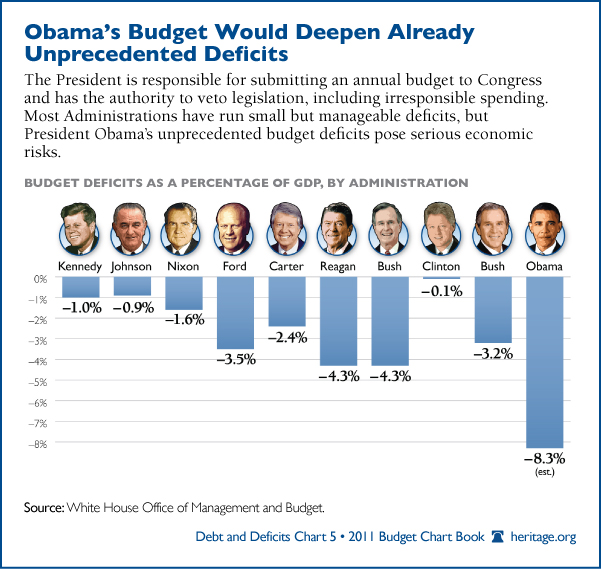
Over the last 10 presidents was have had 16.9% of GDP of deficits total from five Republican presidents and 12.7% total from Democratic presidents. However, what is most disturbing is that 8.3% of the 12.7% comes from the Obama administration who is currently in power and we are no longer in the cold war era. That is almost double the total of all the other four Democratic presidents combined under just one president. Take a look at the chart below from the Heritage Foundation:

Rob Bluey

January 1, 2012 at 9:56 am

Over the past 50 years, 10 U.S. presidents have made annual budget requests to Congress, projecting deficits both big and small. But no other president compares to Barack Obama when it comes to the size and scale of the current budget deficit facing the United States.

The country is facing an 8.3 percent estimated average national deficit of a two-term Obama administration — the biggest of the past 50 years. By comparison, the current estimate for Obama is nearly double the percentage under Presidents Ronald Reagan and George H.W. Bush — and they were fighting the Cold War.

Political party doesn’t tell the whole story, however. President Bill Clinton leads the pack of presidents since 1961, according to data from the White House Office of Management and Budget. Heritage put together this graphic as part of our Budget Chart Book.

So what does the current trajectory mean for the United States? We’re certainly no longer looking at a continuation of manageable deficits in the years to come. This is a dramatic change in the magnitude of annual shortfalls at the federal level. That’s one reason Heritage came up with a plan to fix the debt crisis.

If you have a suggestion for a chart we should feature in the future, please post a comment below, email us at scribe@heritage.org, or send me at tweet @RobertBluey.

_______________________
Here is a perspective from Dan Mitchell of the Cato Institute:

To Fix the Budget, Bring Back Reagan…or Even Clinton

Posted by Daniel J. Mitchell

President Obama unveiled his fiscal year 2012 budget today, and there’s good news and bad news. The good news is that there’s no major initiative such as the so-called stimulus scheme or the government-run healthcare proposal. The bad news, though, is that government is far too big and Obama’s budget does nothing to address this problem.

But perhaps the folks on Capitol Hill will be more responsible and actually try to save America from becoming a big-government, European-style welfare state. The solution may not be easy, but it is simple. Lawmakers merely need to restrain the growth of government spending so that it grows slower than the private economy.

Actual spending cuts would be the best option, of course, but limiting the growth of spending is all that’s needed to slowly shrink the burden of government spending relative to gross domestic product.

Fortunately, we have two role models from recent history that show it is possible to control the federal budget. This video from the Center for Freedom and Prosperity uses data from the Historical Tables of the Budget to demonstrate the fiscal policy achievements of both Ronald Reagan and Bill Clinton.

Spending Restraint, Part I: Lessons from Ronald Reagan and Bill Clinton

Uploaded by on Feb 14, 2011

Ronald Reagan and Bill Clinton both reduced the relative burden of government, largely because they were able to restrain the growth of domestic spending. The mini-documentary from the Center for Freedom and Prosperity uses data from the Historical Tables of the Budget to show how Reagan and Clinton succeeded and compares their record to the fiscal profligacy of the Bush-Obama years.

_____________________


Some people will want to argue about who gets credit for the good fiscal policy of the 1980s and 1990s.

Bill Clinton’s performance, for instance, may not have been so impressive if he had succeeded in pushing through his version of government-run healthcare or if he didn’t have to deal with a Republican Congress after the 1994 elections. But that’s a debate for partisans. All that matters is that the burden of government spending fell during Bill Clinton’s reign, and that was good for the budget and good for the economy. And there’s no question he did a much better job than George W. Bush.

Indeed, a major theme in this new video is that the past 10 years have been a fiscal disaster. Both Bush and Obama have dramatically boosted the burden of government spending — largely because of rapid increases in domestic spending.

This is one of the reasons why the economy is weak. For further information, this video looks at the theoretical case for small government and this video examines the empirical evidence against big government.

Another problem is that many people in Washington are fixated on deficits and debt, but that’s akin to focusing on symptoms and ignoring the underlying disease. To elaborate, this video explains that America’s fiscal problem is too much spending rather than too much debt.

Last but not least, this video reviews the theory and evidence for the “Rahn Curve,” which is the notion that there is a growth-maximizing level of government outlays. The bad news is that government already is far too big in the United States. This is undermining prosperity and reducing competitiveness.

Spending Restraint, Part II: Lessons from Canada, Ireland, Slovakia, and New Zealand

Uploaded by on Feb 22, 2011

Nations can make remarkable fiscal progress if policy makers simply limit the growth of government spending. This video, which is Part II of a series, uses examples from recent history in Canada, Ireland, Slovakia, and New Zealand to demonstrate how it is possible to achieve rapid improvements in fiscal policy by restraining the burden of government spending. Part I of the series examined how Ronald Reagan and Bill Clinton were successful in controlling government outlays — particularly the burden of domestic spending programs. http://www.freedomandprosperity.org


“Soccer Saturday”

My son Wilson got to see Renoldo play while he was in Los Angeles last summer.

Cristiano Ronaldo has had better season than Messi, says Mourinho after Bayern loss

Goal.comBy Tom Webber | Goal.com – Wed, Apr 25, 2012 7:10 PM EDT

Real Madrid coach Jose Mourinho insisted that Cristiano Ronaldo has had a better season than Lionel Messi, despite the forward’s miss from 12 yards in the Champions League semifinal penalty shootout with Bayern Munich on Wednesday.

Los Blancos soared into a two-goal lead with a double from the Portuguese forward but Arjen Robben pulled one back for the visitors to make it 2-1, thus ensuring the tie would be settled from the spot.

Ronaldo, Kaka and Sergio Ramos all missed their kicks for Madrid, which enabled Bastian Schweinsteiger to secure Bayern’s place in the final with a 3-1 shootout win. The 49-year-old trainer however remained supportive of his players, especially his highest scorer.

“Cristiano Ronaldo is fantastic. I will not compare him with [Lionel] Messi, we’re talking about two great players. I will say this year Cristiano Ronaldo has been better,” Mourinho declared in his post-match press conference.

He went on to praise the character of all of his players who stepped up to take a penalty, reminding those present that even the best can fail at times.

“The ones that miss the shot are the ones that have the balls to shoot. Fearless, not selfish, they go and try. I’m proud of my men.

“They’re super men but Superman is a film. Messi missed yesterday [against Chelsea], and today three men missed because this is football, and these things happen.”

“People criticize and question why these errors happen, people that if they climb two floors on ladders are exhausted.

“These guys worked like animals for two hours, they gave it all, then they go there and miss the shot.”

Mourinho was also critical of the fact that while his team was forced to play a potentially title-deciding fixture against Barcelona on Saturday, Jupp Heynckes was able to rest eight key players for Munich’s visit to Werder Bremen with the Bundesliga title out of reach.

“Both of them [Bayern and Chelsea] used their second squads this weekend, and they played versus Barca and Real, who played the most important match of the domestic season last weekend.

“It’s our fault. If we were not playing for La Liga we would have not lined up our best men last Saturday.

“[It is] very difficult to stay in more than one competition. The final of the Champions League will be played between the fifth team of the Premier League and the secnd of the Bundesliga, [which is] 10 points behind [the league leaders].”

Los Blancos will now look to bounce back from defeat and secure the Liga, starting when they welcome Sevilla to the Bernabeu on Sunday.

Follow Goal.com on to get the latest soccer news directly. Check out Goal.com’s page; be part of the best soccer fan community in the world!

Christian view versus Ayn Rand on altruism (Part 1)

Uploaded by on Oct 26, 2009

Ayn Rand makes the case that altruism is evil.

___________________ 

I ran across a fine article that takes a look at Ayn Rand’s view of capitalism and selfishness and compares it to the Christian view found in the Bible. I have decided to start a series on this subject. The Christian comes from the article “Was Ayn Rand Right?” by Jay Richards.

Was Ayn Rand Right?

Capitalism and Greed
JAF1324
Jay W. Richards

Synopsis

In response to the critics of capitalism, many conservative Christians turn to philosopher Ayn Rand for ammunition. Rand was a staunch defender of capitalism, but also an anti-Christian atheist who argued that capitalism was based on greed. Greed, for Rand, is good. But if Rand is right, then Christians can’t be capitalists, because greed is a sin. Fortunately, Rand was wrong. She missed the subtleties of capitalism. First, we should distinguish self-interest from selfishness. Adam Smith, the father of capitalism, famously wrote, “It is not from the benevolence of the butcher, the brewer, or the baker, that we expect our dinner, but from their regard to their own interest.” True enough; but that alone isn’t a problem. Every time you wash your hands or look both ways before you cross the street, you’re pursuing your self-interest—but neither activity is selfish. Second, Smith never argued that the more selfish we are, the better a market works. His point, rather, is that in a free market, each of us can pursue ends within our narrow sphere of competence and concern—our “self-interest”—and yet an order will emerge that vastly exceeds anyone’s deliberations. Finally, Smith argued that capitalism channels greed, which is a good thing. The point is that even if the butcher is selfish, he can’t make you buy his meat. He has to offer you meat at a price you’ll willingly buy. So capitalism doesn’t need greed. What it does need is rule of law, freedom, and human creativity and initiative. And we can point that out without any help from Ayn Rand.

If you’re over forty, you probably remember the 1987 movie Wall Street. Kirk Douglas played the key role, a ruthless corporate raider named Gordon Gekko. Gekko is famous for his defense of selfishness: “Greed…is good,” he tells a young broker. “Greed is right. Greed works. Greed clarifies, cuts through and captures the essence of the evolutionary spirit. Greed, in all its forms…has marked the upward surge of mankind.” Gekko embodies the enduring stereotype of the greedy businessman.

                Given the coverage of the current financial crisis, it’s no surprise that Twentieth Century Fox is now producing a sequel. Many people, including many Christians, believe that the crisis is the product of greedy capitalism—pure and simple. Others, including many Christians, want to defend capitalism, but end up drawing on the work of philosopher and playwright Ayn Rand, who called greed a virtue. That puts most of us between the proverbial rock and the hard place.

                As if in response, some prominent evangelicals such as Tony Campolo, Jim Wallis, and Ron Sider have criticized capitalism as based on the “greed principle” (to quote Campolo).1 And it’s hard to blame them, since even many fans of capitalism, such as Rand, seem to agree. And certainly for Christians, greed is not good. Greed, selfishness, or “avarice” is one of the seven deadly sins, and the Bible has nothing good to say about it. In the Gospels, when Jesus was asked to settle an inheritance dispute, He responded: “Watch Out! Be on your guard against all kinds of greed; life does not consist in an abundance of possessions” (Luke 12:15 TNIV). The Tenth Commandment says, “Do not covet,” which no doubt applies to greed as well. Jesus includes greed with murder and adultery in a long list of sins (Mark 7:21– 22). Paul tells the Ephesians that no greedy person—“that is, an idolater,” he explains—will inherit the kingdom of God (Eph. 5:5 ESV). These are just a few of the dozens of biblical passages condemning greed.

                So what do we do? Must we embrace Rand’s anti-Christian philosophy to defend capitalism? Or must we reject capitalism because it’s based on greed? I don’t think we have to do either. The truth is much more interesting, and much more encouraging.

THE BEEHIVE

                Rand wasn’t the first one to identify capitalism with greed. That honor goes to a Dutchman named Bernard Mandeville. In 1705, he wrote a poem called The Fable of the Bees. Nobody noticed it. So in 1714, he republished it with a lengthy commentary explaining that the poem was a metaphor for English society. Mandeville saw humans and bees as little more than bundles of vicious passions. The Parable reflected that belief.

                In the beehive, different bees do different tasks, but they all have the same motivation—vice. The poem describes avarice, pride, and vanity as producing great wealth for the hive. The bees, however, are discontent. They grumble at the lack of virtue around them. They gripe so incessantly that Jove eventually gives them what they ask for. Honesty and virtue now fill the hive. And everything collapses. The bees’ virtuous actions led to disaster whereas the individual acts of evil had led to social good.

                Taken literally, Mandeville’s claim is ridiculous. Good doesn’t come from evil. Virtue isn’t born from vice. Virtue doesn’t destroy society. Still, he did get one thing right: bad intentions don’t always yield bad results. Recall that the Apostle Paul once delighted that some were preaching the gospel out of envy of him. He didn’t delight in the envy, but in the preaching. So even private sinful acts may lead to a social good.

THE VIRTUE OF SELFISHNESS?

                After Mandeville came the Scottish philosopher Adam Smith, who in 1776 wrote the most famous book in the history of economics, The Wealth of Nations. Though the book is long on pages and detail, its basic purpose was simple. Smith wanted to defend what he called the natural system of liberty: rule of law, unobtrusive government, private property, specialization of labor, and free trade. To prosper, a society needed “little else,” he said, “but peace, easy taxes, and a tolerable administration of justice.”2 But so far from flattering the business class, Smith famously said that “people of the same trade seldom meet together, even for merriment and diversion, but the conversation ends in a conspiracy against the public, or in some contrivance to raise prices.”3 Not exactly a ringing endorsement.

                Smith never credited the happy outcomes of trade and business to the virtues of business people. “It is not from the benevolence of the butcher, the brewer, or the baker,” he wrote, only to be quoted by every economics textbook ever written, “that we expect our dinner, but from their regard to their own interest.”4 Nevertheless, through the invisible hand of the market, individuals will “promote an end which is no part of [their] intention.”5 That end often benefits society overall.

                If you don’t read Smith carefully, you might think that he’s making the same argument as Mandeville: individual greed is good for society. That’s a misreading of Smith, which was made wildly popular by Ayn Rand.

THEN COMES RAND

                Perhaps more than anyone else, Ayn Rand not only identified capitalism with greed, but defended it in those terms. She even wrote a book called The Virtue of Selfishness.6 For Rand, greed was the basis for a free economy. Capitalism and greed go together like fat cats and big cigars. To prevent readers from thinking she was using hyperbole, Rand went out of her way to espouse atheism and stridently denounce Christian altruism as antithetical to capitalism: “Capitalism and altruism are incompatible,” she said, “they are philosophical opposites; they cannot co-exist in the same man or in the same society.”7 In fact, she had a hard time distinguishing Christian altruism from socialism.

                Rand was born in Russia in 1905 as Alisa Zinov’yevna Rosenbaum, and immigrated to the United States in 1925, just as communism was securing its stranglehold on the Soviet Union. Her hatred of the collectivism she saw in her youth was etched into her worldview, her writings, even her strange personality. After coming to the U.S., she worked as a script writer in various Hollywood studios. The release of her novel The Fountainhead in 1943 made her famous. Atlas Shrugged, published in 1957, made her a sensation.

                In her novels, she developed characters that expressed her philosophy “of man as a heroic being, with his own happiness as the moral purpose of his life, with productive achievement as his noblest activity, and reason as his only absolute.”8 Her books read more like tracts for her philosophy of “objectivism” than ordinary novels. As Daniel Flynn puts it, “The themes of Rand’s four novels—We the Living, Anthem, The Fountainhead, Atlas Shrugged—are identical. As far as the philosophy of her novels goes, to read one is to read them all.”9

                But for millions of readers, her books still inspire. I discovered Rand during my senior year in college. Her books were like a blow to the chest. She mercilessly skewered every leftist cliché that I had taken for granted. I found her bracing prose and iconic heroes attractive and repellant at the same time. For a few months, she seized me. I frittered away a week of my senior year reading Atlas Shrugged rather than studying for a German final.

                The book tells about an elite group of creative entrepreneurs and inventors, “individuals of the mind,” who go on strike against a state that implements the communist principle “from each according to his ability, to each according to his need.” For Rand, these entrepreneurial heroes, like Atlas in Greek mythology, hold up the world. By pursuing their long-term self-interest, they create value for everyone. So when they shrug—that is, strike—society begins to decay.

                The hero of Atlas Shrugged, John Galt, founds a secret community off the collectivist grid, called Galt’s Gulch. Here in this New Jerusalem, individuality and self-interest are prized above all else. One long chapter of the book, “This is John Galt Speaking,” is nothing but a speech by Galt. It’s the perfect distillation of Rand’s philosophy.

                Despite Rand’s official praise of selfishness, however, John Galt doesn’t look anything like Ebenezer Scrooge or that fat, cigar-smoking, tuxedo-clad guy in Monopoly. On the contrary, Galt is a pioneer, a brave creator of wealth who pursues his vision despite powerful obstacles, including a malevolent state bent on destroying him. In fact, although Rand despised Christian self-sacrifice, Galt is suspiciously Christ-like. He preaches a message of salvation, founds a community, challenges the status quo and official powers-that-be, who hunt him down, torture him, but ultimately fail to conquer him.

                To be sure, there are dissonant notes. His symbol is not a cross, but the dollar sign. The book ends with Galt and his lover tracing the sign of the dollar across a dry valley. But insofar as Galt’s character works, it’s because he contradicts the miserly stereotype that Rand’s philosophy leads the reader to expect. In fact, not one of Rand’s best fictional characters fits her philosophy very well.

                Rand convinced me that collectivism was a false moral pretense. She also taught me the importance of entrepreneurs in creating wealth. Rand knew, better than some economists, that you can’t have capitalism without capitalists. Rand continues to be popular with some conservatives, including some Christians. Based on my brief description of her work, that might seem unlikely. But the lack of robust moral defenses of capitalism has left a void. And for many, Rand has filled it.

                That’s a problem, of course, since her philosophy as a whole is clearly incompatible with the Christian worldview. Fortunately, we don’t need Rand’s philosophy to defend capitalism. Capitalism and Rand’s defense of it are two different things. This is clear once you realize that Rand bought into a myth more common among critics of capitalism, that the essence of capitalism is greed.

Letter to White House generated form letter response April 3, 2011 (part 4)

I have been writing President Obama letters and have not received a personal response yet.  (He reads 10 letters a day personally and responds to each of them.) However, I did receive a form letter in the form of an email on April 3, 2011. I don’t know which letter of mine generated this response so I have linked several of the letters I sent to him below with the email that I received.

_____

The White House, Washington


April 3, 2012

Dear Everette:

Thank you for writing.  As President, it is my privilege to hear from Americans like you who take time to offer their perspective on the serious issues facing our Nation.  I appreciate your message and value your input.

From putting Americans back to work to expanding access to medical care, my Administration continues to take bold action to do what is right for our Nation.  We have enacted the most comprehensive financial reforms in decades, rescued and helped retool our auto industry, expanded student aid to millions of young people, helped level the playing field for working women, and made the largest investment in clean energy in our history.  Because of the courageous acts of our service members, we have been able to end the war in Iraq and take down Osama bin Laden.  We have also made historic commitments to provide for our troops as they return home.  Securing our country’s future will take time, but I will not stop working to rebuild the kind of America where everyone gets a fair shot, everyone does their fair share, and everyone plays by the same rules. 

I am always eager to hear ideas that will help our country adapt to changing times and lead us toward a brighter day.  The enduring American spirit is revealed in the letters I receive, and I remain dedicated to ensuring it is reflected in our efforts to improve the lives of all Americans.

Thank you, again, for sharing your views.  I encourage you to explore www.WhiteHouse.gov to learn more about the ways we are moving America forward.

Sincerely,

Barack Obama

_____

An open letter to President Obama (Part 56)

President Obama c/o The White House 1600 Pennsylvania Avenue NW Washington, DC 20500 Dear Mr. President, I know that you receive 20,000 letters a day and that you actually read 10 of them every day. I really do respect you for trying to get a pulse on what is going on out here. When you […]

An open letter to President Obama (Part 55)

_______________ President Obama c/o The White House 1600 Pennsylvania Avenue NW Washington, DC 20500 Dear Mr. President, I know that you receive 20,000 letters a day and that you actually read 10 of them every day. I really do respect you for trying to get a pulse on what is going on out here. It […]

An open letter to President Obama (Part 54)

Uploaded by WSJDigitalNetwork on Feb 23, 2012 Editorial board member Steve Moore breaks down Mitt Romney’s and President Obama’s tax plans. _____________________ President Obama c/o The White House 1600 Pennsylvania Avenue NW Washington, DC 20500 Dear Mr. President, I know that you receive 20,000 letters a day and that you actually read 10 of them […]

An open letter to President Obama (Part 53)

Uploaded by CFPEcon101 on May 3, 2011 This Economics 101 video from the Center for Freedom and Prosperity gives seven reasons why the political elite are wrong to push for more taxes. If allowed to succeed, the hopelessly misguided pushing to raise taxes would only worsen our fiscal mess while harming the economy. The seven […]

An open letter to President Obama (Part 52, A response to your budget)

President Obama c/o The White House 1600 Pennsylvania Avenue NW Washington, DC 20500 Dear Mr. President, I know that you receive 20,000 letters a day and that you actually read 10 of them every day. I really do respect you for trying to get a pulse on what is going on out here. If you […]

An open letter to President Obama (Part 51, A response to your budget)

On Bloomberg, Sessions Discusses Astounding Gimmicks In President’s Budget Uploaded by BudgetGOP on Feb 13, 2012 ___ President Obama c/o The White House 1600 Pennsylvania Avenue NW Washington, DC 20500 Dear Mr. President, I know that you receive 20,000 letters a day and that you actually read 10 of them every day. I really do […]

An open letter to President Obama (Part 50, A response to your budget)

On Bloomberg, Sessions Discusses Astounding Gimmicks In President’s Budget Uploaded by BudgetGOP on Feb 13, 2012 ___ President Obama c/o The White House 1600 Pennsylvania Avenue NW Washington, DC 20500 Dear Mr. President, I know that you receive 20,000 letters a day and that you actually read 10 of them every day. I really do […]

An open letter to President Obama (Part 49, A response to your budget)

On Bloomberg, Sessions Discusses Astounding Gimmicks In President’s Budget Uploaded by BudgetGOP on Feb 13, 2012 __________________ Rep. James Lankford Responds to President Obama’s $3.8 Trillion Budget Uploaded by RepLankford on Feb 13, 2012 Rep. James Lankford (R-OK) responded to President Obama’s FY 2013 budget proposal that fails to cut the deficit in half by […]

An open letter to President Obama (Part 48 of my response to State of Union Speech 1-24-12)

An open letter to President Obama (Part 48 of my response to State of Union Speech 1-24-12) Rep Michael Burgess response Uploaded by MichaelCBurgessMD on Jan 25, 2012 This week Dr. Burgess provides an update from Washington and responds to President Obama’s State of the Union address. President Obama’s state of the union speech Jan 24, 2012 […]

An open letter to President Obama (Part 47, A response to your budget)

Corker Says President’s 2012 Budget Proposal Shows “Lack of Urgency” on Spending Uploaded by senatorcorker on Feb 14, 2011 In remarks on the Senate floor today, U.S. Senator Bob Corker, R-Tenn., expressed disappointment in President Obama’s 2012 budget proposal, saying it displayed a “lack of urgency” to get federal spending under control. Corker has introduced […]

An open letter to President Obama (Part 46, A response to your budget)

Senator Blunt Participates in Press Conference in Response to President Obama’s Budget 2/13/2012 Uploaded by SenatorBlunt on Feb 13, 2012 U.S. Senator Roy Blunt (Mo.) participated in a press conference with GOP Senators in response to President Obama’s budget proposal on February 13, 2012. _________________________ President Obama c/o The White House 1600 Pennsylvania Avenue NW […]

An open letter to President Obama (Part 45, A response to your budget)

Rep. James Lankford Responds to President Obama’s $3.8 Trillion Budget Uploaded by RepLankford on Feb 13, 2012 Rep. James Lankford (R-OK) responded to President Obama’s FY 2013 budget proposal that fails to cut the deficit in half by the end of his first term as promised. The budget also delayed the tough decisions to cut […]

Adding another 265 billion to deficit in 2012 will not stimulute economy

Government Spending Doesn’t Create Jobs Uploaded by catoinstitutevideo on Sep 7, 2011 Share this on Facebook: http://on.fb.me/qnjkn9 Tweet it: http://tiny.cc/o9v9t In the debate of job creation and how best to pursue it as a policy goal, one point is forgotten: Government doesn’t create jobs. Government only diverts resources from one use to another, which doesn’t […]

An open letter to President Obama (Part 44, A response to your budget)

On Bloomberg, Sessions Discusses Astounding Gimmicks In President’s Budget Uploaded by BudgetGOP on Feb 13, 2012 _______________________ President Obama c/o The White House 1600 Pennsylvania Avenue NW Washington, DC 20500 Dear Mr. President, I know that you receive 20,000 letters a day and that you actually read 10 of them every day. I really do […]

An open letter to President Obama (Part 43 of my response to State of Union Speech 1-24-12)

An open letter to President Obama (Part 43 of my response to State of Union Speech 1-24-12) Congressman Rick Crawford State of the Union Response 2012 Uploaded by RepRickCrawford on Jan 24, 2012 Rep. Rick Crawford responds to the State of the Union address January 24, 2012 President Obama’s state of the union speech Jan 24, 2012 […]

Quotes from Milton Friedman (part 4)

John Stossel – Influence of Milton Friedman

When I think of the last 4 years and where the federal government has gone crazy spending our money trying to be “fair,” it makes me realize how wise Milton Friedman was when he talked about how to best achieve equality:

Here are some quotes from Milton Friedman that I thought you would enjoy:

  • Spending by government currently amounts to about 45 percent of national income. By that test, government owns 45 percent of the means of production that produce the national income. The U.S. is now 45 percent socialist.
  • The stock of money, prices and output was decidedly more unstable after the establishment of the Reserve System than before. The most dramatic period of instability in output was, of course, the period between the two wars, which includes the severe (monetary) contractions of 1920-1, 1929-33, and 1937-8. No other 20 year period in American history contains as many as three such severe contractions.
    This evidence persuades me that at least a third of the price rise during and just after World War I is attributable to the establishment of the Federal Reserve System… and that the severity of each of the major contractions — 1920-1, 1929-33 and 1937-8 is directly attributable to acts of commission and omission by the Reserve authorities…
    Any system which gives so much power and so much discretion to a few men, [so] that mistakes — excusable or not — can have such far reaching effects, is a bad system. It is a bad system to believers in freedom just because it gives a few men such power without any effective check by the body politic — this is the key political argument against an independent central bank…
    To paraphrase Clemenceau, money is much too serious a matter to be left to the central bankers.

  • I know of no severe depression, in any country or any time, that was not accompanied by a sharp decline in the stock of money and equally of no sharp decline in the stock of money that was not accompanied by a severe depression.
  • The Federal Reserve definitely caused the Great Depression by contracting the amount of money in circulation by one-third from 1929 to 1933
    • National Public Radio interview (Jan 1996)

One of the great mistakes is to judge policies and programmes by their intentions rather than their results.

Margaret Thatcher (Part 4)


Margaret Thatcher is one of my heroes and I have a three part series on her I am posting. “What We Can Learn from Margaret Thatcher,”By Sir Rhodes Boyson and Antonio Martino, Heritage Foundation, November 24, 1999, is an excellent article and here is a portion of it below:

Thatcher

This was the background of the advent of Mrs. Thatcher. Wrong economic theories, entrenched interest groups, and a widespread aversion for the free market had resulted in economic sclerosis, inflation, unemployment, and general decline. She intended to change all of this, and she did.

Her first battle was in the field of macroeconomic policy, where there was a switch from reliance on fiscal policy as a means of managing aggregate demand to the use of monetary policy. In fiscal policy the aim was that of reducing the deficit (PSBR: Public Sector Borrowing Requirement). In the field of taxation, the goal was that of restoring incentives to work, save, and invest through cuts in all tax rates, especially at the highest levels. The underlying philosophy was that the restoration of incentives was more important than the search for equality.

But where she really excelled was in macroeconomic or supply side reforms:

[A]fter the inflation-fighting campaign of 1979-82, [she engaged in] non-stop reform of the supply side — union laws, privatisation, deregulation, local government finance reform, housing, radical tax reform and much else.30

Thatcher also succeeded in taming the unions. Even her detractors concede that that was one of her great successes, one which she shares with President Reagan:

[Reagan and Thatcher] did make considerable progress in shrinking the role of government, and in expanding the reach of market forces in the microeconomy. Both did so, first, by taming the trade union power…. The President successfully broke a strike by air traffic controllers in 1981…. The Prime Minister equally successfully broke a strike in 1984-85 by coal miners determined to impose their leader’s political agenda on an electorate that had rejected it.31

She also succeeded in shrinking government’s direct role in the economy through privatization. It is generally recognized that “Thatcherism’s success in converting state-owned to privately-owned enterprises…[was] a programme so radical in conception, and so successful in operation, as to have won the highest form of flattery from other nations — imitation.”32 Contrary to what people both on the right and on the left maintain, Mrs. Thatcher’s successes do not include a reduction in total public spending: “Indeed, 18 years of Tory government left the state’s overall share of the economy virtually undiminished: 44% of GDP in 1979 and 43% in 1996.”33

To sum up, Thatcher succeeded in drastically reducing inflation in a country that had become dependent on it; taming the power of what were probably the most powerful labor unions in Europe; privatizing a large portion of a bloated public sector; enacting a tax code more favorable to entrepreneurship and investment; and establishing the conditions for long-term economic growth.

She put an end to the “British disease.” She put Britain back to work. Last, but definitely not least, she shifted the focus of political debate on economic issues. Mr. Blair’s economic program would have been considered Conservative in the 1970s. If Labour has been forced to drastically alter its position, this is largely due to Mrs. Thatcher’s legacy. One can criticize some details, but overall hers has been a fantastic success.34

How Did She Do It?

How did she do it? I believe there are several factors that contributed to Thatcher’s “Conservative Revolution.”

Ideas. There is no doubt that Thatcher’s success is largely due to the power of ideas. She acknowledged the important role played by the Institute of Economic Affairs in providing the intellectual ammunition and the inspiration for her program. On the occasion of the 30th anniversary of the IEA, she said:

[T]he Institute began at a time when despite free speech in a free country, there prevailed what I would call a censorship of fashion. Anyone who dared to challenge the conventional wisdom of the post-war years was frowned-upon, criticized, derided and pilloried as being reactionary or ignorant…. You set out to change public sentiment…. May I say how thankful we are to those academics, some of whom were very lonely, and to those journalists who joined your great endeavour. I do not think they ever numbered 364. They were the few. But they were right, and they saved Britain.35

Without those ideas, Thatcher’s revolution would have been impossible. However, let’s not forget that most of them were already available 10 years earlier at the time of the Heath government. It can be argued that in 1979 the justification for a radical change in economic policy was stronger than ever before, but it is still true that ideas alone do not explain the revolution. They were a necessary, but certainly not a sufficient, cause for the change.

Circumstances. It is true that by the end of the 1970s, the evidence of the failure of the statist policies pursued by both Labour and Tory governments was overwhelming. I believe that circumstances did play a role in Thatcher’s success. However, the evidence of the failure of those anti-market policies was already in existence in 1970, even though it was not as conspicuous as in 1979.

Furthermore, let’s not forget that not everybody drew the same conclusions from that experience. Certainly not the Labour Party that in 1979 was as Socialist as ever. And, as far as academic economists are concerned, the vast majority was convinced that there was no need for a change in policy, as revealed by the 364 of them who signed a manifesto against the new policies of the Thatcher government. The evidence was undoubtedly there, and it helped Thatcher’s cause, but it had been there before with no impact, and many educated people still failed to draw the correct conclusions from it.

Interests. The trade unions had abused their power, and this made the case for reducing their influence stronger than ever. However, even this was not new: The danger omnipotent labor unions pose to a free society had been obvious for years, yet nobody had ever tried to tame them.

Leadership. I believe that, while these factors played a role in Thatcher’s success, the crucial element was her personality, her principled and uncompromising leadership. It can be said of her what Ted Kennedy said of Reagan:

It would be foolish to deny that his success was fundamentally rooted in a command of public ideas. Ronald Reagan may have forgotten names, but never his goals. He was a great communicator, not simply because of his personality or his teleprompter, but mostly because he had something to communicate.36

She dared do what no one else had had the courage to do in Britain for decades: challenge the prevailing consensus, the common wisdom, the entrenched interests, and drive a reluctant party and a befuddled country in a radically new direction.

I can testify to her unusual personality. I have had the chance to meet her several times even before I entered politics. Once, in 1991, there was a conference in Fiesole, near Florence, organized by the National Review Institute. During a coffee break, we were walking along the portico of the hotel. Tuscany’s countryside looked magnificent under the afternoon sun. Mrs. Thatcher remarked: “Yours is a beautiful country, with a rotten government.” To which I replied: “My dear lady, the opposite would be much worse.”

Her straightforward, direct way of putting things, so unusual for a political leader, earned her some enemies among other leaders but made for a refreshing contrast with the hypocrisy and vacuity of the accepted political discourse. At times, she probably overdid it. For example, on that same occasion in Fiesole, during her summing-up of the conference, she came out with the statement: “Civilization is the exclusive prerogative of English-speaking peoples.” I was the only non-English, non-American in the room. I looked at John O’Sullivan, who was sitting next to me. He smiled and said, “You have been consigned to barbarism!”

She can also be very kind and thoughtful. When we won the elections in Italy in 1994, she sent me a fax of congratulations. I called her to thank her for her kindness. She gave me her usual pep talk: “You must do for Italy what I did for Britain.” I attempted to explain that we were at a disadvantage compared to her. I said: “You had a Constitution that was written in the hearts and the minds of your people. We don’t. You had an independent judiciary. We don’t. You had a clean and effective civil service. We don’t. You had a single party majority. We don’t. You had those think tanks, like the IEA, that provided you with the right ideas. We don’t.”

“However,” I added, “we have something which you didn’t have.” “What’s that?” she said. “Your example,” I replied.

As to the relative importance of ideas and/or leadership, she gave her own view on the occasion of the celebration of the 30th anniversary of the IEA. After having listened to a series of speeches by distinguished academics, all praising the great importance of ideas, she thus concluded her remarks: “Speaking as the eleventh speaker and the only woman, I hope you will recall that it may be the cock that crows but it is the hen who lays the eggs.”