Monthly Archives: March 2012

Vols win SEC basketball championship

I have always admired Pat Summitt’s coaching ability and she did it again yesterday when the Vols won the SEC tournament championship again. Arkansas had a great team this year and even beat the Vols for the first time in Knoxville but the lady Razorbacks lost to LSU in the tournament.

Here is a link to the story from the Knoxville paper.

SAUL YOUNG/NEWS SENTINEL
From left, Tennessee Shekinna Stricklen, Ariel Massengale, and Glory Johnson run off the court in celebration after defeating LSU, 70-58 on Sunday in the SEC tournament championship game at Bridgestone Arena in Nashville.

Photo by Saul Young, copyright © 2012 // Buy this photo

SAUL YOUNG/NEWS SENTINEL From left, Tennessee Shekinna Stricklen, Ariel Massengale, and Glory Johnson run off the court in celebration after defeating LSU, 70-58 on Sunday in the SEC tournament championship game at Bridgestone Arena in Nashville.

Here are some other pictures from Pat Summitt’s career:

Lady Vol coach Pat Summitt celebrates winning the Mideast Regional title on April 23, 1991 at Thompson- Boling Arena. Tennessee defeated Auburn 69-65 and advanced to the Final Four in New Orleans.<br /><br />

Photo by Fritz Hoffmann, News Sentinel file photo

Lady Vol coach Pat Summitt celebrates winning the Mideast Regional title on April 23, 1991 at Thompson- Boling Arena. Tennessee defeated Auburn 69-65 and advanced to the Final Four in New Orleans.

The 1986 - 87 Lady Vols Championship team from left standing Graduate Assistant Heidi VanDerveer, Head Coach Pat Summitt, Cheryl Littlejohn, Jennifer Tuggle, Karla Horton, Sheila Frost, Carla McGhee, Kathy Spinks, Bridgette Gordon, Assistant Coach Holly Warlick, and Mickie DeMoss. Front row sitting from left are Gay Townson, Melissa McCray, Dawn Marsh, Lisa Webb, Shelley Sexton Collier, Tonya Edwards, and Sabrina Mott. </p><br />
<p>

Photo by Saul Young

The 1986 – 87 Lady Vols Championship team from left standing Graduate Assistant Heidi VanDerveer, Head Coach Pat Summitt, Cheryl Littlejohn, Jennifer Tuggle, Karla Horton, Sheila Frost, Carla McGhee, Kathy Spinks, Bridgette Gordon, Assistant Coach Holly Warlick, and Mickie DeMoss. Front row sitting from left are Gay Townson, Melissa McCray, Dawn Marsh, Lisa Webb, Shelley Sexton Collier, Tonya Edwards, and Sabrina Mott.
Tennessee head coach Pat Summitt raises her arm in celebration, after Tennessee defeated Stanford 64-48 for the NCAA National Championship at the St. Pete Time's Forum in Tampa, FL on April 8, 2008.<br /><br />

Photo by Saul Young

Tennessee head coach Pat Summitt raises her arm in celebration, after Tennessee defeated Stanford 64-48 for the NCAA National Championship at the St. Pete Time’s Forum in Tampa, FL on April 8, 2008.

Lady Vols head coach Pat Summitt leads the cheers after winning the Women's NCAA National Championship 67-44 against Louisiana Tech on March 29, 1987 in Austin , TX. Celebrating with Summitt are players, from left, Melissa McCary, Kathy Spinks, Bridgette Gordon, and Dawn Marsh. The victory earned the Lady Vols their first national championship.<br /><br />

Photo by J. Miles Cary

Lady Vols head coach Pat Summitt leads the cheers after winning the Women’s NCAA National Championship 67-44 against Louisiana Tech on March 29, 1987 in Austin , TX. Celebrating with Summitt are players, from left, Melissa McCary, Kathy Spinks, Bridgette Gordon, and Dawn Marsh. The victory earned the Lady Vols their first national championship.

Santorum goes to Memphis

Once a month we go to Memphis on for a Sunday lunch with my sisters and my parents and all the other relatives (brother-in-laws and 10 cousins, nephews, etc). Sometimes we will attend church at my parents church, Bellevue Baptist. We decided against going this week since we have a guest coming with our family to our church Fellowship Bible Church.

Guess who was at Bellevue this week? Take a look:

Santorum visits Memphis to shore up support; polls show state now a toss up

  • By Scott Carroll, Zack McMillin
  • Memphis Commercial Appeal
  • Posted March 4, 2012 at 10:19 a.m., updated March 4, 2012 at 10:57 p.m.

 Republican presidential candidate and former U.S. Senator Rick Santorum takes questions from the media during a campaign stop at Corky's BBQ, Sunday.

Photo by Nikki Boertman // Buy this photo

Republican presidential candidate and former U.S. Senator Rick Santorum takes questions from the media during a campaign stop at Corky’s BBQ, Sunday.

__________________

As polls showed his formerly huge lead in Tennessee dwindling to almost nothing, Republican presidential candidate Rick Santorum attended church services Sunday in the Memphis area and lunched on barbecue at Corky’s before heading to Oklahoma.

Across the state, in Knoxville, national GOP front-runner Mitt Romney made his first visit to the state in several weeks looking to score a surprise in Tennessee as recent polls showed his national lead growing and his standing in the South improving ahead of this week’s Super Tuesday primaries.

In comments to media after his lunch at Corky’s, Santorum sounded less like a candidate preparing for a triumphant Super Tuesday and more like one trying to keep hope alive.

“Every time you get into these races, as we’ve seen, Governor Romney goes out there and outspends you four, five, six to one. It’s going to take a toll. That’s what’s happened in pretty much all the states,” Santorum said. “That’s why you keep looking at this as a game of survivor.”

Two polls released Sunday showed that a 20-point Santorum advantage over Romney had all but evaporated, and that former House speaker Newt Gingrich was putting himself into position to compete for delegates here.

American Research Group’s poll of 600 likely Tennessee voters Thursday through Saturday put Santorum at 35 percent, Romney at 31 percent, Gingrich at 20 percent and Texas Congressman Ron Paul at 9 percent.

A Rasmussen Reports poll on Saturday of 750 likely Tennessee voters had similar results: Santorum at 34 percent, Romney at 30, Gingrich at 18 and Paul at 8.

Both polls list a margin of error of plus-or-minus 4 percent, meaning the race in Tennessee is essentially a tossup.

It was unclear how many voters cast ballots early, although the presidential primaries in 2008 saw about 80 percent of voters wait until election day to go to the polls.

Santorum said Sunday a key strategy is narrowing the relevant choices for Republican voters to Romney and one other candidate.

“Again, this race, for us to ultimately win this race, it’s going to ultimately have to narrow down to two (candidates), and I think that will happen eventually,” said Santorum.

Neither Gingrich nor Paul shows signs of surrender.

Gingrich plans three stops today in East Tennessee. One of his supporters in Shelby County, Willis Ayres, said there are plans for Gingrich to appear in North Mississippi ahead of next week’s Mississippi primaries.

“What’s happening is the establishment is trying to shove the moderate, Romney, down our throats,” Ayres said. “But I think if you are going to see anyone overperform in Tennessee, it’s Gingrich, not Santorum.”

Santorum took some shots at President Barack Obama, criticizing his administration’s approach to relations with Iran and repeating Republican assertions that, on energy, “we are not doing anything to open up supply lines across this country.”

Earlier Sunday, Santorum attended religious services in Cordova, at St. Francis of Assisi Catholic Church and Bellevue Baptist Church.

Santorum, a Catholic, arrived at Bellevue with his wife, Karen, and three children, and was in the front row of the mega-church.

Bellevue pastor Steve Gaines brought Santorum and his wife onto the stage for a prayer that mentioned abortion and “immorality.”

At one point, two parishioners placed their hands on Santorum’s shoulders, and the congregation raised hands in a symbolic laying on of hands for the former Pennsylvania senator.

The appearance at one of the South’s largest Southern Baptist churches came on the same weekend The New York Times examined Santorum’s faith. According to The Times: “Unlike Catholics who believe that church doctrine should adapt to changing times and needs, the Santorums believe in a highly traditional Catholicism that adheres fully to what scholars call ‘the teaching authority’ of the pope and his bishops.”

Santorum recently drew harsh criticism from liberals and conservatives for saying a 1960 speech by the nation’s only previous non-Protestant president, John F. Kennedy, made him want to “throw up” because of its insistence on separation of church and state.

The visit also came as Santorum tried to hold his advantage in the South over Romney, whose own Mormon faith has been a factor in his struggle to build a stronger following among religious conservatives, particularly in the South.

Romney started his day in Georgia and moved to Knoxville in the evening, looking to solidify a likely second-place finish in Georgia and trying to overtake Santorum in Tennessee, where Romney is backed by most of the state’s top-ranking Republicans, including Gov. Bill Haslam.

The Knoxville News Sentinel contributed to this story.

Super Tuesday voting

Polls are open from 7 a.m. to 7 p.m. for the state’s presidential preference primary and Shelby County’s primaries. Voters must cast ballots at their assigned precincts and must provide a state- or federal-issued photo ID in order to vote.

© 2012 Memphis Commercial Appeal. All rights reserved. This material may not be published, broadcast, rewritten or redistributed.

Milton Friedman:“A Nobel Laureate on the American Economy” VTR: 5/31/77 Transcript and video clip (Part 1)

Milton Friedman on the American Economy (1 of 6)

Uploaded by on Aug 9, 2009

THE OPEN MIND
Host: Richard D. Heffner
Guest: Milton Friedman
Title: A Nobel Laureate on the American Economy VTR: 5/31/77
_____________________________________

Below is a transcipt from a portion of an interview that Milton Friedman gave on 5-31-77:

THE OPEN MIND
Host: Richard D. Heffner
Guest: Milton Friedman
Title: “A Nobel Laureate on the American Economy VTR: 5/31/77

I’m Richard Heffner, your host on The Open Mind. My guest today is perhaps this country’s foremost economist, Milton Friedman of the University of Chicago, of Newsweek magazine, and of wherever it is that persons of brilliance and concern gather to discuss the fate of individual liberty in the midst of ever-expanding governmental responsibilities. Well, that’s the way I introduced Professor Friedman on The Open Mind two years ago. Since then he has been as brilliant, has delighted still more discerning citizens of the world, has become a Nobel laureate, and is here today to pick up where we left off.

Professor Friedman, we were saying two years ago, literally, we left off on the road to serfdom. I was looking back at the transcript of our program together, and we did leave off on the road to serfdom, the road to an overabundance of interference in the lives of most individuals. And you said, “I really do think the chance is a good deal less than 50 percent that we’ll be able to avoid it.” And by avoiding it you were referring to this road to serfdom. Now, two years later, have you changed your mind? Is it still 50 percent? Is it 40 percent, 60 percent, or what?

FRIEDMAN: I am sorry to say that I haven’t changed my mind. I wish I could say I had a favorable direction. I think the odds at the moment are still less than 50 percent. In the past two years there have been some favorable developments from this point of view and some unfavorable ones. If you start with the unfavorable ones first, the developments in Great Britain have been very unfavorable from this point of view. Britain has been in an increasing crisis economically. And that is threatening the political stability of Great Britain. Great Britain, after all, is a fount for most of our ideas on political freedom and liberty. And if Britain were to go, that would not be a good thing from the point of view of the world as a whole or the US in particular. On the continent of Europe, Italy and France seem to be on the verge of moving toward governments in which the communist party will either be dominant or will play a large role. They may yet escape that fate. But certainly the possibility of that development today is larger than it was two years ago. At home in the United States, on the unfavorable side, the energy program development is from a fundamental point of view the most threatening at the moment to the preservation of a free society.

HEFFNER: Why do you say that?

FRIEDMAN: Because the plans that are being made and the programs that are being offered with respect to it are programs fundamentally for nationalizing or the equivalent of nationalizing the production, distribution, consumption of energy. If you look at the program that has been proposed by various groups, not necessarily only those by the Carter administration, they are programs for turning over control over the production and distribution of energy to governmental bureaucracies. That’s a move in the direction of a corporate state. It’s a move of replacing private initiative and voluntary action by compulsory governmental action. Those are the unfavorable developments.

On the favorable side, if I may start with what I think has been the most favorable development of the past two years and one that many people will not find favorable, it’s been what’s happened New York City. Now, that’s very unfavorable for the citizen of New York.

HEFFNER: Tell me about that. I am a citizen of New York.

FRIEDMAN: But for the country as a whole it’s been the most dramatic element that has shaken the confidence of the public at large in the virtues of big government, of paternalistic government, of social welfare measures. Here is New York City. The most welfare state oriented electorate in the country. The city which has the largest government spending per person. A city which has the greatest problems of any city in the country, in which government spending far from solving problems has created or exacerbated them. Now, from the point of view of the public at large, the experience of Britain should have been just as great a cautionary tale. But Britain is a long way off; it’s a different country. New York is close to home; everybody knows about New York and is aware of New York. And therefore the problems of New York City have had, I think,, a very healthy effect on the attitudes of the public at large toward the role that government should play in their lives.

Similarly, on a number of a wide range of other issues there has been increasing disillusionment with what government can accomplish. We all know from all the polls that governmental agencies, whether it be the Congress or the White House or the bureaucracy, rank very low in public esteem. There has been a gathering tax revolt, a gathering reaction against big spending by government. It is this reaction against big spending, this decline in confidence that the way to solve a problem is to throw money at it which has been the major political force behind what commentators have been describing as Mr. Carter’s fiscal conservatism. Now, that’s a good trend. Much more fundamental and much more important potentially from the long run is what’s been happening in the world of ideas. The ideas of socialism, of collectivism, of central planning, of the welfare state, which were for so long the dominant ideology of the intellectual community, have become increasingly discredited. That line of thinking is dead. It has nothing to offer to a young, hopeful man who is trying to look for something to believe in and to have faith in. The ideas and individualism of freedom, of each person doing his own thing, the idea that maybe you have a better society if people tend to their own knitting rather than everybody trying to tend to everybody else’s. Those ancient and honorable ideas are having a resurgence. They have a much better hearing today on campuses, among the intellectual community in general than they did even as short a time ago as two years. That intellectual development, I think, is all to the good. But whether it will be able to stop the road to serfdom, stop us from going all the way down to the road serfdom is a real question, because once you get an avalanche going, if that’s the right image, once you get a big car going down the road it has an enormous amount of inertia. And it takes something really to stop it and turn it around. And the real problem is whether the changing climate of ideas can take effect soon enough before it is overwhelmed by the onrushing behemoth of the state.

HEFFNER: Professor Friedman, I’m interested in what you say as what you see as a shift in ideas away from the welfare state, away from socialism, away from stateism. Yet I had the occasion recently to look at a series of reports that indicated what citizens in this fair city, New York, were thinking about, what they were concerned about. And I was fascinated to note – now, this isn’t two years ago, this is very recently – to note that they are still concerned about the services that they want, additional services. They want more, they want more, they want more. And perhaps on the campuses, perhaps you and your friends are terribly much aware of what the “gimmes” have done to us. But what indication is there that really at the depth of this society, at the basic level of this society, people are moving away from an insistence upon more and more social services?

FRIEDMAN: Well, maybe there isn’t, and maybe you’re right. In which case that pessimistic evaluation that we started out with is supported. But I think one must distinguish between common opinion at a moment and the underlying movement of intellectual ideas which only determines common opinion after a very long lag. Now, of course, most people most times would like to get something for nothing. They…always have the gimmes, in your very evocative term. But yet – and New York, of course, is exceptional, as I said before, New York is the most welfare-oriented electorate in the country – and yet even the people in New York, I suspect, are more aware than they were before about the price, the cost, the consequences of trying to get things by that device of getting it through government. And undoubtedly the majority of the people have not been moved…

An open letter to President Obama (Part 26 of my response to State of Union Speech 1-24-12)

Congressman Rick Crawford State of the Union Response 2012

Uploaded by on Jan 24, 2012

Rep. Rick Crawford responds to the State of the Union address January 24, 2012

Sen. Paul Delivers State of the Union Response – Jan. 24, 2012

Uploaded by on Jan 24, 2012

Sen. Rand Paul delivered the following Republican response to President Barack Obama’s State of the Union Address this evening

President Obama’s state of the union speech Jan 24, 2012

Barack Obama  (Photo by Saul Loeb-Pool/Getty Images)

President Obama c/o The White House
1600 Pennsylvania Avenue NW
Washington, DC 20500

Dear Mr. President,

I know that you receive 20,000 letters a day and that you actually read 10 of them every day. I really do respect you for trying to get a pulse on what is going on out here.

I am an avid reader of the National Review and I remember watching those famous debates at Harvard between John Kenneth Galbraith and William Buckley. You probably were at some of those debates. Below is a portion of an article that talks about your recent State of the Union address:

NATIONAL REVIEW ONLINE          www.nationalreview.com           PRINT

Obama’s Final SOTU?

WILLIAM W. BEACH
The president wants an economy that’s built to last, as he said repeatedly in tonight’s State of the Union speech. However, among the litany of programs he announced, he promised little action on the driver of economic decay: the blooming debt of governments at all levels, but particularly the government that President Obama runs. Total government debt is chewing away at innovation and economic growth by squeezing credit markets for private borrowers; it is spreading fear and uncertainty among investors about this country’s future; and it is condemning an entire generation to an economic life well below their potential.

If you are under 30 years of age, you belong to the Debt-Paying Generation. This enormous, growing federal debt will have to be repaid across your lifetime. Higher taxes will almost certainly be imposed to pay down this debt, thus reducing your income and increasing your cost of living. You are likely to marry later, as you will have trouble saving up to start a family. If you marry later, you are likely to have fewer children, which further hurts the economy by reducing the future labor force. Higher interest rates from higher federal debt will mean that the Debt-Paying Generation will start their home mortgages later in life, which may mean that they will never own a home. A slower economy means not only slower income growth for the Debt-Paying Generation, but also less savings for retirement, education, and health care.

The real tragedy of the president’s litany of economic-policy changes is its failure to address federal debt. Why? Simple: The failure to reduce debt condemns an entire generation to the least prosperous life in U.S. history relative to the generation that preceded it. That’s not the way to build an economy that lasts.

― William W. Beach is director of the Center for Data Analysis at the Heritage Foundation.

____________________

We have got to lower the federal spending or else this country will go bankrupt.

Thank you so much for your time. I know how valuable it is. I also appreciate the fine family that you have and your committment as a father and a husband.

Sincerely,

Everette Hatcher III, 13900 Cottontail Lane, Alexander, AR 72002, ph 501-920-5733, lowcostsqueegees@yahoo.com

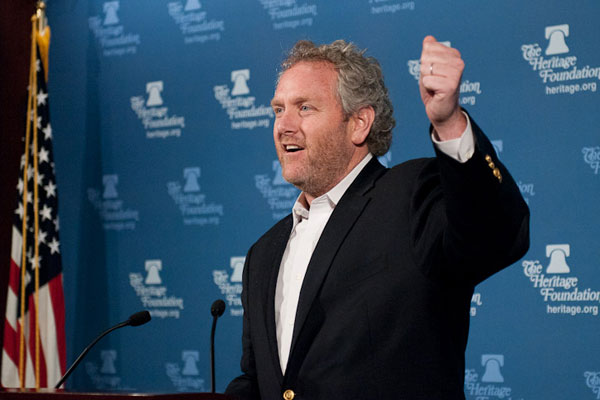
Tributes to Andrew Breitbart from Heritage Foundation Scholars (Part 2)

These comments below were taken from the following article:

Todd Thurman

March 1, 2012 at 3:21 pm

_________

Ernest Istook:  When Andrew Breitbart discovered his passion, he pursued it relentlessly.  Simply put, he hated bullies and made it his mission to expose them, in particular the bullying tactics of the left.  He relished challenging political correctness.

Beneath his aggressive exterior, Breitbart cared deeply for his family and friends and sought to protect them from what liberal bullying is doing to America.  His loyalty was immense.

Andrew was just as open about himself as the openness he asked of others.  When I invited him to lecture in a study group I taught at Harvard’s Institute of Politics, he not only embraced the opportunity but spent many extra hours with the students, infusing them with his passion.

Andrew Breitbart was unselfish with his time and energy.  His example and his leadership will be missed.  As Breitbart’s legacy, he would expect us to be bold.

Brian Darling: I am deeply saddened at the passing of Andrew Breitbart.  I met him when he was in the initial stages of setting up his Big Government web site and I was later approved to be a blogger for it.  Over the years, I would see him at events and we would chat.  We had made plans late last year to get together to discuss ways to take the fight to the left.

I was a regular panelist on Fox Business’ Follow the Money with Eric Bolling.  Andrew was on the show in early December of last year and I sent him an E-Mail about his interview on the show.  As usual, Andrew was a great guest and was very excited to make points about the failed policy of bailing out private enterprise.  I shot him an E-Mail making fun of “Government Motors” – the topic of the segment.  Andrew responded with “see ya next time I get to DC.  We need to touch base, scheme a bit!”  Sadly that was the last communication I had with Andrew.  I missed him at CPAC inWashington,DC a few weeks ago and will forever be saddened that I did not have one last chance to run into him to say hello and scheme.

He shall be missed.

Uploaded by on Mar 1, 2012

Sean Hannity – In My Fathers House There Are Many Mansion And I Know Andrew Is In One Of Them

I got a chance to meet Andrew once and it was on May 25, 2011. He was very gracious and I really enjoyed visiting with him. Below are some links to my previous posts on Breitbart.

Related posts:

Sean Hannity’s tribute to his dear friend Andrew Breitbart

Uploaded by MrTimotheus85 on Mar 1, 2012 Sean Hannity – In My Fathers House There Are Many Mansion And I Know Andrew Is In One Of Them I got a chance to meet Andrew once and it was on May 25, 2011. He was very gracious and I really enjoyed visiting with him. Below are […]

Rep. Louie Gohmert Pays Tribute to Andrew Breitbart

Rep. Louie Gohmert Pays Tribute to Andrew Breitbart Uploaded by GohmertTX01 on Mar 1, 2012 Rep. Louie Gohmert (TX-01) spoke on the House floor about the life and legacy of his friend, conservative writer and American patriot, Andrew Breitbart. “Thank you, dear God, for sharing this extraordinary gift that was Andrew Breitbart with us. We […]

Andrew Breitbart spoke to Little Rock, Arkansas group May 25, 2011 (Part 4,the media world has changed with cable, Fox News, and the web)

Andrew Breibart spoke in Little Rock on May 25, 2011 Andrew Breitbart in Arkansas The second monthly luncheon with featured speaker Andrew Breitbart was excellent. (Check out the Tolbert Report for more coverage of this event.) First, we got to hear from Dave Elswick of KARN   who came up with the idea of this luncheon, […]

Andrew Breitbart spoke to Little Rock, Arkansas group May 25, 2011 (Part 3,one time default cultural liberal, but now a conservative )

Andrew Breibart spoke in Little Rock on May 25, 2011 Andrew Breitbart in Arkansas Dave Elswick Chicago and Introduction.wmv Conservative film activist Andrew Breitbart spoke in Little Rock on Wednseday May 25th at the Hilton Hotel. The room was packed with conservative activist and Tea Party members. Breitbart talked about dealing with the liberal media […]

Andrew Breitbart spoke to Little Rock, Arkansas group May 25, 2011 (Part 2, video clips )

Andrew Breibart spoke in Little Rock on May 25, 2011 to a packed room. The second monthly luncheon with featured speaker Andrew Breitbart was excellent. (Check out the Tolbert Report for more coverage of this event.) First, we got to hear from Dave Elswick of KARN   who came up with the idea of this luncheon, […]

Andrew Breitbart spoke to Little Rock, Arkansas group May 25, 2011 (Part 1, taking on Bill Maher was liberating)

  Andrew Breitbart speaking in Little Rock on May 25, 2011. Andrew Breitbart – Taking Down the Corrupt and Biased, Leftist Mainstream Media Andrew Breitbart joined Hannity to talk about his new book “Righteous Indignation: Excuse Me While I Save the World!”, and about his mission to take down the corrupt and biased, leftist mainstream […]

May 6, 2011 CBS News interview with Andrew Brietbart

Andrew Breitbart Andrew Breitbart CBS News reported on May 6, 2011: Conservative publisher Andrew Brietbart sat down for an extensive interview with CBSNews.com Friday in which he discussed his disdain for the mainstream media, offered his perspective on the Republican presidential field, said President Obama should have released a post-mortem photo of Osama bin Laden, and complained […]

“Music Monday” The Monkees (Part 1)

Davy Jones was a great singer and we will miss him.

Jones, 66, born in Manchester, England, became the principal teen idol of the rock quartet featured on the NBC comedy series “The Monkees,” which was inspired in part by the Beatles film “A Hard Day’s Night” and ran from the fall of 1966 to August of 1968.

Although not allowed to play their own instruments on their early records, Jones and his three cohorts – Micky Dolenz, Michael Nesmith and Peter Tork – had several hits that sold millions of copies, including “Last Train to Clarksville” and “I’m a Believer.”

(Reporting by Christine Kearney; Writing by Steve Gorman; Editing by Greg McCune and Vicki Allen)

Davy Jone of The Monkees has died of a heart attack,The Monkees which was put together in 1965 for the TV show of the same name. Their hits included “Daydream Believer,” “Last Train to Clarksville,” “I’m a Believer,” and “Pleasant Valley Sunday.” They also charted with the theme song from the show.
In 2008, Yahoo Music named him the top teen idol of all time.
After “The Monkees” disbanded in 1971, Jones sang solo as well as with various reincarnations of the group.

He also acted on stage and screen, with his most famous TV appearance as himself on “The Brady Bunch,” in an episode where Marcia Brady was the president of his fan club and tried to get the singer to appear at her school dance. He also played Fagin in “Oliver!” on Broadway.
Recently, he played himself on an episode of “Sponge Bob Square Pants.”
He released his final album in 2009

____________

Davy Jones from The Monkees-The O’Reilly Factor-Bill OReilly

Uploaded by on Jun 16, 2007

Davy Jones of The Monkees sits down with Bill O’Reilly on The O’Reilly Factor to discuss Jann Wenner and the Rock and Rock Hall of Fame Contraversy.

Remembering Andrew Breitbart

Andrew made a big impact in a few short years.

Ed Feulner

March 1, 2012 at 10:45 am

It was with great sadness that I heard this morning Andrew Breitbart passed away from natural causes at the young age of 43. Our first thoughts turn to his family: his wife Susie and his four children. He loved them with the same passion he had for his crusades on behalf of freedom. The prayers of the Heritage family are with them.

This is a loss for the entire country. The cause of truth and freedom will be without one of its biggest champions.

Andrew was fearless. He took on the entrenched powers of liberalism in this country, whether they were in the media, academia, unions or elsewhere, with a zest that was infectious. He had the unmistakable mark of a leader, showing others where they needed to do battle through the force of his own example.

Andrew was also an intellectual, though, and that is indeed a very rare combination. In his last book, properly titled “Righteous Indignation: Excuse Me While I Save the World,” he shined a needed light on the origins of the leftist threat to our freedoms. One such example was the FrankfurtSchool, a mid-20th century invasion of European Marxist academics who realized that taking over our universities would be the first step in seizing our brightest minds. I remember him sitting with me in my office while he was conducting this research and telling me with his trademark fascination about all he was finding out.

But Andrew was eminently a doer, not an armchair intellectual. He will be perhaps best remembered for taking on liberals in the mainstream media, not just by exposing their corrupt biases while claiming impartiality, but by giving them competition through his Big Journalism, Big Government and Big Hollywood websites.

We all mourn Andrew today, but we can’t allow our sorrow to consume us. The challenge for us, for all conservatives, is to react to today’s sad event by following his example, by picking up the sword that lies on the ground before us.

___________

Mark Levin Gives You Memories From The Bunker In His Tribute To Andrew Breitbart

Uploaded by on Mar 1, 2012

Mark Levin Gives You Memories From The Bunker In His Tribute To Andrew Breitbart

______________

Related posts:

Rush Limbaugh’s Moving Tribute To Andrew Breitbart

Rush Limbaugh’s Moving Tribute To Andrew Breitbart Uploaded by MrTimotheus85 on Mar 1, 2012 Rush Limbaugh’s Moving Tribute To Andrew Breitbart Related posts: Sean Hannity’s tribute to his dear friend Andrew Breitbart March 1, 2012 – 3:03 pm Uploaded by MrTimotheus85 on Mar 1, 2012 Sean Hannity – In My Fathers House There Are Many Mansion […]

Andrew Breitbart at CPAC 2012 02102012 – FULL SPEECH

Andrew Breitbart at CPAC 2012 02102012 – FULL SPEECH Uploaded by bydesign001 on Feb 10, 2012 Courtesy of Mediaite via the Right Scoop. Related posts: Sean Hannity’s tribute to his dear friend Andrew Breitbart March 1, 2012 – 3:03 pm Uploaded by MrTimotheus85 on Mar 1, 2012 Sean Hannity – In My Fathers House There Are […]

Uploaded by MrTimotheus85 on Mar 1, 2012 Sean Hannity – In My Fathers House There Are Many Mansion And I Know Andrew Is In One Of Them I got a chance to meet Andrew once and it was on May 25, 2011. He was very gracious and I really enjoyed visiting with him. Below are […]

Rep. Louie Gohmert Pays Tribute to Andrew Breitbart

Rep. Louie Gohmert Pays Tribute to Andrew Breitbart Uploaded by GohmertTX01 on Mar 1, 2012 Rep. Louie Gohmert (TX-01) spoke on the House floor about the life and legacy of his friend, conservative writer and American patriot, Andrew Breitbart. “Thank you, dear God, for sharing this extraordinary gift that was Andrew Breitbart with us. We […]

Andrew Breitbart spoke to Little Rock, Arkansas group May 25, 2011 (Part 4,the media world has changed with cable, Fox News, and the web)

Andrew Breibart spoke in Little Rock on May 25, 2011 Andrew Breitbart in Arkansas The second monthly luncheon with featured speaker Andrew Breitbart was excellent. (Check out the Tolbert Report for more coverage of this event.) First, we got to hear from Dave Elswick of KARN   who came up with the idea of this luncheon, […]

Andrew Breitbart spoke to Little Rock, Arkansas group May 25, 2011 (Part 3,one time default cultural liberal, but now a conservative )

Andrew Breibart spoke in Little Rock on May 25, 2011 Andrew Breitbart in Arkansas Dave Elswick Chicago and Introduction.wmv Conservative film activist Andrew Breitbart spoke in Little Rock on Wednseday May 25th at the Hilton Hotel. The room was packed with conservative activist and Tea Party members. Breitbart talked about dealing with the liberal media […]

Andrew Breitbart spoke to Little Rock, Arkansas group May 25, 2011 (Part 2, video clips )

Andrew Breibart spoke in Little Rock on May 25, 2011 to a packed room. The second monthly luncheon with featured speaker Andrew Breitbart was excellent. (Check out the Tolbert Report for more coverage of this event.) First, we got to hear from Dave Elswick of KARN   who came up with the idea of this luncheon, […]

Andrew Breitbart spoke to Little Rock, Arkansas group May 25, 2011 (Part 1, taking on Bill Maher was liberating)

  Andrew Breitbart speaking in Little Rock on May 25, 2011. Andrew Breitbart – Taking Down the Corrupt and Biased, Leftist Mainstream Media Andrew Breitbart joined Hannity to talk about his new book “Righteous Indignation: Excuse Me While I Save the World!”, and about his mission to take down the corrupt and biased, leftist mainstream […]

May 6, 2011 CBS News interview with Andrew Brietbart

Andrew Breitbart Andrew Breitbart CBS News reported on May 6, 2011: Conservative publisher Andrew Brietbart sat down for an extensive interview with CBSNews.com Friday in which he discussed his disdain for the mainstream media, offered his perspective on the Republican presidential field, said President Obama should have released a post-mortem photo of Osama bin Laden, and complained […]

An open letter to President Obama (Part 25 of my response to State of Union Speech 1-24-12)

Sen. Paul Delivers State of the Union Response – Jan. 24, 2012

Uploaded by  on Jan 24, 2012

Sen. Rand Paul delivered the following Republican response to President Barack Obama’s State of the Union Address this evening


President Obama’s state of the union speech Jan 24, 2012

Barack Obama  (Photo by Saul Loeb-Pool/Getty Images)

President Obama c/o The White House
1600 Pennsylvania Avenue NW
Washington, DC 20500

Dear Mr. President,

I know that you receive 20,000 letters a day and that you actually read 10 of them every day. I really do respect you for trying to get a pulse on what is going on out here.

I am an avid reader of the National Review and I remember watching those famous debates at Harvard between John Kenneth Galbraith and William Buckley. You probably were at some of those debates. Below is a portion of an article that talks about your recent State of the Union address:

HANS VON SPAKOVSKY
President Obama’s State of the Union speech reminded me of some observations made by past celebrities in politics and entertainment. Dean Acheson said that the first requirement of a statesman is to be dull, which is not always easy to achieve. President Obama certainly achieved that tonight.

His speech was a totally predictable mishmash of class warfare, requests for new taxes and fees, proposals for even more spending, and gross exaggerations — such as his claim that he had already agreed to $2 trillion in spending cuts when there has not been a single dollar cut from the budget. And the impending sequestration will make for drastic cuts in defense that threaten one of the government’s core constitutional duties: providing for the common defense.

Lucille Ball once said that when she heard the word “politician,” she immediately thought of chicanery. We certainly saw chicanery in the president’s speech when he blamed the mortgage crisis on regulators looking the other way while banks supposedly forced mortgages on poor, unsuspecting Americans. As we all know, however, the crisis was in large part caused by government regulators forcing banks to relax their standards in order to avoid false claims of racially discriminatory lending practices.

As was said of Robert Taft, President Obama has a positive genius for being wrong. He wants to “double down” on federal “investments” in clean energy. He has obviously learned nothing from the Solyndra fiasco that wasted half a billion dollars of taxpayer funds on “renewable” energy that is inefficient, expensive, and a financially irresponsible “investment.” And while he wants to drastically cut the defense budget, he actually bragged about the Pentagon spending money on clean energy, as if fulfilling his environmental fantasies should be the first priority of our military forces.

National Review’s founder, William F. Buckley Jr., described Eugene McCarthy as meticulously liberal: Never did he err in the direction of common sense when the alternative was to vote liberal. That is a perfect description of Obama. As an English conservative said, Obama will never realize that his kind of socialism is workable only in heaven, where it isn’t needed, and in hell, where they’ve already got it.

— Hans von Spakovsky is senior legal fellow and manager of the Civil Justice Reform Initiative at the Heritage Foundation.

Thank you so much for your time. I know how valuable it is. I also appreciate the fine family that you have and your committment as a father and a husband.

Sincerely,

Everette Hatcher III, 13900 Cottontail Lane, Alexander, AR 72002, ph 501-920-5733, lowcostsqueegees@yahoo.com

Discussion on Equality from Milton Friedman and Bradley Gitz

Milton Friedman – Redistribution of Wealth

Uploaded by on Feb 12, 2010

Milton Friedman clears up misconceptions about wealth redistribution, in general, and inheritance tax, in particular. http://www.LibertyPen.com

__________________

Check out this excellent article below on equality from today’s Arkansas Democrat-Gazette (paywall):

What is equality?

By Bradley Gitz

This article was published today at 3:00 a.m

LITTLE ROCK — A central problem in the “fairness” debate stems from the refusal (perhaps inability?) of those propelling it to define what the word means.

To say that the current level of income inequality is “unfair” only makes sense, for instance, if you have in mind a reasonable conception of what a fair distribution of income would look like. To complain that income inequality has grown compared to 30 years ago only makes sense if we begin with the assumption that income 30 years ago was more “fairly” distributed.

What the proponents of “fairness” are really arguing, then, is that fairness must be defined in terms of degree of equality.

Why this should be so is never explained, as there is no intrinsic reason for assuming that those who have less should have more or that those who have more should have less.

In the classrooms in which I spend a fair amount of time, there is, along these lines, no reason to believe that those who receive poor grades have been treated less “fairly” than those who receive good ones, nor any assumption that those grades should be changed or determined differently in order to make them more equal. Many may resist the conclusion, but equality is not equivalent to, or even necessarily part of, concepts like justice or “fairness.”

Using equality as a barometer of societal fairness also ignores the fact that the term has different meanings for different people.

The original understanding of equality, upon which the American founding was based, meant only “equal protection” under the law. In such a conception there was no pretense that everyone was equal in ability or character, only that everyone would have the same basic (inalienable) rights. The “natural inequalities” flowing from our “different and unequal faculties for acquiring property” would be accepted and it was considered inevitable as well as just (“fair”) that some would get more than others.

Thus, in the “equal protection” framework there was acceptance of considerable income inequality, but also efforts to prevent such inequality from undermining equality of rights and status before the law (what the Founders called “unnatural inequality”).

At the opposite extreme is the form of equality known as “equality of condition,” the central goal of the political left since at least Karl Marx and Friedrich Engels. Based on the idea that the only “fair” society is one in which everyone has roughly the same amount of wealth, this version of equality necessarily allocates great power to the state in order to redistribute resources.

Although few liberals today would openly embrace this particular version of equality (in part because of its less than-admirable historical progeny), its influence can still be found in the way the left accepts redistribution of wealth (for the sake of “fairness”) as a primary function of government, considers whatever level of income inequality that exists at any given time to be unacceptable, and proves eager to grant government ever-greater power to remake society in a more egalitarian direction.

If we leave things at this point, it is relatively easy to understand from where both the right (equal protection) and left (equality of outcome) come at the equality issue. Problems arise, however, when we introduce that third, murkier and inherently problematic version called “equality of opportunity.”

Equality of opportunity is the most dangerous form of equality because it is the version that sounds most appealing in theory but is the most difficult to establish in practice. We can all agree that equal protection of the law is a worthy goal, even if it doesn’t go far enough to satisfy the left.

We can also debate in fairly straightforward manner whether we want to pursue equality of outcome and can even bring into that debate the results (invariably dismal) of previous efforts in different parts of the world to establish it.

But when we move onto the ambiguous terrain of equality of opportunity, all is lost, precisely because we don’t know what kinds of public polices it requires or where on the continuum between equal protection and equal outcomes to place it.

How far, for example, beyond equal protection does it require us to go in terms of granting additional powers to the state to take from some and give to others? And does its acceptance inexorably if unwittingly take us toward equal outcomes on the sly, through the back door?

In a free society where income is inevitably widely distributed, equal opportunity will never exist because the children of the rich will always have many more advantages then the children of the poor. A society truly dedicated to realizing equality of opportunity would consequently have to wage a determined war against those “natural inequalities” that flow from freedom itself, and which are transmitted in the form of better or worse prospects in life from generation to generation.

________

Milton Friedman discusses the inheritance of talent on “Free to Choose”

Uploaded by on Nov 1, 2009

“The inheritance of talent is no different (from an ethical point of view) from the inheritance of other forms of property– of bonds, of stocks, of houses, or of factories. Yet many people resent the one, but not the other.”

From “Free to Choose” (1980), Part V: “Created Equal.”

________________

The crucial realization in all this is that life isn’t fair. The central threat to freedom comes from those who think they can use politics to make it so.

———◊-

———

Freelance columnist Bradley R. Gitz, who lives and teaches in Batesville, received his Ph.D. in political science from the University of Illinois.

Related posts:

Case Study on Chelsea Clinton:Can equality of results be acheived best by punishing those who were born rich?

  Milton Friedman – Redistribution of Wealth Uploaded by LibertyPen on Feb 12, 2010 Milton Friedman clears up misconceptions about wealth redistribution, in general, and inheritance tax, in particular. http://www.LibertyPen.com _______________________________ Many times in the past our government has tried to even the playing field but the rich and poor will always be with us […]

Thomas Sowell:Romney not conservative enough

I have loved reading Thomas Sowell’s articles for many years. I remember when Milton Friedman brought him into the discussion in his film series “Free to Choose.” I have put some links below to some of those episodes. Many papers across the country carried this story below from Sowell. Basically he points out in the […]

Free to Choose by Milton Friedman: Episode “Created Equal” (Part 7 of transcript and video)

Liberals like President Obama want to shoot for an equality of outcome. That system does not work. In fact, our free society allows for the closest gap between the wealthy and the poor. Unlike other countries where free enterprise and other freedoms are not present.  This is a seven part series. Created Equal [7/7]. Milton Friedman’s Free to Choose […]

Liberals’ solution for the poor is more welfare, but that will not work

Milton Friedman’s solution to limiting poverty Liberals like Michael Cook just don’t get it. They should listen to Milton Friedman (who is quoted in this video below concerning the best way to limit poverty). New Video Shows the War on Poverty Is a Failure Posted by Daniel J. Mitchell The Center for Freedom and Prosperity has […]

Free to Choose by Milton Friedman: Episode “Created Equal” (Part 6 of transcript and video)

Liberals like President Obama want to shoot for an equality of outcome. That system does not work. In fact, our free society allows for the closest gap between the wealthy and the poor. Unlike other countries where free enterprise and other freedoms are not present.  This is a seven part series. Created Equal [6/7]. Milton Friedman’s Free to Choose […]

“Friedman Friday” Free to Choose by Milton Friedman: Episode “Created Equal” (Part 5 of transcript and video)

Liberals like President Obama want to shoot for an equality of outcome. That system does not work. In fact, our free society allows for the closest gap between the wealthy and the poor. Unlike other countries where free enterprise and other freedoms are not present.  This is a seven part series. Created Equal [5/7]. Milton Friedman’s Free to Choose […]

Milton Friedman discusses Reagan and Reagan discusses Friedman

Uploaded by YAFTV on Aug 19, 2009 Nobel Laureate Dr. Milton Friedman discusses the principles of Ronald Reagan during this talk for students at Young America’s Foundation’s 25th annual National Conservative Student Conference MILTON FRIEDMAN ON RONALD REAGAN In Friday’s WSJ, Milton Friedman reflectedon Ronald Reagan’s legacy. (The link should work for a few more […]

Free to Choose by Milton Friedman: Episode “Created Equal” (Part 4 of transcript and video)

Liberals like President Obama want to shoot for an equality of outcome. That system does not work. In fact, our free society allows for the closest gap between the wealthy and the poor. Unlike other countries where free enterprise and other freedoms are not present.  This is a seven part series. Created Equal [4/7]. Milton Friedman’s Free to Choose […]

What does created equal mean according to Milton Friedman?

What does created equal mean according to Milton Friedman? In his article “A test for first among equals,” Arkansas News Bureau, September 30, 2011, Matthew Pate asserted: Among the most familiar passages in the Declaration of Independence is the section reading, “We hold these truths to be self-evident, that all men are created equal, that […]

“Sproul Sunday” RC Sproul: Four Steps Backwards – Defending Your Faith Part 4

I got this off the internet and really got a lot out of it.

Uploaded by on Jan 6, 2012

*I do not own this presentation. Used only for education purposes
All rights to Ligonier Ministries. (C) Ligonier Ministries
See the following links to purchase a High Quality Version of the presentation. Please support the ministry!
http://www.ligonier.org/store/defending-your-faith-dvd/
http://www.ligonier.org/store/defending-your-faith-paperback/

MESSAGE INTRODUCTION
Epistemology is the study of how people know what they know. There have been many approaches to this, and some utterly fail to give any certitude to us in the areas of faith.
Why do some theories of knowledge fail and others succeed? And why is this important to Christianity? This study begins to answer that question by establishing four nonnegotiable presuppositions about knowledge.

LEARNING OBJECTIVES
1. To value the science of epistemology.
2. To become familiar with the terms surrounding elementary epistemology.
3. To apply the four basic principles of knowledge to our own ideas and the ideas presented to us by the world.

QUOTATIONS AND THOUGHTS
Argument: An argument consists of one or more premises and one conclusion. A premise is a statement (a sentence that is either true or false) that is offered in support of the claim being made, which is the conclusion.
The latter is also an idea that is either true or false.

LECTURE OUTLINE
I. What is epistemology?

a. How do we know what we know? How can we verify or falsify claims of truth?
b. Do we know only through senses or mind? Or formal proofs, such as mathematics?
c. As this relates to apologetics, it raises the question of what the “real” way is to prove the existence of God, the way that carries the most certitude.

II. Epistemology and Apologetics

a. How do the opponents of theism establish their negative case against the Christian faith? Almost all attack four foundational principles of knowing:-
i. Law of Non-Contradiction
ii. Law of Causality
iii. Basic Reliability of Sense Perception
iv. Analogical Use of Language
b) Certain presuppositions or assumptions must be analyzed concerning these four ideas. We do this by asking:-
i. What premises are asserted by opponents?
ii. What premises are assumed by Scripture?
iii. If these four concepts are negotiable, then not only theology but all sciences are rendered moot, or, at best, unreliable.

III. Conclusion: There is an analogy between Creator and creature that makes the epistemological assumptions of God our own.