Monthly Archives: March 2012

Updated version:Rick Crawford falls for Democrats’ trick:raise taxes first and we will cut spending later

RAISE TAXES: Report says Rick Crawford will break from GOP and back millionaires tax.

  • RAISE TAXES: Report says Rick Crawford will break from GOP and back millionaires’ tax.

The Arkansas Times reported that Congressman Rick Crawford has a plan that includes raising taxes for 5 years if there is an agreement to pass the Balanced Budget Amendment. However, if after 5 years the Balanced Budget Amendment does not get passed then the new tax increase would be abolished.

My question to Crawford would be this: “Would the tax money collected during that 5 year period be refunded?”

In 1982 the Democrats promised future spending cuts if Ronald Reagan would agree to a tax increase, but you guessed it, the taxes were increased and the spending cuts never came. THE REAL PROBLEM IS NOT THAT WE DON’T HAVE ENOUGH TAXES BUT WE DON’T WANT TO CUT SPENDING!!!

Washington Could Learn a Lot from a Drug Addict

Concerning spending cuts Reagan believed, that members of Congress “wouldn’t lie to him when he should have known better.” However, can you believe a drug addict when he tells you he is not ever going to do his habit again? Congress is addicted to spending too much money.  Lee Edwards wrote in his article “Golden Years” about Ronald Reagan:

Sometimes Reagan went along with a pragamatist like chief of staff James Baker, who persuaded the president to accept the Tax Equity and Fiscal Responsibility Act of 1982 (TEFRA), which turned out to be the great tax increase of 1982 — $98 billion over the next three years. That was too much for eighty-nine House Republicans (including second-term Congressman Newt Gingrich of Georgia) or for prominent conservative organizations from the American Conservative Union like the Conservative Caucus and the U.S. Chamber of Commerce, which all opposed the measure.

Baker assured his boss that Congress would approve three dollars in spending cuts for every dollar of tax increase. To Reagan, TEFRA looked like a pretty good “70 percent” deal. But Congress wound up cutting less than twenty-seven cents for every new tax dollar. What had seemed to be an acceptable 70-30 compromise turned out to be a 30-70 surrender. Ed Meese described TEFRA as “the greatest domestic error of the Reagan administration,” although it did leave untouched the individual tax rate reductions approved the previous year. (TEFRA was built on a series of business and excise taxes plus the removal of business tax deductions.)[xxx]

The basic problem was that Reagan believed, as Lyn Nofziger put it, that members of Congress “wouldn’t lie to him when he should have known better.”[xxxi] As a result of TEFRA, Reagan learned to “trust but verify,” whether he was dealing with a Speaker of the House or a president of the Soviet Union.

________

Dan Mitchell has a great article on Crawford.

I’ve remarked before that Democrats are the evil party and Republicans are the stupid party. Well, if anyone needs additional proof about GOPers being clueless and tone deaf, exhibit A is Congressman Rick Crawford of Arkansas, who has decided to preemptively capitulate in favor of higher tax rates.

Here are the relevant details from a Politico story.

Freshman Republican Rep. Rick Crawford will propose a surtax on millionaires Thursday morning, a crack in the steadfast GOP opposition to extracting more money from the nation’s top earners. The Arkansas Republican will unveil the plan during a local television interview Thursday morning, and plans to introduce legislation when the House returns next week, according to sources familiar with his thinking. Crawford will propose the additional tax— expected to be north of 2.5 percent — on individual income over $1 million as part of a broader fiscal responsibility package.

I have no idea if Congressman Crawford is simply naive, unaware that tax-increase deals inevitably lead to higher spending and more red ink. Or perhaps he’s trying to become the kind of Republican who thinks he can advance his career by saying things that will earn him pats on the head from the establishment media.

But I do know that America’s fiscal problem is a government that is far too big. You don’t solve the problem with more taxes, just as you don’t cure alcoholics by giving them more to drink.

Congressman Crawford, though, wants to give away the keys to a liquor store without even asking for an insincere commitment for future sobriety in exchange. Indeed, the Congressman’s naiveté is so impressive that he is the first winner of the Charlie Brown Award for Vapidness and Gullibility.
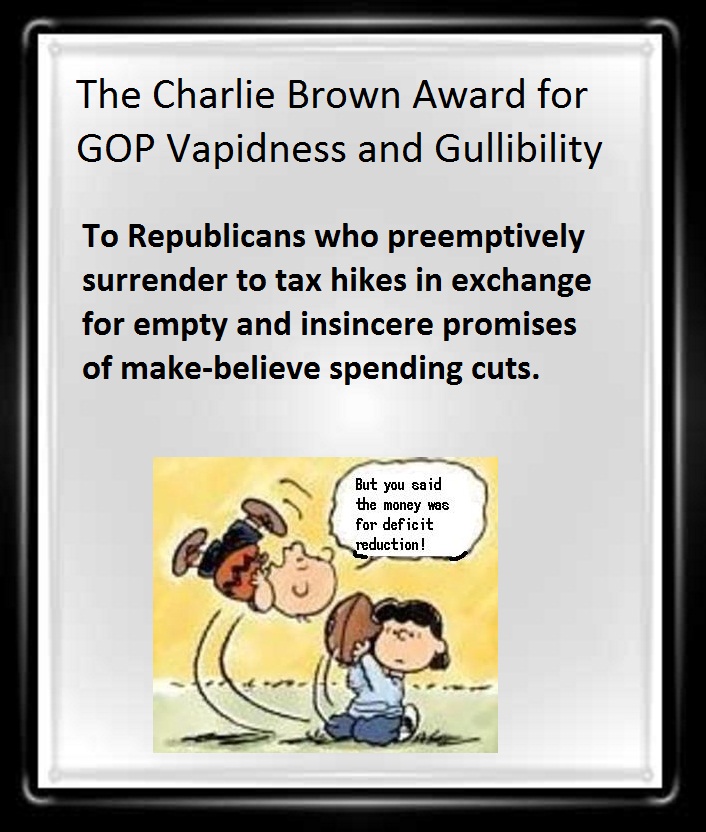
There’s a rumor that he is sending former President George H.W. “read my lips” Bush to collect his award, but I’m unable to confirm at this point.

This new award is part of a series, with the “Bob Dole Award” having been announced earlier this year.

In the same vein, but recognizing concepts rather than people, we also have “Mitchell’s Law” and “Mitchell’s Golden Rule.”

____________

UPDATE: Crawford claims the tax would not go into law until the Balanced Budget Amendment was passed according to the Tolbert Report.

Crawford’s Democrat opponents have called him opportunist and they are right.  People go into the booth to vote for the welfare party or the conservative job creating party and they can tell when someone is talking out of both sides of their mouth. It is sad when a newbie don’t talk to someone who has been in the conservative trenches for years fighting the good fight.

Ronald Wilson Reagan versus Barrack Obama

Government Spending Doesn’t Create Jobs

Uploaded by on Sep 7, 2011

Share this on Facebook: http://on.fb.me/qnjkn9 Tweet it: http://tiny.cc/o9v9t

In the debate of job creation and how best to pursue it as a policy goal, one point is forgotten: Government doesn’t create jobs. Government only diverts resources from one use to another, which doesn’t create new employment.

Video produced by Caleb Brown and Austin Bragg.

___________________________

 I have a son named Wilson Daniel Hatcher and he is named after two of the most respected men I have ever read about : Daniel from the Old Testament and Ronald Wilson Reagan.

One of the thrills of my life was getting to hear President Reagan speak in the beginning of November of 1984 at the State House Convention Center in Little Rock.  Immediately after that program I was standing outside on Markham with my girlfriend Jill Sawyer (now wife of 25 years) and we were alone on a corner and the President was driven by and he waved at us and we waved back.

My former pastor from Memphis, Adrian Rogers, got the opportunity to visit with President Ronald Reagan on several occasions and my St Senator Jeremy Hutchinson got to meet him too. I am very jealous.

Today we are going to compare Reagan’s record to that of Obama:

On this day last year, I posted two charts that I developed using the Minneapolis Federal Reserve Bank’s interactive website.

Those two charts showed that the current recovery was very weak compared to the boom of the early 1980s.

But perhaps that was an unfair comparison. Maybe the Reagan recovery started strong and then hit a wall. Or maybe the Obama recovery was the economic equivalent of a late bloomer.

So let’s look at the same charts, but add an extra year of data. Does it make a difference?

Meh…not so much.

Let’s start with the GDP data. The comparison is striking. Under Reagan’s policies, the economy skyrocketed.  Heck, the chart prepared by the Minneapolis Fed doesn’t even go high enough to show how well the economy performed during the 1980s.

Under Obama’s policies, by contrast, we’ve just barely gotten back to where we were when the recession began. Unlike past recessions, we haven’t enjoyed a strong bounce. And this means we haven’t recovered the output that was lost during the downturn.

This is a damning indictment of Obamanomics

Indeed, I made this point several months ago when analyzing some work by Nobel laureate Robert Lucas. And it’s been highlighted more recently by James Pethokoukis of the American Enterprise Institute and the news pages of the Wall Street Journal.

Unfortunately, the jobs chart is probably even more discouraging. As you can see, employment is still far below where it started.

This is in stark contrast to the jobs boom during the Reagan years.

So what does this mean? How do we measure the human cost of the foregone growth and jobs that haven’t been created?

Writing in today’s Wall Street Journal, former Senator Phil Gramm and budgetary expert Mike Solon compare the current recovery to the post-war average as well as to what happened under Reagan.

If in this “recovery” our economy had grown and generated jobs at the average rate achieved following the 10 previous postwar recessions, GDP per person would be $4,528 higher and 13.7 million more Americans would be working today. …President Ronald Reagan’s policies ignited a recovery so powerful that if it were being repeated today, real per capita GDP would be $5,694 higher than it is now—an extra $22,776 for a family of four. Some 16.9 million more Americans would have jobs.

By the way, the Gramm-Solon column also addresses the argument that this recovery is anemic because the downturn was caused by a financial crisis. That’s certainly a reasonable argument, but they point out that Reagan had to deal with the damage caused by high inflation, which certainly wreaked havoc with parts of the financial system. They also compare today’s weak recovery to the boom that followed the financial crisis of 1907.

But I want to make a different point. As I’ve written before, Obama is not responsible for the current downturn. Yes, he was a Senator and he was part of the bipartisan consensus for easy money, Fannie/Freddie subsidies, bailout-fueled moral hazard, and a playing field tilted in favor of debt, but his share of the blame wouldn’t even merit an asterisk.

My problem with Obama is that he hasn’t fixed any of the problems. Instead, he has kept in place all of the bad policies – and in some cases made them worse. Indeed, I challenge anyone to identify a meaningful difference between the economic policy of Obama and the economic policy of Bush.

  • Bush increased government spending. Obama has been increasing government spending.
  • Bush adopted Keynesian “stimulus” policies. Obama adopted Keynesian “stimulus” policies.
  • Bush bailed out politically connected companies. Obama has been bailing out politically connected companies.
  • Bush supported the Fed’s easy-money policy. Obama has been supporting the Fed’s easy-money policy.
  • Bush created a new healthcare entitlement. Obama created a new healthcare entitlement.
  • Bush imposed costly new regulations on the financial sector. Obama imposed costly new regulations on the financial sector.

I could continue, but you probably get the  point. On economic issues, the only real difference is that Bush cut taxes and Obama is in favor of higher taxes. Though even that difference is somewhat overblown since Obama’s tax policies – up to this point – haven’t had a big impact on the overall tax burden (though that could change if his plans for higher tax rates ever go into effect).

This is why I always tell people not to pay attention to party labels. Bigger government doesn’t work, regardless of whether a politician is a Republican or Democrat. The problem isn’t Obamanomics, it’s Bushobamanomics. But since that’s a bit awkward, let’s just call it statism.

Milton Friedman: Jewish tradition is so akin to capitalism but many Jews are socialists, what a paradox (Part 4)

Milton Friedman on the American Economy (5 of 6)

Uploaded by on Aug 9, 2009

THE OPEN MIND
Host: Richard D. Heffner
Guest: Milton Friedman
Title: A Nobel Laureate on the American Economy VTR: 5/31/77

__________________

Below is a part of the series on an article by Milton Friedman called “Capitalism and the Jews” published in 1972. 

Capitalism and the Jews

October 1988 • Volume: 38 • Issue: 10 • Print This Post11 comments

Milton Friedman, recipient of the 1976 Nobel Memorial Prize in Economic Science, is a Senior Research Fellow at the Hoover Institution. This article is reprinted with the permission of Encounter and The Fraser Institute.

“Capitalism and the Jews” was originally presented as a lecture before the Mont Pelerin Society in 1972. It subsequently was published in England and Canada and appears here without significant revision.

Freedom of Entry and Jewish Representation

 Moreover, within those countries, Jews have flourished most in the sectors that have the freest entry and are in that sense most competitive. Compare the experience of the Jews in banking, that I have referred to, with their experience in retail trade, which has been almost a prototype of the textbook image of perfect competition and free entry. Or compare their minor role in large industry with their prominence in the professions such as law, medicine, accountancy and the like.[4] Though there are barriers to entry in the professions, too, once past the initial barriers, there is a large measure of free competition for custom. Even the differences within the professions illustrate my theme. In the U.S., for which I know the details, there was for a long time a major difference between medicine and law in the extent to which state licensure was an effective bar to entry. For reasons that are not relevant here, there was significant restriction of entry in medicine, relatively little in law. And Jews were proportionately much more numerous in law than in medicine.

 The movie industry in the U.S. was a new industry and for that reason open to all. Jews became a major factor and this carried over to radio and television when they came on the scene. But now that government control and regulation has become more and more important, I am under the impression that the Jewish role in radio and T.V. is declining.

Capitalism and Israel

 A rather different example of the benefits Jews have derived from competitive capitalism is provided by Israel, and this in a dual sense. 

First, Israel would hardly have been viable without the massive contributions that it received from world Jewry, primarily from the U.S., secondarily from Britain and other Western capitalist countries. Suppose these countries had been socialist. The hypothetical socialist countries might conceivably have contributed, but if so they would have done so for very different reasons and with very different conditions attached. Compare Soviet aid to Egypt or official U.S. aid to Israel with private contributions. In a capitalist system, any group, however small a minority, can use its own resources as it wishes, without seeking or getting the permission of the majority. 

Second, within Israel, despite all the talk of central control, the reality is that rapid development has been primarily the product of private initiative. After my first extended visit to Israel two decades ago, I concluded that two traditions were at work in Israel: an ancient one, going back nearly two thousand years, of finding ways around governmental restrictions; a modern one, going back a century, of belief in “democratic socialism” and “central planning.” Fortunately for Israel, the first tradition has proved far more potent than the second. 

To summarize: Except for the sporadic protection of individual monarchs to whom they were useful, Jews have seldom benefited from governmental intervention on their behalf. They have flourished when and only when there has been a widespread acceptance by the public at large of the general doctrine of non-intervention, so that a large measure of competitive capitalism and of tolerance for all groups has prevailed. They have flourished then despite continued widespread anti-Semitic prejudice because the general belief in non-intervention was more powerful than the specific urge to discriminate against the Jews.

III. The Anti-capitalist Mentality of the Jews

Despite this record, for the past century, the Jews have been a stronghold of anti-capitalist sentiment. From Karl Marx through Leon Trotsky to Herbert Marcuse, a sizable fraction of the revolutionary anti-capitalist literature has been authored by Jews. Communist parties in all countries, including the patty that achieved revolution in Russia but also present-day Communist parties in Western countries, and especially in the U.S.,[5] have been run and manned to a disproportionate extent by Jews—though I hasten to add that only a tiny fraction of Jews have ever been members of the Communist party. Jews have been equally active in the less- revolutionary socialist movements in all countries, as intellectuals generating socialist literature, as active participants in leadership, and as members. 

Coming still closer to the center, in Britain the Jewish vote and participation is predominantly in the Labor party, in the U.S., in the left wing of the Democratic party. The party programs of the so-called right-wing parties in Israel would be regarded as “liberal,” in the modern sense, almost everywhere else. These phenomena are so well known that they require little elaboration or documentation.[6]

Cato Institute:Spending is our problem Part 6

But we also know that it is difficult to convince politicians to do what’s right for the nation. And if they don’t change the course of fiscal policy, and we leave the federal government on autopilot, then America is doomed to become another Greece.

The combination of poorly designed entitlement programs (mostly Medicare and Medicaid) and an aging population will lead to America’s fiscal collapse.

People think that we need to raise more revenue but I say we need to cut spending. Take a look at a portion of this article from the Cato Institute:

The Damaging Rise in Federal Spending and Debt

by Chris Edwards

Joint Economic Committee
United States Congress

Joint Economic CommitteeUnited States Congress

Added to cato.org on September 20, 2011

This testimony was delivered on September 20, 2011.

Conclusions

Federal spending is soaring, and government debt is piling up at more than a trillion dollars a year. Official projections show rivers of red ink for years to come unless policymakers enact major budget reforms. Unless spending and deficits are cut, the United States is headed for economic ruin as growth falls and rising debt threatens further financial crises.

Policymakers should turn their full attention to long-run spending reforms. They should begin terminating the many unneeded and damaging federal programs that draw resources out of the private sector and sap the economy’s strength. The essays on Cato’s website http://www.DownsizingGovernment.org describe many federal programs that produce low or negative returns. Programs often create economic distortions, damage the environment, restrict individual freedom, or have high levels of fraud and abuse.

I’ve proposed a plan to cut spending on entitlements, defense, and discretionary spending over 10 years to balance the budget.25 Spending reforms should aim to revive constitutional federalism and reverse the expansion of the federal government into areas better left to state and local governments, businesses, charities, and individuals.

Some analysts worry that spending cuts would hurt the economy, but other high-income nations have cut spending with very positive results. In the mid-1990s, for example, Canada faced a debt crisis caused by runaway spending — similar to our current situation. But the Canadian government changed course and slashed total spending 10 percent in just two years — which would be like us chopping annual spending by $360 billion in two years.26 Total government spending in Canada was cut by more than 10 percentage points of GDP over a decade. The Canadian economy did not sink into a recession as Keynesian economists might fear, but instead was launched on a 15-year economic boom.

A recent Joint Economic Committee report summarizes other international examples of spending cuts coinciding with strong economic growth.27 Thus, spending cuts should not be viewed as bad tasting medicine needed only to cure our debt disease, but as an opportunity to create positive and lasting benefits to the economy and society.

Thank you for holding these important hearings.


Notes:
.
25 http://www.DownsizingGovernment.org/balanced-budget-plan.
26 See http://www.cato-at-liberty.org/cutting-government-the-canadian-way and see http://www.cato-at-liberty.org/canadas-spending-cuts-and-economic-growth.
27 Joint Economic Committee, “Spend Less, Owe Less, Grow the Economy,” Republican Staff, March 15, 2011

Rare Marilyn Monroe pictures surface and another look at her spiritual search

Below you will find the rare pictures that surfaced and then there are links to previous posts that talked about Marilyn’s  spiritual search. Evidently she consulted the psychic Kenny Kingston on several occasions.

Rare Marilyn Monroe photos hit auction block

This image, taken in 1960, released by Julien’s Auctions, shows a black and white photograph of Allan “Whitey” Snyder applying Marilyn Monroe’s makeup on the set of “Lets Make Love.” This item is part of Julien’s Auctions Hollywood Legends being held on Saturday, March 31, 2012 and Sunday April 1 in Beverly Hills, Calif. (AP Photo/Julien’s Auctions)

LOS ANGELES — A collection of never-before-seen photos of Marilyn Monroe — and their accompanying copyrights — are going up for auction.

Celebrity auctioneer Darren Julien says more than 100 images of Monroe will be sold the highest bidders later this month.

The photos come from the estate of Allan “Whitey” Snyder, Monroe’s personal makeup artist for 15 years. One image shows Snyder applying makeup to a lingerie-wearing Monroe on the set of “Let’s Make Love” in 1960.

Letters, telegrams and a money clip from Monroe to Snyder are also among the lots set to be sold during Julien’s Auctions’ Hollywood Legends sale on March 31 and April 1. The auction also includes memorabilia from Frank Sinatra, James Dean, Charlie Chaplin and Sammy Davis, Jr.

Related posts:

Marilyn Monroe had fame, riches, the best wine and companionship, but she never found what she was looking for (Marilyn part 4)

Marilyn Monroe The Final Days (Part 7) John MacArthur delivered this message in 1975: Human Wisdom Disappoints The book of Ecclesiastes has some interesting things to say about human wisdom. This book was written by Solomon, and it chronicles human wisdom. The Lord put it in the Bible for a very special purpose: to show […]

A New Jersey man buys over 30 pictures of Marilyn Monroe (Marilyn part 3)

Marilyn Monroe The Final Days (Part 4) Fox News NY reported: OXNY.COM – A New Jersey man is getting a lot of attention for an item he picked up at a garage sale 30 years ago, but only recently rediscovered. Anton Fury, of Wayne, said he used to hit garage sales all the time in […]

Last hours of Marilyn Monroe’s life indicates she committed suicide because of unhappiness (Marilyn part 2)

 I Still Haven’t Found What Im Looking For Live From Milan Marilyn Monroe THE LAST INTERVIEW Part 1 Wikipedia notes:  Many questions remain unanswered regarding the circumstances and timeline of Monroe’s death after her body was found. 7-7:15p.m. Joe DiMaggio, after trying to get in touch with Monroe all day, speaks with Monroe about DiMaggio’s broken […]

Recently found Marilyn Monroe rare pictures from 1949 (Marilyn part 1)

Marilyn Monroe The Final Days (Part 1)   From Life Magazine:  nly. In the notes accompanying Eyerman’s pictures, LIFE Los Angeles correspondent Carlton McKinney describes the diligence of the young actress and the vets who helped her along: “The processes shot are not terribly complicated, showing as they do how Marilyn trains herself for hoped-for […]

Kurt Cobain’s spiritual search started in a Christian home but ended in Buddhism (Club 27 series part 2)jh41

The Rise And Rise Of Kurt Cobain part 1/3 Amy Winehouse joined the “Club 27 the other day with her early death. I am going through the others one by one. Today is Kurt Cobain.   7. Kurt Cobain very rarely does an artist come along and not just upset the “apple cart” but drops […]


Marilyn Monroe The Final Days (Part 7)

John MacArthur delivered this message in 1975:

Human Wisdom Disappoints

The book of Ecclesiastes has some interesting things to say about human wisdom. This book was written by Solomon, and it chronicles human wisdom. The Lord put it in the Bible for a very special purpose: to show us the frustrations and the inabilities of human wisdom. 

1. Solomon’s Fervent Search

Now Solomon, who was a very intelligent man, said in 1:13, “. . . I gave my heart to seek and search out by wisdom concerning all things that are done under heaven. . . . ” He’s saying, “I decided that I would apply wisdom and figure out all the answers. ” Continuing in verse 16, he said, “I spoke to mine own heart, saying, Lo, I am come to great estate, and have gotten more wisdom than all they that have been before me in Jerusalem; yea, my heart had great experience of wisdom and knowledge [I was so educated there wasn’t anybody as educated as I was]. And I gave my heart to know wisdom, and to know madness and folly [which was the opposite of wisdom]; I perceived that this also is vexation of spirit. For in much wisdom is much grief; and he that increaseth knowledge increaseth sorrow” (vv. 16-18). 

2. Solomon’s Futile Solution

Then, in 2:1 he said, “I said in mine heart, Come now, I will test thee with mirth; therefore enjoy pleasure. . . . ” In other words, “I looked for wisdom and I found it. When I summed up all my wisdom, I had nothing but a troubled spirit because the more I knew, the sadder I became. ” If you’re honest with yourself, you will find that the more you know, the less you really know. Solomon sought to cover up his troubled spirit by living it up:  “. . . I will test thee with mirth; therefore enjoy pleasure. . . . ” But then he said, “. . . this also is vanity” (v. 1b). In verse 3, we find Solomon seeking satisfaction from wine. That didn’t do him any good either. 

Read what else he did: “I made for myself great works; I built houses; I planted vineyards; I made gardens and orchards, and I planted trees in them of all kind of fruits; I made pools of water, to water therewith the wood that bringeth forth trees; I got servants and maidens, and had servants born in my house; also I had great possessions of herds and flocks above all that were in Jerusalem before me” (vv. 4-7). Those are the same things that the world does. The people of the world work hard for gain, possessions, and money. “I gathered also silver and gold, and the peculiar treasure of kings and of the provinces; I got men and women singers, and the delights of the sons of men, as musical instruments, and that of all sorts” (v. 8). Music is a pacifier for our world today, too. You can’t go anywhere without hearing music. People don’t want to live with their own thoughts. They’ve got to have somebody else putting other thoughts in their mind. 

Continuing in verse 9, he said, “So I was great, and increased more than all that were before me in Jerusalem; also my wisdom remained with me [whatever he learned, he remembered]. And whatsoever mine eyes desired, I kept not from them. I withheld not my heart from any joy; for my heart rejoiced in all my labor; and this was my portion of all my labor. Then I looked on all the works that my hands had wrought, and on the labor that I had labored to do; and, behold, all was vanity and vexation of spirit, and there was no profit under the sun. And I turned myself to behold wisdom, and madness, and folly; for what can the man do that cometh after the king? [What could I do now? I’ve done everything there is to do. ] . . . Then I saw that wisdom excelleth folly [It’s better to be smart than stupid. ]. . . . The wise man’s eyes are in his head, but the fool walketh in darkness; and I myself perceived also that one event happeneth to them all. Then said I in my heart, As it happeneth to the fool, so it happeneth even to me; and why was I then more wise?. . . ” (vv. 9-15a). 

Isn’t that amazing? When all that he did came to an end, the wisest man in the world said, “I was a fool. ” Human wisdom doesn’t have anything good to offer us.

Marilyn Monroe The Final Days (Part 8)

________________________________________

What is the answer to the spiritual search that we all have? I have found total satisfaction in my life through putting my faith alone in Christ.

Our views below (this material is from Campus Crusade for Christ) concerning how to go to heaven.

Just as there are physical laws that govern
the physical universe, so are there spiritual laws
that govern your relationship with God.

Law 1

God loves you and offers a wonderful plan for your life.

God’s Love
“God so loved the world that He gave His one and only Son, that whoever
believes in Him shall not perish but have eternal life” (John 3:16, NIV).

God’s Plan
[Christ speaking] “I came that they might have life, and might have it abundantly”
[that it might be full and meaningful] (John 10:10).

Why is it that most people are not experiencing that abundant life?

Because…

Law 2

Man is sinful and separated from God.
Therefore, he cannot know and experience
God’s love and plan for his life.

Man is Sinful
“All have sinned and fall short of the glory of God” (Romans 3:23).

Man was created to have fellowship with God; but, because of his own stubborn
self-will, he chose to go his own independent way and fellowship with God was broken.
This self-will, characterized by an attitude of active rebellion or passive indifference,
is an evidence of what the Bible calls sin.

Man Is Separated
“The wages of sin is death” [spiritual separation from God] (Romans 6:23).

Separation This diagram illustrates that God is holy and man is sinful. A great gulf separates the two. The arrows illustrate that man is continually trying to reach God and the abundant life through his own efforts, such as a good life, philosophy, or religion
-but he inevitably fails.The third law explains the only way to bridge this gulf…

Law 3

Jesus Christ is God’s only provision for man’s sin.
Through Him you can know and experience
God’s love and plan for your life.

He Died In Our Place
“God demonstrates His own love toward us, in that while we were yet sinners,
Christ died for us” (Romans 5:8).

He Rose from the Dead
“Christ died for our sins… He was buried… He was raised on the third day,
according to the Scriptures… He appeared to Peter, then to the twelve.
After that He appeared to more than five hundred…” (1 Corinthians 15:3-6).

He Is the Only Way to God
“Jesus said to him, ‘I am the way, and the truth, and the life, no one comes to
the Father but through Me’” (John 14:6).

Bridge The Gulf This diagram illustrates that God has bridged the gulf that separates us from Him by sending His Son, Jesus Christ, to die on the cross in our place to pay the penalty for our sins.It is not enough just to know these three laws…

Law 4

We must individually receive Jesus Christ as Savior and Lord;
then we can know and experience God’s love and plan for our lives.

We Must Receive Christ
“As many as received Him, to them He gave the right to become children
of God, even to those who believe in His name” (John 1:12).

We Receive Christ Through Faith
“By grace you have been saved through faith; and that not of yourselves,
it is the gift of God; not as result of works that no one should boast” (Ephesians 2:8,9).

When We Receive Christ, We Experience a New Birth
(Read John 3:1-8.)

We Receive Christ Through Personal Invitation
[Christ speaking] “Behold, I stand at the door and knock;
if any one hears My voice and opens the door, I will come in to him” (Revelation 3:20).

Receiving Christ involves turning to God from self (repentance) and trusting
Christ to come into our lives to forgive our sins and to make us what He wants us to be.
Just to agree intellectually that Jesus Christ is the Son of God and that He died on the cross
for our sins is not enough. Nor is it enough to have an emotional experience.
We receive Jesus Christ by faith, as an act of the will.

These two circles represent two kinds of lives:

Circles

Self-Directed Life
S-Self is on the throne
wpe463.jpg (790 bytes)-Christ is outside the life
wpe464.jpg (719 bytes)-Interests are directed by self, often
resulting in discord and frustration
Christ-Directed Life
wpe463.jpg (790 bytes)-Christ is in the life and on the throne
S-Self is yielding to Christ,
resulting in harmony with God’s plan
wpe464.jpg (719 bytes)-Interests are directed by Christ,
resulting in harmony with God’s plan

Which circle best represents your life?
Which circle would you like to have represent your life?


The following explains how you can receive Christ:

You Can Receive Christ Right Now by Faith Through Prayer
(Prayer is talking with God)

God knows your heart and is not so concerned with your words as He is with the attitude
of your heart. The following is a suggested prayer:

Lord Jesus, I need You. Thank You for dying on the cross for my sins. I open the door of my life and receive You as my Savior and Lord. Thank You for forgiving my sins and giving me eternal life.
Take control of the throne of my life. Make me the kind of person You want me to be.

Does this prayer express the desire of your heart? If it does, I invite you to pray this
prayer right now, and Christ will come into your life, as He promised.

Now that you have received Christ

On this web site:
Copyrighted 2007 by Bright Media Foundation and Campus Crusade for Christ.
All rights reserved. Used by permission.
Permission for use from the publisher,
Campus Crusade for Christ, 375 Highway 74 South, Suite A, Peachtree City, GA 30269

Marilyn Monroe The Final Days (Part 9)

“Friedman Friday” (“Free to Choose” episode 1 – Power of the Market. part 7 of 7)


Michael Harrington:  If you don’t have the expertise, the knowledge technology today, you’re out of the debate. And I think that we have to democratize information and government as well as the economy and society.

FRIEDMAN: I am sorry to say Michael Harrington’s solution is not a solution to it. He wants minority rule, I don’t. I want individual rule. I want human beings separately and individually to have control of their lives. I don’t believe that a minority that differs with me should have the right to take money out of my pocket to do research for them. They should go out and try to persuade people to contribute to them. I should be free to get people to contribute to me to present my ideas. But the idea of having some kind of an official government agency that is going to finance dissidents. In the first place, anybody who has any sense of realism about the way government operates at all will know that will end up in the hands of the majority and not the minority.

HARRINGTON: But can government in this extremely interdependent, complex world economy which is developing, can you have a mystical belief in the invisible hand of Adam Smith? I happen to think that Adam Smith was one of the greatest intellectual figures in the history of the world, and that capitalism was one of the greatest advances that humankind has ever made. But precisely because I put this in historical context; capitalism, as a friend of mine by the name of Karl Marx predicted some time ago, has developed tremendous tendencies towards monopoly, concentration, multinational corporations, money supplies that are not controlled by the Federal Reserve Bank or even the President of the United States anymore, and to think that you can respond to this radically new environment by an 18th century solution, I think really comes down to an intellectual exercise whose practical, political effect is to rationalize conservative power in America.

FRIEDMAN: This is a myth, a complete myth, that the development of an inner-developed country in a more complicated world necessitates greater government intervention. Government intervention has not grown in those areas which arise out of the complexity and interdependence of the world. It’s grown where? In taking money from some people and giving it to others. (Several talking at once.)

CONABLE: All I have to say is that government, Dr. Friedman, has to live in the 20th century __

FRIEDMAN: Of course.

CONABLE: __ much less the 19th or the 18th.

FRIEDMAN: Of course, but again __

CONABLE: And we have to take society as it exists today __

FRIEDMAN: Of course we do.

CONABLE: __ and build on that.

HARRINGTON: To me, the decisive thing at issue here is an essentially mythic, nonhistorical presentation of an abstract solution, taken out of time, which does not look to the tremendous evolution of capitalist society, the tremendous interdependence of the world, the fact that we now have not only national economic planning, but at the Tokyo summit we have institutionalized international economic planning of the major industrial capitalist powers. And under those circumstances, granted the enormous achievement of Adam Smith, granted the enormous achievement of the capitalist society, under this radically changed historical situation to propose those classical solutions, I think is to propose something nonserious which, however, does function seriously to rationalize conservative corporate economic and political power.

FRIEDMAN: The great achievements of the 19th century came from __ by departing from the kind of system you now want to reimpose. You want to take us back to the 18th and 17th century when we had a corporate society. When we had government controlling things. The whole issue is not what somebody is proposing in the 20th, or the 19th and the 18th, the whole issue is what is the right thing to do? What is the best way in which we can widen our opportunities, preserve our freedom, maintain our prosperity, and it seems to me the kind of solutions you would propose involve more of the same, more of the measures that have failed over and over again to achieve the objectives.

McKENZIE: Well, we leave the debate there this week and we hope you’ll join us again for the next edition of Free To Choose.


NCAA Bracket picks by Hatcher family part 4 (3-12-12)

UCLA vs. Kentucky 1975 NCAA Tournament

Jim Mone / Associated Press

No. 24: Duke’s monster rally

Final Four, March 31, 2001 — No lead is safe. The Blue Devils trailed ACC rival Maryland 39-17 with just under seven minutes remaining in the first half, but staged a comeback that you had to see to believe. Behind a flurry of 3-pointers and defensive pressure, the Devils trailed by two just minutes into the second half. They closed on a 19-7 run and claimed a 95-84 win. Yes, that’s 78 points in roughly 27 minutes. Loyola Marymount, eat your heart out.

______________

The time is here for the NCAA tournament to start and we have the picks of three members of the Hatcher family. Me, my son wilson and my brother-in-law and below are the links to our picks. May the best man win.

NCAA bracket picks by the Hatcher family 3-12-12

Kansas vs. Memphis – 2008 NCAA Title Game Highlights (HD) We are looking at the picks of the Hatcher family in the next four days leading up to the tip off of the big NCAA Tournament on Thursday March 15th. Wilson Hatcher’s bracket looks like this: Four play in games (which are called the First […]

NCAA Bracket picks by Hatcher family part 3 (3-12-12)

One Shining Moment 1994 – Arkansas vs. Duke These are my picks: 1st round winners: Here’s mine:   1st round winners   Ky UConn wsu Indiana UNLV Baylor xavier Duke Mich State Memphis New Mexico Louisville Murray State Marquette va Missouri Syracuse so miss harvard Wisc Cincy Fla State Gonzaga Ohio State UNC Creighton usf […]

NCAA Bracket picks by Hatcher family part 2 (3-12-12)

1973 NCAA Championship – UCLA vs Memphis State Here are the picks from my brother-in-law: Here’s mine:   1st round winners   Ky UConn VCU Indiana UNLV Baylor Norte Dame Duke Mich State Memphis New Mexico Louisville Murray State Marquette Florida Missouri Syracuse Kansas State Vandy Wisc Cincy Fla State Gonzaga Ohio State UNC Creighton […]

Related posts:

NCAA basketball tournament locations for 2012

I have March Madness fever this time every year and here are the locations and dates for the NCAA Tournament this year: March 15/17, 2012 Albuquerque, NM The Pit Arena University of New Mexico Louisville, KY KFC Yum! Arena University of Louisville Pittsburgh, PA Consol Energy Center Duquesne University Portland, OR Rose Garden Arena University […]

Razorbacks’ basketball season over

It was hard to listen to but the Razorbacks missed many layups on their way to a 70-54 loss to LSU in the SEC Basketball Tournament. ESPN reported: Arkansas 54 (18-14, 6-10 SEC) LSU 70 (18-13, 7-9 SEC)   1 2 T ARK 28 26 54 LSU 28 42 70 Top Performers Arkansas: B. Young […]

Arkansas ladybacks win first game ever in Knoxville

After getting beat at home by Florida by 30 points (the worst ever loss at Bud Walton) and then getting beat by Alabama at Bud Walton, it appears we have nothing to cheer about at Arkansas. However, hold the presses. The Arkansas ladybacks beat Tennessee for the first time ever in basketball last night. The […]

Who gets in NCAA Tournament from SEC, Calipari and Martin say 5, I say 4

Photo by Adam Brimer, copyright © 2012 Tennessee forward Jordan McRae (52), forward Jarnell Stokes (5) and guard Cameron Tatum (23) go up for a rebound during the first half against Arkansas at Thompson-Boling Arena Wednesday, Feb. 15, 2012. Tennessee won 77-58 over Arkansas. (ADAM BRIMER/NEWS SENTINEL) ______________________ I just don’t see 5 SEC schools […]

Who will get 4th place in SEC basketball race?

SEC Basketball race for 4th places heats up Does anyone want 4th place? It seems that everytime a team gets a few wins under their belt and it appears they are going to sew up 4th place then they lose. Look at Tennessee. The Vols played against a Bama team that had their two leading […]

Tea Party for real?

Uploaded by on Mar 5, 2012

If you listen to the media, conservatives are fading everywhere from Congress to the campaign trail. Nothing could be further from the truth; the strength of conservative principles continues to endure and thrive.

There is an awakening across the country, and the fight is on to return power to individuals and localities, empower individuals and unleash America’s entrepreneurial spirit.

Join the fight: http://heritageaction.com/join/fight-for-freedom/

______________________________

I really think the Tea Party movement is here to stay. They have a message of cutting back on the overreach of the federal government in our lives. I named my son Wilson after my hero Ronald Wilson Reagan and he said “It is time to check and reverse the growth of government, which shows signs of having grown beyond the consent of the governed.”

Ericka Andersen

March 10, 2012 at 8:15 am

Constitutional conservatism is alive and well in America today.

From conservatives in Congress working to roll back big government spending to the backlash over Obamacare’s anti-conscience mandate, it’s clear that Americans are clinging to the foundational principles of our country.

Two years ago, the Tea Party movement launched grassroots conservative activists to the forefront of political debate, giving big-government liberals a force to be reckoned with. Reinvigorated citizens began to fight for the constitutional cornerstones of limited government, free markets, and localized empowerment.

The fight to return to a constitutional government is still raging—and it isn’t going anywhere. As Ronald Reagan said, “It is time to check and reverse the growth of government, which shows signs of having grown beyond the consent of the governed.”

America is checking and reversing, President Reagan. The fight has only begun.

Please watch the video above from our sister organization, Heritage Action for America.

NCAA Bracket picks by Hatcher family part 3 (3-12-12)

One Shining Moment 1994 – Arkansas vs. Duke

These are my picks:

1st round winners:

Here’s mine:
 
1st round winners
 
Ky
UConn
wsu
Indiana
UNLV
Baylor
xavier
Duke
Mich State
Memphis
New Mexico
Louisville
Murray State
Marquette
va
Missouri
Syracuse
so miss
harvard
Wisc
Cincy
Fla State
Gonzaga
Ohio State
UNC
Creighton
usf
Michigan
Sdsu
belmont
purdue
Kansas
 
2nd round winners
 
Ky
wsu
Baylor
Duke
Mich State
Louisville
Murray State
Missouri
So miss
wisc
Fla State
Ohio State
UNC
Michigan
sdsu
Kansas
 
Elite 8
 
Ky
baylor
Louisville
Murray State
wisc
fsu
UNC
sdsu
 
Final 4
 
Ky
Louisville
fsu
unc
 
Champ game
 
Ky
unc
 
Winner
 
Ky

ASSOCIATED PRESS

No. 21: Indiana’s perfect finish

NCAA Championship game, March 29, 1976 — Bob Knight’s first NCAA title capped a 32-0 season, the last any men’s team has completed a season without a loss. Six teams had logged unbeaten season in 20 seasons before the Hoosiers did so. Yet in the more than 30 years since, only two teams even entered the NCAA tournament without a loss, let alone won the title. The Hoosiers may be the last of their kind.

Related posts:

NCAA bracket picks by the Hatcher family 3-12-12

Kansas vs. Memphis – 2008 NCAA Title Game Highlights (HD) We are looking at the picks of the Hatcher family in the next four days leading up to the tip off of the big NCAA Tournament on Thursday March 15th. Wilson Hatcher’s bracket looks like this: Four play in games (which are called the First […]

NCAA basketball tournament locations for 2012

I have March Madness fever this time every year and here are the locations and dates for the NCAA Tournament this year: March 15/17, 2012 Albuquerque, NM The Pit Arena University of New Mexico Louisville, KY KFC Yum! Arena University of Louisville Pittsburgh, PA Consol Energy Center Duquesne University Portland, OR Rose Garden Arena University […]

Razorbacks’ basketball season over

It was hard to listen to but the Razorbacks missed many layups on their way to a 70-54 loss to LSU in the SEC Basketball Tournament. ESPN reported: Arkansas 54 (18-14, 6-10 SEC) LSU 70 (18-13, 7-9 SEC)   1 2 T ARK 28 26 54 LSU 28 42 70 Top Performers Arkansas: B. Young […]

Arkansas ladybacks win first game ever in Knoxville

After getting beat at home by Florida by 30 points (the worst ever loss at Bud Walton) and then getting beat by Alabama at Bud Walton, it appears we have nothing to cheer about at Arkansas. However, hold the presses. The Arkansas ladybacks beat Tennessee for the first time ever in basketball last night. The […]

Who gets in NCAA Tournament from SEC, Calipari and Martin say 5, I say 4

Photo by Adam Brimer, copyright © 2012 Tennessee forward Jordan McRae (52), forward Jarnell Stokes (5) and guard Cameron Tatum (23) go up for a rebound during the first half against Arkansas at Thompson-Boling Arena Wednesday, Feb. 15, 2012. Tennessee won 77-58 over Arkansas. (ADAM BRIMER/NEWS SENTINEL) ______________________ I just don’t see 5 SEC schools […]

Who will get 4th place in SEC basketball race?

SEC Basketball race for 4th places heats up Does anyone want 4th place? It seems that everytime a team gets a few wins under their belt and it appears they are going to sew up 4th place then they lose. Look at Tennessee. The Vols played against a Bama team that had their two leading […]

Obama’s plan includes lots of tax increases

Rep Michael Burgess response

Uploaded by on Jan 25, 2012

Taxes are going to be higher under this proposal.

Obama’s Budget Badly Undercounts Tax Hikes

By
February 29, 2012

President Obama’s fiscal year 2013 budget proposal explicitly claims a $1.561 trillion tax hike over 10 years, as reported by the White House Office of Management and Budget (OMB).[1] This is a vast understatement, because that figure fails to account for all of the President’s tax increases and improperly claims credit for reducing tax receipts from tax cuts that are not new policies.

Numbers Do Not Match

The indication that something is amiss with the $1.561 trillion tax hike figure is that it is substantially smaller than the estimate in the Treasury Department’s “Green Book.” The Green Book provides an in-depth explanation of the President’s numerous tax policy changes in the budget. Treasury releases it separately when OMB releases the budget. The Green Book estimates that the President wants to raise taxes by $1.689 trillion.[2] That is $128 billion more than the OMB figure.

The OMB and Treasury estimates should match. The Treasury Department is responsible for estimating the revenue effects of the President’s tax policies for OMB, and OMB uses those estimates in its budget tables.

The reason for the difference is that OMB puts more than $154 billion of tax hikes the President wants outside the tax section of the table, where OMB lists the revenue effect of most of the President’s tax policy changes. This is also where OMB calculates the net revenue effect of the President’s tax hikes and cuts.[3] The Treasury estimate in the Green Book properly accounts for these tax hikes with the other tax changes in the budget.[4]

While OMB does account for these other tax hikes elsewhere in the table, putting them in areas other than the tax section misleads readers to believe that the President’s tax hikes are smaller than they are in reality. After all, it is sensible to find the line in the OMB table that states the net effect of the President’s tax policies and assume that it is the total amount.

The biggest missing tax hike from the tax section is the “Financial Crisis Responsibility Fee,” better known as the bank tax. OMB put this tax in the Treasury Department’s section of the table.[5] This tax hike adds another $61 billion to the President’s tax hike total. Also included in the Treasury Department’s section is a $44 billion tax hike from allowing the IRS to adjust a program integrity cap. OMB put a $48 billion increase of the unemployment tax in a footnote of the Labor Department’s section[6] and a $1 billion hike of user fees for commercial navigation of inland waterways in the Veterans Affairs’ section (Corps of Engineers).[7] These hidden tax hikes account for the missing $154 billion.

OMB also failed to account for a relatively small amount of tax cuts in its total tax hike figure. Those tax cuts total $26 billion. Subtracting that sum from the $154 billion missing tax hikes figure arrives at the missing $128 billion of net tax hikes OMB misclassified that should be included in President Obama’s total tax hike.

Credit Where Credit Is Not Due

Adding the missing tax hikes that OMB misplaced is necessary, but not sufficient, to arrive at the final tally of President Obama’s tax hikes. Both OMB and Treasury give the President credit for tax cuts that are not new policies and therefore wrongly reduce the amount he plans to increase revenue.

These policies include extending the payroll tax holiday ($31 billion), the American Opportunity Tax Credit ($137 billion), the Research and Experimentation Credit ($109 billion), the group of tax-reducing policies known as the “tax extenders” ($34 billion), and several other tax provisions that have long been part of the tax code ($6 billion).[8] These pre-existing tax cuts that President Obama does not deserve credit for equal $317 billion.

Properly remove that $317 billion of previous tax cuts from the President’s net tax hike as reported by OMB, add the missing $128 billion of tax hikes, and the President actually calls for raising taxes by more than $2 trillion over 10 years. That is 31 percent more than the OMB figure suggests the President wants to raise taxes.

Use the Correct Figure

Congress should disregard the misleading tax hike figure from OMB’s table and use the correct $2 trillion amount when referring to the total tax hikes in the President’s budget. Members of Congress should question OMB as to why they chose to mislead readers about the total tax hike that President Obama has called for on American taxpayers.

Curtis S. Dubay is a Senior Analyst in Tax Policy in the Thomas A. Roe Institute for Economic Policy Studies at The Heritage Foundation.