Monthly Archives: February 2012

Remembering Francis Schaeffer at 100 (Part 7)

schaeffer

Two Minute Warning: How Then Should We Live?: Francis Schaeffer at 100

Uploaded by on Jan 31, 2012

Under Francis Schaeffer’s tutelage, Evangelicals like Chuck Colson learned to see life through the lens of a Christian worldview. Join Chuck as he celebrates a life well lived.

_______________________

This year Francis Schaeffer would have turned 100 on Jan 30, 2012. I remember like yesterday when I first was introduced to his books. I was even more amazed when I first saw his films. I was so influenced by them that I bought every one of his 30 something books and his two film series. Chuck Colson’s website www.breakpoint.org  and I was directed from there to Probe’s website where I found this great article below. I will share it in 4 parts. Todd Kappelman is the author and here is some info on him and Probe.

Todd KappelmanTodd A. Kappelman is a field associate with Probe Ministries. He is a graduate of Dallas Baptist University (B.A. and M.A.B.S., religion and Greek), and the University of Dallas (M.A., philosophy/humanities). Currently he is pursuing a Ph.D. in philosophy at the University of Dallas. He has served as assistant director of the Trinity Institute, a study center devoted to Christian thought and inquiry. He has been the managing editor of The Antithesis, a bi-monthly publication devoted to the critique of foreign and independent film. His central area of expertise is Continental philosophy (especially nineteenth and twentieth century) and postmodern thought.

What is Probe?

Probe Ministries is a non-profit ministry whose mission is to assist the church in renewing the minds of believers with a Christian worldview and to equip the church to engage the world for Christ. Probe fulfills this mission through our Mind Games conferences for youth and adults, our 3-minute daily radio program, and our extensive Web site at www.probe.org.

Further information about Probe’s materials and ministry may be obtained by contacting us at:

Probe Ministries
2001 W. Plano Parkway, Suite 2000
Plano TX 75075
(972) 941-4565
info@probe.org
www.probe.org
Copyright information

This is the first part:

The Need to Read: Francis Schaeffer Print E-mail

Todd Kappelman Written by Todd Kappelman

The Need to Read series began several months ago with a program on C.S. Lewis . The rationale for this series is that many of the great writers who have helped many Christians mature are now either unknown or neglected by many who could use these authors insights into the faith.

This installment focuses on Francis Schaeffer (1912-1984), one of the most recognized and respected Christian authors of the twentieth century.

He saw so much more in what he was looking at and agonized over it much more that the rest of us. He was one of the truly great Christians of our time.{1} If this is the case, and I and many others believe that it is, then this question follows: What was Schaeffer looking at? The remarkable answer to this question is all of human history and the long chain of events which have led to modern man as we see him today.

In a time when true scholarship is often equated with specialization in a particular period, people, or subject, Schaeffer was a grand generalist. He was a true Renaissance man who knew something about everything, as opposed to everything about something. In addition to his remarkable and encyclopedic knowledge of human history, he was able to connect important events together such that Christians can see what has happened in human history, what is happening now, and what will happen if man continues on his present course. Schaeffer was a visionary who had an uncanny understanding of the times we live in and what mankind can expect in the near future.

Schaeffers greatest gift, like that of C.S. Lewis, was his concern for the average Christian. He believed philosophy, theology, and ethics should not be reserved for the conversation of learned academics; rather they should be the daily concern of the man on the street. The price for ignorance of the subjects could be our life, or more importantly, our very souls. The Scriptures are very clear concerning the price of ignorance. The prophet Hosea said that Gods people perish for lack of knowledge.{2} In light of this observation, Schaeffers genius was his ability to communicate extremely difficult philosophical and theological issues on a non- technical level. His writings provide Christians with access to some of the most pressing concerns of our times.

Several aspects of Schaeffers style and sweeping concerns will be discussed in this essay. First, he perceived the wholeness of the created order. There is a basic need in all human beings to know the answers to the great questions of life, and Schaeffer believed that God has given man the answers in the form of natural and specific revelation.

Second, Schaeffer believed that man has a natural inclination to desire the reasonable. Schaeffer argued that the Christian faith is not only true, but that it is the most plausible account for the existence of man and his place in the universe. He contended that an irrational faith is not what God intended to communicate to man.

Third, Schaeffer was one of the original cultural critics of the twentieth century. He believed that mankind, both Christians and non-Christians, was adrift on a sea of irrationality. He further believed that this drift was intensifying to the point that true, orthodox Christianity was being lost.

Related posts:

Francis Schaeffer would be 100 years old this year (Schaeffer Sunday)

Dr. Francis Schaeffer – Extra – Interview – Part 2 Francis Schaeffer had a big impact on me in the late 1970′s and I have been enjoying his books and films ever since. Here is great video clip of an interview and below is a fine article about him. Francis Schaeffer 1912-1984 Christian Theologian, Philosopher, […]

Francis Schaeffer’s “How should we then live?” Video and outline of episode 10 “Final Choices” (Schaeffer Sundays)

E P I S O D E 1 0 How Should We Then Live 10#1 FINAL CHOICES I. Authoritarianism the Only Humanistic Social Option One man or an elite giving authoritative arbitrary absolutes. A. Society is sole absolute in absence of other absolutes. B. But society has to be led by an elite: John Kenneth […]

Fellow admirer of Francis Schaeffer, Michele Bachmann quits presidential race

What Ever Happened to the Human Race? Bachmann was a student of the works of Francis Schaeffer like I am and I know she was pro-life because of it. (Observe video clip above and picture of Schaeffer.) I hated to see her go.  DES MOINES, Iowa — Last night, Minnesota Rep. Michele Bachmann vowed to […]

Francis Schaeffer’s “How should we then live?” Video and outline of episode 9 “The Age of Personal Peace and Affluence” (Schaeffer Sundays)

E P I S O D E 9 How Should We Then Live 9#1 T h e Age of Personal Peace and Afflunce I. By the Early 1960s People Were Bombarded From Every Side by Modern Man’s Humanistic Thought II. Modern Form of Humanistic Thought Leads to Pessimism Regarding a Meaning for Life and for Fixed […]

Francis Schaeffer’s “How should we then live?” Video and outline of episode 8 “The Age of Fragmentation” (Schaeffer Sundays)

E P I S O D E 8 How Should We Then Live 8#1 I saw this film series in 1979 and it had a major impact on me. T h e Age of FRAGMENTATION I. Art As a Vehicle Of Modern Thought A. Impressionism (Monet, Renoir, Pissarro, Sisley, Degas) and Post-Impressionism (Cézanne, Van Gogh, Gauguin, […]

Francis Schaeffer’s “How should we then live?” Video and outline of episode 7 “The Age of Non-Reason” (Schaeffer Sundays)

E P I S O D E 7 How Should We Then Live 7#1 I am thrilled to get this film series with you. I saw it first in 1979 and it had such a big impact on me. Today’s episode is where we see modern humanist man act on his belief that we live […]

Francis Schaeffer would be 100 years old this year (Schaeffer Sunday)

Dr. Francis Schaeffer – Extra – Interview – Part 2 Francis Schaeffer had a big impact on me in the late 1970′s and I have been enjoying his books and films ever since. Here is great video clip of an interview and below is a fine article about him. Francis Schaeffer 1912-1984 Christian Theologian, Philosopher, […]

Francis Schaeffer’s “How should we then live?” Video and outline of episode 6 “The Scientific Age” (Schaeffer Sundays)

E P I S O D E 6 How Should We Then Live 6#1 I am sharing with you a film series that I saw in 1979. In this film Francis Schaeffer asserted that was a shift in Modern Science. A. Change in conviction from earlier modern scientists.B. From an open to a closed natural system: […]

Francis Schaeffer’s “How should we then live?” Video and outline of episode 5 “The Revolutionary Age” (Schaeffer Sundays)

E P I S O D E 5 How Should We Then Live 5-1 I was impacted by this film series by Francis Schaeffer back in the 1970′s and I wanted to share it with you. Francis Schaeffer noted, “Reformation Did Not Bring Perfection. But gradually on basis of biblical teaching there was a unique improvement. A. […]

Francis Schaeffer’s “How should we then live?” Video and outline of episode 4 “The Reformation” (Schaeffer Sundays)

How Should We Then Live 4-1 I was impacted by this film series by Francis Schaeffer back in the 1970′s and I wanted to share it with you. Schaeffer makes three key points concerning the Reformation: “1. Erasmian Christian humanism rejected by Farel. 2. Bible gives needed answers not only as to how to be right with […]

Francis Schaeffer’s “How should we then live?” Video and outline of episode 3 “The Renaissance”

How Should We Then Live 3-1 I was impacted by this film series by Francis Schaeffer back in the 1970′s and I wanted to share it with you. Schaeffer really shows why we have so many problems today with this excellent episode. He noted, “Could have gone either way—with emphasis on real people living in […]

Francis Schaeffer’s “How should we then live?” Video and outline of episode 2 “The Middle Ages” (Schaeffer Sundays)

How Should We Then Live 2-1 I was impacted by this film series by Francis Schaeffer back in the 1970′s and I wanted to share it with you. Schaeffer points out that during this time period unfortunately we have the “Church’s deviation from early church’s teaching in regard to authority and the approach to God.” […]

Francis Schaeffer’s “How should we then live?” Video and outline of episode 1 “The Roman Age” (Schaeffer Sundays)

How Should We Then Live 1-1 Today I am starting a series that really had a big impact on my life back in the 1970′s when I first saw it. There are ten parts and today is the first. Francis Schaeffer takes a look at Rome and why it fell. It fell because of inward […]

Andy Rooney was an atheist

How Now Shall We LiveClick here to purchase Chuck Colson and Nancy Pearcey’s How Now Shall We Live?, dedicated to Francis Schaeffer.


Click here for a list of Francis Schaeffer’s greatest works, from the Colson Center store!
SchaefferBooks

Video clip on youtube compares Obama to wicked king from Coldplay song

Uploaded by on Nov 9, 2010

My Democratic friends are pretty glum lately. I put this together to help them remember happier times.

DISCLAIMER: I do not own the audio and images used in this video. All audio and images belong to their rightful owner. No copyright infringement intended. This video is made for entertainment and non-profit purposes only.

_____________________

I found this video on the internet called “When Democrats ruled” and it was uploaded by on Nov 9, 2010 on youtube with these words: “My Democratic friends are pretty glum lately. I put this together to help them remember happier times.”

Then it shows these 43 events in pictures and plays the Coldplay song “Viva La Vida.”

I have written about this song by Coldplay before and I thought it was proper to discuss some of that again after first listing the 43 events pictured in the video:
1. House Speaker Nancy Pelosi on taking up the gavel in January 2007. She lost her speakership as a result of the 2010 election.

3. Rep. John Spratt (D-SC), to Pelosi’s left, first elected in 1982, lost re-election.

4. White House Chief of Staff Rahm Emanuel has resigned to run for Mayor of Chicago.

7. The S-CHIP bill raised taxes on cigarettes to pay for an expansion of the children’s health care program, although expenses will outstrip the new tax revenue.

10. Sen. Blanche Lincoln (D-AR) lost her re-election.

12. Rep. Chet Edwards (D-TX), first elected in 1990, lost re-election.

13. Rep. Charlie Rangel (D-NY) gave up the chairmanship of the Ways and Means Committee after a series of ethics complaints, although he survived a primary challenge and was re-elected in 2010.

14. Rep. Ike Skelton (D-MO), first elected in 1976, lost re-election.

16. Rep. Steve Kagen (D-WI), first elected in 2006, lost re-election.

17. The cap and trade bill passed the House but was never voted on by the Senate, and is now considered dead.

18. Rep. Rick Boucher (D-VA), first elected in 1982, lost re-election.

19. Scandal-plagued Gov. Rod Blagojevich (D-IL) appointed Sen. Roland Burris (D-IL) to President Obama’s old Senate seat, despite allegations that Blagojevich sought to sell the seat. Burris decided not to run for election, and a Republican won the seat.

20. Rep. Walt Minnick (D-ID), first elected in 2008, lost re-election.

21. Gov. Jon Corzine (D-NJ) lost re-election despite a strong campaign effort by President Obama.

22. Rep. Paul Kanjorski (D-PA), first elected in 1984, lost re-election.

23. During President Obama’s State of the Union, Rep. Joe Wilson (R-NC) interrupted by yelling, “You lie!” Wilson apologized; despite being a top Democratic target, won re-election.

24. Rep. Bobby Bright (D-AL), first elected in 2008, lost re-election.

25. Against the background of the health care law debate and despite a strong campaign effort by President Obama, Democratic candidate Martha Coakley unbelievably lost the Massachusetts Senate seat to Republican Scott Brown.

26. Rep. James Oberstar (D-MN), first elected in 1974, lost re-election.

27. Rep. Dave Obey (D-WI), first elected in 1969 and the third longest serving member of the House, retired rather than face re-election.

29. Rep. Patrick Murphy (D-PA), first elected in 2006, lost re-election.

30. Sen. Arlen Specter (PA) switched to the Democratic Party after it became clear he would lose the Republican Party primary, then lost the Democratic Party primary.

31. Rep. Bart Stupak (D-MI), first elected in 1992, retired rather than face re-election. He had been the focus of a bitter debate over the health care law’s funding of abortions.

32. President Obama and his advisers routinely speak of complete agreement among economists regarding additional stimulus spending. The Cato Institute took out an ad signed by hundreds of economists, including Nobel Prize winners, who disagreed.

33. Rep. Earl Pomeroy (D-ND), first elected in 1992, lost re-election.

34. Rep. Alan Grayson (D-FL), first elected in 2008 and considered a progressive hero for his biting criticism of Republicans, lost re-election by 18 points.

35. Sen. Russ Feingold (D-WI), first elected in 1992, lost re-election.

37. Rep. Bob Etheridge (D-NC), first elected in 1996, lost re-election. He had been caught on video manhandling students asking him questions on the street.

38. Rep. Kendrick Meek (D-FL), first elected in 2002, chose to retire and instead run unsuccessfully for the Senate seat, coming in third place.

39. Continuing the Bush Administration policy of defending DOMA and retaining Don’t Ask Don’t Tell alienated gays who supported the Democrats.

40. Sen. Harry Reid (D-NV) hung on to his Senate seat but is severely weakened as Senate Majority Leader.

41. The Obama Administration described how unemployment would drop once the stimulus was enacted, but the actuals have gone in the other direction.

42. Sen. Evan Bayh (D-IN), first elected in 1998, retired rather than run for re-election. He has been critical of his party’s legislative agenda.

43. After the election, President Obama admitted in a morose press conference that his party had suffered a “shellacking.”

__________

Here is a portion of an article I wrote a couple of years ago about Chris Martin’s view of hell. He says he does not believe in it but for some reason he writes a song that teaches that it exists:
 
Belief of Eternal Punishment in Grammy Winning Song
By Everette Hatcher
 
Chris Martin of the rock group Coldplay wrote the song Viva La Vida, and the song just won both the grammy for the “Song of the Year” and “Best Pop Performance by a duo or Group with Vocals.”
 
In this song, Martin is discussing an evil king that has been disposed. “I used to rule the world…Feel the fear in my enemy’s eyes…there was never an honest word and that was when I ruled the world, It was the wicked and wild wind, Blew down the doors to let me in, Shattered windows and the sound of drums, People couldn’t believe what I’d become…For some reason I can’t explain, I know Saint Peter won’t call my name,  Never an honest word, But that was when I ruled the world.”
 
Q Magazine asked Chris Martin about the lyric in this song “I know Saint Peter won’t call my name.” Martin replied, “It’s about…You’re not on the list. I was a naughty boy. Its always fascinated me that idea of finishing your life and then being analyzed on it…That is the most frightening thing you could possibly say to somebody. Eternal damnation. I know about this stuff because I studied it. I was into it all. I know it. It’s mildly terrifying to me. And this is serious.”
 
I have been following the career of Chris Martin for the last decade. He grew up in a Christian home that believed in Heaven and Hell, but made it clear several years ago that he actually resents those who hold to those same religious dogmatic views he did as a youth. Yet it seems his view on the possibility of an afterlife has changed again….
 
Let me give a suggestion on why Chris Martin’s view may have changed. Here is a couple of scripture verses from the Bible that may give insight into a possible explanation. God “has planted eternity in the human heart…” (Ecclesiastes 3:11). This is a direct result of our God-given conscience. The apostle Paul said it best in Romans 1:19, “For that which is known about God is evident to them and made plain in their inner consciousness, because God  has shown it to them” (Amplified Version).
 
Evidently  Chris Martin who said he resented dogmatic religious views a few years ago, has now written a grammy winning song that pictures an evil king being punished in an afterlife. Could it be that his God-given conscience prompted him to put that line in?
 
______________
It is my belief that unborn babies have the same human rights that we have. I do think that evil kings will be punished for their evil deeds unless they repent. Deep down I really believe that everyone knows that God exists. I am glad I ran across this video and I will continue to pray for both Chris Martin and for my president.

Chicago style politics?

In this video above you will see a lot of President Obama’s friends who lost in 2010 and hear the song by Coldplay talking about the wicked king who used to rule the world.
_________________________

I know that some underhanded politics has existed in Chicago for a long time and now our president is from Chicago. Are some of those same type of politics being now practiced in Washington?


Lachlan Markay

February 21, 2012 at 8:37 am

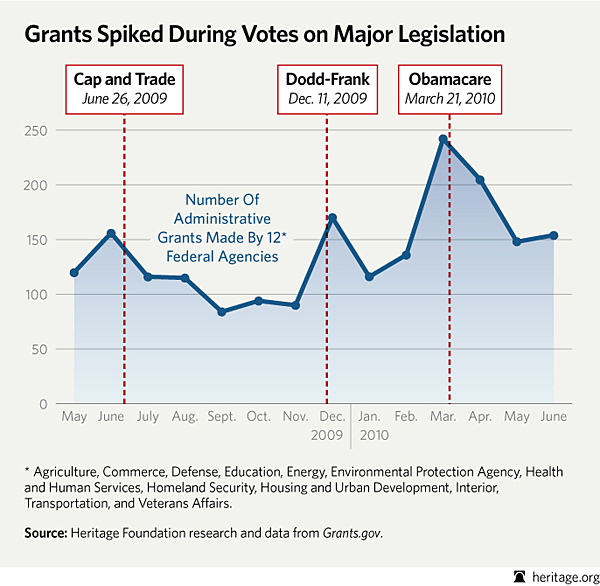
An examination of “administrative earmarks” around the time of congressional votes on key pieces of President Obama’s agenda suggests the White House used its power to fund local projects as a means to “buy” votes for major legislative efforts.

Administrative earmarking refers to the federal government’s allocation of funds from its discretionary budget for specific projects. The practice is less transparent than legislative earmarking, since, according to the Congressional Research Service, “[t]here is no source that defines and comprehensively identifies Administrative earmarks.”

But an analysis of grants from agencies during the early years of the Obama administration shows that the districts of moderate Democrats, whose support was so crucial for Obama during the 111th Congress, received large sums right around the passage of three key pieces of legislation: Obamacare, Dodd-Frank financial regulations, and the cap-and-trade bill.

During the run-up to votes in the House of Representatives for each of those pieces of legislation, the rate of administrative earmarking spiked. This chart shows the number of grants requested by 12 federal agencies, as documented at Grants.gov.

The number of grants given by those agencies spiked precisely when the House was considering each of the three pieces of legislation.

Even more troubling: during the same time periods, significant grant money went to the districts of numerous Democratic representatives who looked to face tough battles for re-election. The legislation Obama was attempting to get through Congress was generally unpopular, and vulnerable members needed other ways to appeal to constituents. Federal grants made for a perfect opportunity.

Then-Rep. Chris Carney (D-PA), for instance, kept his support for Dodd-Frank quiet. His website never posted a press release announcing his “yes” vote on the bill. It did, however, tout two federal grants totaling $3.6 million for businesses in his district two days before the Dodd-Frank vote.

Then-Rep. Zach Space (D-OH) hailed from a district reliant on the coal industry, which would have been hit particularly hard by cap and trade. He voted for the measure, but neglected to publicize the vote on his website. He did, however, announce eight federal grants totaling roughly $1.8 million all made during the month before the House passed cap and trade.

At least 32 vulnerable House Democrats received significant federal grant money in the periods leading up to or directly after their votes on at least one of these three pieces of legislation (see charts below), raising concerns that those grants may have been used either to encourage or reward votes in favor of the administration’s position.

The use of administrative earmarks to “buy votes” is not new. President Richard Nixon saw the practice as “a way to gain political support for Nixon’s re-election by using federal resources and grants to influence key states and voting blocs.”

President Franklin Roosevelt was an early pioneer of the political use of administrative earmarking. He “deliver[ed] large defense projects to key states whose electoral votes he wanted to secure,” according to historian Burt Folsom.

But while administrative earmarking is a practice used by nearly every administration, CRS found in a report published in April 2010 — immediately after the time period at issue — that “[b]oth the number and value of earmarks requested solely by the President increased since FY2008.” The number of earmarks had increased by 54 percent, CRS found, while the value of those requests had increased by a whopping 126 percent.

The timing of those requests also suggests political factors at play. Heritage’s Hans von Spakovsky, a former Federal Elections Commissioner, said the administration’s actions “show how taxpayer funds are used for crass political purposes — it is a rank abuse of the government’s power and another sign of this administration’s lack of a moral compass.”

While speculating on the motives of individuals responsible for these grants is difficult, this administration has a history of using its powers for political purposes. In the case of “vote-buying” in particular, the administration offered to expand Medicaid funding to residents of Louisiana and Nebraska to the tune of roughly $145 million to secure the votes of Sens. Mary Landrieu (D-LA) and Ben Nelson (D-NE) for the Obamacare bill.

Member2008 vote for member2008 percentage of vote for McCain in district2004 percentage of vote for Bush in district2000 percentage of vote for Bush in districtIdentified by DCCC as vulnerable?Identified by NRCC as target?Partisan Voting Index.Alan Grayson (FL-08)52.01%47%55%53%YesYesR + 2.

Bart Stupak (MI-01)65.04%48%53%53%NoNoR + 3.

Bill Foster (IL-14)57.74%44%55%54%YesYesR + 1.

Bruce Braley (IA-01)64.56%41%46%45%NoNoD + 5.

Carol Shea-Porter (NH-01)51.73%46%51%49%YesYesR + 0.

Chris Carney (PA-10)56.33%54%60%56%YesYesR + 8.

Ciro Rodriguez (TX-23)55.76%48%57.3%53.6%YesYesR + 4.

Debbie Halvorson (IL-11)58.4%45%53%50%YesYesR + 1.

Frank Kratovil (MD-01)49.12%58%62%57%YesYesR + 13.

Gabrielle Giffords (AZ-08)54.72%52%53%49%YesYesR + 4.

Heath Shuler (NC-11)61.96%52%57%58%NoYesR + 6.

Jim Himes (CT-04)51.32%40%46%43%YesYesD + 5.

John Boccieri (OH-16)55.36%50%54%56%YesYesR + 4.

John Hall (NY-19)58.67%48%53%49%NoYesR + 3.

John Varmuth (KY-03)59.37%43%49%48%NoNoD + 2.

Kathy Dahlkemper (PA-03)51.24%49%53%50%YesYesR + 3.

Kurt Schrader (OR-05)54.25%43%50%49%YesYesD + 1.

Leonard Boswell (IA-03)56.31%45%49.7%48%YesYesD +1.

Mark Schauer (MI-07)48.78%46%54%53%YesYesR + 2.

Mary Jo Kilroy (OH-15)45.94%45%50%54%YesYesD + 1.

Mike McMahon (NY-13)60.94%51%55%44%YesYesR + 4.

Nick Rahall (WV-03)66.92%56%53%47%NoYesR + 6.

Patrick Murphy (PA-08)56.77%45%48%46%NoYesD + 2.

Paul Hodes (NH-02)856.4%43%47%47%NoYesD + 3.

Paul Kanjorski (PA-11)51.63%42%47%43%NoYesD + 4.

Rick Boucher (VA-09)Unopposed59%59%55%NoYesR + 11.

Scott Murphy (NY-20)50.2%48%53%51%YesYesR + 2.

Steve Driehaus (OH-01)52.47%44%50%53%YesYesD + 1.

Steve Kagen (WI-08)54%53%57%58%YesYesR + 2.

Suzanne Kosmas (FL-24)57.2%51%56%52%YesYesR + 4.

Tim Bishop (NY-01)58.38%48%49.4%43%NoYesR + 0.

Zack Space (OH-18)59.87%53%57%58%YesYesR + 7

Private entrepreneurs can solve our post office problem

When you look at how good the private enterprise does with deliveries and then compare it to how bad the federal government does with the same duties it is laughable. The answer to the federal post office problem is to encourage private entrepreneurs to fill the gap and provide competition for the post office in the delivery of first class mail.

I grew up in Memphis and I am very familar with a company called Federal Express and its president Fred Smith. Actually I have lived in Little Rock since 1983 and Federal Express was started in Little Rock in 1971 and then moved to Memphis in 1972. Entrepreneurs like Fred Smith need to be encouraged, not discouraged by government. Here is a funny Fed Ex Commercial from the 1980’s.

 
On July 3, 1981, I was in Prague, Czechoslovakia in the middle of a 20 country student tour. Our group of 48 American students had the opportunity to speak to a Communist government official for over an hour. We asked him several questions. My questions were quite direct and I share some of them at a later time.
 
However, I did want to share one question that I asked. I told the official about an entrepreneur from Memphis named Fred Smith. Back in the early 1970’s we heard about how Smith had this crazy idea about delivering overnight packages from LA to San Francisco via Memphis. Sounded like it would not work, but Smith was able to invest all his money and eventually it paid off. His idea was successful.
 
I asked the simple question: Could something like this happen here in Communist Czechoslovakia? He responded, “No. That is because no private citizen is allowed to own that much capital. The government must do things like that.”
 
There was no chance for entrepreneurs to exist in communist countries. I was simply pointing out that economic freedom allows an environment for entrepreneurs. Why would someone put the time and energy in putting together a grand plan like Fed Ex when the benefit and reward would just go to a communist government? Entrepreneurship should be encouraged, but many times today in the USA we find that our lawmakers pass laws that discourage entrepreneurs.

USPS: Stuck With the Government Business Model

Posted by Tad DeHaven

The U.S. Postal Service has released a new five-year plan for congressional consideration that it says would get the beleaguered government mail monopoly on sounder financial footing and thus avoid a taxpayer bailout. The plan repeats previous suggestions (i.e., workforce reductions, postal network consolidations, elimination of Saturday delivery, elimination of the retiree healthcare benefit funding requirement) and proposes an increase in the price of a first-class stamp from forty-five to fifty cents.

Whether or not it would achieve what the USPS hopes, it probably doesn’t matter given that asking Congress for greater operational flexibility is like asking a two year old to stop playing with their food. That’s why the focus should be on completely transitioning the USPS from a government-run business to a privately-run business (or perhaps businesses).

Over at the Courier Express and Postal Observer blog, Alan Robinson says that “just like all plans that came before, [the new USPS plan] started with the assumption that the Postal Service remains a quasi-governmental entity.” As a result, Robinson notes that the plan is missing two key ingredients for success that foreign posts have utilized: private capital and an expanded range of products and services.

In an essay on the U.S. Postal Service, I discuss how liberalization in other countries has enabled foreign mailers to diversify into non-postal activities:

Consultants at Accenture have found that diversification not only has a measurable impact on the performance of international posts, but that it is what ultimately distinguishes high performers from low performers. America’s relatively dynamic economy is particularly suited for the diversification opportunities that would arise under postal liberalization.

Germany’s former postal monopoly, Deutsche Post, illustrates the type of transformation possible by liberalization. Today, the private Deutsche Post World Net has changed its compensation structure, imported managers from other industries, modernized the mail and parcels network within Germany, and developed new products such as hybrid mail and e-commerce. The company now has interests in not only the traditional mail and parcels business but also express mail logistics, banking, and more.

Given that the USPS’s plan is going to be unpopular with various postal stakeholders (i.e., special interests), Alan says that they should consider the advantages of privatization:

It is clear that the business plan that the Postal Service has chosen is not the one that has worked in other countries. The plan avoids talking about either private capital or expanding the breadth of service offerings as neither is on the legislative table.    Introducing thinking about how private capital could be introduced and the product offerings could be expanded forces stakeholders to think about privatization, an idea that is nearly as unpopular as the changes that the proposed business model introduced.   However, as this brief post notes, privatization offers significant financial advantages that could reduce the operating and price changes envisions by the Postal Service’s business plan. Therefore, those who see the greatest harm from this plan need to see if the advantages of privatization could benefit their interests sufficiently to overcome long-held objections to the idea.

I think Robinson is right, but I suspect that the “stakeholders” believe there’s a good chance that Congress will ultimately come to their aid with some sort of taxpayer bailout. Therefore, it’s possible that they believe that it is in their best interest to continue fighting for the status quo. Unfortunately, the recent bipartisan federal bailouts of the financial industry and the automakers suggest that they could be correct.

Related posts:

Privatize the post office

The Arkansas Times rightly jumped on Republicans for whining about the local post office branches that were closing.  (It is sad to me that Republican Presidential Candidates are not very brave about offering any spending cuts.) The real answer is privatizing the post office. Here is a good article from the Cato Institute:   The USPS […]

Post Office on the brink of financial collapse

Post Office on the brink of financial collapse You’ve Got (No) Mail: Is the End Near for the Postal Service? By James Gattuso September 29, 2011 The United States Postal Service (USPS) stands on the brink of financial collapse. According to the Postmaster General, by next month, USPS coffers will be down to a week’s […]


Private companies need private capital to succeed, not federal handouts

It seems to me that during the 1980’s we saw the largest growth of our economy because private industry was encouraged to expand because the top tax rate went down from 70 to almost half of that.

It reminded me of the 1960’s when the top income rate went from 91 to almost half of that and the same thing happened. We need to get back to the same atmosphere of taxing cutting and the expansion of private industry. Instead we have today the government offering handouts everywhere we look. Here is a case that makes this very point below:

Franken to Chu: Doggone It, Like My State’s Company

Posted by Tad DeHaven

The Senate Energy and Natural Resources Committee held a hearing last week on the Department of Energy’s budget request for fiscal 2013. Chris Edwards tipped me off to a particularly galling exchange between Energy secretary Steven Chu and Sen. Al Franken (D-MN). Sen. Franken uses his allotted time to badger Chu about a federal loan that Energy conditionally committed to a Minnesota company in 2010 that apparently has yet to be approved.

The exchange begins around the 61 minute mark here. Our trusty interns, Devon Sanchez and Stephen Wooten, transcribed the exchange, which I’ll share a portion of:

Sen. Franken:

One such project is from a company in Minnesota called SAGE Electrochromics. I know you are aware of that. Sage has developed energy efficient windows that are cutting edge, better than anything in the world and uses photo-voltaic cells to control the window how dark it gets during the summer to block out UV light and lower air conditioning costs and to let it all in, lower heating costs in the summer. And it’s really…I’ve been there and it’s just an amazing tech. In the Spring of 2010, the DoE promised the company it would receive a $72 million loan guarantee under the 1703 Program to build a new manufacturing facility that would create 160 manufacturing jobs and 200 construction jobs in southern Minnesota. It’s now been two years since SAGE has been notified that it will receive a loan guarantee and the deal has not yet been closed. While the Department of Energy prolongs closing the deal, time and money are running out for SAGE. There are high-tech manufacturing construction jobs at stake here. It’s been going forward with the project assuming they get this loan guarantee but they’re running out of time and they may have to sell themselves to a French company. My first question is that the SAGE loan guarantee was going to be submitted to the credit committee on August 23rd, but it was stopped. Why is the Department of Energy continuing to delay closing and executing the SAGE loan guarantee?

Secretary Chu tells Sen. Franken that he can’t discuss the details and advises the senator to speak with SAGE. A frustrated Sen. Franken takes another crack at getting Chu to explain the holdup, but doesn’t get anywhere and his speaking time runs out. Anyhow, the exchange is sad commentary on the state of affairs in Washington. Sen. Franken sitting there singing the virtues of handing out other people’s money to commercial interests in general would have been problem enough. That he instead used his time to grovel for a handout to a company in his state just goes to show that too many policymakers see the federal government as a favor dispenser.

If this company is producing such “amazing tech,” then perhaps Sen. Franken should lend SAGE some of his money? (Maybe he could use the royalties he receives from DVD sales of “Stuart Saves His Family” to help the company.) Wisecracks aside, a quick Google search shows that SAGE has already received private capital. If this company is so great then it should have no trouble finding additional investors to lend it the money it needs. Then again, Franken says that it’s running out of money so perhaps it isn’t so great. But that’s the way Washington works: taxpayers get the losses while private companies get the profits…and arrogant senators get to pat themselves on the back for “creating jobs.”

See here for more on downsizing the Department of Energy.

______________
 

AETN presented fair and balanced view of Clinton on 2-21-12 panel discussion

I have watched the 4 hour series on the Clinton Presidency on PBS, but I was even more impressed with the fair and balanced view of Clinton given by the Arkansas journalists and historians on the AETN show that aired on 2-12-12. The show also included former Bush aide French Hill too.

The documentary had included according to the Washingtonian: 

 There are close friends and advisers: David Gergen, Wesley Clark, Mike McCurry, Dick Morris, Sidney Blumenthal, Harold Ickes, James Carville, Dee Dee Myers, Leon Panetta, Mark Penn, Joe Purvis, Robert Reich, Robert Rubin, John Podesta, Harry Thomason, and Betsy Wright. One wonders, though, where is good friend and first White House chief of staff Mack McLarty?

Meanwhile, a boatload of journalists have their say, including Christiane Amanpour, Jonathan Alter, Max Brantley, John Harris, David Maraniss, and Jeffrey Toobin.

MIAMI, FL - FEBRUARY 19:  Former U.S. President Bill Clinton watches a game between the Miami Heat and the Orlando Magic at American Airlines Arena on February 19, 2012 in Miami, Florida.
Mike Ehrmann, Getty Images

The show started off with all the members of the panel summing up what Bill Clinton meant to Arkansas history.

Max Brantley of the Arkansas Times Blog observed:

From my point of view he began Arkansas history although we had some giants before he came along. I think the test about Bill Clinton is that we still talk about him so much, and he still is a such a large figure on the world stage with his continuing effort to build a legacy through his foundation.

In the film journalist Joe Klein said about the Gennifer Flowers affair, “The rumors of him messing around were out there. Not only did she appear, but she was a lounge singer!”

This brings me to an observation by Dr. Randall Woods, professor of history, University of Arkansas:

I must say and this will get me in trouble, JFK was having affairs with Marilyn Monroe and Angie Dickinson and you get, forgive me, Gennifer Flowers (with Bill Clinton). I am sorry but it creates this trailer trash kind of, not only was Clinton having affairs, he wasn’t having affairs with the right sort of people and JFK was.

I was surprised that there was so much harmony on the panel discussion concerning Clinton’s presidency. When I thought about the main points of the discussion it became apparent to me that unlike President Obama, Clinton was more of a pragmatist who could learn how to deal with the other party when it was necessary. That served Clinton well and got him two full terms. It was pointed out in the show that had not happened for a Democrat since FDR.

Bill Clinton on inauguration day 1997. Photograph courtesy of Flickr user <a href="http://www.flickr.com/photos/pingnews/514592106/" target="blank">pingnews.com</a>.
Bill Clinton on inauguration day 1997.

_________________

A lot of good articles have been written about the Clinton documentary and I have put some links below:

Clinton documentaries | The Televisionist | Arkansas news, politics  (Arkansas Times)

He said, she said, they said – Arkansas Online  (Arkansas Democrat-Gazette, pay wall)

WGBH American Experience . Clinton . Participants List | PBS

Here is a good roundup of the series from of the series from AETN:

‘American Experience’ profiles 42nd president in ‘Clinton’ airing on AETN Feb. 20,21

Posted on 01 Feb 2012

“Clinton,” the latest installment in the critically acclaimed and successful collection of presidential biographies by “American Experience,” explores the story of an American president who rose from a turbulent childhood in Arkansas to become one of the most successful politicians in modern American history and one of the most complex and conflicted characters ever to stride across the public stage. “Clinton” airs on the Arkansas Educational Television Network (AETN) in two parts Monday, Feb. 20, at 8 p.m. and Tuesday, Feb. 21, at 7 p.m.

At the conclusion of part two on Feb. 21 at 9 p.m., AETN will air the locally produced follow-up “The Clinton Years: An Arkansas Perspective.” Among those featured in “Clinton” and the AETN follow-up are Arkansans journalists Max Brantley, editor of the Arkansas Times and former reporter for the Arkansas Gazette, and Ernie Dumas, columnists for the Arkansas Times.

From draft dodging to the Dayton Accords, from Monica Lewinsky to a balanced budget, the presidency of William Jefferson Clinton veered between sordid scandal and grand achievement. It recounts a career of accomplishment and scandal, a marriage that would make history and create controversy, and a presidency that would define the crucial and transformative period between the fall of the Berlin Wall and 9/11. It follows Clinton across his two terms as he confronted some of the key forces that would shape the future, including partisan political warfare and domestic and international terrorism, and struggled, with uneven success, to define the role of American power in a post-Cold War world. Most memorably, it explores how Clinton’s conflicted character made history, even as it enraged his enemies and confounded his friends.

Directed by Emmy and Peabody Award-winner Barak Goodman, “Clinton” features unprecedented access to scores of Clinton insiders, including: White House Press Secretary Dee Dee Myers; White House Counsel Bernard Nussbaum; former White House Chief of Staff Leon Panetta (current Secretary of Defense); former Senator Trent Lott; Deputy Chief of Staff Harold Ickes; as well as interviews with dozens of journalists, members of the Republican opposition, childhood friends, staffers from Clinton’s years as Governor of Arkansas, and biographers.

“William Jefferson Clinton is a lightning rod in American history,” Mark Samels, executive producer of “American Experience,” said. “It’s hard to find anyone who is neutral about the man or his presidency.

“The complex dynamic between his public accomplishments and his personal foibles makes him endlessly fascinating. At ‘American Experience’ we like to explore the people who have shaped the times in which they live, and Bill Clinton, both charismatic and confounding, certainly had a profound effect on the country during his presidency.”

The four-hour program will air in two episodes:

• “The Comeback Kid,” Monday, Feb. 20, at 8 p.m.
“The Comeback Kid” follows Clinton’s bumpy road to the 1992 presidential victory, a triumph over repeated scandals and setbacks, through the first two years of his presidency. From the political backwaters of Arkansas, Clinton emerges as a political force unlike any seen on the national stage in a generation. He is determined from the start to succeed, first in Arkansas, then at Georgetown, Oxford and finally Yale. There he meets a young woman named Hillary Rodham who shares his intellect and idealism. Together they forge a marriage and political partnership that takes them to the Arkansas governor’s mansion and ultimately the White House, an election Clinton wins despite a campaign repeatedly under siege by allegations ranging from draft dodging to womanizing. The tumultuous first two years of the Clinton presidency see the beginning of the Whitewater scandal, the death of Deputy White House Counsel Vince Foster, and the defeat of Hillary’s healthcare bill. Although the administration has its domestic successes, troubles brewing in the remote countries of Somalia and Rwanda and the arrival of a new and formidable rival named Newt Gingrich threaten to derail the Clinton presidency before it ever gets off the ground. When Republicans gain control of Congress in the midterm elections, the entire political landscape shifts to the right, leaving Clinton seemingly bereft of power.

__________________

American Experience | Passing the Budget Bill | PBS

• “The Survivor,” Tuesday, Feb. 21, at 7 p.m.
Shattered by the 1994 Republican victory, Clinton begins to sideline his most trusted advisors in favor of an aggressive political consultant named Dick Morris, who uses extensive polling to diagnose the administration’s weaknesses and develop strategies to correct them. The Republican “Contract with America” is riding high and by spring of 1995, Gingrich and his allies select the ground on which to wage their war: a plan to eliminate the federal budget deficit by drastically cutting Medicare and Medicaid. The plan leads to a government shutdown, and slowly the tide begins to turn toward the president, who reclaims the political center with a stream of new initiatives that will curb big government and appeal to middle class families. Clinton wins the 1996 election in a landslide, pulling off one of the greatest turnarounds in political history. He sails buoyantly into his second term: times are good, the economy is booming, and American prestige and power internationally are at an all-time high. Clinton’s dream of repairing the breach with Republicans seems within reach. But, Clinton’s affair with Monica Lewinsky becomes public after she confides in a co-worker named Linda Tripp. The ensuing scandal gives Independent Counsel Kenneth Starr the ammunition he needs to recharge his stalled investigation of the Whitewater affair. Congress initiates impeachment hearings, but the Republican leadership fails to remove Clinton from office. And when Starr’s report is finally released, the ire of the American public is focused more on the independent counsel than the president. Although Clinton survives the ordeal, he fails to reclaim the drive and zeal with which he began his presidency.

“Clinton” will repeat in its entirety Sunday, Feb. 26, beginning at 12:30 p.m.

Clinton is the 16th episode in the “American Experience” presidents series. Previous programs in the series have included “LBJ,” “Nixon,” “FDR,” “Jimmy Carter,” “Reagan” and “George H.W. Bush.”

Television’s most-watched history series, “American Experience” has been hailed as “peerless” (Wall Street Journal), “the most consistently enriching program on television” (Chicago Tribune), and “a beacon of intelligence and purpose” (Houston Chronicle). On air and online, the series brings to life the incredible characters and epic stories that have shaped America’s past and present. Acclaimed by viewers and critics alike, “American Experience” documentaries have been honored with every major broadcast award, including 14 George Foster Peabody Awards, four duPont-Columbia Awards, and 30 Emmy Awards, including, most recently, Exceptional Merit in Nonfiction Filmmaking for “Freedom Riders.” Exclusive corporate funding for “American Experience” is provided by Liberty Mutual. Major funding provided by the Alfred P. Sloan Foundation, the Corporation for Public Broadcasting and public television viewers. “American Experience” is produced for PBS by WGBH Boston.

Keith Green’s article “Grumbling and Complaining–So You Wanna Go Back to Egypt?” (Part 4)

Keith Green – So You Wanna Go Back To Egypt (live)

Uploaded by on May 25, 2008

Keith Green performing “So You Wanna Go Back To Egypt” live at West Coast 1980

____________

This song really shows Keith’s humor, but it really has great message. Keith also had a great newsletter that went out every month and I always enjoyed reading it. Below is a portion of an article he wrote  and I still remember some of the things he said over 30 years ago when I first read it.

Keith Green – So You Wanna Go Back To Egypt

Grumbling and Complaining —So You Wanna Go Back To Egypt?

By Keith Green

#3 Complaints Of Unbelief

In Numbers 13, we find that the complaints against Moses and Aaron have really heated up. What’s key for us is the way they handled it.

At the Lord’s command Moses chose 12 men to go spy out the land of Canaan. He didn’t send flunkies, but the leaders of the tribes. Joshua and Caleb led them across the Jordan to see if the land was fertile and how hard it would be to conquer. They returned with a cluster of grapes so big it took two men to carry it. They also returned with two different reports. Caleb was full of faith. He said, “We should by all means go up and take possession of it, for we shall surely overcome it.” (vs. 30)

But the other men who went with Joshua and Caleb “gave out to the sons of Israel a bad report we saying, ‘The land… devours it’s inhabitants; and all the people whom we saw in it are men of great size.’” They dragged out some old wives’ tale about a tribe of giants called Nephilim and said they were like mere grasshoppers in comparison. They totally lost sight of God and brought back a bad report about the Promised Land.

Well, one thing the Israelites knew how to do by now was complain and they spent all night doing it. By morning everyone was grumbling against Moses and Aaron. They wanted to kill them, and appoint a new leader, and return to Egypt. How stupid. Did they think God would open the Red Sea for them again? Or that the Egyptians would be happy to see them after they had drowned their whole army?

Anyway, the people went to kill Moses and Aaron and just before the stones began to fly “the glory of the Lord appeared... to all the Israelites” (Num. 14:10). God offers to take care of the problem for Moses, saying, “I will smite them with pestilence and dispossess them, and I will make you into a nation greater and mightier than they.” (vs. 12) God was offering Moses the same covenant He’d made with Abraham! This was Moses’ big chance!

But what did Moses do? He prayed for those complaining, rebellious people! He said, “Pardon, I pray, the iniquity of this people according to the greatness of Thy lovingkindness, just as Thou also hast forgiven this people, from Egypt even until now.” (vs. 19) Moses did just what Jesus commands us to do when He said, “But I say to you, love your enemies and pray for those who persecute you in order that you may be sons of your Father who is in heaven we..” (Matt. 5:44-45)

Remember Saul? Who do you think was praying for him on the road to Damascus? Saul was the most vicious Christian-killer in the land and the Christians were probably on their knees crying out on his behalf. God made Saul into a new man with a new name. And on the cross, when Jesus had been scourged, spat upon, and deserted by His closest friends, He prayed, “Father, forgive them, for they do not know what they are doing.” (Luke 23:34)

There’s a big difference between people who say they’re followers of Jesus and people who follow Jesus. Moses asked God to forgive the people of Israel, and reminded Him of His compassion. In other words, “This won’t be too good for Your glory or fame throughout the world if you kill these people.” Here’s a man unselfishly reasoning with God. Does God need to be reminded about His nature? No. But God needs to be reminded we believe His nature. God didn’t strike the people dead, but Joshua and Caleb were the only ones of that generation He let into the Promised Land.

When you step out into the Wilderness of Faith, it’s a one way ticket. You either die in the wilderness, or you enter the Promised Land. You can’t go back to the world.

Many people think they can, but they’re never the same. They are jaded, cynical, sarcastic. Some turn reprobate. I’m not talking about backsliding, I’m talking about completely turning away from the Lord and denying Him. They spiritually die out in the wilderness.

Let me ask you this: Are you willing to forgive those who hurt you? Or do you complain, gossip, and backbite? Do you ask God to “get them” or do you pray for mercy? Moses’ prayer saved the people of Israel from instant destruction. Our prayers can change the hearts of our enemies. They can even change their eternal destiny.

We can obey God, or act according to our flesh. The greatest plan for victory over our enemies is prayer. Prayer shows our belief in the mercy and power of God. If we reject God’s Word, we reject Him. When we complain about the one who has wronged us instead of praying for him, we end up being the loser. Grumbling and complaining is evidence of our unbelief in God’s sovereignty and His ability to work things out for His glory and our good.

In Closing

Let’s take a “relationship inventory.” Are you holding on to hurts? Bitterness? Are you in competition, or a battle with someone? Are you walking in unbelief? Maybe your flesh has opened the door to an ungrateful spirit. Ask God’s forgiveness for your grumbling and complaining right now. He can soften your heart and give you a spirit like His, willing to do battle in prayer – even for your enemies.

Thank you Lord for giving us Your own Spirit which doesn’t only come upon us, but lives inside of us by Your Word. Lord Jesus, help us to believe in You and in others. Help us give a good report of all men and of all ministries. And Lord we ask forgiveness for grumbling and murmuring and complaining because we know You hate it. It’s the greatest proof of our unbelief. God we want to be believers, not just in word, but also in deed. Spank us quickly if we murmur and complain before it grows into the sin of Israel – and send Your blessing of believing faith upon us. We love You Lord Jesus.

“Woody Wednesday” How Allen’s film “Crimes and Misdemeanors makes the point that hell is necessary (jh 14)

Adrian Rogers – Crossing God’s Deadline Part 2

Mike-huckabee-091710jpg-717e34428c62cd01

Jason Tolbert provided this recent video from Mike Huckabee:

John Brummett in his article “Huckabee speaks for bad guy below,” Arkansas News Bureau, May 5, 2011 had to say:

Are we supposed to understand and accept that Mike Huckabee is in hell where he has official duties as a greeter,welcoming Osama bin-Laden?

We all suspect strongly, of course, that bin-Laden will spend eternity in hell, whatever his form and whatever hell’s. But we should not embrace a politician’s seeking electoral gain by dictating and announcing after-life dispositions. Those we should defer to a higher power, whose divine authority no mortal man should dare usurp, even for TV ratings or votes, or both.

I really am uncomfortable with all this kind of lighthearted talk about hell. The traditional Christian view of hell is a very serious doctrine. It is a necessary doctrine and today I want to show why.

Take a look at this portion of the article “Hell:The Horrible Choice,” by Patrick Zukeran of Probe Ministries. Here is the fifth installment:

 Why Hell Is Necessary and Just

Is hell necessary? How is this doctrine consistent with a God of love? These are questions I face when I speak on the fate of unbelievers. The necessity and justice of hell can be recognized when we understand the nature of God and the nature of man.

Hell is necessary because God’s justice requires it. Our culture focuses mostly on God’s nature of love, mercy, and grace. However, God is also just and holy, and this must be kept in balance. Justice demands retribution, the distribution of rewards and punishments in a fair way. God’s holiness demands that He separate himself entirely from sin and evil (Habakkuk 1:13). The author of Psalm 73 struggles with the dilemma of the suffering of the righteous and the prosperity of the wicked. Joseph Stalin was responsible for the death of millions in the Soviet Union, but he died peacefully in his sleep without being punished for his deeds. Since evil often goes unpunished in this lifetime, it must be dealt with at a future time to fulfill God’s justice and holiness.

Notes1. Peter Kreeft and Ronald Tacelli, Handbook of Christian Apologetics (Downers Grove, IL.: InterVarsity Press, 1994), 282.
2. Bertrand Russell, Why I Am Not a Christian (New York: Touchstone Books, 1957), 17 – 18.
3. Charles Darwin, The Autobiography of Charles Darwin, ed. Nora Darwin Barlow, with original omissions restored (N.Y.: W. W. Norton, 1993), 87.
4. C. S. Lewis, Screwtape Letters (New York: Macmillan), 69.Woody Allen’s movie Crimes and Misdemeanors does a great job of showing that if God does not exist then people like Stalin and Hitler were “home free” in that they were never going to be punished for what they did. “Existential subjects to me are still the only subjects worth dealing with. I don’t think that one can aim more deeply than at the so-called existential themes, the spiritual themes.” WOODY ALLEN

Woody Allen’s 1989 movie, CRIMES AND MISDEMEANORS , is an excellent icebreaker concerning the need of God while making decisions in the area of personal morality. In this film, Allen attacks his own atheistic view of morality. Martin Landau plays a Jewish eye doctor named Judah Rosenthal raised by a religious father who always told him, “The eyes of God are always upon you.” However, Judah later concludes that God doesn’t exist. He has his mistress (played in the film by Anjelica Huston) murdered because she continually threatened to blow the whistle on his past questionable, probably illegal, business activities. She also attempted to break up Judah ‘s respectable marriage by going public with their two-year affair. Judah struggles with his conscience throughout the remainder of the movie. He continues to be haunted by his father’s words: “The eyes of God are always upon you.” This is a very scary phrase to a young boy, Judah observes. He often wondered how penetrating God’s eyes are.

Later in the film, Judah reflects on the conversation his religious father had with Judah ‘s unbelieving Aunt May at the dinner table many years ago:

“Come on Sol, open your eyes. Six million Jews burned to death by the Nazis, and they got away with it because might makes right,” says aunt May

Sol replies, “May, how did they get away with it?”

Judah asks, “If a man kills, then what?”

Sol responds to his son, “Then in one way or another he will be punished.”

Aunt May comments, “I say if he can do it and get away with it and he chooses not to be bothered by the ethics, then he is home free.”

Judah ‘s final conclusion was that might did make right. He observed that one day, because of this conclusion, he woke up and the cloud of guilt was gone. He was, as his aunt said, “home free.”

Woody Allen has exposed a weakness in his own humanistic view that God is not necessary as a basis for good ethics. There must be an enforcement factor in order to convince Judah not to resort to murder. Otherwise, it is fully to Judah ‘s advantage to remove this troublesome woman from his life.

The Bible tells us, “{God} has also set eternity in the hearts of men…” (Ecclesiastes 3:11 NIV). The secularist calls this an illusion, but the Bible tells us that the idea that we will survive the grave was planted in everyone’s heart by God Himself. Romans 1:19-21 tells us that God has instilled a conscience in everyone that points each of them to Him and tells them what is right and wrong (also Romans 2:14 -15).

It’s no wonder, then, that one of Allen’s fellow humanists would comment, “Certain moral truths — such as do not kill, do not steal, and do not lie — do have a special status of being not just ‘mere opinion’ but bulwarks of humanitarian action. I have no intention of saying, ‘I think Hitler was wrong.’ Hitler WAS wrong.” (Gloria Leitner, “A Perspective on Belief,” THE HUMANIST, May/June 1997, pp. 38-39)

Here Leitner is reasoning from her God-given conscience and not from humanist philosophy. It wasn’t long before she received criticism. Humanist Abigail Ann Martin responded, “Neither am I an advocate of Hitler; however, by whose criteria is he evil?” (THE HUMANIST, September/October 1997, p. 2)

The secularist can only give incomplete answers to these questions: How could you have convinced Judah not to kill? On what basis could you convince Judah it was wrong for him to murder?

As Christians, we would agree with Judah ‘s father that “The eyes of God are always upon us.” Proverbs 5:21 asserts, “For the ways of man are before the eyes of the Lord, and He ponders all his paths.” Revelation 20:12 states, “…And the dead were judged (sentenced) by what they had done (their whole way of feeling and acting, their aims and endeavors) in accordance with what was recorded in the books” (Amplified Version). The Bible is revealed truth from God. It is the basis for our morality. Judah inherited the Jewish ethical values of the Ten Commandments from his father, but, through years of life as a skeptic, his standards had been lowered. Finally, we discover that Judah ‘s secular version of morality does not resemble his father’s biblically-based morality.

Woody Allen’s CRIMES AND MISDEMEANORS forces unbelievers to grapple with the logical conclusions of a purely secular morality. It opens a door for Christians to find common ground with those whom they attempt to share Christ; we all have to deal with personal morality issues. However, the secularist has no basis for asserting that Judah is wrong.

Larry King actually mentioned on his show, LARRY KING LIVE, that Chuck Colson had discussed the movie CRIMES AND MISDEMEANORS with him. Colson asked King if life was just a Darwinian struggle where the ruthless come out on top. Colson continued, “When we do wrong, is that our only choice? Either live tormented by guilt, or else kill our conscience and live like beasts?” (BREAKPOINT COMMENTARY, “Finding Common Ground,” September 14, 1993)

Later, Colson noted that discussing the movie CRIMES AND MISDEMEANORS with King presented the perfect opportunity to tell him about Christ’s atoning work on the cross. Colson believes the Lord is working on Larry King.

(Caution: CRIMES AND MISDEMEANORS is rated PG-13. It does include some adult themes.)

Brummett on Clinton TV Special

American Experience | Clinton | Chapter 1 | PBS

John Brummett discusses the Clinton special that comes on tv tonight on PBS. I enjoyed the film a lot but I did notice some things that I did not know. Betsy Wright nixed his run for the presidency in 1988. I never knew that.

I remember seeing Clinton at the movie theater (on Merrill St in Little Rock) with his family the weekend after he made the announcement that he would not run for president in 1988. I remember thinking that he really meant it when he said he was going to concentrate on family time. However, we later learned from a friend of mine in Benton that he had a mistress out there.

I never believed my friend but later I noticed in the newspapers in 1992 that when Flowers came home from Dallas to visit her parents that she always went to Benton. Evidently he planned in 1988 to spend more time with Flowers than he was letting on.

Our Boy Bill

Near-great or disastrous failure?

By John Brummett

This article was published February 19, 2012 at 3:30 a.m

LITTLE ROCK — Even in the early 1980s-that is 30 years ago, for heaven’s sake-someone joked at a charity roast-and-toast in Little Rock that there was nothing left to say about Bill Clinton that had not been said already.

So perhaps you will recoil at the prospect of spending four hours over two nights beholding a televised documentary on his life.

That’s especially the case considering that I am here to tell you that the four hours do not offer anything new. There is certainly nothing as spicy in this film as that woeful public dialogue in which we engaged in 1998 over oral sex.

Nonetheless, I hereby tout for your viewing interest and even edification, if not exactly pleasure, the latest installment of American Experience, the stellar signature documentary series on PBS. It will air from 8 to 10 p.m. Monday and from 7 to 9 p.m. Tuesday to explore the subject of-yes-the life and governorship and presidencyof Our Boy Bill Clinton.

I should tell you that the Washington Post, reviewing an advance screening, calls the program “honest but sometimes tediously predictable.”

_________________

American Experience | Passing the Budget Bill | PBS

It may be that the 1990s are not yet so long ago that we can consider Clinton and his presidency throughany meaningful historical lens. After all, neither Bill nor his wife Hillary has yet left the public square. As the old saying goes: How can I miss you if you will not go away?

The Post wonders why the program comes now. PBS points out in a news release that Monday is “Presidents’ Day.” Otherwise, I cannot rightly say.

But what I can tell you is that I’ve seen the program, thanks to an online download of Part 1 and the gift of a DVD of Part 2 from the Arkansas Education Television Network.

And I can tell you that what I liked most was the very thing the Post noted critically. It is that the film is honest and tediously predictable.

It does not sensationalize. It does not seek contrived or overcooked new revelation for a popular hook.

It does not freshly interview Bill or Hillary, since the film is about them, not by them. But nor does it freshly interview many avowed enemies.

Mainly it interviews friends, aides and journalists, more than 50 of whom make talking-head appearances only in snippets and only to advance the narrative.

The film told me not a single thing I did not know already. But what it did was let a compelling personal story, a great American story, refresh itself by pretty much telling itself.

Ponder for a second where Clinton came from and where he ventured. Ponder all the personal dramas that beset him along the way, morepersonal dramas by far than those experienced by any other politician of our time.

No, on second thought: Don’t ponder that yet. Tune in and let this documentary remind and guide you, which is the film’s presumed purpose and value.

In its most tedious honesty, the program does not dare seek a conclusion as to whether Clinton is good or bad. He is-famously, starkly, uncommonly, incurably-both.

Clinton connects with people genuinely and deeply. Then he lies to their faces.

He is the man who drops to a knee to hug a seated and crying woman in New Hampshire who has just toldhim at a campaign event that she can’t afford her $200-a-month prescription medicine bill.

Then he is the man who phones the profoundly creepy Dick Morris to talk about polling Americans on whether he should tell the truth about what he did with that woman,Miss Lewinsky.

If the question is whether Clinton was a near-great president or a disastrously failed one, then the answer is . . . Which year? Which moment?

Surely history will record that he left the White House with the country a richer and better place. But that assumes history will not linger on his leaving the White House having just pardoned some super-rich con whose wife had anted up for the presidential library.

Arkansas viewers may enjoy most Part 1 covering the Arkansas years.

For one thing, the ’80s are longer ago than the ’90s. For another, several Arkansas scenes are shown and several Arkansas people are presented briefly to advance the narrative. You have Bobby Roberts, Betsey Wright, Paul Fray, Carolyn Staley, Marla Crider, Joe Purvis and three of us who were with the old Arkansas Gazette in those days.

If you cannot bring yourself to watch, maybe you could record these hours for viewing later when historic context might make more sense to you.

Even if the time seems wrong, and even if the honest telling is tedious, the tale is a good one and the film is worthy.

John Brummett is a regular columnist for the Arkansas Democrat-Gazette. Email him at jbrummett@arkansasonline.com. Read his blog at brummett.arkansasonline.com.

Related posts:

Brummett on Wall Street Occupiers

Below is a portion of an article by John Brummett published in the Arkansas Democrat Gazette and my response to it. Speaking for the occupiers By John Brummett …But it seems to me that, while they surely vary, these occupiers don’t necessarily protest anybody’s greed. That’s a personal flaw. Nor do they protest anyone’s success. […]

Brummett wants Charter schools to show public schools how to do it

John Brummett (10-26-11, Arkansas Democrat-Gazette online edition) does not want charter schools to put public schools out of business but he wants them to show public schools how to do it. (Paywall) I seek in these matters a kind of Clintonian third-way finesse: I support charter schools only to the extent that they should be […]

New film on Bill Clinton and Monica

AMERICAN EXPERIENCE | CLINTON | Interviews & Preview | PBS Uploaded by PBS on Jan 30, 2012 Coming to PBS beginning Monday, Feb. 20. From draft dodging to the Dayton Accords, from Monica Lewinsky to a balanced budget, the presidency of William Jefferson Clinton veered between sordid scandal and grand achievement. In CLINTON, the latest […]

New details about Clinton’s thoughts during Lewinsky scandal

Bill Clinton admits to having inappropriate relationship with Monica Lewinsky Uploaded by iconic on Nov 18, 2010 Bill Clinton admits to having inappropriate relationship with Monica Lewinsky. ______________________________ After the story I have some links to related posts. Bill Clinton Struggled to Deal With Lewinsky Affair, Film Says By Huma Khan | ABC News – Mon, Feb […]

Cato Institute gives Bill Clinton credit

Cato Institute gives Bill Clinton credit Spending Restraint, Part I: Lessons from Ronald Reagan and Bill Clinton Uploaded by afq2007 on Feb 14, 2011 Ronald Reagan and Bill Clinton both reduced the relative burden of government, largely because they were able to restrain the growth of domestic spending. The mini-documentary from the Center for Freedom […]

White House interns again?

Bill Clinton said he always wanted to be like JFK. Earlier I posted about the recent claim of a White House intern who claimed to have a 18 month affair with JFK. Now I wanted to take a look back at the scandal in 1998 and I have included some info on Newt’s misdeeds and […]

Bush tax cuts work? Is Clinton’s approach better? (Part 3)

The Laffer Curve, Part III: Dynamic Scoring A video by CF&P Foundation that builds on the discussion of theory in Part I and evidence in Part II, this concluding video in the series on the Laffer Curve explains how the Joint Committee on Taxation’s revenue-estimating process is based on the absurd theory that changes in […]

Bush tax cuts work? Is Clinton’s approach better? (Part 2)

The Laffer Curve, Part II: Reviewing the Evidence This video reviews real-world evidence showing that changes in marginal tax rates can have a significant impact on taxable income, thus leading to substantial amounts of revenue feedback. In a few cases, tax-rate reductions even “pay for themselves,” though the key lesson is the more modest point […]

Bush tax cuts work? Is Clinton’s approach better? (Part 1)

The Laffer Curve, Part I: Understanding the Theory The Laffer Curve charts a relationship between tax rates and tax revenue. While the theory behind the Laffer Curve is widely accepted, the concept has become very controversial because politicians on both sides of the debate exaggerate. This video shows the middle ground between those who claim […]

Reagan and Clinton had good fiscal policies according to Cato Institute

Uploaded by HeritageFoundation on Dec 16, 2010 http://blog.heritage.org/2010/12/16/new-video-pork-filled-spending-bill-just-… Despite promises from President Obama last year and again last month that he opposed reckless omnibus spending bills and earmarks, the White House and members of Congress are now supporting a reckless $1.1 trillion spending bill reportedly stuffed with roughly 6,500 earmarks. ________________________ Below you see an […]

Bill Clinton is funny, there is no doubt about that

Bill Clinton is funny, there is no doubt about that I first met Bill Clinton in 1983 in a small meeting in Little Rock at the Excelsior Hotel where he later had the run in with Paula Jones in May of 1991. Clinton was late for our meeting with 30 small business owners and he was very […]

Bill Clinton condemns class-warfare and engages in it in same speech

President Bill Clinton’s Speech Oct 1, 2011 with Joshua & Anna at Little Rock Arkansas Uploaded by bdbaas1 on Oct 2, 2011 _______________________________ Recently while being critical of Lt. Governor Mark Darr, the liberal columnist John Brummett asserted, “Partisan debate is good, indeed vital. Partisan obstruction is not. And not knowing what you’re talking about […]