
In this video above you will see a lot of President Obama’s friends who lost in 2010 and hear the song by Coldplay talking about the wicked king who used to rule the world.
_________________________
I know that some underhanded politics has existed in Chicago for a long time and now our president is from Chicago. Are some of those same type of politics being now practiced in Washington?
February 21, 2012 at 8:37 am
An examination of “administrative earmarks” around the time of congressional votes on key pieces of President Obama’s agenda suggests the White House used its power to fund local projects as a means to “buy” votes for major legislative efforts.
Administrative earmarking refers to the federal government’s allocation of funds from its discretionary budget for specific projects. The practice is less transparent than legislative earmarking, since, according to the Congressional Research Service, “[t]here is no source that defines and comprehensively identifies Administrative earmarks.”
But an analysis of grants from agencies during the early years of the Obama administration shows that the districts of moderate Democrats, whose support was so crucial for Obama during the 111th Congress, received large sums right around the passage of three key pieces of legislation: Obamacare, Dodd-Frank financial regulations, and the cap-and-trade bill.
During the run-up to votes in the House of Representatives for each of those pieces of legislation, the rate of administrative earmarking spiked. This chart shows the number of grants requested by 12 federal agencies, as documented at Grants.gov.
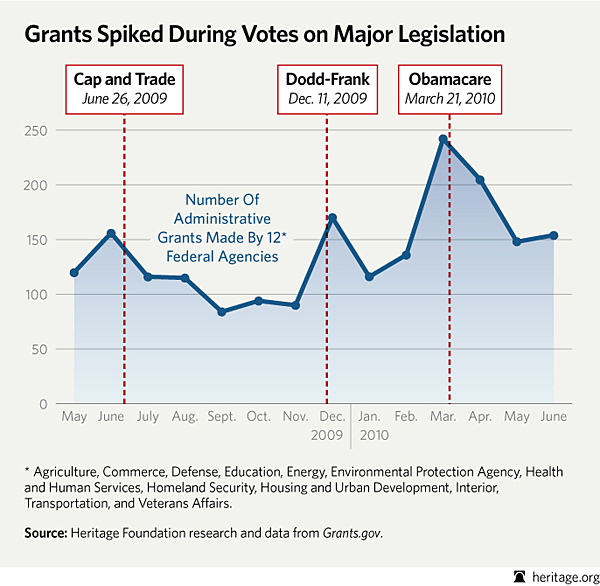
The number of grants given by those agencies spiked precisely when the House was considering each of the three pieces of legislation.
Even more troubling: during the same time periods, significant grant money went to the districts of numerous Democratic representatives who looked to face tough battles for re-election. The legislation Obama was attempting to get through Congress was generally unpopular, and vulnerable members needed other ways to appeal to constituents. Federal grants made for a perfect opportunity.
Then-Rep. Chris Carney (D-PA), for instance, kept his support for Dodd-Frank quiet. His website never posted a press release announcing his “yes” vote on the bill. It did, however, tout two federal grants totaling $3.6 million for businesses in his district two days before the Dodd-Frank vote.
Then-Rep. Zach Space (D-OH) hailed from a district reliant on the coal industry, which would have been hit particularly hard by cap and trade. He voted for the measure, but neglected to publicize the vote on his website. He did, however, announce eight federal grants totaling roughly $1.8 million all made during the month before the House passed cap and trade.
At least 32 vulnerable House Democrats received significant federal grant money in the periods leading up to or directly after their votes on at least one of these three pieces of legislation (see charts below), raising concerns that those grants may have been used either to encourage or reward votes in favor of the administration’s position.
The use of administrative earmarks to “buy votes” is not new. President Richard Nixon saw the practice as “a way to gain political support for Nixon’s re-election by using federal resources and grants to influence key states and voting blocs.”
President Franklin Roosevelt was an early pioneer of the political use of administrative earmarking. He “deliver[ed] large defense projects to key states whose electoral votes he wanted to secure,” according to historian Burt Folsom.
But while administrative earmarking is a practice used by nearly every administration, CRS found in a report published in April 2010 — immediately after the time period at issue — that “[b]oth the number and value of earmarks requested solely by the President increased since FY2008.” The number of earmarks had increased by 54 percent, CRS found, while the value of those requests had increased by a whopping 126 percent.
The timing of those requests also suggests political factors at play. Heritage’s Hans von Spakovsky, a former Federal Elections Commissioner, said the administration’s actions “show how taxpayer funds are used for crass political purposes — it is a rank abuse of the government’s power and another sign of this administration’s lack of a moral compass.”
While speculating on the motives of individuals responsible for these grants is difficult, this administration has a history of using its powers for political purposes. In the case of “vote-buying” in particular, the administration offered to expand Medicaid funding to residents of Louisiana and Nebraska to the tune of roughly $145 million to secure the votes of Sens. Mary Landrieu (D-LA) and Ben Nelson (D-NE) for the Obamacare bill.
| Member2008 vote for member2008 percentage of vote for McCain in district2004 percentage of vote for Bush in district2000 percentage of vote for Bush in districtIdentified by DCCC as vulnerable?Identified by NRCC as target?Partisan Voting Index.Alan Grayson (FL-08)52.01%47%55%53%YesYesR + 2.
Bart Stupak (MI-01)65.04%48%53%53%NoNoR + 3. Bill Foster (IL-14)57.74%44%55%54%YesYesR + 1. Bruce Braley (IA-01)64.56%41%46%45%NoNoD + 5. Carol Shea-Porter (NH-01)51.73%46%51%49%YesYesR + 0. Chris Carney (PA-10)56.33%54%60%56%YesYesR + 8. Ciro Rodriguez (TX-23)55.76%48%57.3%53.6%YesYesR + 4. Debbie Halvorson (IL-11)58.4%45%53%50%YesYesR + 1. Frank Kratovil (MD-01)49.12%58%62%57%YesYesR + 13. Gabrielle Giffords (AZ-08)54.72%52%53%49%YesYesR + 4. Heath Shuler (NC-11)61.96%52%57%58%NoYesR + 6. Jim Himes (CT-04)51.32%40%46%43%YesYesD + 5. John Boccieri (OH-16)55.36%50%54%56%YesYesR + 4. John Hall (NY-19)58.67%48%53%49%NoYesR + 3. John Varmuth (KY-03)59.37%43%49%48%NoNoD + 2. Kathy Dahlkemper (PA-03)51.24%49%53%50%YesYesR + 3. Kurt Schrader (OR-05)54.25%43%50%49%YesYesD + 1. Leonard Boswell (IA-03)56.31%45%49.7%48%YesYesD +1. Mark Schauer (MI-07)48.78%46%54%53%YesYesR + 2. Mary Jo Kilroy (OH-15)45.94%45%50%54%YesYesD + 1. Mike McMahon (NY-13)60.94%51%55%44%YesYesR + 4. Nick Rahall (WV-03)66.92%56%53%47%NoYesR + 6. Patrick Murphy (PA-08)56.77%45%48%46%NoYesD + 2. Paul Hodes (NH-02)856.4%43%47%47%NoYesD + 3. Paul Kanjorski (PA-11)51.63%42%47%43%NoYesD + 4. Rick Boucher (VA-09)Unopposed59%59%55%NoYesR + 11. Scott Murphy (NY-20)50.2%48%53%51%YesYesR + 2. Steve Driehaus (OH-01)52.47%44%50%53%YesYesD + 1. Steve Kagen (WI-08)54%53%57%58%YesYesR + 2. Suzanne Kosmas (FL-24)57.2%51%56%52%YesYesR + 4. Tim Bishop (NY-01)58.38%48%49.4%43%NoYesR + 0. Zack Space (OH-18)59.87%53%57%58%YesYesR + 7 |


 The Daily Hatch