Monthly Archives: January 2012

Christopher Hitchens’ debate with Douglas Wilson (Part 12)

Christopher Hitchens vs. Douglas Wilson Debate at Westminster Theological Seminary, Part 12 of 12

Douglas Wilson

I am afraid your argument is tangled up with greater difficulties than the ethnicity of the Samaritan, and so that issue really need not detain us any longer. I have been asking you to provide a warrant for morality, given atheism, and you have mostly responded with assertions that atheists can make what some people call moral choices. Well, sure. But what I have been after is what rational warrant they can give for calling one choice “moral” and another choice “not moral.” You finally appealed to “innate human solidarity,” a phrase that prompted a series of pointed questions from me. In response, you now tell us that we have an innate predisposition to both good and wicked behavior. But we are still stuck. What I want to know (still) is what

warrant you have for calling some behaviors “good” and others “wicked.” If both are innate, what distinguishes them? What could be wrong with just flipping a coin? With regard to your retort that my “talent for needless complexity” has simply gotten me “God’s coexistence with evil,” I reply that I would rather have my God and the problem of evil than your no God and “Evil? No problem!”

After this many installments, I now feel comfortable in asserting that I have posed this question to you from every point of the compass and have not yet received anything that approaches the semblance of an answer. On this question I am tempted to quote Wyatt Earp from the film Tombstone— ”You gonna do something or just stand there and bleed?”—but I think I’ll pass.

Earp was not very much like the Good Samaritan. But it is interesting that the same thing happens to you when you have to give some warrant for trusting in “reason.”. I noted your citation of LaPlace in your book and am glad you  brought him up here. LaPlace believed he was not in need of the God hypothesis, just like you, but you should also know he held this position as a firm believer in celestial and terrestrial mechanics. He was a causal determinist, meaning that he believed that every element of the universe in the present was “the effect of its past and the cause of its future.”

So if LaPlace is why you think belief in God is now “optional,” this appeal of yours actually turns into quite a fun business. This doctrine means (although LaPlace admittedly got distracted before these implications caught up with him) that you, Christopher Hitchens, are not thinking your thoughts and writing them down because they are true, but rather because the position and velocity of all the atoms in the universe one hundred years ago necessitated it. And I am not sitting here thinking my Christian thoughts because they are the truth of God, but rather because that is what these assembled chemicals in my head always do in this condition and at this temperature. “LaPlace’s demon” could have calculated and predicted your arguments (and word count) a century ago in just the same way that he could have calculated the water levels of the puddles in my driveway — and could have done so using the same formulae. This means that your arguments and my puddles are actually the same kind of thing. They are on the same level, so to speak.

If you were to take a bottle of Mountain Dew and another of Dr. Pepper, shake them vigorously, and put them on a table, it would not occur to anyone to ask which one is “winning the debate.”

They aren’t debating; they are just fizzing. You refer to “language in which to write this argument,” and you do so as though you believed in a universe where argument was a meaningful concept. Argument?

Argument? I have no need for your “argument hypothesis.” Just matter in motion, man.

You dismiss the idea that the death of Jesus—the “torture and death of a single individual in a backward part of the Middle East” — could possibly be the solution to the sorrows of our brutish existence. When I said that Jesus is good for the world because he is the life of the world, you just tossed this away. You said, “You cannot possibly ‘know’ this. Nor can you present any evidence for it.”

Actually, I believe I can present evidence for what I know. But evidence comes to us like food, and that is why we say grace over it. And we are supposed to eat it, not push it around on the plate—and if we don’t give thanks, it never tastes right. But here is some evidence for you, in no particular order. The engineering that went into ankles. The taste of beer. That Jesus rose from

the dead on the third day, just like he said. A woman’s neck. Bees fooling around in the flower bed. The ability of acorns to manufacture enormous oaks out of stuff they find in the air and dirt.

Forgiveness of sin. Storms out of the North, the kind with lightning. Joyous laughter (diaphragm spasms to the atheistic materialist). The ocean at night with a full moon. Delta blues. The peacock that lives in my yard. Sunrise, in color. Baptizing babies. The pleasure of sneezing. Eye contact. Having your feet removed from the miry clay, and established forever on the rock. You may say none of this tastes right to you. But suppose you were to bow your head and say grace over all of it. Try it that way.

You say that you cannot believe that Christ’s death on the Cross was salvation for the world because the idea is absurd. I have shown in various ways that absurdity has not been a disqualifier for any number of your current beliefs. You praise reason to the heights, yet will not give reasons for your strident and inflexible moral judgments, or why you have arbitrarily dubbed certain chemical processes “rational argument.” That’s absurd right now, and yet there you are, holding it. So for you to refuse to accept Christ because it is absurd is like a man at one end of the pool refusing to move to the other end because he might get wet. Given your premises, you will have to come up with a different reason for rejecting Christ as you do.

But for you to make this move would reveal the two fundamental tenets of true atheism. One: There is no God. Two: I hate Him.

Related posts: 

Christopher Hitchens’ view on abortion may surprise you

Christopher Hitchens – Against Abortion Uploaded by BritishNeoCon on Dec 2, 2010 An issue Christopher doesn’t seem to have addressed much in his life. He doesn’t explicitly say that he is against abortion in this segment, but that he does believe that the ‘unborn child’ is a real concept. ___________________________ I was suprised when I […]

Christopher Hitchens discusses Ron Paul in 3-2-11 inteview

Max Brantley in the Arkansas Times Blog reports that Ron Paul is leading in Iowa. Maybe it is time to take a closer look at his views. In the above clip you will see Chistopher Hitchens discuss Ron Paul’s views. In the clip below you will find Ron Paul’s latest commercial. Below is a short […]

Evangelicals react to Christopher Hitchens’ death plus video clips of Hitchens debate (part 3)

DEBATE William Lane Craig vs Christopher Hitchens Does God Exist 07 Below are some reactions of evangelical leaders to the news of Christopher Hitchens’ death:   Christian leaders react to Hitchens’ death Posted on Dec 16, 2011 | by Michael Foust   DEBATE William Lane Craig vs Christopher Hitchens Does God Exist 08 Author and […]

Evangelicals react to Christopher Hitchens’ death plus video clips of Hitchens debate (part 2)

DEBATE William Lane Craig vs Christopher Hitchens Does God Exist 04 Below are some reactions of evangelical leaders to the news of Christopher Hitchens’ death: Christian leaders react to Hitchens’ death Posted on Dec 16, 2011 | by Michael Foust DEBATE William Lane Craig vs Christopher Hitchens Does God Exist 05 Author and speaker Christopher […]

Evangelicals react to Christopher Hitchens’ death plus video clips of Hitchens debate (part 1)

DEBATE William Lane Craig vs Christopher Hitchens Does God Exist 01 Below are some reactions of evangelical leaders to the news of Christopher Hitchens’ death: Christian leaders react to Hitchens’ death Posted on Dec 16, 2011 | by Michael Foust Author and speaker Christopher Hitchens, a leader of an aggressive form of atheism that eventually […]
Review from Cato Institute of “The Iron Lady”

The Weinstein Marketing Team Understands Margaret Thatcher’s Appeal Better than the Writer and Director of “The Iron Lady” Do

Posted by David Boaz

The reviewers warned me — don’t see The Iron Lady, the new movie starring Meryl Streep as Margaret Thatcher. Kelly Jane Torrance of the Washington Examiner mourns, “The climax of this movie about one of the most important people — not just women, but people — of the 20th century comes when Margaret Thatcher decides to throw out her dead husband’s clothes.” James Verniere of the Boston Herald asks, “Mamma mia! Why would you turn the story of Margaret Thatcher into a tale of a sweet, dotty old lady having a love affair with her beloved late husband?” Virginia Postrel excoriates the filmmakers: “These supposedly feminist filmmakers could have portrayed Thatcher as an ambitious woman who had nothing to feel guilty about. Instead they chose to inject guilt where it did not belong. They obscured Thatcher’s public accomplishments in a fog of private angst. The portrait of dementia isn’t the problem. The way the film uses old age to punish a lifetime of accomplishment is.”

Even the Washington Post, the New York Times (“You are left with the impression of an old woman who can’t quite remember who she used to be and of a movie that is not so sure either.”), and the New Yorker wonder why you would make a movie about one of the most influential and controversial political figures, the first woman to lead a Western country, the woman who arguably saved Great Britain and helped Ronald Reagan win the Cold War, and then spend half the film depicting her as a confused old lady with hallucinations.

Nevertheless, Thatcher is indeed a compelling figure, and the commercials and trailers showed Streep portraying her as a leader of conviction and strength. So I ignored the critics and bought a ticket. And the film was slightly better than I expected. It absolutely wastes about 40 percent of its time on the imagined scenes of a confused old lady. How much more rewarding it would have been to see a great actress play a pioneering political figure rising to power, leading her country, and facing opposition from both friends and enemies. Instead, we get a few vignettes of that, about half the film’s running time. So it wasn’t terrible, just a lost opportunity.

Interestingly, the marketing team at Weinstein Company seems to understand the appeal of a film on Margaret Thatcher far better than the writer and director. They know what the audience wants. Take a look at the trailer:

_____________

You’ll notice that there’s not a single shot of the old-lady part of the movie. Instead, it’s two fast minutes of Margaret Thatcher in action. Including a final scene (“Gentlemen, shall we join the ladies”) that harks back to an earlier scene of Thatcher on her way up, dramatizes her uniqueness — and is actually not in the film.

So I have a suggestion: Often the DVD of a film will include the film as released to theaters and also a “Director’s Cut” that reflects the director’s own artistic choices that the studio may have blocked. I recommend that the DVD of The Iron Lady include a “Marketer’s Cut” that omits all the old-lady scenes and just shows us Margaret Thatcher the political figure. And if there’s good material like the “join the ladies” scene left on the cutting-room floor, then the marketers could add that back in. In that case, I’d buy the DVD. In fact, someone should start a Facebook campaign: “Put a Marketer’s Cut of The Iron Lady on the DVD.”

By the way, Mitt Romney should not want Republicans to watch this movie: It will remind them of what it means to be inspired by a political leader.

Francis Schaeffer would be 100 years old this year (Schaeffer Sunday)

Dr. Francis Schaeffer – Extra – Interview – Part 2

Francis Schaeffer had a big impact on me in the late 1970’s and I have been enjoying his books and films ever since. Here is great video clip of an interview and below is a fine article about him.

Francis Schaeffer

1912-1984

Christian Theologian, Philosopher, and Missionary

by Rit Nosotro First Published:: 2003

( Last updated: 09/02/2010 18:08:13)

One of the greatest Christian thinkers of the 20th century, Francis Schaeffer, was born January 30, 1912 in Germantown, Pennsylvania. He was the only son of a tradesman and grew up in a Christian home. However, during his years as an adolescent he rejected Christianity and became an agnostic. In his senior year of high school he began reading the Bible in search of answers, and months later he converted to Christianity at a tent meeting held by Anthony Zeoli. After graduating high school he enrolled in night school to study mechanical engineering. However, he soon decided he wanted to enter the ministry so he enrolled in Hampden Sydney College. During his time there he met his future wife Edith Seville, who was the daughter of missionaries working with China Inland Mission. In 1935 he graduated magna cum laude and that same summer he married Edith Seville. Together they had four children, Janet Priscilla born in 1938, Susan born in 1941, Deborah born in 1945, and Francis August Schaeffer V in 1952. After graduating college Schaeffer enrolled in Westminster Theological Seminary where he studied with Cornelius Van Til and J. Gresham Machen. Then in 1937 he transferred to Faith Theological Seminary where he became the first student to graduate from the seminary and ordained as a minister of the Bible Presbyterian Church. From there he went on to serve as a pastor.

After graduating from Faith Theological Seminary Schaeffer served as the pastor for churches in Grove City and Chester, Pennsylvania and then later went on to serve in St. Louis, Missouri. During those years he left the Bible Presbyterian Church and joined the Reformed Presbyterian Church. In 1947 he was sent to Europe as a representative for the Independent Board for Presbyterian Foreign Missions. His job was to survey the state of the churches in countries affected by World War II. In 1948 he moved the family to Switzerland to serve as missionaries. In 1954 Schaeffer severed ties with the board due to conflicts in emphasis in missionary work. That same year he was awarded the honorary Doctor of Divinity degree from Highland College. A year later he and his wife Edith opened up their home to become L’Abri, which is the French word for shelter. L’Abri became an international spiritual retreat center where people could come to study and discuss Christian thought, lifestyle, and goals. L’Abri was opened to be a center for authentic Christian community. People came from all over to talk to Schaeffer and ask difficult philosophical questions. Several years after the opening of L’Abri, Schaeffer received the honorary Doctor of Letters degree from Gordon College. Then in 1979 he began L’Abri in America. During his last few years of life, Schaeffer spent his time writing books and encouraging Christians to be active in the fight against abortion. He died of cancer May 15, 1984 in his home.

Francis Schaeffer is most famous for his writings and for the establishment of L’Abri community in Switzerland. He wrote twenty two books on topics ranging from the Christian view of philosophy and culture, the inerrancy of the Bible, the Christian view of spirituality and the church, and the Christian view of the west. Some of his works include The God Who Is There, A Christian Manifesto, and How Should We Then Live?. He is often credited for sparking a return to political activism among Protestant evangelicals and fundamentalists. He has been cited numerous times in works by other Christians and is considered to be one of the greatest Christian thinkers of the 20th century alongside C.S. Lewis.

Matthew 7:7 says “Ask, and you will receive; seek, and you will find; knock and the door will be opened for you.” That is exactly what Francis Schaeffer did. He sought after the truth and found it. Ever since that time Schaeffer sought the truth as a senior in high school, he has aided thousands of other people in their search for truth. Instead of ignoring the difficult questions he sought answers and found them. Francis Schaeffer demonstrated that Christianity is not a blind faith without valid reasons for what it believes, but rather that Biblical Christianity is the only worldview compatible with reality. He also demonstrated what Christian community really looks like through the L’Abri communities. President Ronald Reagan summed up Francis Schaeffer’s life nicely when he said “It can rarely be said of an individual that his life touched many others and affected them for the better; it will be said of Dr. Francis Schaeffer that his life touched millions of souls and brought them to the truth of their Creator.”

Sources

“Francis Schaeffer” at http://en.wikipedia.org/wiki/Francis_Schaeffer

“Francis Schaeffer biography” at http://www.heroesofhistory.com/page57.html

“Francis Schaeffer biography” at http://www.wheaton.edu/bgc/archives/GUIDES/220.htm

“Francis Schaeffer biography” at ttp://members.aol.com/JAMIETAMPA/Schaeffer/index2.html

“Francis Schaeffer” at http://prayerfoundation.org/books/book_r19.jpg

A man of pro-life convictions: Bernard Nathanson (part4)

ABORTION – THE SILENT SCREAM 1 / Extended, High-Resolution Version (with permission from APF). Republished with Permission from Roy Tidwell of American Portrait Films as long as the following credits are shown:

VHS/DVDs Available
American Portrait Films
Call 1-800-736-4567
www.amport.com

The Hand of God-Selected Quotes from Bernard N. Nathanson, M.D.,

Unjust laws exist. Shall we be content to obey them, or shall we endeavor to amend them and obey them until we have succeeded, or shall we transgress them at once? Men generally under such a government as this think that they ought to wait until they think they have persuaded the majority to alter them. They think that if they should resist the remedy would be worse than the evil. But it is the fault of the government itself that the remedy is worse than the evil. It makes it worse. Why is it not more apt to anticipate and provide for reform? Why does it not cherish its wise minority? Why does it cry and resist before it is hurt?… Why does it always crucify Christ, and excommunicate Copernicus and Luther, and pronounce Washington and Franklin rebels? p. 183

“Speaking on slavery and the unjust Fugitive Slave Law to a New England audience, Emerson on January 25, 1855, stated the following:

Now what is the effect of this evil government?
To Discredit government. When the public fails in its duty, private men take its place…When the American government and courts are false to their trust, men disobey the government, put it in the wrong; the government is forced into all manner of false and ridiculous attitudes. Men hear reason and truth from private men who have brave hearts and great minds. This is the compensation of bad government–the field it affords for illustrious men, and we have a great debt to the brave and faithful men who in the very hour and place of the evil act, made their protest for themselves and their countrymen, by word and by deed. They are justified and the law is condemned

Emerson was speaking specifically of the slavery controversy…but the majestic sweep of his rhetoric encompasses every phylum, every genus, every species of man’s inhumanity to man. It is strong rhetorical medicine; it applies in every sense to the principles at stake in the abortion conflict.” P. 184

Margaret Thatcher (Part 4)


Margaret Thatcher is one of my heroes and I have a three part series on her I am posting. “What We Can Learn from Margaret Thatcher,”By Sir Rhodes Boyson and Antonio Martino, Heritage Foundation, November 24, 1999, is an excellent article and here is a portion of it below:

Thatcher

This was the background of the advent of Mrs. Thatcher. Wrong economic theories, entrenched interest groups, and a widespread aversion for the free market had resulted in economic sclerosis, inflation, unemployment, and general decline. She intended to change all of this, and she did.

Her first battle was in the field of macroeconomic policy, where there was a switch from reliance on fiscal policy as a means of managing aggregate demand to the use of monetary policy. In fiscal policy the aim was that of reducing the deficit (PSBR: Public Sector Borrowing Requirement). In the field of taxation, the goal was that of restoring incentives to work, save, and invest through cuts in all tax rates, especially at the highest levels. The underlying philosophy was that the restoration of incentives was more important than the search for equality.

But where she really excelled was in macroeconomic or supply side reforms:

[A]fter the inflation-fighting campaign of 1979-82, [she engaged in] non-stop reform of the supply side — union laws, privatisation, deregulation, local government finance reform, housing, radical tax reform and much else.30

Thatcher also succeeded in taming the unions. Even her detractors concede that that was one of her great successes, one which she shares with President Reagan:

[Reagan and Thatcher] did make considerable progress in shrinking the role of government, and in expanding the reach of market forces in the microeconomy. Both did so, first, by taming the trade union power…. The President successfully broke a strike by air traffic controllers in 1981…. The Prime Minister equally successfully broke a strike in 1984-85 by coal miners determined to impose their leader’s political agenda on an electorate that had rejected it.31

She also succeeded in shrinking government’s direct role in the economy through privatization. It is generally recognized that “Thatcherism’s success in converting state-owned to privately-owned enterprises…[was] a programme so radical in conception, and so successful in operation, as to have won the highest form of flattery from other nations — imitation.”32 Contrary to what people both on the right and on the left maintain, Mrs. Thatcher’s successes do not include a reduction in total public spending: “Indeed, 18 years of Tory government left the state’s overall share of the economy virtually undiminished: 44% of GDP in 1979 and 43% in 1996.”33

To sum up, Thatcher succeeded in drastically reducing inflation in a country that had become dependent on it; taming the power of what were probably the most powerful labor unions in Europe; privatizing a large portion of a bloated public sector; enacting a tax code more favorable to entrepreneurship and investment; and establishing the conditions for long-term economic growth.

She put an end to the “British disease.” She put Britain back to work. Last, but definitely not least, she shifted the focus of political debate on economic issues. Mr. Blair’s economic program would have been considered Conservative in the 1970s. If Labour has been forced to drastically alter its position, this is largely due to Mrs. Thatcher’s legacy. One can criticize some details, but overall hers has been a fantastic success.34

How Did She Do It?

How did she do it? I believe there are several factors that contributed to Thatcher’s “Conservative Revolution.”

Ideas. There is no doubt that Thatcher’s success is largely due to the power of ideas. She acknowledged the important role played by the Institute of Economic Affairs in providing the intellectual ammunition and the inspiration for her program. On the occasion of the 30th anniversary of the IEA, she said:

[T]he Institute began at a time when despite free speech in a free country, there prevailed what I would call a censorship of fashion. Anyone who dared to challenge the conventional wisdom of the post-war years was frowned-upon, criticized, derided and pilloried as being reactionary or ignorant…. You set out to change public sentiment…. May I say how thankful we are to those academics, some of whom were very lonely, and to those journalists who joined your great endeavour. I do not think they ever numbered 364. They were the few. But they were right, and they saved Britain.35

Without those ideas, Thatcher’s revolution would have been impossible. However, let’s not forget that most of them were already available 10 years earlier at the time of the Heath government. It can be argued that in 1979 the justification for a radical change in economic policy was stronger than ever before, but it is still true that ideas alone do not explain the revolution. They were a necessary, but certainly not a sufficient, cause for the change.

Circumstances. It is true that by the end of the 1970s, the evidence of the failure of the statist policies pursued by both Labour and Tory governments was overwhelming. I believe that circumstances did play a role in Thatcher’s success. However, the evidence of the failure of those anti-market policies was already in existence in 1970, even though it was not as conspicuous as in 1979.

Furthermore, let’s not forget that not everybody drew the same conclusions from that experience. Certainly not the Labour Party that in 1979 was as Socialist as ever. And, as far as academic economists are concerned, the vast majority was convinced that there was no need for a change in policy, as revealed by the 364 of them who signed a manifesto against the new policies of the Thatcher government. The evidence was undoubtedly there, and it helped Thatcher’s cause, but it had been there before with no impact, and many educated people still failed to draw the correct conclusions from it.

Interests. The trade unions had abused their power, and this made the case for reducing their influence stronger than ever. However, even this was not new: The danger omnipotent labor unions pose to a free society had been obvious for years, yet nobody had ever tried to tame them.

Leadership. I believe that, while these factors played a role in Thatcher’s success, the crucial element was her personality, her principled and uncompromising leadership. It can be said of her what Ted Kennedy said of Reagan:

It would be foolish to deny that his success was fundamentally rooted in a command of public ideas. Ronald Reagan may have forgotten names, but never his goals. He was a great communicator, not simply because of his personality or his teleprompter, but mostly because he had something to communicate.36

She dared do what no one else had had the courage to do in Britain for decades: challenge the prevailing consensus, the common wisdom, the entrenched interests, and drive a reluctant party and a befuddled country in a radically new direction.

I can testify to her unusual personality. I have had the chance to meet her several times even before I entered politics. Once, in 1991, there was a conference in Fiesole, near Florence, organized by the National Review Institute. During a coffee break, we were walking along the portico of the hotel. Tuscany’s countryside looked magnificent under the afternoon sun. Mrs. Thatcher remarked: “Yours is a beautiful country, with a rotten government.” To which I replied: “My dear lady, the opposite would be much worse.”

Her straightforward, direct way of putting things, so unusual for a political leader, earned her some enemies among other leaders but made for a refreshing contrast with the hypocrisy and vacuity of the accepted political discourse. At times, she probably overdid it. For example, on that same occasion in Fiesole, during her summing-up of the conference, she came out with the statement: “Civilization is the exclusive prerogative of English-speaking peoples.” I was the only non-English, non-American in the room. I looked at John O’Sullivan, who was sitting next to me. He smiled and said, “You have been consigned to barbarism!”

She can also be very kind and thoughtful. When we won the elections in Italy in 1994, she sent me a fax of congratulations. I called her to thank her for her kindness. She gave me her usual pep talk: “You must do for Italy what I did for Britain.” I attempted to explain that we were at a disadvantage compared to her. I said: “You had a Constitution that was written in the hearts and the minds of your people. We don’t. You had an independent judiciary. We don’t. You had a clean and effective civil service. We don’t. You had a single party majority. We don’t. You had those think tanks, like the IEA, that provided you with the right ideas. We don’t.”

“However,” I added, “we have something which you didn’t have.” “What’s that?” she said. “Your example,” I replied.

As to the relative importance of ideas and/or leadership, she gave her own view on the occasion of the celebration of the 30th anniversary of the IEA. After having listened to a series of speeches by distinguished academics, all praising the great importance of ideas, she thus concluded her remarks: “Speaking as the eleventh speaker and the only woman, I hope you will recall that it may be the cock that crows but it is the hen who lays the eggs.”

“Soccer Saturday” Pele the greatest player of all time?

“Soccer Saturday” Pele the greatest player of all time?

Here is an article by Gi discussing Pele:

Pele as can be expected came back to play with Brazil in the 1962 World Cup which was played in Chile. This time however Pele was much more known to the fans as well as opposing players; who were not really all that eager to see him score another six goals or perhaps more in this world cup. Brazil were defending champions with basically the same players which won the world cup in 58 and who despite the passage of four years were still relatively young. All of which making it easy to see why a second world cup for Brazil in as many tournaments was not out of the realms of realistic possibilities. Specially since there were no other teams which were really strong enough to challenge them. Germany going through a rebuilding period while Italy still did not have the sort of team which could aspire to recapture their glory days of the 30s. Uruguay pretty much being but a shadow of their former selves.

The world cup known as Chile 62 however become a very defensive affair as teams were no longer willing to score as many as three goals or more in loosing efforts as had been the case in Switzerland 54 and Sweden 58. Teams became more eager to hold on to their leads once they had them and not risk them by going forward for more goals. This making most teams play with four defenders and only three forwards where before it had been with two defenders and five forwards.

Brazil for its part got off to what looking back might have been considered a good start in beating Mexico by 2-0 with Pele scoring Brazil’s first goal yet despite this victory; Brazil was severely criticized with much of the blame falling not only on their performance but on Pele. This despite Pele’s having scored one of Brazil’s two goals. This perhaps allowing Pele to see for himself what Mazola had experienced four years earlier when despite having scored two goals in Brazil’s first match; still had people saying he should not be on Brazil’s team. It being a case that Brazilian fans in those days were used to seeing Brazil beat Mexico by much more goals than only two. Brazil, after all had beaten Mexico by 5-0 in Brazil 50 and by 4-0 in Switzerland 54. All of which standing to their reason that a defending world champion should be able to beat Mexico, once again by at least as wide a margin as their teams in the past had done if not by a wider one.

Brazil’s next game came against Czechoslovakia. This a match which ended in a 0-0 draw and with even more criticism aimed at Brazil by their fans and media back home. It was also in this match that Pele left the field injured not to return for the rest of the tournament. Pele had not even been touched by any of Czechoslovakia’s players yet despite this managed to do damage on himself which would take him out of the remainder of the world cup.

For my part, I being skeptical about almost everything, wonder if Pele’s injury was such that he could not have played Brazil’s next game against Spain. Pele after all had not broken anything and had not even been fouled. Was it perhaps an attempt to try another player? Pele had not really played all that well in Brazil’s first two matches or such it was perceived by the fans and the media back home. So I often wonder if perhaps Brazil’s trainer did not exaggerate the gravity of Pele’s injury in order to try another player in his place like he had done with Pele in Mazola’s place four years earlier. It being Amarildo who took Pele’s place against Spain in a game which though not an absolute must win game for Brazil; was one in which they would have to do better than they had in their first two matches. This if perhaps not to qualify, at least to demonstrate to their fans that they were still a team capable of producing great football.

The game started with Spain taking a 1-0 lead when Adelardo scored 35 minutes in to the game. Spain would even take a 1-0 lead in to the second half. This something which had not happened in a very long that that Brazil ended the first half behind on the scoreboard. Brazil at this point even finding themselves in danger of being eliminated in the first round. This being the case that Spain with a win would have had four points which would have put them first in the group. Brazil with a loss would have had three points which would leave them depending on what Mexico (who was already out of the competition) could do against Czechoslovakia. Naturally a Czech victory or even a tie would have left Brazil out had they lost.

All however proved to be academic, as Brazil came back in the second half to win the game by two goals to one with both goals being scored by Amarildo; who just happened to be the man playing in Pele’s place. Obviously Pele’s replacement was doing his duty so I wonder if Pele would have been able to return to the starting team even if he had been healthy or if his injury was such that it was the real reason he was kept out of the starting lineup.

Amarildo had played well against Spain, this there was no doubts about and specially in a world cup in which defensive play was the order of the day unlike it had been in the last two previous world cups. Spain, in fact having a strong team back then which two years later went on to win the European nations cup.

Brazil went on to win their next two matches with relative ease. First against England by 3-1. This in a game which Garrincha scored two truly amazing goals. First one off a header and the next one of a free kick which could not have been better placed. Brazil’s other goal being scored by Vava, who continued where he left off in Sweden 58. Brazil’s next win came in the semifinals against the home team, Chile whom they defeated by a score of 4-2 with once again; Garrincha and Vava doing the scoring for Brazil. It being Garrincha who scored Brazil’s first two while Vava scored Brazil’s third and fourth.

Brazil was clearly playing well and was in top form and all without Pele. It was a case of this team being of such a high quality that even the absence of Pele did not disturb anything. Apparently Amarildo had been more than capable of filling the void left by Pele while the rest by just keeping up their level allowed Brazil to easily get in to the final. Of course, one could always say that this world cup did not really have very strong teams and those which were in fact solid such as the Soviet Union (winner of the 1960 European Championship) and Hungary did not really live up to expectations; apart the fact that Brazil did not have to face them anyway. Brazil was in the finals however and to their credit deservedly so and all without the man who many would later call the best player of all time.

In the finals Brazil met Czechoslovakia for the second time in the tournament yet unlike in their first match; this one could not end in a draw. Czechoslovakia, for its part like Sweden four years earlier also scored the first goal though not as early in the match as Sweden. Czechoslovakia in fact having to wait till the 15th minute of the game when Masopust slipped past Brazil’s defense to give his team a 1-0 lead. Brazil however being the solid team they were did not take long to reply. Brazil in fact having to wait but two minutes till Amarildo (Pele’s replacement) scored to level matters at one a piece. Amarildo, scoring a brilliant goal from a very tight angle which perhaps Czechoslovakia’s goalkeeper; Schroijf should have saved yet the score none the less was tied at one all.

Czechoslovakia for what concerned them, were playing well and went in to the half time break tied at one though it is my opinion that they perhaps celebrated too much after scoring. This allowing Brazil to get back in to the game after only two minutes of having gone down by a goal to nil. Czechoslovakia had its chances in the first period and had it not been for their lack of concentration after scoring and Schroijf’s error perhaps would have gone in to the half time break with a one goal lead or perhaps a two goal lead. This if they had continued with the solid play which had gotten them to the final in the first place.

Brazil however regrouped at the half and came out strong with Zito scoring his first world cup goal and Brazil’s second in the final to put them up by 2-1. Brazil perhaps was not dominating as strongly as they had in 58 yet were definitely in the drivers seat. It being in the 78th minute of the game that Garrincha sent up a high ball which in all honesty should not have given Czech goalkeeper, Schroijf any problems what so ever yet he somehow managed to drop it. The ball falling straight in to the path of the ever opportunistic Vava, who scored his first goal of the match and Brazil’s third to make the score 3-1; which is how it would end.

This last goal making Vava the first player to score in two finals. Brazil had won the world cup and became just the second team, after Italy to win two in a row and to a certain extent Pele had picked up his second world cup win though in all truth, as I have clearly pointed out; he hardly played. Naturally, to many at the time this did not really matter as Pele was a man who at the age of 21 had already won two world cups even if the second one was just for being on the team and little else. This perhaps making it possible for Argentina to say that Pasarella won two world cups with Argentina, who as a matter of fact only played in their first game against South Korea but I ask is this enough to say he is a double world champion? I would go one step further and ask if Brazil had beaten France in 98 then could Ronaldo claim to have won three world cups as well since he was on their world cup winning team in 94 though did not play at all? This being a matter of interpretation of course.

As an added comment, I would like to say that I feel it is sad that Amarildo did not really get the credit he earned for his performance in Chile 62. It being Amarildo, who to a certain extent with his two goals against Spain saved Brazil from the humiliation of being eliminated in the first round. Amarildo even scoring in the final when Brazil was loosing by 1-0 yet despite his efforts which were important in Brazil’s second world cup win, is rarely if ever mentioned amongst the great players of all time though he undoubtedly was.

My name is Gianni Truvianni, author of many an article to be found on the internet along with the book “New York’s Opera Society”. My works also include the books “What Should Not Matter”, “Love Your Sister” and several others which still remain unpublished though I am presently looking to change this.

Article Source: http://EzineArticles.com/6221508

Tim Tebow

Tim Tebow is the best. Take a look at this article below:

I believe in Tim Tebow

Reilly By Rick Reilly
ESPN.com
Archive


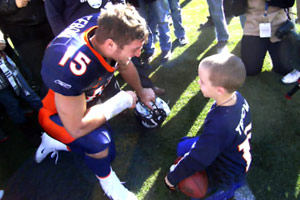
Tim Tebow and JacobTim Tebow FoundationTim Tebow with Jacob Rainey, one of the many people dealing with health problems Tebow hosted at Broncos games this season.


I’ve come to believe in Tim Tebow, but not for what he does on a football field, which is still three parts Dr. Jekyll and two parts Mr. Hyde.


No, I’ve come to believe in Tim Tebow for what he does off a football field, which is represent the best parts of us, the parts I want to be and so rarely am.


Who among us is this selfless?


Every week, Tebow picks out someone who is suffering, or who is dying, or who is injured. He flies these people and their families to the Broncos game, rents them a car, puts them up in a nice hotel, buys them dinner (usually at a Dave & Buster’s), gets them and their families pregame passes, visits with them just before kickoff (!), gets them 30-yard-line tickets down low, visits with them after the game (sometimes for an hour), has them walk him to his car, and sends them off with a basket of gifts.


Home or road, win or lose, hero or goat.


Remember last week, when the world was pulling its hair out in the hour after Tebow had stunned the Pittsburgh Steelers with an 80-yard OT touchdown pass to Demaryius Thomas in the playoffs? And Twitter was exploding with 9,420 tweets about Tebow per second? When an ESPN poll was naming him the most popular athlete in America?


Tebow was spending that hour talking to 16-year-old Bailey Knaub about her 73 surgeries so far and what TV shows she likes.


MORE FROM TIM TEBOW

For Tim Tebow’s take on being named America’s most popular athlete, click here.


“Here he’d just played the game of his life,” recalls Bailey’s mother, Kathy, of Loveland, Colo., “and the first thing he does after his press conference is come find Bailey and ask, ‘Did you get anything to eat?’ He acted like what he’d just done wasn’t anything, like it was all about Bailey.”


More than that, Tebow kept corralling people into the room for Bailey to meet. Hey, Demaryius, come in here a minute. Hey, Mr. Elway. Hey, Coach Fox.


Even though sometimes-fatal Wegener’s granulomatosis has left Bailey with only one lung, the attention took her breath away.


“It was the best day of my life,” she emailed. “It was a bright star among very gloomy and difficult days. Tim Tebow gave me the greatest gift I could ever imagine. He gave me the strength for the future. I know now that I can face any obstacle placed in front of me. Tim taught me to never give up because at the end of the day, today might seem bleak but it can’t rain forever and tomorrow is a new day, with new promises.”


I read that email to Tebow, and he was honestly floored.


“Why me? Why should I inspire her?” he said. “I just don’t feel, I don’t know, adequate. Really, hearing her story inspires me.”


It’s not just NFL defenses that get Tebowed. It’s high school girls who don’t know whether they’ll ever go to a prom. It’s adults who can hardly stand. It’s kids who will die soon.


For the game at Buffalo, it was Charlottesville, Va., blue-chip high school QB Jacob Rainey, who lost his leg after a freak tackle in a scrimmage. Tebow threw three interceptions in that Buffalo game and the Broncos were crushed 40-14.


“He walked in and took a big sigh and said, ‘Well, that didn’t go as planned,'” Rainey remembers. “Where I’m from, people wonder how sincere and genuine he is. But I think he’s the most genuine person I’ve ever met.”


There’s not an ounce of artifice or phoniness or Hollywood in this kid Tebow, and I’ve looked everywhere for it.


Take 9-year-old Zac Taylor, a child who lives in constant pain. Immediately after Tebow shocked the Chicago Bears with a 13-10 comeback win, Tebow spent an hour with Zac and his family. At one point, Zac, who has 10 doctors, asked Tebow whether he has a secret prayer for hospital visits. Tebow whispered it in his ear. And because Tebow still needed to be checked out by the Broncos’ team doctor, he took Zac in with him, but only after they had whispered it together.


And it’s not always kids. Tom Driscoll, a 55-year-old who is dying of brain cancer at a hospice in Denver, was Tebow’s guest for the Cincinnati game. “The doctors took some of my brain,” Driscoll says, “so my short-term memory is kind of shot. But that day I’ll never forget. Tim is such a good man.”


This whole thing makes no football sense, of course. Most NFL players hardly talk to teammates before a game, much less visit with the sick and dying.


Isn’t that a huge distraction?


Tim Tebow with Zac

Stephanie Taylor Not everything Tim Tebow does on one knee is controversial. Ask Zac Taylor.


“Just the opposite,” Tebow says. “It’s by far the best thing I do to get myself ready. Here you are, about to play a game that the world says is the most important thing in the world. Win and they praise you. Lose and they crush you. And here I have a chance to talk to the coolest, most courageous people. It puts it all into perspective. The game doesn’t really matter. I mean, I’ll give 100 percent of my heart to win it, but in the end, the thing I most want to do is not win championships or make a lot of money, it’s to invest in people’s lives, to make a difference.”


So that’s it. I’ve given up giving up on him. I’m a 100 percent believer. Not in his arm. Not in his skills. I believe in his heart, his there-will-definitely-be-a-pony-under-the-tree optimism, the way his love pours into people, right up to their eyeballs, until they believe they can master the hopeless comeback, too.


Remember the QB who lost his leg, Jacob Rainey? He got his prosthetic leg a few weeks ago, and he wants to play high school football next season. Yes, tackle football. He’d be the first to do that on an above-the-knee amputation.


Hmmm. Wonder where he got that crazy idea?


“Tim told me to keep fighting, no matter what,” Rainey says. “I am.”


Follow Rick on Twitter @ReillyRick

Should we still be making horse-drawn buggies today instead of cars?

The Arkansas Times jumped on this story as many other liberals outlets.

Change in the marketplace is driven by the wants and needs of consumers. Are we to protect the jobs of those who work for companies that want to cling to the past?

I posted about this before but I have decided to revisit this issue. Below is liberal piece by Newt on Romney followed by a great article that sets the record straight.

What Happened to the GOP’s Free-Market Principles?

by David Boaz 

David Boaz is the executive vice president of the Cato Institute and has played a key role in the development of the Cato Institute and the libertarian movement.

Added to cato.org on January 13, 2012

This article appeared in Daily Caller on January 13, 2012.


You expect Democrats to accuse former businessman Mitt Romney of “putting profits over people — making a buck or a few million of them no matter what it took or who it hurt,” as Democratic National Committee spokesman Brad Woodhouse did in releasing a new Web video.

But it’s sad to see the economic ignorance displayed by Romney’s Republican rivals. Rick Tyler, long the closest aide to Newt Gingrich who is now running the pro-Gingrich super PAC, Winning Our Future, declares, “His business success comes from raiding and destroy businesses — putting people out of work, stealing their health care.” The PAC’s ad calls Romney “a predatory corporate raider.”

Gingrich himself says that Romney’s work buying and selling companies at the investment firm Bain Capital was comparable to “rich people figuring out clever legal ways to loot a company.”

Rick Perry ran TV ads in Iowa saying that Romney “made millions buying companies and laying off workers.”

Somehow the candidates of the party that claims to defend free enterprise and a dynamic economy are railing against economic change in action.

Somehow the candidates of the party that claims to defend free enterprise and a dynamic economy are railing against economic change in action.

In a growing economy, companies succeed and fail every day. Technology changes. Consumer tastes change. New competitors offer a better product or a better price. Raw materials or labor becomes too expensive. Some companies just aren’t viable, and some investments turn out to have been mistaken.

That’s what the “creative destruction” of a market economy is all about. Companies constantly seek to serve consumers better. And often one company’s success means that other companies fail. Manufacturers of obsolete products often go out of business. Jobs and investments are lost, but what’s the alternative? Should we be keeping the firms that once made horse-drawn buggies, gramophones, and slide rules in business? No, we understand that the process of economic change makes us all better off, even though there can be short-term pain for the owners and employees of failed firms.

Republicans are supposed to know all this. That’s why they proclaim their devotion to free markets and oppose industrial policy, government subsidies, bailouts, and other schemes to override the market process and keep current firms in business even when they’re no longer meeting consumers’ needs.

David Boaz is the executive vice president of the Cato Institute and has played a key role in the development of the Cato Institute and the libertarian movement.


More by David Boaz

But when a businessman runs for president, all bets are off. Republicans let fly with the same denunciations of normal business practices that Democrats do.

Think back to the 2008 campaign when Romney first ran for president. During a Republican debate at the Reagan Library on May 3, 2007, Sen. John McCain derided Romney’s leadership ability, saying, “I led … out of patriotism, not for profit.” Challenged on his statement, McCain elaborated that Romney “managed companies, and he bought, and he sold, and sometimes people lost their jobs. That’s the nature of that business.” He could have been channeling Barack Obama.

There are plenty of good criticisms of Mitt Romney. His health care mandate in Massachusetts was a model for President Obama’s national mandate. No one knows what he really thinks about abortion and same-sex marriage, after he dramatically changed his positions at age 57 as he prepared to run for president. He wants to increase military spending by $2 trillion. Many of his foreign policy advisers helped to get us into the disastrous Iraq war.

But the fact that sometimes he closed companies and laid off workers is not a good reason to criticize him. We’d never get new companies like Staples, Domino’s, Bright Horizons, and Sports Authority — companies that Romney helped fund and nurture at Bain Capital — if investment capital was locked into existing companies.

And sometimes, as the movie “Other People’s Money” demonstrated, it takes a “predatory corporate raider” to go in and shake up a company, moving the land, labor, and capital to places where they can be more productive.

Republicans should stop attacking Romney for his role in the dynamic market process and spend more time explaining how they would limit government and improve the environment for business and economic growth.


Republican delegate count and future primaries

Great website below tracks the delegates for the Republican nomination:

The delegate race

There are 2,286 delegates up for grabs. A candidate needs 1,144 to win the GOP presidential nomination.

Total delegates won, by candidate
Delegates needed: 1,144


Romney
 
20
Santorum
 
12
Paul
 
3
Huntsman
 
2
Perry
 
0
Gingrich
 
0
 
Delegates by state


Date
State /
Territory

Gingrich

Huntsman

Paul

Perry

Romney

Santorum
Delegate Allocation
Jan. 3
0
0
0
0
13
12
Non-binding
Jan. 10
0
2
3
0
7
0
Proportional
Jan. 21
25 delegates at stake
Winner take all
Jan. 31
50 delegates at stake
Winner take all
Feb. 4
28 delegates at stake
Proportional
Feb. 7
36 delegates at stake
Non-binding
Feb. 7
40 delegates at stake
Non-binding
Feb. 11
24 delegates at stake
Non-binding
Feb. 28
29 delegates at stake
Winner take all
Feb. 28
30 delegates at stake
Hybrid proportional
March 3
43 delegates at stake
Non-binding
March 6
27 delegates at stake
Proportional
March 6
76 delegates at stake
Proportional
March 6
32 delegates at stake
Non-binding
March 6
41 delegates at stake
Proportional
March 6
28 delegates at stake
Proportional
March 6
Ohio
66 delegates at stake
Hybrid proportional
March 6
43 delegates at stake
Proportional
March 6
58 delegates at stake
Proportional
March 6
17 delegates at stake
Hybrid proportional
March 6
49 delegates at stake
Hybrid proportional
March 10
Kan.
40 delegates at stake
Hybrid proportional
March 10
Virgin I.
9 delegates at stake
Direct election
March 10
29 delegates at stake
Non-binding
March 13
Ala.
50 delegates at stake
Proportional
March 13
Am. Sam.
9 delegates at stake
Direct election
March 13
Hawaii
20 delegates at stake
Proportional
March 13
Miss.
40 delegates at stake
Proportional
March 17
52 delegates at stake
Non-binding
March 18
P.R.
23 delegates at stake
Winner take all
March 20
Ill.
69 delegates at stake
Direct election
March 24
La.
46 delegates at stake
Proportional
April 3
D.C.
19 delegates at stake
Winner take all
April 3
Md.
37 delegates at stake
Winner take all
April 3
155 delegates at stake
Proportional
April 3
Wis.
42 delegates at stake
Winner take all
April 24
Conn.
28 delegates at stake
Proportional
April 24
Del,
17 delegates at stake
Winner take all
April 24
N.Y.
95 delegates at stake
Proportional
April 24
Penn.
72 delegates at stake
Direct election
April 24
R.I.
19 delegates at stake
Proportional
May 8
Ind.
46 delegates at stake
Hybrid winner take all
May 8
N.C.
55 delegates at stake
Proportional
May 8
W. Va.
31 delegates at stake
Direct election
May 15
Neb.
35 delegates at stake
Advisory
May 15
Ore.
28 delegates at stake
Proportional
May 22
Ark.
36 delegates at stake
Proportional
May 22
Ky.
45 delegates at stake
Proportional
June 5
Calif.
172 delegates at stake
Winner take all
June 5
Mont.
26 delegates at stake
Non-binding
June 5
N.J.
50 delegates at stake
Winner take all
June 5
N.M.
23 delegates at stake
Proportional
June 5
S.D.
28 delegates at stake
Proportional
June 26
Utah
40 delegates at stake
Winner take all
June 30
Guam
9 delegates at stake
Direct election
July 31
N. Mar.
9 delegates at stake
Direct election


SOURCE: AP; Staff reports; GRAPHIC: Sisi Wei, Dan Keating, Karen Yourish and Aaron Blake, The Washington Post. Published Jan. 11, 2012.

The debate continues on Tim Tebow

Another good article I found on Tebow:

  • JANUARY 12, 2012

Does God Care Who Wins Football Games?

After a moment of devotion, our team would all shout in unison, ‘Now let’s go kill those S.O.B.’s!’

By FRAN TARKENTON

On Sunday, when Denver Bronco wide receiver Demaryius Thomas caught a pass from Tim Tebow on the first play of overtime and ran it all the way for a game-winning touchdown, the stadium erupted. At once, people cried that it was a miracle, and Mr. Tebow went down to pray on one knee in his signature pose. Millions of viewers already knew the first words he would say whenever a reporter caught up to him for a postgame interview: “First of all, I want to thank my Lord and Savior, Jesus Christ!”

Tim Tebow is not unique. Even on his own team, there are notably devout players like safety Brian Dawkins. In fact, the NFL has had a number of players who were outspoken in their faith. Think of quarterback Kurt Warner, who famously went from stocking shelves at a grocery store to a pair of league most-valuable-player awards and three Super Bowl appearances. Or Reggie White, one of the greatest defensive linemen of all time, who was also an ordained minister, nicknamed the “Minister of Defense.” The list goes on.

Religion certainly played a role in the game when I played. I grew up the son of a Pentecostal Holiness minister—we were charismatic before charismatic was cool. I was in church Wednesday night, Friday night, Sunday morning and Sunday night—every week of my childhood. I was there at the first-ever national camp for the Fellowship of Christian Athletes, in Estes Park, Co., in 1956, along with everyone from legendary NFL quarterback Otto Graham to a young Don Meredith (although fellow quarterback Don and I didn’t make it to many of the meetings). When I went to the NFL, I needed special dispensation from the church to play on Sundays.

ReutersDenver Broncos quarterback Tim Tebow prays after the Broncos defeated the Pittsburgh Steelers in Denver on Sunday.

As a player, though, I never understood why God would care who won a game between my team and another. It seemed like there were many far more important things going on in the world. There were religious guys on both teams. If God gets credit for the win, does he also take blame for defeat?

For what it’s worth, my forays into hoping for divine intervention didn’t work out. I prayed fervently before each of the three Super Bowls we Minnesota Vikings played in. We played against the Dolphins, the Steelers and the Raiders. I don’t know about the first two games, but I was sure God would be on our side for the game against the Raiders! After all, they were the villains of the league, and it was hard to believe they had more Christians on their team than on our saintly Vikings. We lost.

Faith had a place in every locker room I was in. When I played for the New York Giants, team owner Wellington Mara, a devout Catholic, invited half the priests in New York City into the locker room before games. Sometimes it was hard to find my teammates among all the priests. I’m sure Mara hoped it would somehow help the team win, but it was never enough to get us into the playoffs.

Before every game, no matter what team I was on at the time, the coach would always ask the most devout player to say a prayer. This would happen after we’d already been out warming up—so we’d all seen the crowd, we were in full uniform (complete with eye black doubling as war paint), and the intensity of the week had built up to a near frenzy in the locker room.

The prayer was always pretty much for the same thing: Let there not be any injuries, let everybody play a good game—anything except to win the game. No one ever asked to win the game, probably for fear that God would punish us for asking. After this moment of devotion, the team would all shout in unison, “Now let’s go kill those S.O.B.’s!”

We often attribute supernatural origins to football success, from Roger Staubach’s 1975 “Hail Mary” pass to Franco Harris’s “Immaculate Reception” in 1972, and we enshrine plays with names like the “Holy Roller” in 1978 and the “Music City Miracle” in 2000.

Although faith has been a part of football so long, a player like Mr. Tebow can still be extremely controversial among fans and pundits. But seriously, isn’t it refreshing that the chatter around the NFL is about a great athlete with great character who says and does all the right things and is a relentless leader for his team—and not about more arrests and bad behavior from our presumptive “heroes”?

Tim Tebow is the story of this football season, and a great story it is.

Mr. Tarkenton, an NFL quarterback from 1961-1978, is the chairman and founder of OneMoreCustomer.com.

Related posts:

Tim Tebow and John 3:16

Very interesting article below: The NFL bans eye-black messagers. Tebow’s numbers did the preaching on Sunday. (Lynn Sladky/AP)   You ever feel like there’s too much Tim Tebow news? Neither do I. Here’s a roundup of some of the most interesting Timbits from the aftermath of the Denver Broncos 29-23 overtime victory over the Pittsburgh […]

Barrett Jones and Tim Tebow are very similar

For   Barrett Jones is a Tim Tebow type of person and I am glad that people like Jones and Tebow are not ashamed of their Savior Jesus Christ. They don’t try to live two lives, one in church and one that is different in the lockerroom. Barrett Jones is the 2011 Outland Trophy winner […]

Tebow does it again

He did it again. Tebow does it again. It is simply amazing. With all the odds against him he comes through. I guess that will ruin Bill Maher’s jokes for the week. Can Tebow rally the team for another unlikely victory? The Steelers were 8 point favorites and I am sure the Patriots will be […]

Prolife quotes

Bill O’Reilly Interviews Jehmu Greene About Pro-Life Super Bowl Ad about Tim Tebow I got these quotes from someone off the internet that lives in England. The funny thing is the video is put to music and the song they picked won a grammy for an Arkansas band that lives in Little Rock. Here is […]

Max Brantley and Ark Times bloggers poke fun at Tebow after 3rd straight loss

Arkansas Times Blogger who goes by the name “Elwood” remarked (The New Year line | Arkansas Blog ): I tuned in late to the KC v Denver Bronco game, just the last few minutes to see CBS giving adequate coverage to Tebow on his knees at his team’s bench in deep prayer. He seemed so isolated. Other […]

Tim Tebow attacked by Bill Maher

  Tebow attacked by Bill Maher: Even in defeat, Tim Tebow creates controversy — this time in Tinseltown. HBO’s Bill Maher created a firestorm over the Christmas weekend with a scathing reaction to Tebow’s subpar performance in Buffalo. Shortly after Tebow threw four interceptions in the Broncos’ lopsided defeat to the Bills, Maher turned to […]

Why We Love Tim Tebow

I really enjoyed this article and wanted to share it with you. Why We Love Tim Tebow posted by Linda Mintle | 7:33am Wednesday December 14, 2011   Yesterday I was asked to do a TV interview on Tim Tebow. This time the focus was positive. Tebow is very polarizing. People either love or hate him […]

Tim Tebow: Bestselling religious author of 2011

Tim Tebow seems to win at everything he tries. The Good Book: Tim Tebow A No. 1 Author Monday, December 26, 2011 12:45 pm Written by: Ben Maller Sports experts go crazy debating whether Tim Tebow can win NFL games, but there’s no question he can win over readers. Tebow’s Christian life story, “Through My […]

10 Reasons for Tim Tebow Hate

I enjoyed this article below: 10 Reasons for Tim Tebow Hate posted by Linda Mintle | 7:25am Tuesday December 6, 2011   I walked in to a radio station focused on doing an interview totally unrelated to football and the producer starts ranting about how much he hates Tim Tebow. This was a day after Tebow […]