The liberals have been successful at getting government to spend over 25 percent of our total GDP, but the problem is that money is running out. Actually it ran out a long time ago. In 2011 we spent 3.8 trillion and took in a little over half that amount. At that rate we will be going bankrupt a few years after Greece.
I think the future looks bright for politicans like Ron Paul. There are several reasons why Ron Paul has surged in the polls. Let me list some of the reasons this has happened. These reasons are taken from the article by Edward Crane, “Why Ron Paul Matters,” Wall Street Journal, Dec 31, 2011:
• Austrian economics. Mr. Paul is often criticized for references to what some consider obscure economists of the so-called Austrian School. People should read them before criticizing. Nobel laureate Friedrich von Hayek and his mentor Ludwig von Mises were two of the greatest economists and social scientists ever to live.
Modern Austrian School economists such as Lawrence H. White, now at George Mason University, and Fred Foldvary at Santa Clara University predicted the housing bubble and the recession that followed the massive, multitrillion-dollar malinvestment caused by government redirection of capital into housing. Mr. Paul, like Austrian School economists, understands that we would be better off with a gold standard, competing currencies or a monetary rule than with the arbitrary and discretionary powers of our out-of-control Federal Reserve.
Mr. Paul should be given credit for his efforts to promote these ideas and other libertarian policies, all of which would make America better off. He’d be the first to admit he’s not the most erudite candidate to make the case, but surely part of his appeal is his very genuine persona.
John Duggar, 21, explains why he and his famous family are supporting Rick Santorum’s Republican presidential campaign. Recorded Jan. 2, 2012, in Boone, Iowa._____
UPDATE: Somebody sent me this Twitter from Sen. Bill Pritchard:
I am NOT in Iowa with Duggars & Jon Woods. Instead I am Campaigning hard in NWA for Sen. Bill Pritchard!
Good politics, I’d say. Pritchard beat Duggar in a race for Senate previously. He faces Woods this year. What’s more important — Arkies or catering to the fringe in the Iowa caucuses?
I read on the Arkansas Times Blog this morning this sad news about Duggar’s miscarriage. Michelle said, “I feel like my heart broke telling my children…” Below is the article from People Magazine: Michelle Duggar Miscarries By Alicia Dennis Update Thursday December 08, 2011 08:25 PM EST Originally posted Thursday December 08, 2011 04:30 PM […]
The Arkansas Times Blog reported today: EXPECTING 20th: Michelle Duggar People magazine reports that Jim Bob and Michelle Duggar are expecting their 20th child this spring. She’s 45 and had a rough time with her 19th, Josie, born prematurely weighing 22 ounces Link includes video to TLC, where the Duggar-based reality show airs. ______________________ Related […]
Demonstrators march through the streets of Little Rock on Saturday in a protest organized by Occupy Little Rock. (John Lyon photo) Occupy Arkansas got cranked up today in Little Rock with their first march and several hundred showed up. It was unlike the pro-life marches that I have been a part of that have had […]
What Ever Happened to the Human Race? Jason Tolbert told a story about pro-life marchers and their tactic of prayer: OWNER TURNS SPRINKLERS ON PRO-LIFE PRAYER VIGIL In July, I wrote about a new movement springing up in Arkansas that seeks to combat abortion not with violent protest, but with peaceful prayer demonstrations. It is called “40 […]
TLC stars Josh and Anna Duggar with their newborn son — TLC I was walking at the Another Duggar Baby! Josh & Anna Duggar Welcome Baby Boy Yahoo News reported: The Duggar family continues to grow! Josh Duggar, 23, – the eldest son of Jim Bob and Michelle – and wife Anna, 22, welcomed their […]
In today’s news you will read about Kirk Cameron taking on the atheist Stephen Hawking over some recent assertions he made concerning the existence of heaven. Back in December of 1995 I had the opportunity to correspond with Carl Sagan about a year before his untimely death. Sarah Anne Hughes in her article,”Kirk Cameron criticizes […]
Rep. Tim Griffin and Lt. Gov. Mark Darr at the Arkansas March for Life in Little Rock from Tolbert Report. Go to Fox 16 website and you will read this story below and watch a video clip on both marches. What you will not read is the fact that only 150 people showed up for […]
HALT:HaltingArkansasLiberalswithTruth.com President Obama on abortion Adrian Rogers (former President of Southern Baptist Convention): “I am not as afraid of the Communist, the Russians, the Chinese, as much as I am afraid of God. If God be for us, who can be against us? If God be against us, then who can be for us? It […]
Rick Santorum briefly discusses why they chose to take their newborn son home after he died and also mentions that Colmes called to apologize for his earlier comments:
UPDATE: Just to add to this, Santorum was asked to address the hurtful comments from Colmes earlier in the day, and his wife who was in the audience began to weep (via Hotair):
ABC NEWS – At a Pizza Ranch restaurant in Newton, Iowa, a member of the audience asked Santorum to react to a controversial attack leveled by liberal Fox News contributor Alan Colmes, who called the Santorum family’s approach to grieving for their dead baby boy, who lived for only two hours after his birth in 1996, “crazy.”
In a Fox News interview on Monday, Colmes characterized Santorum’s decision to bring the deceased child home an example of “some of the crazy things he’s said and done.”
But in Iowa this afternoon, Santorum explained that it was important for his other children to “know they had a brother.”
Santorum’s wife, Karen, who was at the event and listened to her husband talk about the experience, began to weep.
“It’s just so inappropriate,” she said as tears streamed from her eyes.
Related pro-life posts:
UPDATE: Just to add to this, Santorum was asked to address the hurtful comments from Colmes earlier in the day, and his wife who was in the audience began to weep (via Hotair):
ABC NEWS – At a Pizza Ranch restaurant in Newton, Iowa, a member of the audience asked Santorum to react to a controversial attack leveled by liberal Fox News contributor Alan Colmes, who called the Santorum family’s approach to grieving for their dead baby boy, who lived for only two hours after his birth in 1996, “crazy.”
In a Fox News interview on Monday, Colmes characterized Santorum’s decision to bring the deceased child home an example of “some of the crazy things he’s said and done.”
But in Iowa this afternoon, Santorum explained that it was important for his other children to “know they had a brother.”
Santorum’s wife, Karen, who was at the event and listened to her husband talk about the experience, began to weep.
“It’s just so inappropriate,” she said as tears streamed from her eyes.
http://blog.heritage.org/2010/12/16/new-video-pork-filled-spending-bill-just-… Despite promises from President Obama last year and again last month that he opposed reckless omnibus spending bills and earmarks, the White House and members of Congress are now supporting a reckless $1.1 trillion spending bill reportedly stuffed with roughly 6,500 earmarks.
________________________
Below you see an article and videos by Dan Mitchell of the Cato Institute concerning Reagan and Clinton. First lets look at where we are now with Obama.
Over the last 10 presidents was have had 16.9% of GDP of deficits total from five Republican presidents and 12.7% total from Democratic presidents. However, what is most disturbing is that 8.3% of the 12.7% comes from the Obama administration who is currently in power and we are no longer in the cold war era. That is almost double the total of all the other four Democratic presidents combined under just one president. Take a look at the chart below from the Heritage Foundation:
Over the past 50 years, 10 U.S. presidents have made annual budget requests to Congress, projecting deficits both big and small. But no other president compares to Barack Obama when it comes to the size and scale of the current budget deficit facing the United States.
The country is facing an 8.3 percent estimated average national deficit of a two-term Obama administration — the biggest of the past 50 years. By comparison, the current estimate for Obama is nearly double the percentage under Presidents Ronald Reagan and George H.W. Bush — and they were fighting the Cold War.
Political party doesn’t tell the whole story, however. President Bill Clinton leads the pack of presidents since 1961, according to data from the White House Office of Management and Budget. Heritage put together this graphic as part of our Budget Chart Book.
So what does the current trajectory mean for the United States? We’re certainly no longer looking at a continuation of manageable deficits in the years to come. This is a dramatic change in the magnitude of annual shortfalls at the federal level. That’s one reason Heritage came up with a plan to fix the debt crisis.
If you have a suggestion for a chart we should feature in the future, please post a comment below, email us at scribe@heritage.org, or send me at tweet @RobertBluey.
President Obama unveiled his fiscal year 2012 budget today, and there’s good news and bad news. The good news is that there’s no major initiative such as the so-called stimulus scheme or the government-run healthcare proposal. The bad news, though, is that government is far too big and Obama’s budget does nothing to address this problem.
Actual spending cuts would be the best option, of course, but limiting the growth of spending is all that’s needed to slowly shrink the burden of government spending relative to gross domestic product.
Fortunately, we have two role models from recent history that show it is possible to control the federal budget. This video from the Center for Freedom and Prosperity uses data from the Historical Tables of the Budget to demonstrate the fiscal policy achievements of both Ronald Reagan and Bill Clinton.
Spending Restraint, Part I: Lessons from Ronald Reagan and Bill Clinton
Ronald Reagan and Bill Clinton both reduced the relative burden of government, largely because they were able to restrain the growth of domestic spending. The mini-documentary from the Center for Freedom and Prosperity uses data from the Historical Tables of the Budget to show how Reagan and Clinton succeeded and compares their record to the fiscal profligacy of the Bush-Obama years.
_____________________
Some people will want to argue about who gets credit for the good fiscal policy of the 1980s and 1990s.
Bill Clinton’s performance, for instance, may not have been so impressive if he had succeeded in pushing through his version of government-run healthcare or if he didn’t have to deal with a Republican Congress after the 1994 elections. But that’s a debate for partisans. All that matters is that the burden of government spending fell during Bill Clinton’s reign, and that was good for the budget and good for the economy. And there’s no question he did a much better job than George W. Bush.
Indeed, a major theme in this new video is that the past 10 years have been a fiscal disaster. Both Bush and Obama have dramatically boosted the burden of government spending — largely because of rapid increases in domestic spending.
Last but not least, this video reviews the theory and evidence for the “Rahn Curve,” which is the notion that there is a growth-maximizing level of government outlays. The bad news is that government already is far too big in the United States. This is undermining prosperity and reducing competitiveness.
Nations can make remarkable fiscal progress if policy makers simply limit the growth of government spending. This video, which is Part II of a series, uses examples from recent history in Canada, Ireland, Slovakia, and New Zealand to demonstrate how it is possible to achieve rapid improvements in fiscal policy by restraining the burden of government spending. Part I of the series examined how Ronald Reagan and Bill Clinton were successful in controlling government outlays — particularly the burden of domestic spending programs. http://www.freedomandprosperity.org
The Kiss bassist – who claims to have slept with over 2,000 women and has for a long time vowed never to marry – popped the question to the actress-and-former-Playboy model, in Belize recently.
In video footage for their reality show ‘Gene Simmons Family Jewels’, he asks Shannon: “I come with so much baggage, but you’re the only friend I’ve got, you’re the only one I’ve ever loved, you’re the only one I love, and the only one I ever will love. I’ve never said those words to anybody, and I don’t ever wanna…
“It’s funny, they used to watch movies where they say I can’t live without you but for me it’s true.”
He then gets down on one knee and says “will you marry me,” at which point Shannon is crying.
Gene, 61, and Shannon, 54, have been together for 27 years and have two children, Nicholas, 22, and Sophie, 19.
___________________________
Above you read that Gene Simmons has gone to bed with 2000 women. However, he is engaged to be married to the mother of his children. The point of contension in the past has been his infidelites. Will he be faithful to his wife? There is a strong warning from the Bible concerning this.
In the Fellowship Bible Church worship service on July 24th, Brandon Barnard read Proverbs chapters 5, 6, and 7 and when he finished he said that was strong and explicit. This warning that comes to us comes with power and intensity. I know when we talk about this, it is talking about the adulterous woman, and Proverbs is speaking to sons, but you have to take the universal context and that is that sexual pressures are coming on all of us. Men and women are engaging in pornography and affairs and romantic fantisies, but when you read Proverbs 5, 6, 7 so you there is the warning STAY AWAY FROM THIS. DEATH IS THERE AND TRAPPING IS THERE AND IT WILL TAKE YOUR LIFE. WE HAVE TO CHOOSE IF WE ARE GOING TO WALK THIS PATH OF IMPURITY OR THIS PATH OF PURITY. ALL OF US HAVE DEALT WITH THIS IN OUR LIVES MAYBE IN MORE WAYS THAN WE CARE TO ADMIT. We just can’t sweep everything under the carpet and go on doing life. We have to deal with it.
He started off the sermon by reading three chapters from Proverbs. Here are the verses:
Proverbs 5:1-23
English Standard Version (ESV)
Proverbs 5
Warning Against Adultery
1 My son, be attentive to my wisdom;
incline your ear to my understanding, 2that you may keep discretion,
and your lips may guard knowledge. 3For the lips of a forbidden[a] woman drip honey,
and her speech[b] is smoother than oil, 4but in the end she is bitter as wormwood,
sharp as a two-edged sword. 5Her feet go down to death;
her steps follow the path to[c] Sheol; 6she does not ponder the path of life;
her ways wander, and she does not know it. 7And now, O sons, listen to me,
and do not depart from the words of my mouth. 8Keep your way far from her,
and do not go near the door of her house, 9lest you give your honor to others
and your years to the merciless, 10lest strangers take their fill of your strength,
and your labors go to the house of a foreigner, 11and at the end of your life you groan,
when your flesh and body are consumed, 12and you say, “How I hated discipline,
and my heart despised reproof! 13I did not listen to the voice of my teachers
or incline my ear to my instructors. 14 I am at the brink of utter ruin
in the assembled congregation.”
15Drink water from your own cistern,
flowing water from your own well. 16Should your springs be scattered abroad,
streams of water in the streets? 17 Let them be for yourself alone,
and not for strangers with you. 18Let your fountain be blessed,
and rejoice in the wife of your youth,
19a lovely deer, a graceful doe.
Let her breasts fill you at all times with delight;
be intoxicated[d] always in her love. 20Why should you be intoxicated, my son, with a forbidden woman
and embrace the bosom of an adulteress?[e] 21For a man’s ways are before the eyes of the LORD,
and he ponders[f] all his paths. 22The iniquities of the wicked ensnare him,
and he is held fast in the cords of his sin. 23 He dies for lack of discipline,
and because of his great folly he is led astray.
Proverbs 6:20-35
English Standard Version (ESV)
Warnings Against Adultery
20 My son, keep your father’s commandment,
and forsake not your mother’s teaching. 21 Bind them on your heart always;
tie them around your neck. 22 When you walk, they[a] will lead you;
when you lie down, they will watch over you;
and when you awake, they will talk with you. 23For the commandment is a lamp and the teaching a light,
and the reproofs of discipline are the way of life, 24to preserve you from the evil woman,[b]
from the smooth tongue of the adulteress.[c] 25 Do not desire her beauty in your heart,
and do not let her capture you with her eyelashes; 26for the price of a prostitute is only a loaf of bread,[d]
but a married woman[e] hunts down a precious life. 27Can a man carry fire next to his chest
and his clothes not be burned? 28Or can one walk on hot coals
and his feet not be scorched? 29So is he who goes in to his neighbor’s wife;
none who touches her will go unpunished. 30People do not despise a thief if he steals
to satisfy his appetite when he is hungry, 31but if he is caught, he will pay sevenfold;
he will give all the goods of his house. 32He who commits adultery lacks sense;
he who does it destroys himself. 33He will get wounds and dishonor,
and his disgrace will not be wiped away. 34For jealousy makes a man furious,
and he will not spare when he takes revenge. 35He will accept no compensation;
he will refuse though you multiply gifts.
Proverbs 7:6-27
English Standard Version (ESV)
6For at the window of my house
I have looked out through my lattice, 7and I have seen among the simple,
I have perceived among the youths,
a young man lacking sense, 8passing along the street near her corner,
taking the road to her house 9in the twilight, in the evening,
at the time of night and darkness.
10And behold, the woman meets him,
dressed as a prostitute, wily of heart.[a] 11She is loud and wayward;
her feet do not stay at home; 12now in the street, now in the market,
and at every corner she lies in wait. 13She seizes him and kisses him,
and with bold face she says to him, 14“I had to offer sacrifices,[b]
and today I have paid my vows; 15so now I have come out to meet you,
to seek you eagerly, and I have found you. 16I have spread my couch with coverings,
colored linens from Egyptian linen; 17I have perfumed my bed with myrrh,
aloes, and cinnamon. 18Come, let us take our fill of love till morning;
let us delight ourselves with love. 19For my husband is not at home;
he has gone on a long journey; 20he took a bag of money with him;
at full moon he will come home.”
21With much seductive speech she persuades him;
with her smooth talk she compels him. 22All at once he follows her,
as an ox goes to the slaughter,
or as a stag is caught fast[c] 23till an arrow pierces its liver;
as a bird rushes into a snare;
he does not know that it will cost him his life.
24And now, O sons, listen to me,
and be attentive to the words of my mouth. 25Let not your heart turn aside to her ways;
do not stray into her paths, 26for many a victim has she laid low,
and all her slain are a mighty throng. 27Her house is the way to Sheol,
going down to the chambers of death.
____________________________________
Pictured above is Gene with his son Nick. Does Gene want to follow what Proverbs says or not? If he doesn’t then will his son also fall down the same trap? It is a powerful question. That is why Solomon directed these warnings to his son!!!!
It is apparent from this statement below that Senator Mark Pryor is against the Balanced Budget Amendment. He has voted against it over and over like his father did and now I will give reasons in this series why Senator Pryor will be defeated in his re-election bid in 2014. However, first I wanted to quote the statement Senator Pryor gave on December 14, 2011. This information below is from the Arkansas Times Blog on 12-14-11 and Max Brantley:
THREE CHEERS FOR MARK PRYOR: Our senator voted not once, but twice, today against one of the hoariest (and whoriest) of Republican gimmicks, a balanced budget amendment. Let’s quote him:
As H.L. Mencken once said, “For every complex problem there is a solution which is simple, clean, and wrong.” This quote describes the balanced budget amendment. While a balanced budget amendment makes for an easy talking point, it is an empty solution. Moreover, it’s a reckless choice that handcuffs our ability to respond to an economic downturn or national emergencies without massive tax increases or throwing everyone off Medicare, Social Security, or veteran’s care.There is a more responsible alternative to balance the budget. President Clinton led the way in turning deficits into record surpluses. We have that same opportunity today, using the blueprint provided by the debt commission as a starting point. We need to responsibly cut spending, reform our tax code and create job growth. This course requires hard choices over a number of years. However, it offers a more balanced approach over jeopardizing safety net programs and opportunity for robust economic growth.
____________________
One of the biggest reasons that Senator Mark Pryor will not be re-elected in 2014 to the Senate is because EVEN THOUGH HE ASKS FOR SPENDING CUT IDEAS, HE REALLY DOESN’T WANT TO EMBRACE THEM. FOR INSTANCE, IN THIS ARTICLE BELOW BY JOHN STOSSEL THERE ARE PLENTY OF GREAT SUGGESTIONS BUT PRYOR HAS HEARD THEM ALL AND DOES NOT LIKE THEM BECAUSE HE LIKES SPENDING MORE!!!!
The point is that we don’t need to choke our government — or, more to the point, ourselves — with such simplistic devices as balanced budget amendments. The point is that we need to make our often-essential deficit and debt more sustainable, more manageable, more responsible and less massive, and that we should do that by addressing both income and outgo.
You’re right, my tea party friend, about how government must change its ways. You’re not right, though, in the over-simplicity of your assessment or in the impractical, even drastic, nature of your remedies.
Brummett’s view used to be the majority view, but in a recent poll by CNN over 70% now favor a Balanced Budget Amendment. I am starting a series today on the Balanced Budget Amendment!!!
Dear Senator Pryor,
Why not pass the Balanced Budget Amendment? As you know that federal deficit is at all time high (1.6 trillion deficit with revenues of 2.2 trillion and spending at 3.8 trillion).
On my blog www.HaltingArkansasLiberalswithTruth.com I took you at your word and sent you over 100 emails with specific spending cut ideas. However, I did not see any of them in the recent debt deal that Congress adopted. Now I am trying another approach. Every week from now on I will send you an email explaining different reasons why we need the Balanced Budget Amendment. It will appear on my blog on “Thirsty Thursday” because the government is always thirsty for more money to spend.
You are right to ask for ideas to cut spending because that is the real cause of the deficit. John Stossel rightly noted, “Milton Friedman always said taxes don’t tell the whole story. What counts is how much of our resources government spends, however it acquires them. The doubling of spending under Bush and Obama hasn’t gotten enough attention.”
Senator Pryor, you asked for spending cut advice. Here is some from John Stossel:
It’s not hard to balance the budget. On my show, we made enough cuts to create a $237 billion surplus. I cut whole departments, like Education and Commerce. I cut two-thirds of the Defense Department (which still leaves it much bigger than China’s). I indexed Medicare, Medicaid and Social Security to inflation, raised the retirement age, and took away benefits for rich people. But I don’t have to run for office. Congressmen do, and they can’t even manage to cut ridiculous tax breaks like those for ethanol.
The political class predicted “disaster” if Congress didn’t raise its debt limit.
I think that was a scam to get more money. See, the poor politicians don’t have enough, and they need to borrow more. We taxpayers are cheap. This year we’ll give them only $2.2 trillion. They want to spend $3.8 trillion.
The president said if he didn’t get more money, Social Security checks wouldn’t go out. Why not?
With $2 trillion, they can pay Social Security, Medicare, the interest on the debt and still have billions left. It’s billions more than the government spent when President George W. Bush took office. What’s the problem?
The problem is that Republicans and Democrats under Bush and President Obama doubled spending. Now, Obama wants more taxes.
Taxes shouldn’t be the answer when spending is the problem.
Grover Norquist, who heads Americans for Tax Reform (ATR), leads the charge to keep the focus on spending. Norquist and ATR are famous for asking officeholders and candidates to sign a pledge not to raise taxes. Some say he is the reason the debt-ceiling debate was so drawn out.
“I think the reason there isn’t a tax increase on the table,” he told me, “is that 235 members of the House of Representatives signed a pledge never to raise taxes, a pledge to their voters, and 41 senators did. …
“Only if you take tax increases off the table do you even begin to … focus on spending, and that’s what Obama wants to keep our focus off of. He wants us to talk about the deficit, not spending.”
I pointed out that Obama might have scored points with the public because new revenues he sought — even though they wouldn’t do much to shrink the deficit — would come from closing unpopular tax “loopholes.”
Norquist said he favors that — if tax rates are lowered at the same time.
“(We) want to simplify the code,” he said. “(We) want to take a lot of the goodies that politicians have laced into that code … as long as you reduce tax rates and it’s not a hidden tax increase.”
Milton Friedman always said taxes don’t tell the whole story. What counts is how much of our resources government spends, however it acquires them. The doubling of spending under Bush and Obama hasn’t gotten enough attention.
“We need to ask what it is government should do,” Norquist said. “But it’s going to be knockdown, drag-out. All government overspending creates the constituency for its own perpetuation. … Weaning people off, that is very difficult.”
He’s right. When politicians make little cuts in the rate of spending growth, every interest group mobilizes to protect its little piece of the pie. That’s why you must cut government like you take off a Band-Aid: quickly and all at once.
It’s not hard to balance the budget. On my show, we made enough cuts to create a $237 billion surplus. I cut whole departments, like Education and Commerce. I cut two-thirds of the Defense Department (which still leaves it much bigger than China’s). I indexed Medicare, Medicaid and Social Security to inflation, raised the retirement age, and took away benefits for rich people. But I don’t have to run for office. Congressmen do, and they can’t even manage to cut ridiculous tax breaks like those for ethanol.
Obama predicted disaster if the debt ceiling wasn’t raised. Some predict disaster if the ratings agencies downgrade Treasury bonds. I’m dubious. In 1995, President Clinton and Republican Congress couldn’t agree on a budget, so the government shut down twice, the second time for three weeks.
Did the economy grind to a halt? No. During the first shutdown, the stock market went up. During the second, it dropped then recovered.
The alarmists screamed that the fight over the debt ceiling would discourage lenders. Wrong. Ten-year Treasury bonds sold for a measly 3 percent interest (versus 15 percent in 1981).
I wasn’t worried that Congress would fail to raise the debt ceiling. But I am worried that Congress will keep spending.
John Stossel
John Stossel is host of “Stossel” on the Fox Business Network. He’s the author of “Give Me a Break” and of “Myth, Lies, and Downright Stupidity.” To find out more about John Stossel, visit his site at johnstossel.com.
The liberals have been successful at getting government to spend over 25 percent of our total GDP, but the problem is that money is running out. Actually it ran out a long time ago. In 2011 we spent 3.8 trillion and took in a little over half that amount. At that rate we will be going bankrupt a few years after Greece.
I think the future looks bright for politicans like Ron Paul. There are several reasons why Ron Paul has surged in the polls. Let me list some of the reasons this has happened. These reasons are taken from the article by Edward Crane, “Why Ron Paul Matters,” Wall Street Journal, Dec 31, 2011:
• Civil liberties. Libertarians often differ with conservatives over issues related to civil liberties. Mr. Paul’s huge support among young people is due in large part to his fierce commitment to protecting the individual liberties guaranteed us in the Constitution. He would work to repeal significant parts of the so-called Patriot Act. Its many civil liberties transgressions include the issuance by the executive branch of National Security Letters (a form of administrative subpoena) without a court order, and the forbiddance of American citizens from mentioning that they have received one of these letters at the risk of jail.
The Bush and Obama administrations have claimed the right to incarcerate an American citizen on American soil, without charge, without access to an attorney, for an indefinite period.
President Obama even claims the right to kill American citizens on foreign soil, without due process of law, for suspected terrorist activities. Meanwhile, the Stop Online Piracy Act moving through the House is a clear effort by the federal government to censor the Internet. Mr. Paul stands up against all this, which should and does engender support from limited government advocates in the GOP.
Dan Mitchell, Senior Fellow at the Cato Institute, speaks at Moving Forward on Entitlements: Practical Steps to Reform, NTUF’s entitlement reform event at CPAC, on Feb. 11, 2011.
__________________________
I am disappointed in some of the Republicans who do not want to take the bull by the horns on this issue.
Michael Tanner is a senior fellow at the Cato Institute and coauthor of Leviathan on the Right: How Big-Government Conservatism Brought Down the Republican Revolution.
There was telling moment during the CNN Republican presidential debate: Asked about the possibility of repealing George W. Bush’s Medicare prescription-drug benefit, which is adding some $17 trillion to Medicare’s unfunded liabilities, every one of the candidates pledged varying degrees of fealty to the program. No one came out for significantly cutting this vestige of Bush-style big-government conservatism, let alone repealing it. This put the current crop of Republicans to the left of John McCain, who at least campaigned in favor of means-testing the program in 2008.
The failure to stand up against one of the Bush administration’s most obvious mistakes is not just a case of hypocrisy; it is part of a disturbing trend toward ducking the tough decisions on budget cutting among the Republican aspirants. For all the sound and fury, and the charges and countercharges surrounding entitlement reform, the GOP candidates have been remarkably reluctant to put forward actual proposals.
Former Massachusetts governor Mitt Romney, for example, has been attacking Texas governor Rick Perry over Social Security from the left, praising the program as “an essential federal program,” that has been a “success” for more than 70 years. But for all his criticism of Perry, Romney has been much vaguer about his own plans for reform. At times he has sounded almost like Obama, suggesting that there are lots of reform ideas — raising the retirement age, means testing, changing the wage-price indexing formula — that are “on the table,” but not actually endorsing any of them. One reform that Romney has taken off the table is allowing younger workers to privately invest a portion of their payroll taxes through personal accounts. In his book, No Apology, Romney endorses so-called “add on” accounts, allowing workers to save in addition to Social Security, but not carving out a portion of their current taxes. “Given the volatility of investment values that we have just experienced, I would prefer that individual accounts were added to Social Security, not diverted from it,” Romney wrote.
The Republican candidates all talk about reducing government spending. But they cannot do that unless they commit to real entitlement reform.
On Medicare, Romney has avoided specifics as well, praising Paul Ryan’s proposed reforms for example as “taking important strides in the right direction,” but not endorsing them.
For his part, Governor Perry has been forthright about the flaws of Social Security but has offered nothing in the way of a proposal for reform. As Romney has pointed out endlessly, Perry suggested in his book that Social Security might be returned to the states. But Perry has since disavowed that idea, claiming that he was only referring to state employees, some 7 million of whom are currently outside the Social Security system. Perry has also praised the privatized system for public employees in Galveston and two other Texas counties, suggesting that he might be open to some type of private investment option. But “suggesting” is as far as he goes.
On Medicare, Perry has been equally murky. At times, he has suggested that we should “transition away from” the current Medicare system, but without saying what we should transition to. His aides point out that Perry has only recently joined the race and hasn’t had time to develop specific proposals. But given his fiery talk on the issues, until he does he will seem more hat than cattle.
Rep. Michelle Bachmann has also largely tried to have it both ways on entitlement reform. She voted for the Ryan plan in Congress but promptly put out a statement distancing herself from it, claiming that her vote came with an asterisk. On Social Security, Bachmann once called the program a “monstrous fraud,” but has now joined Romney in attacking Perry’s “Ponzi scheme” description. She says that a key difference between her and Perry is that she believes Social Security “is an important safety net and that the federal government should keep its promise to seniors.” But with Social Security currently facing more than $20 trillion in unfunded liabilities, the question is how it will keep that promise.
Second-tier candidates, with less to lose, have been more willing to spell out their proposals. Businessman Herman Cain, for example, supports both the Ryan plan and Chilean-style personal accounts for Social Security. Former Pennsylvania senator Rick Santorum takes similar positions, as does former New Mexico governor Gary Johnson. Former Utah governor Jon Huntsman has endorsed the Ryan plan but has not spelled out his views on Social Security reform. Newt Gingrich, on the other hand, has focused on cutting “fraud, waste, and abuse,” rather than fundamentally altering the structure of those programs. Ever the iconoclast, Rep. Ron Paul opposes both the Ryan plan and personal accounts for Social Security, since he opposes a federal role in either health care or retirement on principle.
The facts are both simple and frightening. The unfunded liabilities of Social Security and Medicare run between $50 trillion and $110 trillion. Those two programs, along with Medicaid, are the primary drivers of our future indebtedness. In fact, by 2050, those three programs alone will consume 18.4 percent of GDP. If one assumes that revenues return to and stay at their traditional 18 percent of GDP, then those three programs alone will consume all federal revenues. There would not be a single dime available for any other program of government, from national defense to welfare.
The Republican candidates all talk about reducing government spending. But they cannot do that unless they commit to real entitlement reform. There’s time, and lots of debates, to hear specifics from them. But so far, the omens are not auspicious.
Paul Krugman should make teabaggers’ heads explode today — and by ‘baggers I mean Arkanas’s Republican delegation in Congress. It’s another explanation about why, in a tenuous recovery, the government needs to put job stimulus, not debt reduction, at the forefront. We need more government spending, he writes.
Now, the fact that federal debt isn’t at all like a mortgage on America’s future doesn’t mean that the debt is harmless. Taxes must be levied to pay the interest, and you don’t have to be a right-wing ideologue to concede that taxes impose some cost on the economy, if nothing else by causing a diversion of resources away from productive activities into tax avoidance and evasion. But these costs are a lot less dramatic than the analogy with an overindebted family might suggest.
And that’s why nations with stable, responsible governments — that is, governments that are willing to impose modestly higher taxes when the situation warrants it — have historically been able to live with much higher levels of debt than today’s conventional wisdom would lead you to believe.
It is obvious to me that the stimulus in 2009 failed. However, the liberals keep saying that we must spend more. Where will that take us? It will take us to Greece.
Too many riding in the wagon and not enough pulling the wagon. Is the USA heading down the same path as Greece?
Our long-run outlook is grim, but at least we still have time to reform the entitlement programs and save America from Greek-style fiscal collapse.
The conventional wisdom among economists is that a nation gets in deep trouble when government debt reaches 90 percent of GDP. That’s generally true, but it would be much more accurate to say that a nation gets in deep trouble when debt approaches 90 percent of GDP and the fiscal outlook shows even more red ink.
But this distinction doesn’t really matter much for the United States and Europe. Thanks to a combination of entitlement programs and aging populations, both face a bleak fiscal future. A 2010 study from the Bank for International Settlement shows that government debt in most industrialized nations will soar above 200 percent of GDP (in some cases, much higher) within the next few decades.
At some point, investors are going to realize that the United States is on an unsustainable path.
The only major difference is that European nations are farther down the path to fiscal collapse. The welfare state was adopted earlier in Europe and government spending among euro nations now consumes a staggering 49 percent of economic output. This heavy fiscal burden, especially when combined with onerous tax systems, helps explain why growth is anemic.
But the United States is only a couple of decades behind. According to long-run forecasts from the Congressional Budget Office, the burden of federal spending will reach European levels as the baby boom generation retires.
At some point, investors are going to realize that the United States is on an unsustainable path. Whether that’s 10 years from now or 20 years from now is anybody’s guess.
Daniel J. Mitchell is a top expert on tax reform and supply-side tax policy at the Cato Institute.
What we do know, however, is that Greece, Portugal, and Ireland already have stuck their snouts in the bailout trough, and it’s probably just a matter of time before Italy, Spain, and Belgium are in the same category. Heck, they’re already receiving indirect bailouts from the European Central Bank, which is buying up their dodgy debt in hopes of postponing the day of reckoning.
The one silver lining to this dark cloud is that the United States still can turn things around. Greece, Italy, and other welfare states have probably passed the point of no return, but it’s still possible for American lawmakers to fix the entitlement crisis by turning Medicaid over to the states , modernizing Medicare into a premium-support system, and transitioning to a system of personal retirement accounts for younger workers.
If those reforms don’t take place, the consequences won’t be pleasant. To be blunt, there won’t be an IMF to bail out the United States.
Max Brantley noted today: Paul Krugman should make teabaggers’ heads explode today — and by ‘baggers I mean Arkanas’s Republican delegation in Congress. It’s another explanation about why, in a tenuous recovery, the government needs to put job stimulus, not debt reduction, at the forefront. We need more government spending, he writes. Now, the fact […]
It is apparent from this statement below that Senator Mark Pryor is against the Balanced Budget Amendment. He has voted against it over and over like his father did and now I will give reasons in this series why Senator Pryor will be defeated in his re-election bid in 2014. However, first I wanted to […]
I have talked a lot about spending cuts on this blog. Here is a great article on this very subject: A Guide to the Presidential Candidates’ Proposals to Cut Spending Posted by Tad DeHaven Over at Downsizing the Federal Government, Chris Edwards and I have regularly complained that most policymakers have been insufficiently specific when it comes […]
Liberals want to spend our money and they think that government should get more of our money. Rep. Jan Schakowsky: “You Don’t Deserve To Keep All Your Money” Brandon Stewart September 14, 2011 at 11:16 am In a interview with Chicago’s Don Wade & Roma radio show this morning, Congresswoman Jan Schakowsky claimed that Americans […]
Government Spending Doesn’t Create Jobs Uploaded by catoinstitutevideo on Sep 7, 2011 Share this on Facebook: http://on.fb.me/qnjkn9 Tweet it: http://tiny.cc/o9v9t In the debate of job creation and how best to pursue it as a policy goal, one point is forgotten: Government doesn’t create jobs. Government only diverts resources from one use to another, which doesn’t […]
Dan Mitchell discusses the effectiveness of the stimulus Uploaded by catoinstitutevideo on Nov 3, 2009 11-2-09 When I think of all our hard earned money that has been wasted on stimulus programs it makes me sad. It has never worked and will not in the future too. Take a look at a few thoughts from […]
Government Spending Doesn’t Create Jobs Uploaded by catoinstitutevideo on Sep 7, 2011 Share this on Facebook: http://on.fb.me/qnjkn9 Tweet it: http://tiny.cc/o9v9t In the debate of job creation and how best to pursue it as a policy goal, one point is forgotten: Government doesn’t create jobs. Government only diverts resources from one use to another, which doesn’t […]
Dear Senator Pryor, why not pass the Balanced Budget Amendment? (Part 13 Thirsty Thursday, Open letter to Senator Pryor) Office of the Majority Whip | Balanced Budget Amendment Video In 1995, Congress nearly passed a constitutional amendment mandating a balanced budget. The Balanced Budget Amendment would have forced the federal government to live within its […]
Cato Institute:Spending is our problem Part 4 Should we spend more federal money to help the poor? Uploaded by CFPEcon101 on Oct 3, 2011 The so-called War on Poverty has failed. Making government bigger and creating more federal redistribution programs has been bad news for taxpayers. But the welfare state also has been a disaster […]
Cato Institute:Spending is our problem Part 4 Should we spend more federal money to help the poor? Uploaded by CFPEcon101 on Oct 3, 2011 The so-called War on Poverty has failed. Making government bigger and creating more federal redistribution programs has been bad news for taxpayers. But the welfare state also has been a disaster […]
Senator Mark Pryor wants our ideas on how to cut federal spending. Take a look at this video clip below:
Senator Pryor has asked us to send our ideas to him at cutspending@pryor.senate.gov and I have done so in the past and will continue to do so in the future.
On May 11, 2011, I emailed to this above address and I got this email back from Senator Pryor’s office:
Please note, this is not a monitored email account. Due to the sheer volume of correspondence I receive, I ask that constituents please contact me via my website with any responses or additional concerns. If you would like a specific reply to your message, please visit http://pryor.senate.gov/contact. This system ensures that I will continue to keep Arkansas First by allowing me to better organize the thousands of emails I get from Arkansans each week and ensuring that I have all the information I need to respond to your particular communication in timely manner. I appreciate you writing. I always welcome your input and suggestions. Please do not hesitate to contact me on any issue of concern to you in the future.
Following several “expansion budgets,” President Bush has moved the debate in a more responsible direction by proposing a “belt-tightening budget” that asks most agencies to accept a near-freeze in discretionary spending. But would most families trying to cut costs simply freeze each expenditure equally? Or would they fully fund priorities like food, the mortgage payment, and insurance while completely eliminating unaffordable luxuries such as vacations and entertainment?
Most families would choose this “priority budget” over a “belt-tightening budget,” and so should government. A priority budget would ask lawmakers to fully fund a few top priorities, such as defense, homeland security, and a few domestic programs, and then terminate such unaffordable luxuries as the approximately $60 billion in corporate welfare spending; the $20 billion pork-project budget; $100 billion (at least) in waste, fraud, and abuse; and hundreds of ineffective, outdated, and unnecessary programs.
Belt-tightening budgets are certainly preferable to the expansion budgets of the past few years. However, reducing a program’s funding without correspondingly adjusting its structure, goals, and duties can lead to ineffective government. Better a few vital activities performed well than a multitude of activities performed poorly.
President Bush proposes terminating 65 programs at a savings of $4.9 billion. (See Appendix 1.) Although a step in the right direction, these low-priority terminations represent only 0.2 percent of all federal spending. By contrast, a priority budget would:
Fully fund a limited number of high-priority spending categories, such as defense and homeland security;
Terminate entire categories of lower-priority programs, such as corporate welfare;
Institute a moratorium on pork projects;
Limit non-security spending increases to programs that pass their audits; and
Substantially reform programs growing at unsustainable rates, such as Social Security and Medicare.
Time to be Bold
Congress last attempted to enact a priority budget in 1995 and 1996, when the 104th Congress terminated several programs whose irrelevance was proven by how quickly they were forgotten. But Congress then committed several strategic errors, such as overreaching and shutting down the federal government in 1995. After President Bill Clinton deftly exploited these mistakes, budget cutters overreacted to Clinton’s tactics by completely abandoning the mission of smaller government. By 1998, federal spending was growing once again as a paralyzed Congress decided that budget confrontations with the Clinton White House could never be won and should be avoided at all costs.
In 2004, national defense, homeland security, and entitlement challenges make spending reform more important than ever. It is time to step back and think about the role of government, the obligations of the private sector, and the delineation between federal and state responsibilities. For those interested in lean, effective government with low taxes, the following are 10 guidelines for getting spending under control.

 The Right Scoop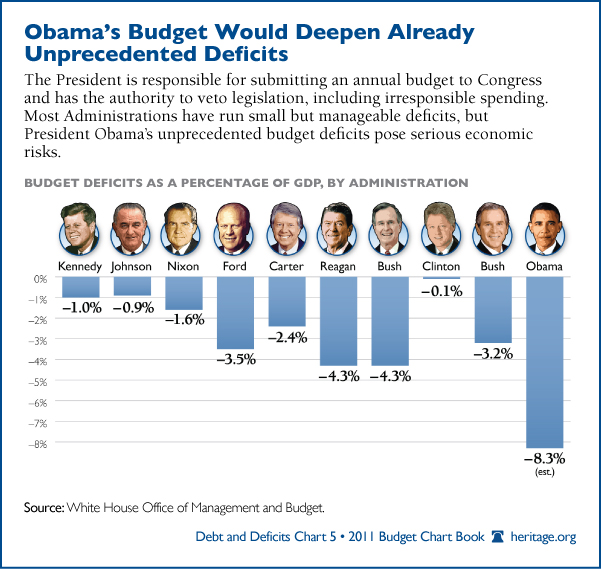


 The Daily Hatch