Yearly Archives: 2011

Social Security is a Ponzi scheme (Part 3)

Social Security is a Ponzi scheme (Part 3)

Governor Rick Perry got in trouble for calling Social Security a Ponzi scheme and I totally agree with that. This is a series of articles that look at this issue.

Personal Accounts and the Savings Rate

by Timothy B. Lee

This article appeared on Forbes.com on September 11, 2011

Rick Perry’s recent comparison of Social Security to a Ponzi scheme has resurrected the long-running debate over the solvency of Social Security. Many libertarians and conservatives advocate shifting from the current pay-as-you-go system — in which taxes on today’s workers finance the Social Security checks of today’s retirees — to a system of personal accounts in which each worker’s retirement funds are set aside for his own retirement. One of the key arguments for such a system is that the stock market’s historically high returns would allow the average worker to retire with more money in his pocket than the meager returns the Social Security system now promises (and projections suggest the system may not even deliver on those promises).

The underlying reason this works is that the money in personal accounts would be invested in private sector businesses, which would use them to create new wealth. In contrast, Social Security taxes are used to finance current government spending. But in a blog post last month, Karl Smith argued that the two situations are more similar than they seem:

I think that sometimes lay people get confused and think that a private retirement system implies that people will only be paying in and thus adding to the capital stock. They forget that on the opposite end people will be extracting and thus depleting the capital stock.

Timothy B. Lee is an adjunct scholar at the Cato Institute. He covers tech policy for Ars Technica and blogs at Forbes.com.

More by Timothy B. Lee

The “investment bonus” is only the time between when the money goes in and when it comes out. I wish I could go into more detail, but you actually get the exact same effect from a Social Security trust fund. Less borrowing by the government — and hence a higher capital stock — when money is going in. More borrowing by the government — and hence a lower capital stock — when money is going out.

To unpack this a bit, the Social Security administration was (until last year) taking in tens of billions of dollars more from payroll taxes than it is sending out in Social Security checks. The difference was lent to the Treasury Department to finance other government programs.

Smith’s point is that if the SSA weren’t running a surplus, then the Treasury Department would have had to go to borrow that money from private bond markets instead, which would have meant less money being invested in private-sector wealth creation. Hence, switching to private accounts doesn’t actually increase the amount of money being invested in the private sector, and hence doesn’t produce any new wealth that can be used to pay future retirees.

In theory, this argument makes sense. But it has a couple of practical problems. First, it assumes that a dollar invested in stocks should have the same wealth-creating effect as a dollar invested in bonds. It’s not obvious that this is true. Stocks have historically generated a higher rate of return than bonds, after all, and it’s not crazy to think this reflects the fact that equity investments generate more wealth per dollar than debt investments.

But the more serious problem with the argument is that it implicitly holds other taxes and government spending constant. That is, it assumes that when the SSA lends a dollar to the Treasury, the result is one less dollar of private-sector borrowing rather than one more dollar of government spending or one more dollar of tax cuts.

But this isn’t a reasonable assumption at all. Consider the late 1990s, the only period in my lifetime the federal government has run a surplus. Bill Clinton began bragging that he’d balanced the budget toward the end of fiscal year 1998. And in that year, the federal governmentdid run a slight surplus of $70 billion dollars. But this surplus is the result of adding a $30 billion “on budget” deficit to Social Security’s $100 billion surplus. If Social Security is ignored, the government didn’t reach a surplus until 1999.

If the US had a system of personal accounts in the 1990s, then elected officials couldn’t have plausibly counted the accumulation of funds in peoples’ accounts as part of a federal budget surplus. And so the deficit would have looked worse than it did. It’s impossible to know how that would have affected the budget debates of the 1990s, but it seems reasonable to assume that politicians would have enacted deeper spending cuts and/or larger tax increases to close what was perceived as a substantially larger deficit.

In other words, one way to think about personal accounts is as a mechanism for Congress to exert self-discipline. As long as Social Security surpluses are saved in a single giant lockbox managed by the government, politicians are going to face irresistable temptations to raid it to finance other programs. It’s simply not credible to think the federal government can “save” money by lending it to itself.

Splitting the lockbox up into millions of individual accounts with peoples’ names on them makes that harder to do, because people are going to be much more sensitive about the government pretending the money in their personal accounts really belongs to the government.

And this means that personal accounts are likely to increase the savings rate. Not because Smith’s technical point is wrong, but because switching to personal accounts changes the political dynamics of the budget process. Without the ability to hide deficits behind Social Security surpluses, politicians in the coming decades would face greater pressure to cut spending and/or raise taxes in order to produce budgets that are actually balanced.
Bobby Bowden’s Christian Faith (Part 5) jh28

Bobby Bowden was probably the best speaker I have ever heard at the Little Rock Touchdown Club. Here is an article about his Christian faith:

Football and faith are big business for Bobby Bowden
Tuesday, Jun 12, 2001
By Sandra Vidak
TALLAHASSEE, Fla. (BP)–Whether it’s leading his team to a national championship on the gridiron, or carefully tending his flock of football players, Florida State’s Bobby Bowden is on-mission for the Lord — 24 hours a day.During 46 years of coaching, Bowden has concerned himself with the salvation of nearly 5,000 young men who have providentially found themselves at his coaching door. Sitting at his desk — family photographs to his right and a picture-window view of the football playing field at Doak Campbell Stadium on his left — the larger-than-life personality becomes the down-to-earth mentor to players and coaches alike. He is just as concerned about his players “getting saved” as he is about them learning playbooks.In fact, when a student athlete signs to play football at Florida State University, one of the first things the coach does is send a letter to the parents asking for permission to take the student to church.Bowden takes the players, as a team, to church twice each season. The churches selected are not necessarily Baptist; typically one is predominantly Anglo and the other predominantly African-American.

“I make all my boys, black or white, go because I want them to see that they are welcomed here in this church no matter what the color of their skin. I want them to understand that.”

He also tells the parents, “I want them to carry on the way that you have trained them in your home because I know how it is when kids get away to college — the first thing they do is quit going to church.”

And while Bowden may be a man of character and integrity, don’t under estimate him as an opponent. Firm coaching principles are as important to him as winning the game.

Tangible evidence of the success of this football legend’s program is on display in the Coyle Moore Athletic Center. The football wing is a museum that houses two Waterford crystal national championship trophies (1993 and 1999), along with hundreds of other awards, rings, trophies, outstanding player portraits and memorabilia from 24 years of winning football games.

Sure, Bowden is proud of winning but it’s mainly others — boosters, media and fans — who bring up the impressive, record-breaking statistics. Bowden unequivocally gives God the glory for his success.

“God hasn’t blessed many coaches more than He has me. He sure has blessed me” and for that “I am very thankful,” Bowden said. Specifically, he mentioned that, “God has given me a great family. We’ve all been very fortunate.”

Bobby and Ann Bowden have been married 51 years and their family includes six children — all married — and 21 grandchildren, all healthy.

Bowden truly loves people. Just to watch him walk around the athletic complex is a lesson in people skills as he speaks and nods to every person he sees. Colleagues say he “never walks past an admiring child without a wink and a smile.”

The Birmingham, Ala., native evidences a God-given talent to motivate others. The genteel charm, quick wit and Southern drawl, mixed with a friendly and outgoing man who loves life and lives it to the fullest, makes people just want to be around him.

“I just love to coach,” he affirmed. “That may sound simple, but I think sometimes people like the things that go around coaching and not the actual job.”

Colleagues use words like “respect, sincerity, class, honesty, charisma, charm and humor” to describe Bowden. His faith in God, commitment to Christ and “rock-solid character” are the things that define this man — not wins, losses or coaching records.

“Our mission on earth is to glorify God, in whatever [situation] He’s put us.” So if you’re doing it to the glory of God, he added, then it better be good.

“I’ve always felt like He put me in coaching to try to reach young men through coaching, through playing ball, you know? It opens a lot of doors for them.”

Startling numbers of Bowden’s players become first-round NFL draft picks, but Bowden encourages them to seek God’s will in planning their futures.

“God is going to find a way for you to make a living,” he said. “He is going to find a profession for you. And to me that’s what all these college students should be doing — searching for the profession into which God wants them to go. Now most of them are going to be led into it by their abilities. Some of them just feel like they want to go into medicine, law, teaching, coaching or criminology. In other words there’s something that just leads you in there, and I feel like if people will ask and seek, that God will lead them where He wants them to go.”

Reflecting on his career and what God has taught him through coaching, Bowden said, “If you love Him and serve Him and try to be loyal to Him and obedient to Him, He’s not going to let you fail. That’s the thing that has happened to me.”

Ever mindful of his Christian testimony, Bowden has “always tried to put God first — I’ve tried. I don’t want people to think that ‘Bobby really thinks he’s a good boy.’ No, I don’t think I’m good. I try to be good. But the thing about it is that God has taught me that if you try to be obedient and try to follow the rules and try to do what He asks you to, you still can be a success.”

Win, lose or draw, Bowden’s first order of business at the end of a game is to immediately shake the other coach’s hand. He is acutely aware of the constant audience of players, coaches, fans and media watching for his reaction, particularly during turbulent times.

Bowden was “raised in a very good Christian home” under the care of “great” parents. They took him to church all of his life, had prayer in the home and read Scripture.

Bowden made a public profession of faith when he was around age 10, but said it wasn’t until he was 23 he really “got the picture” and rededicated his life to the Lord.

He recalled, “As I came up, I thought that being good was being a Christian. I knew you had to join the church. I joined the church. I knew you had to be baptized. I was baptized. I thought that — plus being good — makes you a Christian.

“I finally realized that you are saved by grace.” It’s “nothing that you did and nothing that you earned. Once I understood that, it made life simpler to me. Because, with understanding grace, it makes you want to do better. Nobody’s perfect. I make mistakes every day and do things that are wrong, though I try not to. But that’s the thing about being a Christian and really believing: You try not to.”

He added, “The older I get the stronger I get about my Christian beliefs and faith.”

Ever since his 1953 rededication experience, Bowden has accepted invitations to speak whenever and wherever he can, particularly to church groups, and particularly when he is on the road with the team. Whether the media is watching or not, he minces no words when speaking of eternal salvation.

Comparing his role as a coach and that of ministers, who he admires because “they have got the toughest job in the world,” Bowden acknowledged, “In coaching I can’t make everybody happy. There’s no way. If you win, you didn’t win by a big enough score. … If you are a minister and you are preaching” the responsibility is greater. “You can’t make everybody happy there; don’t water it down so that these people who don’t believe don’t get their feelings hurt,” he admonished. “I think you’ve got to say it like it is, in the best loving way that you can say it now. But, again, preach the Bible and what the Bible teaches and I think your church will flourish.”
–30–

Sixty Six who resisted “Sugar-coated Satan Sandwich” Debt Deal (Part 49)

Sixty Six who resisted “Sugar-coated Satan Sandwich” Debt Deal (Part 49)

This post today is a part of a series I am doing on the 66 Republican Tea Party favorites that resisted eating the “Sugar-coated Satan Sandwich” Debt Deal. Actually that name did not originate from a representative who agrees with the Tea Party, but from a liberal.

Rep. Emanuel Clever (D-Mo.) called the newly agreed-upon bipartisan compromise deal to raise the  debt limit “a sugar-coated satan sandwich.”

“This deal is a sugar-coated satan sandwich. If you lift the bun, you will not like what you see,” Clever tweeted on August 1, 2011.

National Security Cuts a Cause for Concern in Final Debt Deal

Representative Michael Turner of Ohio


Washington, Aug 2 

For months, Congress has been debating how to deal with the economic questions surrounding an increase in our debt limit. At a time when foreign nations own nearly $4.5 trillion of our $14.2 trillion debt – proposed cuts in the recently passed deal could have serious implications for our national security.  That’s why I was concerned that national security funding would be subject to an initial $175 billion cut in the final version of the Budget Control Act of 2011 that has been passed by Congress and signed by the President.

Throughout this debate I have advocated for our government to cut current spending and cap it at a responsible level so that we may balance our budget. We must remember though that in Article I, Section 8 of the U.S. Constitution, the founding fathers empowered Congress to: “Provide for the common Defense… To raise and support Armies … (and) To provide and maintain a Navy.” Fulfilling that obligation and meeting our budgetary responsibilities are not mutually exclusive. As a nation we should be able to provide for our defense and balance our budget. One should not come at the expense of the other.

This is a critical moment for both our nation and our armed forces. We have servicemembers deployed overseas in support of a number of military and humanitarian operations including Iraq, Afghanistan and Libya. Those operations over the past 10 years have taken a toll on our forces. Currently, the Army needs $25 billion to reset its force right now, while the Marines need $12 billion. Our men and women in uniform are not only being asked to make further sacrifices with additional deployments, but in some cases they’re relying on equipment which is often older than they are. For example, Navy ships and light attack vehicles, on average, were built 20 years ago. In addition the Air Force is relying on bombers averaging 34 years in age and is refueling aircraft with tankers that are nearly 50 years old. 

An additional point of concern is that further cuts to defense are being used as a bargaining chip in a yet to be named Congressional “super-committee.” Twelve members of Congress from the House and Senate, both Democrats and Republicans, are required to find an additional $1.8 trillion in cuts. If the committee deadlocks on an agreement, or fails to complete its work by November 23rd of this year – then $281 billion in additional defense cuts automatically take effect. These cuts are unspecified and are an arbitrary number chosen to pressure the “super-committee” members into crafting an inadequate deal in fear of these cuts being enacted. I voted against this bill because I could not support a process which circumvents the normal legislative process and gambles with our national security.

Our military remains strong and morale among servicemembers remains high, but we cannot continue to operate with a strained force or we will not be able to meet the obligations of the future. In fact, the Vice-Chiefs of Staff of each of our braches of the military echoed this same sentiment at a hearing before the House Armed Services Subcommittee on Readiness. General Philip Breedlove, Vice Chief of Staff of the Air Force stated that some components of the Air Force “are right at the ragged edge.”  Furthermore, additional proposed cuts of $281 billon in the bill would result in a “fundamental restructure of what it is our nation expects from our Air Force.”

Our national defense has always been a bipartisan issue in the halls of Congress. Members from both sides of the aisle recognize the role our military plays in both protecting this nation, and advancing the goals of our foreign policy. Subjecting this integral piece of our government to cuts, without thorough debate in committee and on the House floor, sets a dangerous precedent.

Little Rock Touchdown Club speaker Bobby Bowden’s testimony (Part 4) jh27

Uploaded by on Feb 7, 2010

2010 exciting Idlewild baptist church Bobby Bowden guest speaker FSU head coach speaking sermon pastor ken whiten talks about faith in Jesus Christ, God. small story about his mom.

__________________________________

When I attended the Little Rock Touchdown Club on September 12, 2011 I thought that I  something may have to do with Bobby Bowden’s testimony and sure enough he started off with a story about him being a Southern Baptist. However, he did not go into details about his faith in Christ. Here I am posting those details:

CBN.com – Bobby Bowden is a coaching legend. His name is synonymous with success. He’s the all-time winningest coach in Division One history, and he’s directed the Florida State University Seminoles to two national championships.

But he says the defining moment in his life came before his coaching career even began, when he rededicated his life to Jesus Christ.

“When I recommitted my life, my whole thinking was…God I’m making myself available to You. I think You’ve led me into coaching. I think this is what You want me to do, God,” he remembers.

And unashamedly, Coach Bowden has been using football at the stadium as a pulpit to witness to young men for the last 53 years.

“You know, that’s all I’ve done over the last 50 years is make it available, and you can’t believe the boys that have called me 20 to 30 years later.”

According to Bowden, his former players have said, “Coach I’m so glad you did this. I’m so glad you said that.”

“You can’t imagine how many boys I’ve coached here that become ministers. That has to be just as satisfying as winning a football game,” he says. “All we got to do is present it. We ain’t gonna save nobody. But He will, and all He asks us to do is to present it.”

Talk to players, coaches, and the people who work most closely with Bobby Bowden over the years, and the thing you hear over and over again is how much he genuinely cares for people.

“As a coach, he’s had a big influence on my life. He hired me because I was a player here. Bobby showed a lot to me by example as a leader — dependability and accountability,” says defensive line coach, Odell Haggins.

“He’s like a second father to me. He’s been so gracious to my family and I forever,” adds former assistant coach, Chuck Amato. “I’ve often said Coach Bowden is a sermon in shoes. What he says and what he preaches, he follows up. He treats the custodian that cleans the commode in his office just as well as he treats the president of the university. He sees no class in people. He sees no difference in race. He treats everybody kind and with respect.”

He’s fair, but tough — much like a general. In fact, had he not gone into coaching, Bowden said he probably would’ve chosen the military as a career.

“I was raised during World War II. So I became very interested in the military.”

“A lot of those skills and strategies carry over. I get a lot of sayings out of it. Some things that General Patton or Stonewall Jackson said, I can use and you’d be amazed at how much the strategy is alike,” says Coach Bowden.

Coach says one attribute that should carry over whether it’s the battlefield or the football field is character — a trait that he instills in his players.

“I’m one of those guys that thinks if you don’t have adversity, forget about character. Because your character is going to be developed by how well you handle adversity,” he says. “Now if you never have adversity, how are you going to develop character?”

And it’s through his own adversity Coach Bowden’s character shines. He’s been criticized for giving second chances to players who break team rules.  But Coach says God extended grace to him and when given the opportunity, he’ll do the same.

“I was a boy myself one time. If someone had not forgiven me for some of the things I had done, I would never have made it. So I’m coaching these young men, and I know what they go through and the temptations they’re faced with.”

“They’re going to make mistakes. I made them! I still do! But if it’s up to me, and I’ve got a chance to save someone, and it’s the first time they’ve done something like this … I’m going to give them a second chance.”

And he uses those opportunities to be a positive influence in his players’ lives.

“I believe young men need a male in the home. Young boys raised need a male figure in the home. It’s not what most of them got … somebody to discipline them,” he believes. “I take them to church, have bible reading with them, and pray at supper. I think that myself and the staff add a lot.”

The landscape of college football has changed since Bowden arrived on the scene. A lot of coaches have come and gone. But Coach Bowden has had success with a simple philosophy.

“When I put everything in God’s hands, I don’t have to worry about anything. I don’t have to worry about winning ballgames. I want to. I want to win as much as anybody does, but I don’t have to worry about this. I know that when I die, I live eternally with my God, so the pressure’s off!”

_____________________

“Woody Wednesday” Allen is searching for satisfaction in wrong place jh17

Coldplay – 42 Live

Coldplay perform on the french television channel W9.

In 1992 Woody Allen took up with one of his adopted kids and lived in with her. He was given over to the pursuit of pleasure. Actually he has made that a major focus of his life. In the latter part of his life he has thrown all in efforts into his work. Again he has commented that he has found no lasting satisfaction there either.

In recent years the rock band Coldplay has been on a search for satisfaction and I see a close comparison between Chris Martin and Woody Allen.

I wrote this article a couple of years ago:

The Spiritual Search for the Afterlife
Russ Breimeier rightly noted that it seems that Coldplay is “on the verge of identifying a great Truth” and their latest CD is very provocative. Many songs mention God and other Biblical themes such as dealing with death, and the afterlife and meaning in life and the shortness of life. The song “42” states,
Those who are dead are not dead
They’re just living my head
And since I fell for that spell
I am living there as well
Oh…Time is so short and I’m sure
There must be something more
This is the same journey that Solomon went on 3000 years ago in the Book of Ecclesiastes. The Christian Scholar Ravi Zacharias noted, “The key to understanding the Book of Ecclesiastes is the term UNDER THE SUN — What that literally means is you lock God out of a closed system and you are left with only this world of Time plus Chance plus matter.” Most people are not in the position of Solomon was in because he had a great deal of resources and could see if getting true lasting satisfaction was possible without God in the picture and Solomon went about this experiment.  He found out these hard cold facts.
Three things that do not bring lasting Satisfaction
Satisfaction does not come through (#1) learning more, or (#2)  putting more effort in your work or  (#3)seeking pleasure.
Read Solomon’s words for yourself.
Ecclesiastes 1:16- 2:11
16-17 I said to myself, “I know more and I’m wiser than anyone before me in Jerusalem. I’ve stockpiled wisdom and knowledge.” What I’ve finally concluded is that so-called wisdom and knowledge are mindless and witless—nothing but spitting into the wind.18 Much learning earns you much trouble.
The more you know, the more you hurt.
Chapter 2
1-3 I said to myself, “Let’s go for it—experiment with pleasure, have a good time!” But there was nothing to it, nothing but smoke.What do I think of the fun-filled life? Insane! Inane!
My verdict on the pursuit of happiness? Who needs it?
With the help of a bottle of wine
and all the wisdom I could muster,
I tried my level best
to penetrate the absurdity of life.
I wanted to get a handle on anything useful we mortals might do
during the years we spend on this earth.
 4-8 Oh, I did great things: built houses,
planted vineyards,
designed gardens and parks
and planted a variety of fruit trees in them,
made pools of water
to irrigate the groves of trees.
I bought slaves, male and female,
who had children, giving me even more slaves;
then I acquired large herds and flocks,
larger than any before me in Jerusalem.
I piled up silver and gold,
loot from kings and kingdoms.
I gathered a chorus of singers to entertain me with song,
and—most exquisite of all pleasures—
voluptuous maidens for my bed.
 9-10 Oh, how I prospered! I left all my predecessors in Jerusalem far behind, left them behind in the dust. What’s more, I kept a clear head through it all. Everything I wanted I took—I never said no to myself. I gave in to every impulse, held back nothing. I sucked the marrow of pleasure out of every task—my reward to myself for a hard day’s work!
 
 11 Then I took a good look at everything I’d done, looked at all the sweat and hard work. But when I looked, I saw nothing but smoke. Smoke and spitting into the wind. There was nothing to any of it. Nothing.
No band has worked harder than Coldplay (creating 4 of the greatest cds in pop history) and Chris Martin is a very educated man who has achieved the storybook life in many areas. Why has his writing turning more towards spiritual matters now? Could he be traveling down the same road that Solomon was going 3000 years ago?
Other posts that deal with Coldplay:

Three things that do not bring lasting Satisfaction, (Coldplay’s spiritual search Part 5)

Coldplay – 42 Live Coldplay perform on the french television channel W9. I wrote this article a couple of years ago: The Spiritual Search for the Afterlife Russ Breimeier rightly noted that it seems that Coldplay is “on the verge of identifying a great Truth” and their latest CD is very provocative. Many songs mention […]

Are Gwyneth Paltrow and Chris Martin looking for Spiritual Answers? (Coldplay’s spiritual search Part 4)

  CP I wrote this article a couple of years ago. Are Gwyneth Paltrow and Chris Martin looking for Spiritual Answers? Just like King Solomon’s predicament in the Book of Ecclesiastes, both of these individuals are very wealthy, famous, and successful, but they still are seeking satisfying answers to life’s greatest questions even though it […]

Insight into what Coldplay meant by “St. Peter won’t call my name” (Series on Coldplay’s spiritual search, Part 3)

Coldplay seeks to corner the market on earnest and expressive rock music that currently appeals to wide audiences Here is an article I wrote a couple of years ago about Chris Martin’s view of hell. He says he does not believe in it but for some reason he writes a song that teaches that it […]

Will Coldplay’s 2011 album continue on spiritual themes found in 2008 Viva La Vida? (Series on Coldplay’s spiritual search, Part 2)

Views:2 By waymedia Coldplay Coldplay – Life In Technicolor ii Back in 2008 I wrote a paper on the spiritual themes of Coldplay’s album Viva La Vida and I predicted this spiritual search would continue in the future. Below is the second part of the paper, “Coldplay’s latest musical lyrics indicate a Spiritual Search for the […]

Will Coldplay’s 2011 album continue on spiritual themes found in 2008 Viva La Vida? (Series on Coldplay’s spiritual search, Part 1)

Coldplay performing “Glass of Water.” Back in 2008 I wrote a paper on the spiritual themes of Coldplay’s album Viva La Vida and I predicted this spiritual search would continue in the future. Below is the first part of the paper, “Coldplay’s latest musical lyrics indicate a Spiritual Search for the Afterlife.” Coldplay’s latest musical […]

The wait is over, Coldplay single “Every Teardrop is a waterfall”

Coldplay – Every Teardrop Is A Waterfall (Official) The new single – download it now from iTunes at http://cldp.ly/itunescp (except in the UK, where it will be released to download stores at 12.01am on Sunday June 5th). Written by Berryman / Buckland / Champion / Martin / Allen / Anderson. Produced by Markus Dravs, Dan […]

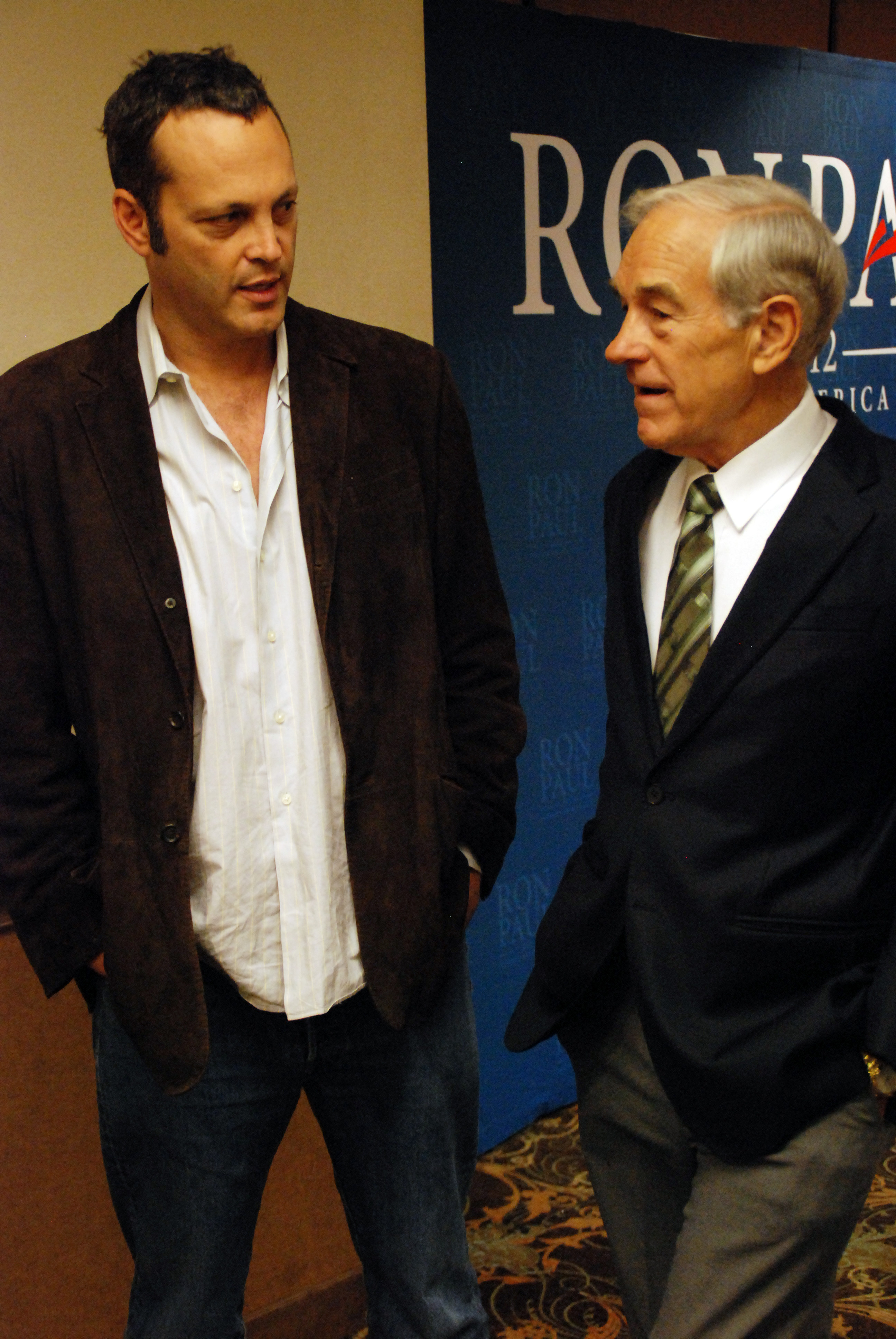
Vince Vaughn introduces Ron Paul

LPAC 2011: Ron Paul – Pt. 1

Uploaded by on Sep 20, 2011

Congressman Ron Paul speaks at LPAC 2011, along with Actor Vince Vaughn, Ron Paul Presidential Campaign Manager John Tate, and Campaign for Liberty Vice President Matt Hawes.

_______________________

I love the politics of Ron Paul although I differ with him a few points. However, I really believe that he best understands what the constitution really wants for our country. The limits of the constitution have been ignored for years as the expanding federal budget as made a mess of everything it gets involved in.

Ron Paul and Vince Vaughn are good friends:

The Ron Paul 2012 Presidential Campaign announced today that actor Vince Vaughn will introduce Dr. Paul at the Liberty Political Action Conference (LPAC).

The exchange will take place tonight, Friday, September 16th at 7:00 p.m. Pacific Time in Reno, Nevada.

“Ron and Vince are friends, with Vince not merely interested in Dr. Paul’s philosophy but he also graciously invited Dr. and Mrs. Paul to the premier of his film ‘Couples Retreat,’” said Ron Paul 2012 National Campaign Chairman Jesse Benton, referring to the October 6, 2009 film premier in California.

Mr. Vaughn, for his part, endorsed Dr. Paul’s 2009 book End the Fed with the following enthusiastic quote: “Everyone must read this book–Congressmen and college students, Democrats and Republicans–all Americans.”

End the Fed was published in hardcover on September 16, 2009, exactly two years ago today, and debuted at number six on The New York Times Best Seller list.

____________________________

Last Updated: 08/01/2008Issues of faith and religion come to the forefront quite often during elections and presidential campaigns. In preparation for the primary elections, I thought it would be helpful to provide a “faith snapshot” of each of the 2008 presidential candidates. I have sent each candidate a brief questionnaire about their faith. This project will be continually updated as I receive responses and find additional faith-related statements from the candidates. Please check back often!

Ron Paul’s Political Profile:

Party: Republican
Age: 72
Education:
Gettysburg College, B.A.
Duke University School of Medicine, M.D.
Current Position: U.S. Representative, Texas
Experience: Surgeon, Obstetrician, Gynecologist, U.S. Representative, Texas
Declared Candidacy: Mar. 2007

Ron Paul’s Faith Snapshot:

Religion/Church: Baptist

Ron Paul was raised by Lutheran parents and attended the Lutheran Church regularly during his childhood. Before deciding to pursue a medical career, for a short time Paul considered becoming a Lutheran minister. Two of Ron’s brothers, David and Jerrold, are Lutheran ministers. While in college Ron Paul was married to Carol Wells an Episcopalian, and together they baptized their five children in this denomination.

Eventually the couple stopped attending the Episcopal Church and began frequenting a Baptist church in Texas. Although Paul says he is uncomfortable discussing his faith as part of his political efforts, for those who ask, he has published a statement of faith on his campaign Web site.

Ron Paul’s Expressions of Faith:

In a summary about his faith, Ron Paul writes, “I have never been one who is comfortable talking about my faith in the political arena. In fact, the pandering that typically occurs in the election season I find to be distasteful. But for those who have asked, I freely confess that Jesus Christ is my personal Savior, and that I seek His guidance in all that I do. I know, as you do, that our freedoms come not from man, but from God. My record of public service reflects my reverence for the Natural Rights with which we have been endowed by a loving Creator.”

Speaking about the First Amendment, Ron Paul says, ” Similarly, the mythical separation of church and state doctrine has no historical or constitutional basis. Neither the language of the Constitution itself nor the legislative history reveals any mention of such separation. In fact, the authors of the First amendment … routinely referred to “Almighty God” in their writings, including the Declaration of Independence. It is only in the last 50 years that federal courts have perverted the meaning of the amendment and sought to unlawfully restrict religious expression.”
____________________
Ten Reasons for Christian to Vote
for Ron Paul for President


By Nathan Radcliffe


The Covenant News ~ December 12, 2007


1. Ron Paul does not believe the government is God. Paul believes the federal government should be limited to its Constitutional size and scope. He wants to withdraw the US from all organizations that violate our national sovereignty (i.e. the United Nations, the International Monetary Fund, the International Criminal Court, et. al.)

2. Ron Paul is a humble man who advocates a humble foreign policy. He does not believe the US should be the policeman of the world.

3. Ron Paul confesses that “Jesus Christ is my personal Savior,” but he does not use the Lord’s name only to pander for votes. He doesn’t just talk the talk; he walks the walk.

4. During his 20 years in Congress, Ron Paul has sponsored more substantive legislation than probably any other single members of Congress. Congressional Quarterly has named him one of the “Fifty Most Effective Members of Congress.”

5. Ron Paul is a 72-year-old grandfather whose service as a statesman has reflected the time-honored principles and values of America’s Founding Fathers.

6. Dr. Paul is pro-life. He has delivered over 4,000 babies and says he has “never once considered performing an abortion, nor did I ever find abortion necessary to save the life of a pregnant woman.” Paul also opposes unjust wars of aggression and will bring our troops home from Iraq.

7. Ron Paul believes marriage is between a man and a woman. He has been faithful to his own wife for 50 years.

8. Ron Paul is committed to protecting property rights. He opposes government theft through “eminent domain” abuses. He has worked to eliminate the income tax and the IRS, inheritance taxes, and the “inflation tax.” He has never voted to raise taxes.

9. Ron Paul is a man of integrity who takes his oath to uphold the Constitution seriously. Congressman Paul never votes for legislation unless the proposal is expressly authorized by the Constitution.

10. Ron Paul has never taken a government-paid junket and has never participated in the lucrative congressional pension program. Lobbyists do not even bother to visit Congressman Paul’s office because they know his vote will not be bought.

Cato Institute gives Bill Clinton credit

Spending Restraint, Part I: Lessons from Ronald Reagan and Bill Clinton

Uploaded by on Feb 14, 2011

Ronald Reagan and Bill Clinton both reduced the relative burden of government, largely because they were able to restrain the growth of domestic spending. The mini-documentary from the Center for Freedom and Prosperity uses data from the Historical Tables of the Budget to show how Reagan and Clinton succeeded and compares their record to the fiscal profligacy of the Bush-Obama years.

_____________________________

Over the years the liberals keep on calling for more spending but our solution is to restrain government growth. The funny thing is that BILL CLINTON BALANCED THE BUDGET BY RESTRAINING SPENDING BUT NOW DEMOCRATS ACT LIKE THEY HAVE FORGOTTEN THE RECIPE FOR SUCCESS.

Real-World Cases Prove: Spending Restraint Works

by Daniel J. Mitchell

Daniel Mitchell is a senior fellow at the Cato Institute in Washington, D.C.

Added to cato.org on March 4, 2011

This article appeared in Investor’s Business Daily on March 4, 2011.

Good fiscal policy doesn’t require miracles — or dramatic showdowns. All politicians have to do is limit the growth of the public sector. Combined with normal revenue growth, this approach eliminates red ink very quickly.

This is what happened in the U.S. during the Clinton-Gingrich years. Between 1994 and 1999, total government spending increased by an average of just 3% annually. The budget deficit, which was projected in early 1995 (18 months after the 1993 tax increase!) to remain above $200 billion for the rest of the century, quickly became a budget surplus once spending was restrained.

Fiscal discipline also works when it is tried in other nations. Data from the Economist Intelligence Unit reveal that four nations — Canada, Ireland, Slovakia and New Zealand — dramatically reduced budget deficits in recent decades by imposing strict limits on government spending.

Daniel Mitchell is a senior fellow at the Cato Institute in Washington, D.C.


More by Daniel J. Mitchell

Interestingly, these data also reveal that the tax burden was stable or falling during these periods of fiscal progress.

Canada, for instance, was in deep fiscal trouble. The burden of government spending had climbed above 53% of gross domestic product in 1992 and the deficit was more than 9% of economic output. Then lawmakers embarked on a new course. Government was put on a diet, and between 1992 and 1997 Canada’s budget rose from $374 billion Canadian to $391 billion, an average annual increase of less than 1%.

This period of frugality paid big dividends. The burden of government spending dropped to 44% of GDP. The budget deficit, meanwhile, completely disappeared. After five years of fiscal discipline, record levels of red ink were transformed into a small budget surplus.

Ireland was in a tailspin by the mid-1980s. The burden of government spending had skyrocketed to more than 60% of GDP and the nation’s deficit was consuming more than 12% of economic output. To avoid a crisis, Irish policy froze the budget. The Irish budget was 14.7 billion euros in 1985, and it was only 14.7 billion euros in 1989.

This four-year spending freeze was enormously successful. The burden of government spending plunged to less than 43% of GDP. The budget deficit also fell dramatically, consuming just 2.7% of economic output at the end of this period.

Slovakia, like many other nations that emerged from the collapse of the Soviet empire, was saddled with a large public sector. To solve the problem, policymakers restrained government. From 2000-03, the Slovakian budget grew from 11.5 billion euros to 11.8 billion euros, an average increase of 1.3%.

This modest period of fiscal discipline had a big impact. The burden of the public sector dropped from 36.9% of GDP down to 29.2% of economic output. During this time, the deficit fell from 8.7% of GDP to 2.0%. Combined with pro-growth policies such as the flat tax and personal retirement accounts, the nation has enjoyed robust growth.

Last but not least, let’s look at New Zealand. The burden of the public sector by the end of the 1980s had climbed to more than one-half of economic output. The Kiwis staged a turnaround by putting a clamp on public-sector spending. Between 1990 and 1995, the New Zealand Budget actually dropped from $39.3 billion New Zealand to $38.8 billion.

This five-year spending freeze put the nation in a much stronger position. The burden of government spending plummeted by more than 10 percentage points of GDP in New Zealand, dropping from 53.5% of economic output down to 43.1%. And a deficit of 4.5% of GDP was transformed during those five years to a surplus of 2.8% of GDP.

This pattern should not be a surprise. Restraining government spending generates good results because the private sector grows faster than the public sector.

Many self-proclaimed deficit hawks in Washington argue that deficit reduction is impossible without substantial tax increases. But American policymakers implemented a big tax cut, in 1997, during the period when the deficit became a surplus.

In other nations, the tax burden actually dropped by significant amounts during the relevant periods — falling by 8.1 percentage points of GDP in Ireland, 1.1 percentage points of GDP in Slovakia, and 3.1 percentage points of GDP in New Zealand. The overall tax burden did rise in Canada, but only by 0.3 percentage point of GDP.

The moral of the story is that limiting the growth of government spending is the right recipe. If the politicians in Washington replicated the spending discipline of these other nations, we would enjoy similar results.

Two percent annual spending increases would lead to fiscal balance by 2021. Limiting spending growth to 1% annually would balance the budget by 2019. A spending freeze would balance the budget by 2017.

Spending Restraint, Part II: Lessons from Canada, Ireland, Slovakia, and New Zealand

Uploaded by on Feb 22, 2011

Nations can make remarkable fiscal progress if policy makers simply limit the growth of government spending. This video, which is Part II of a series, uses examples from recent history in Canada, Ireland, Slovakia, and New Zealand to demonstrate how it is possible to achieve rapid improvements in fiscal policy by restraining the burden of government spending. Part I of the series examined how Ronald Reagan and Bill Clinton were successful in controlling government outlays — particularly the burden of domestic spending programs. http://www.freedomandprosperity.org

Is something spiritually going on with Coldplay? BTW Coldplay on Letterman tonight!

In the past three years I have written many posts concerning the spiritual meaning of the Coldplay songs. There is something going on with them. Even with one of the songs on their upcoming album there is something spiritual they are driving at. Tonight on Letterman the band will perform.

Rare picture: Elusive couple Gwyneth Paltrow and Chris Martin are photographed together at a beach party in the Hamptons

Elusive: Gwyneth Paltrow and Chris Martin in a rare shot together at a beach party in the Hamptons

I was very interested in the first single that came out from Coldplay a few weeks ago, but this second single escaped my attention. Then this morning my son Hunter told me all about this second song and he said that something in the song may be talking about God.
 
I told you guys earlier that in 2008 Coldplay and Chris in particular was on a spiritual search. I predicted that it would continue. With the song “Major Minus” we have some very interesting lyrics. Take a look:

They got one eye on what you knew

And one eye on what you do
So be careful who it is you’re talking to

They got one eye on what you knew
And one eye on what you do
So be careful what it is you’re trying to do

And be careful when you’re walking in the view
Just be careful when you’re walking in the view!

Ooh-oooh-oooh
Ooh-oooh-oooh-ooh
Got one eye on the road and one on you!

Ooh-oooh-oooh
Ooh-oooh-oooh-ooh
Got one eye on the road and one on

They got one eye on what you knew
And one eye on what you do
So be careful ’cause nothing they say is true

But they don’t believe a word
It’s just us against the world
And we just gotta turn up to be heard 

Hear those crocodiles ticking ’round the world
Hear those crocodiles ticking (they go) ticking ’round the world

Ooh-oooh-oooh
Ooh-oooh-oooh-ooh
Got one eye on the road and one on you!
Ooh-oooh-oooh
Ooh-oooh-oooh-ooh
Got one eye on the road.

She can’t hear them climbing the stairs
I got my right side fighting
While my left eye’s on the chairs

Ooh-oooh-oooh
Ooh-oooh-oooh-ooh
Got one eye on the road and one on you!

Ooh-oooh-oooh
Ooh-oooh-oooh-ooh
Got one eye on the road and one on you

___________________________________

Here are the main points of the song.

1. Heaven is watching us constantly. (They got one eye on what you knew,And one eye on what you do)

2. We should be careful because what we do does matter to God. (And be careful when you’re walking in the view, Just be careful when you’re walking in the view!)

3. There are dangers in this world that you must avoid because they will eat you up.(Hear those crocodiles ticking ’round the world, Hear those crocodiles ticking (they go) ticking ’round the world )

4.Chris Martin’s plan is to keep one eye on the road ahead and one on the wife that he loves. (Got one eye on the road and one on you!)

___________________________

These interpretations are based on the assumption that Chris is building on the theme of his last cd. We will have to wait and see what the rest of the cd sounds like. Feel free to share with me your thoughts.

Below is an article from the website popcrush.


Coldplay to Perform at ‘Live on Letterman’

by: Cristin Maher 3 weeks ago


ColdplayJohn Shearer, Getty Images

On Sept. 20, world renowned British rock group Coldplay will perform at ‘Live on Letterman’ at 8PM EST. Although ‘Live on Letterman’ is filmed in New York, Coldplay fans will be able to experience the live performance through a webcast of the show.

The Coldplay ‘Live on Letterman’ performance will be broadcasted on CBS Radio, where fans can either watch and listen to the show live, or catch the show on demand at a later date. If you happen to be in the New York area, ‘Live on Letterman’ is taped at the Ed Sullivan Theater, so you might be able to catch a glimpse of the Brits if you head over to that area on Sept. 20.

The ‘Live on Letterman’ broadcast will follow Coldplay’s taping of ‘Late Night With David Letterman,’ where the quartet will perform on set. The show will televise at 11:37PM EST on Sept. 20, so be sure to tune in to that as well if you’re a fan.

Coldplay will release their fifth studio album ‘Mylo Xyloto’ on Oct. 24, and the album will feature their new hit single ‘Every Teardrop Is a Waterfall.’

Related posts:

Solomon, Woody Allen, Coldplay and Kansas (Coldplay’s spiritual search Part 6)

Here is an article I wrote a couple of years ago: Solomon, Woody Allen, Coldplay and Kansas What does King Solomon, the movie director Woody Allen and the modern rock bands Coldplay and Kansas have in common? All four took on the issues surrounding death, the meaning of life and a possible afterlife, although they all came up with their own conclusions on […]

Three things that do not bring lasting Satisfaction, (Coldplay’s spiritual search Part 5)

Coldplay – 42 Live Coldplay perform on the french television channel W9. I wrote this article a couple of years ago: The Spiritual Search for the Afterlife Russ Breimeier rightly noted that it seems that Coldplay is “on the verge of identifying a great Truth” and their latest CD is very provocative. Many songs mention […]

Are Gwyneth Paltrow and Chris Martin looking for Spiritual Answers? (Coldplay’s spiritual search Part 4)

CP I wrote this article a couple of years ago. Are Gwyneth Paltrow and Chris Martin looking for Spiritual Answers? Just like King Solomon’s predicament in the Book of Ecclesiastes, both of these individuals are very wealthy, famous, and successful, but they still are seeking satisfying answers to life’s greatest questions even though it seems […]

Insight into what Coldplay meant by “St. Peter won’t call my name” (Series on Coldplay’s spiritual search, Part 3)

Coldplay seeks to corner the market on earnest and expressive rock music that currently appeals to wide audiences Here is an article I wrote a couple of years ago about Chris Martin’s view of hell. He says he does not believe in it but for some reason he writes a song that teaches that it […]

Will Coldplay’s 2011 album continue on spiritual themes found in 2008 Viva La Vida? (Series on Coldplay’s spiritual search, Part 2)

Views:2 By waymedia Coldplay Coldplay – Life In Technicolor ii Back in 2008 I wrote a paper on the spiritual themes of Coldplay’s album Viva La Vida and I predicted this spiritual search would continue in the future. Below is the second part of the paper, “Coldplay’s latest musical lyrics indicate a Spiritual Search for the […]

Will Coldplay’s 2011 album continue on spiritual themes found in 2008 Viva La Vida? (Series on Coldplay’s spiritual search, Part 1)

Coldplay performing “Glass of Water.” Back in 2008 I wrote a paper on the spiritual themes of Coldplay’s album Viva La Vida and I predicted this spiritual search would continue in the future. Below is the first part of the paper, “Coldplay’s latest musical lyrics indicate a Spiritual Search for the Afterlife.” Coldplay’s latest musical […]

The wait is over, Coldplay single “Every Teardrop is a waterfall”

Coldplay – Every Teardrop Is A Waterfall (Official) The new single – download it now from iTunes at http://cldp.ly/itunescp (except in the UK, where it will be released to download stores at 12.01am on Sunday June 5th). Written by Berryman / Buckland / Champion / Martin / Allen / Anderson. Produced by Markus Dravs, Dan […]

Free to Choose by Milton Friedman: Episode “Created Equal” (Part 1 of transcript and video)

Image Detail

 Milton Friedman and Ronald Reagan

Liberals like President Obama (and John Brummett) want to shoot for an equality of outcome. That system does not work. In fact, our free society allows for the closest gap between the wealthy and the poor. Unlike other countries where free enterprise and other freedoms are not present.  This is a seven part series.

Created Equal [1/7]. Milton Friedman’s Free to Choose (1980)

Uploaded by on May 30, 2010

In this program, Milton Friedman visits India, the U.S., and Britain, examining the question of equality. He points out that our society traditionally has embraced two kinds of equality: equality before God and equality of opportunity. The first of these implies that human beings enjoy a certain dignity simply because they are members of the human community. The second suggests societies should allow the talents and inclinations of individuals to unfold, free from arbitrary barriers. Both of these concepts of equality are consistent with the goal of personal freedom.

In recent years, there has been growing support for a third type of equality, which Dr. Friedman calls “equality of outcome.” This concept of equality assumes that justice demands a more equal distribution of the economic fruits of society. While admitting the good intentions of those supporting the idea of equality of outcome, Dr. Friedman points out that government policies undertaken in support of this objective are inconsistent with the ideal of personal freedom. Advocates of equality of outcome typically argue that consumers must be protected by government from the insensitivities of the free market place.

Dr. Friedman demonstrates that in countries where governments have pursued the goal of equality of outcome, the differences in wealth and well being between the top and the bottom are actually much greater than in countries that have relied on free markets to coordinate economic activity. Indeed, says Dr. Friedman, it is the ordinary citizen who benefits most from the free market system. Dr. Friedman concludes that any society that puts equality ahead of freedom will end up with neither. But the society that puts freedom before equality will end up with both greater freedom and great equality.

___________________________

FREE TO CHOOSE 5: “Created Equal” (Milton Friedman)
Free to Choose ^ | 1980 | Milton Friedman

Posted on Friday, July 21, 2006 3:58:44 PM by Choose Ye This Day

FREE TO CHOOSE: Created Equal

Friedman: From the Victorian novelists to modern reformers, a favorite device to stir our emotions is to contrast extremes of wealth and of poverty. We are expected to conclude that the rich are responsible for the deprivations of the poor __ that they are rich at the expense of the poor.

Whether it is in the slums of New Delhi or in the affluence of Las Vegas, it simply isn’t fair that there should be any losers. Life is unfair __ there is nothing fair about one man being born blind and another man being born with sight. There is nothing fair about one man being born of a wealthy parent and one of an indigenous parent. There is nothing fair about Mohammed Ali having been born with a skill that enables him to make millions of dollars one night. There is nothing fair about Marleena Detrich having great legs that we all want to watch. There is nothing fair about any of that. But on the other hand, don’t you think a lot of people who like to look at Marleena Detrich’s legs benefited from nature’s unfairness in producing a Marleena Detrich. What kind of a world would it be if everybody was an absolute identical duplicate of anybody else. You might as well destroy the whole world and just keep one specimen left for a museum. In the same way, it’s unfair that Muhammed Ali should be a great fighter and should be able to earn millions. But would it not be even more unfair to the people who like to watch him if you said that in the pursuit of some abstract idea of equality we’re not going to let Muhammed Ali get more for one nights fight than the lowest man on the totem pole can get for a days unskilled work on the docks. You can do that but the result of that would be to deny people the opportunity to watch Mohammad Ali. I doubt very much he would be willing to subject himself to the kind of fights he’s gone through if he were to get the pay of an unskilled docker.

This beautiful estate, its manicured lawns, its trees, its shrubs, was built by men and women who were taken by force in Africa and sold as slaves in America. These kitchen gardens were planted and tended by them to furnish food for themselves and their master, Thomas Jefferson, the Squire of Monticello. It was Jefferson who wrote these words: We hold these truths to be self-evident that all men are created equal. That they are endowed by their creator with certain inalienable rights, that among these are life, liberty and the pursuit of happiness. These words penned by Thomas Jefferson at the age of 33 when he wrote the Declaration of Independence, have served to define a basic ideal of the United States throughout its history.

Much of our history has revolved about the definition and redefinition of the concept of equality, about the intent to translate it into practice. What did Thomas Jefferson mean by the words all men are created equal? He surely did not mean that they were equal and/or identical in what they could do and what they believed. After all, he was himself a most remarkable person. At the age of 26, he designed this beautiful house of Monticello, supervised its construction and indeed is said to have worked on it with his own hands. He was an inventor, a scholar, an author, a statesman, governor of Virginia, President of the United States, minister to France, he helped shape and create the United States. What he meant by the word “equal” can be seen in the phrase “endowed by their creator”. To Thomas Jefferson, all men are equal in the eyes of God. They all must be treated as individuals who have each separately a right to life, liberty and the pursuit of happiness.

Of course, practice did not conform to the ideals. In Jefferson’s life or in ours as a nation, he agonized repeatedly during his lifetime about the conflict between the institution of slavery and the fine words of the declaration. Yet, during his whole life, he was a slave owner.

This is the City Palace in Jaipur, the capitol of the Indian state of Rajasthan, is just one of the elegant houses that were built here 150 years ago by the prince who ruled this land. There are no more princes, no more Maharajas in India today. All titles were swept away by the government of India in its quest for equality. But as you can see, there are still some people here who live a very privileged life. The descendants of the Maharajas financed this kind of life partly by using other palaces as hotels for tourists __ tourists who come to India to see how the other half lives. This side of India, the exotic glamorous side, is still very real. Everywhere in the world there are gross inequalities of income and wealth. They offend most of us.

A myth has grown up that free market capitalism increases such inequalities, that the rich benefit at the expense of the poor. Nothing could be further from the truth. Wherever the free market has been permitted to operate, the ordinary man has been able to attain levels of living never dreamed of before. Nowhere is the gap between rich and poor. Nowhere are the rich richer and the poor poorer than in those societies that do not permit the free market to operate, whether they be feudal societies where status determines position, or modern, centrally-planned economies where access to government determines position.

Central planning was introduced in India in considerable part in the name of equality. The tragedy is that after 30 years, it is hard to see any significant improvement in the lot of the ordinary person.

__________________

Lloyd Carr speaks to Little Rock Touchdown Club

Yesterday I got to hear Lloyd Carr speak to the Little Rock Touchdown Club. Below is how the Arkansas Democrat Gazette covered it.

LITTLE ROCK — Lloyd Carr coached Tom Brady at the beginning of his 13-year tenure as Michigan’s head coach and Ryan Mallett at the end.

Now, Brady and Mallett are New England Patriots quarterbacks — Brady, the NFL superstar who has three Super Bowl rings, and Mallett, the rookie backup.

Carr spoke fondly of both quarterback during Monday’s Little Rock Touchdown Club luncheon at the Embassy Suites hotel.

“If I knew Ryan was going to leave Michigan, I wouldn’t have retired,” Carr, 66, said jokingly as he stepped in front of the audience, which included Mallett’s parents, Jim and Debbie. “I remember working very hard to recruit Ryan. I know our assistant coach Scott Loeffler must have made about 30 trips to Texarkana to see him and he was exactly what we needed to be a championship team at Michigan.”

Mallett played one season at Michigan before transferring to Arkansas after Rich Rodriguez replaced Carr, but Mallett left his mark as a true freshman, throwing for 892 yards with 7 touchdowns and 5 interceptions while seeing action in 11 games, including a 3-0 record as a starter in relief of an injured Chad Henne.

Carr talked about how Mallett took over after Michigan opened 2007 with a 34-32 loss to Appalachian State and a 39-7 loss to Oregon, during which Henne was injured.

“So the next week [against Notre Dame], we were starting a freshman in Ryan Mallett and he played well in a 38-0 victory,” Carr said. “A week later vs. Penn State, he made two or three plays to help us win the game.”

Carr said he is glad to see Mallett at New England, because he said he knows Mallett won’t have to be rushed into the lineup. “He’ll be everything that the Patriots need,” Carr said. Brady played behind Brian Griese— who led the Wolverines to the 1997 national championship — and had to split time with Drew Henson his last two years before becoming a sixth-round draft pick in the 2000 NFL draft.

Brady became New England’s starter when Drew Bledsoe was injured in the 2001 season.

“When Tom was a sophomore, he thought about transferring so I told him to talk to his dad and come back and see me tomorrow. When he came back, I thought he was going to leave, but he told me he was going to stay and prove he is a good quarterback,” Carr said. “He proved when you make up your mind, you can do a lot of good things.”

Brady led the Wolverines to a 45-31 victory over Arkansas in the 1999 Citrus Bowl.

This article was published today at 4:44 a.m.Sports, Pages 19 on 09/20/2011