Yearly Archives: 2011

The Characters referenced in Woody Allen’s “Midnight in Paris” (Part 5 Juan Belmonte)

Gad Elmaleh as Detective Tisserant in "Midnight in Paris." 2011 Roger Arpajou / Sony Pictures Classics

Gad Elmaleh as Detective Tisserant in “Midnight in Paris.”

I love the movie “Midnight in Paris” by Woody Allen and I am going through the whole list of famous writers and artists that he included in the movie. Juan Belmonte was the most famous bullfighter of the time and a close personal friend of Ernest Hemingway.

Corey Stoll does an excellent job of playing Ernest Hemingway (as seen below):

https://i0.wp.com/www.awardsdaily.com/wp-content/uploads/2011/06/211.jpg

By the way, I know that some of you are wondering how many posts I will have before I am finished. Right now I have plans to look at Gertrude Stein, Gauguin, Lautrec, Geores Brague, Dali, Rodin,Coco Chanel, Modigliani, Matisse, Luis Bunuel, Josephine Baker, Van Gogh, Picasso, Man Ray, T.S. Elliot and several more.
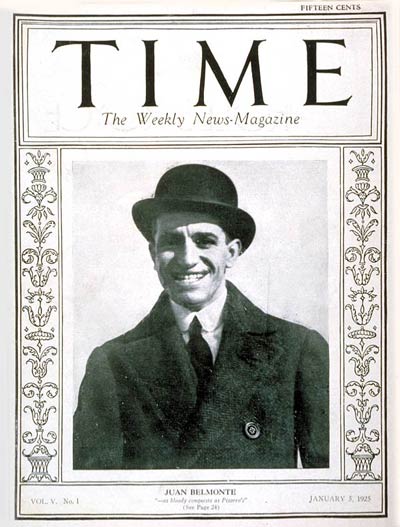
File:TimeCover19250105.jpg

Wikipedia notes:

Juan Belmonte García (April 14, 1892 – April 8, 1962) was a Spanish bullfighter, considered by many to have been the greatest matador of all time.[citation needed]

[edit] Life

Born in the Triana area of Seville, Belmonte began his bullfighting career in 1908, touring around Spain in a children’s bullfighting group called Los Niños Sevillanos. He killed his first bull on July 24, 1910. As an adult, his technique was unlike that of previous matadors; he stood erect and nearly motionless, and always stayed within inches of the bull, unlike previous matadors, who stayed far from the animal to avoid the horns. As a result of this daring technique, Belmonte was frequently gored, sustaining many serious wounds.

One such incident occurred during a November, 1927 bullfight in Barcelona, Spain. Belmonte was gored through his chest and pinned against a wall. Several other toreros rescued him. Among the spectators that day were the King and Queen of Spain and the Infanta Beatriz.[1]

Belmonte’s rivalry with Joselito (a.k.a. Gallito), another contender for the appellation “greatest matador of all time”, from 1914 to 1920 is known as the Golden Age of Bullfighting. The era was cut short when Joselito was fatally gored on May 16, 1920, at a bullfight in Talavera de la Reina, a small town not far from Madrid. Belmonte then had to carry alone the weight of the whole bullfighting establishment, which would prove too much and led to the first of his two temporary retirements.

In 1919, Belmonte fought 109 corridas, a number not matched by any matador before, until the 1965 bullfight season when Manuel Benítez Pérez (“El Cordobés“) performed in 111 corridas, surpassing Belmonte’s record. The Mexican matador Carlos Arruzafought 108 corridas in one season but it is said that he refused to pass Belmonte’s record out of respect for the maestro.

After his retirement, Belmonte published a biography. Written by Manuel Chaves Nogales and published in 1937, it was called Juan Belmonte, matador de toros: su vida y sus hazañas and was translated into English by Leslie Charteris as Juan Belmonte, Killer of Bulls. Belmonte was also close friend with author Ernest Hemingway, and he appears prominently in two of Hemingway’s books: Death in the Afternoon and The Sun Also Rises. Like Hemingway, Belmonte ultimately committed suicide by gunshot.[2]

Juan Belmonte was the single matador that changed the style of bullfighting. Born with slightly deformed legs he could not run like other boys, or jump as they could and so when he finally began his career as a matador, he firmly planted his feet on the ground never giving way. He forced the bull to go around him, whereas others until then had jumped all over the place like circus performers.

When his doctor told him that, because of his lifelong injuries and trauma, he could no longer smoke cigars, ride his horses, drink wine or perform sexual acts with women, he decided he was ready to die. He ordered his favorite horse brought to him, took a handful of cigars, two bottles of his favorite wine and rode out to his finca where he was met by two of Sevilla’s “women of the night.” He smoked his cigars and drank his wine, engaging one more time in his final passions, then took his pistol and shot himself. He had told others prior to his last day that if he could not live like a man he would at least die like one.

_______________________

Here’s a sentence I never thought I’d write again: Woody Allen has made a wonderful new picture, “Midnight in Paris,” and it’s his best, most enjoyable work in years.

If you’re surprised to be reading that, think how I feel writing it. I’ve been a tough sell on the past dozen or so Allen films, very much including the well-acted but finally wearying “Vicky Cristina Barcelona.” It seemed that everything he touched in recent years was tainted by misanthropy and sourness. Until now.

With “Midnight in Paris,” Allen has lightened up, allowed himself a treat and in the process created a gift for us and him. His new film is simple and fable-like, with a definite “when you wish upon a star” quality, but, bolstered by appealing performers like Owen Wilson, Marion Cotillard and Rachel McAdams, it is his warmest, mellowest and funniest venture in far too long.

This is also a film with an unanticipated twist, so the less you know about it the better. Try to see it immediately, before well-meaning friends tell you more than they should. “Midnight in Paris” is too charming to be ruined by anything, but this is a case where ignorance really is bliss.

Allen says he’s been enamored of Paris since he wrote and acted in “What’s New Pussycat?” in 1965. You can sense his continued passion for the city throughout the film, feel the extra pep in his step and pleasure in his heart.

Seductively shot by Darius Khondji (whatever tax credits this film got will be paid back with interest), “Midnight” opens with an extended montage of Paris’ tourist landmarks, a montage that lasts longer than necessary to simply establish location. Allen is saying: Pay attention — this is a special place, a place where magic can happen.

That’s certainly the attitude of Gil (Wilson), a successful Hollywood screenwriter who is an effusive enthusiast for the City of Light in general, and the 1920s golden age of Fitzgerald-Hemingway Paris in particular. So much so that Gil dreams of turning his back on all that studio money and writing novels on the Left Bank.

Gil’s fiancée, Inez (McAdams), doesn’t like the sound of that. She and Gil are in Paris accompanying her wealthy parents on a business trip and she doesn’t even want to think about anything that would diminish Gil’s income.

Gil’s raptures are put on hold when he and Inez bump into Inez’s friend Paul (Michael Sheen) and his wife. A professor whom Inez once had a crush on, Paul is in Paris to lecture at the Sorbonne. It’s soon clear he’s an insufferable bore so pedantic he gets into an argument with a guide at the Rodin Museum (a brief cameo for French First Lady Carla Bruni).

As much to escape Paul as anything else, Gil takes a late-night walk and just as the clock strikes midnight on the Rue Montagne St. Genevieve, something happens that throws everything in Gil’s life into disarray.

Perhaps most unsettling, but in a good way, is Gil’s meeting with the beautiful and spirited Adriana (Cotillard), an aspiring fashion designer who has a history of inspiring artists. The connection between them is immediate but the barriers to any kind of relationship are formidable.

With remarkable naturalness and considerable charisma, Cotillard is just as she should be here, as are both Wilson, one of the most likable of contemporary actors, and McAdams, who deftly handles a part that is less amiable than usual for her.

Also great fun in smaller roles are Kathy Bates and Adrien Brody as well as French stars Lea Seydoux and Gad Elmaleh.

On display as well is Allen’s sharp and satisfying script. It makes jokes about everyone from Djuna Barnes to Luis Bunuel but also takes time to ponder the role of the artist and the importance of not undervaluing the age we live in.

More than anything, obviously, “Midnight” has Paris. For one film, at least, that extraordinary city has changed Allen’s mood and altered his outlook on cinema and life. It may do the same for you.

kenneth.turan@latimes.com Other posts with Woody Allen:

The Characters referenced in Woody Allen’s “Midnight in Paris” (Part 6 Gertrude Stein)

Midnight In Paris – SPOILER Discussion by What The Flick?! Associated Press Gertrude Stein and Alice B. Toklas in 1934 This video clip below discusses Gertrude Stein’s friendship with Pablo Picasso: I love the movie “Midnight in Paris” by Woody Allen and I am going through the whole list of famous writers and artists that […]

The Characters referenced in Woody Allen’s “Midnight in Paris” (Part 5 Juan Belmonte)

2011 Roger Arpajou / Sony Pictures Classics Gad Elmaleh as Detective Tisserant in “Midnight in Paris.” I love the movie “Midnight in Paris” by Woody Allen and I am going through the whole list of famous writers and artists that he included in the movie. Juan Belmonte was the most famous bullfighter of the time […]

The Characters referenced in Woody Allen’s “Midnight in Paris” (Part 4 Ernest Heminingway)

  Woody Allen explores fantasy world with “Midnight in Paris” 2011 Roger Arpajou / Sony Pictures Classics Corey Stoll as Ernest Hemingway in “Midnight in Paris.” The New York Times Ernest Hemingway, around 1937 I love the movie “Midnight in Paris” by Woody Allen and I am going through the whole list of famous writers […]

The Characters referenced in Woody Allen’s “Midnight in Paris” (Part 3 Scott and Zelda Fitzgerald)

What The Flick?!: Midnight In Paris – Review by What The Flick?! 2011 Roger Arpajou / Sony Pictures Classics Alison Pill as Zelda Fitzgerald and Tom Hiddleston as F. Scott Fitzgerald in “Midnight in Paris.” 2011 Roger Arpajou / Sony Pictures Classics Owen Wilson as Gil in “Midnight in Paris.” 2011 Roger Arpajou / Sony […]

The Characters referenced in Woody Allen’s “Midnight in Paris” (Part 2 Cole Porter)

The song used in “Midnight in Paris” I am going through the famous characters that Woody Allen presents in his excellent movie “Midnight in Paris.” This series may be a long one since there are so many great characters. De-Lovely – Movie Trailer De-Lovely – So in Love – Kevin Kline, Ashley Judd & Others […]

The Characters referenced in Woody Allen’s “Midnight in Paris” (Part 1 William Faulkner)

Photo by Phill Mullen The only known photograph of William Faulkner (right) with his eldest brother, John, was taken in 1949. Like his brother, John Faulkner was also a writer, though their writing styles differed considerably. My grandfather, John Murphey, (born 1910) grew up in Oxford, Mississippi and knew both Johncy and “Bill” Faulkner. He […]

I love Woody Allen’s latest movie “Midnight in Paris”

I love the movie “Midnight in Paris” was so good that I will be doing a series on it. My favorite Woody Allen movie is Crimes and Misdemeanors and I will provide links to my earlier posts on that great movie. Movie Guide the Christian website had the following review: MIDNIGHT IN PARIS is the […]

  The Associated Press reported today:   The signature under the typewritten words on yellowing sheets of nearly century-old paper is unmistakable: Adolf Hitler, with the last few scribbled letters drooping downward. The date is 1919 and, decades before the Holocaust, the 30-year-old German soldier — born in Austria — penned what are believed to be […]

Solomon, Woody Allen, Coldplay and Kansas (Coldplay’s spiritual search Part 6)

Here is an article I wrote a couple of years ago: Solomon, Woody Allen, Coldplay and Kansas What does King Solomon, the movie director Woody Allen and the modern rock bands Coldplay and Kansas have in common? All four took on the issues surrounding death, the meaning of life and a possible afterlife, although they all came up with their own conclusions on […]

Insight into what Coldplay meant by “St. Peter won’t call my name” (Series on Coldplay’s spiritual search, Part 3)

Coldplay seeks to corner the market on earnest and expressive rock music that currently appeals to wide audiences Here is an article I wrote a couple of years ago about Chris Martin’s view of hell. He says he does not believe in it but for some reason he writes a song that teaches that it […]

The Characters referenced in Woody Allen’s “Midnight in Paris” (Part 4 Ernest Hemingway)

Woody Allen explores fantasy world with “Midnight in Paris”

Corey Stoll as Ernest Hemingway in "Midnight in Paris." 2011 Roger Arpajou / Sony Pictures Classics

Corey Stoll as Ernest Hemingway in “Midnight in Paris.”

The New York Times

Ernest Hemingway, around 1937

I love the movie “Midnight in Paris” by Woody Allen and I am going through the whole list of famous writers and artists that he included in the movie. By the way, I know that some of you are wondering how many posts I will have before I am finished. Right now I have plans to look at Juan Belmonte,Gertrude Stein, Gauguin, Lautrec, Geores Brague, Dali, Rodin,Coco Chanel, Modigliani, Matisse, Luis Bunuel, Josephine Baker, Van Gogh, Picasso, Man Ray, T.S. Elliot and several more.

The Hemingway-Pfeiffer Museum and Educational Center in Piggott, Arkansas includes a barn-studio associated with Ernest Hemingway and the family home of his second wife, Pauline Pfeiffer.  Pauline’s parents, Paul and Mary Pfeiffer, were prominent citizens of Northeast Arkansas and owned more than 60,000 acres of land.  During the 1930s the barn was converted to a studio to give Hemingway privacy for writing while visiting Piggott.  Portions of one of his most famous novels, A Farewell to Arms, and several short stories were written in this studio.

Both the home and the barn studio were named to the National Historic Register in 1982.  The properties have been renovated, focusing on the 1930s era.  Areas of emphasis for the museum and educational center include literature of the period, 1930s world events, agriculture and family lifestyles, family relationships and development of Northeast Arkansas during the Depression and New Deal eras.

Arkansas State University’s Hemingway-Pfeiffer Museum and Educational Center, located approximately 60 miles north of ASU’s main campus in Jonesboro, also serves as the Visitors’ Center for the northern terminus of Crowley’s Ridge Parkway,  Arkansas’s first National Scenic Byway. 

Owen Wilson and Rachel McAdams star in Woody Allen’s latest film, “Midnight in Paris,” an unusual tale of romance and comedy set in the City Of Light. CBS News’ Terrell Brown reports.

Owen Wilson as Gil and Rachel McAdams as Inez in "Midnight in Paris." 2011 Roger Arpajou / Sony Pictures Classics

Owen Wilson as Gil and Rachel McAdams as Inez in “Midnight in Paris.”

Woody Allen‘s cinematic love letter to Paris kicked off the 2011 Cannes Film Festival and is already playing on French screens. Starring Owen Wilson, Rachel McAdams, and Marion Cotillard, Midnight in Paris has received a number of positive English-language reviews. Oscar buzz, in fact, has already begun — though how far-reaching that will be remains to be seen.

Now, what have the French film critics said about it? Below are snippets from three French-language reviews:

Cinema is a dream machine. And this new movie, the least neurotic by the Annie Hall filmmaker, is alive with magic and romance. A little bit like in The Purple Rose of Cairo, Woody Allen forgets his paranoia, puts his hypochondria in the closet, and serves us a highly successful romantic comedy. The Parisian atmosphere suits him, whether it’s rainy, windy, or sunny. (Olivier Delcroix, Le Figaro.)

A meditation on creativity and the passing of time (were things better in the past?), Midnight in Paris is the film of an old gentleman still alert and lucid, one who isn’t afraid of coming up with his own autocriticism (who else better depicts the immobility of which his character seems to be a prisoner?), while paying homage to the artists that have marked him. If Midnight in Paris doesn’t always skirt the commonplace … the film shines thanks to the superior quality of its subtle dialogue and to Owen Wilson’s performance… (Christophe Narbonne, Premiere.)

… [W]hen the screen turned black at the end of the film, we asked ourselves if we enjoyed Midnight in Paris or if Woody Allen was better in the past … as far as we’re concerned, we savored the film one scene at a time the way we would enjoy a creamy mille-feuilles — one layer at a time! Delicious. (Laetitia Santos, toutlecine.com.)

https://i0.wp.com/www.awardsdaily.com/wp-content/uploads/2011/06/19.jpg

The Lost Generation A&E Biography. I DO NOT OWN THIS MATERIAL.

Other posts related to Woody Allen:

The Characters referenced in Woody Allen’s “Midnight in Paris” (Part 6 Gertrude Stein)

Midnight In Paris – SPOILER Discussion by What The Flick?! Associated Press Gertrude Stein and Alice B. Toklas in 1934 This video clip below discusses Gertrude Stein’s friendship with Pablo Picasso: I love the movie “Midnight in Paris” by Woody Allen and I am going through the whole list of famous writers and artists that […]

The Characters referenced in Woody Allen’s “Midnight in Paris” (Part 5 Juan Belmonte)

2011 Roger Arpajou / Sony Pictures Classics Gad Elmaleh as Detective Tisserant in “Midnight in Paris.” I love the movie “Midnight in Paris” by Woody Allen and I am going through the whole list of famous writers and artists that he included in the movie. Juan Belmonte was the most famous bullfighter of the time […]

The Characters referenced in Woody Allen’s “Midnight in Paris” (Part 4 Ernest Heminingway)

  Woody Allen explores fantasy world with “Midnight in Paris” 2011 Roger Arpajou / Sony Pictures Classics Corey Stoll as Ernest Hemingway in “Midnight in Paris.” The New York Times Ernest Hemingway, around 1937 I love the movie “Midnight in Paris” by Woody Allen and I am going through the whole list of famous writers […]

The Characters referenced in Woody Allen’s “Midnight in Paris” (Part 3 Scott and Zelda Fitzgerald)

What The Flick?!: Midnight In Paris – Review by What The Flick?! 2011 Roger Arpajou / Sony Pictures Classics Alison Pill as Zelda Fitzgerald and Tom Hiddleston as F. Scott Fitzgerald in “Midnight in Paris.” 2011 Roger Arpajou / Sony Pictures Classics Owen Wilson as Gil in “Midnight in Paris.” 2011 Roger Arpajou / Sony […]

The Characters referenced in Woody Allen’s “Midnight in Paris” (Part 2 Cole Porter)

The song used in “Midnight in Paris” I am going through the famous characters that Woody Allen presents in his excellent movie “Midnight in Paris.” This series may be a long one since there are so many great characters. De-Lovely – Movie Trailer De-Lovely – So in Love – Kevin Kline, Ashley Judd & Others […]

The Characters referenced in Woody Allen’s “Midnight in Paris” (Part 1 William Faulkner)

Photo by Phill Mullen The only known photograph of William Faulkner (right) with his eldest brother, John, was taken in 1949. Like his brother, John Faulkner was also a writer, though their writing styles differed considerably. My grandfather, John Murphey, (born 1910) grew up in Oxford, Mississippi and knew both Johncy and “Bill” Faulkner. He […]

I love Woody Allen’s latest movie “Midnight in Paris”

I love the movie “Midnight in Paris” was so good that I will be doing a series on it. My favorite Woody Allen movie is Crimes and Misdemeanors and I will provide links to my earlier posts on that great movie. Movie Guide the Christian website had the following review: MIDNIGHT IN PARIS is the […]

  The Associated Press reported today:   The signature under the typewritten words on yellowing sheets of nearly century-old paper is unmistakable: Adolf Hitler, with the last few scribbled letters drooping downward. The date is 1919 and, decades before the Holocaust, the 30-year-old German soldier — born in Austria — penned what are believed to be […]

Solomon, Woody Allen, Coldplay and Kansas (Coldplay’s spiritual search Part 6)

Here is an article I wrote a couple of years ago: Solomon, Woody Allen, Coldplay and Kansas What does King Solomon, the movie director Woody Allen and the modern rock bands Coldplay and Kansas have in common? All four took on the issues surrounding death, the meaning of life and a possible afterlife, although they all came up with their own conclusions on […]

Insight into what Coldplay meant by “St. Peter won’t call my name” (Series on Coldplay’s spiritual search, Part 3)

Coldplay seeks to corner the market on earnest and expressive rock music that currently appeals to wide audiences Here is an article I wrote a couple of years ago about Chris Martin’s view of hell. He says he does not believe in it but for some reason he writes a song that teaches that it […]

Advice for Gene Simmons jh13a

I watched with great interest the first episode of Gene Simmons show two days ago when his wife left him because of his repeated unfaithfulness.

Nerve editors are divided on the subject of Chelsea Handler, by which I mean that I find her kind of funny and Ben made a barfy face when I said her name. But he too chuckled at this clip, in which the vodka-loving comedienne sits bloated narcissist Gene Simmons down on her stage and then tears into him for sleeping around.

Simmons’ longtime partner, Shannon Tweed, is sitting in the audience, and probably the funniest moment of this clip involves her jumping into the conversation; I won’t spoil it. Suffice to say, you may find Chelsea Handler abrasive, but it’s nice to see someone actually get Gene Simmons to shut up.

_____________________________

Below is an excellent article that may be helpful in a time like this:

Avoiding and Ending an Affair

Meeting your spouse’s needs is one way to avoid infidelity.

by Brad Lewis, David Sanford
What can spouses do to safeguard their marriage? In his book, His Needs, Her Needs: Building an Affair-Proof Marriage, Dr. Willard Harley says that the marriages most susceptible to infidelity are those where one or both spouses fail to meet their partners’ primary needs. For wives, those needs are affection, conversation, honesty and openness, financial commitment and family commitment. Husbands’ primary needs are sexual fulfillment, recreational companionship, an attractive spouse, domestic support and admiration.

Ways to Avoid Affairs

If you’ve only reached the point of temptation, but you haven’t acted on it yet, make changes in your life so that it doesn’t go any farther. Some ideas:

  • Avoid spending time alone with people of the opposite sex. If you struggle with fantasizing about a sexual relationship with a particular person, stay away from the temptation by staying away from that person.
  • Refuse to act on (or even reveal) feelings of attraction to someone other than your spouse. Don’t share details of your marriage relationship — particularly problems — with a member of the opposite sex.
  • Avoid outside influences and environments — such as business parties and private lunches, especially where drinking is involved — that could encourage infidelity.
  • Make your spouse your top priority. Talk about problems and concerns and work through them together. Get joint counseling to help if necessary. If your spouse is angry or won’t go to counseling, go by yourself. As he or she sees changes in you, your spouse might soften.
  • Change your attitude about your marriage. See it as a commitment that can’t be broken. Love flourishes in a relationship where there is complete trust, respect, and acceptance. Have fun with your spouse. Date each other again. How would you treat that person differently if you were trying to win his or her affections for the first time?

If You’re in an Affair and Want Out

While it won’t be easy, your marriage may be able to survive an affair if you work at it.

  • Ask for forgiveness from your spouse. Keep in mind that when you confess your affair to your spouse, it might be a big relief to you, but it will be just the beginning of the heartache, pain, and distrust for him or her. It may take years of counseling and work to regain that person’s trust. While you’ll want to move on, seeking forgiveness is more than a one-time act; for your spouse to grant you forgiveness is certainly a long process. You can’t try to rush through the emotional healing process.
  • Don’t be afraid to seek help and support. Get counseling from a minister or a professional counselor who can help you work through issues of lying, betrayal, mistrust, etc.
  • Change your environment if necessary. If the affair happened at work, as hard as it is to take this step, maybe you need to find a different job. If it happened with a neighbor, maybe you need to move.

The good news is that infidelity doesn’t have to be a marriage-killer. When couples are determined to work through the pain of adultery, to end the affair, to forgive and to seek counseling, their unions can often be restored.

If Your Spouse is Having an Affair

After discovering that your spouse has been unfaithful, you’ll likely experience a torrent of conflicting emotions. Here are some important things to keep in mind as you sort through your feelings.

  • Don’t give in to the extremes of “love-hate” feelings. Don’t immediately demand a divorce. Instead, affirm your desire to do whatever it takes to rebuild a healthy, vibrant marriage.
  • Don’t give in to the extremes of “all my fault” or “all your fault” thinking. Don’t insist on knowing why your spouse has been having an affair. Instead, ask if he or she is willing to start over.
  • At this point, you need to turn to others who can help you. Don’t ask a mutual friend or relative. Instead, ask an objective party who is in a position to help. That person might be an experienced senior pastor, certified Christian counselor, or respected marriage ministry.
  • Cling to the promise that — with God’s help — even the most broken marriage can be saved.
  • Remember, nobody wakes up one day and suddenly decides to have an extramarital affair. A person has been unfaithful in heart and mind long before he or she begins an affair.
  • Be patient. It takes time to begin to rebuild trust, love and commitment.
Copyright © 2002,2004, Brad Lewis and Focus on the Family. All rights reserved. International copyright secured. Used by permission.

Ronald Wilson Reagan (Part 93)

https://i0.wp.com/www.reagan.utexas.edu/archives/photographs/large/C40615-15.jpg

President Reagan and Bob Hope performing at the Bob Hope Salute to the United Sates Air Force 40th Anniversary Celebration at the Pope Air Force Base in Fayetteville, North Carolina. 5/10/87.

the first presidential debate between Ronald Reagan and Walter Mondale in 1984

Lee Edwards of the Heritage Foundation wrote an excellent article on Ronald Reagan and the events that transpired during the Reagan administration,  and I wanted to share it with you. Here is the sixth portion:

Five principles guided the Reagan budget cuts: The growth of government should be curbed; federal benefits should be focused primarily on the poor; benefits should be contingent on an individual’s effort to leave welfare; decisions on social programs should be returned to the states and localities; and finally, programs that don’t work should be eliminated. At the heart of all these principles was a simple proposition: entitlements as the “underlying principle of American social policy” should be replaced by “benefits contingent on responsible behavior.”[xvii]

But in practice these principles were sometimes shunted aside — as in the case of the politically popular Medicare program. The “most serious policy error of the Reagan administration,” conservative analyst Ronald F. Docksai asserted, was its support for the expansion of Medicare to provide catastrophic acute care protection for the elderly. Reagan believed, correctly, that senior citizens should not be impoverished by a serious or persistent illness. But instead of seeking legislation to give private insurance companies an incentive to offer catastrophic hospital and long-term care insurance, the president was “persuaded by administration officials and Republican lawmakers” to endorse an expansion of Medicare and the federal government. Conservative congressmen who favored a private-sector approach to provide quality care and constrain federal spending were undercut by the White House and labeled “anti-elderly” by liberal Democrats.[xviii]

Reagan’s personal feelings about Social Security had not changed since his 1964 televised address for Barry Goldwater when he had suggested the introduction of “voluntary features” into the system so that “those who can make better provisions for themselves” be allowed to do so.[xix] But he had come to accept, reluctantly, that Social Security was an issue that Republicans could not touch without getting badly burned. Two months into his presidency, biographer Lou Cannon wrote, the White House was given a congressional initiative that would have sharply slowed the growth of Social Security and reduced the budget deficit. The device was a freeze or severe reduction in automatic cost-of-living allowances (COLAs), which had increased Social Security payments so much that the program now accounted for 21 percent of the total budget.

Reagan was tempted, but as he told Senator Peter Domenici of New Mexico, the author of the amendment and chairman of the Senate Budget Committee, “I made a commitment during the campaign not to cut Social Security, and … I don’t want to go back on my word.”[xx] Other senators, including John Tower and William Armstrong of Colorado, endorsed Domenici’s approach, but Reagan would not be moved. And regardless of the modest bipartisan support in the Senate, liberal House Democrats would have relished an opportunity to charge that Republicans were once again trying to reduce the size of the monthly Social Security checks on which millions of senior Americans depended.

Brantley claims Barton is wrong about darwinism pt 3

On June 9th Max Brantley on the Arkansas Times Blog referred to a Mother Jones Article that noted:

On Wednesday, Right Wing Watch flagged a recent interview Barton gave with an evangelcial talk show, in which he argues that the Founding Fathers had explicitly rejected Charles Darwin’s theory of evolution. Yes, that Darwin. The one whose seminal work, On the Origin of Species, wasn’t even published until 1859. Barton declared, “As far as the Founding Fathers were concerned, they’d already had the entire debate over creation and evolution, and you get Thomas Paine, who is the least religious Founding Father, saying you’ve got to teach Creation science in the classroom. Scientific method demands that!” Paine died in 1809, the same year Darwin was born.

Here is the third part of the series that I started a few days ago about the founding fathers’ views on the origin of man. Below is an portion of an article by David Barton, “The Founding Fathers on Creation and Evolution.” 

While uninformed laymen erroneously believe the theory of evolution to be a product of Charles Darwin in his first major work of 1859 (The Origin of Species), the historical records are exceedingly clear that the evolution-creation-intelligent design debate was largely formulated well before the birth of Christ. Numerous famous writings have appeared on the topic for almost two thousand years; in fact, our Founding Fathers were well-acquainted with these writings and therefore the principle theories and teachings of evolution – as well as the science and philosophy both for and against that thesis – well before Darwin synthesized those centuries-old teachings in his writings.

Nobel-Prize winner Bertrand Russell (1872-1970) explains: “The general idea of evolution is very old; it is already to be found in Anaximander (sixth century B.C.). . . . [and] Descartes [1596-1650], Kant [1724-1804], and Laplace [1749-1827] had advocated a gradual origin for the solar system in place of sudden creation.” 1  ( Bertrand Russell, Human Knowledge: Its Scope and Limits (New York: Simon and Schuster, 1948), pp. 33-34.)…

Significantly, then, the history of this controversy through recent years and even previous centuries makes clear that subsequent scientific discovery across the centuries has not yet significantly altered any of these four views. Therefore, it was not in the absence of knowledge about the debate over evolution but rather in its presence, that our Framers made the decision to incorporate in our governing documents the principle of a creator. One example affirming the Framers’ view on this subject is provided by Thomas Paine. Although Paine was the most openly and aggressively anti-religious of the Founders, in his 1787 “Discourse at the Society of Theophilanthropists in Paris,” Paine nevertheless forcefully denounced the French educational system which taught students that man was the result of prehistoric cosmic accidents, or had developed from some other species:

It has been the error of schools to teach astronomy, and all the other sciences and subjects of natural philosophy, as accomplishments only; whereas they should be taught theologically, or with reference to the Being who is the Author of them: for all the principles of science are of divine origin. Man cannot make, or invent, or contrive principles; he can only discover them, and he ought to look through the discovery to the Author. When we examine an extraordinary piece of machinery, an astonishing pile of architecture, a well-executed statue, or a highly-finished painting where life and action are imitated, and habit only prevents our mistaking a surface of light and shade for cubical solidity, our ideas are naturally led to think of the extensive genius and talent of the artist. When we study the elements of geometry, we think of Euclid. When we speak of gravitation, we think of Newton. How, then, is it that when we study the works of God in creation, we stop short and do not think of God? It is from the error of the schools in having taught those subjects as accomplishments only and thereby separated the study of them from the Being who is the Author of them. . . . The evil that has resulted from the error of the schools in teaching natural philosophy as an accomplishment only has been that of generating in the pupils a species of atheism. Instead of looking through the works of creation to the Creator Himself, they stop short and employ the knowledge they acquire to create doubts of His existence. They labor with studied ingenuity to ascribe everything they behold to innate properties of matter and jump over all the rest by saying that matter is eternal. And when we speak of looking through nature up to nature’s God, we speak philosophically the same rational language as when we speak of looking through human laws up to the power that ordained them. God is the power of first cause, nature is the law, and matter is the subject acted upon. But infidelity, by ascribing every phenomenon to properties of matter, conceives a system for which it cannot account and yet it pretends to demonstrate. 17

Paine certainly did not advocate this position as a result of religious beliefs or of any teaching in the Bible, for he believed that “the Bible is spurious” and “a book of lies, wickedness, and blasphemy.” 18 Yet, this anti-Bible founder was nevertheless a strong supporter of teaching the theistic origins of man. Many other Founding Fathers also held clear positions on this issue.17. Thomas Paine, Life and Writings of Thomas Paine, Daniel Edwin Wheeler, editor (New York: Printed by Vincent Parke and Company, 1908), Vol. 7, pp. 2-8, “The Existence of God,” A Discourse at the Society of Theophilanthropists, Paris. (Return)

18. Thomas Paine, Life and Writings of Thomas Paine, Daniel Edwin Wheeler, editor (New York: Vincent Parke and Company, 1908), Vol. 6, p. 132, from his “Age of Reason Part Second,” January 27, 1794.

Here are some other posts about David Barton’s word on the unconfirmed quotes that have been attributed to the Founding Father and Barton’s effort to stop the Righteous Right for using these quotes in the future:

Unconfirmed Quote attributed to Thomas Jefferson

HALT:HaltingArkansasLiberalswithTruth.com Part 6 David Barton:Were the Founding Fathers Deists? In 1988 only 25% of Christians voted but that doubled in 1994. Christians are the salt of the world. The last few days I have been  looking at this issue of unconfirmed quotes that people think that the Founding Fathers actually said and the historical evidence […]

Two Unconfirmed quotes attributed to Noah Webster

HALT:HaltingArkansasLiberalswithTruth.com Part 5 David Barton: Were the Founding Fathers Deists? First Bible printed in USA was printed by our founding fathers for use in the public schools. 20,000 Bibles. 10 commandments hanging in our courthouses. The last few days I have been  looking at this issue of unconfirmed quotes that people think that the Founding […]

Unconfirmed Quote attibuted to Patrick Henry

HALT:HaltingArkansasLiberalswithTruth.com Part 4 David Barton: Were Founding Fathers Deists? Only 5% of the original 250 founding fathers were not Christians (Ben Franklin, Thomas Jefferson, Aaron Burr, Thomas Paine, Ethan Allen, Joe Barlow, Charles Lee, Henry Dearborn, ect) In the next few weeks I will be looking at this issue of unconfirmed quotes that people think […]

Samuel Adams Unconfirmed Quote was Confirmed Eventually

HALT:HaltingArkansasLiberalswithTruth.com Part 3 David Barton: Were Founding Fathers Deists? American Bible Society filled with Founding Fathers Here is another in the series of  unconfirmed quotes that people think that the Founding Fathers actually said and the historical evidence concerning them. David Barton has collected these quotes and tried to confirm them over the last 20 […]

Unconfirmed Quote attributed to Ben Franklin

HALT:HaltingArkansasLiberalswithTruth.com Part 2 David Barton on Founding Fathers were they deists? Not James Wilson and William Samuel Johnson In the next few weeks I will be looking at this issue of unconfirmed quotes that people think that the Founding Fathers actually said and the historical evidence concerning them. David Barton has collected these quotes and […]

Unconfirmed Quote attributed to Alexis de Tocqueville

HALT: HaltingArkansasLiberalswithTruth.com Part 1 David Barton: Were the Founding Fathers Deists? Religious holidays, Court cases, punishing kids in school for praying in Jesus name In the next few weeks I will be looking at this issue of unconfirmed quotes that people think that the Founding Fathers actually said and the historical evidence concerning them. David […]

By Everette Hatcher III | Also posted in David Barton | Edit | Comments (0)

Supreme Court never said It.

Halting Arkansas Liberals with Truth David Barton goes through American History and looks at some of the obscure names in our history and how prayer and Bible Study affected some of our founding fathers In the next few weeks I will be looking at this issue of unconfirmed quotes that people think that the Founding […]

By Everette Hatcher III | Also posted in David Barton | Edit | Comments (0)

Lots of Fake Quotes of Founding Fathers in Circulation

HALT: Halting Arkansas Liberals with Truth   ___ I wanted to thank Gene Lyons for bringing this issue of fake quotes of the Founding Fathers to our attention because it should be addressed. In April 8, 2010 article “Facts Drowning in Disinformation,” he rightly notes that Thomas Jefferson never said, “The democracy will cease to [

The Characters referenced in Woody Allen’s “Midnight in Paris” (Part 3 Scott and Zelda Fitzgerald)

What The Flick?!: Midnight In Paris – Review by What The Flick?!

Alison Pill as Zelda Fitzgerald and Tom Hiddleston as F. Scott Fitzgerald in "Midnight in Paris." 2011 Roger Arpajou / Sony Pictures Classics

Alison Pill as Zelda Fitzgerald and Tom Hiddleston as F. Scott Fitzgerald in “Midnight in Paris.”

Owen Wilson as Gil in "Midnight in Paris." 2011 Roger Arpajou / Sony Pictures Classics

Owen Wilson as Gil in “Midnight in Paris.”

Marion Cotillard, Alison Pill, Owen Wilson and Director Woody Allen on the set of "Midnight in Paris." 2011 Roger Arpajou / Sony Pictures Classics

Marion Cotillard, Alison Pill, Owen Wilson and Director Woody Allen on the set of “Midnight in Paris.”

Associated Press

F. Scott Fitzgerald, center, with his daughter Scottie, left and his wife Zelda in Paris in 1925

Woody Allen has a great movie with his latest effort. “Midnight in Paris” goes back to the 1920’s and visits lots of great writers and artists. I am going to do a series of posts looking at some of these characters. By the way, I know that some of you are wondering how many posts I will have before I am finished. Right now I have plans to look at Heminingway, Juan Belmonte,Gertrude Stein, Gauguin, Lautrec, Geores Brague, Dali, Rodin,Coco Chanel, Modigliani, Matisse, Luis Bunuel, Josephine Baker, Van Gogh, Picasso, Man Ray, T.S. Elliot and several more. Scott and Zelda Fitzgerald are featured below.

Fitzgerald’s own tempestuous relationship with his wife Zelda would be reflected in his many short stories and novels, first serialised in such literary journals as Scribner’s and the Saturday Evening Post. Their lives are a classic study of the American Dream in all its highs, lows, excesses, and joys. Highly lauded as a writer, Fitzgerald was often mired in debt because of his and Zelda’s lavish lifestyle, living beyond their means. The Great Gatsby and Fitzgerald’s characters Daisy and Tom Buchanan, Myrtle, Jay Gatsby, and Nick Carraway epitomise the Jazz Age but is has also remained timeless in its examination of man’s obsessions with and need for money, power, knowledge, and hope.

Francis Scott Key Fitzgerald (named after Francis Scott Key, author of the United States’ national anthem “The Star Spangled Banner”) was born into an upper-middle class family on 24 September 1896 in St. Paul, Minnesota. He was the only son of Edward Fitzgerald (1853-1931) and Mary ‘Mollie’ McQuillan (1860-1936), but had one sister, Annabel, born in 1901. In 1898 the Fitzgeralds moved to Buffalo, New York where Edward obtained a job as salesman with Proctor and Gamble after his furniture-making company foundered. It was the first move of many that Francis would make during his lifetime. When Edward lost his job in 1908 they were back in St. Paul.

That same year, young Francis was enrolled in the St. Paul Academy. Early on he showed a love of the theatre and writing–his first work to appear in print was a detective story The Mystery of the Raymond Mortgage (1909) in the Academy’s student paper Now and Then. He next attended The Newman School, a Catholic prep school in Hackensack, New Jersey. It was there that he met mentor, friend and Monsignor Darcy’s real-life model, Father Cyril Webster Sigourney Fay (1875-1919). In 1913 he entered Princeton University and his love of theatre came to the fore–he wrote many scripts for the Princeton Triangle Club’s musicals including Fie! Fie! Fi-Fi! (1914). He also had stories printed in The Princeton Tiger and the Nassau Literary Magazine. Fitzgerald met many lifelong friends at Princeton including John Peale Bishop and Edmund Wilson. His amateur play titles include The Girl From Lazy J (1911), Coward (1913), and Assorted Spirits (1914).

In 1917 Fitzgerald left Princeton to join the army. While in Montgomery, Alabama in 1918 he met Zelda Sayre (1900-1948). A year later they were engaged, but Zelda broke it off a few months later. After his discharge from the army in 1919, Fitzgerald moved to New York City. While working in advertising, he also found time to develop his first novel The Romantic Egoist. It was rejected by Charles Scribner but after three revisions they published it to great success as This Side Of Paradise (1920). Examining the morality of, and trials and tribulations of, early twentieth century youth, Fitzgerald’s voice spoke to many of his contemporaries. He gained much esteem from fellow authors including Ring Lardner and Ernest Hemingway, although years later Hemingway would viciously criticise him.

Fitzgerald now finally got a taste of his own paradise; he and Zelda married on 3 April 1920 at St Patrick’s Cathedral in New York City. Their daughter Frances Scott ‘Scottie’ was born in 1922. The Fitzgeralds honeymooned at the Biltmore Hotel but were asked to leave because of what would become a pattern, their notoriously raucous parties. They settled at a home in Westport, Connecticut and continued the lifestyle of the rich and famous, constantly entertaining. Zelda was flirtatious, Fitzgerald was jealous, and it was the beginning of a turbulent life together. While he continued to write short stories for magazines, his next major published work was a collection of short stories, Flappers and Philosophers (1920). Zelda embraced the flapper lifestyle dressing provocatively and smoking cigarettes, and she and her husband enjoyed the free-thinking, hedonistic pursuits of the roaring twenties when the post-war American economy was booming. Although it was a time of prohibition, there was no deficit of alcohol in the Fitzgerald household.

Tales of the Jazz Age (1922), Fitzgerald’s second collection of shorts contains one of his most famous short stories “The Diamond As Big As the Ritz”. His second novel, also adapted to the screen, was published the same year, The Beautiful and The Damned (1922);

“I love it,” she said frankly. It was impossible to doubt her. …. At her happiness, a gorgeous sentiment welled into his eyes, choked him up, set his nerves a-tingle, and filled his throat with husky and vibrant emotion. There was a hush upon the room. The careless violins and saxophones, the shrill rasping complaint of a child near by, the voice of the violet-hatted girl at the next table, all moved slowly out, receded, and fell away like shadowy reflections on the shining floor–and they two, it seemed to him, were alone and infinitely remote, quiet. Surely the freshness of her cheeks was a gossamer projection from a land of delicate and undiscovered shades; her hand gleaming on the stained table-cloth was a shell from some far and wildly virginal sea….–Ch. 2

Like Armory Blaine in This Side Of Paradise, Anthony Patch and Gloria Gilbert, like many of his stories to come, reflect autobiographical elements to Fitzgerald and Zelda’s life. Zelda herself wrote; many of her stories and reviews, some of them of her husband’s works were published in the same magazines as Fitzgerald’s. Titles include her short story “The Original Follies Girl” (1929), Scandalabra (play, 1933), and her only novel Save Me the Waltz (1932). Zelda was also a talented painter.

After the immense success of The Great Gatsby, Fitzgerald’s All the Sad Young Men (1926) prophetically harkened things to come. While his short stories and another collection Taps at Reveille (1934) continued to appear in magazines, and he started “The Crack Up” essays for Esquire magazine, it was not until 1934 that Fitzgerald published his next book Tender is the Night. Zelda was profoundly upset to discover that Nicole Diver was modeled after her, but the late 1920’s and early 1930’s provided much fodder for the novel. In 1927 the Fitzgeralds rented the 27 bedroom mansion Ellerslie, near Wilmington, Delaware and drunken parties ensued. Fitzgerald was increasingly turning to alcohol, sometimes becoming abusive. Zelda often acted out impetuously, embarrassing herself in front of friends and strangers. She became fixated on her old love, ballet, often practicing to the point of physical and emotional collapse. For the next three years the couple travelled back and forth between New York, Montgomery, and Baltimore. They also travelled to and stayed in Europe for months at a time, sometimes with fellow Americans in Paris, the Riviera, Cannes, St. Raphaël, Capri, Antibes, and Rome. In 1930 they were in North Africa, the same year Zelda had a nervous breakdown. For the next few years she was in and out of clinics in Switzerland.

Fitzgerald continued to use his wife’s mental breakdowns and their overall dysfunctional relationship in his writings including “The Last of the Belles” (1929), “Babylon Revisited” (1930), “Emotional Bankruptcy” (1931), “Crazy Sunday” (1932), and “Trouble” (1937). Back in America in 1931, Fitzgerald went to California to work on scripts for the Metro Goldwyn Meyer film company. “Red-Headed Woman”, “A Yank at Oxford”, “Marie Antoinette”, and “Three Comrades” are among the scripts he worked on. He moved there in 1938, having fallen in love with writer and movie critic Sheilah Graham. While his contract with MGM was not renewed, a number of other film companies hired him to do freelance work. But Fitzgerald’s alcoholism continually interfered with his life and work, requiring hospitalisation at times.

Still struggling with her illness, Zelda moved back to America and went to live with her mother in Montgomery in 1940. The same year, Fitzgerald had a heart attack; a month later, on 21 December 1940 he died of a second heart attack at Sheilah Graham’s apartment in Hollywood, California. He now rests in Rockville Union Cemetery in Rockville, Maryland, with Zelda by his side. She survived him by eight years, until she died in a fire at the Highland Hospital in Asheville, North Carolina. In 1975 they were re-interred in Scott’s family plot at St. Mary’s Catholic Church Cemetery, Rockville, Maryland, where their daughter Scottie was buried in 1986.

Alison Pill as Zelda Fitzgerald and Owen Wilson as Gil in "Midnight in Paris." 2011 Roger Arpajou / Sony Pictures Classics

Alison Pill as Zelda Fitzgerald and Owen Wilson as Gil in “Midnight in Paris.”

Other posts related to Woody Allen:

The Characters referenced in Woody Allen’s “Midnight in Paris” (Part 6 Gertrude Stein)

Midnight In Paris – SPOILER Discussion by What The Flick?! Associated Press Gertrude Stein and Alice B. Toklas in 1934 This video clip below discusses Gertrude Stein’s friendship with Pablo Picasso: I love the movie “Midnight in Paris” by Woody Allen and I am going through the whole list of famous writers and artists that […]

The Characters referenced in Woody Allen’s “Midnight in Paris” (Part 5 Juan Belmonte)

2011 Roger Arpajou / Sony Pictures Classics Gad Elmaleh as Detective Tisserant in “Midnight in Paris.” I love the movie “Midnight in Paris” by Woody Allen and I am going through the whole list of famous writers and artists that he included in the movie. Juan Belmonte was the most famous bullfighter of the time […]

The Characters referenced in Woody Allen’s “Midnight in Paris” (Part 4 Ernest Heminingway)

  Woody Allen explores fantasy world with “Midnight in Paris” 2011 Roger Arpajou / Sony Pictures Classics Corey Stoll as Ernest Hemingway in “Midnight in Paris.” The New York Times Ernest Hemingway, around 1937 I love the movie “Midnight in Paris” by Woody Allen and I am going through the whole list of famous writers […]

The Characters referenced in Woody Allen’s “Midnight in Paris” (Part 3 Scott and Zelda Fitzgerald)

What The Flick?!: Midnight In Paris – Review by What The Flick?! 2011 Roger Arpajou / Sony Pictures Classics Alison Pill as Zelda Fitzgerald and Tom Hiddleston as F. Scott Fitzgerald in “Midnight in Paris.” 2011 Roger Arpajou / Sony Pictures Classics Owen Wilson as Gil in “Midnight in Paris.” 2011 Roger Arpajou / Sony […]

The Characters referenced in Woody Allen’s “Midnight in Paris” (Part 2 Cole Porter)

The song used in “Midnight in Paris” I am going through the famous characters that Woody Allen presents in his excellent movie “Midnight in Paris.” This series may be a long one since there are so many great characters. De-Lovely – Movie Trailer De-Lovely – So in Love – Kevin Kline, Ashley Judd & Others […]

The Characters referenced in Woody Allen’s “Midnight in Paris” (Part 1 William Faulkner)

Photo by Phill Mullen The only known photograph of William Faulkner (right) with his eldest brother, John, was taken in 1949. Like his brother, John Faulkner was also a writer, though their writing styles differed considerably. My grandfather, John Murphey, (born 1910) grew up in Oxford, Mississippi and knew both Johncy and “Bill” Faulkner. He […]

I love Woody Allen’s latest movie “Midnight in Paris”

I love the movie “Midnight in Paris” was so good that I will be doing a series on it. My favorite Woody Allen movie is Crimes and Misdemeanors and I will provide links to my earlier posts on that great movie. Movie Guide the Christian website had the following review: MIDNIGHT IN PARIS is the […]

  The Associated Press reported today:   The signature under the typewritten words on yellowing sheets of nearly century-old paper is unmistakable: Adolf Hitler, with the last few scribbled letters drooping downward. The date is 1919 and, decades before the Holocaust, the 30-year-old German soldier — born in Austria — penned what are believed to be […]

Solomon, Woody Allen, Coldplay and Kansas (Coldplay’s spiritual search Part 6)

Here is an article I wrote a couple of years ago: Solomon, Woody Allen, Coldplay and Kansas What does King Solomon, the movie director Woody Allen and the modern rock bands Coldplay and Kansas have in common? All four took on the issues surrounding death, the meaning of life and a possible afterlife, although they all came up with their own conclusions on […]

Insight into what Coldplay meant by “St. Peter won’t call my name” (Series on Coldplay’s spiritual search, Part 3)

Coldplay seeks to corner the market on earnest and expressive rock music that currently appeals to wide audiences Here is an article I wrote a couple of years ago about Chris Martin’s view of hell. He says he does not believe in it but for some reason he writes a song that teaches that it […]

Transcript and video of Republican Debate June 13, 2011 New Hampshire (Part 5)

From left, former Pennsylvania Sen. Rick Santorum, Rep. Michele Bachmann, R-Minn., former House Speaker Newt Gingrich, former Massachusetts Gov. Mitt Romney, Rep. Ron Paul, R-Texas, former Minnesota Gov. Tim Pawlenty and businessman Herman Cain stand on stage before first New Hampshire Republican presidential debate at St. Anselm College in Manchester, N.H., Monday, June 13, 2011. (AP Photo/Jim Cole)


Republican Presidential Debate In New Hampshire pt.5

KING: Welcome back to our Republican debate here in the first- in-the-nation primary state of New Hampshire. Seven candidates up on stage as they try to impress the voters of New Hampshire and the voters of the country tonight. We’ve become, we are told, a trending topic on Twitter.

Ladies and gentlemen, I want you to look up there just a bit, and we’ll get to some of these questions, because they’re good questions, privatization there, improving relationships with the Middle East, what industries do you think can reinvent America. All good suggestions from concerned citizens across the country watching this debate unfold.

Before we go and out of every break, we’re doing an exercise called “This or That” to learn more about our candidates. The speaker had no hesitation at all: “American Idol” over “Dancing with the Stars.

Congressman Paul, BlackBerry or iPhone?

PAUL: BlackBerry. KING: BlackBerry it is.

All right. We’re going to continue our conversation now. We want to bring up a very important issue I know all of you will want to weigh in on, and that is the debate about entitlements — Mr. Cain mentioned those — and specifically — specifically Medicare. Right now, I want to go down to our audience. We’ve got Josh McElveen with a question.

MCELVEEN: Thanks very much, John. And I have Dr. Paul Collins who — you’ve been running a family practice in Manchester for how long?

QUESTION: Twenty-seven years.

MCELVEEN: Nice work. So not surprising your question is related to health care. What’s your question, sir?

QUESTION: Yes, sir. As a member of the Baby Boomer generation, I’ve been contributing to Medicare through payroll taxes for over 30 years. How do you propose to keep Medicare financially solvent for the next 50 years and beyond?

KING: Let’s start with Dr. Paul on this one.

PAUL: Well, under these conditions, it’s not solvent and won’t be solvent. You know, if you’re — if you’re an average couple and you paid your entire amount into — into Medicare, you would have put $140,000 into it. And in your lifetime, you will take out more than three times that much.

So a little bit of arithmetic tells you it’s not solvent, so we’re up against the wall on that, so it can’t be made solvent. It has to change. We have to have more competition in medicine.

And I would think that if we don’t want to cut any of the medical benefits for children or the elderly, because we have drawn so many in and got them so dependent on the government, if you want to work a transition, you have to cut a lot of money.

And that’s why I argue the case that this money ought to be cut out of foreign welfare, and foreign militarism, and corporate welfare, and the military industrial complex. Then we might have enough money to tide people over.

But some revamping has to occur. What we need is competition. We need to get a chance for the people to opt out of the system. Just — you talk about opting out of Obamacare? Why can’t we opt out of the whole system and take care of ourselves?

(APPLAUSE)

KING: All right, let’s — let’s continue the conversation. Governor Pawlenty, Congressman Paul says opt out. Congressman Ryan says squeeze a lot of savings across the federal budget, including a lot out of Medicare to turn it into a — he doesn’t like this word — but it turns essentially into a voucher program. Instead of having the federal program, the government would give you some money and you’d go out in the marketplace and shop for it. Is that the right way to do it?

PAWLENTY: Let me first address the doctor. Doctor, you said in your question that you’ve paid in your whole life, and we respect that. People have made plans, particularly people who are on the program now or close to eligibility. We should keep our word to people that we’ve made promises to.

So under my proposal, if you’re on the program or near the program, we’ll keep our word. But we also have to recognize what Congressman Paul just said. There was a recent report out that the premiums for Medicare and the payroll withholdings are only paying about half the program. So it is not financially solvent. We have to fix it; we have to reform it.

I’m going to have my own plan, John, that will feature some differences from Congressman Ryan’s plan. It will feature performance pay rather than just volume pay to hospitals and clinics and providers. It will allow Medicare to continue as an option, but it’ll be priced against various other options that we’re going to offer people, as well, and some other things.

And I also said, if it was a choice between Barack Obama’s plan and doing nothing (ph), we have a president of the United States got one of the worst crises financially in the history of the country, and you can’t find him on these issues. He’s missing. I’ll lead on this issue.

KING: All right, Governor.

Mr. Speaker, I want to bring you into this conversation, because I’m looking down — I want to get the words just right — your initial reaction to the Ryan plan? It’s radical right-wing social engineering. Then you backtracked. Why?

GINGRICH: Well, first of all, it was a very narrow question, which said, should Republicans impose an unpopular bill on the American people? Now, I supported the Ryan budget as a general proposal. I actually wrote a newsletter supporting the Ryan budget. And those words were taken totally out of context.

I’m happy to repeat them. If you’re dealing with something as big as Medicare and you can’t have a conversation with the country where the country thinks what you’re doing is the right thing, you better slow down.

Remember, we all got mad at Obama because he ran over us when we said don’t do it. Well, the Republicans ought to follow the same ground rule. If you can’t convince the American people it’s a good idea, maybe it’s not a good idea. So let me start there.

Second, there are certain things I would do different than Paul Ryan on Medicare. I agree strongly with him on Medicaid, and I think it could be done. But let me just say two quick things. KING: Quickly.

GINGRICH: Congressman Tom Price has a very good bill in that would allow private contracting so those people who want to voluntarily could contract with their doctor or their hospital in addition to Medicare, and it would be outside the current system and it would relieve the pricing pressure on the current system. We did a study called “Stop Paying the Crooks.” We think you can save $70 billion to $120 billion in Medicare and Medicaid annually by not paying crooks…

KING: All right. We have to — we have to save time.

GINGRICH: … two examples.

KING: We have to save time. Let me start with the senator first. Should the Republicans slow down?

SANTORUM: No. We have a $1.4 trillion deficit, and it isn’t getting any better anytime soon. We have to deal with this problem now. And what Paul Ryan has suggested, which I wholeheartedly support, is to use a program that is identical to what seniors already have. It’s called Medicare Part D.

They have a program right now which seniors like. It is a program that’s called a premium support program. We give seniors — depending on income — a certain amount of money so they can go out and they can purchase health care that they want that helps them — and this is the key, John — we need to include seniors in controlling costs.

What President Obama — let me finish, please — what President Obama has done is he put in, in the Obamacare bill, the Independent Payment Advisory Board. Ladies and gentlemen, seniors, Medicare is going to be cut, starting in 2014, by the federal government, and it’s going to be rationing of care from the top down.

What Paul Ryan and Rick Santorum want to do, which is not radical, which is take a program, Medicare prescription drugs, that is 41 percent under budget, because seniors are involved in controlling costs, and apply it all to Medicare. It is the right approach for Medicare.

KING: The speaker’s point — the speaker’s point, Mr. Cain, was that if you’ve lost the American people, if they’re not following you, you have to slow down until you can get them with you. Is that a fair point?

CAIN: We don’t need to slow down. I hate to tell you — I hate to be the one to give you the bad news, Doctor. You’re not going to get most of the money you put into Medicare if we don’t restructure it.

The reason we’re in the situation we are today with Medicare and Social Security is because the problem hasn’t been solved. We can no longer rearrange it. We’ve got to restructure those programs. And the Paul Ryan approach I totally support.

And he has been very courageous in taking the lead on this.

And you know that commercial where they have demagogued the whole thing with medi-scare and having grandma tossed off the bridge? If we don’t fix this problem, it’s going to be our grandkids in that wheelchair that they were going to be throwing off the bridge. We have got to fix the problem.

KING: Let’s continue the conversation on entitlements. I know Congresswoman Bachmann wants to get in and others want to get in.

Let’s get on John Distaso on the floor.

DISTASO: Thank you, John.

Mr. Cain, back to you. And while you’re fired up there, let’s turn to Social Security. Can you be specific regarding ages and income levels? Everyone talks about reform. What is your specific Social Security reform plan in regards to raising the retirement age, at what ages, cutting benefits and what income level means testing kicking in?

Thank you.

CAIN: Let’s fix the problem and that is to restructure Social Security. I support a personal retirement account option in order to phase out the current system. We know that this works. It worked in the small country of Chile when they did it 30 years.

That payroll tax had gotten up to 27 percent for every dollar that the worker made. I believe we can do the same thing. That break point would approximately 40 years of age.

Now, young people realize they still got to contribute to the current system for those people that are on Social Security, that are near Social Security.

DISTASO: Are you going to raise the retirement age as president of the United States?

CAIN: I don’t have to raise the retirement age, because that by itself isn’t going to solve the problem. If Congress decides to do that, that’s a different matter.

Here’s — let me give you one another example where this approach has worked. The city of Galveston, they opted out of the Social Security system way back in the ’70s. And now, they retire with a whole lot more money. Why? For a real simple reason — they have an account with their money on it.

What I’m simply saying is we’ve got to restructure the program using a personal retirement account option in order to eventually make it solvent.

KING: All right. We’re going to keep the conversation move. I know people want to weigh in. You’ll get a chance to weigh in.

Let’s move now. Jennifer Vaughn is on the floor with a question.

VAUGHN: John, thank you very much.

Governor Romney, I’d like to ask this to you first, please.

The Treasury Department says the United States will hit its credit limit on August the 2nd. Do you believe we will ultimately have to raise the debt ceiling?

ROMNEY: I believe we will not raise the debt ceiling unless the president finally, finally is willing to be a leader on issues that the American people care about. And the number one issue that relates to that debt ceiling is whether the government is going to keep on spending money they don’t have.

And the American people and Congress and every person elected in Washington has to understand we want to see a president finally lay out plans for reining in the excesses of government.

You’ve heard on here a whole series of ideas about entitlements. And that’s about 60 percent of federal spends. That’s a big piece. That’s a big chunk. Ideas from all these people up here.

Where are the president’s ideas?

Each person has different ideas here. We can try them and try different ideas in different states and different programs at the federal level.

But why isn’t the president leading? He isn’t leading on balancing our budget and he’s not leading on jobs. He’s failed the American people both in job creation and the scale the government.

VAUGHN: Governor —

ROMNEY: And that’s why he’s not going to be reelected.

VAUGHN: Governor, what happens if you don’t raise it? What happens then? Is it OK not to?

ROMNEY: Well, what happens if we continue to spend time and time again, year and year again more money than we take in?

What we say to America is: at some point, you hit a wall. At some point, people around the world say, “I’m not going to keep loaning money to America to pay these massive deficits pay for them because America can’t pay them back and the dollar is not worth anything anymore.” In that circumstance, we saddled our future — the future of our kids in a way that is just unacceptable.

And so, you’re going to see Republicans stand up and say, “Mr. President, lay down plans to balance this budget.” If he does so, if we gets Democrats to come at that time table and honestly deal with the challenges we have, with the entitlement challenges, with the spending and discretionary accounts, with our jobs issues, and finally say you know what? We really can’t afford another trillion dollars of Obamacare.

KING: OK.

ROMNEY: If he’ll be honest about these things, then I think you’ll see the kind of progress you’d hope to see.

KING: Congresswoman Bachmann, you’ll get a vote on this issue. What Governor Romney outlined is the goal of Republicans, who’s got a big deal to balance the budget. If you can’t get that on the short term and this date approaches, those negotiations are continuing, what is your price tag — what is your price tag in at least a first wave of cuts? And if you don’t get it, would you say to the House Republicans, “No, let the government go into default, that’s where we need to stand”?

BACHMANN: I’ve already voted no on raising the debt ceiling in the past. And unless there are serious cuts, I can’t.

But I want — I want to speak to someone that’s far more eloquent than I. Someone who said just dealing with the issue of raising the debt ceiling is a failure of leadership. That person was then Senator Barack Obama. He refused to raise the debt ceiling because he said President Bush had failed in leadership.

Clearly, President Obama has failed in leadership. Under his watch, in two and a half years, we’ve increased the federal debt 35 percent just in that amount of time.

So, what we need to do both, from the Congress and president, he needs to direct his treasury secretary: pay the interest on the debt first, then we won’t have a failure of our full faith and credit from their prioritized spending. We have to have serious spending cuts.

KING: OK. Appreciate that again. I want to ask the candidates a little shorter on those answers so we can keep the voters involved.

Let’s go down to Josh on the floor.

MCELVEEN: Thank you, John.

And I’m joined by Mr. Jerry Kitty (ph) who runs a juvenile institution out of Massachusetts.

And I’m told that has nothing to do with your question.

UNIDENTIFIED MALE: Correct.

I’m just wondering what your definition of the separation of church and state is and how it will affect your decision-making.

KING: Governor Pawlenty, I want you to take that one first.

PAWLENTY: Well, the protections between the separation of church and state were designed to protect people of faith from government, not government from people of faith. This is a country that in our founding documents says we’re a nation that’s founded under God, and the privileges and blessings at that we have are from our creator. They’re not from our member of Congress. They’re not from our county commissioner.

And 39 of the 50 states have in the very early phrases of their constitutions language like Minnesota has in its preamble. It says this, “We the people of Minnesota, grateful to God for our civil and religious liberties,” and so the Founding Fathers understood that the blessings that we have as a nation come from our creator and we should stop and say thanks and express gratitude for that. I embrace that.

Senator Pryor asks for Spending Cut Suggestions! Here are a few!(Part 63)

Senator Mark Pryor wants our ideas on how to cut federal spending. Take a look at this video clip below:

Senator Pryor has asked us to send our ideas to him at cutspending@pryor.senate.gov and I have done so in the past and will continue to do so in the future.

On May 11, 2011,  I emailed to this above address and I got this email back from Senator Pryor’s office:

Please note, this is not a monitored email account. Due to the sheer volume of correspondence I receive, I ask that constituents please contact me via my website with any responses or additional concerns. If you would like a specific reply to your message, please visit http://pryor.senate.gov/contact. This system ensures that I will continue to keep Arkansas First by allowing me to better organize the thousands of emails I get from Arkansans each week and ensuring that I have all the information I need to respond to your particular communication in timely manner.  I appreciate you writing. I always welcome your input and suggestions. Please do not hesitate to contact me on any issue of concern to you in the future.

Therefore, I went to the website and sent this email below:

Here are a few more I just emailed to him myself.

Senator Rand Paul on Feb 7, 2011 wrote the article “A Modest $500 Billion Proposal: My spending cuts would keep 85% of government funding and not touch Social Security,” Wall Street Journal and he observed:

Here are some of his specific suggestions:

Sell Unused Federal Assets: Saves $19 billion
Currently, the government owns or leases 3.87 billion square feet of property. In addition to the property, the federal
government owns or leases 55.7 million acres of land. For every 40 acres of land in the United States, 1 acre is
owned by the government. Citizens Against Government Waste estimates these holdings to be worth $1.2 trillion.
Of that property the Office of Management and Budget (OMB) claims more than 21,800 federal properties are
abandoned assets, which could be sold for approximately $19 billion.

Transcript and video of Republican Debate June 13, 2011 New Hampshire (Part 4)

Republican Presidential Debate In New Hampshire pt.4

Rep. Ron Paul, R-Texas gestures as he answers a question as former Massachusetts Gov. Mitt Romney, left, and former Minnesota Gov. Tim Pawlenty, listen during the first New Hampshire Republican presidential debate at St. Anselm College in Manchester, N.H., Monday, June 13, 2011. (AP Photo/Jim Cole)

KING: Welcome back to our Republican debate at Saint Anselm College in Manchester, New Hampshire.

One of the things we are very eager to do throughout the campaign is to involve you at home and to use technology and innovation. So if you have a smartphone, look at your screen right now.

If you’ve used it before, you’ll know. You’ll see an electronic code on your screen. You can snap a picture of that code, you’ll get some exclusive access about the debate. Some behind-the-scenes video, some analysis and content. We’ll do this throughout the debate and we’ll do it throughout the campaign.

Now we’re going to get back to questioning our seven Republican candidates for president.

Right before the break we did this thing called “This or That.” Just to learn a little bit about the personality of the candidates.

Senator Santorum doesn’t stay up very late. He’s a parent. I understand that. He said if he had to he would pick Leno over Conan.

Congresswoman Bachmann, to you, Elvis or Johnny Cash?

BACHMANN: That’s really tough. That’s really — both, both.

KING: Both?

BACHMANN: Yes.

KING: Both.

BACHMANN: I’ve “Christmas with Elvis” on my iPod.

(LAUGHTER)

KING: All right. Now we know what’s on the congresswoman’s iPod.

Let’s get to John Distaso of the “Union Leader.” He’s down here in the audience and he has a question.

JOHN DISTASO, NEW HAMPSHIRE UNION LEADER SR. POLITICAL REPORTER: Thank you, John.

To federal — Congressman Paul, this is for you. The federal government now assists many industries, green jobs, the auto industry, research and development, all get subsidies. Given the current state of the economy, what standards do you have, if any, for government assistance to private enterprise?

PAUL: There shouldn’t be any government assistance to private enterprise. It’s not morally correct, it’s legal, it’s bad economics. It’s not part of the constitution. If you allow an economy to thrive, they’ll decide how R&D works or where they invest their monies.

But when the politicians get in and direct things, you get the malinvestment. They do the dumb things. They might build too many houses. And they might not direct their research to the right places. So no, it’s a fallacy to think that government and politicians and bureaucrats are smart enough to manage the economy, so it shouldn’t happen.

KING: All right. These are the Republicans, the conservative candidates. Every time you applaud, I know you’re happy with the answer. You take your time away, though.

We would expect to get an answer of less government is better. One of the questions we want to explore tonight is when — when do you reach that extraordinary moment where the government might want to do something.

Mr. Cain, I want to ask you because you’re a businessman who initially at least supported the TARP program. The former senator Judd Gregg of this great state of New Hampshire was one of the architects of that program during the late hours of the Bush administration. Then you said, quote, “We needed to do something drastic because we were facing a very drastic situation.”

CAIN: I studied the financial meltdown and concluded on my own that we needed to do something drastic, yes. When the concept of TARP was first presented to the public, I was willing to go along with it. But then when the administration started to implement it on a discretionary basis, picking winners and losers and also directing funds to General Motors and others that had nothing to do with the financial system, that’s where I totally disagreed.

We should — the government should not be selecting winners and losers, and I don’t believe in this concept of too big to fail. If they fail, the free market will figure out who’s going to pick the up the pieces.

KING: Well, let’s stay on this topic. Let’s bring Tom Fahey back into the conversation. He has a question — Tom.

FAHEY: Yes, thank you, John. I wanted to ask Governor Romney about the auto industry. General Motors and Chrysler have rebounded since the Obama administration bailed them up. Bankruptcy is no longer a threat.

Would you say the bailout program was a success?

ROMNEY: The bailout program was not a success because the bailout program wasted a lot of money. About $17 billion was used unnecessarily.

When the CEOs of the auto companies went to Washington asking for money from Washington, I wrote an op-ed, and I said, look, the right process for these companies is not a bailout, not a big check from Washington, but instead letting these enterprises go through bankruptcy, re-emerge, getting rid of the unnecessary costs that they had, the excessive debt, re-emerge, and that would be the preferred way for them to be able to get on their feet again.

Instead, the Bush administration and the Obama administration wrote checks to the auto industry. Ultimately, they went through the very bankruptcy process that I suggested from the beginning.

But the big difference was $17 billion was wasted. And then President Obama, given that money, was able to put his hands on the scales of justice and give the company to the UAW.

There is a perception in this country that government knows better than the private sector, that Washington and President Obama have a better view for how an industry ought to be run. Well, they’re wrong. The right way for America to create jobs is to — is to keep government in its place and to allow the private sector and the — and the energy and passion of the American people create a brighter future for our kids and for ourselves.

KING: Let me read you, Governor, just a little bit of an op-ed piece you wrote back in November 2008.

(APPLAUSE)

“If General Motors, Ford and Chrysler get the bailout, you can kiss the American automotive industry goodbye.” From a profit standpoint, they’re doing pretty well right now. On that point, “kiss goodbye,” I understand you disagree with the policy. Kiss the industry goodbye, were you wrong?

ROMNEY: No, I wasn’t wrong, because if you read the rest of the op-ed piece, it says what they need to do is go through a bankruptcy process to shed unnecessary costs. If they just get paid checks after checks from the federal government, they’re going to be locked in with high UAW costs, legacy costs. They’ll never be able to get on their feet. They have to go through bankruptcy.

And it turned out that that’s finally what they did. And the head of the UAW, he wrote an op-ed piece saying, Romney’s wrong, the government has to step in and give them a check.

That’s the wrong way to go. Use the process of law. Use the process of American ingenuity. Don’t have government try and guide this economy.

KING: Anyone — is there anyone here who, given that prospect, and President Bush started the program, given that prospect, anyone here who would have stepped in and said, “I don’t want to do this, but this is the backbone of American manufacturing, I’ll do something”?

SANTORUM: No, absolutely not. We should — we should not have had a TARP. We should not have had the auto bailout. Governor Romney’s right. They could have gone through a structured bankruptcy without the federal government.

All the federal government did was basically tip to the cronies, tip to the unions, gave the unions the company. If they’d have gone through the orderly bankruptcy process, gone through a structured bankruptcy, they’d have come out in the same place, only we would have kept the integrity of the bankruptcy process without the government putting its fingers into it.

KING: Quickly, please.

BACHMANN: John, I was in the middle of this debate. I was behind closed doors with Secretary Paulson when he came and made the extraordinary, never-before-made request to Congress: Give us a $700 billion blank check with no strings attached.

And I fought behind closed doors against my own party on TARP. It was a wrong vote then. It’s continued to be a wrong vote since then. Sometimes that’s what you have to do. You have to take principle over your party.

KING: All right, let’s continue the conversation, but we’ll come back to this if we have to. Let’s go to Jean Mackin in Hancock. She has a question.

MACKIN: Thanks, John. This question goes out to Speaker Gingrich. Next month, the space shuttle program is scheduled to retire after 30 years, and last year, President Obama effectively killed government-run space flight to the International Space Station and wants to turn it over to private companies. In the meantime, U.S. astronauts would ride Russian spacecraft at a cost of $50 million to $63 million a seat. What role should the government play in future space exploration?

GINGRICH: Well, sadly — and I say this, sadly, because I’m a big fan of going into space and I actually worked to get the shuttle program to survive at one point — NASA has become an absolute case study in why bureaucracy can’t innovate.

If you take all the money we’ve spent at NASA since we landed on the moon and you had applied that money for incentives to the private sector, we would today probably have a permanent station on the moon, three or four permanent stations in space, a new generation of lift vehicles. And instead, what we’ve had is bureaucracy after bureaucracy after bureaucracy and failure after failure.

I think it’s a tragedy, because younger Americans ought to have the excitement of thinking that they, too, could be part of reaching out to a new frontier.

You know, you’d asked earlier, John, about this idea of limits because we’re a developed country. We’re not a developed country. The scientific future is going to open up, and we’re at the beginning of a whole new cycle of extraordinary opportunities. And, unfortunately, NASA is standing in the way of it, when NASA ought to be getting out of the way and encouraging the private sector.

KING: Is there any candidate who would step in and say, no, this is vital to America’s identity, this is vital to America’s innovation, I want the government to stay in the lead here when it comes to manned space flight? Nobody?

PAWLENTY: Yeah, I think the space program has played a vital role for the United States of America. I think in the context…

KING: But can we afford it going forward?

PAWLENTY: In the context of our budget challenges, it can be refocused and reprioritized, but I don’t think we should be eliminating the space program. We can partner with private providers to get more economies of scale and scale it back, but I don’t think we should eliminate the space program.

KING: In a sentence — in a sentence or two?

(CROSSTALK)

GINGRICH: John, you mischaracterized me. I didn’t say end the space program. We built the transcontinental railroads without a national department of railroads. I said you could get into space faster, better, more effectively, more creatively if you decentralized it, got it out of Washington, and cut out the bureaucracy. It’s not about getting rid of the space program; it’s about getting to a real space program that works.

ROMNEY: I think fundamentally there are some people — and most of them are Democrats, but not all — who really believe that the government knows how to do things better than the private sector.

KING: All right, let’s go down to the…

ROMNEY: And they happen to be wrong. And… (CROSSTALK)

KING: All right, the role of government — we’ll continue on the role of government. I’m sorry — Josh, please.

MCELVEEN: Thanks very much, John. And, Governor Pawlenty, I’d like to go back to you. Let’s talk about housing. Roughly right now, there are about a million — a million homes in the — in the hands of banks and lenders, millions of more homeowners are upside-down, meaning they owe more than their home is worth. What would you or your administration do to try to right the housing ship?

PAWLENTY: Well, the first thing we need to do is get the government out of crony capitalism. We have this alliance between big government, big unions, and certain big bailout businesses. And as Congressman Paul said a few minutes ago, we had politicians in Congress trying to micromanage the housing market, and they created a bubble and they created the mess. And now we have all these innocent bystanders, the good people of the United States of America, many middle-income and modest-income people, who’ve been devastated by this.

And so the market is going to have to adjust. The programs that President Obama has put forward haven’t really worked. They’ve been a failure. They’ve been slow. They haven’t really solved the problem.

But the best thing that we can do is get the economy moving again. And it’s not going to happen by growing government. His way failed. We’ve got to get the private sector going. We have to have people starting businesses, growing businesses, building things, starting places of employment. This is how we’re going to get money back in people’s pockets and get them financially stable.

KING: So, Congressman, come into the conversation. As you do, don’t make it just about foreclosures. This is — this is an interesting topic of discussion, especially — especially when money is scarce and you’ve got to start cutting. It’s a question of priorities. What should the government be doing? And maybe what should the government be doing in a better economy that it can’t do now that has to go?

So talk about foreclosures a bit, but then tell me something, if you were president and you were dealing with it in your first few weeks, and you said, “I might like to do this, but I can’t afford to do this,” be as specific as you can, what goes?

PAUL: Well, I — I would want to do much less, much sooner. The government shouldn’t be involved. You take the bankruptcies, we’ve been doing a whole lot. We’ve been propping them up. We’ve had the Federal Reserve buy all the illiquid assets, which were worthless, stick it with the taxpayers. The people who’ve made the money when the bubble was being blown up, they’re the ones who got bailed out.

But you want the correction. Corrections are good. The mal- investment in the bubbles are caused by the Federal Reserve and the government, and we keep propping it up. And that’s why this is going — it was predictable it would come. It’s predictable it’s lasted three years. And it’s predictable, as long as we do what we’re doing in Washington, it’s going to last another 10 years.

We’re doing what we did in the depression. We’re doing what the Japanese have done. You need to get the prices of houses down to clear the market, but they’re trying to keep the prices up. They actually have programs in Washington which stimulating housing. You need to clear the — clear the market and then we can all go back to work. But what we’re doing now is absolutely wrong.

KING: Well, let me give you another topic that people say the government is too involved in. That’s food safety. You worked in the business.

CAIN: Yes.

KING: You see the E. coli scare that’s going on in Europe right now. You’re trying to cut money. The FDA, other agencies that get involved in that are in front of you. What do you do?

CAIN: You look inside the FDA and determine whether or not it needs to be streamlined, and maybe it does.

KING: But should the federal government be doing food safety inspections?

CAIN: The federal government should be doing food safety, yes. But I want to go back to this point about what we need to do to help the housing market.

We don’t just have one problem; we have a crisis of the three E’s. We’ve got the economy, entitlement spending, and energy. We’ve got to simultaneously work on all of those so we can put 13 million to 14 million people back to work. That’s what we’ve got to do. So it’s not just a single issue. It is the multiplicity and the compounding effect of those three critical problems.

KING: What else, Governor Romney? You’ve been a chief executive of a state. I was just in Joplin, Missouri. I’ve been in Mississippi and Louisiana and Tennessee and other communities dealing with whether it’s the tornadoes, the flooding, and worse. FEMA is about to run out of money, and there are some people who say do it on a case-by-case basis and some people who say, you know, maybe we’re learning a lesson here that the states should take on more of this role. How do you deal with something like that?

ROMNEY: Absolutely. Every time you have an occasion to take something from the federal government and send it back to the states, that’s the right direction. And if you can go even further and send it back to the private sector, that’s even better.

Instead of thinking in the federal budget, what we should cut — we should ask ourselves the opposite question. What should we keep? We should take all of what we’re doing at the federal level and say, what are the things we’re doing that we don’t have to do? And those things we’ve got to stop doing, because we’re borrowing $1.6 trillion more this year than we’re taking in. We cannot…

KING: Including disaster relief, though?

ROMNEY: We cannot — we cannot afford to do those things without jeopardizing the future for our kids. It is simply immoral, in my view, for us to continue to rack up larger and larger debts and pass them on to our kids, knowing full well that we’ll all be dead and gone before it’s paid off. It makes no sense at all.

KING: All right, we need to work in another break. I know all the candidates want to get in on these issues and other issues. We will get back to them, I promise you that.

As we go to break, remember at home, if you have a question on Facebook, send it to us. If you have a question on Twitter, send it to us. You also can use your smartphone to get some exclusive information.

We’re playing a little bit of an exercise called “This or That” to learn more about our candidates. It was Conan or Leno. It was Elvis or Johnny Cash.

Mr. Speaker, “Dancing with the Stars” or “American Idol”?

GINGRICH: “American Idol.”

KING: “American Idol” it is.

Our candidates continue their debate in just a moment. Stay with us.

(APPLAUSE)

(COMMERCIAL BREAK)

Pakistan arrests 5 CIA informants who helped bring down Osama

  • Members of the anti-terrorism squad are seen surrounding the compound where al Qaeda leader Osama bin Laden was killed in AbbottabadMembers of the anti-terrorism squad are seen surrounding the compound where al Qaeda …

Reuters reported:

 Pakistan’s top military spy agency has arrested five CIA informants who fed information to U.S. intelligence before the raid last month which killed Osama bin Laden, The New York Times reported on Wednesday.

One of the detainees was reported to be a Pakistani Army major whom officials said copied license plates of cars visiting the al Qaeda leader’s compound 30 miles northwest of Islamabad.

The fate of the CIA informants arrested in Pakistan was unclear, the newspaper reported, citing American officials.

Outgoing CIA Director Leon Panetta raised the issue of the informants’ detention during a trip to Islamabad last week where he met Pakistani military and intelligence officers, the newspaper said.

The Inter-Services Intelligence (ISI) directorate, Pakistan’s main military spy agency, declined to comment, but the army denied that any army major was among those arrested in connection with the May 2 raid by U.S. special forces in the garrison town of Abbottabad.

“There is no truth in NYT story with regards to involvement and arrest of army major in connection with the OBL (Osama bin Laden) incident,” military spokesman Major-General Athar Abbas said in a statement.

A senior Pakistani security official said some people were detained in connection with the Abbottabad raid and they were still being investigated.

Asked whether those arrested were CIA informants as mentioned in the NYT report, he said: “Investigations are under way and after completion of investigation one cay say which category they belonged to.”

Some in Washington see the arrest as another sign of the deep disconnect between U.S. and Pakistani priorities in the fight against extremists, the Times reported.

The United States kept Islamabad in the dark about the May 2 raid by Navy SEALs until after it was completed, humiliating Pakistan’s armed forces and putting U.S. military and intelligence ties under serious strain.

Last week, at a closed Senate Intelligence Committee briefing, Deputy CIA Director Michael Morell rated Pakistan’s cooperation with the United States on counterterrorism operations a “three” on a scale of 1 to 10, the Times reported, citing officials familiar with the exchange.

Other officials cautioned that his comments did not represent the administration’s overall assessment, the newspaper said. “We have a strong relationship with our Pakistani counterparts and work through issues when they arise,” CIA spokesman Marie Harf told the newspaper.

“Director Panetta had productive meetings last week in Islamabad. It’s a crucial partnership, and we will continue to work together in the fight against Al Qaeda and other terrorist groups who threaten our country and theirs.”

Asked about the Times report, a CIA spokeswoman neither confirmed nor denied it and said she had no further comment.

Pakistan’s Ambassador to the United States, Husain Haqqani, was quoted as saying that the CIA and the Pakistani spy agency “are working out mutually agreeable terms for their cooperation in fighting the menace of terrorism. It is not appropriate for us to get into the details at this stage.”

(Reporting by JoAnne Allen; additional reporting by Zeeshan Haider in Islamabad; Editing by Chris Allbritton and Alex Richardson)