Monthly Archives: October 2011

Some say Steve Jobs was an atheist jh42

Some people have called Steve Jobs an atheist. According to published reports Steve Jobs was a Buddhist and he had a very interesting quote on death which I discussed in another post. Back in 1979 I saw the film series HOW SHOULD WE THEN LIVE? by Francis Schaeffer and I also read the book.

Francis Schaeffer observes in How Should We Then Live: The Rise And Decline Of Western Thought And Culturethat evolutionary theory in the form of humanistic thought has reduced everything to the level of a component in a great universal machine.

Of this outlook, Schaeffer writes, “In one form of reductionism, man is explained by reducing him to the smallest particles which make up his body. Man is seen as being only the molecule or the energy particle, more complex but not intrinsically different (164).”

To prove such an observation is more than Evangelical hyperbole, Schaeffer quotes Harvard University Chemistry Professor George Wald who said, “Four hundred years ago there was a collection of molecules named Shakespeare which produced Hamlet(164).”

In order to remain consistent, those holding to such a perspective have to concede such a masterpiece is not so much the result of creative insight as it is a fortuitous case of gas. And to any naturalist offended by my remarks, they cannot very well complain about them since by their own worldview, I had no control over what I wrote.

(Above remarks taken from blog of  Frederick Meekins)

After I read that I had the opportunity three times in the 1990′s to correspond with Dr. George Wald of Harvard. In one of his letters he suggested that Atheism and Buddhism are the same thing. I tend to agree.

Many Buddhists do not believe in reincarnation. I would call these individuals atheists. The article below points out that the others believe: “When a person becomes enlightened, reincarnation ceases.” Both views are close to the same end result of atheism.

Below is a futher discussion of Buddhism.

Steve McConkey, president of 4 WINDS, a website also known as christianinvestigator.com, and minister to track and field athletes (www.trackandfieldreport.com): “From all indications, Steve Jobs was a Buddhist. The college dropout started Apple Computer with friend Steve Wozniak in the late 1970s. By 1980, he was a millionaire. Jobs was born in San Francisco. His favorite musicians were the Beatles and Bob Dylan. The San Francisco counterculture had an influence on Jobs. He experimented with psychedelic drugs. The name Apple was inspired by the Beatles’ Apple Corps. Like the Beatles, Jobs went to India to seek spiritual truth. He eventually converted to Buddhism. Buddhist monk Kobun Chino presided over his wedding. Also, Forbes magazine is publishing a comic book about Steve Jobs. The book focuses on Steve’s travels to Japan. The [comic] book re-creates the relationship with his mentor, Kobun Chino Otogawa, a Buddhist priest. Ö Steve Jobs’ mission was to understand Buddhism better. Steve Jobs was the Einstein of our time with advances in technology that shape everything we do. Because of his Buddhist beliefs, our concern is about this worldview. Buddha was a prince in India and founded Buddhism. Buddhists do not believe in a Supreme Being. Seven percent of the world’s population are Buddhists. Buddhists believe suffering comes from desire. In order to remedy the situation, they believe a person should have right thoughts and do good things. They follow the ‘Eightfold Path’ and ‘The Four Noble Truths.’ Many Buddhists believe in reincarnation. When a person becomes enlightened, reincarnation ceases. Christianity counters Buddhism. Christians believe in Jesus Christ, the Son of God. There is one God who reveals Himself eternally through the Father, Son, and Holy Spirit. Christians believe that all people have sinned and need salvation through Jesus Christ. Good works cannot save a person. Christians believe that Jesus Christ died for man’s sins so that those who believe in Christ will be saved. Once a Christian, a person will spend eternity with Jesus Christ.”

Related posts:

Steve Jobs’ last words and his spiritual views

Steve Jobs’ 2005 Stanford Commencement Address Uploaded by StanfordUniversity on Mar 7, 2008 Drawing from some of the most pivotal points in his life, Steve Jobs, chief executive officer and co-founder of Apple Computer and of Pixar Animation Studios, urged graduates to pursue their dreams and see the opportunities in life’s setbacks — including death […]

The many sides of Steve Jobs

Another look at Steve Jobs. Best Bits From the Steve Jobs Bio By Sadie Bass | The Daily Beast – 1 hr 0 mins ago The Profound Effect of Being Adopted What’s the key to understanding Steve Jobs? According to his biographer, Walter Isaacson, it starts at the beginning—literally. Jobs was born to unwed parents and placed […]

Steve Jobs to the President: “You’re headed for a one-term presidency,”

I have posted a lot about Steve Jobs and I have the links below after this fine aricle: Steve Jobs to Obama in 2010: ‘You’re Headed for a One-Term Presidency’ Lachlan Markay October 21, 2011 at 12:04 pm   Steve Jobs, the late Apple founder and digital pioneer, told President Obama in a 2010 meeting […]


Steve Jobs left conservative Lutheran upbringing behind

Steve Jobs was raised as a conservative Lutheran but he chose to leave those beliefs behind. Below is a very good article on his life. COVER STORY ARTICLE | Issue: “Steve Jobs 1955-2011″ October 22, 2011 A god of our age Who was Steve Jobs? A revered technology pioneer and a relentless innovator, the Apple […]

Occupy Wall Street vs. Steve Jobs

COUNTER-DEMONSTRATION: At Kappa Sigma house in Fayetteville. The Drew Wilson photo above went viral last night — at least in Arkansas e-mail and social media users — after the Fayetteville Flyer posted it in coverage of an Occupy Northwest Arkansas demonstration in Fayetteville. The 1 percent banner was unfurled briefly on the Kappa Sigma frat […]

Steve Jobs’ Father

(If you want to check out other posts I have done about about Steve Jobs:Some say Steve Jobs was an atheist , Steve Jobs and Adoption , What is the eternal impact of Steve Jobs’ life? ,Steve Jobs versus President Obama: Who created more jobs? ,Steve Jobs’ view of death and what the Bible has to say about it ,8 things you might not know about Steve Jobs ,Steve […]

Steve Jobs at Stanford

(If you want to check out other posts I have done about about Steve Jobs:Some say Steve Jobs was an atheist , Steve Jobs and Adoption , What is the eternal impact of Steve Jobs’ life? ,Steve Jobs versus President Obama: Who created more jobs? ,Steve Jobs’ view of death and what the Bible has to say about it ,8 things you might not know about Steve Jobs ,Steve […]

Steve Jobs depicted at pearly gates with Saint Peter

It is strange that the New Yorker Magazine did no research. (If you want to check out other posts I have done about about Steve Jobs:Some say Steve Jobs was an atheist , Steve Jobs and Adoption , What is the eternal impact of Steve Jobs’ life? ,Steve Jobs versus President Obama: Who created more jobs? ,Steve Jobs’ view of death and what the Bible […]


___________________________

Some say Steve Jobs was an atheist

According to published reports Steve Jobs was a Buddhist and he had a very interesting quote on death which I discussed in another post. Back in 1979 I saw the film series HOW SHOULD WE THEN LIVE? by Francis Schaeffer and I also read the book. Francis Schaeffer observes in How Should We Then Live: The Rise […]

Steve Jobs and Adoption

Steve Jobs’ 2005 Stanford Commencement Address Uploaded by StanfordUniversity on Mar 7, 2008 It was a quite moving story to hear about Steve Jobs’ adoption. Ryan Scott Bomberger (www.toomanyaborted.com), co-founder of The Radiance Foundation, an adoptee and adoptive father: “As a creative professional, [Jobs’] visionary work has helped my own visions become reality. But his […]

What is the eternal impact of Steve Jobs’ life?

I have written several posts on Steve Jobs and they are listed below. Today I want to look at the eternal impact of Steve Jobs’ life. Below are the words of – R. Albert Mohler Jr., president of Southern Baptist Theological Seminary in Louisville, Ky.: “Christians cannot leave the matter where the secular world will […]

Steve Jobs versus President Obama: Who created more jobs?

I loved reading this article below. (Take a look at the link to other posts I have done on Steve Jobs.) David Boaz makes some great observations: How much value is the Post Office creating this year? Or Amtrak? Or Solyndra? And if you point out that the Post Office does create value for its […]

Steve Jobs’ view of death and what the Bible has to say about it

Steve Jobs’ 2005 Stanford Commencement Address Uploaded by StanfordUniversity on Mar 7, 2008 Drawing from some of the most pivotal points in his life, Steve Jobs, chief executive officer and co-founder of Apple Computer and of Pixar Animation Studios, urged graduates to pursue their dreams and see the opportunities in life’s setbacks — including death […]

8 things you might not know about Steve Jobs

Things you may not know about Steve Jobs: Steve Jobs leans against his wife, Laurene Powell Jobs (Lea Suzuki/San Francisco Chronicle/Corbis) For all of his years in the spotlight at the helm of Apple, Steve Jobs in many ways remains an inscrutable figure — even in his death. Fiercely private, Jobs concealed most specifics about […]

Steve Jobs was a Buddhist: What is Buddhism?

Steve Jobs passed away on October 5, 2011. I personally am very grateful to him for helping the world so much with his ideas and I have written about that before. Dan Mitchell of the Cato Institute noted: He’s built a $360 billion company. That presumably means at least $352 billion of wealth in the […]

  Did Steve Jobs help people even though he did not give away a lot of money? (I just finished a post concerning Steve’s religious beliefs and a post about 8 things you may not know about Steve Jobs) Uploaded by UM0kusha0kusha on Sep 16, 2010 clip from The First Round Up *1934* ~~enjoy!! ______________________________________________ In the short film […]
Bono has the wrong answer for the poor of the world (Part 3)

Bono has the wrong answer for the poor of the world (Part 3)

Bono praises the election of President Obama!!!

I love Milton Friedman’s film series “Free to Choose.” In that film series over and over it is shown that the ability to move from poor to rich is more abundant here than any other country in the world. This article below reminded me of that that.

_________________________

This is a series of posts that show that Bono (who I have been listening to since 1983) has the wrong solution to the problem of worldwide hunger.

Max Brantley wrote on the Arkansas Times Blog:

Politico reports here that a group of celebrities, including former Baptist pastor Mike Huckabee, shouted a four-letter obscenity for cameras in a promotion to speak up against famine. Bleeps and labels to cover mouths obscure the actual word.

ONE, the Bono-founded organization, says: 

In the PSA, our celebrity supporters shout out one four letter word that the majority of viewers will find offensive, in order to shine a light on something only a minority seems to be offended by. I know the tone is a bit rough for ONE — that’s no accident. If it feels like a punch in the face, then good — mission accomplished. It’s time for a wakeup call and here’s the alarm. Love it? Great. Hate it? OK. Just don’t ignore it.

 I’m not sure I believe Huck did precisely as described.

_____________

One of the key parts of the solution is economic freedom, economic growth and free trade. It is not the bailout, welfare approach of President Obama who Bono supported in 2008.  

Here is a portion of an excellent article the Cato Institute that discusses free trade and I have included some videos by Milton Friedman that show that capitalism has benefitted the poor’s path up the economic latter more than any other system.

Making the Case for Free Trade

by Daniel Griswold 

Daniel Griswold is director of the Center for Trade Policy Studies at the Cato Institute.

Added to cato.org on October 30, 2004

This article appeared on cato.org on October 30, 2004.

I’m happy to talk about how to explain the benefits of free trade to the public. It took me until I was about 35 years old to figure out that that is my calling in life, explaining free trade, and doing it not just to the high and mighty in Washington, but to people around the country and hopefully around the world. I’ve spent two thirds of my adult life outside of Washington, D.C. Twelve of those years were in Colorado Springs, Colorado, as an editorial page editor, writing daily editorials for 100,000 different households in a community that’s very much a slice of Middle America.

How we explain the benefits of free trade is hugely important today. Trade and globalization are being debated on cable TV every night. The expansion of trade and foreign investment is determining the shape of our world. And it is controversial among the public if not in the economics profession. Surveys of economist show that a large majority free trade is the right policy. Study after study confirms what theory has long taught, that countries open to trade grow faster and achieve higher incomes than those that are closed.

The public does not share the view of the economics profession on trade. People have a general notion that trade is good for the country, but then they have all sorts of qualifications. Most people will accept trade as a general principle as long as we require minimum labor and environmental standards in poor countries and protect U.S. workers. So you see this gap between the economics profession and the public.

Daniel Griswold is director of the Center for Trade Policy Studies at the Cato Institute.


More by Daniel Griswold

This gap persists despite 200 plus years of having “The Wealth of Nations” by Adam Smith. If you haven’t read “The Wealth of Nations,” I would highly recommend it, especially Book IV. Adam Smith’s writing is so lively and applicable to today. Then we have the French economist Frederic Bastiat. I’m not sure how anybody could explain free trade better than Bastiat. And yet, here we are, 150 years later, still debating and trying to explain free trade.

Trade Benefits for Producers

Another point is that companies and businesses are huge importers. Half of what we import to the United States each year is imported for businesses. They import raw materials, energy and lumber and cement and that sort of thing. They import intermediate components, parts, auto parts, computer parts, that go in for final assembly. And then of course they import re is capital machinery, machines that come in that make U.S. companies more competitive.

Here are some examples: A typical American computer has “Dell” or “Hewlett Packard” stamped on it, but most of it is made overseas. Maybe some of the most important parts are made in the United States, the brains of it, but the components, the hard drives, the flat panel display screens are made abroad. In fact, 60 percent of a typical American computer is made in the Far East. We are much better off because of that. We can afford computers in our homes, in our businesses. Our whole economy is more productive.

Consider steel. It was not one of President Bush’s finest moments when he imposed tariffs on steel in March of 2002. Yes, it probably kept one or two aging steel mills in business, but it raised the price of steel for a broad swath of U.S. industry–the automobile industry, the tool and die industry and other metal fabrication businesses, the construction industry. Those sectors use a lot of steel, and they paid a price for those tariffs.

One of the arguments the Cato Institute made that was quite effective in Congress in stopping steel protection was we pointed out that for every job in the steel industry, there are 40 jobs in the United States in industries that use steel as a component in its production. This was a perfectly legitimate free trade argument that also playing on this public desire to defend jobs. You want to protect jobs? There are more jobs in jeopardy from higher steel prices than are protected by higher steel prices.

Sugar is yet another example. Yes, sugar quotas cost costs U.S. consumers almost $2 billion a year, or $20 a year to a typical American household. But the quotas also cost jobs. Chicago used to be ringed by confectionery companies that would take sugar in as an important input and crank out Lifesavers and candy bars. In 2002 a Lifesaver factory in Holland, Michigan, announced it was moving to Canada because Canada allows sugar to be bought at the global price. We’re losing jobs because of sugar protection.

So again, you’re emphasizing the producer. You’re putting protectionists on the defensive. The sugar program is costing manufacturing jobs. The steel tariffs are costing manufacturing jobs.

When foreigners sell us something, they earn dollars, but then they have to do something with those dollars. They can’t pay their workers and suppliers back in Japan or China with dollars. They exchange the dollars they earn for their local currency, and then those dollars come back to the United States to buy our goods and services. They also come back to buy investment assets.

So what happens when we raise trade barriers? It’s harder for foreigners to earn those dollars to spend in our markets. So when you suppress imports into the United States through trade protection, you’re also going to see exports fall. You’re going to see foreign investment fall. And of course you invite retaliation, too. If we raise our trade barriers, other countries raise theirs. So import barriers put exports at risk. It’s a very important point to make.

Let me add a concluding word about production. We hear the charge that America is “de industrializing.” Here is where some simple facts can work so well. I just love to point out that, in the United States, we are manufacturing 50 percent more stuff than we were a decade ago. According to the Federal Reserve, manufacturing output in the United States is up 50 percent in the past ten year, double what it was in 1980, and triple what it was in the good old 1960s. We’re producing more stuff with fewer workers because they are so much more productive. Is that bad that our workers are more productive?

Trade and Jobs–The Real Story

This leads us to a third major battle ground–jobs. All right, you want to talk about jobs? Let’s talk about trade and jobs. Again, acknowledge the pain of workers laid off because of import competition, but we need to put those layoffs in the context of the tremendous job churn in a dynamic market economy. Our eye is always on the net jobs gained and jobs lost, but underneath that number are millions of jobs that are created and destroyed every year. This is the “creative destruction” Joseph Schumpeter talked about.

The U.S. Labor Department has actually tried to calculate total jobs lost and total jobs created, and what they found is that in a typical year, there are something like 30 million jobs in the U.S. economy that are eliminated, half of them permanently. Fifteen million jobs every year just disappear, never to come back again. The other 15 million are seasonal type jobs that disappear and then pop up again.

How many jobs do you think are lost from trade every year? It’s about 400,000. Those are jobs lost because of imports from China and other places that displacing U.S. production, from outsourcing, that sort of thing. To put that number in context, the U.S. economy employs 140 million workers. Of those, about 325,000 people every week are lining up for unemployment insurance. There is a story behind every one of them. So of the 15 million jobs that disappear permanently each year, trade and outsourcing accounts for 2 percent–2 percent–of the total jobs displaced in the U.S. economy.

What eliminates the other 98 percent? Changing consumer tastes, new technology, domestic competition. Let’s put some flesh and blood on that fact. Kodak, the good old camera company, has laid off 25, 000 workers in the past two years. Because of outsourcing? Because of trade? No. Because of those nifty digital cameras that I bet just about everybody in this room owns. You contributed to putting a Kodak worker out of work with that digital camera. Would we seriously think of banning digital cameras to save those jobs? It would be ludicrous. And yet, that’s what we’re talking about when we consider restricting outsourcing or raising tariffs. When we talk about people who have lost their jobs from trade, we should talk about everybody who has lost their jobs for whatever reason. There is nothing unique about trade when it comes to jobs.

Free Trade and the World’s Poor

Another area of positive terrain for us that we shouldn’t give up is the poor and the world’s children. The highest trade barriers remaining in the United States are aimed at products that are disproportionately consumed by poor people at home and produced by poor people abroad. Our highest trade barriers are on farm products, on textiles and apparel and shoes. And not just all shoes. We have our highest trade barriers on low end shoes, the kind you would buy in a Pay Less Shoe Store. But not on the kind you would buy in a Gucci store.

A moderate Democratic think tank in Washington called the Progressive Policy Institute issued a study in 2004 that documented that U.S. tariffs are much higher on low-end goods than high-end goods. For example, the tariff on imported silk underwear into the United States is virtually zero, but the tariff on imported synthetic or low grade cotton is higher. So if you wear silk underwear, you get a low tariff. If you wear the regular kind of underwear like the rest of us, you pay a high tariff. This study calculated that a single mother with two children earning $20,000 a year pays an effective tariff on the goods she consumes that’s three times higher than what a single executive earning $100,000 a year would pay.

Our existing trade barriers are biased against the poor at home. A trade representative in Washington likes to say that our goal should “to make sure that every discount store in America is a duty free shop for working families.”

How about the world’s poor? Here’s a headline you probably didn’t see in your local newspaper:” Global Poverty Down by Half Since 1981.” The Share of the world’s population living on dollar a day or less has dropped from 40 percent then to 20 percent today, and that share is expected to continue to fall. And by the way, virtually all that progress has happened in poor countries that have progressively globalized. Places like Sub Saharan Africa, there is very little progress. In fact, the number of poor is rising in those places.

The World Bank could not find a single example of a poor country that had kept its markets closed and chased away foreign investment, and at the same time made progress against poverty. In other words, all the poor countries that followed our example, most of them have made progress against poverty. Those that follow the teachings of the anti globalization people have made no progress.

The evidence on trade and poverty became so overwhelming that Oxfam International issue a study in 2002 that, while critical of a lot of things in the global economy, came down firmly on the side of trade being a friend of the poor. And they pointed out that by getting rid of these rich-country trade barriers, we could deliver twice as much income to poor countries as all the aid we give them.

More trade, more democracy

Let me end up with a few thoughts about war and peace and democracy, another area where we’re on solid terrain and where this does resonate with people more than the consumer issues. And this is especially effective in the post 9/11 world. September 11th made my job of promoting immigration more difficult. It made the job of promoting trade liberalization a little bit easier.

Bob Zoellick, the former U.S. Trade Representative, was fast out of the block. He had an op-ed in the Post about a month after September 11th, saying this is one more reason to progressively pursue global trade, because trade promotes higher living standards, human rights, democracy, and more cooperation among nations. And he was on solid ground. That was not an opportunistic argument; it was a factual argument.

I think this especially works with older audiences, people who can remember, or at least their parents can remember, the Great Depression. We had the Smoot Hawley Tariff Act in 1930. It was a disaster by all measures. Let’s remind people of that. It’s a good history lesson. Granted, Smoot Hawley did not cause the Great Depression, but it certainly didn’t end it. It didn’t create jobs. It deepened and prolonged the Great Depression. It launched a downward global spiral in trade, by encouraging trade barriers abroad that exacerbated international tensions and helped lay the groundwork for World War II.

One of the many good decisions made during and after World War II was, in the United States, to turn away from protectionism towards freer trade. We launched the General Agreement on Tariffs and Trade. We encouraged the Europeans to trade more with each other through the common market. And you have to say, that’s been a spectacular success in terms of promoting the peace in Western Europe. And this was a bipartisan policy supported by JFK, Eisenhower, and Truman.

The world today is more democratic and politically free because of trade and globalization. A 2004 Cato study documented that countries that are open to trade are more likely to be democracies and respect human rights. We can point to examples of South Korea, Taiwan, Chile, Mexico, Ghana–all are countries that embarked on economic liberalization, which laid the groundwork for political liberalization.

Free trade begets a growing middle class, which often forms the backbone of political pluralism. Freedom House, a New York-based think tank, has documented that a higher share of the world’s people are living under democracies today, where they enjoy political and civil liberties, than at any time in human history. That’s another headline you probably didn’t see in the New York Times recently, but it’s true.

More peace on Earth

Finally, free trade has spread peace around the world. By encouraging democracy, democracies are less likely to fight wars with each other. In fact, they virtually never do. But also globalization has given governments one more reason not to go to war because, among its evils, it disrupts trade, which raises the cost of war. Trade doesn’t prevent war, but it gives leaders one more reason to stop and think before they go to war.

Here’s another headline I bet you didn’t see in one of the major papers. This was actually an Associated Press headline from April 2004: “War declining worldwide, studies say.” And sure enough, according to a Swedish think tank, the number of people who die in international wars annually is down to about 20,000, the lowest figure in the postwar era. That compares to the 700,000 people who died in 1951. According to the World Bank, civil wars are declining in those less developed regions that are globalizing. All this dies into the war on terrorism, of course. The Middle East is one of the least globalized regions in the world. Their share of global trade and investment has been declining significantly. Outside of oil, they offer virtually nothing to the rest of the world.

Mohammed Atta, the ringleader of the September 11 attacks, was not poor. He had a master’s degree can came from a well-to-do Egyptian family. He just didn’t have a future. He came from a stagnant country, socially, politically, and economically. We need to encourage, among other things, for countries in the Middle East to trade more with each other.

We do not help the situation with cotton subsidies in the United States. They deliver subsidies to 25,000 U.S. cotton farmers, with an average per capita wealth of $800,000. That drives down the global price of cotton. Where are the cotton producers in poor countries? Well, among them are Sub Saharan African countries like Mali. Mali is one of the few Muslim majority countries in the world that is free, that has a democracy, where people enjoy full civil and political liberties. How do we encourage that sort of political and economic reform in the Muslim world? We drive down the global price of their chief commodity export through our cotton program, extracting $250 million a year from that part of the world, where that is no small change.

Free trade makes us freer as individuals. It makes us better off as consumers. It makes us more productive as workers and producers, lifting hundreds of millions of people out of poverty around the world and spreading democracy, human rights and peace around the world. That is the story we must tell.

Uploaded by on Jan 18, 2009

U2 performs Pride: In the name of Love, a song about Martin Luther King, at President-elect Barack Obama’s Inaugural concert on the Lincoln Memorial in Washington D.C. Bono told the estimated 600,000 there that on Tuesday “that dream comes to pass.” Jan. 18, 2009

Steve Jobs and Adoption

Steve Jobs’ 2005 Stanford Commencement Address

Uploaded by on Mar 7, 2008

It was a quite moving story to hear about Steve Jobs’ adoption.

Ryan Scott Bomberger (www.toomanyaborted.com), co-founder of The Radiance Foundation, an adoptee and adoptive father: “As a creative professional, [Jobs’] visionary work has helped my own visions become reality. But his vision, his destiny and his ability to affect people, globally, may never have happened. Jobs was adopted as a baby and loved by his parents, Clara and Paul Jobs. The baby they took into their hearts and home had a purpose in life that would be unleashed by the powerful act of adoption. It’s amazing to me that, in 2011, especially among Christians, how foreign a concept adoption is. Adoption is the essence of salvation. There is no Christianity without adoption, in the spiritual sense. Yet, in the physical sense, it is rarely considered as an option. For those who are so passionately pro-life, it is often the challenge thrown before us in our opposition to abortion, and rightfully so. We have an opportunity to unleash purpose in a child waiting to be loved. I was one of those children back in 1971. Steve Jobs was back in 1955. The beauty of possibility is that we all can play a role in helping to foster and encourage it. Who knows what my children, both adopted and biological, will become? All I know is that loving them, unconditionally, will allow their God-given purpose to flourish. There are so many well-known adopted individuals that have impacted many of our lives in one way or another: Charles Dickens, George Washington Carver, Nat King Cole, Babe Ruth, Dave Thomas (Wendy’s), Bo Diddley (musician/performer), Dan O’Brien (Olympic Decathlon gold medalist) and Faith Hill, just to name a few. Steve Jobs is among this list of infinite possibility. No matter the perceived worldly success of an adoptee, adoption is a loving act that transforms, not only the life of the child, but the entire family. And, sometimes, the world.”

Related posts:

Steve Jobs and Adoption

Steve Jobs’ 2005 Stanford Commencement Address Uploaded by StanfordUniversity on Mar 7, 2008 It was a quite moving story to hear about Steve Jobs’ adoption. Ryan Scott Bomberger (www.toomanyaborted.com), co-founder of The Radiance Foundation, an adoptee and adoptive father: “As a creative professional, [Jobs’] visionary work has helped my own visions become reality. But his […]

What is the eternal impact of Steve Jobs’ life?

I have written several posts on Steve Jobs and they are listed below. Today I want to look at the eternal impact of Steve Jobs’ life. Below are the words of – R. Albert Mohler Jr., president of Southern Baptist Theological Seminary in Louisville, Ky.: “Christians cannot leave the matter where the secular world will […]

Steve Jobs versus President Obama: Who created more jobs?

I loved reading this article below. (Take a look at the link to other posts I have done on Steve Jobs.) David Boaz makes some great observations: How much value is the Post Office creating this year? Or Amtrak? Or Solyndra? And if you point out that the Post Office does create value for its […]

Steve Jobs’ view of death and what the Bible has to say about it

Steve Jobs’ 2005 Stanford Commencement Address Uploaded by StanfordUniversity on Mar 7, 2008 Drawing from some of the most pivotal points in his life, Steve Jobs, chief executive officer and co-founder of Apple Computer and of Pixar Animation Studios, urged graduates to pursue their dreams and see the opportunities in life’s setbacks — including death […]

8 things you might not know about Steve Jobs

Things you may not know about Steve Jobs: Steve Jobs leans against his wife, Laurene Powell Jobs (Lea Suzuki/San Francisco Chronicle/Corbis) For all of his years in the spotlight at the helm of Apple, Steve Jobs in many ways remains an inscrutable figure — even in his death. Fiercely private, Jobs concealed most specifics about […]

Steve Jobs was a Buddhist: What is Buddhism?

Steve Jobs passed away on October 5, 2011. I personally am very grateful to him for helping the world so much with his ideas and I have written about that before. Dan Mitchell of the Cato Institute noted: He’s built a $360 billion company. That presumably means at least $352 billion of wealth in the […]

Did Steve Jobs help people even though he did not give away a lot of money?

  Did Steve Jobs help people even though he did not give away a lot of money? (I just finished a post concerning Steve’s religious beliefs and a post about 8 things you may not know about Steve Jobs) Uploaded by UM0kusha0kusha on Sep 16, 2010 clip from The First Round Up *1934* ~~enjoy!! ______________________________________________ In the short film […]


Free to Choose by Milton Friedman: Episode “What is wrong with our schools?” (Part 2 of transcript and video)

Free to Choose by Milton Friedman: Episode “What is wrong with our schools?” (Part 2 of transcript and video)

Here is the video clip and transcript of the film series FREE TO CHOOSE episode “What is wrong with our schools?” Part 2 of 6.

 
Volume 6 – What’s Wrong with our Schools
Transcript:

Groups of concerned parents and teachers decided to do something about it. They used private funds to take over empty stores and they set up what became known as store front schools. One of the first and most successful was Harlem Prep. It was designed to cater to students for whom conventional education had failed. Many of the teachers didn’t have the right pieces of paper to qualify for employment in public schools. That didn’t stop them from doing a good job here. A lot of the students had been misfits and dropouts. Here they found the sort of teaching they wanted. After all, they had made a deliberate choice to come to Harlem Prep. It was a very successful school. Many students went on to college and some to leading colleges.

But after some years, the school ran short of cash. The board of education offered Ed Carpenter, the head of the school and one of its founders, tax money, provided he would conform to their regulations. After a long battle to preserve independence, he finally gave in. The school was taken over by bureaucrats.
Ed Carpenter, Former Principal, Harlem Preparatory School: I felt that a school like Harlem Prep would certainly die and not prosper under the rigid bureaucracy of a board of education. We had to see what was going to happen. I didn’t believe it was going to be good. I am right. What has happened since we have come to the board of education is not all good __ it is not all bad __ but it is more bad than good.
Friedman: The school may not look different yet, but 30 of the former teachers have gone. Ed Carpenter has resigned. The school is being moved to a traditional school building. No one, except maybe the bureaucrats, is very optimistic about its future.
Unfortunately, the strangling of successful experiments by bureaucrats is not unusual. The same thing happened in California, at a place called Alum Rock. For three years parents at this school could choose to send their children to any of several specially created mini-schools, each with a different curriculum. The experiment was designed to restore a choice to those who were most closely involved, the parents and the teachers.
Don Ayers, Former Principal, Millard McCollam Elementary School: Probably the most significant thing that happened was that the teachers, for the first time, had some power and they were able to build the curriculum to fit the needs of the children as they saw it. The state and local school board did not dictate the kind of curriculum that was used in the McCollam School. The parents became more involved in this school. They attended more meetings. They also had a power to pull their child out of that particular mini-school if they chose another mini-school
Friedman: Giving parents greater choice had a dramatic effect on educational quality. In terms of test scores, this school went from 13th to 2nd place among the schools in its district, but the experiment is now over. When school resumed after the summer vacation, this was just another public school, back in the hands of the bureaucrats.
Giving parents a choice is a good idea, yet it always meets with opposition from the educational establishment. This is Ashford, a town in the south of England. For four years, there have been efforts here to introduce an experiment in greater parental choice. Parents would be given vouchers covering the cost of schooling. They could use the voucher to send their child to any school of their choice. I have long believed that children, teachers, all of us, would benefit from a voucher system. But the head master here, who happens also to be secretary of the local teacher’s union, has very different views about introducing vouchers.
Mr. Dennis Gee, Headmaster, Newtown Primary School: We see this as a barrier between us and the parent. This sticky little piece of paper in their hand, coming in and under due writ you will do this or else. We make our judgment because we believe it is in the best interest of every Willy and every little Johnny that we have got, and not because someone is going to say, if you don’t do it, we will do that. It is this sort of philosophy of the marketplace that we object to.
Friedman: In other words, Mr. Gee objects to giving the customer, in this case the parent, anything to say about the kind of schooling his child gets. Instead, the bureaucrats should decide.
Mr. Gee: We are answerable to parents and to our government bodies, through the inspectorate of the county council and through her Majesty’s inspectorate to the secretary of state. These are professionals who are able to make professional judgments.
Friedman: But things look very different from the point of view of parents. Jason Walton’s parents had to fight the bureaucracy, the professionals, for a year before they could get him into the school that they thought was best suited to his needs.
Maurice Walton, Parent: As the present system stands, I think virtually parents have got no freedom of choice whatsoever. They are told what is good for them by the teachers and are told that the teachers are doing a great job, and I just got no sign at all. If the voucher system were introduced, I think it would bring teachers and parents together, I think closer. A parent that is worried about his child would remove their child from the school that wasn’t giving a good service and take it to one that was. And if a school is going to crumble because it’s got nothing but vandalism, it is generally slack on discipline, and the children aren’t learning well, then it is a good thing from my point of view.
Friedman: Even good schools like this would benefit from a voucher system. From having to shape up or see parents take children elsewhere, but that is not how it looks to the head master.
Gee: I am not sure that parents know what is best educationally for their children. They know what is best for them to eat, they know the best environment they can provide at home, but we’ve been trained to ascertain the problems of children, to detect their weaknesses, and put light in things that need putting light, and we want to do this freely, with the cooperation of parents, and not under any undue strains.
Walton: I can understand the teacher saying yes, it is a gun at my head, but they have got the same gun at the parents’ head at the moment. The parent goes up to the teacher and says, well I am not satisfied with what you are doing, and the teacher can say, well tough, you can’t take him away, you can’t remove him, you can’t do what you like so go away and stop bothering me. That can be the attitude of some teachers today __ it often is. But now that the positions are being reversed and the roles are changed, I can only say tough on the teachers __ let them pull their socks up and give us a better deal and let us participate more.
Friedman: In America there is one part of education where the market has had extensive scope, that is higher education. These students attend Dartmouth College, a private school founded in 1769. The college is supported entirely by private donations, income from endowment, and student fees. It has a high reputation and a fine record. Ninety-five percent of the students who enroll here complete their undergraduate course and get a degree.
The students here pay high fees, fees which cover most of the cost of the schooling which they get. Most of them get the money from their parents, but some are on scholarships provided either by Dartmouth or by outside sources. Still others take out loans to pay the costs of schooling, loans which they will have to pay back years later. Still others work either during the school year or during the summer to pay the costs. Many students work in the college’s own hotel. This girl is helping to pay her own way which is pretty good evidence that she is serious about getting an education.
Parents of perspective students come here on shopping expeditions to check out the product before they buy.
What you have here is a private market in education and the college is selling schooling. The students are buying schooling. And as in most such markets, both sides have a strong incentive to serve one another.
For the college, it has a strong incentive to provide the kind of schooling that its students want. 

What is the eternal impact of Steve Jobs’ life?

(If you want to check out other posts I have done about about Steve Jobs:Some say Steve Jobs was an atheist , Steve Jobs and Adoption , What is the eternal impact of Steve Jobs’ life? ,Steve Jobs versus President Obama: Who created more jobs? ,Steve Jobs’ view of death and what the Bible has to say about it ,8 things you might not know about Steve Jobs ,Steve Jobs was a Buddhist: What is Buddhism? ,Did Steve Jobs help people even though he did not give away a lot of money? )

I have written several posts on Steve Jobs and they are listed below. Today I want to look at the eternal impact of Steve Jobs’ life. Below are the words of – R. Albert Mohler Jr., president of Southern Baptist Theological Seminary in Louisville, Ky.:

“Christians cannot leave the matter where the secular world will settle on Steve Jobs’ legacy. The secular conversation will evade questions of eternal significance, but Christians cannot. As is the case with so many kings, rulers, inventors, leaders, and shapers of history, Christians can learn from Steve Jobs and even admire many of his gifts and contributions. Yet, we must also observe what is missing here.

“I am writing this essay on an Apple laptop computer. I am listening to the strains of Bach playing from my iPad via an AirPort Express. My iPhone sits on my desk, downloading a new App from iTunes. Steve Jobs has invaded my life, my house, my office, my car, and my desktop, and I am thankful for all of these technologies.

“But Christians know what the world does not – that the mother tending her child, the farmer planting his crops, the father protecting his family, the couple faithfully living out their marital vows, the factory worker laboring to support his family, and the preacher preparing to preach the Word of God are all doing far more important work.

We have to measure life by its eternal impact, even as we are thankful for every individual who makes this world a better place. But, don’t expect eternal impact to be the main concern of the business pages.”

Related posts:

Steve Jobs and Adoption

Steve Jobs’ 2005 Stanford Commencement Address Uploaded by StanfordUniversity on Mar 7, 2008 It was a quite moving story to hear about Steve Jobs’ adoption. Ryan Scott Bomberger (www.toomanyaborted.com), co-founder of The Radiance Foundation, an adoptee and adoptive father: “As a creative professional, [Jobs’] visionary work has helped my own visions become reality. But his […]

What is the eternal impact of Steve Jobs’ life?

I have written several posts on Steve Jobs and they are listed below. Today I want to look at the eternal impact of Steve Jobs’ life. Below are the words of – R. Albert Mohler Jr., president of Southern Baptist Theological Seminary in Louisville, Ky.: “Christians cannot leave the matter where the secular world will […]

Steve Jobs versus President Obama: Who created more jobs?

I loved reading this article below. (Take a look at the link to other posts I have done on Steve Jobs.) David Boaz makes some great observations: How much value is the Post Office creating this year? Or Amtrak? Or Solyndra? And if you point out that the Post Office does create value for its […]

Steve Jobs’ view of death and what the Bible has to say about it

Steve Jobs’ 2005 Stanford Commencement Address Uploaded by StanfordUniversity on Mar 7, 2008 Drawing from some of the most pivotal points in his life, Steve Jobs, chief executive officer and co-founder of Apple Computer and of Pixar Animation Studios, urged graduates to pursue their dreams and see the opportunities in life’s setbacks — including death […]

8 things you might not know about Steve Jobs

Things you may not know about Steve Jobs: Steve Jobs leans against his wife, Laurene Powell Jobs (Lea Suzuki/San Francisco Chronicle/Corbis) For all of his years in the spotlight at the helm of Apple, Steve Jobs in many ways remains an inscrutable figure — even in his death. Fiercely private, Jobs concealed most specifics about […]

Steve Jobs was a Buddhist: What is Buddhism?

Steve Jobs passed away on October 5, 2011. I personally am very grateful to him for helping the world so much with his ideas and I have written about that before. Dan Mitchell of the Cato Institute noted: He’s built a $360 billion company. That presumably means at least $352 billion of wealth in the […]

Did Steve Jobs help people even though he did not give away a lot of money?

  Did Steve Jobs help people even though he did not give away a lot of money? (I just finished a post concerning Steve’s religious beliefs and a post about 8 things you may not know about Steve Jobs) Uploaded by UM0kusha0kusha on Sep 16, 2010 clip from The First Round Up *1934* ~~enjoy!! ______________________________________________ In the short film […]

Francis Bacon: Humanist artist who believed life “is meaningless” (Part 1)

Francis Bacon: Humanist artist who believed life “is meaningless” (Part 1)

John Whitehead in an article noted:

Bacon, however, clearly expressed his atheistic pessimism: “Man now realizes that he is an accident, that he is a completely futile being, that he has to play out the game without purpose, other than of his own choosing.” On another occasion, he remarked: “We are born and we die and there’s nothing else. We’re just part of animal life.”

Thus, Bacon, in terms of humanity and the supernatural, reached not only a position of unbelief but of despair. His paintings express modern humanity’s condition: dehumanized man dispossessed of any durable paradise.

________________________

I first read about Francis Bacon in a book written by Francis Schaeffer. I was interested in looking into his art. His art really shows where modern man has come to the place of desperation since modern man has embraced the closed system that does not include God. What is left for man but what time and chance can bring. Bacon admitted that he was very depressed about man’s future and it comes out in his paintings.

I wish he would have read the work of Francis Schaeffer. I have posted links to Schaeffer’s works below.

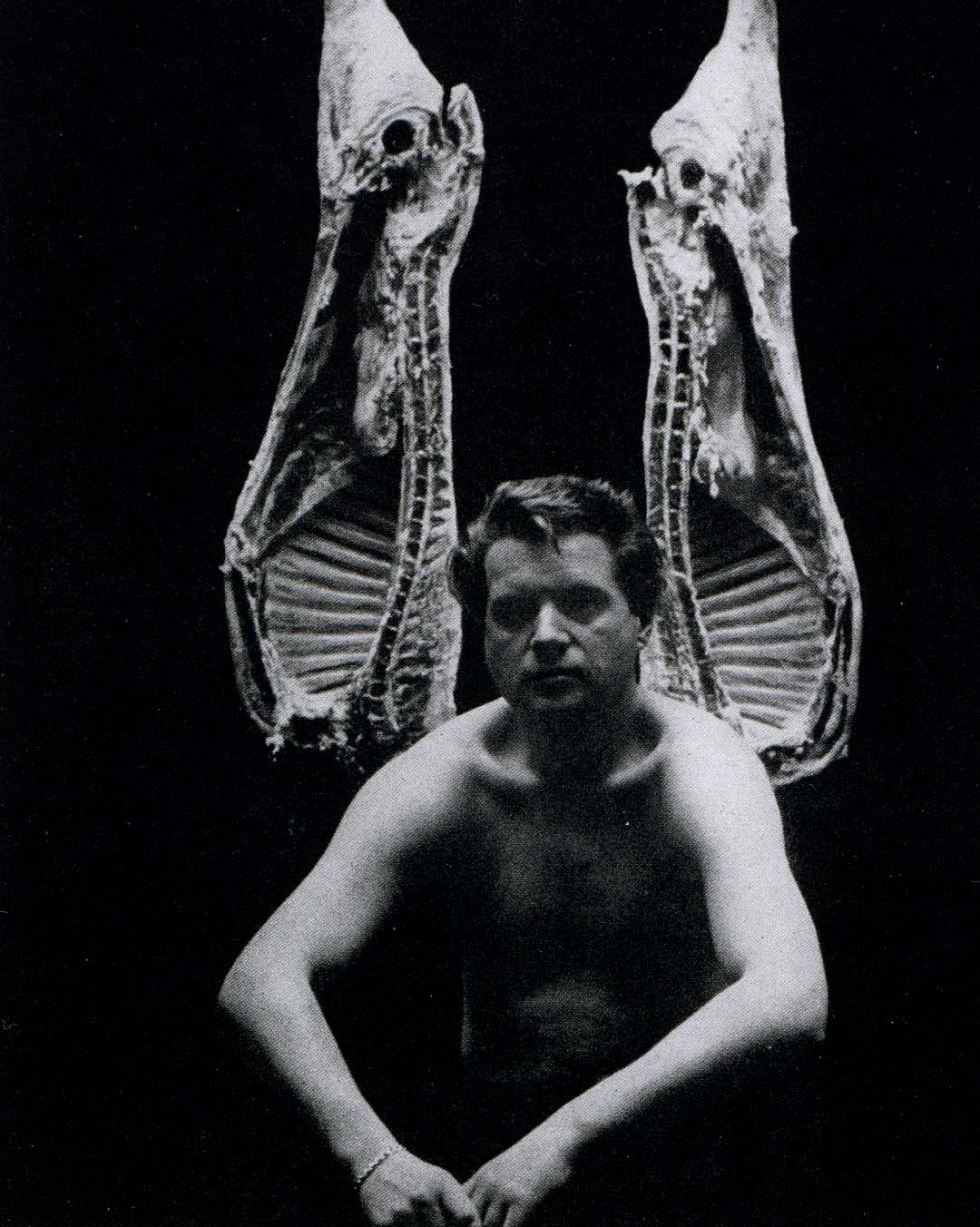
Photograph of Bacon taken by John Deakin for Vogue, 1962

Francis Bacon was a modern painter.

August 1, 2009 • Volume 23, Number 10

Artspace

Francis Bacon: The darker side of art

By Jenna Smith  |  ChristianWeek Columnist

Francis Bacon’s Painting 1946

This summer, the Metropolitain Museum of Art is hosting the first major Francis Bacon exhibition it has known in twenty years. “Francis Bacon: A Centenary Retrospective” celebrates the 100th anniversary of the artist’s birth. The British painter had the rare luxury of becoming rich and famous in his own lifetime. By his death in 1992, his paintings were already selling for millions, and their value has only risen since.

Bacon is a celebrated and controversial figure in the art world, or any world at that. One New York Times critic wrote, “If paintings could speak, Bacon’s would shriek.” Those who shudder in the presence his works are justified in doing so. The harshness of his critique of humanity is surpassed only by the grotesque nature of his images. Open bleeding flesh, exposed bones and carcasses fill the canvas. His faces and figures are often distorted, made to look broken or mutilated. The violence in his art is palpable. In a televised interview with Charlie Rose, Thomas Campbell, director of the Met, said “These are paintings that are created to evoke a reaction. Their subject matter is disturbing, unpleasant even revolting. But the surface of his paintings is also so engaging… you’re compelled to look.”

Critics, art historians and philosophers alike have offered up explanations as to Bacon’s view on life. He was abused as a child, a lifelong alcoholic who died of sclerosis of the liver, and he reached his prime as a painter during the last years of World War II.

His negative view of humankind was not unfounded. It would be false, however, to romanticize Bacon’s suffering. He rejected people’s complaints about his art being too harsh, stating, “People complain that I show the horrible side of life. I try to show the excitement of life.” In some ways, whether the viewer likes this or not, Bacon felt he was stating facts, not pushing buttons on our delicate sensibilities.

Gary Tinterow, the show’s curator, said this to Rose: “Here is the problem. He was constantly rubbing our face in our own mess, the mess that men and women are capable of doing to one another. He is constantly reminding us of our own bestiality….he would say that his art was the history of Europe in his own time.”

As if to add insult to injury, Bacon had recurring themes of Christian religious art in his work, recognizing the power of tryptichs and iconography. The crucifixion is especially present, representing for him the epitome of what horrible cruelty men are able of inflicting one upon the other. Take Painting 1946, for example. A faceless crucified figure dominates the backdrop, its skinless rib cage exposed. Above it hangs what looks like sausage from a butcher shop, and at the bottom of the canvas are two pieces of a carcass. A disfigured man holds a black umbrella in the centre of the painting. Bacon’s message is clear: we are meat.

Study After Velazquez’s Portrait of Pope Innocent X (“The Screaming Pope”), 1953

Bacon also loved painting popes. His Study after Velzquez’s portrait of Innocent X evokes a renaissance portrait of this pope, except once more, there is a twist. Innocent X’s mouth is open in a scream, barely hidden by black shuttered stripes. Tinterow commented on his take of Christian religion: “He was an old-fashioned militant atheist…there was always a general squeamishness about his take on Christianity.”

What can a Christian’s response be to such art? What should it be? Can we accept the place of violence and darkness in our dialogue with art? Should we take into consideration his contribution to the ongoing debate about human existence? I would be inclined to say we must. We may not like the fact that there is little redemption in Bacon’s work, nor are we obliged to agree with his interpretation of the crucifixion. But there is undeniable power in his works, shocking us even today, some 60 years after their execution. And there is undeniable truth to his take on humanity.

Let us not be too hurt by his distortion of Christianity. He had a much bigger bone to pick with humans than he did with God. “He respected Christian ethics, and maintained that the Christian way of life was amongst the best in the panoply of ways of life,” commented Tinterow. “It’s just that his common sense forbade him from believing in the Church. He recognized, however, that the Church didn’t believe in him. The feeling was mutual.”

Jenna Smith is completing a joint Masters degree in the faculties of music and theology at the Université de Montréal. She lives in Montreal where she directs Innovation-Jeunes, an arts and nutrition centre for teens.

Related posts:

Responding to Oppenneimer and Lizza:Defending Francis Schaeffer’s influence on believers such as Michele Bachmann(Part 1)

Today I read an article in the New York Times, “Son of Evangelical Royalty, turns his back and tells the tale,” August 19, 2011. The liberal Max Brantley of the Arkansas Times Blog called this article by Mark Oppenneimer “the best reading of the morning.” Oppenneimer asserted: Edith Schaeffer also wrote books, and in 1977, Frank, an amateur filmmaker, […]

Francis Schaeffer’s “How should we then live?” Video and outline of episode 10 “Final Choices”

E P I S O D E 1 0 How Should We Then Live 10#1 FINAL CHOICES I. Authoritarianism the Only Humanistic Social Option One man or an elite giving authoritative arbitrary absolutes. A. Society is sole absolute in absence of other absolutes. B. But society has to be led by an elite: John Kenneth […]

Francis Schaeffer’s “How should we then live?” Video and outline of episode 9 “The Age of Personal Peace and Affluence”

E P I S O D E 9 How Should We Then Live 9#1 T h e Age of Personal Peace and Afflunce I. By the Early 1960s People Were Bombarded From Every Side by Modern Man’s Humanistic Thought II. Modern Form of Humanistic Thought Leads to Pessimism Regarding a Meaning for Life and for Fixed […]

Francis Schaeffer’s “How should we then live?” Video and outline of episode 8 “The Age of Fragmentation”

E P I S O D E 8 How Should We Then Live 8#1 I saw this film series in 1979 and it had a major impact on me. T h e Age of FRAGMENTATION I. Art As a Vehicle Of Modern Thought A. Impressionism (Monet, Renoir, Pissarro, Sisley, Degas) and Post-Impressionism (Cézanne, Van Gogh, Gauguin, […]

Francis Schaeffer’s “How should we then live?” Video and outline of episode 7 “The Age of Non-Reason”

E P I S O D E 7 How Should We Then Live 7#1 I am thrilled to get this film series with you. I saw it first in 1979 and it had such a big impact on me. Today’s episode is where we see modern humanist man act on his belief that we live […]

Taking up for Francis Schaeffer’s book Christian Manifesto

I have made it clear from day one when I started this blog that Francis Schaeffer, Milton Friedman, Ronald Reagan and Adrian Rogers had been the biggest influences on my political and religious views. Today I am responding to an unfair attack on Francis Schaeffer’s book “A Christian Manifesto.” As you can see on the […]

Francis Schaeffer’s “How should we then live?” Video and outline of episode 6 “The Scientific Age”

E P I S O D E 6 How Should We Then Live 6#1 I am sharing with you a film series that I saw in 1979. In this film Francis Schaeffer asserted that was a shift in Modern Science. A. Change in conviction from earlier modern scientists.B. From an open to a closed natural system: […]

Francis Schaeffer’s “How should we then live?” Video and outline of episode 5 “The Revolutionary Age”

E P I S O D E 5 How Should We Then Live 5-1 I was impacted by this film series by Francis Schaeffer back in the 1970′s and I wanted to share it with you. Francis Schaeffer noted, “Reformation Did Not Bring Perfection. But gradually on basis of biblical teaching there was a unique improvement. A. […]

Steve Jobs versus President Obama: Who created more jobs?

I loved reading this article below. (Take a look at the link to other posts I have done on Steve Jobs.) David Boaz makes some great observations:

How much value is the Post Office creating this year? Or Amtrak? Or Solyndra? And if you point out that the Post Office does create value for its customers even though it loses money every year, I would ask, how much more value might its competitors create, if it allowed competition?

Steve Jobs created a lot of new jobs, but President Obama’s stimulus did not stimulus much of anything but waste in government. Take a look at the final paragraph:

Instead of another bag of taxpayers’ money for state and local governments and politically favored businesses, a real jobs program would encourage the next Steve Jobs to create value. What would that involve? Keep taxes on investment and creativity low. Reduce the national debt and its threat of huge tax hikes to come. Ease the burdens of regulation, especially regulations that make it difficult to open a business, hire and keep the best employees, and develop new ideas. Open the huge, stagnant postal and schooling businesses to competition, innovation, and entrepreneurship. Repeal some of the licensing laws that now afflict 1,100 occupations. Renew progress toward free trade. Make it smart for businesses to invest their time, money, and brainpower in productive activity, not lobbying.

Steve Jobs, Prosperity Creator

Posted by David Boaz

The all-too-early death of Steve Jobs was reported on the day that President Obama made another defense of his so-called jobs bill. Which one actually benefited (or would benefit) Americans and the American economy? Lots of people have talked about the way Steve Jobs changed technology, changed business, changed the world. And I trust there’ll be no more churlish complaints about his alleged lack of philanthropy. As Dan Pallotta definitively pointed out,

What a loss to humanity it would have been if Jobs had dedicated the last 25 years of his life to figuring out how to give his billions away, instead of doing what he does best…. [T]he world has no greater philanthropist than Steve Jobs. If ever a man contributed to humanity, here he is.

Two years ago Portfolio magazine did a great graphic on “The Steve Jobs Economy,” trying to assess just how much value he himself had created for the economy. The conclusion: Jobs’s personal wealth at the time was estimated at $5.7 billion. But he was generating $30 billion a year in revenue for Apple, its partners, and its competitors (who were spurred to get better). Here’s the analysis (sorry for the imperfect tear sheet):

Click image to enlarge. And for text but not graphics at Portfolio, click here.

According to Portfolio and the experts it consulted, Jobs was producing $30 billion a year in value for various companies. And of course that means that consumers believed they were getting at least that much value themselves, or they wouldn’t buy the products. That’s a wealth creator. And that number pales in comparison to this one: After returning to Apple in 1997, Jobs took the total value of the company from about $2 billion to $350 billion.

How much value is the Post Office creating this year? Or Amtrak? Or Solyndra? And if you point out that the Post Office does create value for its customers even though it loses money every year, I would ask, how much more value might its competitors create, if it allowed competition?

Instead of another bag of taxpayers’ money for state and local governments and politically favored businesses, a real jobs program would encourage the next Steve Jobs to create value. What would that involve? Keep taxes on investment and creativity low. Reduce the national debt and its threat of huge tax hikes to come. Ease the burdens of regulation, especially regulations that make it difficult to open a business, hire and keep the best employees, and develop new ideas. Open the huge, stagnant postal and schooling businesses to competition, innovation, and entrepreneurship. Repeal some of the licensing laws that now afflict 1,100 occupations. Renew progress toward free trade. Make it smart for businesses to invest their time, money, and brainpower in productive activity, not lobbying.

Related posts:
 

Steve Jobs versus President Obama: Who created more jobs?

I loved reading this article below. (Take a look at the link to other posts I have done on Steve Jobs.) David Boaz makes some great observations: How much value is the Post Office creating this year? Or Amtrak? Or Solyndra? And if you point out that the Post Office does create value for its […]


Steve Jobs’ view of death and what the Bible has to say about it

Steve Jobs’ 2005 Stanford Commencement Address Uploaded by StanfordUniversity on Mar 7, 2008 Drawing from some of the most pivotal points in his life, Steve Jobs, chief executive officer and co-founder of Apple Computer and of Pixar Animation Studios, urged graduates to pursue their dreams and see the opportunities in life’s setbacks — including death […]


8 things you might not know about Steve Jobs

Things you may not know about Steve Jobs: Steve Jobs leans against his wife, Laurene Powell Jobs (Lea Suzuki/San Francisco Chronicle/Corbis) For all of his years in the spotlight at the helm of Apple, Steve Jobs in many ways remains an inscrutable figure — even in his death. Fiercely private, Jobs concealed most specifics about […]


Steve Jobs was a Buddhist: What is Buddhism?

Steve Jobs passed away on October 5, 2011. I personally am very grateful to him for helping the world so much with his ideas and I have written about tha before. Dan Mitchell of the Cato Institute noted: He’s built a $360 billion company. That presumably means at least $352 billion of wealth in the […]


Did Steve Jobs help people even though he did not give away a lot of money?

  Did Steve Jobs help people even though he did not give away a lot of money? (I just finished a post concerning Steve’s religious beliefs and a post about 8 things you may not know about Steve Jobs) Uploaded by UM0kusha0kusha on Sep 16, 2010 clip from The First Round Up *1934* ~~enjoy!! ______________________________________________ In the short film […]


Heritage Foundation Scholars respond to Obama debt reduction proposal (Part 2)

I love going to the Heritage Foundation website for articles like this:

Obama’s Debt Reduction and Tax Proposal

Heritage Responds to Obama’s Debt Reduction and Tax Proposal

Mike Brownfield

September 19, 2011 at 11:16 am

Heritage’s experts watched President Barack Obama’s debt reduction and tax increase proposal. Here are their immediate reactions:

_______________

The President’s Debt Reduction Proposals: The Wrong Diagnosis

The President’s “debt reduction” proposals released today are a fine statement of liberal ideology, but a poor attempt at fiscal policy. His so-called “balanced approach” – using a mix of spending reductions and tax increases – is the wrong formulation to start with. It merely perpetuates a misunderstanding of the fundamental problem: deficits and debt are symptoms; the underlying illness is excessive and uncontrolled spending.

The federal government today is claiming roughly one-fourth of total economic output – about 25 percent of gross domestic product (GDP) – a post-World War II record. This is dead weight on the economy, because every dollar of spending gets paid for – through taxes, borrowing, fees, offsetting receipts, etc. – and hence is no longer available to growth producing activities in the economy. That is why spending is considered one of the best measures of the size and scope of government. As Professor Allen Schick has written, fundamentally government is what it spends.

But even more problematic than the level of spending is its trajectory – especially in federal entitlements. According to the latest figures by the Congressional Budget Office, entitlement spending is projected to rise at a rate of about 5.3 percent per year. That is faster than projected inflation, and faster than nominal GDP. So even if the gap between spending and revenue were closed, entitlements would immediately begin outrunning taxes again, resurrecting deficits.

As is well known, the problem is most acute in the Big Three entitlements: Social Security is growing at a rate of 5.8 percent per year, Medicare at 6.3 percent, and Medicaid at 9 percent. Clearly, these growth rates cannot be lowered by trimming around the edges of the programs, cutting wasteful spending and overpayments, and squeezing medical providers. It requires fundamental reforms that alter the incentives toward overutilization and inefficient delivery of medical services. But these are exactly the kinds of things the President has ruled out. He expressly rejects adjusting benefits or eligibility. He claims his proposal will save $248 billion in Medicare, of which 90 percent would come from reducing overpayments, not from restructuring the program. This is not a serious proposal for addressing the government’s spending and debt problems.

Similarly, he claims savings “that build on the Affordable Care Act” almost entirely from vague improvements in efficiency: “by reducing wasteful spending and erroneous payments, and supporting reforms that boost the quality of care.” Nevertheless, it is curious that his vaunted health care program – which was advertised as reducing deficits – is so inefficient that it is already projected to generate $320 billion in overspending over the next 10 years.

In addition to all these failings, the President takes credit for a whopping $2.3 trillion in spending reductions that either are already assumed, or are based on manufactured spending projections.

First he claims $1.2 trillion in savings (including debt service reduction) from the spending caps in the Budget Control Act. Those are not new savings.

Even more exotic is his $1.1 trillion in savings from drawing down military activities in Iraq and Afghanistan. The President’s budget proposed a total of just $576.5 billion over 10 years for Overseas Contingency Operations (OCO). This amount consists of a $126.5-billion request for fiscal year 2012, and then placeholders of $50 billion a year through 2021. In other words, the 10-year total is largely illusory. Even if it were real, however, it would be impossible to save $1.1 trillion in war spending when the President proposed to spend only about half that amount. It appears the savings are measured against a Congressional Budget Office (CBO) baseline hat assumed the peak, 2010 “surge” level for war spending, and then inflated it for subsequent years. This was an unreal figure to begin with – and one CBO removed in estimating discretionary savings in the Budget Control Act – and yet the President assumes the savings. This is emblematic of just how disingenuous his debt reduction plan truly is.

This is not a serious effort to address the government’s very real spending and deficit crisis – which has worsened significantly in the past two-and-a-half years. It is, to repeat, ideology, not policy.

Patrick Louis Knudsen
Grover M. Hermann Senior Fellow in Federal Budgetary Affairs

Tax Hikes Not the Answer, but Obama Wants Them to Be

President Obama seems intent on not solving our budget and debt crisis. Indeed, he seems almost fixated on making it worse.  His latest plan would immediately ramp up spending to “jolt” job creation in ways that have proven to fail. Once again, Obama is sticking to his strategy of ramping up spending thus “locking in” higher levels that make the job of budget cutters more difficult.  Somehow, he maintains, this is necessary and right for America, making it seem that this spending is inevitable and inexorable.  Thus, the only thing we can do is to hike taxes.

Riiiiiiight.

Tax hike are not the answer.  Plain and simple.  Unless we fundamentally tackle entitlement programs taxes will have to be perpetually raised to keep pace with dramatic growth in spending as Medicare, Medicaid and – yes Mr. President — Social Security grow like a giant tsunami blowing toxic red ink all over the budget and the economy.

Yes, the President did propose spending cuts.  Teeeeensie tiny ones.  $250 billion to Medicare and $72 billion to Medicaid likely over ten years. But bear in mind these are two of the biggest and fastest growing programs in the budget. Medicare this year alone is over $500 billion and over the next ten years will likely reach $7.5 trillion.  But here, the devil is in the details.  The small changes he may propose that would affect retirees will be backloaded – until after any possible second term.  And he abandons future retirees by taking any changes to Social Security off the table. He’s right that spending cuts alone aren’t the solution – the policies must be right too.

Obama is demanding a “balanced” approach as though somehow hiking taxes is both fair and necessary.  But this notion that he is pushing – half tax hikes and half spending cuts – is beyond the class warfare message it sends.  It is a tactic.  A tactic to stall the real reforms that our leaders in Washington must undertake now in order to avert a fiscal, economic and moral crisis.

The simple fact is that our budget and debt crisis can be solved without hiking taxes.   Saving the American Dream, the Heritage Plan to Fix the Debt, Cut Spending and Restore Prosperity is a bold, innovative plan that does just that.  It transforms our entitlement programs, rolls back wasteful and inefficient spending, protects the nation and overhauls our punitive, inefficient and uncompetitive tax code.

Federal Spending needs a complete do-over. We must return to our roots our founding fathers’ laid out – of a limited government. A low tax, low spending and fast growing nation.  One where our kids can enjoy the same kind of opportunity as their parents and grandparents.  One where our seniors know they can go into retirement with the economic security that they will be able to access quality health care that works for them, and a Social Security benefit that will protect them from poverty.

President Obama’s newest plan is simply his April speech cast under the lighting of the Super Committee with the election as a backdrop.  The nation needs more.

Alison Fraser

The Sixty Six who resisted “Sugar-coated Satan Sandwich” Debt Deal (Part 9)

The Sixty Six who resisted “Sugar-coated Satan Sandwich” Debt Deal (Part 9)

This post today is a part of a series I am doing on the 66 Republican Tea Party favorites that resisted eating the “Sugar-coated Satan Sandwich” Debt Deal. Actually that name did not originate from a representative who agrees with the Tea Party, but from a liberal.

Rep. Emanuel Clever (D-Mo.) called the newly agreed-upon bipartisan compromise deal to raise the  debt limit “a sugar-coated satan sandwich.”

“This deal is a sugar-coated satan sandwich. If you lift the bun, you will not like what you see,” Clever tweeted on August 1, 2011


Washington, D.C., Aug 1 

Tonight, I voted against the Budget Control Act. It leaves real cuts in federal spending to another day. We don’t need congressional super committees and triggers to do the heavy lifting for which Members of Congress were elected.

_______________________________

Nunes favored the bill below:

Cut, Cap and Balance Statement
Debt Limit Plan


Washington, Jul 20 – Congressman Nunes issued the following statement on passage of the Cut, Cap and Balance Act:

“The Cut, Cap and Balance Act is not a perfect bill but it is certainly one that under any other circumstance would have garnered the unanimous support of conservatives across America. It contains a spending cap that would inoculate us against spending excess, while forcing budget reforms to ensure the federal government lives within its means. Leading up to the debate, I joined critics who desired more immediate spending reforms, including to our nation’s entitlements, and sought to have those reforms included. However, I ultimately sided with 233 of my Republican colleagues in supporting Cut, Cap and Balance recognizing the debate is not over. The bill will be considered in the Senate on Saturday.”


Steve Jobs’ view of death and what the Bible has to say about it jh55

(If you want to check out other posts I have done about about Steve Jobs:Some say Steve Jobs was an atheist , Steve Jobs and Adoption , What is the eternal impact of Steve Jobs’ life? ,Steve Jobs versus President Obama: Who created more jobs? ,Steve Jobs’ view of death and what the Bible has to say about it ,8 things you might not know about Steve Jobs ,Steve Jobs was a Buddhist: What is Buddhism? ,Did Steve Jobs help people even though he did not give away a lot of money? )

Steve Jobs’ 2005 Stanford Commencement Address

Uploaded by on Mar 7, 2008

Drawing from some of the most pivotal points in his life, Steve Jobs, chief executive officer and co-founder of Apple Computer and of Pixar Animation Studios, urged graduates to pursue their dreams and see the opportunities in life’s setbacks — including death itself — at the university’s 114th Commencement on June 12, 2005.

___________________

Steve Jobs noted:

Remembering Steve Jobs in quotesRemembering that I’ll be dead soon is the most important tool I’ve ever encountered to help me make the big choices in life. Because almost everything — all external expectations, all pride, all fear of embarrassment or failure — these things just fall away in the face of death, leaving only what is truly important. Remembering that you are going to die is the best way I know to avoid the trap of thinking you have something to lose. You are already naked. There is no reason not to follow your heart. — Steve Jobs, speaking at Stanford University’s commencement, June 2005.

Steve Jobs was a Buddhist and it is my view that this is almost the same as being an atheist. In this clip above he discusses the issue of death. There is one book in the Bible that confronts the view of death and the issue of atheism more than any other book.

Three thousand years ago, Solomon took a look at life “under the sun” in his book of Ecclesiastes. Christian scholar Ravi Zacharias has noted, “The key to understanding the Book of Ecclesiastes is the term ‘under the sun.’ What that literally means is you lock God out of a closed system, and you are left with only this world of time plus chance plus matter.”

Let me show you some inescapable conclusions if you choose to live without God in the picture. Solomon came to these same conclusions when he looked at life “under the sun.”

  1. Death is the great equalizer (Eccl 3:20, “All go to the same place; all come from dust, and to dust all return.”)
  2. Chance and time have determined the past, and they will determine the future.  (Ecclesiastes 9:11-13 “I have seen something else under the sun:  The race is not to the swift
    or the battle to the strong, nor does food come to the wise
    or wealth to the brilliant  or favor to the learned; but time and chance happen to them all.  Moreover, no one knows when their hour will come: As fish are caught in a cruel net,
    or birds are taken in a snare, so people are trapped by evil times  that fall unexpectedly upon them.”)
  3. Power reigns in this life, and the scales are not balanced(Eccl 4:1; “Again I looked and saw all the oppression that was taking place under the sun: I saw the tears of the oppressed—
    and they have no comforter; power was on the side of their oppressors—  and they have no comforter.” 7:15 “In this meaningless life of mine I have seen both of these: the righteous perishing in their righteousness,  and the wicked living long in their wickedness. ).
  4. Nothing in life gives true satisfaction without God including knowledge (1:16-18), ladies and liquor (2:1-3, 8, 10, 11), and great building projects (2:4-6, 18-20).

_______________________

Power reigns in this life and the scales are not balanced.

Solomon comes to the realization that powers reigns in this life and the scales are not balanced. Solomon notes, “Again, I observed all the oppression that takes place under the sun. I saw the tears of the oppressed, with no one to comfort them. The oppressors have great power, and their victims are helpless. (Ecclesiastes 4:1).

People that believe there is no afterlife must concede that Hitler will never face the due punishment for his acts. I am a big Woody Allen movie fan and no other movie better demonstrates Ecclesiastes 4:1 better than the movie CRIMES AND MISDEMEANORS because the character Judah was able to get away with murder and in the end of the movie does not fear that God will punish him. 

If you do not have God in the picture then you must come to the same conclusions that Solomon came to and Woody Allen shows that very clearly in his film.

By the way, the final chapter of Ecclesiastes finishes with Solomon emphasizing that serving God is the only proper response of man. Solomon looks above the sun and brings God back into the picture.  I am hoping that Woody Allen will also come to that same conclusion that Solomon came to concerning the meaning of life and man’s proper place in the universe in Ecclesiastes 12:13-14:
13 Now all has been heard;
here is the conclusion of the matter:
Fear God and keep his commandments,
for this is the whole duty of man.

14 For God will bring every deed into judgment,
including every hidden thing,
whether it is good or evil

Another chapter in Ecclesiastes takes on the issue of death head on.

Ecclesiastes 9:1-12

The Message (MSG)

Ecclesiastes 9

1-3Well, I took all this in and thought it through, inside and out. Here’s what I understood: The good, the wise, and all that they do are in God’s hands—but, day by day, whether it’s love or hate they’re dealing with, they don’t know.

Anything’s possible. It’s one fate for everybody—righteous and wicked, good people, bad people, the nice and the nasty, worshipers and non-worshipers, committed and uncommitted. I find this outrageous—the worst thing about living on this earth—that everyone’s lumped together in one fate. Is it any wonder that so many people are obsessed with evil? Is it any wonder that people go crazy right and left? Life leads to death. That’s it.

Seize Life!

4-6 Still, anyone selected out for life has hope, for, as they say, “A living dog is better than a dead lion.” The living at least know something, even if it’s only that they’re going to die. But the dead know nothing and get nothing. They’re a minus that no one remembers. Their loves, their hates, yes, even their dreams, are long gone. There’s not a trace of them left in the affairs of this earth.

7-10 Seize life! Eat bread with gusto,
Drink wine with a robust heart.
Oh yes—God takes pleasure in your pleasure!
Dress festively every morning.
Don’t skimp on colors and scarves.
Relish life with the spouse you love
Each and every day of your precarious life.
Each day is God’s gift. It’s all you get in exchange
For the hard work of staying alive.
Make the most of each one!
Whatever turns up, grab it and do it. And heartily!
This is your last and only chance at it,
For there’s neither work to do nor thoughts to think
In the company of the dead, where you’re most certainly headed.

11 I took another walk around the neighborhood and realized that on this earth as it is—

The race is not always to the swift,
Nor the battle to the strong,
Nor satisfaction to the wise,
Nor riches to the smart,
Nor grace to the learned.
Sooner or later bad luck hits us all.

12 No one can predict misfortune.
Like fish caught in a cruel net or birds in a trap,
So men and women are caught
By accidents evil and sudden.

In 1978 I heard the song “Dust in the Wind” by Kansas when it rose to #6 on the charts. That song told me thatKerry Livgren the writer of that song and a member of Kansas had come to the same conclusion that Solomon had. I remember mentioning to my friends at church that we may soon see some members of Kansas become Christians because their search for the meaning of life had obviously come up empty even though they had risen from being an unknown band to the top of the music business and had all the wealth and fame that came with that. Furthermore, like Solomon and Coldplay, they realized death comes to everyone and “there must be something more.”

Livgren wrote:

“All we do, crumbles to the ground though we refuse to see, Dust in the Wind, All we are is dust in the wind, Don’t hang on, Nothing lasts forever but the Earth and Sky, It slips away, And all your money won’t another minute buy.”

Both Kerry Livgren and Dave Hope of Kansas became Christians eventually. Kerry Livgren first tried Eastern Religions and Dave Hope had to come out of a heavy drug addiction. I was shocked and elated to see their personal testimony on The 700 Club in 1981 and that same  interview can be seen on youtube today. Livgren lives in Topeka, Kansas today where he teaches “Diggers,” a Sunday school class at Topeka Bible Church. Hope is the head of Worship, Evangelism and Outreach at Immanuel Anglican Church in Destin, Florida.

You can hear Kerry Livgren’s story from this youtube link:

(part 1 ten minutes)

(part 2 ten minutes)

Related posts:

Steve Jobs left conservative Lutheran upbringing behind

Steve Jobs was raised as a conservative Lutheran but he chose to leave those beliefs behind. Below is a very good article on his life. COVER STORY ARTICLE | Issue: “Steve Jobs 1955-2011″ October 22, 2011 A god of our age Who was Steve Jobs? A revered technology pioneer and a relentless innovator, the Apple […]

Occupy Wall Street vs. Steve Jobs

COUNTER-DEMONSTRATION: At Kappa Sigma house in Fayetteville. The Drew Wilson photo above went viral last night — at least in Arkansas e-mail and social media users — after the Fayetteville Flyer posted it in coverage of an Occupy Northwest Arkansas demonstration in Fayetteville. The 1 percent banner was unfurled briefly on the Kappa Sigma frat […]

Steve Jobs’ Father

(If you want to check out other posts I have done about about Steve Jobs:Some say Steve Jobs was an atheist , Steve Jobs and Adoption , What is the eternal impact of Steve Jobs’ life? ,Steve Jobs versus President Obama: Who created more jobs? ,Steve Jobs’ view of death and what the Bible has to say about it ,8 things you might not know about Steve Jobs ,Steve […]

Steve Jobs at Stanford

(If you want to check out other posts I have done about about Steve Jobs:Some say Steve Jobs was an atheist , Steve Jobs and Adoption , What is the eternal impact of Steve Jobs’ life? ,Steve Jobs versus President Obama: Who created more jobs? ,Steve Jobs’ view of death and what the Bible has to say about it ,8 things you might not know about Steve Jobs ,Steve […]

Steve Jobs depicted at pearly gates with Saint Peter

It is strange that the New Yorker Magazine did no research. (If you want to check out other posts I have done about about Steve Jobs:Some say Steve Jobs was an atheist , Steve Jobs and Adoption , What is the eternal impact of Steve Jobs’ life? ,Steve Jobs versus President Obama: Who created more jobs? ,Steve Jobs’ view of death and what the Bible […]


Steve Jobs versus President Obama: Who created more jobs?

I loved reading this article below. (Take a look at the link to other posts I have done on Steve Jobs.) David Boaz makes some great observations: How much value is the Post Office creating this year? Or Amtrak? Or Solyndra? And if you point out that the Post Office does create value for its […]

Steve Jobs’ view of death and what the Bible has to say about it

Steve Jobs’ 2005 Stanford Commencement Address Uploaded by StanfordUniversity on Mar 7, 2008 Drawing from some of the most pivotal points in his life, Steve Jobs, chief executive officer and co-founder of Apple Computer and of Pixar Animation Studios, urged graduates to pursue their dreams and see the opportunities in life’s setbacks — including death […]

8 things you might not know about Steve Jobs

Things you may not know about Steve Jobs: Steve Jobs leans against his wife, Laurene Powell Jobs (Lea Suzuki/San Francisco Chronicle/Corbis) For all of his years in the spotlight at the helm of Apple, Steve Jobs in many ways remains an inscrutable figure — even in his death. Fiercely private, Jobs concealed most specifics about […]

Steve Jobs was a Buddhist: What is Buddhism?

Steve Jobs passed away on October 5, 2011. I personally am very grateful to him for helping the world so much with his ideas and I have written about tha before. Dan Mitchell of the Cato Institute noted: He’s built a $360 billion company. That presumably means at least $352 billion of wealth in the […]

Did Steve Jobs help people even though he did not give away a lot of money?

  Did Steve Jobs help people even though he did not give away a lot of money? (I just finished a post concerning Steve’s religious beliefs and a post about 8 things you may not know about Steve Jobs) Uploaded by UM0kusha0kusha on Sep 16, 2010 clip from The First Round Up *1934* ~~enjoy!! ______________________________________________ In the short film […]