This post today is a part of a series I am doing on the 66 Republican Tea Party favorites that resisted eating the “Sugar-coated Satan Sandwich” Debt Deal. Actually that name did not originate from a representative who agrees with the Tea Party, but from a liberal.
Rep. Emanuel Clever (D-Mo.) called the newly agreed-upon bipartisan compromise deal to raise the debt limit “a sugar-coated satan sandwich.”
“This deal is a sugar-coated satan sandwich. If you lift the bun, you will not like what you see,” Clever tweeted on August 1, 2011.
Southerland: Cuts and Caps Will Help Us Conquer the Debt Crisis
Steve Southerland, II (published by The Tallahassee Democrat)
By the time you finish reading this sentence, Washington will add another $360,000 to our national debt. With each day of delay, we dig our economic hole $4 billion deeper.
Make no mistake about it — we’re gazing into an economic abyss. Incredibly, some in Washington believe the best way to get back on track is to move the guardrail closer to the cliff’s edge. I refuse to join the agents of inaction who would rather bankrupt this great nation than make the tough, forward-thinking decisions necessary to fix our fiscal future.
Since 1962, Washington has raised the debt ceiling a mind-boggling 74 times. Yet with every increase, our elected officials failed to implement cost controls on future spending, choosing instead to shift responsibility onto the shoulders of future generations.
We simply cannot afford to continue down this path to economic ruin. The buck stops here and accountability begins now.
There’s an adage that says success has many fathers, but failure is an orphan.
Those words could fittingly be the official motto of Washington, D.C.
The time has come for Republicans and Democrats alike to take ownership of this massive failure of governance. Short-sighted neglect from both parties helped create our $14.3 trillion debt. Both parties have, at one time or another, been more concerned with maintaining their grip on power than with empowering a change of culture in Washington.
I’ve heard loud and clear from citizens across North and Northwest Florida: You’ve had enough. You want Washington to reflect the challenges you face every day in meeting a family budget or keeping a small business afloat. You rightly expect the federal government to do more with less.
Nearly 100 days ago, I publicly announced my support for a common-sense plan of cuts and caps to conquer our debt crisis. I am pleased that a bipartisan majorityof the House joined me in committing to this effort by approving last week the Cut, Cap, and Balance Act of 2011.
This responsible plan would ensure that Washington cuts its spending immediately while enforcing caps on future spending and sending a federal balanced budget amendment to the states.
If you are a senior or a veteran, your benefits are protected under this plan. Wasteful spending will be weeded out, but your Medicare, Social Security and veterans benefits absolutely will not change.
If you are a small-business owner, lifting our crushing burden of debt will restore certainty and stability to the marketplace, allowing you to expand operations and create jobs.
And if you are a parent, you can take comfort in knowing that your children and grandchildren have hope for a day when they won’t be saddled with the consequences of poor economic decisions from the past.
The House has acted boldly to approve a concrete, measurable strategy to cut the debt.
I am hopeful that ongoing negotiations between President Obama and congressional leaders will build upon this momentum to achieve an agreement in line with the House-passed plan.
As I have consistently stated, I am firmly opposed to increasing the debt limit unless there is a serious, game-changing plan to cut, cap and balance Washington’s checkbook. We will never digest this mountain of debt by simply nibbling around the edges.
With the president’s self-imposed Aug. 2 deadline fast approaching, many Americans are understandably concerned about what will happen if a debt-ceiling agreement proves elusive.
Whether there is an agreement in the next 10 days or not, revenue will continue to come in to the federal treasury. The president will continue to have the constitutional responsibility to prioritize federal spending. His administration will continue to set the timetable by which Social Security, Medicare and veteran benefits are paid.
In an effort to reassure those who have earned federal benefits, I introduced legislation that would ensure our seniors, veterans and active duty troops come first, receiving their full pay and benefits even if there is no debt limit agreement in place by Aug. 2. Your government made a promise to you, and you deserve to know that promise will be honored.
Great nations have fallen throughout history when they grew too bloated and careless to prepare for their economic future. We must not repeat those same mistakes.
When our children and grandchildren look back on the debates of today, do we want them to mark these times as the moment when the American Dream slipped away? Or do we want them to be thankful that we finally stood up, fought for their future and changed the culture in Washington?
The United States Postal Service (USPS) stands on the brink of financial collapse. According to the Postmaster General, by next month, USPS coffers will be down to a week’s worth of cash.[1] The government-owned enterprise barely avoided default this week when Congress extended the due date for a $5.5 billion payment due to the U.S. Treasury for retiree health benefits. The new deadline is November 18. And by early 2012, USPS may be unable to meet payroll.
Congress should act quickly to address this not-so-slow-motion postal train wreck. The goal, however, should not be to “save” USPS or even to save mail delivery. Policymakers should not play King Canute, ordering back the advancing tides of technology to preserve an obsolete industry. Nor should taxpayers be asked to pay for such an effort. Instead, the aim of policymakers should be to remove barriers that are hindering efforts by USPS to adjust to the new digital world. This should include making it easier for USPS to close post offices, reduce its workforce, and trim services.
The Decline of Mail
USPS’s decline is not a new story. As early as 1992, the U.S. General Accounting Office (now the U.S. Government Accountability Office) raised concerns about diversion of business from USPS by new electronic communications, including the then-exotic “e-mail.”[2] In recent years, the steady migration to online forms of communication has become a stampede, leaving mailmen holding the (empty) bag. The numbers are stark.
From 2006 to 2010, overall USPS mail volume dropped by 20 percent, from 213 billion pieces of mail to 170 billion.[3] During the same period, the government-owned business incurred $20 billion in losses. It expects to lose nearly $10 billion more in 2011.
Certainly, the sour economy has not helped things. But the losses began before the downturn began, and after the overall economy recovers, postal fortunes are unlikely to rebound. According to a 2010 study by the Boston Consulting Group,[4] mail volume will decline an additional 15 percent by 2020, with first-class mail falling a jaw-dropping 35 percent. This means the average postal customer will receive only one first-class letter per day, down from around two today. At that level of mail, USPS will lose a staggering $15 billion per year.
Restructuring Needed
Recognizing the need for change, USPS has proposed a wide-ranging set of restructuring steps, many of which would require congressional action to implement:
Reducing the postal workforce. USPS has proposed cutting 220,000 positions, leaving its workforce—which once ranked with Indian Railways and the People’s Liberation Army as among the world’s largest—at 425,000 employees. Some 120,000 of these cutbacks would be through layoffs, which are barred under current union contracts. For most private companies, such provisions would be lifted as part of the normal bankruptcy process. As a federal agency, however, USPS cannot enter into bankruptcy. Nonetheless, Congress should adopt legislation to allow USPS to reduce its workforce.
Closing post offices and other facilities.USPS plans to reduce the number of retail facilities it operates from 32,000 to 20,000 by 2015 and has already identified 3,700 for closure. In addition, it plans to cut its 500 processing plants to 200. With declining mail volume and improved technologies, this makes sense. Yet the efforts are hindered by a warren of federal rules restricting the closure of facilities and requiring cumbersome processes for doing so. Congress should eliminate these restrictions.
Discontinuing Saturday delivery of mail. Moving to five-day-a-week delivery would save $2 billion–3 billion per year. Such an adjustment is not unprecedented. Before telephone service was widely available, mail deliveries were sometimes made several times a day. Just as telephony made such multiple deliveries unnecessary, Internet communication has made Saturday delivery nonessential. Under current law, however, USPS is barred from paring back its current delivery schedule. This prohibition should be lifted.
Several proposals are pending in Congress to allow this restructuring to take place. The most comprehensive is H.R. 2309, sponsored by Representative Darrell Issa (R–CA), which was approved by a subcommittee of the House Oversight and Government Reform Committee last week. The bill, however, would place USPS, once it defaults on an obligation, under the direction of a financial control board. Operating much as a bankruptcy court operates, the board would have the power to force renegotiation of union contracts and other cost-cutting steps. In addition, the bill would create an independent commission to select post offices for closure, similar to the Base Realignment and Closure Commission used to identify military bases for termination.
There are also a number of proposals pending in Congress that would move in the opposite direction, further limiting USPS’s ability to close facilities or change service levels. These proposals would limit USPS’s ability to respond to today’s challenges.
Putting Taxpayers at Risk
Some have also suggested refunding to the USPS billions in supposed overpayments it has made to the U.S. Treasury to fund its retirement obligations or to allow it to only partially fund those liabilities. President Obama, for instance, has proposed refunding to USPS billions in retiree health care payments and refunding claimed pension fund overpayments. There is, however, considerable doubt as to whether USPS actually overpaid.
Moreover, as the Office of Personnel Management’s Inspector General has pointed out, if USPS is not required to fully fund its full retirement cost, American taxpayers will be put at risk if USPS defaults.[5]
In any case, such cash infusions would only kick the can down the road at taxpayer expense while leaving USPS’s fundamental problems unresolved.
Ending Special Privileges
USPS can also benefit from innovative uses of its assets and new business offerings. Ideas range from putting advertising on delivery trucks to offering Internet-based services. Such innovation and diversification may hold the key to USPS’s survival. But before USPS is allowed to expand into new areas, it must relinquish its ties to the federal government and the special legal privileges it still holds.
For instance, while USPS has struggled to compete against e-mail, it still holds a protected legal monopoly on the delivery of physical letter mail. This should be eliminated. If others are willing and able to provide a competing business in the shrinking letter-mail market, they should be encouraged, not restrained. Abolition of this outdated law, moreover, could itself actually help USPS reform. Allowing new entrants to try their hand at mail delivery could foster new ideas and fresh perspectives in the postal business. Such new blood may be just what mail delivery needs.
Delay Is Not an Option
USPS is failing and needs to change. As currently structured, it cannot survive unless supported by tens of billions of dollars in subsidy. Congress, however, is making that change harder to achieve by not allowing USPS to restructure and respond to today’s communications marketplace. It should act now to lift these barriers to change while protecting taxpayers.
James L. Gattuso is Senior Research Fellow in Regulatory Policy in the Thomas A. Roe Institute for Economic Policy Studies at The Heritage Foundation.
Runaway Spending, Not Inadequate Tax Revenue, Is Responsible for Future Deficits
Everyone wants to know more about the budget and here is some key information with a chart from the Heritage Foundation and a video from the Cato Institute.
The main driver behind long-term deficits is government spending—not low revenues. While revenue will surpass its historical average of 18.0 percent of GDP by 2021, spending will shoot past its historical average of 20.3 percent, reaching 26.4 percent in the same year.
PERCENTAGE OF GDP
Download
Source: Heritage Foundation calculations based on Congressional Budget Office data.
The charts in this book are based primarily on data available as of March 2011 from the Office of Management and Budget (OMB) and the Congressional Budget Office (CBO). The charts using OMB data display the historical growth of the federal government to 2010 while the charts using CBO data display both historical and projected growth from as early as 1940 to 2084. Projections based on OMB data are taken from the White House Fiscal Year 2012 budget. The charts provide data on an annual basis except… Read More
Authors
Emily GoffResearch Assistant
Thomas A. Roe Institute for Economic Policy StudiesKathryn NixPolicy Analyst
Center for Health Policy StudiesJohn FlemingSenior Data Graphics Editor
Using Social Security as his prime example, Professor Friedman explodes the myth that the major expansions in government resulted from popular demand. In a speech delivered more than 30 years ago, he directly relates this dynamic to today’s health care debate. http://www.LibertyPen.com
Professor Williams explains what’s ahead for Social Security
Governor Rick Perry got in trouble for calling Social Security a Ponzi scheme and I totally agree with that. This is a series of articles that look at this issue.
This article appeared in the Washington Times on January 22, 2010.
Could it be time to put Social Security reform back on the table? That would seem to be a bizarre question, given the spectacular failure of President George W. Bush’s attempt to reform the troubled retirement program. Yet, none of Social Security’s problems have gotten better during the intervening years.
Social Security is the largest government program in the world, accounting for 23 percent of the federal budget. The Social Security tax is the largest tax the average American family pays. Indeed, nearly 80 percent of Americans pay more in Social Security taxes than they do in federal income tax. And, millions of seniors depend on Social Security for their retirement income.
The program is unsustainable. It cannot pay future benefits without drowning our children and grandchildren in debt and taxes. Social Security will begin running a deficit by 2016, just six years from now. In theory, the Social Security trust fund will pay benefits until 2037, which should serve as cold comfort to today’s 31-year-olds. But that figure is misleading because the trust fund contains no actual assets. The government bonds it holds are simply a form of IOU, a measure of how much money the government owes the system. It says nothing about where the government will get the money to pay back those IOUs. Even if Congress can find a way to redeem the bonds, the trust-fund surplus will be exhausted by 2037. Overall, the amount the system has promised beyond what it can actually pay now totals $17.5 trillion. Yes, that’s trillion with a T.
[S]tudies show that long-term investment remains remarkably safe.
Equally important, workers still have no ownership of their benefits. This means that workers are left totally dependent on the goodwill of 535 politicians to determine what they will receive in retirement. Low- and middle-income workers are still unable to accumulate a nest egg of real, inheritable wealth. And younger workers still receive a dismal rate of return on their money.
If Social Security’s problems haven’t changed since the Bush years, neither have the possible ways to fix those problems: Raise taxes (the Social Security payroll tax would have to be nearly doubled to keep the program afloat), cut benefits by as much as 25 percent or allow younger workers to invest privately.
We could always raise taxes or cut benefits enough to bring the system into balance. Some have suggested removing the cap on income subject to the payroll tax. But while that would be the largest tax increase in U.S. history, at least $1.3 trillion over the first 10 years, it would increase Social Security’s cash-flow solvency by just seven years. Raising taxes or cutting benefits will make an already bad deal worse for younger workers, many of whom will end up paying more in taxes than they receive in benefits. And raising taxes will do nothing to fix the fundamental problems of ownership, inheritability and choice.
The only workable solution still is to allow younger workers to invest privately a portion of their Social Security taxes through personal accounts so as to take advantage of the higher returns earned through investment in real assets, and offset the reduction in government benefits that will be required to bring the system into solvency.
Critics undoubtedly will point to the collapse of the stock market in 2008 and suggest that private investing is just too risky. However, studies show that long-term investment remains remarkably safe. If workers retiring today had been allowed to start privately investing their taxes 40 years ago, they obviously would have less money than those who retired a couple of years ago, but they still would have more than Social Security promises. Remember, someone retiring today would have begun contributing to his or her retirement account 40 years ago, when the Dow was at less than 1000.
Not every worker would want to take on the risks and volatility of private investment. Some might prefer the political risks of today’s system despite its looming insolvency. But that’s why personal accounts have always been – and should continue to be – an option. Those who want to remain in the current system should do so, but those who wish to invest a portion of their money privately should be given that choice.
Not surprisingly, a great many would do so. A survey taken last year by Sun Life Financial at the nadir of the market’s decline found that 48 percent of American workers would opt out of Social Security even if doing so meant the loss of all future Social Security benefits (something far more drastic than is being proposed). Among workers younger than 30, the number wanting out of Social Security was a startling 59 percent.
Today’s conservative leaders might want, understandably, to stay far away from any initiative associated with Mr. Bush. Yet no one who aspires to political leadership can ignore the need to reform entitlement programs, including Social Security. Those who are willing to do so in a way that gives workers more choice and more control over their money may find themselves doing something that is surprisingly popular as well as good public policy.
President Obama and other politicians are advocating higher taxes, with a particular emphasis on class-warfare taxes targeting the so-called rich. This Center for Freedom and Prosperity Foundation video explains why fiscal policy based on hate and envy is fundamentally misguided. For more information please visit our web page: www.freedomandprosperity.org.
______________________
Should the rich move off the land?
Another great article from the Wall Street Journal. (I do not believe in evolution but the illustration is a good one as far as the point goes.)
Megaship ahoy! To escape higher taxes, the wealthy could relocate…to open waters
According to biologists, billions of years ago the first sea creature wiggled onto the beach. This was a pivotal moment in life’s long march from amorphous sea snot into the highest form of mammalian beings—hedge-fund managers. Many people see that as an improvement, but I’m not judgmental. What we don’t know is why the first sea creatures were so anxious to leave their ocean habitats. My guess is that it had something to do with taxes.
Reliable people on television have informed me that taxes are the root cause of all behavior. And that means we can predict the future by looking at tax policy. In fact, I hear tax-related predictions every time I accidentally stop thinking about myself long enough to notice that others are talking. What I haven’t yet seen is anyone correctly predicting the future based on tax policy. Apparently that burden has fallen to me.
Scott AdamsFreed of taxes, a billionaire could save enough money to pay for a floating fortress of awesomeness.
Somewhere in Washington our leaders are furiously planning an economic death spiral. It will start innocently with a modest tax increase on the rich, the same way you might pluck a chicken to give it fair warning before you barbecue it. The final phase will involve a tax rate on the top 1% of earners that is so high it can’t be described without the Viking word for pillage. I base my prediction on the fact that the country is out of money, poor people don’t have any, rich people do, and the middle class has almost figured out how voting works.
In the old days, every member of the middle class thought he or she had a chance of becoming rich. In that sort of optimistic environment, you don’t want to urinate in the pool that you hope to someday swim in. But lately there’s more fatalism in the air, thanks to our crushing debt and the hobo militias that I assume are forming all over the country. The middle class will soon trade their unrealistic dreams of wealth for the opportunity to transfer money from total strangers to themselves—a process often referred to as fairness. That’s when the rich will get serious about an escape plan, just like the brave little sea creatures billions of years ago.
But where can the rich go? Their choices include nations that have swarms of malaria-infested mosquitoes, bad TV, deadly climates, decapitation issues, French people, bland food and other signs of inhospitableness. When you consider these factors plus wars, pollution, terrorism, floods, droughts, earthquakes and tornadoes, I think you’ll agree that most of the surveyed land on Earth is unfit for fancy people.
This is where technology trends come in. We’ve already entered the era of megaships, including plans for island-size vessels with permanent homes and businesses. We’ll soon see rapid advances in high-speed Internet for seafaring vessels, floating fisheries, hydroponic gardens, energy generated from waves, and desalination. The only other element needed to trigger mass migration of the wealthy to the oceans is a financial motive. If a billionaire can escape taxation by leaving his dirt-based country behind, he’ll save more than enough money to pay for his floating fortress of awesomeness.
Out at sea, you can declare your own sovereign state or form alliances with other island-vessels. Taxes would be a thing of the past. Any government-like decisions can be handled through a Facebook page. The only downside would be listening to Ron Paul nagging you to use Twitter instead to keep government small.
Pirates would be a cause of concern, obviously. But if a billionaire has enough money to buy an island-size vessel, he probably has enough to outfit it with a drone air force, radar, sonar, laser guns, torpedoes, ship-to-ship missiles, and other technology so cool that just thinking about it raises my testosterone count.
If some country with a military tells you to move from its favorite part of the ocean, you can turn off your stabilizers and let the current do the rest. Your island home would be like a Gandhi that floats. (That’s not redundant, because I’m almost positive that Gandhi would go straight to the bottom of the pool if he tried to tread water.)
And no nation is going to try to conquer an island vessel for its treasure, because most of the residents’ riches will be invested in financial instruments, not stuffed in mattresses on the ship. For a fully equipped military, the cost of attacking an island vessel would exceed the value of the designer handbags and gold toilets it could seize.
The ocean is the safest place on Earth if you play it right. Super hurricanes caused by climate change (allegedly!) are no problem for ships that can relocate at any time. And droughts can’t hurt you if you get the desalinization technology right. There’s almost no problem so big that it can’t be avoided by a billionaire in the middle of an ocean.
You might doubt my vision of the future, but let me ask you two questions: 1) How big is Larry Ellison’s yacht? 2) Does his Japanese-style house have paper walls for realism or to make it lighter because he plans to someday lift it with helicopters and move it to his boat?
Free to Choose by Milton Friedman: Episode “What is wrong with our schools?” (Part 4 of transcript and video)
Here is the video clip and transcript of the film series FREE TO CHOOSE episode “What is wrong with our schools?” Part 4 of 6.
Volume 6 – What’s Wrong with our Schools
Transcript:
It seems to me that if one is truly interested in liberty, which I think is the ultimate value that Milton Friedman talks about, one has to be very careful how he structures the kinds of subsidies that are proposed for education so that you do not wind up with the poor in one kind of school and the rich all in the other, and very little liberty for low-income people left over, which is what is what I think he has in mind. That is, I don’t think he has that result in mind. He has the hope in mind of liberty, but that it’s going to need a certain kind of tailoring before it works that way.
SHANKER: I think your remarks about free competition are very unfair for a very simple reason. You cannot have free competition where one group of schools must accept every single student who comes along, no matter what his physical or emotional handicaps or other problems; whereas the very essence of a private school and your voucher school is that they’re going to be able to keep out the students and the finest schools that you saw in that film were schools that deliberately kept out the most difficult students. Of course you can have a wonderful school if you pick students whose parents __
(Several talking at once)
SHANKER: __ no, no. Whose parents are so highly motivated that they’re willing to spend more money and willing to go out of their way to do something like that. Now the public schools have to take the handicapped, must provide bilingual education, must engage in bussing or other programs in terms of integration, must do all of these things. Whereas the private school can come along and say, well if your child has no problems, you know what we can do? We can offer you a school where you don’t have to sit next a child with these other problems. We’re gonna put you next to other children who are advantaged.
SHANNON: I think in the real world there is no competition between private schools and public schools because private schools, especially parochial schools, do not have to comply with Federal and State mandates and constitutional limitations and things of that sort.
McKENZIE: Dr. Anrig.
ANRIG: I think the part of the film that speaks to the greater parental involvement, I agree with very enthusiastically. However, I think the solution is the wrong solution for the problem that you identify. I think the role of public education in a democracy is not akin to that of the marketplace. The purpose for the common school is not the same as the purpose for the marketplace. We are trying in our public schools to create a democracy, to create an educated electorate. If you’re going to do that, you have to have the common school.
McKENZIE: How far do you accept his analysis of the present condition of the public education system? A pretty drastic analysis.
ANRIG: Well, I think he’s established three straw men that I think have to be challenged with all respect, Professor Friedman. The first is that there is a profession of education out there which has run amuck. We have the most decentralized system in the world in the American education. Sixteen thousand school districts that are governed not by the profession, but by elected citizen representatives, most of whom are parents. Secondly, you long, as I would, for the good old days of the one-room school in Vermont. That school served a small proportion of the youngsters for a short period of time, and those days will never come back. Third, you as an example of American education, a troubled high school in an urban center.
McKENZIE: In your bailiwick.
ANRIG: In my bailiwick, which is not typical of where the American student goes to school, first of all; and secondly is not typical of the City of Boston. And I do think it’s important to point out that that particular school, at the time that you took filming there, or your production crew did, was in the middle of a desegregation process that was not anywhere remarked about in the film. So it was not a typical example either of education in America or of education in Boston.
McKENZIE: The one unsurprising thing about these comments is that all of the opposition to allowing the market work comes from people who have a very strong vested interest in the present public school system. I am not proposing, we are not proposing to destroy the public school system. We are only asking that the public school system should be free to compete, should be open to competition, if it is really as good as you people make it out to be, it has nothing to worry about. Now, in terms of your comment, of course there’s a great deal of decentralization. We showed a very good school in this film as well as a very bad school. There are many good schools, and the more decentralized the control, in my opinion, the more satisfactory is the schooling. The real problem is concentrated in those areas where decentralization is broken down. Where you have moved to much greater centralization, much greater control, and the main trouble areas are in the large cities. That’s why we picked that school to show. In response to the question of the excellence of the schooling that’s coming, I think there is nobody who can question the declining SAT scores, the declining scores on exams, the declining performance in the schools, the fact that there is widespread dissatisfaction, that many schools, not all schools, some schools, in urban areas are more accurately described as centers to keep people off the street than as educational institutions.
SHANKER: When you have a free market, there are dangers that go along with that market. Now, we know that there are people in our society who buy consumer’s reports, and there are people who do a great deal of research before they buy something, and there are other people who are taken in by the Crest commercials and instant appeal to give them some sort of a gimmick with a thing. And I think that the evidence is pretty clear that if you take middle class and wealthier families they are gonna do a good deal of research. They may very well be able to invest some additional money of their own to take some inconvenience. And if you have an open system of this sort it may very well be that the poorest parents are gonna have to take what is most convenient for them. What is going to fit in with their own work schedules, what is not going to require additional sums of money. And there is no doubt in my mind that you set up a system of free choice of this sort, you’re going to end up with the poor in one set of schools of their own on the basis of a good deal of gimmicks that will be offered to them.
COONS: They can’t learn, right? They’re __
FRIEDMAN: Excuse me, Mr. Shanker. I want to ask you one question: How do you explain the fact that there is no area of the free market, no area of the private market, in which the poor people who live in the ghettos of our major cities are as disadvantaged as they are with respect to the kind of schooling they can get. I want you to name me any aspect in the kind of supermarkets they can go to. They’re not as disadvantaged even in the kind of housing they can occupy as they are in respect of the kind of schooling their children can go to. How does __
SHANKER: What’s your evidence for that? I don’t think you have any evidence for that.
COONS: But, they’re trying to get out.
FRIEDMAN: They’re trying desperately to get out. Families with very low incomes are trying to get into the parochial schools that you’re talking about.
SHANKER: Exactly. And they’re trying to get out of the slums, and they’re trying to get into different neighborhoods __
FRIEDMAN: They are trying to, sure.
SHANKER: __ they’re trying to do all sorts of things.
FRIEDMAN: They’re doing better on that. They’re doing better on that. And instead, in a free choice system you would have more heterogeneous schools in my opinion, far less segregation by social and economic class than you now have. Because __
(Several talking at once.)
McKENZIE: Dr. Anrig.
ANRIG: It just doesn’t hold up by the very examples he’s used.
FRIEDMAN: Excuse me. It so happens that right now, the parochial schools are the only alternative really available to low-income people.
SHANKER: Do they take all the children who want to get in?
FRIEDMAN: And the reason for that is that it’s very hard to sell something when other people are giving it away. Anybody who wants to send his child to a nonpublic school has to pay twice for it. Once in the form of taxes and once in the form of tuition. Under the kind of voucher scheme that Jack Coons and I would support, that difficulty would be eliminated. You would now have a situation in which the low-income people would have the kind of bargaining power, the kind of possibility of choice, that those of us who are in the upper-income groups have had all along. (Several talking at once.)
McKENZIE: I want to move __ Jack Coons. Jack Coons, I want you to come in now. I know you’re in principle advocating the voucher system. Could you give us the case as you see it. I know you’ve got your differences with Milton on it, but let’s have the case.
COONS: What we are doing in California is establishing a form of change, possible change, proposing a change, in which lower-income people will get information along with the opportunity to go to any school of their choice and transportation to get there. Of course they need information. Anybody needs information in a market. And they need information from independent sources, not from the schools themselves, and that’s the way the initiative is designed, to come from independent sources. Now, we believe that ordinary people can make the best judgments for their children about where they should go, if they’re given good professional advice. And it also helps teachers because they can, for the first time, be professionals. They can act like real professionals, because they don’t have a captive audience. They don’t dominate their client, they respect their client, and they deal with them on the basis of a contract. What could be better for teachers than for the first time to become people who are dealing in a democratic and respectful way with clientele instead of with captives.
SHANNON: I am concerned that a voucher system will lead towards havens for white flight, will lead towards a duel school system in the sense that you have one school system operating under one set of rules, the other school system, public school system, operating under carefully articulated educational policy in any given state. And that’s why I think it’s __
COONS: Exactly, in Los Angeles County the movement to private schools last year was less, a smaller percentage than in the statewide pattern.
SHANKER: You may have five or ten percent of the students __
FRIEDMAN: Right, right.
SHANKER: __ you have very severe problems and come from families with very severe problems, and those students take up 95 percent of the time of the teachers and the administrators and the other children aren’t getting an education. Now, you’re gonna set up your voucher school. Are your voucher schools going to accept these tough children?
Chynna Phillips is open about her Christian faith jh31
“Dancing with the Stars” (DWTS) is a very popular show. I have only watched it a little, but I am a big fan of Chynna Phillips. I love a lot of her music.
Actress and singer Chynna Phillips has proven to also be a skilled dancer and a faithful Christian on “Dancing with the Stars” as she has openly expressed her faith live on air.
Formerly a member of Wilson Phillips, she is the daughter of The Mamas and the Papas band members John and Michelle Phillips.
Access Hollywood reported Phillips saying, “I think some people will be surprised that I am doing Christian music.”
The 43-year-old is a born-again Christian, and released a Christian album entitled “One Reason” in 2009.
In an interview with the Christian media source Charisma, Phillips explained her transition after her singing group broke up.
“Although I did accomplish a lot of the things I wanted to… as a member of Wilson Phillips, nothing compares to what I’m doing now. Nothing is more gratifying as a Christian believer than being able to thread my faith and love for Jesus into my music.”
The singer has been married to actor Billy Baldwin since 1995, and the couple share three children together. Phillips told Charisma that she noticed something was missing from her life, and thought: “I know there’s more.”
Writing songs about her faith and love for God has given her “true joy, peace, and fulfillment,” said Phillips.
Appearing on season 13 of “DWTS” Phillips has impressed the judges with her graceful dancing as well as positive attitude. During the second week of performances on “DWTS,” Phillips exclaimed on camera, “Sometimes dancing is so hard, there’s nothing you can do BUT curse!”
Frustrated with learning the quickstep, Phillips added, “Sorry Jesus I have to curse!”
Her performance that week earned her a score of 21.
Frequently mentioning her Christian faith and love for Jesus on the show, Phillips also took to her Twitter account ahead of her third performance on “DWTS” Sunday to thank fans as well as Jesus.
“@wallacejnichols love your work! Thank you Jesus for people like you!” Wrote Phillips, who also said, “@jaydozthegreat hilarious!! I’m here! Sweet dreams- take Jesus!”
During Monday’s dance performance on “DWTS” Phillips and her dance partner Tony Dovolani danced to “Hold On” a song of her own which she claims a strong personal connection to. The elegant Rumba earned her a massive 26 points out of 30.
Phillips and her partner will be dancing the encore performance on Tuesday’s episode of “Dancing with the Stars,” which airs on ABC at 8 p.m. EST.
Posted by Max Brantley on Tue, Oct 11, 2011 at 6:29 PM
U.S. Sen. Mark Pryor’s office issued the following statement tonight:
In order to reach better days, job creation should be the number one priority in Congress. This jobs package, far from perfect, deserves debate and a vigorous amendment process. I see it as an opportunity to insert proposals to fix the fundamental challenges holding our economy back and chart a long-term course to move us forward. Only then can we inspire the confidence and certainty to get banks financing and businesses growing and hiring again.
In the debate of job creation and how best to pursue it as a policy goal, one point is forgotten: Government doesn’t create jobs. Government only diverts resources from one use to another, which doesn’t create new employment.
Video produced by Caleb Brown and Austin Bragg.
___________________________
When I think of all our hard earned money that has been wasted on stimulus programs it makes me sad. It has never worked and will not in the future too. Take a look at a few thoughts from Cato Institute:
On Thursday night, the president laid out his plan for job creation, a $447 billion stimulus proposal, most of which we have seen before. After all, if Congress passes this new round of government spending, it would be the seventh such stimulus program since the recession began. George W. Bush pushed through two of them, totaling some $200 billion, and Obama already has enacted four more, with a total price tag of roughly $1.3 trillion.
The result: Three years and $1.5 trillion of spending later, we are back to the same gallimaufry of failed ideas. Among the worst:
1. Temporary Tax Cuts. The president wants to extend and expand the temporary reduction in the Social Security payroll tax that Congress enacted last December. The president also called for a grab-bag of tax credits for businesses that buy new equipment, hire veterans or even give workers a raise. There is obviously nothing wrong with letting workers keep a bit more of their money. And some of the tax breaks might encourage businesses to speed up otherwise planned hiring or purchases, providing a short-term economic boost. But neither people nor businesses tend to make the sort of long-term plans needed to boost production, generate growth and create jobs on the basis of temporary tax changes. This is especially true when businesses can look down the road and see tax hikes in their future.
If government spending brought about prosperity, we should be experiencing a golden age.
2. Further Extending Unemployment Benefits. The president wants to spend $49 billion to provide another extension of unemployment benefits to 99 weeks. Of course everyone can sympathize with the plight of the long-term unemployed. But, the overwhelming body of economic evidence suggests that extending unemployment benefits may actually increase unemployment and keep people out of work for longer. In fact, many economists believe that current extensions of unemployment benefits have already extended the average length of unemployment by three weeks or more.
President Obama just does not learn from the past. The Stimulus: The Government Job Creation Myth by Tad DeHaven Tad DeHaven is a budget analyst at the Cato Institute and co-editor of Downsizing the Federal Government. Added to cato.org on August 2, 2010 This article appeared in the Richmond Times-Dispatch on August 1, 2010 […]
COUNTER-DEMONSTRATION: At Kappa Sigma house in Fayetteville.
The Drew Wilson photo above went viral last night — at least in Arkansas e-mail and social media users — after the Fayetteville Flyer posted it in coverage of an Occupy Northwest Arkansas demonstration in Fayetteville. The 1 percent banner was unfurled briefly on the Kappa Sigma frat house at UA.
I have posted a lot about Steve Jobs and I think this article below from the Cato Institute is probably one of the finest I have ever read on him.
I love reading the Arkansas Times Blog because Max Brantley does a great job of keeping us up with all the latest national and Arkansas news. However, when I read this article today on the Cato Institute, I thought of Max and his failed liberal ideas. Max is great at trying to fire up the middle class against the rich.
Michael Tanner of the Cato Institute said it all baby with this paragraph:
The next time someone suggests that what we need is more taxes, more regulation, more class warfare, more government programs, we should instead suggest that what we really need are policies that encourages a poor boy from San Francisco to become rich and thereby make the rest of us a little richer as well.
Michael Tanner is a senior fellow at the Cato Institute and coauthor of Leviathan on the Right: How Big-Government Conservatism Brought Down the Republican Revolution.
The last week brought us a striking contrast that tells us much about the current debate over the direction of this country.
On one hand were the perpetually aggrieved protestors of Occupy Wall Street. While much of the media, desperate to find a liberal counterpart to the Tea Party (remember coverage of the state-house takeover in Wisconsin?), tried to pretend that this was an organic and leaderless uprising by middle America, the reality was that most of the demonstrators were the same motley crew that regularly shows up to demonstrate against the World Bank or G8 meetings, their ranks bolstered by union activists, MoveOn.org, and the Obama front group Organizing for America — not to mention the usual collection of filthy-rich movie stars who flew in on private jets and then climbed into waiting limousines to show up to denounce the filthy rich.
But while Roseanne Barr was suggesting that the rich should be beheaded and demonstrators were making such reasonable demands as the forgiveness of all debt, much of the rest of the world was mourning the death of Steve Jobs, the filthy-rich businessman who was responsible for all those iPhones and iPads that the iPod-sporting protestors used to organize their demonstrations.
[W]hat government jobs program has created as many net new jobs as Jobs?
Jobs certainly was rich. Estimates suggest he was worth more than $7 billion. But it’s important to realize that he didn’t start out that way. Jobs’s story was a quintessential American one. Born poor (and out of wedlock), he achieved success through hard work and brilliance. Along the way he failed sometimes. But when he did, he didn’t beg Washington for a bailout. Instead he frequently put his own capital at risk, taking chances, because entrepreneurship truly is risky. And he showed us that no amount of adversity can stop someone who is truly determined and talented from achieving the American dream.
Does it really matter what tax rate Steve Jobs paid? He was not even a notable contributor to charity. Yet, he did more to contribute to American prosperity and the general betterment of mankind than any government program could ever hope to. Start with the obvious: The various businesses started and run by Jobs employed more than 30,000 Americans and thousands more around the world. Jobs truly was one of those job creators so disparaged by the Occupy Wall Street crowd.
Estimates suggest that Jobs generated as much as $30 billion annually in increased wealth for the U.S. economy. Obviously, without the wealth that Jobs created, all of society would be that much poorer. And, of course, as Jobs drove the value of Apple from $2 billion to $350 billion following his return as CEO in 1997, all of us moved a bit closer to a comfortable retirement as the value of our pension plans and 401(k)s, almost all of which include Apple stock, increased.
But that only captures a small fraction of the social benefits generated by Jobs.
The technology that Jobs brought to the mainstream of American life doesn’t just let us listen to music or play Angry Birds. It has made businesses more efficient, lowering the cost of goods and services for all of us. It has made it easier for everyone from doctors to teachers and students to soldiers on the battlefield to access information and stay in contact with others. It has disseminated knowledge, improved medical diagnostics, and helped bring about the overthrow of dictators. It has helped the blind read the denominations of dollar bills and alleviated the symptoms of children with autism.
The Occupy Wall Street crowd, and for that matter President Obama, see government as the center of our existence. It is government that makes for a better society, while the rich, businessmen, and entrepreneurs are “takers” who don’t “pay their fair share.” But would we really have been better off if we had taken more of Jobs’s wealth and given it to the government? Would President Obama really have used it better than Jobs did? Would the government have given us all that Jobs did?
Government has spent trillions on schools that don’t educate, anti-poverty programs that don’t lift people out of poverty, stimulus programs that don’t stimulate, and health-care programs that don’t control the cost of health care. Compare Apple or Pixar’s record of success with the failures of government. For that matter, what government jobs program has created as many net new jobs as Jobs?
In fact, the next time someone suggests that what we need is more taxes, more regulation, more class warfare, more government programs, we should instead suggest that what we really need are policies that encourages a poor boy from San Francisco to become rich and thereby make the rest of us a little richer as well.
(If you want to check out other posts I have done about about Steve Jobs:Some say Steve Jobs was an atheist , Steve Jobs and Adoption , What is the eternal impact of Steve Jobs’ life? ,Steve Jobs versus President Obama: Who created more jobs? ,Steve Jobs’ view of death and what the Bible has to say about it ,8 things you might not know about Steve Jobs ,Steve […]
(If you want to check out other posts I have done about about Steve Jobs:Some say Steve Jobs was an atheist , Steve Jobs and Adoption , What is the eternal impact of Steve Jobs’ life? ,Steve Jobs versus President Obama: Who created more jobs? ,Steve Jobs’ view of death and what the Bible has to say about it ,8 things you might not know about Steve Jobs ,Steve […]
It is strange that the New Yorker Magazine did no research. (If you want to check out other posts I have done about about Steve Jobs:Some say Steve Jobs was an atheist , Steve Jobs and Adoption , What is the eternal impact of Steve Jobs’ life? ,Steve Jobs versus President Obama: Who created more jobs? ,Steve Jobs’ view of death and what the Bible […]
(If you want to check out other posts I have done about about Steve Jobs:Some say Steve Jobs was an atheist , Steve Jobs and Adoption , What is the eternal impact of Steve Jobs’ life? ,Steve Jobs versus President Obama: Who created more jobs? ,Steve Jobs’ view of death and what the Bible has to say about it ,8 things you might not know about Steve Jobs ,Steve […]
Some people have called Steve Jobs an atheist. According to published reports Steve Jobs was a Buddhist and he had a very interesting quote on death which I discussed in another post. Back in 1979 I saw the film series HOW SHOULD WE THEN LIVE? by Francis Schaeffer and I also read the book. Francis Schaeffer observes […]
Steve Jobs’ 2005 Stanford Commencement Address Uploaded by StanfordUniversity on Mar 7, 2008 It was a quite moving story to hear about Steve Jobs’ adoption. Ryan Scott Bomberger (www.toomanyaborted.com), co-founder of The Radiance Foundation, an adoptee and adoptive father: “As a creative professional, [Jobs’] visionary work has helped my own visions become reality. But his […]
(If you want to check out other posts I have done about about Steve Jobs:Some say Steve Jobs was an atheist , Steve Jobs and Adoption , What is the eternal impact of Steve Jobs’ life? ,Steve Jobs versus President Obama: Who created more jobs? ,Steve Jobs’ view of death and what the Bible has to say about it ,8 things you might not know about Steve Jobs ,Steve […]
I loved reading this article below. (Take a look at the link to other posts I have done on Steve Jobs.) David Boaz makes some great observations: How much value is the Post Office creating this year? Or Amtrak? Or Solyndra? And if you point out that the Post Office does create value for its […]
(If you want to check out other posts I have done about about Steve Jobs:Some say Steve Jobs was an atheist , Steve Jobs and Adoption , What is the eternal impact of Steve Jobs’ life? ,Steve Jobs versus President Obama: Who created more jobs? ,Steve Jobs’ view of death and what the Bible has to say about it ,8 things you might not know about Steve Jobs ,Steve […]
(If you want to check out other posts I have done about about Steve Jobs:Some say Steve Jobs was an atheist , Steve Jobs and Adoption , What is the eternal impact of Steve Jobs’ life? ,Steve Jobs versus President Obama: Who created more jobs? ,Steve Jobs’ view of death and what the Bible has to say about it ,8 things you might not know about Steve Jobs ,Steve […]
(If you want to check out other posts I have done about about Steve Jobs: Some say Steve Jobs was an atheist , Steve Jobs and Adoption , What is the eternal impact of Steve Jobs’ life? ,Steve Jobs versus President Obama: Who created more jobs? ,Steve Jobs’ view of death and what the Bible has to say about it ,8 things you might not […]
Did Steve Jobs help people even though he did not give away a lot of money? (I just finished a post concerning Steve’s religious beliefs and a post about 8 things you may not know about Steve Jobs) Uploaded by UM0kusha0kusha on Sep 16, 2010 clip from The First Round Up *1934* ~~enjoy!! ______________________________________________ In the short film […]
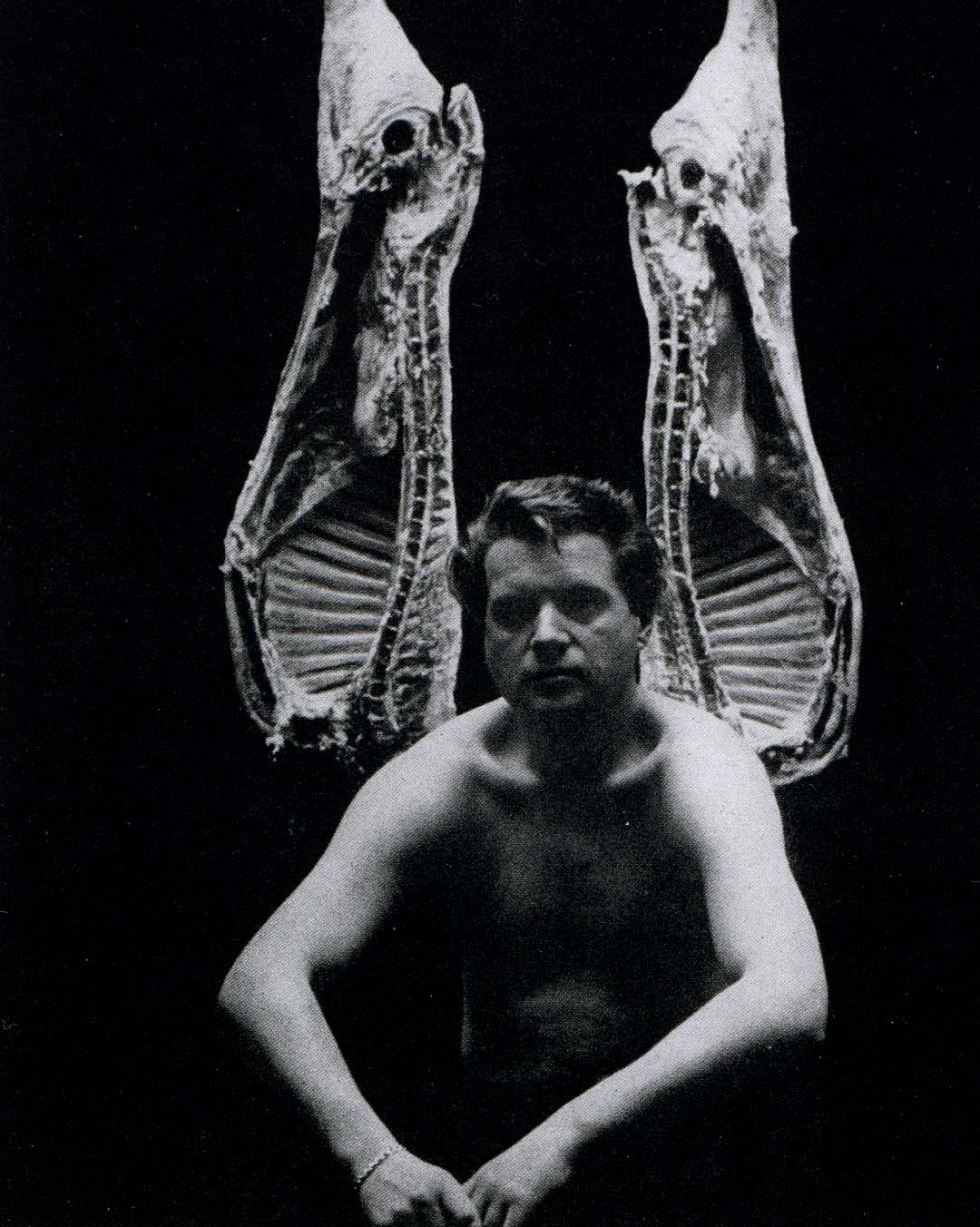
Bacon, however, clearly expressed his atheistic pessimism: “Man now realizes that he is an accident, that he is a completely futile being, that he has to play out the game without purpose, other than of his own choosing.” On another occasion, he remarked: “We are born and we die and there’s nothing else. We’re just part of animal life.”
Thus, Bacon, in terms of humanity and the supernatural, reached not only a position of unbelief but of despair. His paintings express modern humanity’s condition: dehumanized man dispossessed of any durable paradise.
________________________
I first read about Francis Bacon in a book written by Francis Schaeffer. I was interested in looking into his art. His art really shows where modern man has come to the place of desperation since modern man has embraced the closed system that does not include God. What is left for man but what time and chance can bring. Bacon admitted that he was very depressed about man’s future and it comes out in his paintings.
I wish he would have read the work of Francis Schaeffer. I have posted links to Schaeffer’s works below.
Photograph of Bacon taken by John Deakin for Vogue, 1962
The Striptease of Humanism
This, then, is “the striptease of humanism,” a gathering crisis of optimism, an escape from reason, a surfacing of subterranean pessimism. Understanding it as the daily climate of our time, we can now analyze more closely certain features of its arrival and of its permanent residue.
First, there is the strong element of surprise. For any who had read Nietzsche, this should not have been so but in fact it was. In 1929 Freud remarked on this in Civilization and Its Discontents: “Man has, as it were, become a prosthetic god. . . . Future ages . . . will increase man’s likeness to God still more. But . . . present day man does not feel happy in his Godlike character.”33 In 1951 Camus felt it still more keenly: “During the last century, man cast off the fetters of religion. Hardly was he free, however, when he created new and utterly intolerable chains. . . . The kingdom of grace has been conquered, but the kingdom of justice is crumbling too. Europe is dying of this deception.”34
The situation is pregnant with irony: There is a crisis of disbelief as well as a crisis of belief. Some religious thinkers may be endlessly reporting the death of God (almost as their contemporary creedal confession), but the fact no longer seems heroic to the perceptive atheist. If the city of God has been razed, who is in need of a home now? Who feels the chill most keenly?
A second feature is the irreversibility of the exposure of humanism. It would be comforting to regard the present pessimism as a cycle, or swing of the pendulum, but there are various reasons why we cannot. For one thing there are new factors which prevent a reversal. Here we come to the difference between Oswald Spengler and Max Weber. Spengler thought the decline of the West was essentially what had happened before. Weber held that what was occurring had never happened before. It was different because, although there were similar symptoms, the “disenchantment of the world” by technology was new. So the situation was irreversible.
These elements of surprise and irreversibility were two features of the arrival of the crisis, but of even greater importance are the various symptomatic features of its continuing presence. We shall now examine these. The key to the understanding of each of them is that they stem from the humanist’s lack of a basis, the loss of center, the death of absolutes.
Alienation
The first symptom is alienation which occurs when the lack of basis is actually seen, felt or experienced. Whenever a man is not fulfilled by his own view of himself, his society or his environment, then he is at odds with himself and feels estranged, alienated and called in question. Optimistic humanism, lacking sufficient basis for the full range of humanness, also lacks sufficient balance, and alienation is inescapable when this is so. First of all this is true today of metaphysical alienation. Denying the optimistic implications of Darwinism, Nietzsche pointed to man’s “ontological predicament”: “Man is a rope, tied between beast and overman — a rope over an abyss.”49 Caught between the all-too-human and the superhuman, man, if he is not to despair, must stretch across an unbridgeable chasm to the revalued ideals of the overman. Nietzsche himself felt mocked, even in madness, by this impossible struggle. As all-too-human he knew only anguish, terror, loneliness, desperation, disgust, “the great seasickness” of the world without God.
This last phrase was picked up by Sartre in his first novel Nausea, a classic of existentialism. Walking in the city park one day, Roquentin was overcome by the nausea of the meaninglessness of life. Looking around him, he concluded, “Every existent is born without reason, prolongs itself out of weakness and dies by chance.”50 He was forced to the unhappy conclusion that the key to life is its fundamental absurdity. Man as man has to reach towards being God in order to fulfill his aspirations, yet with God dead and the world as it is these aspirations are limitations cast back in his face as an absurdity. Sartre’s reluctant conclusion is that “man is a useless passion.”51
The drastic extremity of this is well portrayed in the drama of Samuel Beckett, whose Parisian home and early research in Marcel Proust’s philosophy of time bring him close to the thought world of existentialism. In Waiting for Godot, Godot’s failure to arrive reduces all of life to the level of irrational absurdity.52 In Krapp’s Last Tape, the personality of the old man is completely desiccated by the sequential flow of time shattering his identity into fragments.53 Beckett’s ultimate in economic starkness is Breath, thirty seconds in duration, with no actors nor dialogue nor any props on the stage except miscellaneous rubbish; the whole script is the sigh of human life from a baby’s cry to a man’s last gasp before the grave.
The same metaphysical alienation, expressed in terms of the counter culture, is brilliantly distilled in Yoko Ono’s single line poems in Grapefruit.54All of them are capsules of nihilism, variations on a theme of meaninglessness. “Map Piece” reads, “Draw a map to get lost.” Another called “Lighting Piece” runs, “Light a match and watch it till it goes out.” These are the poetic counterpoint to Breath.
The same sense of alienation can be heard in many expressions of protest chafing at the constricting philosophies and psychologies dominant today. Paul Simon cries out in “Patterns” against the reductionism of determinism that conceives of man as a rat in a cage.55
Jean Luc Godard says much the same in his film La Chinoise.56When love is meaningful, to say “I don’t love you” is tragic, but when love is reduced to the chemistry of the color of the eye or the preference of the sweater color, to say “I don’t love you” is to say almost nothing.
Metaphysical alienation is also seen in the attempt to escape from nihilism through gamesmanship. Whether the games are crass, like the money or success games, or sophisticated and esoteric, like aesthetics or meditation techniques, they are only games created to escape the meaninglessness. Speaking as an artist, Francis Bacon says that man now realizes that he is an accident, a completely futile being and that he can attempt to beguile himself only for a time. Art has become a game by which man distracts himself.57
The heightened tragedy of the contemporary situation is that this is being confirmed, cemented and compounded by a newly felt sociological alienation. This alienation stems partly from the disjointedness of society, but even more from the estrangement induced by a modern technological environment in which men feel unfulfilled, depersonalized, dehumanized and condemned to grow up absurd. Jacques Ellul describes this graphically: “The human being was made to breathe the good air of nature, but what he breathes is an obscure compound of acids and coal tars. He was created for a living environment, but he dwells in a lunar world of stone, cement, asphalt, glass, cast iron and steel. The trees wilt and blanch among sterile and stone facades. Cats and dogs disappear little by little in the city, going the way of the horse. Only rats and men remain to populate a dead world.”58 Man is ill at ease in this environment and the tension demanded of him weighs heavily on his time and nerves, his life and being. If he tries to escape, he is drawn towards an entertainment world of dreams, and if he complies, he falls into a life of crowded, organized routine in which to conform is to feel the malaise of maladjustment.
This alienation, metaphysical and environmental, is an inescapable consequence of humanism and symptomatic of its lack of a basis, making man unfulfillable on the basis of his own views of himself…..
Modern humanism also refuses to touch the danger points, to face the logic of its own premises. It prefers to live in intellectual inconsistency. In The Disinherited Mind Erich Heller says, “In Kafka we have before us the modern mind, seemingly self-sufficient, intelligent, sceptical, ironical, splendidly trained for the great game of pretending that the world it comprehends in sterilized sobriety is the only and ultimate reality there is — yet a mind living in sin with the soul of Abraham. Thus he knows two things at once, and both with equal assurance; that there is no God, and that there must be God.”83
Kafka was not unique. Nietzsche himself, for all his scorn, made his leap of faith. He asserts that any attempt to understand the universe is prompted by man’s will to power but fails to see that his own conception of the will to power must then be admitted by him to be a creation of his will to power. What to Kafka was a weakness is now a disease of almost epidemic proportions. Erich Fromm ponders, “In the nineteenth century the problem was that God is dead, in the twentieth century the problem is that man is dead,”84 but Fromm shies away from exploring the connection between the two. R. D. Laing poses the alternative, “Deus absconditus. Or we have absconded,”85 but his vision of the divine is Eastern, not Christian, and his use of Luther’s concept is merely rhetorical.
Thus optimistic humanism is currently in the throes of a gathering crisis. But we dare not let this negate the humanness of its ideals. What is needed is a stronger humanism, not a weaker one. We need a concern for humanness that has a basis for its ideals and the possibility of their substantial realization.
There are several requirements which any contending solution must satisfy. First, it must provide a basis that will define and demonstrate the individuality of man as human. Here the Eastern conceptions of man with their essential negation of the value of man in this life, the communist subordination of the individual to the state, and the post-Christian failure of Western man to resist the trends of dehumanization point to answers which do not satisfy this first requirement.
Second, it must provide a basis for the fulfillment of an individual’s aspirations. The Eastern religions, communism and humanism again fall short for similar reasons. So also do determinism and existentialism.
Third, it must provide a basis for the substantial healing of man’s alienations in terms of an individual’s becoming more fully himself. Many views falter here.
Fourth, it must provide a basis for community, combining social unity and diversity, and it must avoid the chaos of relativism or the swing to control seen in many modern states and intentional communes.
These together must provide a basis for defining and demonstrating a humanness sufficiently robust to be an anchor against the dehumanization coming from social disruption and the fear of global destruction.
A Third Way is obviously required — one which speaks to the basic situation of humanity, both in individuality and in community. It must provide an answer to existentialism and a fulfillment to optimistic humanism. But this is still to run ahead of ourselves.
With the erosion of the Christian culture and the crisis of humanism, the direction of Western culture is uncertain. Will we see a desperate vacuum from which nihilism will rise? Will we lurch on uneasily to a new technological barbarism? Will a novel mysticism turn the West into the East? Or will the slow disintegration of Western culture herald a decline of power, until the egoism of Western culture is judged by the hammer of the Soviets?
Only the future will show. Curiously, the recent pre-occupation with “the end of ideology” has given rise to a new ideology — futurology. Here evolutionary optimistic humanism has its last chance. If, searching into his future, man finds grounds for believing in himself and his ability to control his future, then secular humanism may become solvent again. This quest forms the story of our next chapter.
Notes
Friedrich Wilhelm Nietzsche, The Gay Science, 125, in The Portable Nietzsche (New York: The Viking Press, 1954), p. 96; C. G. Jung. “Epilogue,” Modern Man in Search of a Soul (New York: Routledge Books, 1933); Bertrand Russell, Has Man a Future? (Harmondsworth: Penguin Books, 1961), p. 110; Federico Fellini, Fellini’s Satyricon, ed. Darlo Zanelli, trans. Eugene Walters and John Matthews (New York: Ballantine Books, 1970), p. 269.
Quoted in Kenneth Clark, Civilisation (London: John Murray Ltd., 1971), p. 104.
Quoted in ibid., p. 101.
Peter Gay, The Enlightenment: An Interpretation (New York: Alfred A. Knopf, Inc., 1966), p. 44.
Ibid.,p.417.
Michael Harrington, The Accidental Century (Harmondsworth: Penguin Books, 1967), p. 31.
Gordon Childe, Man Makes Himself (New York: Mentor Books, 1951).
Julian Huxley, ed., The Humanist Frame (London: George Allen and Unwin Ltd., 1961), p. 44.
Ibid.,p.7.
Algernon Charles Swinburne, “Hymn of Man.”
J. Huxley, p. 6.
Ibid., p. 26.
Harrington, p. 35.
Heinrich Heine, quoted in WaIter Kaufmann, Nietzsche: Philosopher, Psychologist, Antichrist (New York: Meridian Books, 1956), p. 375.
Nietzsche, The Will to Power, 1-2, quoted in Kaufmann, p. 103.
C. S. Lewis, Christian Reflections (London: Geoffrey Bles Ltd., 1967), p. 82.
Frantz Fanon, The Wretched of the Earth, trans. Constance Farrington (Harmondsworth: Penguin Books, 1967), p. 251.
lbid., p.21.
Letter of Aldous Huxley to Sibylle Bedford quoted in Time, May 4, 1970.
J. R. Platt, The Step to Man (New York: John Wiley & Sons Ltd., 1966), p. 196.
Norman O. Brown, Life Against Death (London: Sphere Books Ltd., 1968), p. 267.
See discussion in Nigel Calder, Technopolis (London: MacGibbon & Kee Ltd., 1969), pp. 98-99.
Arnold Toynbee, “Changing Attitudes towards Death in the Modern Western World” in Arnold Toynbee and others, Man’s Concern with Death (London: Hodder and Stoughton Ltd., 1968), p. 125.
Arthur Koestler, The Ghost in the Machine (London: Hutchinson & Co. Ltd., 1967), p. 15.
Viktor E. Frankl, “Reductionism and Nihilism” in Beyond Reductionism, ed. Arthur Koestler and J. R. Smythies (London: Hutchinson & Co. Ltd., 1969), p. 398.
Mortimer J. Adler, The Difference of Man and the Difference It Makes (London: Holt, Rinehart & Winston Ltd., 1967).
Quoted in T. M. Kitwood, What Is Human? (Downers Grove, Ill.: InterVarsity Press, 1970), p. 49.
Nietzsche, Ecce Homo, IV, 1, as quoted in Kaufmann, pp. 83-84.
Harrington, p. 26.
Koestler, p. 313.
Fanon, pp. 251-52.
Harrington, p. 36.
Sigmund Freud, Civilization and Its Discontents, Standard Works of Freud, 21 (London: The Hogarth Press Ltd., 1961), p. 91-92.
Albert Camus, The Rebel, trans. Anthony Bower (Harmondsworth: Penguin Books, 1962), pp. 243-44.
Nietzsche, The Gay Science, 125.
Quoted in Gay, p. 65.
Quoted in Kitwood, p. 54.
Erich Heller, The Disinherited Mind (Harmondsworth: Penguin Books, 1961), p. 75.
Nietzsche, p. 409.
Nietzsche, Thus Spake Zarathustra, I, 11, in The Portable Nietzsche, p. 160.
Fyodor Dostoevsky, The Possessed (New York: Signet Classics, 1962), pp. 384-85.
Camus, The Rebel, p. 199.
Fyodor Dostoevsky, The Brothers Karamazov (Harmondsworth: Penguin Books, Inc., 1968), p. 733.
Quoted in Camus, The Rebel, p. 58.
Quoted in ibid., p. 62.
Quoted in ibid.
Quoted in ibid.
Heller, p. 76.
Nietzsche, Zarathustra’s Prologue, 4, in The Portable Nietzsche, p. 126.
Jean Paul Sartre, Nausea (Harmondsworth: Penguin Books, 1965), p. 191.
Sartre, Being and Nothingness, trans. Hazel E. Barnes (London: Methuen, 1957), p. 566.
Samuel Beckett, Waiting for Godot (London: Faber and Faber Ltd., 1956).
Samuel Beckett, Krapp’s Last Tape (New York: Grove Press, Inc., 1958).
Yoko Ono, Grapefruit (London: Peter Owen Ltd., 1970).
Paul Simon, The Paul Simon Songbook, C.B.S. 62579.
Jean Luc Godard, La Chinoise, filmed 1967.
Quoted in H. R. Rookmaaker, Modern Art and the Death of a Culture (Downers Grove, Ill.: InterVarsity Press, 1970), p. 174.
Jacques Ellul, The Technological Society, trans. John Wilkinson (New York: Alfred A. Knopf, 1970), p.321.
Chores and Roy Medvedev, A Question of Madness (New York: Alfred A. Knopf, 1971).
“Psychoadaptation, or How to Handle Dissenters,” Time,September 27, 1971, p. 45.
lbid., p.44.
Quoted in Harrison Salisbury, “Introduction,” The Prison Diary of Ho Chi Minh (New York: Bantam Books, 1971), p. ix.
Fyodor Dostoevsky, The Idiot (New York: Bantam Books, 1958), p. 71.
Jerzy Grotowski, Towards a Poor Theatre (New York: Simon and Schuster, 1968), p. 123.
Erich Fromm, The Sane Society (New York: Routledge Books, 1956).
R. D. Laing, The Politics of Experience (Harmondsworth: Penguin Books, 1967), p. 24.
Ibid., p.24.
David Cooper, ed., The Dialectics of Liberation (Harmondsworth: Penguin Books, 1968).
Malcolm Muggeridge, Tread Softly for You Tread on My Jokes (Glasgow: William Collins Sons & Co. Ltd.), p. 28.
Ibid., p. 29.
Christopher Booker, The Neophiliacs (Glasgow: Fontana, 1970), p. 70.
Ibid., p. 44.
Ibid., p. 339.
Ernst Fischer, The Necessity of Art, trans. Anna Bostock (Harmondsworth: Penguin Books, 1963).
Lewis Feuer, “What Is Alienation? The Career of a Concept,” New Politics, Spring 1962, pp. 116-34.
Fischer, p. 80.
Erich Frornm, Marx’s Concept of Man (New York: Frederick Ungar Publishing Co., 1961).
Hermann Dooyeweerd, A New Critique of Theoretical Thought, 4 vols. (Nutley, N.J.: The Presbyterian and Reformed Publishing Co., 1957); The Twilight of Western Thought (Nutley, N.J.: Craig Press, 1960).
Francis A. Schaeffer, The God Who Is There (Downers Grove, Ill.: InterVarsity Press, 1968); Escape from Reason(Downers Grove, III.: InterVarsity Press, 1968).
J. A. Rushdoony, “Preface,” Dooyeweerd, The Twilight of Western Thought, p. 9.
Camus, The Rebel, p. 16.
Nietzsche in a letter to Gersdorff, November 7, 1970, quoted in Erich Heller, p. 70.
Ibid., p.181.
Fromm, Sane Society, p. 360.
Laing, The Politics of Experience, p. 118.
Author
Os Guinness is an Englishman born in China during the war with Japan and educated at the University of London. He has traveled widely in the East and lectured to student groups in Europe, the United States and Canada. His major work was with Francis Schaeffer at L’Abri Fellowship in Switzerland.
Today I read an article in the New York Times, “Son of Evangelical Royalty, turns his back and tells the tale,” August 19, 2011. The liberal Max Brantley of the Arkansas Times Blog called this article by Mark Oppenneimer “the best reading of the morning.” Oppenneimer asserted: Edith Schaeffer also wrote books, and in 1977, Frank, an amateur filmmaker, […]
E P I S O D E 1 0 How Should We Then Live 10#1 FINAL CHOICES I. Authoritarianism the Only Humanistic Social Option One man or an elite giving authoritative arbitrary absolutes. A. Society is sole absolute in absence of other absolutes. B. But society has to be led by an elite: John Kenneth […]
E P I S O D E 9 How Should We Then Live 9#1 T h e Age of Personal Peace and Afflunce I. By the Early 1960s People Were Bombarded From Every Side by Modern Man’s Humanistic Thought II. Modern Form of Humanistic Thought Leads to Pessimism Regarding a Meaning for Life and for Fixed […]
E P I S O D E 8 How Should We Then Live 8#1 I saw this film series in 1979 and it had a major impact on me. T h e Age of FRAGMENTATION I. Art As a Vehicle Of Modern Thought A. Impressionism (Monet, Renoir, Pissarro, Sisley, Degas) and Post-Impressionism (Cézanne, Van Gogh, Gauguin, […]
E P I S O D E 7 How Should We Then Live 7#1 I am thrilled to get this film series with you. I saw it first in 1979 and it had such a big impact on me. Today’s episode is where we see modern humanist man act on his belief that we live […]
I have made it clear from day one when I started this blog that Francis Schaeffer, Milton Friedman, Ronald Reagan and Adrian Rogers had been the biggest influences on my political and religious views. Today I am responding to an unfair attack on Francis Schaeffer’s book “A Christian Manifesto.” As you can see on the […]
E P I S O D E 6 How Should We Then Live 6#1 I am sharing with you a film series that I saw in 1979. In this film Francis Schaeffer asserted that was a shift in Modern Science. A. Change in conviction from earlier modern scientists.B. From an open to a closed natural system: […]
E P I S O D E 5 How Should We Then Live 5-1 I was impacted by this film series by Francis Schaeffer back in the 1970′s and I wanted to share it with you. Francis Schaeffer noted, “Reformation Did Not Bring Perfection. But gradually on basis of biblical teaching there was a unique improvement. A. […]


 Total Welfare Spending Is Rising Despite Attempts at Reform
 Taxes per Household Have Risen Dramatically




 The Daily Hatch