Senator Mark Pryor wants our ideas on how to cut federal spending. Take a look at this video clip below:
Senator Pryor has asked us to send our ideas to him at cutspending@pryor.senate.gov and I have done so in the past and will continue to do so in the future.
On May 11, 2011, I emailed to this above address and I got this email back from Senator Pryor’s office:
Please note, this is not a monitored email account. Due to the sheer volume of correspondence I receive, I ask that constituents please contact me via my website with any responses or additional concerns. If you would like a specific reply to your message, please visit http://pryor.senate.gov/contact. This system ensures that I will continue to keep Arkansas First by allowing me to better organize the thousands of emails I get from Arkansans each week and ensuring that I have all the information I need to respond to your particular communication in timely manner. I appreciate you writing. I always welcome your input and suggestions. Please do not hesitate to contact me on any issue of concern to you in the future.
Reducing the number of consultants employed by the federal government by 150,000;
Suspending acquisition of new federal office space;
Trimming the federal vehicle budget by 5 percent; and
Freezing the federal travel budget at $8 billion15 (Total annual savings: $11 billion).
Implement some additional housekeeping items, including:
Taking back grants to state and local governments that have not been spent within the past three years;
Rescinding any remaining appropriated funds to promote the new $20 bill (2004 spending: up to $53 million, discretionary); and
Consolidating the dozens of small, irrelevant education programs that divert money from more effective education programs ($200 million, discretionary).
Entitlement spending is on autopilot, with annual spending determined by benefit formulas and caseloads.
Entitlements (excluding net interest) account for 56 percent of all federal spending and 14 percent of GDP—up from 10 percent of GDP three years ago.
The three largest entitlements are Social Security, Medicare, and Medicaid. Their total cost is projected to leap from 8.4 percent of GDP in 2007 to 18.4 percent by 2050.
Unless those three programs are reformed, policymakers will eventually have to choose from among:
$12,636 per household by 2050, and further thereafter;
Eliminating every federal program except Social Security, Medicare, and Medicaid; or
Increasing the national debt to unprecedented levels that could cause an economic collapse.
Milton Friedman’s film series “Free to Choose” Episode on Education part 5. It was Friedman’s voucher plan that was put into practice in Sweden in 1993.
DL: What do parents and students think of the voucher system?
TI: On a general level, most parents and students don’t specifically choose between one independent and one public school—people tend to choose the schools that fit their needs and requirements best, regardless of whether they are independent or public. In all cities and municipalities with widespread opportunities to choose, parents and students are more and more active in comparing different schools out of a wide range of quality and personal variables. This was also the main point in establishing an education market: People are different and have different needs and ways to reach their goals.
But when you ask people about their satisfaction with their choice or with their school as a whole, you can see that the independent schools outperform the public schools quite massively.
The latest national survey on parental satisfaction was undertaken in October 2009 and showed that parents with their children in independent schools are much more satisfied than parents with their children in public schools regarding all surveyed areas—such as, for example:
The school’s closeness to the parents’ “ideal school” ;
The stimulation and support of every single student;
The level of resources that are being spent on education, teacher engagement, the quality of teaching materials, information, and cooperation with parents; and
The sense of value of taxpayer money spent on education and trust for school management.
For every surveyed area there is at least a 10 percent higher satisfaction rate among independent school parents!
And regarding the voucher system itself, different surveys show that a majority of people view the right to choose school as almost a “natural” right. Some technical details might still be controversial among politicians (such as aspects of the profit-dividend issue), but among ordinary people, the right to choose is well rooted.
A clear majority of all parents, no matter if their kids go to independent or public schools, agree on that the independent school owners have right to show profits and to dispose of them at their own discretion!
Replacing Farm Subsidies with Farmer Savings Accounts. Intended to
remedy low crop prices and farmer poverty, the current farm subsidy system does
neither. Farm subsidies encourage overplanting, which drives prices down
further, necessitating even more subsidies. Moreover, rather than focusing on
low-income farmers, most farm subsidies go to commercial farmers who report an
average annual income of nearly $200,000. Claims that the agriculture industry
could not survive without large subsidies are contradicted by the fact that
nearly all subsidies go to growers of just five crops (wheat, cotton, corn,
soybeans, and rice), while fruit, vegetable, livestock, and poultry operations
thrive with almost no government aid.
The real problem—yearly income fluctuations due to crop and weather
unpredictability—can be solved inexpensively with farmer savings accounts. Under
the Heritage plan, growers of all crops, not just the “big five,” can save money
during boom years in tax-deductible IRA-style accounts and withdraw those funds
during bust years as taxable income, thus smoothing out their yearly income
fluctuations. An improved no-net-cost crop insurance system will assist when
major disasters deplete most farmers’ accounts. All farmers can participate in
the new system regardless of income or crop grown and at a fraction of the
current costtotaxpayers.
Capping and Reforming Antipoverty Spending. Since 1990, federal
antipoverty spending, including Medicaid, has expanded 236 percent faster than
inflation, from $190 billion to $639 billion (an increase of 2.2 percent of
GDP). Antipoverty spending has grown as much as Social Security, Medicare,
defense, and education spending combined. Overall, the federal government
spends approximately $28,000 per family with children in the bottom third of the
income table without encouraging independence. Many of the programs do not
include enforced work requirements and continue to reward illegitimacy and other
destructive behaviors that block the road to independence.
Once the unemployment rate drops back to normal levels (projected in 2014),
the Heritage plan returns total federal antipoverty spending to its 2007 level
(adjusted for inflation) and then caps total spending growth at the inflation
rate (using the medical inflation rate for the health care portion). Congress or
states could shift spending among antipoverty programs to increase effectiveness
as long as total spending does not exceed the cap. This cap and flexibility will
force lawmakers at all levels to reexamine the size and goals of the welfare
state and tailor assistance more efficiently to help families escape poverty and
dependence and achieve independence.
Other Spending Reforms. Multiple federal programs should be returned
to the state or local levels. For instance, there is no compelling reason for
Washington to finance local job training, justice, environmental, or community
and economic development programs. Therefore, the plan eliminates these federal
grant programs with the expectation that state and local governmentswill
determine whether to address these local issues with local funds and be held
accountable by local voters. Energy research and development spending that is
commercial in nature is moved to the private sector. Lawmakers are also expected
to pare $15 billion in costs associated with the estimated $125 billion in
annual federal payment errors.
Asset Sales. The federal government currently owns and controls vast
assets, including huge swaths of commercial land, especially in the West; power
generation facilities; valuable portions of the electromagnetic spectrum;
underutilized buildings; and financial assets. Given the federal government’s
huge debt, it makes sense to sell at least a portion of these assets, especially
those that are currently generating revenue below market levels (in which case
the sale value would be above the present value of the current income on the
assets). Sales of assets would immediately reduce the government’s operating
deficit and debt, reducing future interest costs.
The Heritage plan includes a program of asset sales totaling approximately
$260 billion over 15 years. This includes partial sales of federal properties,
real estate, mineral rights, the electromagnetic spectrum, and energy-generation
facilities.
Senator Mark Pryor wants our ideas on how to cut federal spending. Take a look at this video clip below:
Senator Pryor has asked us to send our ideas to him at cutspending@pryor.senate.gov and I have done so in the past and will continue to do so in the future.
On May 11, 2011, I emailed to this above address and I got this email back from Senator Pryor’s office:
Please note, this is not a monitored email account. Due to the sheer volume of correspondence I receive, I ask that constituents please contact me via my website with any responses or additional concerns. If you would like a specific reply to your message, please visit http://pryor.senate.gov/contact. This system ensures that I will continue to keep Arkansas First by allowing me to better organize the thousands of emails I get from Arkansans each week and ensuring that I have all the information I need to respond to your particular communication in timely manner. I appreciate you writing. I always welcome your input and suggestions. Please do not hesitate to contact me on any issue of concern to you in the future.
(UPDATE: A reader that used the username “therealchirpy” notes, “Although any affair with Picasso may be fictional, isn’t the ‘Adriana’ referred to in Allen’s ‘Midnight in Paris’ based on Hemingway’s mistress Adriana Ivancich.” I have found some evidence for that. I read a review that draws that same conclusion although some have said that Hemingway just had a crush on her. )
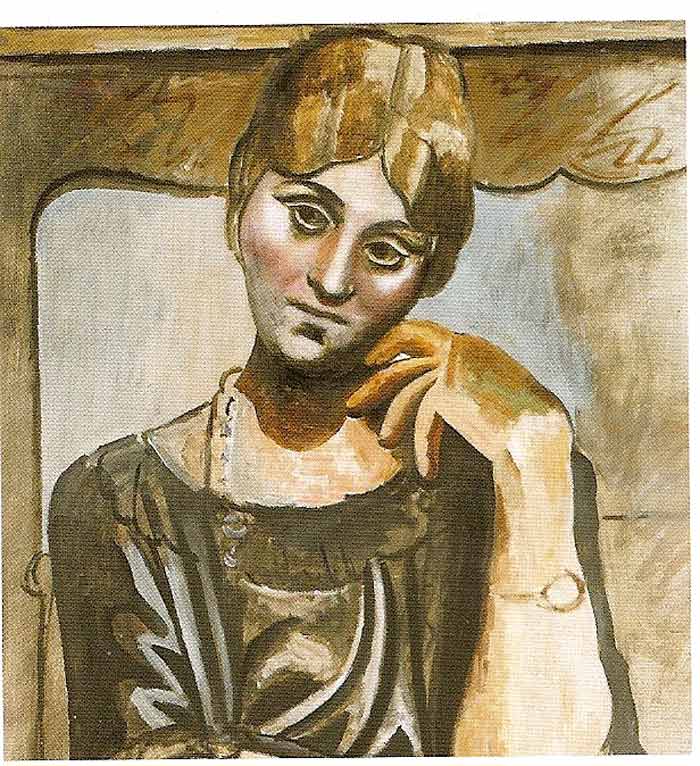
I can’t express how much I have learned during this series on the characters referenced in Woody Allen’s latest movie “Midnight in Paris.” Today’s is one of my favorites because she allows us to look at all of the women in Picasso’s life and in the process we get to take a closer look at how Picasso’s worldview was expressed in his paintings.
The character Adriana in “Midnight in Paris” is a fictional character but she exposes the fact that Picasso was constantly possessive of his mistresses and hateful at times to the women in his life. Francis Schaeffer in his film series “How should we then live?” has some very insightful commentary on Picasso and the loss of humanity pictured in his paintings. However, Picasso could not be consistent because when it came to painting Olga, Jacqueline and his children, Picasso would use all of abilities to show them the way God made them and not in a fragmented way.
Francis Schaeffer in the episode, “The Age of Fragmentation,” Episode 8 of HOW SHOULD WE THEN LIVE? noted:
Monet, Renoir, Pissaro, Sisley, Degas were following nature as it has been called in their painting they were impressionists.They painted only what their eyes brought them. But was there reality behind the light waves reaching their eyes? After 1885 Monet carried this to its conclusion and reality tended to become a dream. With impressionism the door was open for art to become the vehicle for modern thought. As reality became a dream, impressionism began to fall apart. These men Cezanne, Van Gogh, Gauguin, Seurat, all great post Impressionists felt the problem, felt the loss of meaning. They set out to solve the problem, to find the way back to reality, to the absolute behind the individual things, behind the particulars, ultimately they failed.
I am not saying that these painters were always consciously painting their philosophy of life, but rather in their work as a whole their worldview was often reflected. Cezanne reduced nature to what he considered its basic geometric forms. In this he was searching for an universal which would tie all kinds of individual things in nature together, but this gave a broken fragmented appearance to his pictures.
In his bathers there is much freshness, much vitality. An absolute wonder in the balance of the picture as a whole, but he portrayed not only nature but also man himself in fragmented form. I want to stress that I am not minimizing these men as men. To read van Gogh’s letters is to weep for the pain of this sensitive man. Nor do I minimize their talent as painters. Their work often has great beauty indeed. But their art did become the vehicle of modern man’s view of fractured truth and light. As philosophy had moved from unity to fragmentation so did painting. In 1912 Kaczynski wrote an article saying that in so far as the old harmony, that is an unity of knowledge have been lost, that only two possibilities remained: extreme abstraction or extreme naturalism, both he said were equal.
With this painting modern art was born. Picasso painted it in 1907 and called it Les Demoiselles d’Avignon. It unites Cezzanne’s fragmentation with Gauguin’s concept of the nobel savage using the form of the african mask which was popular with Parisian art circle of that time. In great art technique is united with worldview and the technique of fragmentation works well with the worldview of modern man. A view of a fragmented world and a fragmented man and a complete break with the art of the Renaissance which was founded on man’s humanist hopes.
Here man is made to be less than man. Humanity is lost. Speaking of a part of Picasso’s private collection of his own works David Douglas Duncan says “Of course, not one of these pictures was actually a portrait, but his prophecy of a ruined world.”
But Picasso himself could not live with this loss of the human. When he was in love with Olga and later Jacqueline he did not consistently paint them in a fragmented way. At crucial points of their relationship he painted them as they really were with all his genius, with all their humanity. When he was painting his own young children he did not use fragmented techniques and presentation. I want you to understand that I am not saying that gentleness and humanness is not present in modern art, but as the techniques of modern art advanced, humanity was increasingly fragmented.
The opposite of fragmentation would be unity, and the old philosophic thinkers thought they could bring forth this unity from the humanist base and then they gave this up.
How Should We Then Live – Episode 8 – The Age of Fragmentation
__________
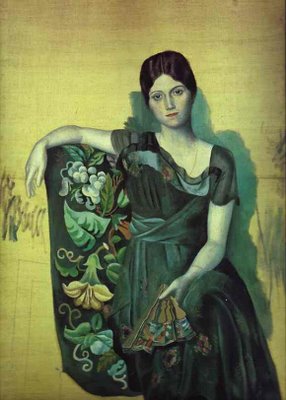
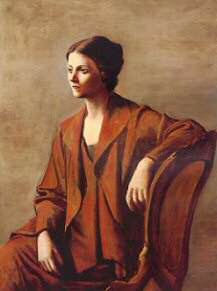
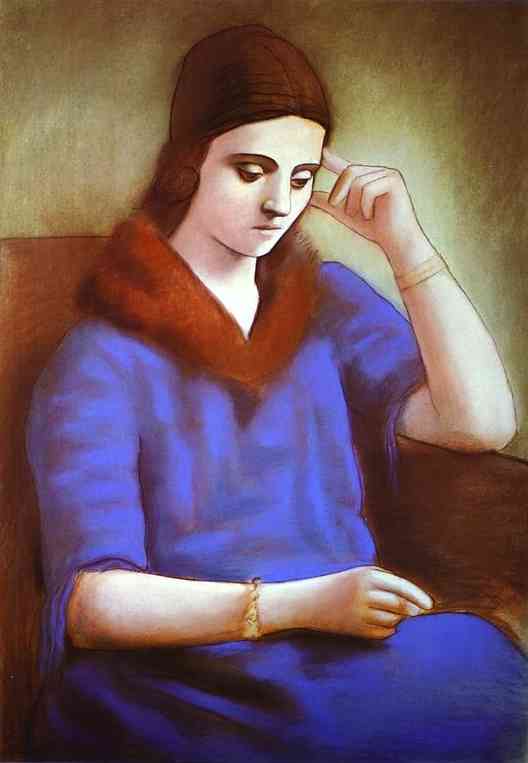
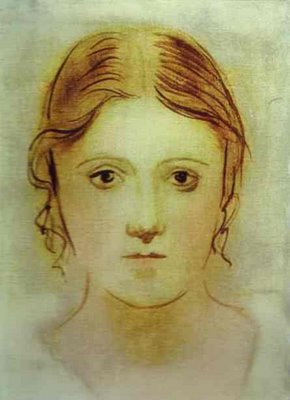
Olga Khokhlova and Picasso (1917-1927)
In 1917 ballerina Olga Khokhlova (1891-1955) met Picasso while the artist was designing the ballet “Parade” in Rome, to be performed by the Ballet Russe.
They married in the Russian Orthodox church in Paris in 1918 and lived a life of conflict.
She was of high society and enjoyed formal events while Picasso was more bohemian in his interests and pursuits.
Their son Paulo (Paul) was born in 1921 (and died in 1975), influencing Picasso’s imagery to turn to mother and child themes. Paul’s three children are Pablito (1949-1973), Marina (born in 1951), and Bernard (1959). Some of the Picassos in this Saper Galleries exhibition are from Marina and Bernard’s personal Picasso collection.
Portrait of Paul Picasso as a Child. 1923. Oil on canvas.
Collection of Paul Picasso, Paris, France.
________________________
Most of the art displayed in the Saper Galleries exhibition of original graphics and ceramics revolves around Picasso’s relations with his various mistresses and wives, sometimes overlapping, sometimes, private, and sometimes public. It has been said that Picasso changed his companions as often as he changed painting styles. Many of his portraits are of his wives, mistresses and children. Click herefor a genealogical picture of these relationships. Picasso had two wives (Olga and Jacqueline) and four children by three women. We have assembled this summary below to provide you a better understanding of eight of Picasso’s major relationships.
1904-1912
Artist model Fernande Olivier (1881-1966) was Picasso’s first long term relation and subject of many of Picasso’s Rose Period paintings (1905-07). Picasso met her after settling in Paris in 1904. Although Fernande was married, she stayed with Picasso for 7 years. Fernande modeled for other artists between 1900 and 1905 after which she moved in with “the Spanish artist”, Picasso, who then prevented her from modeling for others. Fernande’s having published selections from the memoirs of her life with Picasso infuriated the artist but eventually, at age 70, Picasso paid the ailing and bedridden Fernande a small pension. The full memoir was not published until 1988, “Loving Picasso”. In early 2004 the National Gallery in Washington, D.C. had an exhibition of 60 portraits of Fernande that Picasso painted in a few months of 1909.
1912-1915
Fernande left Picasso in 1912, months after Picasso took an interest in Marcelle Humbert, known as Eva Gouel (1885-1915). Picasso was devastated by her early death due to tuberculosis or cancer in 1915. Picasso professed his love to Eva by painting “I Love Eva” in some of his paintings. Still, during Eva’s sickness Picasso managed a relationship with Gaby Lespinasse. (Picasso’s father died in May, 1913 at the time that Eva moved in with him.)
1917-1927
In 1917 ballerina Olga Khokhlova (1891-1955) met Picasso while the artist was designing the ballet “Parade” in Rome, to be performed by the Ballet Russe. They married in the Russian Orthodox church in Paris in 1918 and lived a life of conflict. She was of high society and enjoyed formal events while Picasso was more bohemian in his interests and pursuits. Their son Paulo (Paul) was born in 1921 (and died in 1975), influencing Picasso’s imagery to turn to mother and child themes. Paul’s three children are Pablito (1949-1973), Marina (born in 1951), and Bernard (1959). Some of the Picassos in this Saper Galleries exhibition are from Marina and Bernard’s personal Picasso collection.
1927-1936
In 1927 Picasso met Marie-Thérèse Walter (1909-1977), a 17 year old who Picasso then lived with in a flat across the street from his marital home (while still married to Olga). Marie-Thérèse and Picasso had a daughter, Maya (Maria de la Concepcion) on October 5, 1935. (Picasso and Olga later separated although they remained married so Olga would not receive half of Picasso’s wealth — until she died in 1955. ) Picasso’s relation with Marie was kept from Olga until Olga was told of Marie’s pregnancy. Marie understandably became jealous when Picasso started to fall in love with Dora Maar in 1936, a year after Maya was born. It was Marie-Thérèse who was the inspiration for many of Picasso’s famous Vollard Suite etchings. Marie-Thérèse died by hanging herself in 1977, four years after Picasso died. Maya’s son, Olivier Widmaier wrote “Picasso: The Real Family Story” about his artist grandfather, in 2004.
1936-1944
In 1936 54-year old Picasso met Yugoslavian Dora Maar (1907 -1997), the photographer who documented Picasso’s painting of Guernica, the 1937 painting of Picasso’s depiction of the German’s having bombed the Basque city of Guernica, Spain during the Spanish Civil War. She became Picasso’s constant companion and lover from 1936 through April, 1944. Maar went back to painting and exhibited in Paris soon after Picasso left her for Françoise. Picasso referred to Dora as his “private muse”. In later years she became a recluse, dying poor and alone.
1943-1953
In 1943 Picasso (age 62) then kept company with young art student Françoise Gilot (born in 1921). Their two children were Claude (1947) and Paloma (1949) who was named for the dove of peace that Picasso painted in support of the peace movement post World War II. Gilot, frustrated with Picasso’s relationships with other woman and his abusive nature left him in 1953. Gilot’s book “Life with Picasso” was published 11 years after their separation. In 1970 she married American physician-researcher Jonas Salk (who later died in 1995).
1951-1953
In 1944 17-year old Genevieve Laporte (born in 1927) interviewed Picasso for a school newspaper. Years later in May,1951 Picasso began an affair with the then-24 year old. The relationship started when Laporte visited the 70-year old Picasso at his studio while he was still living with Françoise Gilot. That summer of 1951 Picasso took Laporte to St Tropez, leaving Françoise behind. After declining Picasso’s invitation to move in with him in St. Tropez, she left him in 1953 at the same time that Françoise left the artist.
In 1972 she went public with the affair and stored the art that Picasso created of her in a safe. In 2005, at age 79, the poet Laporte auctioned 20 drawings of her that Picasso created during their secret affair. Picasso’s time with Laporte has been referred to as Picasso’s “tender period”.
1953-1973
Dejected and alone, in 1953 Picasso met Jacqueline Roque (1926 -1986) at the Madoura Pottery where Picasso created his ceramics. In 1961 (when Picasso was 79) she became his second wife. Picasso created more works of art based on Jacqueline than any of his other loves, in one year painting over 70 portraits of her.
When Picasso died on April 8, 1973, Jacqueline, who had been with Picasso for 20 years, prevented Picasso’s children Claude and Paloma from attending his funeral. Jacqueline died from shooting herself in 1986.
Seeing the huge Picasso exhibit now touring the world reminded me of why Christians should make time for the fine arts.
Karen Swallow Prior
Amid the press of daily demands, most of us think we don’t have time for enjoying the fine arts. A recent visit to a Picasso exhibit reminded me why Christians especially should make time for it.
If Horace’s adage is correct, that good art both “teaches and delights” (a description that certainly applies to the works of the Creator), then Pablo Picasso has rightly earned his reputation as one of the great artists of the modern age.
“Picasso: Masterpieces from the Musee National Picasso, Paris,” an exhibit touring worldwide during renovation of its permanent home in Paris, proved Picasso’s ability to delight even before gaining admission to the show. On the day I attended, traffic was gridlocked, the parking garage was full, and those like me with pre-paid reservations for an appointed time found out our tickets granted a place in line with hundreds of other ticket holders. And no wonder: During its three-month run at the Virginia Museum of Fine Arts (one of only three U.S. stops), a whopping 229,729 people made time for Picasso.
Of course, just because something is popular doesn’t mean it’s good. But Picasso really is good. Known for his place in the avant-garde as one of the originators of cubism, Picasso also produced works in the schools of naturalism and classicism. This exhibit of 176 pieces from among those Picasso selected himself for his personal collection featured a breathtaking array of mediums, styles, genres, and techniques: chalk drawings, classical portraits, sculptures, collages, bronze busts, and photographs.
To dismiss Picasso’s more abstract paintings as mere child’s play, as some do, is a great error. This was a serious artist. To prepare for the creation of his greatest masterpiece, Les Desmoiselles d ’Avignon(1907), Picasso produced 1,000 sketches and studies. Although the eleven-room exhibit represented a fraction of the works produced over a lifetime (Picasso began painting as a teenager and didn’t stop until his death in 1973, at age 92) from it, a worldview clearly emerges. So, too, does the reminder that Christians who wish to have significant influence in the culture ignore the arts at their peril.
In How Should We Then Live?, Francis Schaeffer explains, “In great art the technique fits the worldview being presented.” On this test alone, Picasso passes with flying colors. Les Desmoiselles d ‘Avignon was shocking both for its content (nude prostitutes) and its form (human figures reduced to geometric angles representing multiple perspectives).
Literature professor Gene Edward Veith describes how Picasso’s efforts to depict reality “as it is” resulted, ironically, in an extreme version of classical formalism that turns in on itself. In the “attempt to pin down objective form,” Picasso “reduces human beings to objects,” mere “grotesque caricatures or mathematical patterns.” Picasso’s work marked a watershed in art history, Veith says, ushering in a kind of art that’s “cut off from ordinary perception and dependent upon theory. The work of art no longer can stand alone; it needs an explanation.”
The worldview expressed by Les Desmoiselles d ‘Avignon and the body of Picasso’s works is one in which the “real” or “nature” exists underneath the surfaces; reality cannot be singularly or finally captured or represented, so is analyzed and dissected beyond recognition. With Les Desmoiselles d ‘Avignon, Schaeffer claims, came the age of modern art, a period characterized by the same experimentation, subjectivity, and rejection of tradition that defines the modern worldview.
Take just one issue, one at the center of the culture wars and the focus of Picassos’ masterpiece: sex. The experimentation, subjectivity, and rejection of tradition that define modern art also describe Picasso’s approach to sex in both his life and his art.
Picasso was married twice and had numerous affairs, mistresses, and girlfriends. He depicted many of these women in his paintings. The various styles, colors, moods, and techniques of these works reveal the fragmentation of his relationships and his skewed perspective on sexual relationships. His depictions of women range from classical to naturalistic to cubist. His most characteristic feature — uneven faces in which one eye is higher than the other — reflects a disjointed worldview based on two ways of seeing the world: the way of nature (the lower) and the way of grace (the higher). Schaeffer describes these realms of grace and nature as those dealing with the things of God, universals, and meaning (grace), and the created order of humanity, particularities, and individual experience (nature). Both realms are evident in the body of Picasso’s works, but are rarely in harmony, tending instead to reflect a dichotomized view of nature and grace at war with one another.
Thus Picasso’s portrayals of sexual liaisons frequently resort to abstraction: discombobulated human figures intertwine, limbs arranged helter-skelter, recognizable as isolated parts but not as organic wholes. One mother who brought her young daughter to the exhibit stood before the surrealist painting Figures at the Seashore (1931), explaining to her child, “See? Here are arms . . . boobs . . . and legs.” When nature and grace are dissevered, so too is everything else. Schaeffer says that in the early modern age when nature was separated from God, nature began to “eat up” grace. One can see this phenomenon at work in Picasso’s paintings and personal life.
One of Picasso’s mistresses, Marie-Thérèse Walter, was only 17 when the then-married 45-year-old first seduced her. She later bore him a daughter but eventually found herself replaced by a new mistress. A few years after Picasso’s death, Marie-Thérèse hanged herself.
Just as Christians can and should critique the worldviews expressed by the world’s great artists, so too is our worldview displayed through our creative works. What worldview does the world see in the artistry of Christians today?
Woody’s in good form and Paris looks glorious in this droll time-traveling fantasy.
Venue:
Cannes Film Festival (Opening night, Out of Competition)
Opens:
May 20 (Sony Pictures Classics)
Cast:
Owen Wilson, Rachel McAdams, Marion Cotillard, Michael Sheen
Director-screenwriter:
Woody Allen
Literary giants of the 1920s and Owen Wilson interact in Woody Allen’s love letter to the City of Light.
As beguiling as a stroll around Paris on a warm spring evening — something that Owen Wilson’s character here becomes very fond of himself — Midnight in Paris represents Woody Allen’s companion piece to his The Purple Rose of Cairo, a fanciful time machine that allows him to indulge playfully in the artistic Paris of his, and many other people’s, dreams. A sure-fire source of gentle amusement to Allen’s core audience but unlikely to connect with those with no knowledge of or feel for the Paris of the Fitzgeralds, Hemingway, Gertrude Stein and Picasso, this love letter to the City of Light looks to do better-than-average business for the writer-director in the U.S. upon its May 20 release, and expectations in certain foreign territories could be even higher.
As has happened before when Allen has filmed in photogenic foreign locales — London in Match Point, Barcelona in Vicki Cristina Barcelona — the director seems stimulated by discovering the possibilities of a new environment. In fact, Allen has worked in Paris before, as a writer and actor in What’s New Pussycat? 46 years ago and in one section of Everyone Says I Love You, but this is the first time he’s given the city the royal treatment.
Granted, it’s mostly a touristic view of the city, as witness the voluptuously photographed opening montage of famous sites, but that’s entirely acceptable given that the leading characters are well-off Americans on vacation. Playing Allen’s alter ego this time around is Owen Wilson as Gil, a highly successful hack Hollywood screenwriter still young enough to feel pangs over not having seriously tested himself as a novelist.
That things may not be entirely right between Gil and his pushy fiancée Inez (Rachel McAdams) becomes clear early on, as the couple tours around with Inez’s friends Carol (Nina Arianda) and Paul (Michael Sheen), the latter an insufferable expert on all things cultural (that Inez’s parents are right-wingers also allows Allen to sneak in some Tea Party jokes). “Nostalgia is denial,” Paul intones to Gil, who is keen to break off on his own to indulge his own reveries of the literary Paris that fuels his creative imagination.
Lo and behold, that night, while wandering through a quiet part of the city, Gil is invited into an elegant old car carrying some inebriated revelers. Arriving at an even more elegant party, Gil shortly finds that he’s in the company of F. Scott and Zelda Fitzgerald and that it’s Cole Porter playing the piano. Later, they end up at a bar with Ernest Hemingway, who promises to show Gil’s unfinished novel to Gertrude Stein.
And so begins a flight of fancy that allows Gil to circulate with, and receive a measure of approval from, his lifelong literary heroes, not to mention such other giants as Dali (a vastly amusing Adrien Brody), Picasso, Man Ray, T.S. Eliot and Luis Bunuel, to whom the young American gives the premise of The Exterminating Angel. If not more important, he also meets the beauteous Adriana (Marion Cotillard), the former lover of Braque and Modigliani who’s now involved with Picasso, will shortly go off with Hemingway but is also curiously receptive to Gil, who seems somehow different than everyone else.
After trying but failing to bring the balky Inez along through the midnight portal along with him, Gil keeps returning to the 1920s night after night, getting pertinent advice from Stein about his novel and becoming seriously distracted by Adriana, who herself would prefer to have lived during La Belle Epoque. Although it’s all done glibly in traditional Allen one-liner style, the format nonetheless allows the writer, who has never been shy about honoring his idols in his work, to reflect on the way people have always idealized earlier periods and cultural moments, as if they were automatically superior to whatever exists at the time. “Surely you don’t think the ‘20s is a Golden Age?” Adriana asks a bewildered Gil, who has always been so certain of it. “It’s the present. It’s dull,” she insists.
For anyone whose historical and cultural fantasies run anywhere near those that Allen toys with here, Midnight in Paris will be a pretty constant delight. As Allen surrogates go, Wilson is a pretty good one, being so different from the author physically and vocally that there’s little possibility of the annoying traces of imitation that have sometimes afflicted other actors in such roles. Cotillard is the perfect object of Gil’s romantic and creative dreams; Kathy Bates, speaking English, French and Spanish, makes Stein into a wonderfully appealing straight-shooter, Sheen has fun with his fatuous walking encyclopedia role and McAdams is a bundle of argumentative energy in a role one is meant to find a bit off-putting. French first lady Carla Bruni is perfectly acceptable in her three scenes as a tour guide at the Rodin Museum, while Corey Stoll very nicely pulls off the trick of both sending up Hemingway’s manly pretentions and honestly conveying his core artistic values.
Darius Khondji’s cinematography evokes to the hilt the gorgeously inviting Paris of so many people’s imaginations (while conveniently ignoring the rest), and the film has the concision and snappy pace of Allen’s best work.
Venue: Cannes Film Festival (Opening night, Out of Competition)
Opens: May 20 (Sony Pictures Classics)
Production: Mediapro, Versatil Cinema, Gravier Prods., Pontchartrain Prods.)
Cast: Owen Wilson, Rachel McAdams, Marion Cotillard, Michael Sheen, Kathy Bates, Adrien Brody, Carla Bruni, Nina Arianda, Kurt Fuller, Tom Hiddleston, Alison Pill, Lea Seydoux, Corey Stoll
Director-screenwriter: Woody Allen
Producers: Letty Aronson, Stephen Tenenbaum, Jaume Roures
Executive producers: Javier Mendez
Director of photography: Darius Khondji
Production designer: Anne Seibel
Costume designer: Sonia Grande
Editor: Alisa Lepselter
Rated PG-13, 94 minutes
In the Miyagi port city of Kesennuma, which has a population of 74,000, the waves smashed cars up against houses.
Steeling the Mind Bible Conference Pt 5 of 6 David Barton
In Washington’s own words:
In offering to you, my countrymen, these counsels of an old and affectionate friend I dare not hope they will make the strong and lasting impression I could wish – that they will control the usual current of the passions or prevent our nation from running the course which has hitherto marked the destiny of nations. But if I may even flatter myself that they may be productive of some partial benefit, some occasional good – that they may now and then recur to moderate the fury of party spirit, to warn against the mischiefs of foreign intrigue, to guard against the impostures of pretended patriotism – this hope will be a full recompense for the solicitude for your welfare by which they have been dictated.
How far in the discharge of my official duties I have been guided by the principles which have been delineated the public records and other evidences of my conduct must witness to you and to the world. To myself, the assurance of my own conscience is that I have at least believed myself to be guided by them.
In relation to the still subsisting war in Europe my proclamation of the 22d of April, 1793, is the index to my plan. Sanctioned by your approving voice and by that of your representatives in both Houses of Congress, the spirit of that measure has continually governed me, uninfluenced by any attempts to deter or divert me from it.
After deliberate examination, with the aid of the best lights I could obtain, I was well satisfied that our country, under all the circumstances of the case, had a right to take, and was bound in duty and interest to take, a neutral position. Having taken it, I determined as far as should depend upon me to maintain it with moderation, perseverance, and firmness.
The considerations which respect the right to hold this conduct it is not necessary on this occasion to detail. I will only observe, that, according to my understanding of the matter, that right, so far from being denied by any of the belligerent powers, has been virtually admitted by all.
The duty of holding a neutral conduct may be inferred, without any thing more, from the obligation which justice and humanity impose on every nation, in cases in which it is free to act, to maintain inviolate the relations of peace and amity towards other nations.
The inducements of interest for observing that conduct will best be referred to your own reflections and experience. With me a predominant motive has been to endeavor to gain time to our country to settle and mature its yet recent institutions, and to progress without interruption to that degree of strength and consistency which is necessary to give it, humanly speaking, the command of its own fortunes.
In the next few days I will post portions of the speech (which really was just a newspaper article) but since it is so long I will put an outline of the speech that is provided by David Barton of Wallbuilders.
Conclusion.
Washington hopes his counsel will:
“help moderate the fury of party spirit”
“warn against the mischiefs of foreign intrigue”
“guard against the impostures of pretended patriotism.”
He believes himself to be guided by the “principles which have been delineated” above.
A “neutral position” is the best course to take regarding the “subsisting war in Europe.”
that neutrality is the right course has been “admitted by all.”
our “motive has been to endeavor to gain time for our country to settle and mature” until America has “command of its own fortunes.”





 The Daily Hatch