Senator Mark Pryor wants our ideas on how to cut federal spending. Take a look at this video clip below:
Senator Pryor has asked us to send our ideas to him at cutspending@pryor.senate.gov and I have done so in the past and will continue to do so in the future.
On May 11, 2011, I emailed to this above address and I got this email back from Senator Pryor’s office:
Please note, this is not a monitored email account. Due to the sheer volume of correspondence I receive, I ask that constituents please contact me via my website with any responses or additional concerns. If you would like a specific reply to your message, please visit http://pryor.senate.gov/contact. This system ensures that I will continue to keep Arkansas First by allowing me to better organize the thousands of emails I get from Arkansans each week and ensuring that I have all the information I need to respond to your particular communication in timely manner. I appreciate you writing. I always welcome your input and suggestions. Please do not hesitate to contact me on any issue of concern to you in the future.
GUIDELINE #7: Consolidate duplicative and contradictory programs.
Government’s layering of new programs on top of old ones inherently creates duplication. Having several agencies perform similar duties is wasteful and confuses program beneficiaries who must navigate each program’s distinct rules and requirements.
Some overlap is inevitable because some agencies are defined by whom they serve (e.g., veterans, Native Americans, urbanites, and rural families), while others are defined by what they provide (e.g., housing, education, health care, and economic development). When these agencies’ constituencies overlap, as in veterans housing or rural economic development, each relevant agency will often have its own program. With 342 separate economic development programs, the federal government needs to make consolidation a priority
From 1989 through 2008, annual budget deficits averaged $210 billion (adjusted for inflation).
President Bush handed President Obama a $1.2 trillion deficit for 2009. Obama added more than $200 billion to it.
President Bush’s budget deficits averaged $447 billion. President Obama’s budget shows average deficits of $851 billion over the eight years he would serve if he wins a second term.
President Obama’s budget would double the publicly held national debt by 2020.
Health Savings Accounts. Health savings accounts are replaced by the
new Roth IRA savings system under the tax reform features of the Heritage plan.
Existing HSAs are grandfathered, meaning that current HSA balances are not taxed
when withdrawn, but account owners may make no further deposits in the
accounts.
However, under the Heritage tax reform, money saved for future health care
needs or for any other purpose is no longer double-taxed. In addition, any
health credit or health assistance amount not used for premiums and any unused
supplemental subsidies can be deposited into a Roth IRA–style savings account
and can be used for out-of-pocket health care expenses, including deductibles,
co-pays, and other medical expenses. Under the plan, withdrawals from these
accounts are not taxed. (See the tax reform proposal.)
New Medicaid Safety-Net Program. In the Heritage plan, low-income
nondisabled individuals and families currently on Medicaid, are covered through
the credit/assistance. Low-income disabled and elderly continue to receive care
and assistance through Medicaid.
For the Medicaid-eligible elderly and the disabled, federal Medicaid acute
and long-term care spending is converted into a capped federal allotment to the
state. Total federal Medicaid spending is set at its 2007 levels beginning in
2014, after the recovery is solid and unemployment at a normal level, and is
adjusted for medical inflation thereafter.
In exchange for the capped federal allotment, states are granted considerable
new flexibility to manage and administer the restructured Medicaid program to
meet its mutual federal and state objectives. This means that states are granted
broad discretion and authority to meet general objectives and outcome measures.
States that wish to try very different approaches to better serve and improve
health care quality for these key populations would have additional authority
beyond the normal waiver process.
While states receive an allotment from the federal government, they
still need to use their own funds to achieve agreed goals for providing care and
services for the elderly and disabled on Medicaid. However, if states use
innovative approaches that require less state spending than is now the case
under the current Medicaid formula that determines the state share (known as
FMAP), they can keep the savings and spend them on state priorities or provide
tax breaks to their citizens.
The Bottom Line
Health care is a major cost for several important federal spending programs
and for households and businesses. Thus, in addition to redesigning the
programs, health care reform is needed to slow down rising costs in the public
and private sectors. The Heritage approach to this challenge of rising health
care costs and uncertainty over coverage is to transform the current government
and employer-based models into a consumer-centered, market-based system in which
individuals own and control health care dollars and decisions and the health
industry competes for their business.
The stimulus spending has not balooned the deficit nearly as much as the Republican forays into foreign wars. To say otherwise would be bordering on the intellectually dishonest.
I will be responding to the issue of the Obama stimulus in my future articles on that specically. Today I will discuss the foreign wars that “PresRevRob” has brought up.
My son Hunter Hatcher fought in Iraq in 2008 and will be in Afghanistan in 2012. My nephew Jeremy Parks just got back from being in Afghanistan for a year. While they were there I wrote them letters almost every day. This subject concerning these wars has been on my mind a lot in the last few years.
I often argue with liberals but I hope I am brave enough to admit when I am wrong. I remember when President Bush decided not to send troops in on the ground in 1991 to take over the country, I knew that the problem with Sadam Hussein in Iraq may rise again and it did. At that point I thought it was right to send ground troops in after 9/11. However, looking back that was not a prudent move.
After reading this article below my eyes were opened even more.
Christopher A. Preble is the director of foreign policy studies at the Cato Institute and the author of The Power Problem: How American Military Dominance Makes Us Less Safe, Less Prosperous and Less Free.
The appropriate question is not whether the war is winnable. If we define victory narrowly, if we are willing to apply the resources necessary to have a reasonable chance of success, and if we have capable and credible partners, then of course the war is winnable. Any war is winnable under these conditions.
None of these conditions exist in Afghanistan, however. Our mission is too broadly construed. Our resources are constrained. The patience of the American people has worn thin. And our Afghan partners are unreliable and unpopular with their own people.
Given this, the better question is whether the resources that we have already ploughed into Afghanistan, and those that would be required in the medium to long term, could be better spent elsewhere. They most certainly could be.
More important still is the question of whether the mission is essential to American national security interests — a necessary component of a broader strategy to degrade al-Qaeda’s capacity for carrying out another terrorist attack in America. Or has it become an interest in itself? (That is, we must win the war because it is the war we are in.)
Judging from most of the contemporary commentary, it has become the latter. This explains why our war aims have expanded to the point where they are serving ends unrelated to our core security interests.
The current strategy in Afghanistan is flawed. Population centric counterinsurgency (COIN) amounts to large-scale social engineering. The costs in blood and treasure that we would have to incur to accomplish this mission — in addition to what we have already paid — are not outweighed by the benefits, even if we accept the most optimistic estimates as to the likelihood of success.
It is also unnecessary. We do not need a long-term, large-scale presence to disrupt al-Qaeda. Indeed, that limited aim has largely been achieved. The physical safe haven that al-Qaeda once enjoyed in Afghanistan has been disrupted, but it could be recreated in dozens of other ungoverned spaces around the world — from Pakistan to Yemen to Somalia. The claim that Afghanistan is uniquely suited to hosting would-be terrorists does not withstand close scrutiny.
Nor does fighting terrorism require over 100,000 foreign troops building roads and bridges, digging wells and crafting legal codes. Indeed, our efforts to convince, cajole or compel our ungrateful clients to take ownership of their problems might do more harm than good. Building capacity without destroying the host nation’s will to act has always proved difficult. This fact surely annoys most Americans, who have grown tired of fighting other people’s wars and building other people’s countries. It is little surprise, then, that a war that once enjoyed overwhelming public support has lost its lustre. Polls show that a majority of Americans would like to see the mission drawn to a close. The war is even less popular within the European countries that are contributing troops to the effort.
You go to war with the electorate you have, not the electorate you wished you had. But while the public’s waning appetite for the war in Afghanistan poses a problem for our current strategy, Hamid Karzai poses a greater one. Advocates of COIN explain ad nauseam that the success of these missions depends upon a reliable local partner, something that Mr Karzai is not. Efforts to build support around his government are likely to fail. An individual who lacks legitimacy in the eyes of his people does not gain from the perception that he is a foreign puppet. Mr Karzai is caught in a Catch-22. His ham-fisted efforts to distance himself from the Obama administration have eroded support for him in America without boosting his standing in Afghanistan.
America and its allies must narrow their focus in Afghanistan. Rather than asking if the war is winnable, we should ask instead if the war is worth winning. And we should look for alternative approaches that do not require us to transform what is a deeply divided, poverty stricken, tribal-based society into a self-sufficient, cohesive and stable electoral democracy.
If we start from the proposition that victory is all that matters, we are setting ourselves up for ruin. We can expect an endless series of calls to plough still more resources — more troops, more civilian experts and more money, much more money — into Afghanistan. Such demands demonstrate a profound misunderstanding of the public’s tolerance for an open-ended mission with ill-defined goals.
More importantly, a disdain for a focused strategy that balances ends, ways and means betrays an inability to think strategically about the range of challenges facing America today. After having already spent more than eight and a half years in Afghanistan, pursuing a win-at-all-costs strategy only weakens our ability to deal with other security challenges elsewhere in the world.
People just don’t understand how wasteful government can be and how giving government more control of our lives destroys much of the freedom that we should have. This series on the stimulus demostrates these points. This whole series started because of a post I did on July 6, 2011 about an post in the Arkansas Times Blog.
Tim Griffin spoke in Central Arkansas recently at a townhall meeting and mentioned that a couple of million of stimulus money went to build the walking bridge in Little Rock that will be opening this summer. Then he went on to show how it was silly for our government to try to stimulate the economy with our national credit card. Steve Chapman rightly noted in his article “Stimulus to Nowhere” noted:
The federal government took out loans that it will have to cover with future tax increases … so states don’t have to. It’s like paying your Visa bill with your MasterCard.
Bridge = good stuff for Central Arkansas. Not sure why it is a bad thing. It is your money at work here being used for your benefit. I applaud this type of government activity. This is the type of project and progress you can see, touch, smell, hear.
That being said, Saline Republican, is this a waste of your money? You can use it as you wish.
________________________________________
Today I am responding to “Arkansas Panic Fan” with a few comments from Milton Friedman. Is this bridge a “waste of your money?” I have to say yes it is. Many people will look at it and say that their taxes have not gone up recently and they will assume that it is free in that sense. However, Friedman makes it clear that “to spend is to tax.”
His (Milton Friedman’s) worldview began with a bedrock belief in people and their ability to make judgments for themselves, and thus an imperative to maximize individual freedom. On top of that was layered a trust in free markets as almost always the best and most magical way of coordinating every conceivable task. On top of that was layered a powerful conviction that a look at the empirical facts — a comparison, or a “marking to market,” of one’s beliefs with reality — would generate the right conclusions. And crowning that was a fear and suspicion of government as an easily captured tool for the enrichment of cynical and selfish interests. Suffusing all was a faith in the power of argument and the primacy of reason. Friedman was an optimist. He was convinced people could be taught the truths of economics, and if people were properly taught, then institutions could be built to protect society as a whole against the corruption and overreach of the government.
And he did fear the government. He was a conservative of the old, libertarian school, from the days before the scolds had captured the levers of power in the conservative movement. He hated any government intrusion into people’s private business. And he interpreted “people’s private business” extremely widely… He scorned government licensing of professionals — especially doctors, who heard over and over again about how their incomes were boosted by restrictions on the number of doctors that made Americans sicker. He abhorred deficit spending — again, he was a conservative from another era. He feared that cynical politicians could pretend that the costs of government were less than they were by pushing the raising of taxes to pay for spending off into the future. He sought to inoculate citizens against such political games of three-card monte. “Remember,” he would say, “to spend is to tax.“
This did not mean that government had no role to play. He endorsed the enforcement of property rights, adjudication of contract disputes — the standard and powerful rule-of-law underpinnings of the market — plus a host of other government interventions when empirical circumstances made them appropriate.
In his weekly opinion piece, Andy Rooney shares his views on public art.
I have really enjoyed this series on the characters referenced in the film “Midnight in Paris.” I can’t express how much I have learned during this series on the characters referenced in Woody Allen’s latest movie “Midnight in Paris.” Today I am looking at Pablo Picasso. We are going to explore the life and worldview of Picasso too.
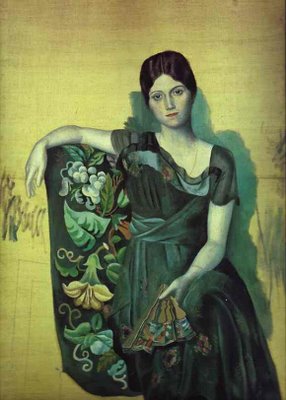
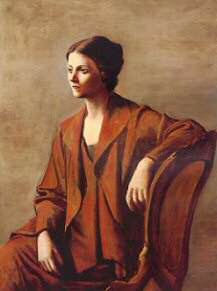
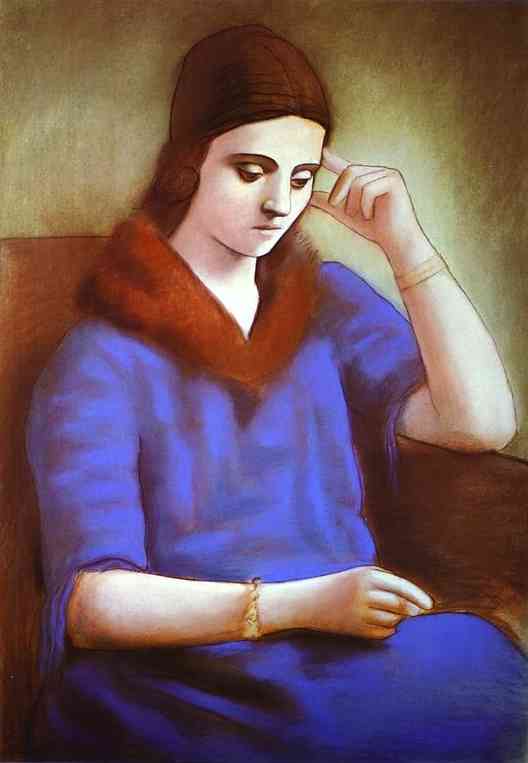
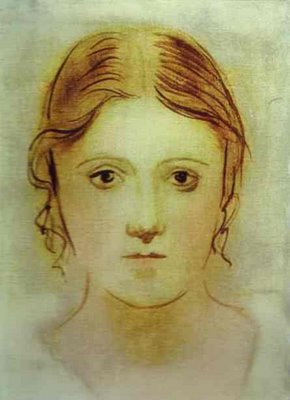
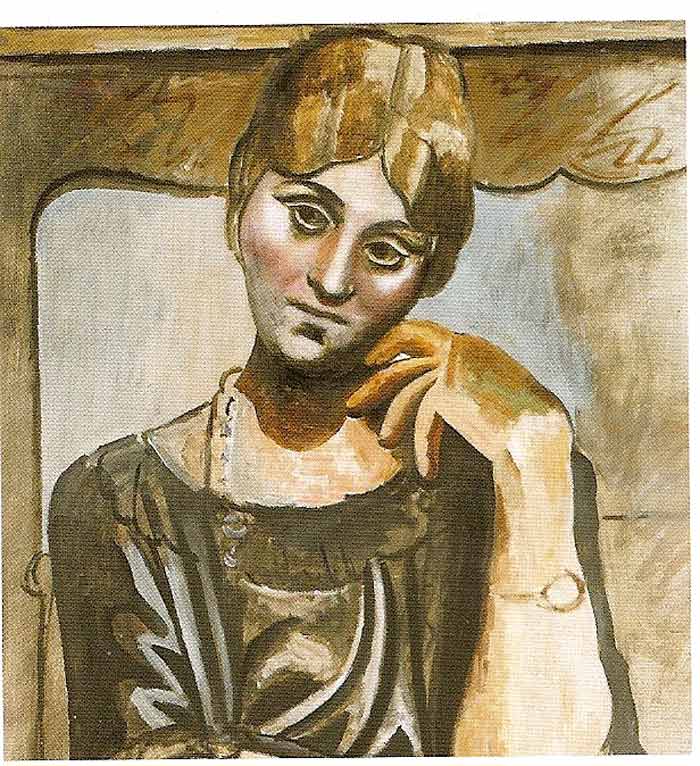
The character Adriana in “Midnight in Paris” is a fictional character but she exposes the fact that Picasso was constantly possessive of his mistresses and hateful at times to the women in his life. Francis Schaeffer in his film series “How should we then live?” has some very insightful commentary on Picasso and the loss of humanity pictured in his paintings. However, Picasso could not be consistent because when it came to painting Olga, Jacqueline and his children, Picasso would use all of abilities to show them the way God made them and not in a fragmented way.
In 1943 Picasso (age 62) then kept company with young art student Françoise Gilot (born in 1921). Their two children were Claude (1947) and Paloma (1949) who was named for the dove of peace that Picasso painted in support of the peace movement post World War II. Gilot, frustrated with Picasso’s relationships with other woman and his abusive nature left him in 1953. Gilot’s book “Life with Picasso” was published 11 years after their separation. In 1970 she married American physician-researcher Jonas Salk (who later died in 1995).
_______________________________
Picasso and Françoise with their two children were Claude (1947) and Paloma (1949) pictured below in the early 1950’s.
Picasso’s drawing, Portrait of Francoise, from 1946:
Francis Schaeffer in the episode, “The Age of Fragmentation,” Episode 8 of HOW SHOULD WE THEN LIVE? noted:
Monet, Renoir, Pissaro, Sisley, Degas were following nature as it has been called in their painting they were impressionists.They painted only what their eyes brought them. But was there reality behind the light waves reaching their eyes? After 1885 Monet carried this to its conclusion and reality tended to become a dream. With impressionism the door was open for art to become the vehicle for modern thought. As reality became a dream, impressionism began to fall apart. These men Cezanne, Van Gogh, Gauguin, Seurat, all great post Impressionists felt the problem, felt the loss of meaning. They set out to solve the problem, to find the way back to reality, to the absolute behind the individual things, behind the particulars, ultimately they failed. I am not saying that these painters were always consciously painting their philosophy of life, but rather in their work as a whole their worldview was often reflected. Cezanne reduced nature to what he considered its basic geometric forms. In this he was searching for an universal which would tie all kinds of individual things in nature together, but this gave a broken fragmented appearance to his pictures. In his bathers there is much freshness, much vitality. An absolute wonder in the balance of the picture as a whole, but he portrayed not only nature but also man himself in fragmented form. I want to stress that I am not minimizing these men as men. To read van Gogh’s letters is to weep for the pain of this sensitive man. Nor do I minimize their talent as painters. Their work often has great beauty indeed. But their art did become the vehicle of modern man’s view of fractured truth and light. As philosophy had moved from unity to fragmentation so did painting. In 1912 Kaczynski wrote an article saying that in so far as the old harmony, that is an unity of knowledge have been lost, that only two possibilities remained: extreme abstraction or extreme naturalism, both he said were equal.
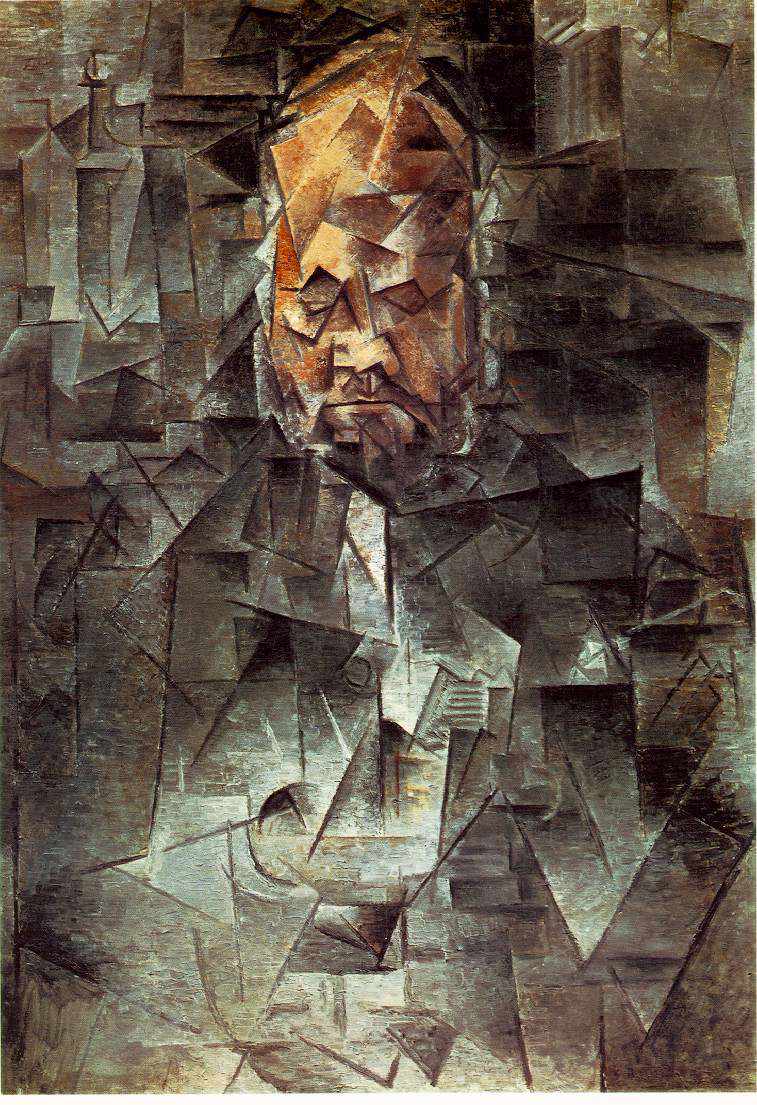
With this painting modern art was born. Picasso painted it in 1907 and called it Les Demoiselles d’Avignon. It unites Cezzanne’s fragmentation with Gauguin’s concept of the nobel savage using the form of the african mask which was popular with Parisian art circle of that time. In great art technique is united with worldview and the technique of fragmentation works well with the worldview of modern man. A view of a fragmented world and a fragmented man and a complete break with the art of the Renaissance which was founded on man’s humanist hopes.
Here man is made to be less than man. Humanity is lost. Speaking of a part of Picasso’s private collection of his own works David Douglas Duncan says “Of course, not one of these pictures was actually a portrait, but his prophecy of a ruined world.”
But Picasso himself could not live with this loss of the human. When he was in love with Olga and later Jacqueline he did not consistently paint them in a fragmented way. At crucial points of their relationship he painted them as they really were with all his genius, with all their humanity. When he was painting his own young children he did not use fragmented techniques and presentation. I want you to understand that I am not saying that gentleness and humanness is not present in modern art, but as the techniques of modern art advanced, humanity was increasingly fragmented. The opposite of fragmentation would be unity, and the old philosophic thinkers thought they could bring forth this unity from the humanist base and then they gave this up.
__________
Olga Khokhlova and Picasso (1917-1927)
In 1917 ballerina Olga Khokhlova (1891-1955) met Picasso while the artist was designing the ballet “Parade” in Rome, to be performed by the Ballet Russe.
They married in the Russian Orthodox church in Paris in 1918 and lived a life of conflict.
She was of high society and enjoyed formal events while Picasso was more bohemian in his interests and pursuits.
Their son Paulo (Paul) was born in 1921 (and died in 1975), influencing Picasso’s imagery to turn to mother and child themes. Paul’s three children are Pablito (1949-1973), Marina (born in 1951), and Bernard (1959). Some of the Picassos in this Saper Galleries exhibition are from Marina and Bernard’s personal Picasso collection.
Portrait of Paul Picasso as a Child. 1923. Oil on canvas.
Collection of Paul Picasso, Paris, France.
Full Name: Pablo Diego José Francisco de Paula Juan Nepomuceno María de los Remedios Cipriano de la Santísima Trinidad Clito Ruiz y Picasso
Born October 25, 1881 – Died April 8, 1973.
“Everyone wants to understand art. Why don’t we try to understand the song of a bird? Why do we love the night, the flowers, everything around us, without trying to understand them? But in the case of a painting, people think they have to understand. If only they would realize above all that an artist works of necessity, that he himself is only an insignificant part of the world, and that no more importance should be attached to him than to plenty of other things which please us in the world though we can’t explain them; people who try to explain pictures are usually barking up the wrong tree.” – Picasso
The Beginning, Childhood and Youth: 1881-1901
Pablo Ruiz Picasso was born on October 25, 1881 to Don José Ruiz Blasco (1838-1939) and Doña Maria Picasso y Lopez (1855-1939). The family at the time resided in Málaga, Spain, where Don José, a painter himself, taught drawing at the local school of Fine Arts and Crafts. Pablo spent the first ten years of his life there. The family was far from rich, and when 2 other children were born — Dolorès (“Lola”) in 1884 and Concepción (“Conchita”) in 1887 — it was often difficult to make ends meet. When Don José was offered a better-paid job, he accepted it immediately, and the Picassos moved to the provincial capital of La Coruna, where they lived for the next four years. In 1892, Pablo entered the School of Fine Arts there, but it was mostly his father who taught him painting. By 1894 Pablo’s works were so well executed for a boy of his age that his father recognized Pablo’s amazing talent, and, handing Pablo his brush and palette, declared that he would never paint again.
The Blue and Rose periods: 1901-1906
In February 1901 Picasso’s friend Casagemas committed suicide: he shot himself in a Parisian café because a girl he loved had refused him. His death was a great shock to Picasso, and the painter would return to it again and again in his art: he painted the Death of Casagemas in color, the Death of Casagemas again in blue and then “Evocation – The Burial of Casagemas”. In this latter canvas the compositional and stylistic influence of El Greco’s “The Burial of Count Orgaz” can be traced. Picasso began to use blue and green almost exclusively. “I began to paint in blue, when I realized that Casademas had died” Picasso later wrote.
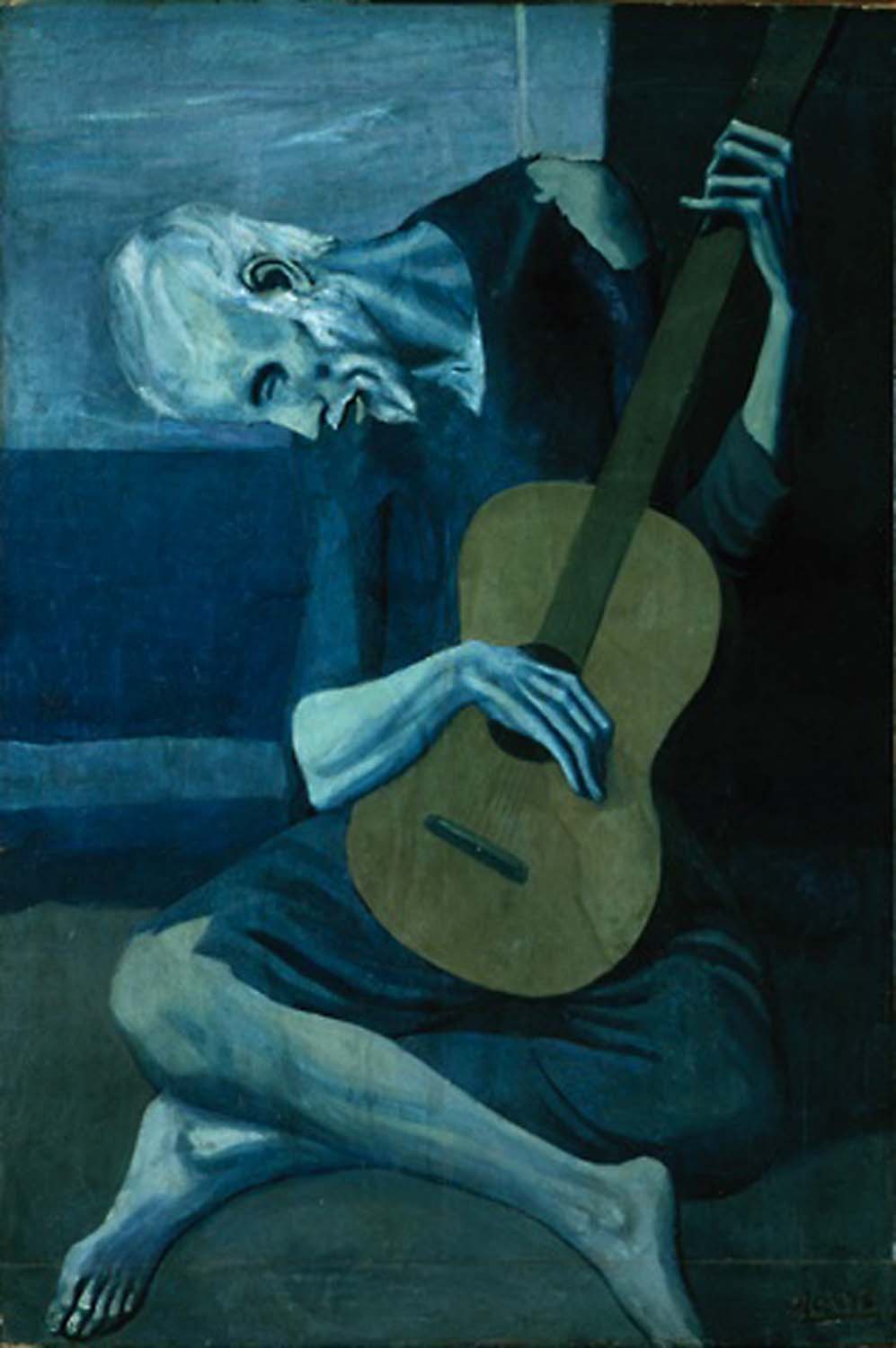
Restless and lonely, the arist moved constantly between Paris and Barcelona, depicting isolation, unhappiness, despair, misery of physical weakness, old age, and poverty; all of it in shades of blue. In the allegorical La Vie (1903), in monochrome blue, the man has the face of his deceased friend.
In 1904 Picasso finally settled in Paris, at 13 Rue Ravignan, called “Bateau-Lavoir”. He met Fernande Olivier, a model, who would be his mistress for the next seven years. He even proposed to her, but she had to refuse because she was already married. They paid frequent visits to the Circus Médrano, whose bright pink tent at the foot of the Montmartre shone for miles and was quite close to his studio. There, Picasso got ideas for his pictures of circus actors. The pub Le Lapin Agile (The Agile Rabbit) was a meeting place of young artists and authors. In the pub, Picasso got acquainted with the poets Guillaume Apollinaire and Max Jacob. The landlord, Frédé, accepted pictures as payment, and this made his café attractive for the artists and he acquired a splendid collection of paintings, including, of course, one by Picasso “At the Lapin Agile”, with Picasso as a harlequin and Frédé as a guitar player. The picture “Woman with a Crow” shows Frédé’s daughter.
By 1905, Picasso lightened his palette, relieving it with pink and rose, yellow-ochre and gray. His circus performers, harlequins and acrobats became more graceful, delicate and sensuous. In 1906 the art dealer Ambroise Vollard bought most of Picasso’s “Rose” pictures. This marked the beginning of Picasso’s prosperity: he would never again experience financial worries. Accompanied by Fernande the painter traveled to Barcelona, then to Gosol in the north of Catalonia, where he painted “La Toilette”. Deeply impressed by the Iberian sculptures at the Louvre, he began to think over and experiment with geometrical forms.
Cubism: 1907-1917
“Cubism is no different from any other school of painting. The same principles and the same elements are common to all. The fact that for a long time cubism has not been understood and that even today there are people who cannot see anything in it, means nothing. I do not read English, and an English book is a blank to me. This does not mean that the English language does not exist, and why should I blame anyone but myself if I cannot understand what I know nothing about?” – Picasso
African Period
In 1907, after numerous studies and variations Picasso painted his first Cubist picture – “Les demoiselles d’Avignon”. Impressed with African sculptures at an ethnographic museum he tried to combine the angular structures of the “primitive art” and his new ideas about cubism. The critics immediately dubbed this stage in his work the African Period, seeing in it only an imitation of African ethnic art.
“In the Demoiselles d’Avignon I painted a profile nose into a frontal view of a face. I had to depict it sideways so that I could give it a name, so that I could call it ‘nose’. And so they started talking about Negro art. Have you ever seen a single African sculpture — just one — where a face mask has a profile nose in it?”Picasso wrote.
Picasso’s new experiments were received very differently by his friends, some of whom were sincerely disappointed, and even horrified, while others were interested. The art dealer Kahnweiler loved the Demoiselles and took it for sale. Picasso’s new friend, the artist Georges Braque (1882-1963), was so enthusiastic about Picasso’s new works that the two painters came together to explore the possibilities of cubism over several of the following years. In the summer of 1908, the two began their experiments by going on holidays in the countryside. Afterwards, they found that they had painted very similar pictures completely independently of each other.
Analytical Cubism
Bread and Fruit Dish on a Table (1909) marks the beginning of Picasso’s “Analytical” Cubism: he gives up a central perspective and splits forms up into facet-like stereo-metric shapes. The famous portraits of Fernande, Woman with Pears, and of the art dealers Vollard and Kahnweiller are fulfilled in the analytical cubist style .
By 1911, Picasso’s relationship with Fernande went through a crisis. He broke up with her and started a liaison with Eva Gouel (Marcelle Humbert), whom he called “Ma Jolie”.
Synthetic or Collage Cubism
By 1912 the possibilities of analytical cubism seemed to be exhausted. Picasso and Braque began new experiments. Within a year they were composing still lifes of cut-and-pasted scraps of material, with only a few lines added to complete the design, such as Still-Life with Chair Caning. These collages led to synthetic cubism — paintings with large, schematic patterning, such as The Guitar.
“Cubism has remained within the limits and limitations of painting, never pretending to go beyond. Drawing, design and color are understood and practiced in cubism in the spirit and manner that are understood and practiced in other schools. Our subjects might be different, because we have introduced into painting objects and forms that used to be ignored. We look at our surroundings with open eyes, and also open minds. We give each form and color its own significance, as we see it; in our subjects, we keep the joy of discovery, the pleasure of the unexpected; our subject itself must be a source of interest. But why tell you what we are doing when everybody can see it if they want to?” wrote Picasso.
World War I (1914-18) changed the life, mood, state of mind, and, of course, art of Picasso. His fellow French artists, Braque and Derain, were called up into the army at the beginning of the war. The art dealer Kahnweiler, a German, had to go to Italy, and his gallery was confiscated. Picasso’s pictures became somber, showing realistic more often, for example Pierrot.
“When I paint a bowl, I want to show you that it is round, of course. But the general rhythm of the picture, its composition framework, may compel me to show the round shape as a square. When you come to think of it, I am probably a painter without style. ‘Style’ is often something that ties the artist down and makes him look at things in one particular way, the same technique, the same formulas, year after year, sometimes for a whole lifetime. You recognize him immediately, for he is always in the same suit, or a suit of the same cut. There are, of course, great painters who have a certain style. However, I always thrash about rather wildly. I am a bit of a tramp. You can see me at this moment, but I have already changed, I am already somewhere else. I can never be tied down, and that is why I have no style,” Picasso wrote.
In 1916, the young poet Jean Cocteau brought the Russian ballet impresario Diaghilev and the composer Erik Satie to meet Picasso in his studio. They asked him to design the décor for their ballet “Parade”, which was to be performed by Diaghilev’s Ballet Russe. The meeting and Picasso’s affirmative answer would bring major changes to his life in the followng years. In 1917, he traveled to Rome with Cocteau and spent time with Diaghilev’s ballet company, working on décor for “Parade”. There, Picasso met Igor Stravinsky and fell in love with the dancer Olga Khokhlova. He accompanied the ballet group to Madrid and Barcelona because of Olga, and eventually persuaded her to stay with him.
Between Wars, Classicism and Surrealism: 1918-1936
In 1918, Olga and Picasso got married. The young couple moved to an apartment that occupied two floors at 23 Rue La Boétie, acquired servants, a chauffeur, and began to move in different social circles, no doubt due to Olga’s influence. The chaotic get-togethers Picasso had with his artist friends gradually changed into formal receptions. Picasso’s image of himself changed as well, and this was reflected in the more conventional style he adopted in his art and the way in which he consciously made use of artistic traditions and ceased to be provocative.
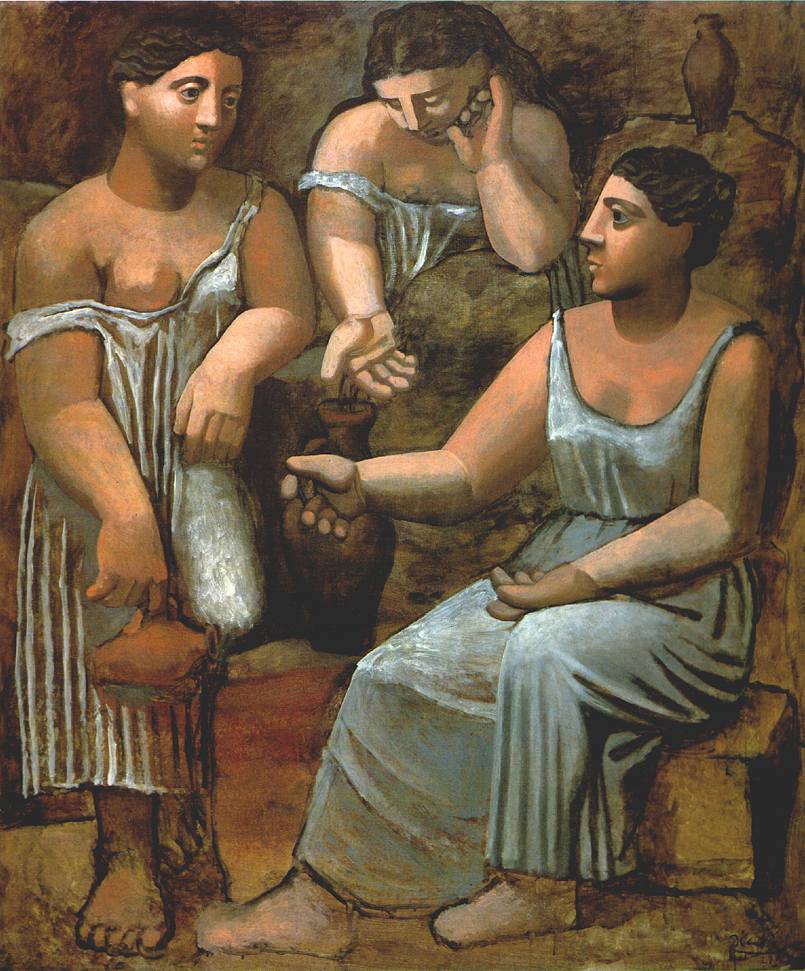
After cubism, Picasso returned to more traditional patterns — if not exactly classical ones — and this period is thus known as his Classicist period. A typical example of this new style is The Lovers. From time to time, he would return to cubism. His collaboration with the Ballet Russe went on: he worked on décor for “Le Tricorne” and drew portraits of the dancers. In 1920, he began to work on the décor for Stravinsky’s ballet Pulcinella. With the birth of his son Paul (Paolo) (1921), he returned to the Mother and Child theme again and again: Mother and Child.
In 1921, he painted his Cubist Three Musicians, in which he used a group of people as a cubist subject for the first time. The three figures are characters from the Italian Commedia dell’Arte (Pierrot, Harlequin and a monk). Though created after his Cubist period, the picture came to be regarded as a masterpiece of cubism. “Those who set out to explain a picture are setting out on the wrong foot. A short time ago Gertrude Stein elatedly informed me that at last she understood what my painting ‘Three Musicians’ represented. It was a still life!” wrote Picasso.
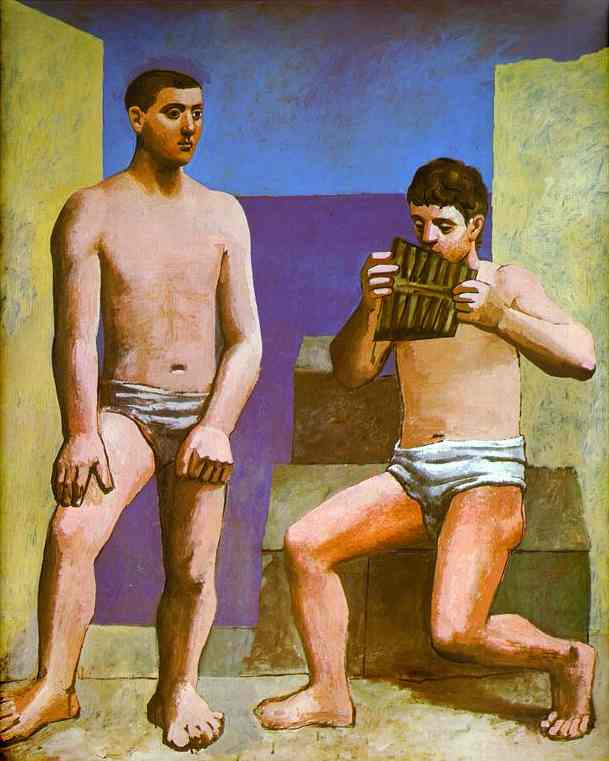
In 1923, Picasso painted The Pipes of Pan, which is regarded as the most important work of his “classicist period”. Other interesting works include The Seated Harlequin and Women Running on the Beach.
“Of all the misfortunes – hunger, misery, being misunderstood by the public – fame is by far the worst. This is how God chastises the artist. It is sad. It is true,” wrote Picasso
God had chastised Picasso. By the mid-twenties he became so popular that he “had to suffer a public that was gradually suppressing his individuality by blindly applauding every single picture he produced.” In addition to this, the artist was having marital problems. His wife Olga, a former ballet dancer, for whom the attention and admiration of the public was necessary, vital, and natural, could not understand Picasso’s discomfort with his fame.
Picasso tried to preserve his independence by taking an interest in the unknown and the unfamiliar. He set up a sculptor’s studio near Paris and began to experiment with this new artistic medium. He produced a series of assemblies with a Guitar theme, using objects such as shirts, floor-rags, nails and string, as well as sculptures. In 1927, Picasso began an affair with seventeen-year old Marie-Thérèse Walter, his son Paolo’s nurse.
Much of his work after 1927 is fantastic and visionary in character. His Woman with Flower (1932) is a portrait of Marie-Thérèse, distorted and deformed in the manner of Surrealism. The Surrealism movement was growing in strength and popularity at the time, and even Picasso could not really avoid being influenced by this group of Parisian artists, although they, conversely, regarded him as their artistic stepfather.
“I keep doing my best not to lose sight of nature. I want to aim at similarity, a profound similarity which is more real than reality, thus becoming surrealist,” Picasso wrote.
The worst time of his life, according to Picasso himself, began in June 1935. Marie-Thérèse was pregnant with his child, and his divorce from Olga had to be postponed again and again: their common wealth had become a target for lawyers. During this time of personal financial crisis, Picasso would add the bull, either dying or snorting furiously and threatening both man and animal alike, to his artistic arsenal. Being Spanish, Picasso had always been fascinated by bullfights, the so-called “tauromachia”. On October 5th of that year, his second child, a daughter, Maria de la Concepcion, called Maya, was born.
In 1936, he met Dora Maar, a Yugoslavian photographer. Later, during the war, she became his constant companion. See Portrait of Dora.
Wartime Experience: 1937-1945
“Guernica, the oldest town of the Basque provinces and the center of their cultural traditions, was almost completely destroyed by the rebels in an air attack yesterday afternoon. The bombing of the undefended town far behind the front line took exactly three quarters of an hour. During this time and without interruption a group of German aircraft – Junker and Heinkel bombers as well as Heinkel fighters – dropped bombs weighing up to 500 kilogrammes on the town. At the same time low-flying fighter planes fired machine-guns at the inhabitants who had taken refuge in the fields. The whole of Guernica was in flames in a very short time.” – The Times, April 27, 1937.
The Spanish government had asked Picasso to paint a mural for the Spanish pavilion at the Paris World Exhibition. He planned to depict the subject “a painter in his studio”, but when he heard about the events in Guernica, he changed his original plans. After numerous sketches and studies, Picasso gave his own personal view of the tragedy. His gigantic mural Guernica has remained part of the collective consciousness of the twentieth century, a forceful reminder of the event. Though painted for the Spanish government, it wasn’t until 1981, after forty years of exile in New York, that the picture found its way to Spain. This was because Picasso had decreed that it should not become Spanish property until the end of fascism. In October 1937, Picasso also painted the “Weeping Woman” as a kind of postscript to “Guernica”.
In 1940, when Paris was occupied by the Nazis, he handed out prints of his painting to German officers. When they asked asked him “Did you do this?” (referring to the pictures), he replied, “No, you did”. Whether those world-reknowned military brains were simply unable to perceive the symbolism of the picture, or whether it was Picasso’s fame that stopped them from taking any action, the painter was not arrested and went on working. During the war, he met a young female painter, Françoise Gillot, who would later become his third official wife.
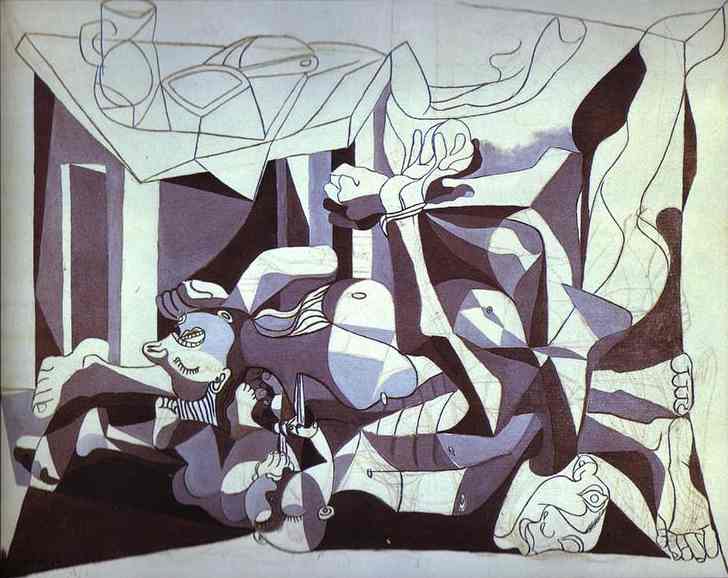
With his Charnel House of 1945, Picasso concluded the series of pictures that he had started with “Guernica”. The connection between the paintings becomes immediately obvious when we consider the rigidly limited color scheme and the triangular composition of the center. However, in the latter painting, the nightmare had been superceded by reality. The Charnel House was painted under the impact of reports from the Nazi concentration camps which had been discovered and liberated. It wasn’t until then, that people realized the atrociousness of the Second World War. It was a time when the lives of millions of people had been literally pushed aside, a turn of phase which Picasso expressed rather vividly in the pile of dead bodies in his Charnel House.
After WWII, The Late Works: 1946-1973
In 1944, after the liberation of Paris, Picasso joined the Communist Party and became an active participant of the Peace Movement. In 1949, the Paris World Peace Conference adopted a dove created by Picasso as the official symbol of the various peace movements. The USSR awarded Picasso the International Stalin Peace Prize twice, once in 1950 and for the second time in 1961 (by this time, the award had been renamed the International Lenin Peace Prize, as a result of destalinization) . He protested against the American intervention in Korea and against the Soviet occupation of Hungary. In his public life, he always expressed humanitarian views.
After WWII, Françoise gave birth to two children: Claude (1947) and Paloma (1949). Paloma is the Spanish word for “dove” — the girl was named after the peace symbol.
Picasso would not settle down, and more women would come into his life, some coming and going, like Sylvette David; and some staying longer, like Jacqueline Rogue. Picasso would remain sexually active and seeking throughout most of his life; it wasn’t that he was looking for something better than what he had had previously; the artist had a passion for the new and untried, evident in his travels, his art and, of course, his women. For him, it was a way of staying young.
In the summer of 1955, Picasso bought “La Californie”, a large villa near Cannes. From his studio, he had a view of the enormous garden, which he filled with his sculptures. The south and the Mediterranean were just right for his mentality; they reminded of Barcelona, his childhood and youth. There, he painted “Studio ‘La Californie’ at Cannes” (1956) and Jacqueline in the Studio (1956). By 1958, however “La Californie” had become a tourist attraction. There had been a constantly increasing stream of admirers and of people trying to catch a glimpse of the painter at his work, and Picasso, who disliked public attention, chose to move house. Picasso bought the Chateau Vauvenargues, near Aix-en-Provence, and this was reflected in his art with an increasing reduction of his range of colors to black, white and green.
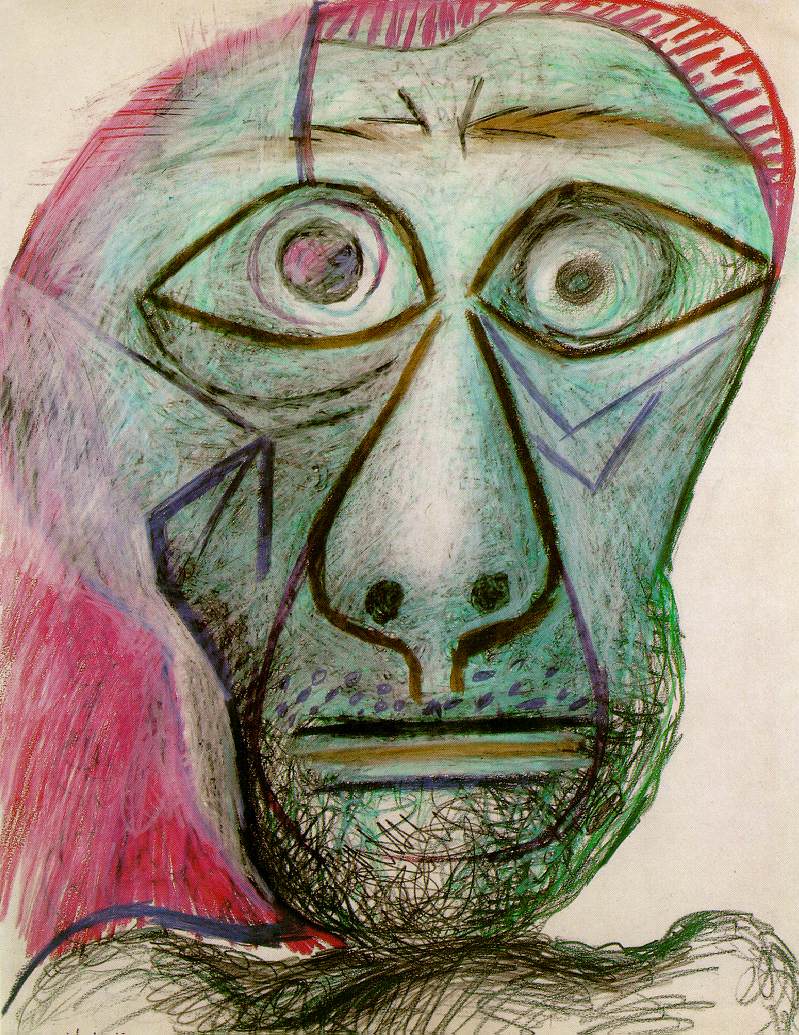
The mass media turned Picasso into a celebrity, and the public deprived him of privacy and wanted to know his every step, but his later art was given very little attention and was regarded as no more than the hobby of an aging genius who could do nothing but talk about himself in his pictures. Picasso’s late works are an expression of his final refusal to fit into categories. He did whatever he wanted in art and did not arouse a word of criticism.
With his adaptation of “Las Meninas” by Velászquez and his experiments with Manet’s Luncheon on the Grass, was Picasso still trying to discover something new, or was he just laughing at the public, its stupidity and its inability to see the obvious.
A number of elements had become characteristic in his art of this period: Picasso’s use of simplified imagery, the way he let the unpainted canvas shine through, his emphatic use of lines, and the vagueness of the subject. In 1956, the artist would comment, referring to some schoolchildren: “When I was as old as these children, I could draw like Raphael, but it took me a lifetime to learn to draw like them.”
In the last years of his life, painting became an obsession with Picasso, and he would date each picture with absolute precision, thus creating a vast amount of similar paintings — as if attempting to crystallize individual moments of time, but knowing that, in the end, everything would be in vain.
Pablo Picasso passed away at last on April 8, 1973, at the age of 92. He was buried on the grounds of his Chateau Vauvenargues.
“The different styles I have been using in my art must not be seen as an evolution, or as steps towards an unknown ideal of painting. Everything I have ever made was made for the present and with the hope that it would always remain in the present. I have never had time for the idea of searching. Whenever I wanted to express something, I did so without thinking of the past or the future. I have never made radically different experiments. Whenever I wanted to say something, I said it the way I believed I should. Different themes inevitably require different methods of expression. This does not imply either evolution or progress; it is a matter of following the idea one wants to express and the way in which one wants to express it.” – Picasso
A Christian Manifesto Francis Schaeffer
Published on Dec 18, 2012
A video important to today. The man was very wise in the ways of God. And of government. Hope you enjoy a good solis teaching from the past. The truth never gets old.
The Roots of the Emergent Church by Francis Schaeffer
How Should We then Live Episode 7 small (Age of Nonreason)
#02 How Should We Then Live? (Promo Clip) Dr. Francis Schaeffer
10 Worldview and Truth
Two Minute Warning: How Then Should We Live?: Francis Schaeffer at 100
Francis Schaeffer Whatever Happened to the Human Race (Episode 1) ABORTION
Francis Schaeffer “BASIS FOR HUMAN DIGNITY” Whatever…HTTHR
2011 Roger Arpajou / Sony Pictures Classics
Rachel McAdams as Inez and Owen Wilson as Gil in “Midnight in Paris.”
2011 Roger Arpajou / Sony Pictures Classics
Owen Wilson as Gil and Marion Cotillard as Adriana in “Midnight in Paris.”
“Midnight in Paris” is, without question, the best Woody Allen film I’ve seen in the past decade.And, I should stop right there. As I was setting out to catch the screening of “Midnight in Paris”, it occurred to me that it has actually been some time since I last saw a Woody Allen film when it was new. It sure didn’t feel that way, as I’ve been keeping up the director vicariously, but the last one I saw in the theater was “Small Time Crooks”, in 2000. Sheesh, that is a while ago.
In the meantime, Allen has, for better or for worse, continued to churn out movie after movie at his standard clip of one per year. Obviously, with a regiment like that, particularly at this point in ones career, we cannot expect every effort to be a masterpiece. And although it seems that for almost every new Allen film, there’s at least a small contingent of critics who shrug and say, “well, it’s the best he’s done in the past decade”, it occurs to me that “Midnight in Paris” must be different. Different in a good way. Naturally, with my dismal recent Allen track record, I cannot say for sure, not by a long shot. But I do know this – “Midnight in Paris” has a little bit of magic in it.”Midnight in Paris” has been most compared to Allen’s 1986 classic “The Purple Rose of Cairo”, an apt comparison if not a perfect one. The melancholy comedic tone fused with the protagonist’s longing to escape to a more lush, romantic time (and then doing so) are the greatest common bonds, although both films also stand close in terms of overall quality (the edge of course going to “Purple Rose”, a perennial favorite of mine). Also, Allen himself does not appear in either film. (Consider that fact however you will.)Unlike Mia Farrow’s desired “Purple Rose” escapism from the Great Depression of 1930s America, this time, for Gil – Owen Wilson’s frustrated-but-successful screenwriter of Hollywood schlock – his depression is now. And who can blame him, as his vacation in Paris is comprised of either being dragged from one high-end shop to the next by his steamroller of a fiancée (Rachel McAdams) and her staunchly conservative parents, or being condescended to in various museums and galleries by her insufferable know-it-all friends. Even as he finds himself in the most wonderful and romantic of cities, he is all the more pained by the fact that he’s there in the wrong decade, with the wrong people. Paris in the 1920s. Now THAT was a time. Pablo Picasso, on the cusp on his painterly brilliance. Ernest Hemingway, hunting wild beasts and churning out prose of inner bravado. Gertrude Stein, at the hub of it all. And the surrealists – Dali, Bunuel, and Man Ray – striving valiantly to live life in the non sequitur. Right city, wrong time. If only…And then it happens. One night as Gil is out for a midnight stroll, an extended vintage motor carriage comes by and picks him up. This is his magical ride to the Paris of yore, the Paris he’s been pining for, the Paris he’s been utterly romanticizing. All the luminaries are there. He takes this trip each night, developing relationships with them, and realizing their own human neuroses. Pablo Picasso, the uncertain lover. Ernest Hemingway, the unblinking blowhard. Gertrude Stein, enduring mother hen. And the surrealists – Dali, Bunuel, and Man Ray – striving ridiculously to live life in the non sequitur. This abrupt humanization of these icons of the art and literature is as amusing to Gil as it is to us. The electricity of the time is felt as he makes not just priceless connections and contacts, but friendships. The magic and charm of 1920s Paris is right out in front of everything, but at the same time, the imperfections begin to show, and not just the contrasts, but the comparisons to his present-time situation grow all the more evident.Allen does a remarkable job of putting a fresh and fun spin on the well-worn time travel story device. One must bear in mind Allen’s age, as the pacing and flow of the film veers into that fascinatingly tempered category of “old man cinema”, a type of film that although it’s in no hurry, does not have to lack spark or wisdom for years. Heck, Allen even has the audacity to begin his film with a five-minute travelogue pictorial of modern day Paris, in all its charm. Wilson, as one-note as his performances can be, here proves to be yet another quality Woody Allen surrogate protagonist – watchable, witty and yes, neurotic. For those even a little familiar with the luminaries met in vintage Paris, this will prove to be an engaging and rewarding trip.Nostalgia for a past time is a theme not only of this film, but of the film career of Woody Allen (as many continue to pine away for his “older, funnier movies”). But of the several things that “Midnight in Paris” tells us, one big one is that for fans of its filmmaker, 2011 is a perfectly fine time to be in.
Congressman Paul Ryan is probably the hottest name in Washington right now. 50% of the people love him and the rest hate him.
Americans for Prosperity hosted a Social Security Reform Roundtable with Congressman Paul Ryan. Part 1 of 3.
“Provides tax breaks for the wealthy”
False charges about Roadmap and our responses: – The proposed simplified tax code retains its progressivity, and cleans out the tangled web of tax deductions and credits that are disproportionately used by the wealthy. The tax base is broadened so that rates can be lowered. It also offers generous standard deductions so that a middle-income family of four pays no taxes on the first $39,000 of its income. More important, the business-tax changes in the Roadmap would deliver what all Americans seek at this time — increased job opportunities and higher economic growth.
_________________________
Here is part of the series I am doing on “Famous Arkansans.” Wayne Jackson grew up in West Memphis and performed on some famous songs like this one below:
Music video from the new DVD
‘Dreams To Remember: The Legacy of Otis Redding’
by Reelin’ In The Years Productions
VISIT: http://reelinintheyears.com/
This DVD features 16 complete performances by Otis along with brand new interviews with Stax musicians Steve Cropper, Wayne Jackson, Stax Records founder Jim Stewart and Reddings wife Zelma. Release date Sept 18, 2007.
Music video Directed & Edited by Bob Sarles
Produced by Ravin’ Films
VISIT: http://ravinfilms.com/
Otis Redding wrote this song while living on a houseboat in Sausalito on the San Francisco Bay. We discovered the actual spot where Otis’ housboat was berthed, and shot new Super8 footage from the spot for use in this video. Thanks to Anne Garfield, Joel Selvin and Bill Belmont. Otis recorded this song shortly before his tragic death. Steve Cropper finished production on the song after Otis’ plane went down. Released posthumously, it was Otis’ biggest hit ever. Enjoy!
Wayne Jackson has played with all the greats from Aretha Franklin, Otis Redding, Neil Diamond to Elvis Presley. Playing with The Memphis Horns, Wayne’s sweet trumpet is one of the most recognised soulful sounds in the last 50 years of pop music. He has played on over 300 Number 1 records and still is one of the nicest people you could ever meet.
Wayne Jackson knew Elvis from an early age, and not only played on some of Elvis’ greatest songs but was also a visitor to Graceland and has some great insights into music and the man.
First some essential Memphis musical background.
Born in Memphis and raised across the river Wayne Jackson’s love of music began with a guitar. But one night his mother came home with a trumpet for her 11 year-old son. “I opened up the case, and it smelled like oil and brass. I loved that, so I put it together, blew, and out came a pretty noise. My first taste of Sweet Medicine.” The rest is music history.
By 12th grade Wayne Jackson found himself playing with a group called The Mar-Keys. They had a number one instrumental smash called, ‘Last Night.’ It was 1961. What followed was a magical ride making music history with Otis Redding, Sam & Dave, Rufus Thomas, Isaac Hayes, all the soul greats. In 1969, Wayne and sax man, Andrew Love, became “The Memphis Horns” and found themselves working with a host of stars such as Neil Diamond, Aretha Franklin, B.J. Thomas and Elvis Presley.
EIN’s Piers Beagley was fortunate to meet Wayne Jackson and to spend some time with him chatting about soul music, life and Elvis.
EIN – Thanks for sparing some of your valuable time & talking to us.
Wayne Jackson – You know that I’ve been down there to Australia several times & I love it. If it wasn’t for family over here I could get lost down there!
EIN – You’ve done a lot of touring in your time. I have recently been watching some of those great STAX shows of you in Europe. They are sensational.
W.J – Oh man! We were 25 years old. Otis Redding, me & Andrew Love & Booker T & the MGs. We’d never been to Europe before and me being a country boy from the sleepy, cotton-town of West Memphis (Arkansas), even Memphis was a big deal. I had never been on a jet plane before and we had the biggest time you could imagine. But it was so hard to get any sleep there was always something to do. A lot of times we all felt like The Beatles ‘cos people were frantic to see us. To us it was just “family” but we had craziness & screaming fans all along the way. It was sure an eye opener.
EIN – Who were the original Stax horn section when you were the Mar-keys?W.J – Originally it was actually me & Andrew Love & Floyd Newman but Floyd dropped out ‘cos of College obligations. Joe Arnold who is a great saxophone player used to play with us too.Right: Wayne Jackson, Andrew Love. The sort after 1995 LP, “The Memphis Horns & Special Guests”.
EIN – Before you worked with Elvis you worked also on an incredible number of classic Memphis songs both at Stax and Chips Moman’s American Studios.
W.J – It’s a shame that they tore down both those original studios. American Studios is a parking lot now! We’ve been going through the RIAA website and we’ve found 60 platinum rated records that I played on that the record companies haven’t awarded me yet!
In the end I’ll have over One Hundred platinum records and most of them were done at American Studios. Andrew and I reckon that as The Memphis Horns we have performed on over 300 number One singles!We were kids and we worked 7 days & 7 nights a week, even Christmas. We did that for about 10 years. We only got paid strictly Union rates. Sometimes we might only make $48! Eventually we were put on a staff salary that made up for it.(Left: Wayne Jackson in soulful action)
EIN – It seems crazy that your horn sound is so identifiable in all those records yet you got less than $50!
W.J – Luckily Wilson Pickett’s ‘Land of A Thousand Dances’ was General Motors theme song back in summer 2002 and so I made several thousand dollars that year, although I only got paid $65 to record it initially!
EIN – There’s a very scary story about how an Otis Redding overdub saved your life?
W.J – I remember that week (December 8th 1967) so well because I had gone out with Otis to Hernando’s Hideaway the Thursday night and he was such a nice young man – and just 2 days later he was dead. We had just worked on ‘Dock Of The Bay’ and Otis was going out on the road with his touring band The Barkays to do a live album. Andrew & I were supposed to go out to beef-up their sound but we had to stay and do the overdubs on ‘Dock Of The Bay’. So I was really supposed to be on that plane that killed Otis and the band – but having to stay back for the overdubs on ‘Dock Of The Bay’ saved my life!
A New Health Tax Credit. The Heritage plan ends the existing tax
exclusion for employee compensation in the form of employer-sponsored health
insurance. This means that the value of employer-paid health insurance premiums
is included in the employee’s total taxable compensation. Today’s system
excludes this compensation from income and payroll taxes, effectively giving
upper-income workers in high-tax brackets a large tax benefit.
In return for ending this tax break, the plan introduces a new uniform,
nonrefundable federal tax credit to assist families in their purchase of health
insurance. Employers and employees could decide whether to have the employer
continue to buy coverage or to cash out the existing coverage in the form of
higher cash income. Either way, the tax break for coverage would change from an
exclusion to a credit.
The net value of the credit is $2,000 for an individual and $3,500 for a
couple or family. Under the Heritage plan, this credit can be used either to
offset the cost of coverage offered through the workplace or to buy insurance
outside the workplace. For most middle-income working families, the value of the
credit is similar to the tax relief that they receive for health insurance
today. For upper-income households, the new credit is typically less and is
reduced as income rises. The phaseout begins at $50,000 for an individual and
$100,000 for a family. The credit is fully phased out at $90,000 for an
individual and $170,000 for a family.
The credit is advanceable, assignable, and available on a prorated basis.
This means that the credit is available when premiums are due, enabling families
to claim the credit for premiums already paid before the end of the tax year. An
assignable credit allows a family to assign their tax credit to a health plan in
return for a dollar-for-dollar lower premium, eliminating the need to claim it
on their own tax forms.
It is important to note that health care benefits are a form of worker
compensation directed by the employer and are not “paid for” in any charitable
sense by the employers. Therefore, in the labor market, employers would likely
adapt to the tax reform either by increasing the wages for their employees
instead of offering health insurance or by continuing to offer coverage to their
employees. Either way, we know from research that the employee’s overall
compensation should stay the same in most cases.
There is no mandate on individuals to obtain insurance, but if they did not
obtain coverage, they would have to forgo the credit or assistance for
insurance. Importantly, the Heritage plan envisions much wider use by employers
of auto-enrollment mechanisms in the future, with employees automatically
enrolled in a plan as the default option. Research suggests that such an
auto-enrollment approach, combined with tax incentives or subsidies, is likely
to result in high rates of enrollment under the credit system.
Assistance for Lower-Income Working Families. Financial assistance for
purchasing insurance, equivalent to the tax credit, is made available to
households with no tax liability and prorated to those households with a tax
liability less than the value of the available credit. This money can be used
only for purchasing health insurance and typically would be sent directly to the
chosen plan in return for a dollar-for-dollar reduction in the premium to the
family. This is like the way the government’s contribution to a federal
employee’s FEHBP reduces the employee’s premium.
Thus, if a family’s tax liability is less than the value of the credit, the
family receives assistance partly in the form of a credit (up to its tax
liability) with the rest in the form of direct assistance for insurance. If this
family’s income rises in subsequent years, the amount it receives as assistance
is phased out and the credit amount is phased in, maintaining the same full
credit/assistance amount throughout the income change. In contrast to the
current patchwork health care model, the Heritage plan streamlines federal
assistance to ensure that no families fall through the cracks.
For very-low-income families with children earning less than 200 percent of
the federal poverty level (FPL), the Heritage plan provides an additional
federal subsidy worth $5,500. The full additional subsidy would be available to
families up to 133 percent of the FPL and would gradually phase out between 133
percent and 200 percent of FPL. This enhanced subsidy is intended for the
traditional, “mandatory” Medicaid populations—the groups that states are
required by federal law to include in Medicaid—and the eligibility phaseout is
designed to minimize work disincentives, unlike current law, in which Medicaid
has a very sharp eligibility cutoff. In 2011, a family of three with an income
below $37,000would meet this threshold. Again, this is paid for with
reductions in federal spending. Of course, states may provide additional
assistance to low-income families and individuals.
Senator Mark Pryor wants our ideas on how to cut federal spending. Take a look at this video clip below:
Senator Pryor has asked us to send our ideas to him at cutspending@pryor.senate.gov and I have done so in the past and will continue to do so in the future.
On May 11, 2011, I emailed to this above address and I got this email back from Senator Pryor’s office:
Please note, this is not a monitored email account. Due to the sheer volume of correspondence I receive, I ask that constituents please contact me via my website with any responses or additional concerns. If you would like a specific reply to your message, please visit http://pryor.senate.gov/contact. This system ensures that I will continue to keep Arkansas First by allowing me to better organize the thousands of emails I get from Arkansans each week and ensuring that I have all the information I need to respond to your particular communication in timely manner. I appreciate you writing. I always welcome your input and suggestions. Please do not hesitate to contact me on any issue of concern to you in the future.
Enact user fees that recover all the costs of programs with identifiable users, such as:
Requiring agribusinesses and farmers to assume the full cost of their crop insurance coverage (2004 spending: $3,965 million, mandatory); and
Imposing user fees on commodity futures and options contract transactions to help finance the Commodity Futures Trading Commission ($91 million, discretionary).
Reform other programs targeted to the wrong recipients by:
Restricting federal housing assistance to those with the greatest need and requiring able-bodied, non-elderly recipients to engage in work-related activities;
No longer providing substantially more federal aid to Howard University than is provided to other private universities;
Limiting Congress’s franking privilege to non-election years to prevent taxpayer funding of campaign mailings; and
Enforcing current laws limiting School Lunch program eligibility to low-income families.
People just don’t understand how wasteful government can be and how giving government more control of our lives destroys much of the freedom that we should have. This series on the stimulus demostrates these points. This whole series started because of a post I did on July 6, 2011 about an post in the Arkansas Times Blog.
Tim Griffin spoke in Central Arkansas recently at a townhall meeting and mentioned that a couple of million of stimulus money went to build the walking bridge in Little Rock that will be opening this summer. Then he went on to show how it was silly for our government to try to stimulate the economy with our national credit card. Steve Chapman rightly noted in his article “Stimulus to Nowhere” noted:
The federal government took out loans that it will have to cover with future tax increases … so states don’t have to. It’s like paying your Visa bill with your MasterCard.
Bridge = good stuff for Central Arkansas. Not sure why it is a bad thing. It is your money at work here being used for your benefit. I applaud this type of government activity. This is the type of project and progress you can see, touch, smell, hear.
That being said, Saline Republican, is this a waste of your money? You can use it as you wish.
________________________________
Let me respond with several points:
1. If the bridge is such a good thing then why can’t those who are excited about it get the funds to build it?
2. If you applaud the government for spending money for every good idea out there, ultimately where does all the money come from? Our grandchildren will be paying off this bridge in about 50 years if our country survives.
3. Building things with the government involvement is the most wasteful thing that you can do. How long does it take them to get the highway work done? Turn the highways over to private enterprise and things would change radically for the good. Do you get great service from Fed Ex or the U.S.Post Office? I had two relatives tell me stories of working part time at the post office and each time they were told to “slow down or you will get us all fired.”
4. The stimulus approach taken by President Obama has been to blow up our deficit when he should have sought to cut spending because the signs were there at the end of the Bush era that the recession was deepening. Instead, he decided to increase the spending even more than Bush had.
My name is J.D. Foster. I am the Norman B. Ture Senior Fellow in the Economics of Fiscal Policy at The Heritage Foundation. The views I express in this testimony are my own, and should not be construed as representing any official position of The Heritage Foundation.
At best, stimulus efforts based on government spending and tax cuts with little or no incentive effects have done no harm. At best. It is quite possible most of these efforts over the past couple of years have slowed the recovery while adding hundreds of billions of dollars to the national debt.
The record is all the more unfortunate because it is possible for a President and Congress to work together to stimulate the economy to faster growth during and after a recession. They can do so by improving incentives to produce and to work: for example, by reducing regulations and tax distortions. They can do so by reducing the uncertainties surrounding future policy. They can do so by expanding foreign markets for domestic goods and services. Recent efforts to stimulate the economy have been unsuccessful because they did little or none of these things. Regulations have increased. Uncertainty has increased. Tax distortions have been left in place or even increased in some areas. And efforts toward free trade have been anemic, at best.
Stimulus can work, but it has not worked because the Administration took another approach, emphasizing tax relief with little or no incentive effects combined with massive increases in spending. The President inherited a ballooning budget deficit and opted to grow it further. At best, this would be expected to be ineffectual. At best, because the resulting increased deficits infused economic decision-making with even more uncertainty about the consequences of massive deficit spending and how and when government will act to restore fiscal sanity.
Fortunately, the economy is showing clear signs of sustained recovery; uneven recovery to be sure, stronger in some areas than others both geographically and by industry, but recovery nonetheless. Despite the tremendous blows from the financial crisis and all that it entailed, the underlying strengths of our free market system once again are at work, giving expression to the vitality, energy, and innovation of the American people. Make no mistake: Our economy is recovering despite—not because of—the actions taken in Washington to grow it.
Tim Griffin spoke in Central Arkansas recently at a townhall meeting and mentioned that a couple of million of stimulus money went to build the walking bridge in Little Rock that will be opening this summer. Then he went on to show how it was silly for our government to try to stimulate the economy with our national credit card. I was reminded on that when I read these two articles below:
The bikers/walkers/runners are humming about the dedication of the Two Rivers Bridge across the Little Maumelle River. It’s set for 11:30 a.m. Friday. The Transportation secretary, Ray LaHood, is to be in attendance.
Enthusiasts want to turn out a crowd to show support for future bike/hike projects in the area.
Mired in excruciating negotiations over the budget and the debt ceiling, President Barack Obama might reflect that things didn’t have to turn out this way. The impasse grows mainly out of one major decision he made early on: pushing through a giant stimulus.
When he took office in January 2009, this was his first priority. The following month, Obama signed the American Recovery and Reinvestment Act, with a price tag eventually put at $862 billion.
It was, he said at the time, the most sweeping economic recovery package in our history,” and would “create or save three and a half million jobs over the next two years.”
The president was right about the first claim. As a share of gross domestic output, it was the largest fiscal stimulus program ever tried in this country. But the second claim doesn’t stand up so well. Today, total nonfarm employment is down by more than a million jobs.
The package had three main components: tax cuts, aid to state governments and spending on infrastructure projects. Tax cuts would induce consumers to buy stuff. State aid would prop up spending by keeping government workers employed. Infrastructure outlay would generate hiring to build roads, bridges and other public works.
The idea behind channeling money to state governments is that it would reduce the paring of government payrolls, thus preserving the spending power of public employees. But the plan went awry, according to a paper by Dartmouth College economists James Feyrer and Bruce Sacerdote published by the National Bureau of Economic Research.
“Transfers to the states to support education and law enforcement appear to have little effect,” they concluded. Most likely, they said, states used the money to avoid raising taxes or borrowing money.
That’s right: The federal government took out loans that it will have to cover with future tax increases … so states don’t have to. It’s like paying your Visa bill with your MasterCard.
The public works component could have been called public non-works. It sounds easy for Washington to pay contractors to embark on “shovel-ready projects” that needed only money to get started. The administration somehow forgot that even when the need is urgent, the government moves at the speed of a glacier.
John Cogan and John Taylor, affiliated with Stanford University and the Hoover Institution, reported earlier this year that out of that $862 billion, a microscopic $4 billion has been used to finance infrastructure. Even Obama has been chagrined.
“There’s no such thing as shovel-ready projects,” he complained last year.
Even if jobs were somehow created or saved by this ambitious effort, they came at a prohibitive price. Feyrer and Sacerdote say the costs may have been as high as $400,000 perjob.
Based on all this evidence, we don’t really know whether the federal government can use fiscal policy to engineer a recovery. We do know it can go broke trying.





 2011 Roger Arpajou / Sony Pictures Classics
 2011 Roger Arpajou / Sony Pictures Classics


 The Daily Hatch