Prince William, Duke of Cambridge and Catherine, Duchess of Cambridge leave Clarence House for Buckingham Palace on April 29, 2011 in London, England. (Jeff J Mitchell/Getty Images)
Leave it to Crown Princess Victoria of Sweden to spice things up a bit in a fitted, coral dress.
The Royal Wedding Ceremony of William and Kate Live part 2/4
I really do wish Kate and William success in their marriage. I hope they truly are committed to each other, and if they are then the result will be a marriage that lasts their whole lifetime. Nevertheless, I do not think it is best to live together before marriage like they did, and I writing this series to help couples see how best to prepare for marriage.
What can my spouse and I do to build a strong marriage?
You should both recognize that your marriage is first of all a commitment to Jesus Christ and then to each other. Your best defense against forces that will erode your marriage is for you both to maintain a deep, profound, and shared relationship with Jesus Christ and a commitment to obey God’s Word. Your faithful, obedient walk with the Lord will keep you from stumbling.
Here are a few practical principles to follow:
Concentrate on your heart, not your appearance.Your inner life is more important than your outer appearance. The writer of Proverbssaid as much when he remarked, “Charm is deceitful and beauty is vain, But a woman who fears the Lord, she shall be praised” (Proverbs 31:30).Peter gave this principle to wives in 1 Peter 3:3-4, but it applies to husbands as well: “Your adornment must not be merely external—braiding the hair, and wearing gold jewelry, or putting on dresses; but let it be the hidden person of the heart, with the imperishable quality of a gentle and quiet spirit, which is precious in the sight of God.”If you focus on developing your love for Christ, your inner qualities of godliness will mature, develop, and strengthen your marriage.
Concentrate on who your spouse really is, not on an ideal partner.Many marriages falter simply because the partners never have taken the time to get to know each other. Your spouse, as wonderful as he or she seemed at the altar, is not perfect. If you cling to an ideal of what you want your spouse or marriage to be like, you’ll hurt your marriage. Abandon the idea of a perfect mate and marriage and begin learning to understand and love the spouse you have—as he or she is today. That is what Peter meant when he told husbands to live with their wives “with understanding” (1 Peter 3:7).
Concentrate on loving your spouse, not on your compatibility.No matter who your spouse is, you can learn to love each other. In contrast to the prevailing idea that love is something that just happens, Paul commanded husbands to love their wives (Ephesians 5:25) and wives to love their husbands (Titus 2:4). Scripture doesn’t even recognize the possibility of incompatibility between two marriage partners—God simply commands both the husband and the wife to love each other.
Senator Mark Pryor wants our ideas on how to cut federal spending. Take a look at this video clip below:
Senator Pryor has asked us to send our ideas to him at cutspending@pryor.senate.gov and I have done so in the past and will continue to do so in the future.
On May 11, 2011, I emailed to this above address and I got this email back from Senator Pryor’s office:
Please note, this is not a monitored email account. Due to the sheer volume of correspondence I receive, I ask that constituents please contact me via my website with any responses or additional concerns. If you would like a specific reply to your message, please visit http://pryor.senate.gov/contact. This system ensures that I will continue to keep Arkansas First by allowing me to better organize the thousands of emails I get from Arkansans each week and ensuring that I have all the information I need to respond to your particular communication in timely manner. I appreciate you writing. I always welcome your input and suggestions. Please do not hesitate to contact me on any issue of concern to you in the future.
Therefore, I went to the website and sent this email below:
Reduce Federal Vehicle Budget: Saves $600 million The federal government owns approximately 652,000 cars and trucks in their fleet of vehicles. General maintenance on these vehicles is an annual expense of $4 billion. Since 2006, the amount of vehicles owned by the government has increased by 20,000 and operating costs have increased by 5.4 percent. It is not unreasonable to ask all agencies to slow down acquiring new vehicles and decrease the number of miles driven to help drive reduce cost of general maintenance.
The newest Duggar is very close in age to his Aunt Josie (Jim Bob and Michelle’s youngest child, who was born premature, but is now healthy), who is only 17 months old.
“I think of Josie being born at only 25 weeks,” Josh told the mag prior to the birth of his son, “and it makes us think about how precious life is and what a blessing each child is.”
The Duggars are back on TLC this Sunday in “19 Kids: First Grandson” at 8 PM.
_____________________
I went on the 2011 March for Life in Little Rock in January with some of my children and with my grandson. I looked around and noticed that I was actually surrounded by Duggars!!!
March for Life Little Rock, AR January 23, 2011, Duggar Family singing
If you are in San Francisco for the summer and are looking for something to do, then perhaps you should go to the SF MOMA and check out the exhibit, The Steins Collect.
Through September 6, you can browse the art collection of the Steins which include lauded writer Gertrude and brothers Leo and Michael, and Michael’s wife, Sarah. They were Bay Area natives that uprooted and spent time in Paris when it was a bohemian epicenter in the early 20th century (which is cleverly showcased in the movie Midnight in Paris).
The Steins were one of the first people to recognize the avant-garde talent of famous artists like Henri Matisse and Pablo Picasso. By befriending and supporting artists like them as well as Paul Cézanne, Pierre-Auguste Renoir, Henri de Toulouse-Lautrec, and others, they were early adopters of an artistic revolution.
In addition to the exhibition, the SF MOMA will be featuring insightful curator talks, films and other events through its September run.
Midnight In Paris – SPOILER Discussion by What The Flick?!
Associated Press
Gertrude Stein and Alice B. Toklas in 1934
This video clip below discusses Gertrude Stein’s friendship with Pablo Picasso:
I love the movie “Midnight in Paris” by Woody Allen and I am going through the whole list of famous writers and artists that he included in the movie. Today is Gertrude Stein. By the way, I know that some of you are wondering how many posts I will have before I am finished. Right now I have plans to look at Gauguin, Lautrec, Geores Brague, Dali, Rodin,Coco Chanel, Modigliani, Matisse, Luis Bunuel, Josephine Baker, Van Gogh, Picasso, Man Ray, T.S. Elliot and several more.
How had he been in business in Baltimore? He had been in business before in Baltimore,
he had not been in business before he was in business in Baltimore.
Business in Baltimore is business in Baltimore
and business in Baltimore is this business in Baltimore.
How many more are there in business in Baltimore than there were before?
–from “Business in Baltimore”
Gertrude Stein came to Baltimore because she wanted to be or not to be a doctor. She wasn’t a stranger to the city; she had various relatives here. But she moved to Baltimore to Baltimore she moved to Baltimore to attend Johns Hopkins Medical School with plans to become a doctor.
Stein was born in Allegany, Pennsylvania, in 1874, and later moved with her family to Oakland, California. When her parents died (she was 18 at the time), she and her brother Leo came to Baltimore to live with their Aunt Fanny Bachrach and near their extended family.
Even while attending Radcliffe College, she returned frequently to visit that family. After graduating in 1897, she returned to Baltimore once again, this time to attend Johns Hopkins Medical School. She never graduated; having made it to her final year, she found her studies no longer enticing. She also experienced heartbreak in the romance department—which may have cooled her enthusiasm for school.
She moved to Europe with Leo, spending most of the rest of her life in Paris. But her influence in Baltimore continues. During medical school, she had become friends with medical researcher Claribel Cone, who became a well-known specialist in tuberculosis. Stein’s friendship with Claribel and her sister Etta would provide great happiness for the Cone sisters and later for the city of Baltimore. Stein taught the Cones to appreciate the works of the French Impressionist painters and introduced them to Henri Matisse, Pablo Picasso, and others. She convinced them to buy Impressionist paintings when everyone else was still buying traditional portraits and landscapes. The Cone sisters amassed and later left to the Baltimore Museum of Art a magnificent collection, including works by Picasso, Matisse, Degas, Monet, and Cassatt.
Many Baltimoreans are probably more familiar with Stein through her association with the Cone sisters-or for the museum’s restaurant that bears her name-than through her experimental writing. Among her most widely read works is Three Lives (1909), fictional portraits of three women, including Melanctha, a liberated and intelligent black woman living in Baltimore. This was a rare case, at the time, of a white writer creating a sympathetic portrait of a black woman. What Stein knew of the black community, she may have learned as a medical student in clinical practice, according to a least one source (Cohen, 1984).
Stein remains a controversial figure in literature—possibly because of her openly gay relationship with her secretary, Alice B. Toklas, and her often inaccessible writing style. She once said that she attempted in her writing to parallel the theories of Cubism, emphasizing the present moment and using slightly varied repetitions. She influenced the American and European literary and art scenes in the United States, befriending many emerging writers and artists, including Katherine Anne Porter and Ernest Hemingway (who said that he and Stein were “just like brothers”).
Gertrude Stein died in 1946 at age 72 from stomach cancer.
John Bumby Hemingway and Gertrude Stein in Paris
Christy Lemire (AP critic and host of Ebert Presents at the Movies, check your local PBS listings) and Alonso Duralde (Movieline) have a spoiler-filled talk aboutt he Woody Allen film Midnight in Paris.
2011 Roger Arpajou / Sony Pictures Classics
Owen Wilson as Gil and Rachel McAdams as Inez in “Midnight in Paris.”
Director: Woody Allen Writer: Woody Allen Stars: Owen Wilson, Rachel McAdams, Michael Shannon, Kathy Bates Studio: Sony Pictures Classics
Owen Wilson’s dudeness and a daring plot twist serve Woody Allen well.
Late-era Woody has been an interesting phenomenon to watch, as his occasional hits (Vicky Cristina Barcelona) and stupefying misses (Scoop) come hard on each other’s heels. This year’s offering in his recent “Cities I Have Loved” series is set in Paris, and of course, given the setting and the auteur, is a heady love story. But more importantly, Midnight in Paris is also an exploration of nostalgia, the artistic impulse, and even happiness itself. It’s an entertaining and sometimes hilarious film that belongs squarely in Allen’s “hit” column.
It’s also a very difficult film to write about, as there’s a major plot twist not far into the movie, a plot twist that the filmmakers have taken great pains to conceal from the public. Until recently, the Midnight in Paris IMDB page lacked names for many of the characters, and the twist isn’t explained or even alluded to in the film’s trailer. In the spirit of respecting their judgment of how one can best appreciate the movie, perhaps it’s best not to specifically reveal it here. Suffice to say that in the hands of a lesser director (or even in those of Allen himself, at his weaker moments), the twist would be cloying and cringe-inducing, but Allen makes it work well.
The cast is, for the most part, exquisitely chosen. Rachel McAdams’ natural (and considerable) charm and charisma are a perfect counterpoint to her character, who in her unlikeability actually recalls Billy Zane’s ridiculous cad in Titanic. The part as written needs some balance, but in McAdams, Allen got all the likeability he needed simply from his casting choice. Michael Sheen is a different kind of cad—the pedantic know-it-all that is so fun to hate that it’d be a shame to give him any redeeming qualities. Other standout performances, ones I can’t reveal too much about, are turned in by Marion Cotillard, Kathy Bates, and Corey Stoll in a pitch-perfect career turn.
And against all odds, Owen Wilson turns out to be an excellent choice for the Allen-esque protagonist (Woody, of course, seldom writes any other type). Wilson seems to project a goofy thoughtfulness naturally, and it softens the edges of Allen’s neurotic writing and draws the viewer in. Unlike many of Allen’s protagonists, we’re really rooting for Gil. Combine that with a daring concept, a charming supporting cast, and some classic Allen zingers, and you’ve got an ideal summer confection for the film buff set.
Artists and bohemians inspired Woody Allen for ‘Midnight in Paris I love the movie “Midnight in Paris” by Woody Allen and I am going through the whole list of famous writers and artists that he included in the movie. Today we will look at Salvador Dali. In this clip below you will see when Picasso […]
2011 Roger Arpajou / Sony Pictures Classics Lea Seydoux as Gabrielle in “Midnight in Paris.” Adriana and Gil are seen above walking together in the movie “Midnight in Paris.” Adriana was a fictional character who was Picasso’s mistress in the film. Earlier she had been Georges Braque’s mistress before moving on to Picasso according to […]
How Should We Then Live 7#3 2011 Roger Arpajou / Sony Pictures Classics Owen Wilson as Gil in “Midnight in Paris.” Paul Gauguin and Henri Toulouse Lautrec were the greatest painters of the post-impressionists. They are pictured together in 1890 in Paris in Woody Allen’s new movie “Midnight in Paris.” My favorite philosopher Francis Schaeffer […]
How Should We Then Live 7#1 Dr. Francis Schaeffer examines the Age of Non-Reason and he mentions the work of Paul Gauguin. 2011 Roger Arpajou / Sony Pictures Classics Kurt Fuller as John and Mimi Kennedy as Helen in “Midnight in Paris.” I love the movie “Midnight in Paris” by Woody Allen and I am […]
Midnight In Paris – SPOILER Discussion by What The Flick?! Associated Press Gertrude Stein and Alice B. Toklas in 1934 This video clip below discusses Gertrude Stein’s friendship with Pablo Picasso: I love the movie “Midnight in Paris” by Woody Allen and I am going through the whole list of famous writers and artists that […]
2011 Roger Arpajou / Sony Pictures Classics Gad Elmaleh as Detective Tisserant in “Midnight in Paris.” I love the movie “Midnight in Paris” by Woody Allen and I am going through the whole list of famous writers and artists that he included in the movie. Juan Belmonte was the most famous bullfighter of the time […]
Woody Allen explores fantasy world with “Midnight in Paris” 2011 Roger Arpajou / Sony Pictures Classics Corey Stoll as Ernest Hemingway in “Midnight in Paris.” The New York Times Ernest Hemingway, around 1937 I love the movie “Midnight in Paris” by Woody Allen and I am going through the whole list of famous writers […]
What The Flick?!: Midnight In Paris – Review by What The Flick?! 2011 Roger Arpajou / Sony Pictures Classics Alison Pill as Zelda Fitzgerald and Tom Hiddleston as F. Scott Fitzgerald in “Midnight in Paris.” 2011 Roger Arpajou / Sony Pictures Classics Owen Wilson as Gil in “Midnight in Paris.” 2011 Roger Arpajou / Sony […]
The song used in “Midnight in Paris” I am going through the famous characters that Woody Allen presents in his excellent movie “Midnight in Paris.” This series may be a long one since there are so many great characters. De-Lovely – Movie Trailer De-Lovely – So in Love – Kevin Kline, Ashley Judd & Others […]
Photo by Phill Mullen The only known photograph of William Faulkner (right) with his eldest brother, John, was taken in 1949. Like his brother, John Faulkner was also a writer, though their writing styles differed considerably. My grandfather, John Murphey, (born 1910) grew up in Oxford, Mississippi and knew both Johncy and “Bill” Faulkner. He […]
I love the movie “Midnight in Paris” was so good that I will be doing a series on it. My favorite Woody Allen movie is Crimes and Misdemeanors and I will provide links to my earlier posts on that great movie. Movie Guide the Christian website had the following review: MIDNIGHT IN PARIS is the […]
The Associated Press reported today: The signature under the typewritten words on yellowing sheets of nearly century-old paper is unmistakable: Adolf Hitler, with the last few scribbled letters drooping downward. The date is 1919 and, decades before the Holocaust, the 30-year-old German soldier — born in Austria — penned what are believed to be […]
Here is an article I wrote a couple of years ago: Solomon, Woody Allen, Coldplay and Kansas What does King Solomon, the movie director Woody Allen and the modern rock bands Coldplay and Kansas have in common? All four took on the issues surrounding death, the meaning of life and a possible afterlife, although they all came up with their own conclusions on […]
Coldplay seeks to corner the market on earnest and expressive rock music that currently appeals to wide audiences Here is an article I wrote a couple of years ago about Chris Martin’s view of hell. He says he does not believe in it but for some reason he writes a song that teaches that it […]
Gad Elmaleh as Detective Tisserant in “Midnight in Paris.”
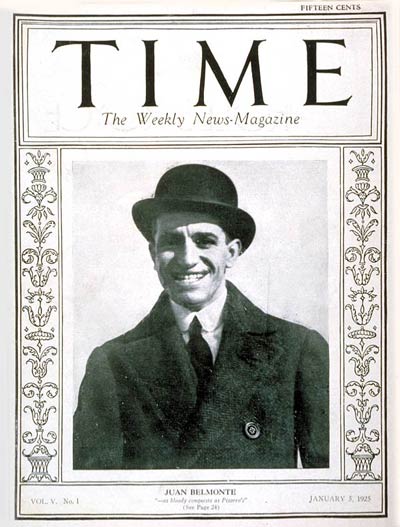
I love the movie “Midnight in Paris” by Woody Allen and I am going through the whole list of famous writers and artists that he included in the movie. Juan Belmonte was the most famous bullfighter of the time and a close personal friend of Ernest Hemingway.
Corey Stoll does an excellent job of playing Ernest Hemingway (as seen below):
By the way, I know that some of you are wondering how many posts I will have before I am finished. Right now I have plans to look at Gertrude Stein, Gauguin, Lautrec, Geores Brague, Dali, Rodin,Coco Chanel, Modigliani, Matisse, Luis Bunuel, Josephine Baker, Van Gogh, Picasso, Man Ray, T.S. Elliot and several more.
Juan Belmonte García (April 14, 1892 – April 8, 1962) was a Spanishbullfighter, considered by many to have been the greatest matador of all time.[citation needed]
Born in the Triana area of Seville, Belmonte began his bullfighting career in 1908, touring around Spain in a children’s bullfighting group called Los Niños Sevillanos. He killed his first bull on July 24, 1910. As an adult, his technique was unlike that of previous matadors; he stood erect and nearly motionless, and always stayed within inches of the bull, unlike previous matadors, who stayed far from the animal to avoid the horns. As a result of this daring technique, Belmonte was frequently gored, sustaining many serious wounds.
One such incident occurred during a November, 1927 bullfight in Barcelona, Spain. Belmonte was gored through his chest and pinned against a wall. Several other toreros rescued him. Among the spectators that day were the King and Queen of Spain and the Infanta Beatriz.[1]
Belmonte’s rivalry with Joselito (a.k.a. Gallito), another contender for the appellation “greatest matador of all time”, from 1914 to 1920 is known as the Golden Age of Bullfighting. The era was cut short when Joselito was fatally gored on May 16, 1920, at a bullfight in Talavera de la Reina, a small town not far from Madrid. Belmonte then had to carry alone the weight of the whole bullfighting establishment, which would prove too much and led to the first of his two temporary retirements.
In 1919, Belmonte fought 109 corridas, a number not matched by any matador before, until the 1965 bullfight season when Manuel Benítez Pérez (“El Cordobés“) performed in 111 corridas, surpassing Belmonte’s record. The Mexican matador Carlos Arruzafought 108 corridas in one season but it is said that he refused to pass Belmonte’s record out of respect for the maestro.
After his retirement, Belmonte published a biography. Written by Manuel Chaves Nogales and published in 1937, it was called Juan Belmonte, matador de toros: su vida y sus hazañas and was translated into English by Leslie Charteris as Juan Belmonte, Killer of Bulls. Belmonte was also close friend with author Ernest Hemingway, and he appears prominently in two of Hemingway’s books: Death in the Afternoon and The Sun Also Rises. Like Hemingway, Belmonte ultimately committed suicide by gunshot.[2]
Juan Belmonte was the single matador that changed the style of bullfighting. Born with slightly deformed legs he could not run like other boys, or jump as they could and so when he finally began his career as a matador, he firmly planted his feet on the ground never giving way. He forced the bull to go around him, whereas others until then had jumped all over the place like circus performers.
When his doctor told him that, because of his lifelong injuries and trauma, he could no longer smoke cigars, ride his horses, drink wine or perform sexual acts with women, he decided he was ready to die. He ordered his favorite horse brought to him, took a handful of cigars, two bottles of his favorite wine and rode out to his finca where he was met by two of Sevilla’s “women of the night.” He smoked his cigars and drank his wine, engaging one more time in his final passions, then took his pistol and shot himself. He had told others prior to his last day that if he could not live like a man he would at least die like one.
If you’re surprised to be reading that, think how I feel writing it. I’ve been a tough sell on the past dozen or so Allen films, very much including the well-acted but finally wearying “Vicky Cristina Barcelona.” It seemed that everything he touched in recent years was tainted by misanthropy and sourness. Until now.
With “Midnight in Paris,” Allen has lightened up, allowed himself a treat and in the process created a gift for us and him. His new film is simple and fable-like, with a definite “when you wish upon a star” quality, but, bolstered by appealing performers like Owen Wilson, Marion Cotillard and Rachel McAdams, it is his warmest, mellowest and funniest venture in far too long.
This is also a film with an unanticipated twist, so the less you know about it the better. Try to see it immediately, before well-meaning friends tell you more than they should. “Midnight in Paris” is too charming to be ruined by anything, but this is a case where ignorance really is bliss.
Allen says he’s been enamored of Paris since he wrote and acted in “What’s New Pussycat?” in 1965. You can sense his continued passion for the city throughout the film, feel the extra pep in his step and pleasure in his heart.
Seductively shot by Darius Khondji (whatever tax credits this film got will be paid back with interest), “Midnight” opens with an extended montage of Paris’ tourist landmarks, a montage that lasts longer than necessary to simply establish location. Allen is saying: Pay attention — this is a special place, a place where magic can happen.
That’s certainly the attitude of Gil (Wilson), a successful Hollywood screenwriter who is an effusive enthusiast for the City of Light in general, and the 1920s golden age of Fitzgerald-Hemingway Paris in particular. So much so that Gil dreams of turning his back on all that studio money and writing novels on the Left Bank.
Gil’s fiancée, Inez (McAdams), doesn’t like the sound of that. She and Gil are in Paris accompanying her wealthy parents on a business trip and she doesn’t even want to think about anything that would diminish Gil’s income.
Gil’s raptures are put on hold when he and Inez bump into Inez’s friend Paul (Michael Sheen) and his wife. A professor whom Inez once had a crush on, Paul is in Paris to lecture at the Sorbonne. It’s soon clear he’s an insufferable bore so pedantic he gets into an argument with a guide at the Rodin Museum (a brief cameo for French First Lady Carla Bruni).
As much to escape Paul as anything else, Gil takes a late-night walk and just as the clock strikes midnight on the Rue Montagne St. Genevieve, something happens that throws everything in Gil’s life into disarray.
Perhaps most unsettling, but in a good way, is Gil’s meeting with the beautiful and spirited Adriana (Cotillard), an aspiring fashion designer who has a history of inspiring artists. The connection between them is immediate but the barriers to any kind of relationship are formidable.
With remarkable naturalness and considerable charisma, Cotillard is just as she should be here, as are both Wilson, one of the most likable of contemporary actors, and McAdams, who deftly handles a part that is less amiable than usual for her.
On display as well is Allen’s sharp and satisfying script. It makes jokes about everyone from Djuna Barnes to Luis Bunuel but also takes time to ponder the role of the artist and the importance of not undervaluing the age we live in.
More than anything, obviously, “Midnight” has Paris. For one film, at least, that extraordinary city has changed Allen’s mood and altered his outlook on cinema and life. It may do the same for you.
Midnight In Paris – SPOILER Discussion by What The Flick?! Associated Press Gertrude Stein and Alice B. Toklas in 1934 This video clip below discusses Gertrude Stein’s friendship with Pablo Picasso: I love the movie “Midnight in Paris” by Woody Allen and I am going through the whole list of famous writers and artists that […]
2011 Roger Arpajou / Sony Pictures Classics Gad Elmaleh as Detective Tisserant in “Midnight in Paris.” I love the movie “Midnight in Paris” by Woody Allen and I am going through the whole list of famous writers and artists that he included in the movie. Juan Belmonte was the most famous bullfighter of the time […]
Woody Allen explores fantasy world with “Midnight in Paris” 2011 Roger Arpajou / Sony Pictures Classics Corey Stoll as Ernest Hemingway in “Midnight in Paris.” The New York Times Ernest Hemingway, around 1937 I love the movie “Midnight in Paris” by Woody Allen and I am going through the whole list of famous writers […]
What The Flick?!: Midnight In Paris – Review by What The Flick?! 2011 Roger Arpajou / Sony Pictures Classics Alison Pill as Zelda Fitzgerald and Tom Hiddleston as F. Scott Fitzgerald in “Midnight in Paris.” 2011 Roger Arpajou / Sony Pictures Classics Owen Wilson as Gil in “Midnight in Paris.” 2011 Roger Arpajou / Sony […]
The song used in “Midnight in Paris” I am going through the famous characters that Woody Allen presents in his excellent movie “Midnight in Paris.” This series may be a long one since there are so many great characters. De-Lovely – Movie Trailer De-Lovely – So in Love – Kevin Kline, Ashley Judd & Others […]
Photo by Phill Mullen The only known photograph of William Faulkner (right) with his eldest brother, John, was taken in 1949. Like his brother, John Faulkner was also a writer, though their writing styles differed considerably. My grandfather, John Murphey, (born 1910) grew up in Oxford, Mississippi and knew both Johncy and “Bill” Faulkner. He […]
I love the movie “Midnight in Paris” was so good that I will be doing a series on it. My favorite Woody Allen movie is Crimes and Misdemeanors and I will provide links to my earlier posts on that great movie. Movie Guide the Christian website had the following review: MIDNIGHT IN PARIS is the […]
The Associated Press reported today: The signature under the typewritten words on yellowing sheets of nearly century-old paper is unmistakable: Adolf Hitler, with the last few scribbled letters drooping downward. The date is 1919 and, decades before the Holocaust, the 30-year-old German soldier — born in Austria — penned what are believed to be […]
Here is an article I wrote a couple of years ago: Solomon, Woody Allen, Coldplay and Kansas What does King Solomon, the movie director Woody Allen and the modern rock bands Coldplay and Kansas have in common? All four took on the issues surrounding death, the meaning of life and a possible afterlife, although they all came up with their own conclusions on […]
Coldplay seeks to corner the market on earnest and expressive rock music that currently appeals to wide audiences Here is an article I wrote a couple of years ago about Chris Martin’s view of hell. He says he does not believe in it but for some reason he writes a song that teaches that it […]
Woody Allen explores fantasy world with “Midnight in Paris”
2011 Roger Arpajou / Sony Pictures Classics
Corey Stoll as Ernest Hemingway in “Midnight in Paris.”
The New York Times
Ernest Hemingway, around 1937
I love the movie “Midnight in Paris” by Woody Allen and I am going through the whole list of famous writers and artists that he included in the movie. By the way, I know that some of you are wondering how many posts I will have before I am finished. Right now I have plans to look at Juan Belmonte,Gertrude Stein, Gauguin, Lautrec, Geores Brague, Dali, Rodin,Coco Chanel, Modigliani, Matisse, Luis Bunuel, Josephine Baker, Van Gogh, Picasso, Man Ray, T.S. Elliot and several more.
The Hemingway-Pfeiffer Museum and Educational Center in Piggott, Arkansas includes a barn-studio associated with Ernest Hemingway and the family home of his second wife, Pauline Pfeiffer. Pauline’s parents, Paul and Mary Pfeiffer, were prominent citizens of Northeast Arkansas and owned more than 60,000 acres of land. During the 1930s the barn was converted to a studio to give Hemingway privacy for writing while visiting Piggott. Portions of one of his most famous novels, A Farewell to Arms, and several short stories were written in this studio.
Both the home and the barn studio were named to the National Historic Register in 1982. The properties have been renovated, focusing on the 1930s era. Areas of emphasis for the museum and educational center include literature of the period, 1930s world events, agriculture and family lifestyles, family relationships and development of Northeast Arkansas during the Depression and New Deal eras.
Arkansas State University’s Hemingway-Pfeiffer Museum and Educational Center, located approximately 60 miles north of ASU’s main campus in Jonesboro, also serves as the Visitors’ Center for the northern terminus of Crowley’s Ridge Parkway, Arkansas’s first National Scenic Byway.
Owen Wilson and Rachel McAdams star in Woody Allen’s latest film, “Midnight in Paris,” an unusual tale of romance and comedy set in the City Of Light. CBS News’ Terrell Brown reports.
2011 Roger Arpajou / Sony Pictures Classics
Owen Wilson as Gil and Rachel McAdams as Inez in “Midnight in Paris.”
Woody Allen‘s cinematic love letter to Paris kicked off the 2011 Cannes Film Festival and is already playing on French screens. Starring Owen Wilson, Rachel McAdams, and Marion Cotillard, Midnight in Paris has received a number of positive English-language reviews. Oscar buzz, in fact, has already begun — though how far-reaching that will be remains to be seen.
Now, what have the French film critics said about it? Below are snippets from three French-language reviews:
Cinema is a dream machine. And this new movie, the least neurotic by the Annie Hall filmmaker, is alive with magic and romance. A little bit like in The Purple Rose of Cairo, Woody Allen forgets his paranoia, puts his hypochondria in the closet, and serves us a highly successful romantic comedy. The Parisian atmosphere suits him, whether it’s rainy, windy, or sunny. (Olivier Delcroix, Le Figaro.)
A meditation on creativity and the passing of time (were things better in the past?), Midnight in Paris is the film of an old gentleman still alert and lucid, one who isn’t afraid of coming up with his own autocriticism (who else better depicts the immobility of which his character seems to be a prisoner?), while paying homage to the artists that have marked him. If Midnight in Paris doesn’t always skirt the commonplace … the film shines thanks to the superior quality of its subtle dialogue and to Owen Wilson’s performance… (Christophe Narbonne, Premiere.)
… [W]hen the screen turned black at the end of the film, we asked ourselves if we enjoyed Midnight in Paris or if Woody Allen was better in the past … as far as we’re concerned, we savored the film one scene at a time the way we would enjoy a creamy mille-feuilles — one layer at a time! Delicious. (Laetitia Santos, toutlecine.com.)
The Lost Generation A&E Biography. I DO NOT OWN THIS MATERIAL.
Midnight In Paris – SPOILER Discussion by What The Flick?! Associated Press Gertrude Stein and Alice B. Toklas in 1934 This video clip below discusses Gertrude Stein’s friendship with Pablo Picasso: I love the movie “Midnight in Paris” by Woody Allen and I am going through the whole list of famous writers and artists that […]
2011 Roger Arpajou / Sony Pictures Classics Gad Elmaleh as Detective Tisserant in “Midnight in Paris.” I love the movie “Midnight in Paris” by Woody Allen and I am going through the whole list of famous writers and artists that he included in the movie. Juan Belmonte was the most famous bullfighter of the time […]
Woody Allen explores fantasy world with “Midnight in Paris” 2011 Roger Arpajou / Sony Pictures Classics Corey Stoll as Ernest Hemingway in “Midnight in Paris.” The New York Times Ernest Hemingway, around 1937 I love the movie “Midnight in Paris” by Woody Allen and I am going through the whole list of famous writers […]
What The Flick?!: Midnight In Paris – Review by What The Flick?! 2011 Roger Arpajou / Sony Pictures Classics Alison Pill as Zelda Fitzgerald and Tom Hiddleston as F. Scott Fitzgerald in “Midnight in Paris.” 2011 Roger Arpajou / Sony Pictures Classics Owen Wilson as Gil in “Midnight in Paris.” 2011 Roger Arpajou / Sony […]
The song used in “Midnight in Paris” I am going through the famous characters that Woody Allen presents in his excellent movie “Midnight in Paris.” This series may be a long one since there are so many great characters. De-Lovely – Movie Trailer De-Lovely – So in Love – Kevin Kline, Ashley Judd & Others […]
Photo by Phill Mullen The only known photograph of William Faulkner (right) with his eldest brother, John, was taken in 1949. Like his brother, John Faulkner was also a writer, though their writing styles differed considerably. My grandfather, John Murphey, (born 1910) grew up in Oxford, Mississippi and knew both Johncy and “Bill” Faulkner. He […]
I love the movie “Midnight in Paris” was so good that I will be doing a series on it. My favorite Woody Allen movie is Crimes and Misdemeanors and I will provide links to my earlier posts on that great movie. Movie Guide the Christian website had the following review: MIDNIGHT IN PARIS is the […]
The Associated Press reported today: The signature under the typewritten words on yellowing sheets of nearly century-old paper is unmistakable: Adolf Hitler, with the last few scribbled letters drooping downward. The date is 1919 and, decades before the Holocaust, the 30-year-old German soldier — born in Austria — penned what are believed to be […]
Here is an article I wrote a couple of years ago: Solomon, Woody Allen, Coldplay and Kansas What does King Solomon, the movie director Woody Allen and the modern rock bands Coldplay and Kansas have in common? All four took on the issues surrounding death, the meaning of life and a possible afterlife, although they all came up with their own conclusions on […]
Coldplay seeks to corner the market on earnest and expressive rock music that currently appeals to wide audiences Here is an article I wrote a couple of years ago about Chris Martin’s view of hell. He says he does not believe in it but for some reason he writes a song that teaches that it […]
I watched with great interest the first episode of Gene Simmons show two days ago when his wife left him because of his repeated unfaithfulness.
Nerve editors are divided on the subject of Chelsea Handler, by which I mean that I find her kind of funny and Ben made a barfy face when I said her name. But he too chuckled at this clip, in which the vodka-loving comedienne sits bloated narcissist Gene Simmons down on her stage and then tears into him for sleeping around.
Simmons’ longtime partner, Shannon Tweed, is sitting in the audience, and probably the funniest moment of this clip involves her jumping into the conversation; I won’t spoil it. Suffice to say, you may find Chelsea Handler abrasive, but it’s nice to see someone actually get Gene Simmons to shut up.
_____________________________
Below is an excellent article that may be helpful in a time like this:
What can spouses do to safeguard their marriage? In his book, His Needs, Her Needs: Building an Affair-Proof Marriage, Dr. Willard Harley says that the marriages most susceptible to infidelity are those where one or both spouses fail to meet their partners’ primary needs. For wives, those needs are affection, conversation, honesty and openness, financial commitment and family commitment. Husbands’ primary needs are sexual fulfillment, recreational companionship, an attractive spouse, domestic support and admiration.
Ways to Avoid Affairs
If you’ve only reached the point of temptation, but you haven’t acted on it yet, make changes in your life so that it doesn’t go any farther. Some ideas:
Avoid spending time alone with people of the opposite sex. If you struggle with fantasizing about a sexual relationship with a particular person, stay away from the temptation by staying away from that person.
Refuse to act on (or even reveal) feelings of attraction to someone other than your spouse. Don’t share details of your marriage relationship — particularly problems — with a member of the opposite sex.
Avoid outside influences and environments — such as business parties and private lunches, especially where drinking is involved — that could encourage infidelity.
Make your spouse your top priority. Talk about problems and concerns and work through them together. Get joint counseling to help if necessary. If your spouse is angry or won’t go to counseling, go by yourself. As he or she sees changes in you, your spouse might soften.
Change your attitude about your marriage. See it as a commitment that can’t be broken. Love flourishes in a relationship where there is complete trust, respect, and acceptance. Have fun with your spouse. Date each other again. How would you treat that person differently if you were trying to win his or her affections for the first time?
If You’re in an Affair and Want Out
While it won’t be easy, your marriage may be able to survive an affair if you work at it.
Ask for forgiveness from your spouse. Keep in mind that when you confess your affair to your spouse, it might be a big relief to you, but it will be just the beginning of the heartache, pain, and distrust for him or her. It may take years of counseling and work to regain that person’s trust. While you’ll want to move on, seeking forgiveness is more than a one-time act; for your spouse to grant you forgiveness is certainly a long process. You can’t try to rush through the emotional healing process.
Don’t be afraid to seek help and support. Get counseling from a minister or a professional counselor who can help you work through issues of lying, betrayal, mistrust, etc.
Change your environment if necessary. If the affair happened at work, as hard as it is to take this step, maybe you need to find a different job. If it happened with a neighbor, maybe you need to move.
The good news is that infidelity doesn’t have to be a marriage-killer. When couples are determined to work through the pain of adultery, to end the affair, to forgive and to seek counseling, their unions can often be restored.
If Your Spouse is Having an Affair
After discovering that your spouse has been unfaithful, you’ll likely experience a torrent of conflicting emotions. Here are some important things to keep in mind as you sort through your feelings.
Don’t give in to the extremes of “love-hate” feelings. Don’t immediately demand a divorce. Instead, affirm your desire to do whatever it takes to rebuild a healthy, vibrant marriage.
Don’t give in to the extremes of “all my fault” or “all your fault” thinking. Don’t insist on knowing why your spouse has been having an affair. Instead, ask if he or she is willing to start over.
At this point, you need to turn to others who can help you. Don’t ask a mutual friend or relative. Instead, ask an objective party who is in a position to help. That person might be an experienced senior pastor, certified Christian counselor, or respected marriage ministry.
Cling to the promise that — with God’s help — even the most broken marriage can be saved.
Remember, nobody wakes up one day and suddenly decides to have an extramarital affair. A person has been unfaithful in heart and mind long before he or she begins an affair.
Be patient. It takes time to begin to rebuild trust, love and commitment.
President Reagan and Bob Hope performing at the Bob Hope Salute to the United Sates Air Force 40th Anniversary Celebration at the Pope Air Force Base in Fayetteville, North Carolina. 5/10/87.
the first presidential debate between Ronald Reagan and Walter Mondale in 1984
Five principles guided the Reagan budget cuts: The growth of government should be curbed; federal benefits should be focused primarily on the poor; benefits should be contingent on an individual’s effort to leave welfare; decisions on social programs should be returned to the states and localities; and finally, programs that don’t work should be eliminated. At the heart of all these principles was a simple proposition: entitlements as the “underlying principle of American social policy” should be replaced by “benefits contingent on responsible behavior.”[xvii]
But in practice these principles were sometimes shunted aside — as in the case of the politically popular Medicare program. The “most serious policy error of the Reagan administration,” conservative analyst Ronald F. Docksai asserted, was its support for the expansion of Medicare to provide catastrophic acute care protection for the elderly. Reagan believed, correctly, that senior citizens should not be impoverished by a serious or persistent illness. But instead of seeking legislation to give private insurance companies an incentive to offer catastrophic hospital and long-term care insurance, the president was “persuaded by administration officials and Republican lawmakers” to endorse an expansion of Medicare and the federal government. Conservative congressmen who favored a private-sector approach to provide quality care and constrain federal spending were undercut by the White House and labeled “anti-elderly” by liberal Democrats.[xviii]
Reagan’s personal feelings about Social Security had not changed since his 1964 televised address for Barry Goldwater when he had suggested the introduction of “voluntary features” into the system so that “those who can make better provisions for themselves” be allowed to do so.[xix] But he had come to accept, reluctantly, that Social Security was an issue that Republicans could not touch without getting badly burned. Two months into his presidency, biographer Lou Cannon wrote, the White House was given a congressional initiative that would have sharply slowed the growth of Social Security and reduced the budget deficit. The device was a freeze or severe reduction in automatic cost-of-living allowances (COLAs), which had increased Social Security payments so much that the program now accounted for 21 percent of the total budget.
Reagan was tempted, but as he told Senator Peter Domenici of New Mexico, the author of the amendment and chairman of the Senate Budget Committee, “I made a commitment during the campaign not to cut Social Security, and … I don’t want to go back on my word.”[xx] Other senators, including John Tower and William Armstrong of Colorado, endorsed Domenici’s approach, but Reagan would not be moved. And regardless of the modest bipartisan support in the Senate, liberal House Democrats would have relished an opportunity to charge that Republicans were once again trying to reduce the size of the monthly Social Security checks on which millions of senior Americans depended.
On Wednesday, Right Wing Watch flagged a recent interview Barton gave with an evangelcial talk show, in which he argues that the Founding Fathers had explicitly rejected Charles Darwin’s theory of evolution. Yes, that Darwin. The one whose seminal work, On the Origin of Species, wasn’t even published until 1859. Barton declared, “As far as the Founding Fathers were concerned, they’d already had the entire debate over creation and evolution, and you get Thomas Paine, who is the least religious Founding Father, saying you’ve got to teach Creation science in the classroom. Scientific method demands that!” Paine died in 1809, the same year Darwin was born.
While uninformed laymen erroneously believe the theory of evolution to be a product of Charles Darwin in his first major work of 1859 (The Origin of Species), the historical records are exceedingly clear that the evolution-creation-intelligent design debate was largely formulated well before the birth of Christ. Numerous famous writings have appeared on the topic for almost two thousand years; in fact, our Founding Fathers were well-acquainted with these writings and therefore the principle theories and teachings of evolution – as well as the science and philosophy both for and against that thesis – well before Darwin synthesized those centuries-old teachings in his writings.
Nobel-Prize winner Bertrand Russell (1872-1970) explains: “The general idea of evolution is very old; it is already to be found in Anaximander (sixth century B.C.). . . . [and] Descartes [1596-1650], Kant [1724-1804], and Laplace [1749-1827] had advocated a gradual origin for the solar system in place of sudden creation.” 1 ( Bertrand Russell, Human Knowledge: Its Scope and Limits (New York: Simon and Schuster, 1948), pp. 33-34.)…
…
Significantly, then, the history of this controversy through recent years and even previous centuries makes clear that subsequent scientific discovery across the centuries has not yet significantly altered any of these four views. Therefore, it was not in the absence of knowledge about the debate over evolution but rather in its presence, that our Framers made the decision to incorporate in our governing documents the principle of a creator. One example affirming the Framers’ view on this subject is provided by Thomas Paine. Although Paine was the most openly and aggressively anti-religious of the Founders, in his 1787 “Discourse at the Society of Theophilanthropists in Paris,” Paine nevertheless forcefully denounced the French educational system which taught students that man was the result of prehistoric cosmic accidents, or had developed from some other species:
It has been the error of schools to teach astronomy, and all the other sciences and subjects of natural philosophy, as accomplishments only; whereas they should be taught theologically, or with reference to the Being who is the Author of them: for all the principles of science are of divine origin. Man cannot make, or invent, or contrive principles; he can only discover them, and he ought to look through the discovery to the Author. When we examine an extraordinary piece of machinery, an astonishing pile of architecture, a well-executed statue, or a highly-finished painting where life and action are imitated, and habit only prevents our mistaking a surface of light and shade for cubical solidity, our ideas are naturally led to think of the extensive genius and talent of the artist. When we study the elements of geometry, we think of Euclid. When we speak of gravitation, we think of Newton. How, then, is it that when we study the works of God in creation, we stop short and do not think of God? It is from the error of the schools in having taught those subjects as accomplishments only and thereby separated the study of them from the Being who is the Author of them. . . . The evil that has resulted from the error of the schools in teaching natural philosophy as an accomplishment only has been that of generating in the pupils a species of atheism. Instead of looking through the works of creation to the Creator Himself, they stop short and employ the knowledge they acquire to create doubts of His existence. They labor with studied ingenuity to ascribe everything they behold to innate properties of matter and jump over all the rest by saying that matter is eternal. And when we speak of looking through nature up to nature’s God, we speak philosophically the same rational language as when we speak of looking through human laws up to the power that ordained them. God is the power of first cause, nature is the law, and matter is the subject acted upon. But infidelity, by ascribing every phenomenon to properties of matter, conceives a system for which it cannot account and yet it pretends to demonstrate. 17
Paine certainly did not advocate this position as a result of religious beliefs or of any teaching in the Bible, for he believed that “the Bible is spurious” and “a book of lies, wickedness, and blasphemy.” 18 Yet, this anti-Bible founder was nevertheless a strong supporter of teaching the theistic origins of man. Many other Founding Fathers also held clear positions on this issue.17. Thomas Paine, Life and Writings of Thomas Paine, Daniel Edwin Wheeler, editor (New York: Printed by Vincent Parke and Company, 1908), Vol. 7, pp. 2-8, “The Existence of God,” A Discourse at the Society of Theophilanthropists, Paris. (Return)
18. Thomas Paine, Life and Writings of Thomas Paine, Daniel Edwin Wheeler, editor (New York: Vincent Parke and Company, 1908), Vol. 6, p. 132, from his “Age of Reason Part Second,” January 27, 1794.
Here are some other posts about David Barton’s word on the unconfirmed quotes that have been attributed to the Founding Father and Barton’s effort to stop the Righteous Right for using these quotes in the future:
HALT:HaltingArkansasLiberalswithTruth.com Part 6 David Barton:Were the Founding Fathers Deists? In 1988 only 25% of Christians voted but that doubled in 1994. Christians are the salt of the world. The last few days I have been looking at this issue of unconfirmed quotes that people think that the Founding Fathers actually said and the historical evidence […]
HALT:HaltingArkansasLiberalswithTruth.com Part 5 David Barton: Were the Founding Fathers Deists? First Bible printed in USA was printed by our founding fathers for use in the public schools. 20,000 Bibles. 10 commandments hanging in our courthouses. The last few days I have been looking at this issue of unconfirmed quotes that people think that the Founding […]
HALT:HaltingArkansasLiberalswithTruth.com Part 4 David Barton: Were Founding Fathers Deists? Only 5% of the original 250 founding fathers were not Christians (Ben Franklin, Thomas Jefferson, Aaron Burr, Thomas Paine, Ethan Allen, Joe Barlow, Charles Lee, Henry Dearborn, ect) In the next few weeks I will be looking at this issue of unconfirmed quotes that people think […]
HALT:HaltingArkansasLiberalswithTruth.com Part 3 David Barton: Were Founding Fathers Deists? American Bible Society filled with Founding Fathers Here is another in the series of unconfirmed quotes that people think that the Founding Fathers actually said and the historical evidence concerning them. David Barton has collected these quotes and tried to confirm them over the last 20 […]
HALT:HaltingArkansasLiberalswithTruth.com Part 2 David Barton on Founding Fathers were they deists? Not James Wilson and William Samuel Johnson In the next few weeks I will be looking at this issue of unconfirmed quotes that people think that the Founding Fathers actually said and the historical evidence concerning them. David Barton has collected these quotes and […]
HALT: HaltingArkansasLiberalswithTruth.com Part 1 David Barton: Were the Founding Fathers Deists? Religious holidays, Court cases, punishing kids in school for praying in Jesus name In the next few weeks I will be looking at this issue of unconfirmed quotes that people think that the Founding Fathers actually said and the historical evidence concerning them. David […]
Halting Arkansas Liberals with Truth David Barton goes through American History and looks at some of the obscure names in our history and how prayer and Bible Study affected some of our founding fathers In the next few weeks I will be looking at this issue of unconfirmed quotes that people think that the Founding […]
HALT: Halting Arkansas Liberals with Truth ___ I wanted to thank Gene Lyons for bringing this issue of fake quotes of the Founding Fathers to our attention because it should be addressed. In April 8, 2010 article “Facts Drowning in Disinformation,” he rightly notes that Thomas Jefferson never said, “The democracy will cease to [
What The Flick?!: Midnight In Paris – Review by What The Flick?!
2011 Roger Arpajou / Sony Pictures Classics
Alison Pill as Zelda Fitzgerald and Tom Hiddleston as F. Scott Fitzgerald in “Midnight in Paris.”
2011 Roger Arpajou / Sony Pictures Classics
Owen Wilson as Gil in “Midnight in Paris.”
2011 Roger Arpajou / Sony Pictures Classics
Marion Cotillard, Alison Pill, Owen Wilson and Director Woody Allen on the set of “Midnight in Paris.”
Associated Press
F. Scott Fitzgerald, center, with his daughter Scottie, left and his wife Zelda in Paris in 1925
Woody Allen has a great movie with his latest effort. “Midnight in Paris” goes back to the 1920’s and visits lots of great writers and artists. I am going to do a series of posts looking at some of these characters. By the way, I know that some of you are wondering how many posts I will have before I am finished. Right now I have plans to look at Heminingway, Juan Belmonte,Gertrude Stein, Gauguin, Lautrec, Geores Brague, Dali, Rodin,Coco Chanel, Modigliani, Matisse, Luis Bunuel, Josephine Baker, Van Gogh, Picasso, Man Ray, T.S. Elliot and several more. Scott and Zelda Fitzgerald are featured below.
Fitzgerald’s own tempestuous relationship with his wife Zelda would be reflected in his many short stories and novels, first serialised in such literary journals as Scribner’s and the Saturday Evening Post. Their lives are a classic study of the American Dream in all its highs, lows, excesses, and joys. Highly lauded as a writer, Fitzgerald was often mired in debt because of his and Zelda’s lavish lifestyle, living beyond their means. The Great Gatsby and Fitzgerald’s characters Daisy and Tom Buchanan, Myrtle, Jay Gatsby, and Nick Carraway epitomise the Jazz Age but is has also remained timeless in its examination of man’s obsessions with and need for money, power, knowledge, and hope.
Francis Scott Key Fitzgerald (named after Francis Scott Key, author of the United States’ national anthem “The Star Spangled Banner”) was born into an upper-middle class family on 24 September 1896 in St. Paul, Minnesota. He was the only son of Edward Fitzgerald (1853-1931) and Mary ‘Mollie’ McQuillan (1860-1936), but had one sister, Annabel, born in 1901. In 1898 the Fitzgeralds moved to Buffalo, New York where Edward obtained a job as salesman with Proctor and Gamble after his furniture-making company foundered. It was the first move of many that Francis would make during his lifetime. When Edward lost his job in 1908 they were back in St. Paul.
That same year, young Francis was enrolled in the St. Paul Academy. Early on he showed a love of the theatre and writing–his first work to appear in print was a detective story The Mystery of the Raymond Mortgage (1909) in the Academy’s student paper Now and Then. He next attended The Newman School, a Catholic prep school in Hackensack, New Jersey. It was there that he met mentor, friend and Monsignor Darcy’s real-life model, Father Cyril Webster Sigourney Fay (1875-1919). In 1913 he entered Princeton University and his love of theatre came to the fore–he wrote many scripts for the Princeton Triangle Club’s musicals including Fie! Fie! Fi-Fi! (1914). He also had stories printed in The Princeton Tiger and the Nassau Literary Magazine. Fitzgerald met many lifelong friends at Princeton including John Peale Bishop and Edmund Wilson. His amateur play titles include The Girl From Lazy J (1911), Coward (1913), and Assorted Spirits (1914).
In 1917 Fitzgerald left Princeton to join the army. While in Montgomery, Alabama in 1918 he met Zelda Sayre (1900-1948). A year later they were engaged, but Zelda broke it off a few months later. After his discharge from the army in 1919, Fitzgerald moved to New York City. While working in advertising, he also found time to develop his first novel The Romantic Egoist. It was rejected by Charles Scribner but after three revisions they published it to great success as This Side Of Paradise (1920). Examining the morality of, and trials and tribulations of, early twentieth century youth, Fitzgerald’s voice spoke to many of his contemporaries. He gained much esteem from fellow authors including Ring Lardner and Ernest Hemingway, although years later Hemingway would viciously criticise him.
Fitzgerald now finally got a taste of his own paradise; he and Zelda married on 3 April 1920 at St Patrick’s Cathedral in New York City. Their daughter Frances Scott ‘Scottie’ was born in 1922. The Fitzgeralds honeymooned at the Biltmore Hotel but were asked to leave because of what would become a pattern, their notoriously raucous parties. They settled at a home in Westport, Connecticut and continued the lifestyle of the rich and famous, constantly entertaining. Zelda was flirtatious, Fitzgerald was jealous, and it was the beginning of a turbulent life together. While he continued to write short stories for magazines, his next major published work was a collection of short stories, Flappers and Philosophers (1920). Zelda embraced the flapper lifestyle dressing provocatively and smoking cigarettes, and she and her husband enjoyed the free-thinking, hedonistic pursuits of the roaring twenties when the post-war American economy was booming. Although it was a time of prohibition, there was no deficit of alcohol in the Fitzgerald household.
Tales of the Jazz Age (1922), Fitzgerald’s second collection of shorts contains one of his most famous short stories “The Diamond As Big As the Ritz”. His second novel, also adapted to the screen, was published the same year, The Beautiful and The Damned (1922);
“I love it,” she said frankly. It was impossible to doubt her. …. At her happiness, a gorgeous sentiment welled into his eyes, choked him up, set his nerves a-tingle, and filled his throat with husky and vibrant emotion. There was a hush upon the room. The careless violins and saxophones, the shrill rasping complaint of a child near by, the voice of the violet-hatted girl at the next table, all moved slowly out, receded, and fell away like shadowy reflections on the shining floor–and they two, it seemed to him, were alone and infinitely remote, quiet. Surely the freshness of her cheeks was a gossamer projection from a land of delicate and undiscovered shades; her hand gleaming on the stained table-cloth was a shell from some far and wildly virginal sea….–Ch. 2
Like Armory Blaine in This Side Of Paradise, Anthony Patch and Gloria Gilbert, like many of his stories to come, reflect autobiographical elements to Fitzgerald and Zelda’s life. Zelda herself wrote; many of her stories and reviews, some of them of her husband’s works were published in the same magazines as Fitzgerald’s. Titles include her short story “The Original Follies Girl” (1929), Scandalabra (play, 1933), and her only novel Save Me the Waltz (1932). Zelda was also a talented painter.
After the immense success of The Great Gatsby, Fitzgerald’s All the Sad Young Men (1926) prophetically harkened things to come. While his short stories and another collection Taps at Reveille (1934) continued to appear in magazines, and he started “The Crack Up” essays for Esquire magazine, it was not until 1934 that Fitzgerald published his next book Tender is the Night. Zelda was profoundly upset to discover that Nicole Diver was modeled after her, but the late 1920’s and early 1930’s provided much fodder for the novel. In 1927 the Fitzgeralds rented the 27 bedroom mansion Ellerslie, near Wilmington, Delaware and drunken parties ensued. Fitzgerald was increasingly turning to alcohol, sometimes becoming abusive. Zelda often acted out impetuously, embarrassing herself in front of friends and strangers. She became fixated on her old love, ballet, often practicing to the point of physical and emotional collapse. For the next three years the couple travelled back and forth between New York, Montgomery, and Baltimore. They also travelled to and stayed in Europe for months at a time, sometimes with fellow Americans in Paris, the Riviera, Cannes, St. Raphaël, Capri, Antibes, and Rome. In 1930 they were in North Africa, the same year Zelda had a nervous breakdown. For the next few years she was in and out of clinics in Switzerland.
Fitzgerald continued to use his wife’s mental breakdowns and their overall dysfunctional relationship in his writings including “The Last of the Belles” (1929), “Babylon Revisited” (1930), “Emotional Bankruptcy” (1931), “Crazy Sunday” (1932), and “Trouble” (1937). Back in America in 1931, Fitzgerald went to California to work on scripts for the Metro Goldwyn Meyer film company. “Red-Headed Woman”, “A Yank at Oxford”, “Marie Antoinette”, and “Three Comrades” are among the scripts he worked on. He moved there in 1938, having fallen in love with writer and movie critic Sheilah Graham. While his contract with MGM was not renewed, a number of other film companies hired him to do freelance work. But Fitzgerald’s alcoholism continually interfered with his life and work, requiring hospitalisation at times.
Still struggling with her illness, Zelda moved back to America and went to live with her mother in Montgomery in 1940. The same year, Fitzgerald had a heart attack; a month later, on 21 December 1940 he died of a second heart attack at Sheilah Graham’s apartment in Hollywood, California. He now rests in Rockville Union Cemetery in Rockville, Maryland, with Zelda by his side. She survived him by eight years, until she died in a fire at the Highland Hospital in Asheville, North Carolina. In 1975 they were re-interred in Scott’s family plot at St. Mary’s Catholic Church Cemetery, Rockville, Maryland, where their daughter Scottie was buried in 1986.
2011 Roger Arpajou / Sony Pictures Classics
Alison Pill as Zelda Fitzgerald and Owen Wilson as Gil in “Midnight in Paris.”
Midnight In Paris – SPOILER Discussion by What The Flick?! Associated Press Gertrude Stein and Alice B. Toklas in 1934 This video clip below discusses Gertrude Stein’s friendship with Pablo Picasso: I love the movie “Midnight in Paris” by Woody Allen and I am going through the whole list of famous writers and artists that […]
2011 Roger Arpajou / Sony Pictures Classics Gad Elmaleh as Detective Tisserant in “Midnight in Paris.” I love the movie “Midnight in Paris” by Woody Allen and I am going through the whole list of famous writers and artists that he included in the movie. Juan Belmonte was the most famous bullfighter of the time […]
Woody Allen explores fantasy world with “Midnight in Paris” 2011 Roger Arpajou / Sony Pictures Classics Corey Stoll as Ernest Hemingway in “Midnight in Paris.” The New York Times Ernest Hemingway, around 1937 I love the movie “Midnight in Paris” by Woody Allen and I am going through the whole list of famous writers […]
What The Flick?!: Midnight In Paris – Review by What The Flick?! 2011 Roger Arpajou / Sony Pictures Classics Alison Pill as Zelda Fitzgerald and Tom Hiddleston as F. Scott Fitzgerald in “Midnight in Paris.” 2011 Roger Arpajou / Sony Pictures Classics Owen Wilson as Gil in “Midnight in Paris.” 2011 Roger Arpajou / Sony […]
The song used in “Midnight in Paris” I am going through the famous characters that Woody Allen presents in his excellent movie “Midnight in Paris.” This series may be a long one since there are so many great characters. De-Lovely – Movie Trailer De-Lovely – So in Love – Kevin Kline, Ashley Judd & Others […]
Photo by Phill Mullen The only known photograph of William Faulkner (right) with his eldest brother, John, was taken in 1949. Like his brother, John Faulkner was also a writer, though their writing styles differed considerably. My grandfather, John Murphey, (born 1910) grew up in Oxford, Mississippi and knew both Johncy and “Bill” Faulkner. He […]
I love the movie “Midnight in Paris” was so good that I will be doing a series on it. My favorite Woody Allen movie is Crimes and Misdemeanors and I will provide links to my earlier posts on that great movie. Movie Guide the Christian website had the following review: MIDNIGHT IN PARIS is the […]
The Associated Press reported today: The signature under the typewritten words on yellowing sheets of nearly century-old paper is unmistakable: Adolf Hitler, with the last few scribbled letters drooping downward. The date is 1919 and, decades before the Holocaust, the 30-year-old German soldier — born in Austria — penned what are believed to be […]
Here is an article I wrote a couple of years ago: Solomon, Woody Allen, Coldplay and Kansas What does King Solomon, the movie director Woody Allen and the modern rock bands Coldplay and Kansas have in common? All four took on the issues surrounding death, the meaning of life and a possible afterlife, although they all came up with their own conclusions on […]
Coldplay seeks to corner the market on earnest and expressive rock music that currently appeals to wide audiences Here is an article I wrote a couple of years ago about Chris Martin’s view of hell. He says he does not believe in it but for some reason he writes a song that teaches that it […]


 2011 Roger Arpajou / Sony Pictures Classics
 2011 Roger Arpajou / Sony Pictures Classics
 2011 Roger Arpajou / Sony Pictures Classics
 2011 Roger Arpajou / Sony Pictures Classics

 2011 Roger Arpajou / Sony Pictures Classics
 2011 Roger Arpajou / Sony Pictures Classics
 2011 Roger Arpajou / Sony Pictures Classics
 2011 Roger Arpajou / Sony Pictures Classics


 The Daily Hatch