

(Picture from the Ronald Reagan Library, courtesy of the National Archives)
Picture of the Reagans eating on TV trays in the White House residence. (November 6, 1981)
I am posting a great March Madness Moment from the article by A. J. Foss called Ultimate March Madness: The 20 Greatest Moments in NCAA Tournament History
19. 1990 Connecticut-Clemson
With exactly one second left, Uconn guard Tate George catches a full-court pass from Scott Burrell, lands, then squares up to shoots a jumper that goes in the basket at the buzzer to give the Huskies a miraculous 71-70 win over the Clemson Tigers and send Connecticut to their first ever Elite Eight.
The Arkansas State Government is still battling over the Congressional Districts. Maybe it will be resolved soon. You never know with Arkansas politics though. You will notice below a mention of Hot Springs and Lucky Luciano. Back then Luciano was able to take advantage of the crooked politicians running Hot Springs. Politics may get dirty sometimes but hopefully not as bad as it was back then in Hot Springs.
______________________________________
1980 Presidential Debate Reagan v Carter
GOVERNOR REAGAN
Well, that just isn’t true. It has, as I said, delayed the actuarial imbalance falling on us for just a few years with that increase in taxes. And I don’t believe we can go on increasing the tax, because the problem for the young people today is that they’re paying in far more than they can ever expect to get out.
Now, again this statement that somehow I wanted to destroy it. and I just changed my tune, that I am for voluntary social security, which would mean the ruin of it. Mr. President, the voluntary thing that I suggested many years ago was that a young man, orphaned and raised by an aunt who died, his aunt was ineligible for social security insurance, because she was not his mother. And I suggested that if this is an insurance program, certainly the person who’s paying in should be able to name his own beneficiaries. And that’s the closest I’ve ever come to anything voluntary with social security. I, too, am pledged to a social security program that will reassure these senior citizens of ours they’re going to continue to get their money.
There are some changes I’d like to make. I would like to make a change that discriminates in the regulations against a wife who works and finds that she then is faced with a choice between her husband’s benefits, if he dies first, or what she has paid in; but it does not recognize that she has also been paying in herself, and she is entitled to more than she presently can get. I’d like to change that.
_____________________________________________
Free-lance columnist Rex Nelson is the president of Arkansas’ Independent Colleges and Universities. He’s also the author of the Southern Fried blog at rexnelsonsouthernfried. com.

Rex Nelson wrote in the Arkansas Democrat-Gazette on April 2, 2011 a great article called “Arkansas Bucket List.” The readers of his blog http://www.rexnelsonsouthernfried.com came up with a list of things you must do at least once in your life to be considered a well-rounded Arkansan. Nelson asked others to add their suggestions at his website. I am going through the list slowly.
1. Spend a night at the Arlington Hotel in Hot Springs and the Crescent Hotel in Eureka Springs. (I have had the opportunity to do both.
File:Picturesque Hot Springs Central Avenue 1924 Arlington.jpg

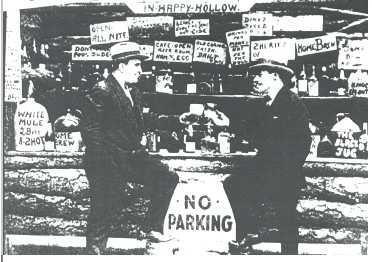
This picture is believed to be Al Capone and an unidentified friend at Happy Hollow in Hot Springs, Arkansas.
(Photo and info. courtesy of the Garland County Historical Society)
Our most famous visitor down through the ages…. must have been Al Capone. During the prohibition era, Capone came from Chicago to strike deals with bootleggers in Hot Springs to stock his clubs in Chicago with alcohol. Not only is Hot Springs a remote town located in the middle of the Ouachita mountains, but the pine trees provide “cover” for the moonshine stills year round. Capone would ship his bootleg liquor in tanker railroad cars, and for protection, he had the words “Mountain Valley Water” painted on the side of the railcars!
In Chicago, Detroit, New York – when the heat was on because of a robbery or murder, the overlords knew where to come to relax in safety. Hot Springs was a sanctuary from prosecution and enemies. Gangsters could enjoy the entertainment of gambling, and be pampered with the hot mineral baths and massages.
At one time, Capone and his entourage occupied the 4th floor of the Arlington Hotel. (Legend has it that Capone always stayed in room 442, and that the Arlington Hotel has locked that room up and will not rent it to anyone to this day) Capone’s arch enemy Bugs Moran and his gang were checked in at the Majestic Hotel, just one block away. There was no conflict, and no violence – both gangsters were on vacation!
____________________________________
In the early 1930s, Luciano lived in a penthouse suite at New York’s Waldorf Towers, where he was registered as Charles Ross. In March 1936, Luciano fled New York after being alerted by a friendly desk clerk that two men who looked like detectives were on their way up to see him. He drove to Philadelphia, Pennsylvania, changed cars, and borrowed $25,000 from friends. He then drove to Cleveland, Ohio, where he took the train to Hot Springs, which at the time was a gambling sanctuary run by fellow gangster Owen “Owney the Killer” Madden.
New York special prosecutor Thomas E. Dewey proclaimed Luciano “Public Enemy Number One” and started a nationwide manhunt to arrest Luciano and return him to New York to face indictment for allegedly running a $12 million prostitution syndicate. Luciano was originally charged with ninety counts of compulsory prostitution, later reduced to sixty-two.
New York detective John J. Brennan went to Hot Springs on an unrelated case and, on April 1, 1936, saw Luciano strolling along Bathhouse Row with Hot Springs’ chief of detectives. Brennan approached Luciano and invited the gangster to return with him to New York. Luciano declined, saying that he was having a good time in Hot Springs.
New York authorities asked Hot Springs and Arkansas officials to extradite Luciano to New York, and he was arrested on April 1, 1936. However, a local judge released Luciano after setting a $5,000 bond. An enraged Dewey contacted Governor J. Marion Futrell and state attorney general Carl E. Bailey, demanding action. Futrell ordered Hot Springs officials to re-capture Luciano, but Hot Springs officials were reluctant to begin extradition hearings. Bailey issued a fugitive warrant on April 3 and ordered Luciano transported to Little Rock (Pulaski County), sending twenty state troopers to Hot Springs to collect Luciano. They removed him from the Hot Springs jail at midnight and rushed him to Little Rock.
A man claiming to be an associate of Madden’s allegedly approached Bailey and offered him $50,000 (ten times his yearly salary) to make sure the extradition was denied. As the extradition hearing was being held in the governor’s conference room on April 6, Bailey made the bribery attempt public, saying Arkansas was not for sale: “Every time a major criminal of this country wants asylum, he heads for Hot Springs. We must show that Arkansas cannot be made an asylum for them.” Bailey’s revelation led to Futrell’s upholding the extradition warrant. Within days, Luciano was returned from Arkansas to New York to stand trial.
On June 18, 1936, Luciano was sentenced to thirty to fifty years at the maximum security Dannemora Prison in New York. It was the longest sentence ever handed down in New York for compulsory prostitution.
He served his time quietly, determined to be a model prisoner. During World War II, Luciano allegedly helped the government by forging ties and collecting intelligence in Sicily prior to the Allied invasion of Italy. He also claimed that he helped prevent maritime sabotage by the enemy in the United States through his connections on the waterfront. In 1946, his sentence was commuted, and Luciano was deported to Italy, as he had never become an American citizen. The U.S. government blocked his attempts to return to the Americas, including Cuba, and he lived the rest of his days in Italy.
While he had several long-term mistresses in the United States and Italy, he never married and claimed no children. Luciano died of a heart attack on January 26, 1962, at Capodichino Airport in Naples, Italy, where he had gone to meet a Hollywood movie producer. Though Luciano was denied entry into the United States during his lifetime, he was buried at St. John’s Cathedral Cemetery in Queens, New York.
For additional information:
Buchanan, Edna. “Lucky Luciano.” Time. December 7, 1998, pp. 131–32.
Gosch, Martin, and Richard Hammer. The Last Testament of Lucky Luciano. Boston: Little, Brown and Company, 1974.
Ledbetter, Calvin Jr. “Carl Bailey: A Pragmatic Reformer.” Arkansas Historical Quarterly 57 (Summer 1998): 134–159.
McMath, Sid. Promises Kept. Fayetteville: University of Arkansas Press, 2003.
Reppetto, Thomas. American Mafia: A History of its Rise to Power. New York: Henry Holt & Co., 2004.
The Crescent Hotel was built in 1886 in Eureka Springs (Carroll County) by the Eureka Springs Investment Company, the president of which was former governor Powell Clayton.

The hotel boasted every modern convenience, from electricity to elevators, and was well known for its location near the springs that supposedly held healing waters. The cost for this hotel, declared America’s most opulent resort, was $294,000. The hotel opened its doors to the public on May 1, 1886, with an open house two weeks later. On May 20, a banquet was held for guest of honor James G. Blaine, the 1884 Republican presidential nominee. A gala ball was held for the 400 attendants, with Harry Barton’s orchestra entertaining, followed by a speech from Blaine.
The Crescent enjoyed great success for many years, but as the economy worsened in the 1900s, the hotel opened for business only during the summer months.
The Crescent fell into disrepair for six years, and not until 1946 was the property purchased again and renovated to its original look, reopening on July 4, 1946, as “A Castle in the Air High Atop the Ozarks.”
The hotel has enjoyed a long period of success, despite a fire on the fourth floor in 1967, which damaged some of the building. In 1973, restorations began, and the hotel was again open to the public by May of that year. Renovations came again in 1980 to restore the original luxury to the hotel, and improvements continued to be made until 2002. The hotel remains open as of 2010, with the addition of the New Moon Spa to the basement level, which reflects the original purpose of the hotel as a destination for relaxation and healing. It is also a member of the National Trust Historic Hotels of America and has been featured on the Discovery Channel for its historic Victorian beauty and many reported ghost sightings.


 The Daily Hatch


