Milton Friedman addressed the belief that inflation can cure unemployment, implicit in the Obama administration’s spending blowout

Ep. 9 – How to Cure Inflation [1/7]. Milton Friedman’s Free to Choose (1980)

Cochrane’s Kinky Curves

Posted by Jim Powell

The doctrine that inflation can cure unemployment, implicit in the Obama administration’s spending blowout, goes way back.

The modern version originated with William Phillips, a New Zealand-born economist who, in 1958, wrote a paper modestly titled “The Relation between Unemployment and the Rate of Change of Money Wage Rates in the United Kingdom, 1861‑1957.”  Phillips suggested that when inflation went up, unemployment went down. Keynesian economists Paul Samuelson and Robert Solow popularized Phillips’ idea as a reason to ratchet up government spending and inflate the money supply.  That’s what the Kennedy and Johnson administrations did during the 1960s.

In 1967, Milton Friedman expressed a skeptical view about what had come to be known as the Phillips Curve, launching an extended debate.  Then in 1973, President Richard Nixon, who had famously declared “I am now a Keynesian,” leaned hard on Fed Chairman Arthur Burns to inflate the money supply and drive down unemployment, hopefully to improve Nixon’s prospects for re-election.  Well, as those of us who were around back then recall, both inflation and unemployment went up!  This was a bit of a problem for Phillips Curve aficionados.

As if the stubborn stagflation of the 1970s wasn’t bad enough, subsequent efforts by new Fed Chairman Paul Volcker and President Ronald Reagan to stop inflation cold delivered another hammer blow against the Phillips Curve: both inflation and unemployment went down!

Now fast-forward to January 2009: President Obama levitated the Phillips Curve from the dead when he repeatedly declared that it was urgent to enact his $825 billion stimulus bill so unemployment would go down.  But both spending and unemployment went up!  It became harder to deny that the stimulus spending flopped, though the New York Times’ Keynesian columnist Paul Krugman tried valiantly.  He claimed stimulus spending flopped because Obama didn’t spend enough.  Accordingly, several weeks ago, Obama proposed still more stimulus spending to fight unemployment, and he begged people to support it: “If you love me, pass this bill!”

There shouldn’t have been any surprise about Obama’s flop, since the underlying idea – the Phillips Curve – proved to be a dud long ago.  This would be a good time to review experience with the Phillips Curve.

Thankfully, Cato Adjunct Scholar John H. Cochrane, the AQR Capital Management Distinguished Service Professor of Finance at the University of Chicago Booth School of Business, has done just that.  He focused on the period from 1966 to the present.  That year, President Lyndon Johnson was going full bore, promoting runaway spending on new entitlement programs and on the Vietnam war simultaneously, and inflation reared its ugly head.

Cochrane charted what happened year-by-year to inflation and unemployment.  The result wasn’t a nice smooth curve dreamed about by Keynesians.  Rather, there was a kinky curve.  One year, inflation went up, and unemployment went down.  Next year, inflation went up again, and unemployment went up.  Then when inflation went down, unemployment went up again.  On and on as if we followed a drunk stumbling around a street.  Since a single chart would have become an unreadable tangle if it tried to cover the entire 45-year period, Cochrane developed two charts, 1966-1984 and 1985-2011.  Clearly, what we see is a random relationship between inflation and unemployment, that makes the Phillips Curve worthless as a policy tool.

The charts appear in an insightful article Cochrane wrote, published in the Fall 2011 National Affairs.  The article is important quite apart from the Phillips Curve charts.  Although the prevailing view seems to be that high inflation is most likely to occur if and when the Fed increases the money supply, Cochrane warns high inflation could occur as a consequence of soaring government debt.  Such inflation would amount to a default.  It would be triggered by a run on dollar-denominated assets, if and when investors conclude that the government cannot pay its debts.  Runs occur without warning, often after a succession of events have undermined investor confidence.

The Sixty Six who resisted “Sugar-coated Satan Sandwich” Debt Deal (Part 4)

We Need a Balanced Budget!

The Sixty Six who resisted “Sugar-coated Satan Sandwich” Debt Deal (Part 4)

This post today is a part of a series I am doing on the 66 Republican Tea Party favorites that resisted eating the “Sugar-coated Satan Sandwich” Debt Deal. Actually that name did not originate from a representative who agrees with the Tea Party, but from a liberal.

Rep. Emanuel Clever (D-Mo.) called the newly agreed-upon bipartisan compromise deal to raise the  debt limit “a sugar-coated satan sandwich.”

“This deal is a sugar-coated satan sandwich. If you lift the bun, you will not like what you see,” Clever tweeted on August 1, 2011.

Franks Votes Against Debt Ceiling Hike

 
Washington, D.C. – Congressman Trent Franks (AZ-02), on the heels of his vote against the debt ceiling plan proposed yesterday, released the following statement, reiterating his remarks last night on the House floor emphasizing the vital importance of a Balanced Budget Amendment:
 
“It is simply undeniable at this point that Democrats do not grasp the threat posed by our perpetual deficit spending and ever-ballooning debt. Even as the debt ceiling has been raised yet again, Democrats, who claim to support a Balanced Budget Amendment, despite having opposed BOTH Balanced Budget Amendment proposals that passed the House, have again made certain to include numerous exceptions into the debt ceiling legislation, so that a Balanced Budget Amendment to permanently fix our deficit spending problem is not a requirement, but an option they can opt out of at a later date.
 
“Lip service to a balanced budget it no longer enough. All financial budgets will eventually balance. That includes the budget of the United States government. The question before our nation now is whether our budget will balance due to proactive work by those of us sent to fix the broken system in Washington, or by financial calamity due to the unwillingness of so many to stop a looming disaster when we had the opportunity to do so.”
 
###
 
Congressman Franks is serving his fifth term in the U.S. House of Representatives and is a member of the Judiciary Committee, where he serves as Chairman of the Subcommittee on the Constitution and a member of the Subcommittee on Courts, Commercial and Administrative Law. He is also a member of the Armed Services Committee, where he serves on the Strategic Forces Subcommittee and the Subcommittee on Emerging Threats and Capabilities.

Congressman Franks is serving his fifth term in the U.S. House of Representatives and is a member of the Judiciary Committee, where he serves as Chairman of the Subcommittee on the Constitution and a member of the Subcommittee on Courts, Commercial and Administrative Law. He is also a member of the Armed Services Committee, where he serves on the Strategic Forces Subcommittee and the Subcommittee on Emerging Threats and Capabilities.

###

2435 Rayburn HOB, Washington, D.C. 20515
202-225-4576


Dear Senator Pryor, why not pass the Balanced Budget Amendment? (Part 9 Thirsty Thursday, Open letter to Senator Pryor)

Dear Senator Pryor,

Why not pass the Balanced Budget Amendment? As you know that federal deficit is at all time high (1.6 trillion deficit with revenues of 2.2 trillion and spending at 3.8 trillion).

On my blog www.HaltingArkansasLiberalswithTruth.com I took you at your word and sent you over 100 emails with specific spending cut ideas. However, I did not see any of them in the recent debt deal that Congress adopted. Now I am trying another approach. Every week from now on I will send you an email explaining different reasons why we need the Balanced Budget Amendment. It will appear on my blog on “Thirsty Thursday” because the government is always thirsty for more money to spend.

Huntsman Supports Radical Balanced Budget Amendment

Huntsman Supports Radical Balanced Budget Amendment

Brian Beutler | June 20, 2011, 20digg

Jon Huntsman
In a private conference call with a handful of university students across the country, GOP Presidential hopeful — and President Obama’s former Ambassador to China — Jon Huntsman argued in support of one of the most far-reaching, controversial elements of the conservative political agenda.

As first reported in a broader piece by theHuffington Post, Huntsman argued in favor of a constitutional amendment requiring the federal government to maintain a balanced budget — an innocuous-sounding, but radical plan pushed by Sen. Jim DeMint (R-SC) and numerous other congressional conservatives.

“We’re going to have to fight for a balanced budget amendment,” Huntsman said. “Every governor in this country has a balanced budget amendment. It keeps everybody honest. It’s the best safeguard imaginable.”

At its core, a balanced-budget amendment would make it unconstitutional for the government to spend more than it collects in revenue — a requirement that, without safeguards, would make stimulus and emergency spending impossible.

Faced with a similar requirement, states responded to the recession with budget cuts that exacerbated the downturn.

But Republicans on the Hill have taken the idea a step further to the right by including a provision that would make it functionally impossible for the government to raise taxes. The goal, then, is to force future Congresses to slash or eliminate federal spending programs — which disproportionately benefit the needy and elderly — to bring them in line with a revenue base that’s likely to shrink over time.

It’s unclear whether Huntsman supports this version of a Balanced Budget Amendment, or a less extreme one. But the nature of the idea is such that it allows conservatives to signal their support for slashing programs without providing the unpopular details. And in the GOP primary, this will likely be a key test for candidates hoping to curry favor with influential conservatives like DeMint.

Unemployment benefits do not stimulate economy

President Obama is wrong again.

Unemployment Insurance System Fosters Unemployment

Posted by Tad DeHaven

The Wall Street Journal reports on rising state and federal unemployment taxes at a time when unemployment remains high. Keynesian economists keep telling us that unemployment benefits have a stimulative “multiplier effect” on the economy. Unfortunately, that sticky little problem of the government having to suck resources out of the economy to pay for this alleged stimulus keeps getting in the way:

The higher tax tab could discourage hiring. ‘It’s just one more cost to add,’ said Douglas Devnew, vice president for finance and administration at Trumpf Inc., a Farmington, Conn., manufacturer. ‘Companies like ours are going to think that much harder if we need more folks.’

Yes, that’s only an anecdote. But I find anecdotes to be considerably more indicative of reality than, say, the fancy economic models favored by the White House that continue to erroneously predict growth and reduced unemployment if the government spends more of the private sector’s money.

If anecdotes aren’t your thing, check out this excellent Cato essay on the unemployment insurance system. Critics of a government administered unemployment insurance system are often accused of being callous toward the plight of those seeking work. But the essay’s examination of the history of unemployment insurance, and the ill-effects and failures of the government-run system indicate that it’s the supporters of the government-run system who should be on the defensive.

Obamacare at the Supreme Court

John Brummett has called the Republicans in Arkansas obstructionists for trying to stop Obamacare but the more I study it, the more I oppose it too. The Blue Arkansas Blog says that Mark Pryor may get defeated because of his conservative votes but it is evident that Pryor’s vote for Obamacare is the one he will regret the most.

Obamacare at the Supreme Court

The time is finally here for the Supreme Court to hear this case.

Hans von Spakovsky

September 28, 2011 at 11:00 am

The National Federation of Independent Business (NFIB) stole a march on the Obama Administration this morning by filing a petition with the U.S. Supreme Court appealing the 11th Circuit’s Obamacare decision.

The Department of Justice (DOJ) had announced on Monday that it was not going to ask all 11 judges of the 11th Circuit Court of Appeals to review en banc the August 12 decision of a three-judge panel of the 11th Circuit that found the individual mandate unconstitutional. This opened up a path to an appeal by DOJ to the Supremes.

Dan Mitchell gives 12 reasons Obamacare will fail.

__________________

However, with this petition, the NFIB jumped ahead of Eric Holder’s slow-moving DOJ (which until Monday had done everything it could to slow-walk this case filed by 26 states and the NFIB). The NFIB is obviously not appealing the three-judge panel’s opinion about the unconstitutionality of the individual mandate. But the NFIB is appealing the portion of the panel’s decision that held that the unconstitutional individual mandate could be severed from the Obamacare legislation.

The NFIB is asking the Court to overrule this holding, since “Congress itself deemed [the mandate] ‘essential’ to the Act’s new insurance regulations.” Given that the 11th and 6th Circuits have issued “directly conflicting final judgments about the facial constitutionality of [Obamacare’s] mandate,” the case is one that the Court should obviously take up given its interest in eliminating conflicting opinions in the courts of appeal.

What also differentiates this particular case from the many other lawsuits that have been filed against Obamacare is the “all star” lineup of Supreme Court litigators that the NFIB and the 26 states have lined up to argue their case before the Supreme Court. It includes Michael Carvin, a former DOJ official who has argued (and won) numerous cases before the Court; Gregory Katsas, a former DOJ official who was a clerk to Justice Clarence Thomas; Kevin Marshal, another former DOJ official and Thomas clerk; Hashim Mooppan, a former Justice Antonin Scalia clerk; and Randy Barnett, a nationally recognized constitutional scholar and professor at Georgetown.

The lawyers for the states include Paul Clement, former Bush Administration Solicitor General; Lee Casey, another former DOJ official who clerked for Alex Kozinski, who is now the Chief Judge of the Ninth Circuit; and David Rivkin, another Supreme Court litigator with wide experience in the government, including in the White House and the DOJ.

The government lawyers in the DOJ’s Office of the Solicitor General who will be arguing the constitutionality of Obamacare will have their work cut out for them.

The Sixty Six who resisted “Sugar-coated Satan Sandwich” Debt Deal (Part 3)

The Sixty Six who resisted “Sugar-coated Satan Sandwich” Debt Deal (Part 3)

This post today is a part of a series I am doing on the 66 Republican Tea Party favorites that resisted eating the “Sugar-coated Satan Sandwich” Debt Deal. Actually that name did not originate from a representative who agrees with the Tea Party, but from a liberal.

Rep. Emanuel Clever (D-Mo.) called the newly agreed-upon bipartisan compromise deal to raise the  debt limit “a sugar-coated satan sandwich.”

“This deal is a sugar-coated satan sandwich. If you lift the bun, you will not like what you see,” Clever tweeted on August 1, 2011.

Congressman Flake Votes Against Debt Deal
Greater Congressional Spending Restraints Needed
Washington, D.C. , Aug 1 –

Republican Congressman Jeff Flake, who represents Arizona’s Sixth District, today voted against the revised version of the Budget Control Act of 2011.

“I don’t think that this deal takes into account the severity of the budget crisis we face.  The age-old trick in Washington is to produce a ten-year budget with serious cuts only taking effect in later years.  This deal continues that practice.  Additionally, the requirement for a balanced budget amendment, which was included in the Boehner bill, was excluded from the final legislation.”

Congressman Flake: So Just How Broke Are We?
Mesa, Arizona, Aug 2 – Republican Congressman Jeff Flake, who represents Arizona’s Sixth District, today illustrated the size and scope of the growing national debt.          The Washington Times reports that Vice President Joe Biden collects rent from the Secret Service for use of a cottage on a property he owns in a Wilmington, Delaware suburb. The Secret Service pays the vice president $2,200 each month in rent.

The U.S. is so broke that Vice President Biden would have to rent his cottage to the Secret Service for 545.8 million years – long after he’s left office – to have the money to pay down our debt of more than $14.4 trillion.

“Biden’ our time clearly isn’t solving the debt problem,” said Flake.          Along with Senators McCain and Rubio, Congressman Flake introduced in the 112th Congress the Debt Buy-Down Act, which allows taxpayers to designate up to 10 percent of their federal income tax liability to reduce the national debt.  The bill then requires Congress to reduce federal spending by that amount.  More information on the Debt Buy-Down Act can be found here.

Print version of this document

How to tackle Medicaid?

How to tackle Medicaid?

We got to take the bull by the horns eventually.

Block-Granting Medicaid Is a Long-Overdue Way of Restoring Federalism and Promoting Good Fiscal Policy

Posted by Daniel J. Mitchell

This new video, based in large part on the good work of Michael Cannon, explains why Medicaid should be shifted to the states. As I note in the title of this post, it’s good federalism policy and good fiscal policy. But the video also explains that Medicaid reform is good health policy since it creates an opportunity to deal with the third-party payer problem.

_________

One of the key observations of the video is that Medicaid block grants would replicate the success of welfare reform. Getting rid of the federal welfare entitlement in the 1990s and shifting the program to the states was a very successful policy, saving billions of dollars for taxpayers and significantly reducing poverty. There is every reason to think ending the Medicaid entitlement will have similar positive results.

Medicaid block grants were included in Congressman Ryan’s budget, so this reform is definitely part of the current fiscal debate. Unfortunately, the Senate apparently is not going to produce any budget, and the White House also has expressed opposition. On the left, reducing dependency is sometimes seen as a bad thing, even though poor people are the biggest victims of big government.

It’s wroth noting that Medicaid reform and Medicare reform often are lumped together, but they are separate policies. Instead of block grants, Medicare reform is based on something akin to vouchers, sort of like the health system available for Members of Congress. This video from last month explains the details.

In closing, I suppose it would be worth mentioning that there are two alternatives to Medicaid and Medicare reform. The first alternative is to do nothing and allow America to become another Greece. The second alternative is to impose bureaucratic restrictions on access to health care—what is colloquially known as the death panel approach. Neither option seems terribly attractive compared to the pro-market reforms discussed above.

The current federal budget brought down to a level a family could understand

I got this off the internet.

U.S. Tax revenue: $2,170,000,000,000
Fed budget: $3,820,000,000,000
New debt: $1,650,000,000,000
National debt: $14,271,000,000,000
Recent budget cut: $38,500,000,000

Now, remove 8 zeros and pretend it’s a household budget

Annual family income: $21,700
Money the family spent: $38,200
New debt on the credit card: $16,500
Outstanding balance on credit card: $142,710
Total budget cuts: $385

Sort of brings the true issue “home” doesn’t it?

Related posts:

Tea Party Conservative Senator Mike Lee interview

Tea Party Conservative Senator Mike Lee interview Here is an excellent interview above with Senator Lee with a fine article below from the Heritage Foundation. Sen. Mike Lee (R-UT) came to Washington as the a tea-party conservative with the goal of fixing the economy, addressing the debt crisis and curbing the growth of the federal […]

Dear Senator Pryor, why not pass the Balanced Budget Amendment? (Part 8 Thirsty Thursday, Open letter to Senator Pryor)

Dear Senator Pryor, Why not pass the Balanced  Budget Amendment? As you know that federal deficit is at all time high (1.6 trillion deficit with revenues of 2.2 trillion and spending at 3.8 trillion). On my blog http://www.HaltingArkansasLiberalswithTruth.com I took you at your word and sent you over 100 emails with specific spending cut ideas. However, […]

Sixty Six who resisted “Sugar-coated Satan Sandwich” Debt Deal (Part 48)

Sixty Six who resisted “Sugar-coated Satan Sandwich” Debt Deal (Part 48) This post today is a part of a series I am doing on the 66 Republican Tea Party favorites that resisted eating the “Sugar-coated Satan Sandwich” Debt Deal. Actually that name did not originate from a representative who agrees with the Tea Party, but […]

Sixty Six who resisted “Sugar-coated Satan Sandwich” Debt Deal (Part 46)

  Sixty Six who resisted “Sugar-coated Satan Sandwich” Debt Deal (Part 46) This post today is a part of a series I am doing on the 66 Republican Tea Party favorites that resisted eating the “Sugar-coated Satan Sandwich” Debt Deal. Actually that name did not originate from a representative who agrees with the Tea Party, […]

Sixty Six who resisted “Sugar-coated Satan Sandwich” Debt Deal (Part 44)

Sixty Six who resisted “Sugar-coated Satan Sandwich” Debt Deal (Part 44) This post today is a part of a series I am doing on the 66 Republican Tea Party favorites that resisted eating the “Sugar-coated Satan Sandwich” Debt Deal. Actually that name did not originate from a representative who agrees with the Tea Party, but […]

Dear Senator Pryor, why not pass the Balanced Budget Amendment? (Part 7 Thirsty Thursday, Open letter to Senator Pryor)

Dear Senator Pryor,  Why not pass the Balanced Budget Amendment? As you know that federal deficit is at all time high (1.6 trillion deficit with revenues of 2.2 trillion and spending at 3.8 trillion). On my blog http://www.HaltingArkansasLiberalswithTruth.com I took you at your word and sent you over 100 emails with specific spending cut ideas. However, […]


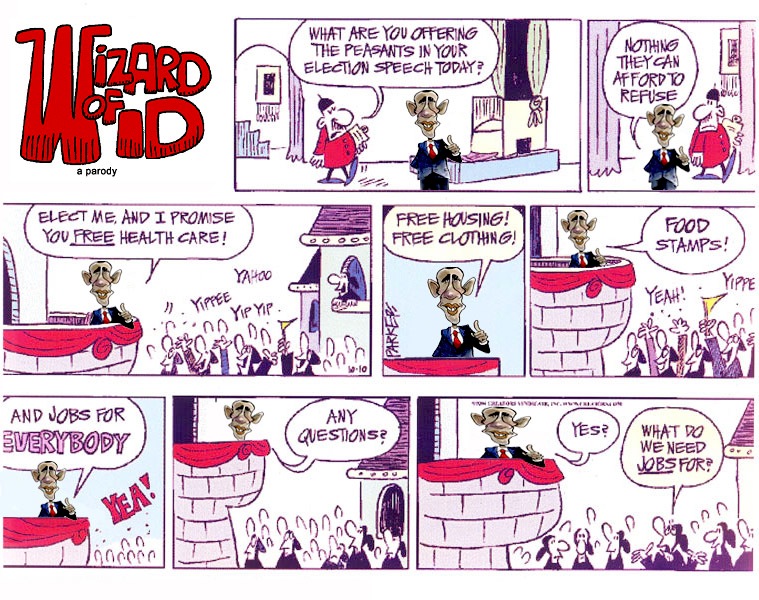
Liberals love socialism so much they would have you give up your job and get on the public dole

Great carton.

image

USA slips from 3rd to 10th in ranking of freedom

Uploaded by on Jan 12, 2011

http://www.heritage.org/index Is the American Dream dead? How free is America’s economy? Check out the 2011 Index of Economic Freedom for all the answers.

______________________

Economic freedom is not heading the right direction in the USA. My son Wilson has been asking me if there are any other countries that are less socialistic then us and I have been painting a pretty bleak picture out there for him. This article and chart below show there are some countries heading the right direction. Unfortunately, the USA is not one of them.

Economic Freedom of the World: Lessons for the U.S.

by James D. Gwartney, Robert Lawson and Joshua Hall 

James Gwartney is a professor at Florida State University. Robert Lawson is a professor at Southern Methodist University. Joshua Hall is a professor at Beloit College. They are co-authors of the Economic Freedom of the World report, which can be found at http://www.freetheworld.com, and is co-published by the Cato Institute.

Added to cato.org on September 26, 2011

This article appeared on The Huffington Post on September 25, 2011

Economic freedom in the United States is on the wane. Historically a standard bearer for freer markets, the United States has seen its economic freedom rating fall in the last decade according to the latest Economic Freedom of the World index, published by a world-wide network of institutes. In 2000, the U.S. was ranked 3rd in the world behind only Hong Kong and Singapore, but in the most recent report, the U.S. is ranked 10th behind countries like Canada, Chile, Australia, and the United Kingdom.

The index measures the degree to which people in a nation are free to pursue their own economic objectives without government taxes and regulations, as well as the extent to which government protects property rights and provides a sound monetary environment. The decline of the U.S. is the result of massively higher government spending and borrowing, increased regulation, and especially less secure property rights. Ballooning budget deficits are crowding out private credit causing the rating in this component to fall to 0.0 from 9.3 (out of 10) since 2000. Asset forfeiture laws, eminent domain abuse, the wars on drugs and terrorism, TSA, and warrantless wiretaps have apparently taken their toll on the security of property rights.

The so-called Washington Consensus of the 1990s — free trade, stable money, and privatization — appears dead. The housing bubbles, financial crises, bankruptcies, bailouts, stimulus, debt crises, and erratic markets of the past few years seem to have led to a new consensus. Policymakers now tell us that markets have failed, and government stimulus, subsidies and new regulations are needed to set things right.

James Gwartney is a professor at Florida State University. Robert Lawson is a professor at Southern Methodist University. Joshua Hall is a professor at Beloit College. They are co-authors of the Economic Freedom of the World report, which can be found at http://www.freetheworld.com, and is co-published by the Cato Institute.


More by James D. Gwartney

When evaluating such claims, it is important to remember the fundamental truth of economic life: Markets work. When people are free to buy, sell, produce, trade, and move they do a pretty good job of bettering themselves and others in the process. This is not just common sense or idle theory — there is tons of evidence.

Nations that score higher on the index tend to be richer, grow faster, have less poverty, live longer, be more educated, and on and on. On virtually every measure of the good life, we find that more economic freedom yields better results. Other research finds economic freedom corresponds with less warfare, greater human rights, more gender equity, less unemployment, improved democracy, more trust, and less corruption. The results of the Economic Freedom of the World project and the scholarly analysis it has facilitated are simply overwhelming. Economic freedom works.

Over the past decade, the rating of the United States has fallen almost a full point on the economic freedom scale. Prior research indicates that a decline of this magnitude will reduce a country’s long-term growth rate by at least a full percentage point. In the case of the United States, this will mean future average annual growth of real GDP of 2 percent rather than our 3 percent historical average.

While economic freedom has fallen in the United States, there is good news in the former communist world. A number of formerly centrally planned economies have made remarkable progress toward freer markets during the past decade. Eight of them, Slovakia, Estonia, Hungary, Lithuania, Bulgaria, Albania, Mongolia, and Georgia, now rank in the top 40. By way of comparison, only three Latin American countries, Chile, Panama, and Peru, place in the top 40. All of these countries now rank higher than Sweden and France, for example.

With economic freedom, profits and losses direct resources toward socially beneficial activities. When too many resources are allocated by politics, a system of crony capitalism emerges where politicians can reward the politically powerful. Unlike true entrepreneurs, crony capitalists do not create wealth; instead they plunder wealth from taxpayers and other citizens.

America has prospered historically because we have chosen economic freedom rather than political allocation and crony capitalism. To the extent we move away from economic freedom, our future prosperity will be diminished.

_________________

This article includes a List of countries by economic freedom.

2011 List by the Fraser Institute[1] 2011 List by The Heritage Foundation[2]
Rank↓ Country↓ Score↓
1  Hong Kong 9.01
2  Singapore 8.68
3  New Zealand 8.20
4  Switzerland 8.03
5  Australia 7.98
6  Canada 7.81
7  Chile 7.77
8  United Kingdom 7.71
9  Mauritius 7.67
10  United States 7.60
11  Bahrain 7.59
11  Finland 7.59
13  Slovakia 7.56
14  United Arab Emirates 7.54
15  Denmark 7.52
15  Estonia 7.52
15  Hungary 7.52
18  Cyprus 7.51
19  Austria 7.50
20  Luxembourg 7.49
21  Germany 7.45
22  Japan 7.44
23  Panama 7.41
24  Lithuania 7.40
25  Ireland 7.38
26  Taiwan 7.37
27  Georgia 7.36
28  Bulgaria 7.34
28  Oman 7.34
30  Albania 7.32
30  Netherlands 7.32
30  South Korea 7.32
Rank↓ Country↓ Score↓
1  Hong Kong 89.7
2  Singapore 87.2
3  Australia 82.5
4  New Zealand 82.3
5  Switzerland 81.9
6  Canada 80.8
7  Ireland 78.7
8  Denmark 78.6
9  United States 77.8
10  Bahrain 77.7
11  Chile 77.4
12  Mauritius 76.2
13  Luxembourg 76.2
14  Estonia 75.2
15  Netherlands 74.7
16  United Kingdom 74.5
17  Finland 74.0
18  Cyprus 73.3
19  Macau 73.1
20  Japan 72.8
21  Austria 71.9
22  Sweden 71.9
23  Germany 71.8
24  Lithuania 71.3
25  Taiwan 70.8
26  Saint Lucia 70.8
27  Qatar 70.5
28  Czech Republic 70.4
29  Georgia 70.4
30  Norway 70.3