Francis Bacon: Humanist artist who believed life “is meaningless” (Part 1)

Francis Bacon: Humanist artist who believed life “is meaningless” (Part 1)

John Whitehead in an article noted:

Bacon, however, clearly expressed his atheistic pessimism: “Man now realizes that he is an accident, that he is a completely futile being, that he has to play out the game without purpose, other than of his own choosing.” On another occasion, he remarked: “We are born and we die and there’s nothing else. We’re just part of animal life.”

Thus, Bacon, in terms of humanity and the supernatural, reached not only a position of unbelief but of despair. His paintings express modern humanity’s condition: dehumanized man dispossessed of any durable paradise.

________________________

I first read about Francis Bacon in a book written by Francis Schaeffer. I was interested in looking into his art. His art really shows where modern man has come to the place of desperation since modern man has embraced the closed system that does not include God. What is left for man but what time and chance can bring. Bacon admitted that he was very depressed about man’s future and it comes out in his paintings.

I wish he would have read the work of Francis Schaeffer. I have posted links to Schaeffer’s works below.
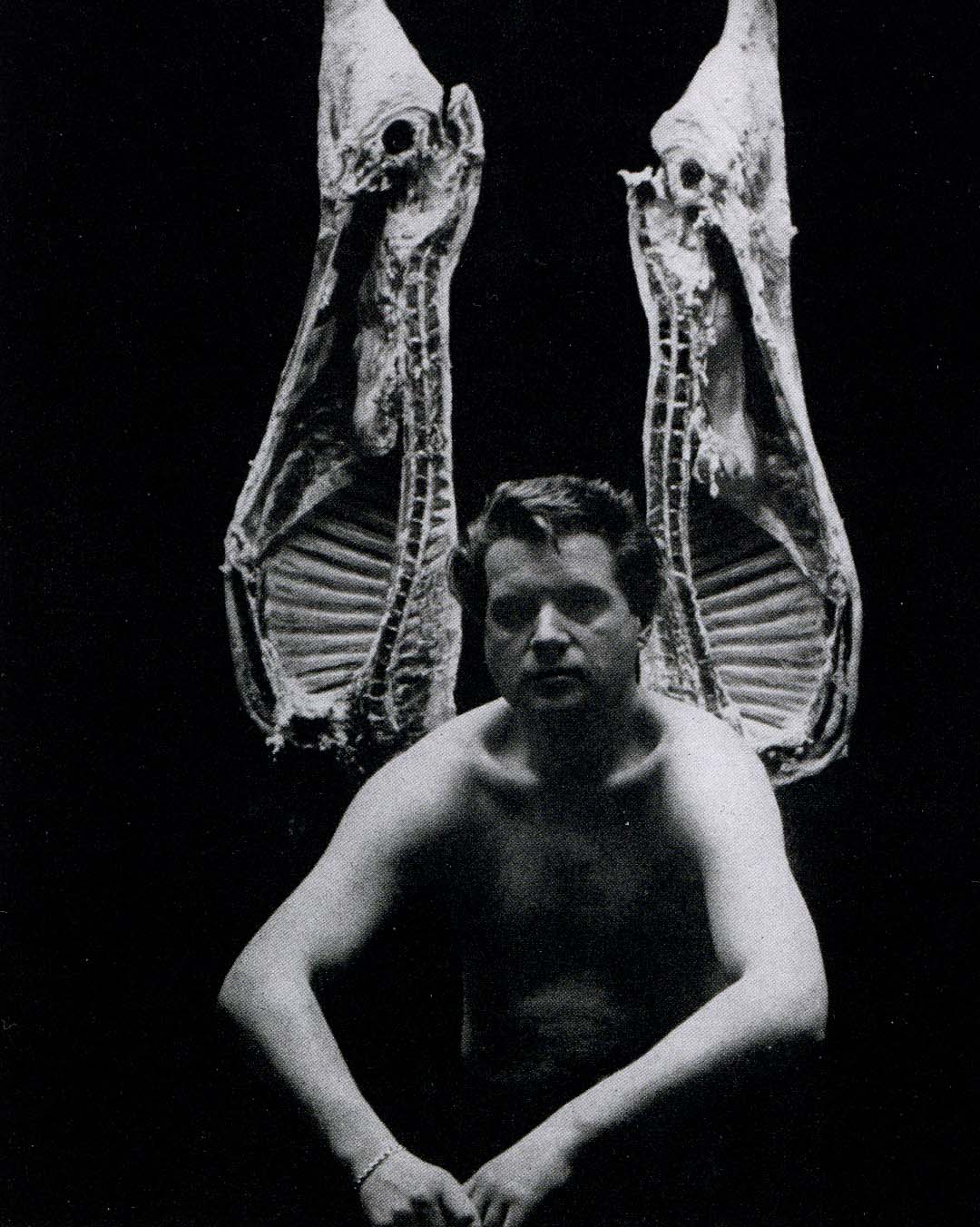
Photograph of Bacon taken by John Deakin for Vogue, 1962

Francis Bacon was a modern painter.

August 1, 2009 • Volume 23, Number 10

Artspace

Francis Bacon: The darker side of art

By Jenna Smith  |  ChristianWeek Columnist

Francis Bacon’s Painting 1946

This summer, the Metropolitain Museum of Art is hosting the first major Francis Bacon exhibition it has known in twenty years. “Francis Bacon: A Centenary Retrospective” celebrates the 100th anniversary of the artist’s birth. The British painter had the rare luxury of becoming rich and famous in his own lifetime. By his death in 1992, his paintings were already selling for millions, and their value has only risen since.

Bacon is a celebrated and controversial figure in the art world, or any world at that. One New York Times critic wrote, “If paintings could speak, Bacon’s would shriek.” Those who shudder in the presence his works are justified in doing so. The harshness of his critique of humanity is surpassed only by the grotesque nature of his images. Open bleeding flesh, exposed bones and carcasses fill the canvas. His faces and figures are often distorted, made to look broken or mutilated. The violence in his art is palpable. In a televised interview with Charlie Rose, Thomas Campbell, director of the Met, said “These are paintings that are created to evoke a reaction. Their subject matter is disturbing, unpleasant even revolting. But the surface of his paintings is also so engaging… you’re compelled to look.”

Critics, art historians and philosophers alike have offered up explanations as to Bacon’s view on life. He was abused as a child, a lifelong alcoholic who died of sclerosis of the liver, and he reached his prime as a painter during the last years of World War II.

His negative view of humankind was not unfounded. It would be false, however, to romanticize Bacon’s suffering. He rejected people’s complaints about his art being too harsh, stating, “People complain that I show the horrible side of life. I try to show the excitement of life.” In some ways, whether the viewer likes this or not, Bacon felt he was stating facts, not pushing buttons on our delicate sensibilities.

Gary Tinterow, the show’s curator, said this to Rose: “Here is the problem. He was constantly rubbing our face in our own mess, the mess that men and women are capable of doing to one another. He is constantly reminding us of our own bestiality….he would say that his art was the history of Europe in his own time.”

As if to add insult to injury, Bacon had recurring themes of Christian religious art in his work, recognizing the power of tryptichs and iconography. The crucifixion is especially present, representing for him the epitome of what horrible cruelty men are able of inflicting one upon the other. Take Painting 1946, for example. A faceless crucified figure dominates the backdrop, its skinless rib cage exposed. Above it hangs what looks like sausage from a butcher shop, and at the bottom of the canvas are two pieces of a carcass. A disfigured man holds a black umbrella in the centre of the painting. Bacon’s message is clear: we are meat.

Study After Velazquez’s Portrait of Pope Innocent X (“The Screaming Pope”), 1953

Bacon also loved painting popes. His Study after Velzquez’s portrait of Innocent X evokes a renaissance portrait of this pope, except once more, there is a twist. Innocent X’s mouth is open in a scream, barely hidden by black shuttered stripes. Tinterow commented on his take of Christian religion: “He was an old-fashioned militant atheist…there was always a general squeamishness about his take on Christianity.”

What can a Christian’s response be to such art? What should it be? Can we accept the place of violence and darkness in our dialogue with art? Should we take into consideration his contribution to the ongoing debate about human existence? I would be inclined to say we must. We may not like the fact that there is little redemption in Bacon’s work, nor are we obliged to agree with his interpretation of the crucifixion. But there is undeniable power in his works, shocking us even today, some 60 years after their execution. And there is undeniable truth to his take on humanity.

Let us not be too hurt by his distortion of Christianity. He had a much bigger bone to pick with humans than he did with God. “He respected Christian ethics, and maintained that the Christian way of life was amongst the best in the panoply of ways of life,” commented Tinterow. “It’s just that his common sense forbade him from believing in the Church. He recognized, however, that the Church didn’t believe in him. The feeling was mutual.”

Jenna Smith is completing a joint Masters degree in the faculties of music and theology at the Université de Montréal. She lives in Montreal where she directs Innovation-Jeunes, an arts and nutrition centre for teens.

Related posts:

Responding to Oppenneimer and Lizza:Defending Francis Schaeffer’s influence on believers such as Michele Bachmann(Part 1)

Today I read an article in the New York Times, “Son of Evangelical Royalty, turns his back and tells the tale,” August 19, 2011. The liberal Max Brantley of the Arkansas Times Blog called this article by Mark Oppenneimer “the best reading of the morning.” Oppenneimer asserted: Edith Schaeffer also wrote books, and in 1977, Frank, an amateur filmmaker, […]

Francis Schaeffer’s “How should we then live?” Video and outline of episode 10 “Final Choices”

E P I S O D E 1 0 How Should We Then Live 10#1 FINAL CHOICES I. Authoritarianism the Only Humanistic Social Option One man or an elite giving authoritative arbitrary absolutes. A. Society is sole absolute in absence of other absolutes. B. But society has to be led by an elite: John Kenneth […]

Francis Schaeffer’s “How should we then live?” Video and outline of episode 9 “The Age of Personal Peace and Affluence”

E P I S O D E 9 How Should We Then Live 9#1 T h e Age of Personal Peace and Afflunce I. By the Early 1960s People Were Bombarded From Every Side by Modern Man’s Humanistic Thought II. Modern Form of Humanistic Thought Leads to Pessimism Regarding a Meaning for Life and for Fixed […]

Francis Schaeffer’s “How should we then live?” Video and outline of episode 8 “The Age of Fragmentation”

E P I S O D E 8 How Should We Then Live 8#1 I saw this film series in 1979 and it had a major impact on me. T h e Age of FRAGMENTATION I. Art As a Vehicle Of Modern Thought A. Impressionism (Monet, Renoir, Pissarro, Sisley, Degas) and Post-Impressionism (Cézanne, Van Gogh, Gauguin, […]

Francis Schaeffer’s “How should we then live?” Video and outline of episode 7 “The Age of Non-Reason”

E P I S O D E 7 How Should We Then Live 7#1 I am thrilled to get this film series with you. I saw it first in 1979 and it had such a big impact on me. Today’s episode is where we see modern humanist man act on his belief that we live […]

Taking up for Francis Schaeffer’s book Christian Manifesto

I have made it clear from day one when I started this blog that Francis Schaeffer, Milton Friedman, Ronald Reagan and Adrian Rogers had been the biggest influences on my political and religious views. Today I am responding to an unfair attack on Francis Schaeffer’s book “A Christian Manifesto.” As you can see on the […]

Francis Schaeffer’s “How should we then live?” Video and outline of episode 6 “The Scientific Age”

E P I S O D E 6 How Should We Then Live 6#1 I am sharing with you a film series that I saw in 1979. In this film Francis Schaeffer asserted that was a shift in Modern Science. A. Change in conviction from earlier modern scientists.B. From an open to a closed natural system: […]

Francis Schaeffer’s “How should we then live?” Video and outline of episode 5 “The Revolutionary Age”

E P I S O D E 5 How Should We Then Live 5-1 I was impacted by this film series by Francis Schaeffer back in the 1970′s and I wanted to share it with you. Francis Schaeffer noted, “Reformation Did Not Bring Perfection. But gradually on basis of biblical teaching there was a unique improvement. A. […]

Steve Jobs versus President Obama: Who created more jobs?

I loved reading this article below. (Take a look at the link to other posts I have done on Steve Jobs.) David Boaz makes some great observations:

How much value is the Post Office creating this year? Or Amtrak? Or Solyndra? And if you point out that the Post Office does create value for its customers even though it loses money every year, I would ask, how much more value might its competitors create, if it allowed competition?

Steve Jobs created a lot of new jobs, but President Obama’s stimulus did not stimulus much of anything but waste in government. Take a look at the final paragraph:

Instead of another bag of taxpayers’ money for state and local governments and politically favored businesses, a real jobs program would encourage the next Steve Jobs to create value. What would that involve? Keep taxes on investment and creativity low. Reduce the national debt and its threat of huge tax hikes to come. Ease the burdens of regulation, especially regulations that make it difficult to open a business, hire and keep the best employees, and develop new ideas. Open the huge, stagnant postal and schooling businesses to competition, innovation, and entrepreneurship. Repeal some of the licensing laws that now afflict 1,100 occupations. Renew progress toward free trade. Make it smart for businesses to invest their time, money, and brainpower in productive activity, not lobbying.

Steve Jobs, Prosperity Creator

Posted by David Boaz

The all-too-early death of Steve Jobs was reported on the day that President Obama made another defense of his so-called jobs bill. Which one actually benefited (or would benefit) Americans and the American economy? Lots of people have talked about the way Steve Jobs changed technology, changed business, changed the world. And I trust there’ll be no more churlish complaints about his alleged lack of philanthropy. As Dan Pallotta definitively pointed out,

What a loss to humanity it would have been if Jobs had dedicated the last 25 years of his life to figuring out how to give his billions away, instead of doing what he does best…. [T]he world has no greater philanthropist than Steve Jobs. If ever a man contributed to humanity, here he is.

Two years ago Portfolio magazine did a great graphic on “The Steve Jobs Economy,” trying to assess just how much value he himself had created for the economy. The conclusion: Jobs’s personal wealth at the time was estimated at $5.7 billion. But he was generating $30 billion a year in revenue for Apple, its partners, and its competitors (who were spurred to get better). Here’s the analysis (sorry for the imperfect tear sheet):

Click image to enlarge. And for text but not graphics at Portfolio, click here.

According to Portfolio and the experts it consulted, Jobs was producing $30 billion a year in value for various companies. And of course that means that consumers believed they were getting at least that much value themselves, or they wouldn’t buy the products. That’s a wealth creator. And that number pales in comparison to this one: After returning to Apple in 1997, Jobs took the total value of the company from about $2 billion to $350 billion.

How much value is the Post Office creating this year? Or Amtrak? Or Solyndra? And if you point out that the Post Office does create value for its customers even though it loses money every year, I would ask, how much more value might its competitors create, if it allowed competition?

Instead of another bag of taxpayers’ money for state and local governments and politically favored businesses, a real jobs program would encourage the next Steve Jobs to create value. What would that involve? Keep taxes on investment and creativity low. Reduce the national debt and its threat of huge tax hikes to come. Ease the burdens of regulation, especially regulations that make it difficult to open a business, hire and keep the best employees, and develop new ideas. Open the huge, stagnant postal and schooling businesses to competition, innovation, and entrepreneurship. Repeal some of the licensing laws that now afflict 1,100 occupations. Renew progress toward free trade. Make it smart for businesses to invest their time, money, and brainpower in productive activity, not lobbying.

Related posts:
 

Steve Jobs versus President Obama: Who created more jobs?

I loved reading this article below. (Take a look at the link to other posts I have done on Steve Jobs.) David Boaz makes some great observations: How much value is the Post Office creating this year? Or Amtrak? Or Solyndra? And if you point out that the Post Office does create value for its […]


Steve Jobs’ view of death and what the Bible has to say about it

Steve Jobs’ 2005 Stanford Commencement Address Uploaded by StanfordUniversity on Mar 7, 2008 Drawing from some of the most pivotal points in his life, Steve Jobs, chief executive officer and co-founder of Apple Computer and of Pixar Animation Studios, urged graduates to pursue their dreams and see the opportunities in life’s setbacks — including death […]


8 things you might not know about Steve Jobs

Things you may not know about Steve Jobs: Steve Jobs leans against his wife, Laurene Powell Jobs (Lea Suzuki/San Francisco Chronicle/Corbis) For all of his years in the spotlight at the helm of Apple, Steve Jobs in many ways remains an inscrutable figure — even in his death. Fiercely private, Jobs concealed most specifics about […]


Steve Jobs was a Buddhist: What is Buddhism?

Steve Jobs passed away on October 5, 2011. I personally am very grateful to him for helping the world so much with his ideas and I have written about tha before. Dan Mitchell of the Cato Institute noted: He’s built a $360 billion company. That presumably means at least $352 billion of wealth in the […]


Did Steve Jobs help people even though he did not give away a lot of money?

  Did Steve Jobs help people even though he did not give away a lot of money? (I just finished a post concerning Steve’s religious beliefs and a post about 8 things you may not know about Steve Jobs) Uploaded by UM0kusha0kusha on Sep 16, 2010 clip from The First Round Up *1934* ~~enjoy!! ______________________________________________ In the short film […]


Heritage Foundation Scholars respond to Obama debt reduction proposal (Part 2)

I love going to the Heritage Foundation website for articles like this:

Obama’s Debt Reduction and Tax Proposal

Heritage Responds to Obama’s Debt Reduction and Tax Proposal

Mike Brownfield

September 19, 2011 at 11:16 am

Heritage’s experts watched President Barack Obama’s debt reduction and tax increase proposal. Here are their immediate reactions:

_______________

The President’s Debt Reduction Proposals: The Wrong Diagnosis

The President’s “debt reduction” proposals released today are a fine statement of liberal ideology, but a poor attempt at fiscal policy. His so-called “balanced approach” – using a mix of spending reductions and tax increases – is the wrong formulation to start with. It merely perpetuates a misunderstanding of the fundamental problem: deficits and debt are symptoms; the underlying illness is excessive and uncontrolled spending.

The federal government today is claiming roughly one-fourth of total economic output – about 25 percent of gross domestic product (GDP) – a post-World War II record. This is dead weight on the economy, because every dollar of spending gets paid for – through taxes, borrowing, fees, offsetting receipts, etc. – and hence is no longer available to growth producing activities in the economy. That is why spending is considered one of the best measures of the size and scope of government. As Professor Allen Schick has written, fundamentally government is what it spends.

But even more problematic than the level of spending is its trajectory – especially in federal entitlements. According to the latest figures by the Congressional Budget Office, entitlement spending is projected to rise at a rate of about 5.3 percent per year. That is faster than projected inflation, and faster than nominal GDP. So even if the gap between spending and revenue were closed, entitlements would immediately begin outrunning taxes again, resurrecting deficits.

As is well known, the problem is most acute in the Big Three entitlements: Social Security is growing at a rate of 5.8 percent per year, Medicare at 6.3 percent, and Medicaid at 9 percent. Clearly, these growth rates cannot be lowered by trimming around the edges of the programs, cutting wasteful spending and overpayments, and squeezing medical providers. It requires fundamental reforms that alter the incentives toward overutilization and inefficient delivery of medical services. But these are exactly the kinds of things the President has ruled out. He expressly rejects adjusting benefits or eligibility. He claims his proposal will save $248 billion in Medicare, of which 90 percent would come from reducing overpayments, not from restructuring the program. This is not a serious proposal for addressing the government’s spending and debt problems.

Similarly, he claims savings “that build on the Affordable Care Act” almost entirely from vague improvements in efficiency: “by reducing wasteful spending and erroneous payments, and supporting reforms that boost the quality of care.” Nevertheless, it is curious that his vaunted health care program – which was advertised as reducing deficits – is so inefficient that it is already projected to generate $320 billion in overspending over the next 10 years.

In addition to all these failings, the President takes credit for a whopping $2.3 trillion in spending reductions that either are already assumed, or are based on manufactured spending projections.

First he claims $1.2 trillion in savings (including debt service reduction) from the spending caps in the Budget Control Act. Those are not new savings.

Even more exotic is his $1.1 trillion in savings from drawing down military activities in Iraq and Afghanistan. The President’s budget proposed a total of just $576.5 billion over 10 years for Overseas Contingency Operations (OCO). This amount consists of a $126.5-billion request for fiscal year 2012, and then placeholders of $50 billion a year through 2021. In other words, the 10-year total is largely illusory. Even if it were real, however, it would be impossible to save $1.1 trillion in war spending when the President proposed to spend only about half that amount. It appears the savings are measured against a Congressional Budget Office (CBO) baseline hat assumed the peak, 2010 “surge” level for war spending, and then inflated it for subsequent years. This was an unreal figure to begin with – and one CBO removed in estimating discretionary savings in the Budget Control Act – and yet the President assumes the savings. This is emblematic of just how disingenuous his debt reduction plan truly is.

This is not a serious effort to address the government’s very real spending and deficit crisis – which has worsened significantly in the past two-and-a-half years. It is, to repeat, ideology, not policy.

Patrick Louis Knudsen
Grover M. Hermann Senior Fellow in Federal Budgetary Affairs

Tax Hikes Not the Answer, but Obama Wants Them to Be

President Obama seems intent on not solving our budget and debt crisis. Indeed, he seems almost fixated on making it worse.  His latest plan would immediately ramp up spending to “jolt” job creation in ways that have proven to fail. Once again, Obama is sticking to his strategy of ramping up spending thus “locking in” higher levels that make the job of budget cutters more difficult.  Somehow, he maintains, this is necessary and right for America, making it seem that this spending is inevitable and inexorable.  Thus, the only thing we can do is to hike taxes.

Riiiiiiight.

Tax hike are not the answer.  Plain and simple.  Unless we fundamentally tackle entitlement programs taxes will have to be perpetually raised to keep pace with dramatic growth in spending as Medicare, Medicaid and – yes Mr. President — Social Security grow like a giant tsunami blowing toxic red ink all over the budget and the economy.

Yes, the President did propose spending cuts.  Teeeeensie tiny ones.  $250 billion to Medicare and $72 billion to Medicaid likely over ten years. But bear in mind these are two of the biggest and fastest growing programs in the budget. Medicare this year alone is over $500 billion and over the next ten years will likely reach $7.5 trillion.  But here, the devil is in the details.  The small changes he may propose that would affect retirees will be backloaded – until after any possible second term.  And he abandons future retirees by taking any changes to Social Security off the table. He’s right that spending cuts alone aren’t the solution – the policies must be right too.

Obama is demanding a “balanced” approach as though somehow hiking taxes is both fair and necessary.  But this notion that he is pushing – half tax hikes and half spending cuts – is beyond the class warfare message it sends.  It is a tactic.  A tactic to stall the real reforms that our leaders in Washington must undertake now in order to avert a fiscal, economic and moral crisis.

The simple fact is that our budget and debt crisis can be solved without hiking taxes.   Saving the American Dream, the Heritage Plan to Fix the Debt, Cut Spending and Restore Prosperity is a bold, innovative plan that does just that.  It transforms our entitlement programs, rolls back wasteful and inefficient spending, protects the nation and overhauls our punitive, inefficient and uncompetitive tax code.

Federal Spending needs a complete do-over. We must return to our roots our founding fathers’ laid out – of a limited government. A low tax, low spending and fast growing nation.  One where our kids can enjoy the same kind of opportunity as their parents and grandparents.  One where our seniors know they can go into retirement with the economic security that they will be able to access quality health care that works for them, and a Social Security benefit that will protect them from poverty.

President Obama’s newest plan is simply his April speech cast under the lighting of the Super Committee with the election as a backdrop.  The nation needs more.

Alison Fraser

The Sixty Six who resisted “Sugar-coated Satan Sandwich” Debt Deal (Part 9)

The Sixty Six who resisted “Sugar-coated Satan Sandwich” Debt Deal (Part 9)

This post today is a part of a series I am doing on the 66 Republican Tea Party favorites that resisted eating the “Sugar-coated Satan Sandwich” Debt Deal. Actually that name did not originate from a representative who agrees with the Tea Party, but from a liberal.

Rep. Emanuel Clever (D-Mo.) called the newly agreed-upon bipartisan compromise deal to raise the  debt limit “a sugar-coated satan sandwich.”

“This deal is a sugar-coated satan sandwich. If you lift the bun, you will not like what you see,” Clever tweeted on August 1, 2011


Washington, D.C., Aug 1 –

Tonight, I voted against the Budget Control Act. It leaves real cuts in federal spending to another day. We don’t need congressional super committees and triggers to do the heavy lifting for which Members of Congress were elected.

_______________________________

Nunes favored the bill below:

Cut, Cap and Balance Statement
Debt Limit Plan


Washington, Jul 20 – Congressman Nunes issued the following statement on passage of the Cut, Cap and Balance Act:

“The Cut, Cap and Balance Act is not a perfect bill but it is certainly one that under any other circumstance would have garnered the unanimous support of conservatives across America. It contains a spending cap that would inoculate us against spending excess, while forcing budget reforms to ensure the federal government lives within its means. Leading up to the debate, I joined critics who desired more immediate spending reforms, including to our nation’s entitlements, and sought to have those reforms included. However, I ultimately sided with 233 of my Republican colleagues in supporting Cut, Cap and Balance recognizing the debate is not over. The bill will be considered in the Senate on Saturday.”


Steve Jobs’ view of death and what the Bible has to say about it jh55

(If you want to check out other posts I have done about about Steve Jobs:Some say Steve Jobs was an atheist , Steve Jobs and Adoption , What is the eternal impact of Steve Jobs’ life? ,Steve Jobs versus President Obama: Who created more jobs? ,Steve Jobs’ view of death and what the Bible has to say about it ,8 things you might not know about Steve Jobs ,Steve Jobs was a Buddhist: What is Buddhism? ,Did Steve Jobs help people even though he did not give away a lot of money? )

Steve Jobs’ 2005 Stanford Commencement Address

Uploaded by on Mar 7, 2008

Drawing from some of the most pivotal points in his life, Steve Jobs, chief executive officer and co-founder of Apple Computer and of Pixar Animation Studios, urged graduates to pursue their dreams and see the opportunities in life’s setbacks — including death itself — at the university’s 114th Commencement on June 12, 2005.

___________________

Steve Jobs noted:

Remembering Steve Jobs in quotesRemembering that I’ll be dead soon is the most important tool I’ve ever encountered to help me make the big choices in life. Because almost everything — all external expectations, all pride, all fear of embarrassment or failure — these things just fall away in the face of death, leaving only what is truly important. Remembering that you are going to die is the best way I know to avoid the trap of thinking you have something to lose. You are already naked. There is no reason not to follow your heart. — Steve Jobs, speaking at Stanford University’s commencement, June 2005.

Steve Jobs was a Buddhist and it is my view that this is almost the same as being an atheist. In this clip above he discusses the issue of death. There is one book in the Bible that confronts the view of death and the issue of atheism more than any other book.

Three thousand years ago, Solomon took a look at life “under the sun” in his book of Ecclesiastes. Christian scholar Ravi Zacharias has noted, “The key to understanding the Book of Ecclesiastes is the term ‘under the sun.’ What that literally means is you lock God out of a closed system, and you are left with only this world of time plus chance plus matter.”

Let me show you some inescapable conclusions if you choose to live without God in the picture. Solomon came to these same conclusions when he looked at life “under the sun.”

  1. Death is the great equalizer (Eccl 3:20, “All go to the same place; all come from dust, and to dust all return.”)
  2. Chance and time have determined the past, and they will determine the future.  (Ecclesiastes 9:11-13 “I have seen something else under the sun:  The race is not to the swift
    or the battle to the strong, nor does food come to the wise
    or wealth to the brilliant  or favor to the learned; but time and chance happen to them all.  Moreover, no one knows when their hour will come: As fish are caught in a cruel net,
    or birds are taken in a snare, so people are trapped by evil times  that fall unexpectedly upon them.”)
  3. Power reigns in this life, and the scales are not balanced(Eccl 4:1; “Again I looked and saw all the oppression that was taking place under the sun: I saw the tears of the oppressed—
    and they have no comforter; power was on the side of their oppressors—  and they have no comforter.” 7:15 “In this meaningless life of mine I have seen both of these: the righteous perishing in their righteousness,  and the wicked living long in their wickedness. ).
  4. Nothing in life gives true satisfaction without God including knowledge (1:16-18), ladies and liquor (2:1-3, 8, 10, 11), and great building projects (2:4-6, 18-20).

_______________________

Power reigns in this life and the scales are not balanced.

Solomon comes to the realization that powers reigns in this life and the scales are not balanced. Solomon notes, “Again, I observed all the oppression that takes place under the sun. I saw the tears of the oppressed, with no one to comfort them. The oppressors have great power, and their victims are helpless. (Ecclesiastes 4:1).

People that believe there is no afterlife must concede that Hitler will never face the due punishment for his acts. I am a big Woody Allen movie fan and no other movie better demonstrates Ecclesiastes 4:1 better than the movie CRIMES AND MISDEMEANORS because the character Judah was able to get away with murder and in the end of the movie does not fear that God will punish him. 

If you do not have God in the picture then you must come to the same conclusions that Solomon came to and Woody Allen shows that very clearly in his film.

By the way, the final chapter of Ecclesiastes finishes with Solomon emphasizing that serving God is the only proper response of man. Solomon looks above the sun and brings God back into the picture.  I am hoping that Woody Allen will also come to that same conclusion that Solomon came to concerning the meaning of life and man’s proper place in the universe in Ecclesiastes 12:13-14:
13 Now all has been heard;
here is the conclusion of the matter:
Fear God and keep his commandments,
for this is the whole duty of man.

14 For God will bring every deed into judgment,
including every hidden thing,
whether it is good or evil

Another chapter in Ecclesiastes takes on the issue of death head on.

Ecclesiastes 9:1-12

The Message (MSG)

Ecclesiastes 9

1-3Well, I took all this in and thought it through, inside and out. Here’s what I understood: The good, the wise, and all that they do are in God’s hands—but, day by day, whether it’s love or hate they’re dealing with, they don’t know.

Anything’s possible. It’s one fate for everybody—righteous and wicked, good people, bad people, the nice and the nasty, worshipers and non-worshipers, committed and uncommitted. I find this outrageous—the worst thing about living on this earth—that everyone’s lumped together in one fate. Is it any wonder that so many people are obsessed with evil? Is it any wonder that people go crazy right and left? Life leads to death. That’s it.

Seize Life!

4-6 Still, anyone selected out for life has hope, for, as they say, “A living dog is better than a dead lion.” The living at least know something, even if it’s only that they’re going to die. But the dead know nothing and get nothing. They’re a minus that no one remembers. Their loves, their hates, yes, even their dreams, are long gone. There’s not a trace of them left in the affairs of this earth.

7-10 Seize life! Eat bread with gusto,
Drink wine with a robust heart.
Oh yes—God takes pleasure in your pleasure!
Dress festively every morning.
Don’t skimp on colors and scarves.
Relish life with the spouse you love
Each and every day of your precarious life.
Each day is God’s gift. It’s all you get in exchange
For the hard work of staying alive.
Make the most of each one!
Whatever turns up, grab it and do it. And heartily!
This is your last and only chance at it,
For there’s neither work to do nor thoughts to think
In the company of the dead, where you’re most certainly headed.

11 I took another walk around the neighborhood and realized that on this earth as it is—

The race is not always to the swift,
Nor the battle to the strong,
Nor satisfaction to the wise,
Nor riches to the smart,
Nor grace to the learned.
Sooner or later bad luck hits us all.

12 No one can predict misfortune.
Like fish caught in a cruel net or birds in a trap,
So men and women are caught
By accidents evil and sudden.

In 1978 I heard the song “Dust in the Wind” by Kansas when it rose to #6 on the charts. That song told me thatKerry Livgren the writer of that song and a member of Kansas had come to the same conclusion that Solomon had. I remember mentioning to my friends at church that we may soon see some members of Kansas become Christians because their search for the meaning of life had obviously come up empty even though they had risen from being an unknown band to the top of the music business and had all the wealth and fame that came with that. Furthermore, like Solomon and Coldplay, they realized death comes to everyone and “there must be something more.”

Livgren wrote:

“All we do, crumbles to the ground though we refuse to see, Dust in the Wind, All we are is dust in the wind, Don’t hang on, Nothing lasts forever but the Earth and Sky, It slips away, And all your money won’t another minute buy.”

Both Kerry Livgren and Dave Hope of Kansas became Christians eventually. Kerry Livgren first tried Eastern Religions and Dave Hope had to come out of a heavy drug addiction. I was shocked and elated to see their personal testimony on The 700 Club in 1981 and that same  interview can be seen on youtube today. Livgren lives in Topeka, Kansas today where he teaches “Diggers,” a Sunday school class at Topeka Bible Church. Hope is the head of Worship, Evangelism and Outreach at Immanuel Anglican Church in Destin, Florida.

You can hear Kerry Livgren’s story from this youtube link:

(part 1 ten minutes)

(part 2 ten minutes)

Related posts:

Steve Jobs left conservative Lutheran upbringing behind

Steve Jobs was raised as a conservative Lutheran but he chose to leave those beliefs behind. Below is a very good article on his life. COVER STORY ARTICLE | Issue: “Steve Jobs 1955-2011″ October 22, 2011 A god of our age Who was Steve Jobs? A revered technology pioneer and a relentless innovator, the Apple […]

Occupy Wall Street vs. Steve Jobs

COUNTER-DEMONSTRATION: At Kappa Sigma house in Fayetteville. The Drew Wilson photo above went viral last night — at least in Arkansas e-mail and social media users — after the Fayetteville Flyer posted it in coverage of an Occupy Northwest Arkansas demonstration in Fayetteville. The 1 percent banner was unfurled briefly on the Kappa Sigma frat […]

Steve Jobs’ Father

(If you want to check out other posts I have done about about Steve Jobs:Some say Steve Jobs was an atheist , Steve Jobs and Adoption , What is the eternal impact of Steve Jobs’ life? ,Steve Jobs versus President Obama: Who created more jobs? ,Steve Jobs’ view of death and what the Bible has to say about it ,8 things you might not know about Steve Jobs ,Steve […]

Steve Jobs at Stanford

(If you want to check out other posts I have done about about Steve Jobs:Some say Steve Jobs was an atheist , Steve Jobs and Adoption , What is the eternal impact of Steve Jobs’ life? ,Steve Jobs versus President Obama: Who created more jobs? ,Steve Jobs’ view of death and what the Bible has to say about it ,8 things you might not know about Steve Jobs ,Steve […]

Steve Jobs depicted at pearly gates with Saint Peter

It is strange that the New Yorker Magazine did no research. (If you want to check out other posts I have done about about Steve Jobs:Some say Steve Jobs was an atheist , Steve Jobs and Adoption , What is the eternal impact of Steve Jobs’ life? ,Steve Jobs versus President Obama: Who created more jobs? ,Steve Jobs’ view of death and what the Bible […]


Steve Jobs versus President Obama: Who created more jobs?

I loved reading this article below. (Take a look at the link to other posts I have done on Steve Jobs.) David Boaz makes some great observations: How much value is the Post Office creating this year? Or Amtrak? Or Solyndra? And if you point out that the Post Office does create value for its […]

Steve Jobs’ view of death and what the Bible has to say about it

Steve Jobs’ 2005 Stanford Commencement Address Uploaded by StanfordUniversity on Mar 7, 2008 Drawing from some of the most pivotal points in his life, Steve Jobs, chief executive officer and co-founder of Apple Computer and of Pixar Animation Studios, urged graduates to pursue their dreams and see the opportunities in life’s setbacks — including death […]

8 things you might not know about Steve Jobs

Things you may not know about Steve Jobs: Steve Jobs leans against his wife, Laurene Powell Jobs (Lea Suzuki/San Francisco Chronicle/Corbis) For all of his years in the spotlight at the helm of Apple, Steve Jobs in many ways remains an inscrutable figure — even in his death. Fiercely private, Jobs concealed most specifics about […]

Steve Jobs was a Buddhist: What is Buddhism?

Steve Jobs passed away on October 5, 2011. I personally am very grateful to him for helping the world so much with his ideas and I have written about tha before. Dan Mitchell of the Cato Institute noted: He’s built a $360 billion company. That presumably means at least $352 billion of wealth in the […]

Did Steve Jobs help people even though he did not give away a lot of money?

  Did Steve Jobs help people even though he did not give away a lot of money? (I just finished a post concerning Steve’s religious beliefs and a post about 8 things you may not know about Steve Jobs) Uploaded by UM0kusha0kusha on Sep 16, 2010 clip from The First Round Up *1934* ~~enjoy!! ______________________________________________ In the short film […]

Stephens Media loses John Brummett to Ark Democrat-Gazette

I will continue to comment a lot on Brummett’s articles and I have posted links to some of my past posts below. (Brummett is a liberal although some have disputed that.) Brummett is one of the best journalists I have had the chance to read. Many others have articles that don’t engage the issues of the day like he does. I started reading his articles in the 1980’s and haven’t ever stopped since.

The Max Brantley of the Arkansas Times Blog reported this morning:

John Brummett moves to Democrat-Gazette — again

Posted by Max Brantley on Fri, Oct 7, 2011 at 12:01 AM

DOG GONE: John Brummett

  • GONE TO DOG: John Brummett

The Arkansas Democrat-Gazette has a big story this morning about the return of the prodigal — columnist John Brummett is joining the newspaper as an op-ed page columnist. 

He’ll write three columns for the newspaper and one column for on-line use only. You’ll have to subscribe to get the on-line colum.

I’ll leave it to the Democrat-Gazette to chronicle Brummett’s resume — Log Cabin Democrat, Arkansas Democrat, Arkansas Gazette, Arkansas Times/Arkansas Business, Arkansas Democrat-Gazette, Arkansas Times, Stephens Media , Arkansas Democrat-Gazette. The move means he’ll be departing the pages of the Arkansas Times. He appeared here through a syndicate agreement with Stephens Media.

Brummett will be an independent contractor, not a Democrat-Gazette employee. He fills a niche — local news columnist — that has been sorely lacking in the state’s largest newspaper.

Departing Stephens Media for the Democrat-Gazette? To be edited by Paul Greenberg, who was known to take a crack or two at Brummett during the days they were on the same team?

It’s not really that surprising. He was hired away from the D-G at extraordinarily high pay when Stephens and the Democrat-Gazette were in a Northwest Arkansas newspaper war (shades of Orville Henry). The war’s over. Hussman won. He controls the operations of blended papers in the region, though Stephens shares in the profits, if any, and staffs the papers that wrap around the regional edition of the D-G. Stephens has pared its newspaper payroll nationwide substantially. Its flagship newspaper property, the Las Vegas Review-Journal, is no longer a cash cow. It, too, has been rocked by layoffs. The Stephens Little Rock news bureau is much smaller than it was during the war, serving mostly to supply copy to Pine Bluff, which no longer takes AP, and Fort Smith. The Democrat-Gazette, with its statewide circulation, can make better use of a columnist. And if the subscription model works, it might even make some money on the deal.

__________________________

Related posts:

Let’s turn the table on Brummett’s comedy at Republicans’ expense

John Brummett enjoyed an evening of comedy at Republicans’ expense. Let me make two points here. First, Lorne Michaels who runs Saturday Night Live observed that it is Republicans that are better at laughing at the jokes directed to them than the Democrats. Many times Democrats get offended. Second, I laugh at all the jokes […]

Is it class warfare? Brummett says no

Take a look above at this clip. In his article “Class Warfare versus Pay it forward,” Sept 26, 2011, Arkansas News Bureau, John Brummett tries to make the case that Obama is not involved in class warefare. He quotes Elizabeth Warren to prove his point. Unfortunately, logically this argument fails because although we all benefit […]

Rick Perry says Social Security is a Ponzi scheme

Rick Perry says Social Security is a Ponzi scheme Rick Perry and Mitt Romney went after each other at the debate over this term “Ponzi scheme.” Over and over Rick Perry has said that Social Security is a Ponzi scheme and I agree with him. John Brummett asserted,”Rick Perry was last week’s savior, but then he […]

Three points where Brummett misses the boat in discussion versus Charlie Collins

Five Key Reasons to Reject Class-Warfare Tax Policy Uploaded by afq2007 on Jun 15, 2009 President Obama and other politicians are advocating higher taxes, with a particular emphasis on class-warfare taxes targeting the so-called rich. This Center for Freedom and Prosperity Foundation video explains why fiscal policy based on hate and envy is fundamentally misguided. […]

Brummett wrong on Capital Punishment

John Brummett on Sept 18, 2011 commented : …that the debate audience had cheered and whistled the week before at the Reagan library. It happened when a questioner related that 234 death row inmates had been executed in Rick Perry’s gubernatorial tenure in Texas, far more than in any other state. The question to Perry, […]


Stimulus plans do not work but liberals like Brummett and Obama do not get it

John Brummett in his article, ”Will we stimulate with schools, not roads?,” Arkansas News Bureau, September 5, 2011, suggested that the Republicans have several reasons for opposing President Obama’s latest idea to stimulate the economy. However, the real reason is that none of these stimulus programs has ever worked in the past.  Many years ago Frederic Bastiat […]

Brantley and Brummett: Government needs to stimulate economy

John Brummett in his article, “More stimulus? Seriously?,” Arkansas News Review, August 29, 2011, observed: The general point, though, is simple yet profound: We are in a self-perpetuating fix of serious proportion, and when you have only one tool in the box that might work, you need to figure out how best to use it. […]

Pryor changing his views? Brummett says no!

Today in John Brummett’s article, “A Pryor offense? Surely not,” Arkansas News Bureau, August 28, 2011, noted: Meantime, another e-mailer, a Democrat in Northwest Arkansas, was highly agitated that Pryor had sounded from press reports like a doctrinaire Republican in this Rotary address, advocating cuts to Social Security and Medicare while extolling a corporate giant like […]

Potential Headlines: Beebe beats Pryor in 2014, Hillary beats Obama in 2012

It is my view that if the economy keeps stinking that Republicans will have a field day  in November of 2012. However, the same principle holds true that challengers to Democrats will be  very successful in Democratic primaries. In Arkansas many have longed for another Clinton in the White House. Could it happen? It is my […]

Brummett still resistant to vouchers because he wants us to save public schools at all cost

John Brummett in his article, “A new civil rights struggle in Little Rock?” Arkansas News Burea, August 25, 2011, asserted the main role vouchers should have is  “providing new models for regular public schools to emulate, not about replacing regular public schools.” The Heritage Foundation cares nothing about saving the public schools. If the public […]

Brummett: Republicans think Wisconsin “public employee unions are too fat”

John Brummett in his article, “Economic expansion comes to Wisconsin,” August 15, 2011, asserts: So this estimated $35 million got spent by national special interest groups on these recall campaigns, these temper tantrums. This is a big chasm; generally speaking, Republicans think public employee unions are too fat while Democrats think they are noble champions […]

Kerry and Brummett: Downgrade was Tea Party’s fault

They denied that there would be a downgrade. Then they denied it meant anything,  and now they are blaming it all on the Tea Party. The truth of the matter is that the Tea Party has been pushing for a balanced budget. So how could they have been responsible for all this overspending which is […]


Letting Tax Cuts Expire Will Not Balance the Budget

Letting Tax Cuts Expire Will Not Balance the Budget

(This chart originally came out before the decision was made in Dec of 2010 to extend the tax cuts, but it is important now to look at this subject again since they will again expire at the end of 2012!!!)

Everyone wants to know more about the budget and here is some key information with a chart from the Heritage Foundation and a video from the Cato Institute about the Laffer Curve. In a year and half (end of 2012) the Bush Tax Cuts will expire. However, is that wise? Not if you understand the Laffer Curve.

Some argue for allowing the 2001 and 2003 tax cuts to expire, including subjecting the middle class to the alternative minimum tax in order to balance the budget. Under this scenario, unaffordable deficit spending would still continue, and economic growth and job creation would suffer.

PERCENTAGE OF GDP

Download

Letting Tax Cuts Expire Will Not Balance the Budget

Source: Congressional Budget Office.

Chart 34 of 42

In Depth

  • Policy Papers for Researchers

  • Technical Notes

    The charts in this book are based primarily on data available as of March 2011 from the Office of Management and Budget (OMB) and the Congressional Budget Office (CBO). The charts using OMB data display the historical growth of the federal government to 2010 while the charts using CBO data display both historical and projected growth from as early as 1940 to 2084. Projections based on OMB data are taken from the White House Fiscal Year 2012 budget. The charts provide data on an annual basis except… Read More

  • Authors

    Emily GoffResearch Assistant
    Thomas A. Roe Institute for Economic Policy StudiesKathryn NixPolicy Analyst
    Center for Health Policy StudiesJohn FlemingSenior Data Graphics Editor

Projected Federal spending caused U.S. credit downgrade

Everyone wants to blame the Tea Party for the downgrade, but a Tea party approach is needed to get on the right tract.


The Debt Ceiling and the Balanced Budget Amendment

Posted by David Boaz

The Washington Post editorializes:

A balanced-budget amendment would deprive policymakers of the flexibility they need to address national security and economic emergencies.

A fair point. Statesmen should have the ability to “address national security and economic emergencies.” But the same day’s paper included this graphic on the growth of the national debt:

National Debt

Does this look like the record of policymakers making sensible decisions, running surpluses in good year and deficits when they have to “address national security and economic emergencies”? Of course not. Once Keynesianism gave policymakers permission to run deficits, they spent with abandon year after year. And that’s why it makes sense to impose rules on them, even rules that leave less flexibility than would be ideal if you had ideal statesmen. Indeed, the debt ceiling itself should be that kind of rule, one that limits the amount of debt policymakers can run up. But it has obviously failed.

We’ve become so used to these stunning, incomprehensible, unfathomable levels of deficits and debt — and to the once-rare concept of trillions of dollars — that we forget how new all this debt is. In 1980, after 190 years of federal spending, the national debt was “only” $1 trillion. Now, just 30 years later, it’s sailing past $14 trillion.

Historian John Steele Gordon points out how unnecessary our situation is:

There have always been two reasons for adding to the national debt. One is to fight wars. The second is to counteract recessions. But while the national debt in 1982 was 35% of GDP, after a quarter century of nearly uninterrupted economic growth and the end of the Cold War the debt-to-GDP ratio has more than doubled.

It is hard to escape the idea that this happened only because Democrats and Republicans alike never said no to any significant interest group. Despite a genuine economic emergency, the stimulus bill is more about dispensing goodies to Democratic interest groups than stimulating the economy. Even Sen. Charles Schumer (D., N.Y.) — no deficit hawk when his party is in the majority — called it “porky.”

Annual federal spending rose by a trillion dollars when Republicans controlled the government from 2001 to 2007. It has risen another trillion during the Bush-Obama response to the financial crisis. So spending every year is now twice what it was when Bill Clinton left office. Republicans and Democrats alike should be able to find wasteful, extravagant, and unnecessary programs to cut back or eliminate. They could find some of them here in this report by Chris Edwards.

In the Kentucky Resolutions, Thomas Jefferson wrote, “In questions of power, then, let no more be heard of confidence in man, but bind him down from mischief by the chains of the Constitution.” Just so. When it becomes clear that Congress as a body cannot be trusted with the management of the public fisc, then bind them down with the chains of the Constitution, even — or especially — chains that deny them the flexibility they have heretofore abused.

President Obama’s Statement on Credit Downgrade

Uploaded by on Aug 8, 2011

The President assures Americans that, “we will always be a triple-A country.” August 8, 2011.

______________________________________

Milton Friedman Friday:(“Free to Choose” episode 4 – From Cradle to Grave, Part 5 of 7)

 I am currently going through his film series “Free to Choose” which is one the most powerful film series I have ever seen.

PART 5 of 7

MCKENZIE: Ah, well, that’s not on our agenda actually. (Laughter)
VOICE OFF SCREEN: Why not?
MCKENZIE: I boldly repeat the question, though, the expectation having been __ having been raised in the public mind, can you reverse this process where government is expected to produce the happy result?
LEKACHMAN: Oh, no way. And it would be very foolish of the public which is on the whole more sensible than academic, to come to this conclusion. They look around them, what do they see? They see a whole collection of visible hands attached to EXXON, other large corporations. These are not small, independent competitors jostling with each other for the patronage of the public. These are large organizations, with substantial influence on their markets. Government’s interference, clumsy as it often is, is an almost unavoidable response to the very visible manipulations of large organizations.
FRIEDMAN: If there again, you’re an academic, we’re talking about fact in history. Now the history is that the growth of government has not been as a result of the things you’re pointing out. It isn’t the large corporations. It isn’t the large unions. It isn’t the technological development that has produced the major growth of government. The major growth of government in our time has come in the redistributive area. It’s come in the area of designing programs which take from some people and give to others. We’re not going to go into those here, because we discuss those in our next two programs which deal with exactly the question of whether the government intervention that was stimulated by The Great Depression has been a success or a failure. But to your point, the grounds that you give for greater government intervention have almost nothing whatsoever to do with the actual factual growth of government. Now at the end of the war, immediately after World War II, it was thought that government was going to get involved, especially in Britain, in France, in central economic planning on a large scale.
JAY: Partly because of the war experience, too, when government was very much involved.
FRIEDMAN: Partly.
MCKENZIE: In Germany and Japan as well.
FRIEDMAN: Germany and Japan as well, it was a war. It created a myth just as the, as The Great Depression created myth.
MCKENZIE: Or rather reinforced the myth of government responsibility.
FRIEDMAN: Yes, but it created a different myth. This is a subject we don’t discuss much in the film. We’ve discussed it in a book that we’re bringing out with the same title to go along with it but __ but the great, but the great myth that was created by the war, was the myth that government was inefficient. And it was.
MCKENZIE: We won the war.
FRIEDMAN: For wartime purposes in, at least in Britain and the United States. It wasn’t so inefficient in Germany and the losing countries. But why is that a myth? It was a myth because it is one thing for government to plan and to control an economy for a single overriding objective. One solitary objective __ win the war. It’s a very different thing for government to control the economy for the many numerous tastes of all us, of a very large number of people in a complex world. And I __ you ask the question of whether people’s opinions can be changed.
MCKENZIE: Yes.
FRIEDMAN: I can’t change their opinions. You can’t change their opinions, but experience is changing their opinions. Is there anybody, anywhere now who believes that government is an efficient way to run an industrial enterprise?
JAY: I think your question, can you get the genie back into the bottle, is a very important one. It is undoubtedly true that in democratic countries there will be a public urge expressed through the political process, for something to be done about anything that seems to be wrong. The one thing that inhibits that is the belief that it can’t be done. There is not politically expressed desire for the government to do something about the weather because it is widely believed that the government does not control the weather. It was widely believed under the gold standard and pre-Keynes that there was nothing the government could do about the kind of economic traits I call in depressions that we had before that time. Since then it is very widely believed, Milton may believe, I may believe wrongly, but nonetheless, it’s very widely believed that is now a manageable thing, and therefore the demand is expressed that unemployment should not rise too high, inflation should not rise too high, and so forth.
MCKENZIE: That we keep a war on want or a war on poverty.
JAY: If you believe, as Milton does, and on this issue I agree with him, that in fact government cannot handle this issue, and you want to get that genie back into the bottle, you can’t simply do it by authorities, or pundits, or academics, or others saying, “Here is a new rule. The government will do nothing. It will not intervene; it will not perform, but will just be a simple monetary rule.” You’ve got politically to persuade people that this is part of a system which they can understand, which will, in fact, deliver for them the minimal economic objectives that they have, which are basically high employment __ high employment and stability of prices, and one of two other things. Now in order to do that you’ve got to describe a political economic system which will in fact deliver that result. And they will not believe, and in my opinion they will rightfully not believe, that simply going back to where we were, or where we imagined that we were in 1930 or 1870, by withdrawing the government form the game and doing nothing else, will produce that result. And they’re right not to believe it.
TEMIN: The kind of pristine view that you appear to be putting up of no government isn’t really a consistent view because if you __
FRIEDMAN: I’m not putting up a view of no government. I’m putting up a view of a limited government. Limited __
TEMIN: Just how do you, how do you impose the limit?
FRIEDMAN: Note __ note that today the budget of HEW is one-and-a-half times the whole defense budget. That is not where the major growth of government has come. Whether we spend too little of too much on the military is very a arguable issue which I’m not competent to discuss.
TEMIN: Okay.
FRIEDMAN: But it is not the cutting edge of the dispute that we’re engaged in. That cutting edge is on all these other functions which government has increasingly taken on its shoulders.
TEMIN: Yes, but the question __
VON HOFFMAN: How do you get from here to there?
FRIEDMAN: By persuading people to do it, and by doing it gradually. You do not get it overnight. CAB was a very, very persuasive element on __ on getting rid of one branch of regulation. The failure of government to produce the full employment and the stable prices that was promised is another. You know what is __ who are we kidding? Is there anybody around any more who really believes that government knows how to prevent by its present methods inflation or unemployment? We’ve had increasing inflation. We’ve had increasing unemployment. Not only in the United States __
VON HOFFMAN: Well we __ we know that this government doesn’t __
VOICE OFF SCREEN: Wait, wait.
LEKACHMAN: It seems to me that we’re talking about at least four kinds of government intervention of different popularity among the public. One is redistributive __ via the Social Security System and so on __ and lots of that is popular. Welfare is unpopular, but Social Security is quite popular. Medicare has a mixed reputation, Medicaid a bad reputation. The redistributive system is a mixed bag from the public’s standpoint. Another kind of intervention deals with unemployment; a third kind deals with prices; and a fourth kind deals with regulation. Now, again, there is a cry about regulation which itself breaks down, it seems to me, into two parts: Partly a safety kind of thing, partly an economic kind of thing. I doubt that the public is prepared, for example, to eliminate the Food and Drug Administration.
FRIEDMAN: Take the way of trying to smooth out the business cycle.
LEKACHMAN: All right, now wait on that. I think that the record of doing this, in its clumsy way, Republicans, Democrats, assorted administrations in England and elsewhere, between 1945 and 1973 was quite good. Average unemployment during this considerable span of years was lower than had been probably in any previous spell of modern economic history. Inflation was not a persistent problem in this. Now I would say, putting the claim at a very modest one, that Keynesian intervention, if we use that as a label,

8 things you might not know about Steve Jobs

(If you want to check out other posts I have done about about Steve Jobs:Some say Steve Jobs was an atheist , Steve Jobs and Adoption , What is the eternal impact of Steve Jobs’ life? ,Steve Jobs versus President Obama: Who created more jobs? ,Steve Jobs’ view of death and what the Bible has to say about it ,8 things you might not know about Steve Jobs ,Steve Jobs was a Buddhist: What is Buddhism? ,Did Steve Jobs help people even though he did not give away a lot of money? )

Things you may not know about Steve Jobs:

Steve Jobs leans against his wife, Laurene Powell Jobs (Lea Suzuki/San Francisco Chronicle/Corbis)

For all of his years in the spotlight at the helm of Apple, Steve Jobs in many ways remains an inscrutable figure — even in his death. Fiercely private, Jobs concealed most specifics about his personal life, from his curious family life to the details of his battle with pancreatic cancer — a disease that ultimately claimed him on Wednesday, at the age of 56.

While the CEO and co-founder of Apple steered most interviews away from the public fascination with his private life, there’s plenty we know about Jobs the person, beyond the Mac and the iPhone. If anything, the obscure details of his interior life paint a subtler, more nuanced portrait of how one of the finest technology minds of our time grew into the dynamo that we remember him as today.

1. Early life and childhood
Jobs was born in San Francisco on February 24, 1955. He was adopted shortly after his birth and reared near Mountain View, California by a couple named Clara and Paul Jobs. His adoptive father — a term that Jobs openly objected to — was a machinist for a laser company and his mother worked as an accountant.

Later in life, Jobs discovered the identities of his estranged parents. His birth mother, Joanne Simpson, was a graduate student at the time and later a speech pathologist; his biological father, Abdulfattah John Jandali, was a Syrian Muslim who left the country at age 18 and reportedly now serves as the vice president of a Reno, Nevada casino. While Jobs reconnected with Simpson in later years, he and his biological father remained estranged.

Reed College

2. College dropout
The lead mind behind the most successful company on the planet never graduated from college, in fact, he didn’t even get close. After graduating from high school in Cupertino, California — a town now synonymous with 1 Infinite Loop, Apple’s headquarters — Jobs enrolled in Reed College in 1972. Jobs stayed at Reed (a liberal arts university in Portland, Oregon) for only one semester, dropping out quickly due to the financial burden the private school’s steep tuition placed on his parents.

In his famous 2005 commencement speech to Stanford University, Jobs said of his time at Reed: “It wasn’t all romantic. I didn’t have a dorm room, so I slept on the floor in friends’ rooms, I returned coke bottles for the 5 cent deposits to buy food with, and I would walk the seven miles across town every Sunday night to get one good meal a week at the Hare Krishna temple.”

Breakout for the Atari

3. Fibbed to his Apple co-founder about a job at Atari
Jobs is well known for his innovations in personal computing, mobile tech, and software, but he also helped create one of the best known video games of all-time. In 1975, Jobs was tapped by Atari to work on the Pong-like game Breakout.

He was reportedly offered $750 for his development work, with the possibility of an extra $100 for each chip eliminated from the game’s final design. Jobs recruited Steve Wozniak (later one of Apple’s other founders) to help him with the challenge. Wozniak managed to whittle the prototype’s design down so much that Atari paid out a $5,000 bonus — but Jobs kept the bonus for himself, and paid his unsuspecting friend only $375, according to Wozniak’s own autobiography.

4. The wife he leaves behind
Like the rest of his family life, Jobs kept his marriage out of the public eye. Thinking back on his legacy conjures images of him commanding the stage in his trademark black turtleneck and jeans, and those solo moments are his most iconic. But at home in Palo Alto, Jobs was raising a family with his wife, Laurene, an entrepreneur who attended the University of Pennsylvania’s prestigious Wharton business school and later received her MBA at Stanford, where she first met her future husband.

For all of his single-minded dedication to the company he built from the ground up, Jobs actually skipped a meeting to take Laurene on their first date: “I was in the parking lot with the key in the car, and I thought to myself, ‘If this is my last night on earth, would I rather spend it at a business meeting or with this woman?’ I ran across the parking lot, asked her if she’d have dinner with me. She said yes, we walked into town and we’ve been together ever since.”

In 1991, Jobs and Powell were married in the Ahwahnee Hotel at Yosemite National Park, and the marriage was officiated by Kobin Chino, a Zen Buddhist monk.

5. His sister is a famous author
Later in his life, Jobs crossed paths with his biological sister while seeking the identity of his birth parents. His sister, Mona Simpson (born Mona Jandali), is the well-known author of Anywhere But Here — a story about a mother and daughter that was later adapted into a film starring Natalie Portman and Susan Sarandon.

After reuniting, Jobs and Simpson developed a close relationship. Of his sister, he told a New York Times interviewer: “We’re family. She’s one of my best friends in the world. I call her and talk to her every couple of days.” Anywhere But Here is dedicated to “my brother Steve.”

Joan Baez

6. Celebrity romances
In The Second Coming of Steve Jobs, an unauthorized biography, a friend from Reed reveals that Jobs had a brief fling with folk singer Joan Baez. Baez confirmedthe the two were close “briefly,” though her romantic connection with Bob Dylan is much better known (Dylan was the Apple icon’s favorite musician). The biography also notes that Jobs went out with actress Diane Keaton briefly.

7. His first daughter
When he was 23, Jobs and his high school girlfriend Chris Ann Brennan conceived a daughter, Lisa Brennan Jobs. She was born in 1978, just as Apple began picking up steam in the tech world. He and Brennan never married, and Jobs reportedly denied paternity for some time, going as far as stating that he was sterile in court documents. He went on to father three more children with Laurene Powell. After later mending their relationship, Jobs paid for his first daughter’s education at Harvard. She graduated in 2000 and now works as a magazine writer.

8. Alternative lifestyle
In a few interviews, Jobs hinted at his early experience with the psychedelic drug LSD. Of Microsoft founder Bill Gates, Jobs said: “I wish him the best, I really do. I just think he and Microsoft are a bit narrow. He’d be a broader guy if he had dropped acid once or gone off to an ashram when he was younger.”

The connection has enough weight that Albert Hofmann, the Swiss scientist who first synthesized (and took) LSD, appealed to Jobs for funding for research about the drug’s therapeutic use.

In a book interview, Jobs called his experience with the drug “one of the two or three most important things I have done in my life.” As Jobs himself has suggested, LSD may have contributed to the “think different” approach that still puts Apple’s designs a head above the competition.

Jobs will forever be a visionary, and his personal life also reflects the forward-thinking, alternative approach that vaulted Apple to success. During a trip to India, Jobs visited a well-known ashram and returned to the U.S. as a Zen Buddhist.

Jobs was also a pescetarian who didn’t consume most animal products, and didn’t eat meat other than fish. A strong believer in Eastern medicine, he sought to treat his own cancer through alternative approaches and specialized diets before reluctantly seeking his first surgery for a cancerous tumor in 2004.

9. His fortune
As the CEO of the world’s most valuable brand, Jobs pulled in a comically low annual salary of just $1. While the gesture isn’t unheard of in the corporate world  — Google’s Larry Page, Sergey Brin, and Eric Schmidt all pocketed the same 100 penny salary annually — Jobs has kept his salary at $1 since 1997, the year he became Apple’s lead executive. Of his salary, Jobs joked in 2007: “I get 50 cents a year for showing up, and the other 50 cents is based on my performance.”

In early 2011, Jobs owned 5.5 million shares of Apple. After his death, Apple shares were valued at $377.64 — a roughly 43-fold growth in valuation over the last 10 years that shows no signs of slowing down.

He may only have taken in a single dollar per year, but Jobs leaves behind a vast fortune. The largest chunk of that wealth is the roughly $7 billion from the sale of Pixar to Disney in 2006. In 2011, with an estimated net worth of $8.3 billion, he was the 110th richest person in the world, according to Forbes. If Jobs hadn’t sold his shares upon leaving Apple in 1985 (before returning to the company in 1996), he would be the world’s fifth richest individual.

While there’s no word yet on plans for his estate, Jobs leaves behind three children from his marriage to Laurene Jobs (Reed, Erin, and Eve), as well as his first daughter, Lisa Brennan-Jobs.

Related posts:

Steve Jobs was a Buddhist: What is Buddhism?

Steve Jobs passed away on October 5, 2011. I personally am very grateful to him for helping the world so much with his ideas and I have written about tha before. Dan Mitchell of the Cato Institute noted: He’s built a $360 billion company. That presumably means at least $352 billion of wealth in the […]

Did Steve Jobs help people even though he did not give away a lot of money?

  Did Steve Jobs help people even though he did not give away a lot of money? (I just finished a post concerning Steve’s religious beliefs) Uploaded by UM0kusha0kusha on Sep 16, 2010 clip from The First Round Up *1934* ~~enjoy!! ______________________________________________ In the short film above you can see that it was the kindness of the two […]