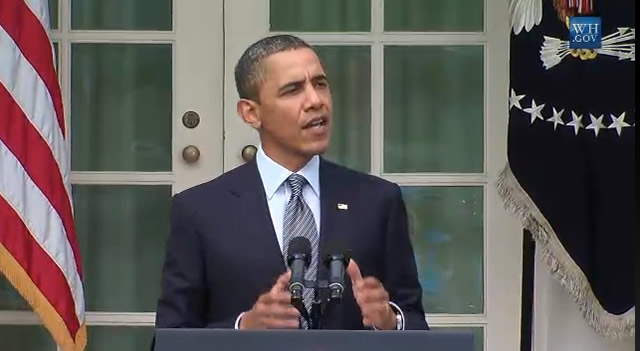
Ernest Istook at the Saint Paul Tea Party Rally 4/16/2011 Part 1
Ernest Istook, US Congressman, Heritage Foundation, http://www.heritage.org, spoke at the Saint Paul Tea Party Rally 4/16/2011. Hosted by North Star Tea Party Patriots, and Sue Jeffers.
I love going to the Heritage Foundation website for articles like this:
Heritage’s experts watched President Barack Obama’s debt reduction and tax increase proposal. Here are their immediate reactions:
_______________
Who Really Is Paying Obama’s Latest Tax Hikes
Over half of President Obama’s deficit reduction plan announced today would come from tax increases – to the tune of $1.5 trillion – on families and businesses earning over $250,000 a year.
His plan singles out both industries and individuals, such as oil companies and corporate-jet owners. This is a worn out, faulty proposal for a tax system that needs major restructuring rather than a few fine-sounding flourishes. Taxing those who Obama calls the wealthiest of Americans won’t solve our deficit problem – and it certainly won’t solve our spending problem. The top 10 percent of earners in America already pay about 70 percent of federal income taxes. And adopting the flawed deficit reduction proposal of taxing the wealthiest Americans would require mathematically unfeasible tax rates.
How ironic for this speech – specifically its tax hikes component – to come on the heels of Obama’s speech on job creation? Never mind the President’s flawed assumption that the federal government can and should be in the business of creating jobs. But to propose taxing further the very Americans who should be the ones creating jobs in our economy flies in the face of logic. Rep. Paul Ryan (R-WI) summed up the situation well over the weekend:
If you tax job creators more, you get less job creation. If you tax investment more, you get less investment.”
Mr. President, America needs more investment and it needs more job creation. It needs Washington to get out of the way.
Emily Goff
This is not Tax Reform Mr. President
President Obama’s says he wants to debt committee to reform the tax code but raise taxes by $1.5 trillion at the same time. That isn’t tax reform. It is dressing up tax hikes in tax reform’s robes.
Tax Reform entails fixing the tax base so it does not favor certain economic behaviors or deter others. This is done by closing so-called “loopholes.” The revenue raised from eliminating those credits, deductions, and exemptions is then used to lower income tax rates and eliminate taxation on saving and investing to encourage more productive activity. The new and improved tax code should raise the same amount of revenue as the old code.
The new revenue would come from allowing the Bush tax cuts to expire for families and small businesses earning more than $250,000 a year, limiting deductions their deductions, and the President’s new “Buffett Rule” that would further raise these job creator’s taxes in some way which the President has not defined. He also wants to eliminate deductions, credits, and exemptions. This is a war the President is waging on success – as if so-called fat cats were the root of our spending problems.
The $1.5 trillion in higher taxes would grow the already bloated federal government by that amount. Congress never uses tax hikes for deficit reduction. It always uses the extra revenue to pay for new programs.
The brunt of these tax hikes would fall on job creators – businesses that employ workers and investors – that the economy desperately needs to start adding new jobs. Raising their taxes will only cause them to cut further back on their hiring plans or scrap them altogether. And without seriously tackling spending, taxes will have to rise perpetually.
The economy and the American people cannot afford the President’s government-growing, job-killing conception of tax reform.
The Sixty Six who resisted “Sugar-coated Satan Sandwich” Debt Deal (Part 15)
This post today is a part of a series I am doing on the 66 Republican Tea Party favorites that resisted eating the “Sugar-coated Satan Sandwich” Debt Deal. Actually that name did not originate from a representative who agrees with the Tea Party, but from a liberal.
Rep. Emanuel Clever (D-Mo.) called the newly agreed-upon bipartisan compromise deal to raise the debt limit “a sugar-coated satan sandwich.”
“This deal is a sugar-coated satan sandwich. If you lift the bun, you will not like what you see,” Clever tweeted on August 1, 2011.
“The Chairman of the Joint Chiefs of Staff identified our deficit crisis as America’s greatest threat, and this measure does not go far enough in holding down the growth in our national debt,” said Rep. Cliff Stearns (R-Sixth). “Without significant spending cuts and reforms to essential programs, we are facing fiscal insolvency and the collapse of essential programs such as Social Security and Medicare.”
Stearns today opposed passage of S. 365, the Budget Control Act, which would increase the debt limit by $2.4 trillion. “The final measure cuts less spending in the first year than the Boehner plan; the Boehner plan cut $22 billion compared with as little as $6 billion in this measure,” added Stearns. “I supported the Boehner plan to move us forward in reaching the $4 trillion in savings needed to avoid a ratings downgrade. This bill is $1.6 trillion short of what is needed to prevent a downgrade.”
Concluded Stearns, “This measure also makes it easier for the President to increase the debt limit in the future. In addition, the language for a balanced budget amendment is less precise and only requires a vote in the House and Senate instead of its actual passage by both that would result in it being sent to the states for ratification. Another concern was that this final plan sets discretionary spending for fiscal year 2012 at $24 billion higher than in the Ryan Budget Resolution, which I supported.”
President Obama and other politicians are advocating higher taxes, with a particular emphasis on class-warfare taxes targeting the so-called rich. This Center for Freedom and Prosperity Foundation video explains why fiscal policy based on hate and envy is fundamentally misguided. For more information please visit our web page: www.freedomandprosperity.org.
_________________
President Obama really does stick to his view that the wealthy need to rescue the rest of us on everything, but that view does not work. There are not enough rich people out there to solve our budget woes. Actually what has happened in the past when the government wants more money it starts off going after the rich, but when that does not bring in much money then the only alternative is to go after the rest of us.
Max Brantley argues on the Arkansas Times Blog that most of us are taxed too much so we must tax the rich more but that will not come close to bringing us to a balanced budget. However, it will destroy job creation.
Like the villain in a horror movie, the many-lived millionaire tax is once again back from the dead. Senate Majority Leader Harry Reid (D–NV) dusted off this economically frightening tax hike that has repeatedly failed to pass Congress to pay for President Obama’s jobs plan (American Jobs Act of 2011, S. 1660) after Senate Democrats rejected the tax hikes the President proposed to pay for his bill.
This is the third time in the past two years that congressional Democrats have proposed a millionaire tax. The first time it was a 5.4 percent surtax to pay for health care reform. The second time was in “the People’s Budget” released by the Congressional Progressive Caucus. It failed to garner much support either time.
If the third time is the charm for the millionaire tax to become law, the economy would suffer lasting damage and reduced international competitiveness. And American workers would bear the brunt of the pain.
Permanent Tax Hike on Job Creators
The millionaire’s tax would be a 5.6 percent surtax on incomes of married filers earning over $1 million starting on January 1, 2013. The surtax would kick in at $500,000 for individual filers, so it cannot be called a true millionaire tax. It would take the place of several tax hikes President Obama proposed to pay for his jobs plan, the biggest of which was capping the deductions of high-income earners.[1] It would raise approximately $450 billion over 10 years.
The millionaire surtax is contradictory to the stated aim of the President’s jobs plan, which is to create jobs. The tax hike would fall squarely on the very job creators that the President wants to add jobs and reduce their incentive to add new workers.
Taxpayers earning more than $1 million per year are investors and businesses that are directly responsible for creating jobs. Investors provide the capital to existing businesses and startups so they can expand and add new workers. Raising their taxes would deprive them of resources they could invest in promising businesses that are looking to add employees. Raising their tax rate would deter them from taking the risk to invest.
The President and his allies say often that only a few businesses would pay higher taxes under their soak-the-rich policies. But a recent study from President Obama’s own Treasury Department shows that 50 percent of the income earned by businesses that pay their taxes through the individual income tax code and employ workers would pay the millionaire tax.[2]
The millionaire tax is a direct blow to the pass-through businesses that employ the most workers. Higher taxes would deprive these important job creators of resources they could use to add new workers or pay their workers higher wages, and it would reduce their incentive for adding new workers. These impediments to economic growth and job creation would plague the economy permanently, while the questionable jobs policies the millionaire tax would pay for are temporary.
More Job Destruction
The millionaire surtax would also apply to capital gains and dividends. This would be yet another surtax on investment income, as Obamacare already applied an extra 3.8 percent tax. Combined with that surtax and the President’s policy of increasing the capital gains and dividends rate to 20 percent from the current 15 percent rate, the millionaire surtax would raise the total rate to 29.4 percent—a 96 percent increase over the current rate.
Higher capital gains taxes would further impede job creation because it would increase the cost of new capital for businesses looking to grow or replace worn-out capital. This would make it more expensive for businesses to buy the equipment, tools, and other things they need to employ more workers and make their current workers more productive. The end result would be fewer jobs and lower wages for American workers.
The President frequently calls his tax hike plans “tax reform.” But one of the goals of tax reform is to lower the cost of capital to improve economic growth and enhance job creation. Higher taxes on capital are opposed to the aims of true tax reform.
Highest Tax Rates in the World
The U.S. is generally regarded as a low-tax nation compared to other industrialized countries. This is one of the main factors that has allowed the U.S. economy to grow at a faster rate than other developed countries for decades and has made it the envy of the world. If the millionaire surtax becomes law, the U.S. would no longer enjoy the advantages of being a low-tax country.
After adding state and local income tax rates, the 39.6 percent top federal income tax rate long fought for by President Obama and his congressional allies, the higher Medicare surtax from Obamacare, and the new millionaire surtax, the average top marginal income tax rate in the U.S. would be 55 percent. A rate at that level would leave the average U.S. rate as the third highest among developed nations in the 30-member Organization for Economic Cooperation and Development (OECD). It would be behind only Sweden and Denmark.
Taxpayers in states with above-average top marginal income tax rates would compare even worse. In fact, taxpayers in Oregon, Hawaii, and New York would pay the highest tax rates in the developed world. Taxpayers in California, Iowa, New Jersey, Vermont, Maine, Maryland, Minnesota, Idaho, North Carolina, Wisconsin, and Ohio would pay higher rates than every developed country except Denmark.
Taxpayers in the nine states without state income taxes—and therefore with the lowest income tax rates in the U.S.—would still be taxed at a higher rate than in all but seven other developed countries. Their rates would be higher than traditional high-tax countries such as France, Germany, Italy, and Spain.
In the global race for investment and capital, the millionaire tax would make almost every other developed country more competitive than the U.S.
Real Reform
The millionaire tax would end up costing the U.S. economy more jobs than the President’s jobs plan it is supposed to pay for would ever create. It would ruin American competitiveness among other developed countries.
The President and his congressional allies are better off spending their time pursuing true tax reform, which would repair the tax base and lower marginal tax rates. That would mean dropping their class warfare policies for the good of the economy and the country.
Curtis S. Dubay is a Senior Analyst in Tax Policy in the Thomas A. Roe Institute for Economic Policy Studies at The Heritage Foundation.
Discussing the troubles facing social security, with Mark Walsh, Left Jab host and Dan Mitchell, Cato Institute.
Social Security is a Ponzi scheme (Part 4)
Governor Rick Perry got in trouble for calling Social Security a Ponzi scheme and I totally agree with that. This is a series of articles that look at this issue.
So, President Obama believes that Republican leaders are “pushing to make privatizing Social Security a key part of their legislative agenda if they win a majority in Congress this fall.”
To which one responds, “If only!”
There is no doubt that Social Security desperately needs reform. Social Security is already running a temporary deficit, and that deficit will turn permanent in just five years. In theory, the Social Security Trust Fund will pay benefits until 2037. That’s not much comfort to today’s 35-year-olds, who will face a 27 percent cut in benefits unless the program is reformed before they retire. But even that figure is misleading, because the trust fund contains no actual assets. The government bonds it holds are simply IOUs, a measure of how much money the government owes the system. It says nothing about where the government will get the $2.6 trillion to pay off those IOUs.
Even if Congress can find a way to redeem the bonds, the trust-fund surplus will be completely exhausted by 2037. At that point, Social Security will have to rely solely on revenue from the payroll tax — and that won’t be sufficient to pay all the promised benefits. Overall, the amount the system has promised beyond what it can actually pay now totals $18.7 trillion.
Moreover, Social Security taxes are already so high, relative to benefits, that Social Security has simply become a bad deal for younger workers, providing a below-market rate of return. In fact, many young workers will end up paying more in taxes than they receive in benefits. And most important, workers have no ownership of their benefits. This means that they are left totally dependent on the goodwill of 535 politicians to determine what they’ll receive in retirement.
Benefits are not inheritable, and the program is a barrier to wealth accumulation. Lower-income families, African-Americans, and working women suffer disproportionately.
But Republican leaders, battered by the failure of President Bush’s reform initiative and years of Democratic demagoguery, show no signs of venturing back into this issue. In fact, the only senior Republican willing to support personal accounts these days appears to be Rep. Paul Ryan, who has included in his “roadmap” a plan to allow younger workers the option of investing slightly less than half of their Social Security taxes. However, it is telling that Ryan’s roadmap has just 13 co-sponsors, none of whom are among the Republican leadership.
Given their large lead in current polls, it is perhaps understandable that Republicans don’t want to risk offending voters, particularly seniors, by wading back into the Social Security thicket. But they are making a mistake.
From a purely political standpoint, if Republicans think that remaining silent on the issue will protect them from Democratic attacks, they are the stupid party indeed. The president’s comments should serve clear notice that Democrats are not going to let a simple thing like Republicans’ actual position to get in the way of a good political weapon. Senate Majority Leader Harry Reid has run television ads attacking his opponent, Sharron Angle, for wanting “to wipe the program out,” even though she’s made clear she wants to keep it. In Kentucky, Republican senatorial candidate Rand Paul is being criticized for remarks he made in favor of Social Security privatization — in 1998. There isn’t any escape.
Even worse, as a matter of policy, by taking personal accounts off the table, Republicans may be boxing themselves into a very bad corner. There are, after all, only three options for Social Security reform: raise taxes, cut benefits, or switch to personal accounts. While benefit cuts are defensible economically, they are not likely to prove any more politically popular than personal accounts, probably less so. Democrats are already organizing to fight any reductions. And, if Republican opposition to the Medicare cuts under Obamacare is any indication, no one should expect an overabundance of courage in fighting to cut Social Security benefits.
Therefore, if Republicans are not willing to embrace personal accounts, they will be left with … tax hikes, which has been the Democrats’ goal all along.
One reason the Democrats have been so successful in expanding the government year after year is that they have the courage of their convictions. They lose on an issue time after time, but they keep coming back until they win. Take national health care: After Hillarycare went down to defeat in 1993, the Left didn’t give up. And today we have Obamacare. Republicans lost on Social Security and curled up into a fetal position, begging for mercy.
Factcheck.org rates the president’s statement that Republicans want to privatize Social Security as “mostly false.” Before too long, we may come to wish that this time he had been telling the truth.
I am currently going through his film series “Free to Choose” which is one the most powerful film series I have ever seen
worked pretty well for a whole generation. Now anything that works well for a whole generation isn’t entirely bad. From the fact __ from that fact, and the undeniable fact that things are working poorly now, are we to conclude that the Keynesian sort of mixed regulation was wrong __
FRIEDMAN: Yes.
LEKACHMAN: __ or alternatively that we need still more regulation. That’s my conclusion, I might say.
FRIEDMAN: You want the right people manipulating the leaders. But go back. Memory smooths things out. If you really look at that 25_year period you’re talking about, it was not a period of stability; it was a period that was punctuated by the very sharp inflation of the Korean War. It was a period that was punctuated by three recessions in the course of about eight years in the fifties and early sixties. It was a period in which you had a __ inflation really starting to go from creeping to running, in the latter sixties. It was a period which laid the ground work for the kind of situation in which we are now, where you have both higher unemployment and higher inflation. It was __
TEMIN: I don’t think that followed. I mean there were these movements, as we say, but they weren’t the movements like the 1930s. There was a recession in ’58, yes.
FRIEDMAN: I agree.
TEMIN: We all called it a recession. We all worried about it and so on, but it was a small thing, little potatoes.
FRIEDMAN: The same thing was true in earlier periods between The Great Depression. If you take the area between the great depression in the United States of the 1870s and the 1890s, again you had a period like that. If you take it between The Great Depression of the 1890s and World War I, with a minor __ with one minor exception, it was similar to that. So that what you have, and this is a historical fact, is that except for the great depressions, all of which are linked to monetary collapses and to governmental involvement, in the interim period, the society has been reasonably stable.
MCKENZIE: Haven’t we reached the stage, incidentally, where we need not again see anything like the great depression. You say recessions, yes; but it bears no relationship to what we knew __
FRIEDMAN: No.
MCKENZIE: __ in the thirties. Have we solved that problem now? People are deeply __
JAY: No, we haven’t. Because I think the seeds of it remain there. I don’t agree with Professor Lekachman that everything was __ I don’t want to misparaphrase him __ but did pretty well until 1973 and then it suddenly all went wrong. It seems to me that the seeds of the subsequent instability, stagflation, were there before. That each time round the economic cycle inflation went a little faster. Each time around the economic cycle unemployment tended to be a bit higher. But this brings me to what is my disagreement with Professor Friedman. I agree with him that government has failed to correct, and is bound to fail to correct that instability. I do not agree with him that it is the root cause of that instability or simply removing or containing the government will remove that instability. Because his constitution, and I agree with all the things he wants to put into it, but I want to put more into it, leaves big capital entirely free to operate. Now he doesn’t mind that. In response to big capital, you are bound to get __ as a simple, natural reaction __ big labor. He doesn’t mind that. He’s quite happy with that. But my contention is that once you have big labor, you have a way of setting rewards in society, not only by trade unions, but through all sorts of other processes whereby groups get together in order to exploit the political process and legal rights, and to protect themselves from competition, in which, inevitably, people set rewards above what economists call the “market clearing price” for labor. They set levels of rewards which make it impossible that everybody should be employed and you therefore have a built-in tendency to high unemployment. If governments react to that on the Keynesian pattern by trying to inject spending which will enable these people to be employed, then I agree with Professor Friedman that all you get is faster and faster inflation, and that if you like, is caused by the government. But the government is a proximate cause of an original instability that is already there. And there’s nothing in Professor Friedman’s constitution which would correct that inherent, if you like, contradiction or flaw in classical western political economy.
FRIEDMAN: Do you deny, Peter __
MCKENZIE: Let me get the reaction to that __
FRIEDMAN: __no, I want to ask just one question of Peter. Do you deny that big government plays a large part in the rise of big capital and big labor?
JAY: I think they’re interactive. I once said big capital causes big labor, causes big government, causes big failure. That is the tragic story, in my opinion, of the 20th century.
FRIEDMAN: And what about if you start that __
JAY: We have to unravel that.
FRIEDMAN: __ if you start that route with big government. Will it be wrong? Big government causes big capital, causes big labor, causes big failure?
JAY: I don’t think historically that’s what happened. But you and I are agreed, we don’t want big government.
FRIEDMAN: That’s right.
JAY: What we’re disagreed about is what else we need.
LEKACHMAN: I think something is seriously wrong with a beautiful system which develops this big, clumsy, aggressive government, huge corporations, with more influence over their markets than is desirable from the standpoint of free competitive theory, trade unions, which at least according to some opinions, have a similarly malignant influence on their markets. There must be something radically flawed with the capitalist system which allows these institutional developments. This doesn’t alarm me because I’m a socialist, but I would __ I would readily __
FRIEDMAN: There must be something radically wrong with socialist philosophy which allows the __ extraordinary __ the much worse developments that have occurred, wherever there has been any real significant attempt to put a thoroughgoing socialism into practice.
LEKACHMAN: Socialism is a word of many meanings.
MCKENZIE: Now I think we might easily get into a quite serious debate on that point.
VOICE OFF SCREEN: Right.
JAY: I think it’s possible to note in passing that they may both be right.
MCKENZIE: Yes.
JAY: That conventional capitalism, conventional socialism, as conceived in the 20th century, are both wrong and that the polarization of the debate between those simple two alternatives greatly impoverishes the real range of political-economic choices which modern societies have.
FRIEDMAN: But what has happened? Over and over again one claim after another for the kind of socialism __ this kind of socialism or that kind of socialism __ has turned to ashes. And each time the answer has come, “Oh well, it was a wrong brand of socialism that was adopted, or the wrong people were running it.”
VOICE OFF SCREEN: But you’re saying __
JAY: You’re arguing with yourself when you’re saying __
FRIEDMAN: No I’m not.
JAY: The Federal Reserve in 1929 failed to do the right thing. It was the wrong brand of government.
FRIEDMAN: It was the wrong brand, absolutely, but what I’m saying is something different. I can at least point to examples in history of systems of capitalist systems in which the government had a fairly limited role, not my ideal government. Many things, doing many things I would not want it to do. But I’m going to point to such examples over long stretches of history in __ which have been relatively successful. Where the major achievements of humankind, not merely in economics, but in all other areas, have largely arisen. It is very difficult to point to any similar examples __
TEMIN: But then you are pointing back __
FRIEDMAN: __ of where big government has achieved such success.
TEMIN: But you said before you didn’t like to go back. You’re now talking about going back.
FRIEDMAN: No, no. I didn’t say I didn’t like to go back.
TEMIN: They took place in different times.
FRIEDMAN: What I said is going back or forward is irrelevant. What we want to do is __
TEMIN: But it’s not irrelevant to this discussion __
FRIEDMAN: __ the right thing wherever it comes from.
TEMIN: __ because as Bob Lekachman said earlier, things have increased in scale, and the scale of business and increased, and you were saying just before, big government, big labor, big industry, big firms go together, and you didn’t accept it before, when Bob said you’ll accept it now from here.
FRIEDMAN: No, no. I don’t accept it. What I accept is that big government is a major factor promoting big labor and big capital. I did not accept that in the absence of big government you would have the big capital and big labor that worries him.
Official music video for MUTEMATHs Spotlight. Song available on MUTEMATHs Spotlight EP and Twilight Original Motion Picture Soundtrack. Directed by MUTEMATH and Brandon Goodwin
____________________________
I really enjoyed the concert the other night and wanted to share with you some of the pictures from then. Also I have put up some of the songs they selected to play here too.
I am going to see Mutemath tonight at 8:30pm tonight at the Revolution Music Room in downtown Little Rock. Here is an old review I dug up on them: 2004 saw the debut of one of the most promising new acts in the Christian music scene. The demise of rock band Earthsuit gave birth to […]
I have loved the music of Mutemath since the first time I heard them. I wanted to pass on a great review of their band. Mute Math: Is It Christian Music? posted by Patton Dodd | 11:50am Thursday August 2, 2007 A Burn or Burn profile of Mute Math almost writes itself. This is a band […]
“Music Monday”:Coldplay’s best songs of all time (Part 5) This is “Music Monday” and I always look at a band with some of their best music. I am currently looking at Coldplay’s best songs. Here are a few followed by another person’s preference: Hunter picked “Don’t Panic,” as his number 16 pick of Coldplay’s best […]
CHICAGO (AP) — Former Weezer bass player Mikey Welsh, who also found success in his second career as an artist, died in aChicago hotel room, police said Sunday. Chicago police spokeswoman Laura Kubiak said Welsh was supposed to check out of the Raffaello Hotel at 1 p.m. Saturday. When he didn’t, hotel staff went to his room, entered it and […]
Dave Hogan/ Getty Images This is “Music Monday” and I always look at a band with some of their best music. I am currently looking at Coldplay’s best songs. Here are a few followed by another person’s preference: For the 17th best Coldplay song of all-time, Hunter picks “42.” He notes, “You thought you might […]
The best band in the world. Below I have linked some articles I have earlier about the search for meaning in life the band seems to involved in. Chris Martin, Jonny Buckland, Guy Berryman, and Will Champion formed Coldplay in 1996 while going to University in London. The young band quickly established themselves in the […]
That video looked at the relationship between economic freedom and various indices that measure quality of life. Not surprisingly, free markets and small government lead to better results.
For years the United States has been a world leader in economic freedom. But runaway government spending and burdensome regulations have caused a decline in economic freedom in the United States. If our economic freedom continues to fall, how will it affect our quality of life?
_________
The entire video is superb, but there are two things that merit special praise, one because of intellectual honesty and the other because of intellectual effectiveness.
1. The refreshingly honest aspect of the video is its non-partisan tone. It explains, in a neutral fashion, that Bush undermined prosperity by making government bigger and that Obama is undermining prosperity by increasing the burden of government.
It’s also worth pointing out that there are several policies that impact on economic performance. The Koch Institute video focuses primarily on the key issues of fiscal policy and regulation, but trade, monetary policy, property rights, and rule of law are examples of other policies that also are very important.
This video, narrated by yours truly, looks at economic growth from this more comprehensive perspective.
Now that the so-called stimulus has been enacted, hopefully policy makers will turn their attention to policies that actually improve economic performance. This Center for Freedom and Prosperity Foundation video reviews the key finding in the Fraser Institute’s Economic Freedom of the World and explains that, contrary to the policies of Presidents Bush and Obama, smaller government and free markets are the way to boost economic growth. For more information: http://www.freedomandprosperity.org
________
The moral of the story from both videos is very straightforward. If the answer is bigger government, you’ve asked a very strange question.
Sometimes I truly wonder if the Republicans have the guts to cut spending? This is what I think when I read articles like this one below. That is also the reason I wrote the series “The Sixty Six who resisted “Sugar-coated Satan Sandwich” series. Some links below.
Now the crowd in DC is squabbling over Obama’s latest stimulus/tax-the-rich scheme, though that’s really more of a test run by the White House to determine whether class warfare will be an effective theme for the 2012 campaign.
The real budget fight, the one we should be closely monitoring, is what will happen with the so-called Supercommittee.
To refresh your memory, this is the 12-member entity created as part of the debt limit legislation. Split evenly between Democrats and Republicans, the Supercommittee is supposed to recommend $1.2 trillion-$1.5 trillion of deficit reduction over the next 10 years. Assuming, of course, that 7 out of the 12 members can agree on anything.
There are two critical things to understand about the Supercommittee.
With these points in mind, it doesn’t take a genius to realize that the Supercommittee is designed — at least from the perspective of the left — to seduce gullible Republicans into going along with a tax hike.
In other words, the likelihood that the Supercommittee will produce a good plan is about the same as seeing me in the outfield during the World Series (the real World Series, not this one).
Fortunately, there is a way to win this fight. All Republicans have to do is…(drum roll, please)…nothing.
To be more specific, if the Supercommittee can’t get a majority for a plan, then automatic budget cuts (a process known as sequestration) will go into effect. But don’t get too excited. We’re mostly talking about the DC version of spending cuts, which simply means that spending won’t rise as fast as previously planned.
But compared to an inside-the-beltway tax-hike deal, a sequester would be a great result.
You’re probably wondering if there’s a catch. After all, if Republicans can win a huge victory for taxpayers by simply rejecting the siren song of higher taxes, then isn’t victory a foregone conclusion?
Republicans haven’t expunged the philosophical corruption of the Bush years and they still think big government is good even though they are telling voters they learned their lesson.
Republicans are worried that a sequester will mean too little money for the defense budget.
If GOPers sell out for either of the first two reasons, then there’s really no hope. America will become Greece and we may as well stock up on canned goods, bottled water, and ammo.
The defense issue, though, is more challenging. Republicans instinctively want more defense spending, so Democrats are trying to exploit this vulnerability. They are saying — for all intents and purposes — that the defense budget will be cut unless GOPers agree to a tax hike.
Republicans should not give in to this budgetary blackmail.
I could make a conservative case for less defense spending, by arguing that the GOP should take a more skeptical view of nation building (the approach they had in the 1990s) and that they should reconsider the value of spending huge sums of money on an outdated NATO alliance.
But I’m going to make two other points instead, in hopes of demonstrating that a sequester is acceptable from the perspective of those who favor a strong national defense.
First, the sequester does not take place until January 2013, so defense hawks will have ample opportunity to undo the defense cuts – either through supplemental spending bills or because the political situation changes after the 2012 elections.
Second, the sequester is based on dishonest Washington budget math, so the defense budget would still grow, but not as fast as previously planned.
This chart shows what will happen to the defense budget over the next 10 years, based on Congressional Budget Office data comparing “baseline” outlays to spending under a sequester.
As you can see, even with a sequester, the defense budget climbs over the 10-year period by about $100 billion. And, as noted above, that doesn’t even factor in supplemental spending bills.
In other words, America’s national defense will not be eviscerated if there is a sequester.
Here’s the bottom line. The Supercommittee battle should be a no-brainer for the GOP.
The Sixty Six who resisted “Sugar-coated Satan Sandwich” Debt Deal (Part 10) This post today is a part of a series I am doing on the 66 Republican Tea Party favorites that resisted eating the “Sugar-coated Satan Sandwich” Debt Deal. Actually that name did not originate from a representative who agrees with the Tea […]
The Sixty Six who resisted “Sugar-coated Satan Sandwich” Debt Deal (Part 9) This post today is a part of a series I am doing on the 66 Republican Tea Party favorites that resisted eating the “Sugar-coated Satan Sandwich” Debt Deal. Actually that name did not originate from a representative who agrees with the Tea Party, […]
The Sixty Six who resisted “Sugar-coated Satan Sandwich” Debt Deal (Part This post today is a part of a series I am doing on the 66 Republican Tea Party favorites that resisted eating the “Sugar-coated Satan Sandwich” Debt Deal. Actually that name did not originate from a representative who agrees with the Tea Party, but […]
Duncan Hunter at San Diego Eagle Forum.MP4 The Sixty Six who resisted “Sugar-coated Satan Sandwich” Debt Deal (Part 7) This post today is a part of a series I am doing on the 66 Republican Tea Party favorites that resisted eating the “Sugar-coated Satan Sandwich” Debt Deal. Actually that name did not originate from a […]
Rep Himes and Rep Schweikert Discuss the Debt and Budget Deal The Sixty Six who resisted “Sugar-coated Satan Sandwich” Debt Deal (Part 6) This post today is a part of a series I am doing on the 66 Republican Tea Party favorites that resisted eating the “Sugar-coated Satan Sandwich” Debt Deal. Actually that name did […]
Rep. Quayle on Fox News with Neil Cavuto The Sixty Six who resisted “Sugar-coated Satan Sandwich” Debt Deal (Part 5) This post today is a part of a series I am doing on the 66 Republican Tea Party favorites that resisted eating the “Sugar-coated Satan Sandwich” Debt Deal. Actually that name did not originate from […]
We Need a Balanced Budget! The Sixty Six who resisted “Sugar-coated Satan Sandwich” Debt Deal (Part 4) This post today is a part of a series I am doing on the 66 Republican Tea Party favorites that resisted eating the “Sugar-coated Satan Sandwich” Debt Deal. Actually that name did not originate from a representative who […]
The Sixty Six who resisted “Sugar-coated Satan Sandwich” Debt Deal (Part 3) This post today is a part of a series I am doing on the 66 Republican Tea Party favorites that resisted eating the “Sugar-coated Satan Sandwich” Debt Deal. Actually that name did not originate from a representative who agrees with the Tea Party, […]
I got this off the internet. U.S. Tax revenue: $2,170,000,000,000 Fed budget: $3,820,000,000,000 New debt: $1,650,000,000,000 National debt: $14,271,000,000,000 Recent budget cut: $38,500,000,000 Now, remove 8 zeros and pretend it’s a household budget Annual family income: $21,700 Money the family spent: $38,200 New debt on the credit card: $16,500 Outstanding balance on credit card: $142,710 […]
“What good is a debt limit that is always increased?” The Sixty Six who resisted “Sugar-coated Satan Sandwich” Debt Deal (Part 2) This post today is a part of a series I am doing on the 66 Republican Tea Party favorites that resisted eating the “Sugar-coated Satan Sandwich” Debt Deal. Actually that name did not […]
When then-Massachusetts governor Mitt Romney signed into law the nation’s most far-reaching state health care reform proposal, it was widely expected to be a centerpiece of his presidential campaign. In fact Governor Romney bragged that he would “steal” the traditionally Democratic issue of health care. “Issues which have long been the province of the Democratic Party to claim as their own will increasingly move to the Republican side of the aisle,” he told Bloomberg News Service shortly after signing the bill. He told other reporters that the biggest difference between his health care plan and Hillary Clinton’s was “mine got passed and hers didn’t.”
Outside observers on both the Right and Left praised the program. Edmund Haislmaier of the Heritage Foundation hailed it as “one of the most promising strategies out there.” And Hillary Clinton adviser Stuart Altman said, ‘‘The Massachusetts plan could become a catalyst and a galvanizing event at the national level, and a catalyst for other states.”
Today, however, Romney seldom mentions his plan on the campaign trail. If pressed he maintains that he is “proud” of what he accomplished, while criticizing how the Democratic administration that succeeded him has implemented the program. Nevertheless, he now focuses on changing federal tax law in order to empower individuals to buy health insurance outside their employer, and on incentives for states to deregulate their insurance industry. He would also use block grants for both Medicaid and federal uncompensated care funds to encourage greater state innovation. He encourages states to experiment, but does not offer his own state as a model.
A Double Failure
There’s good reason for his change of position. The Massachusetts plan was supposed to accomplish two things-achieve universal health insurance coverage while controlling costs. As Romney wrote in the Wall Street Journal, “Every uninsured citizen in Massachusetts will soon have affordable health insurance and the costs of health care will be reduced.” In reality, the plan has done neither.
Perhaps the most publicized aspect of the Massachusetts reform is its mandate that every resident have health insurance, whether provided by an employer or the government or purchased individually. “I like mandates,” Romney said during a debate in New Hampshire. “The mandate works.” But did it?
Technically the last day to sign up for insurance in compliance with that mandate was November 15, though as a practical measure Massachusetts residents actually had until January 1, 2008. Those without insurance as of that date will lose their personal exemption for the state income tax when they file this spring. In 2009, the penalty will increase to 50 percent of the cost of a standard insurance policy.
Such a mandate was, of course, a significant infringement on individual choice and liberty. As the Congressional Budget Office noted, the mandate was “unprecedented,” and represented the first time that a state has required that an individual, simply because they live in a state and for no other reason, must purchase a specific government- designated product.
It was also a failure.
When the bill was signed, Governor Romney, the media, state lawmakers, and health care reform advocates hailed the mandate as achieving universal coverage. “All Massachusetts citizens will have health insurance. It’s a goal Democrats and Republicans share, and it has been achieved by a bipartisan effort,” Romney wrote.
Before RomneyCare was enacted, estimates of the number of uninsured in Massachusetts ranged from 372,000 to 618,000. Under the new program, about 219,000 previously uninsured residents have signed up for insurance. Of these, 133,000 are receiving subsidized coverage, proving once again that people are all too happy to accept something “for free,” and let others pay the bill. That is in addition to 56,000 people who have been signed up for Medicaid. The bigger the subsidy, the faster people are signing up. Of the 133,000 people who have signed up for insurance since the plan was implemented, slightly more than half have received totally free coverage.
It’s important to note that the subsidies in Massachusetts are extensive and reach well into the middle class-available on a sliding scale to those with incomes up to 300 percent of the federal poverty level. That means subsidies would be available for those with incomes ranging from $30,480 for a single individual to as much as $130,389 for a married couple with seven children. A typical married couple with two children would qualify for a subsidy if their income were below $63,000.
What we don’t know is how many of those receiving subsidized insurance were truly uninsured and how many had insurance that either they or their employer was paying for. Studies indicate that substitution of taxpayer-financed for privately funded insurance is a common occurrence with other government programs such as Medicaid and the State Children’s Health Insurance Program (S-CHIP). Massachusetts has attempted to limit this “crowdout” effect by requiring that individuals be uninsured for at least six months before qualifying for subsidies. Still some substitution is likely to have occurred.
The subsidies may have increased the number of Massachusetts citizens with insurance, but as many as 400,000 Massachusetts residents by some estimates have failed to buy the required insurance. That includes the overwhelming majority of those with incomes too high to qualify for state subsidies. Fewer than 30,000 unsubsidized residents have signed up as a result of the mandate. And that is on top of the 60,000 of the state’s uninsured who were exempted from the mandate because buying insurance would be too much of a financial burden.
Billion-Dollar Overrun
According to insurance industry insiders, the plans are too costly for the target market, and the potential customers- largely younger, healthy men-have resisted buying them. Those who have signed up have been disproportionately older and less healthy. This should come as no surprise since Massachusetts maintains a modified form of community rating, which forces younger and healthier individuals to pay higher premiums in order to subsidize premiums for the old and sick.
Thus, between half and two-thirds of those uninsured before the plan was implemented remain so. That’s a far cry from universal coverage. In fact, whatever progress has been made toward reducing the ranks of the uninsured appears to be almost solely the result of the subsidies. The much ballyhooed mandate itself appears to have had almost no impact.
The Massachusetts plan might not have achieved universal coverage, but it has cost taxpayers a great deal of money. Originally, the plan was projected to cost $1.8 billion this year. Now it is expected to exceed those estimates by $150 million. Over the next 10 years, projections suggest that Romney- Care will cost about $2 billion more than was budgeted. And the cost to Massachusetts taxpayers could be even higher because new federal rules could deprive the state of $100 million per year in Medicaid money that the state planned to use to help finance the program.
Given that the state is already facing a projected budget deficit this year, the pressure to raise taxes, cut reimbursements to health care providers, or cap insurance premiums will likely be intense. Romney likes to brag that he accomplished his health care plan “without raising taxes.” Unless something turns around, that is not likely to be the case much longer.
Moreover, the cost of the plan is also likely to continue rising, because the Massachusetts reform has failed to hold down the cost of health care. When Romney signed his plan he claimed “a key objective is to lower the cost of health insurance for all our citizens and allow our citizens to buy the insurance plan that fits their needs.” In actuality, insurance premiums in the state are expected to rise 10–12 percent next year, double the national average.
The Bureaucratic Connector
Although there are undoubtedly many factors behind the cost increase, one reason is that the new bureaucracy that the legislation created-the “Connector”-has not been allowing Massachusetts citizens to buy insurance that “fits their needs.”
Although it has received less media attention than other aspects of the bill, one of the most significant features of the legislation is the creation of the Massachusetts Health Care Connector to combine the current small-group and individual markets under a single unified set of regulations. Supporters such as Robert E. Moffit and Nina Owcharenko of the Heritage Foundation consider the Connector to be the single most important change made by the legislation, calling it “the cornerstone of the new plan” and “a major innovation and a model for other states.”
The Connector is not actually an insurer. Rather, it is designed to allow individuals and workers in small companies to take advantage of the economies of scale, both in terms of administration and risk pooling, which are currently enjoyed by large employers. Multiple employers are able to pay into the Connector on behalf of a single employee. And, most importantly, the Connector would allow workers to use pretax dollars to purchase individual insurance. That would make insurance personal and portable, rather than tied to an employer-all very desirable things.
However, many people were concerned that the Connector was being granted too much regulatory authority. It was given the power to decide what products it would offer and to designate which types of insurance offered “high quality and good value.” This phrase in particular worried many observers because it is the same language frequently included in legislation mandating insurance benefits.
At the time the legislation passed, Ed Haislmaier of the Heritage Foundation reassured critics that “the Connector will neither design the insurance products being offered nor regulate the insurers offering the plans.” In reality, however, the Connector’s board has seen itself as a combination of the state legislature and the insurance commissioner, adding a host of new regulations and mandates.
For example, the Connector’s governing board has decreed that by January 2009, no one in the state will be allowed to have insurance with more than a $2,000 deductible or total out-of-pocket costs of more than $5,000. In addition, every policy in the state will be required to phase in coverage of prescription drugs, a move that could add 5–15 percent to the cost of insurance plans. A move to require dental coverage barely failed to pass the board, and the dentists-along with several other provider groups-have not given up the effort to force their inclusion. This comes on top of the 40 mandated benefits that the state had previously required, ranging from in vitro fertilization to chiropractic services.
Thus, it appears that the Connector offers quite a bit of pain for relatively little gain. Although the ability to use pretax dollars to purchase personal and portable insurance should be appealing in theory, only about 7,500 nonsubsidized workers have purchased insurance through the Connector so far. On the other hand, rather than insurance that “fits their needs,” Massachusetts residents find themselves forced to buy expensive “Cadillac” policies that offer many benefits that they may not want.
Governor Romney now says that he cannot be held responsible for the actions of the Connector board, because it’s “an independent body separate from the governor’s office.” However, many critics of the Massachusetts plan warned him precisely against the dangers of giving regulatory authority to a bureaucracy that would last long beyond his administration.
ClintonRomneyEdwardsCare
Despite the problems being encountered in Massachusetts, the Romney plan continues to receive a surprising amount of support as a model for reform. The health care plans advocated by all three of the leading Democratic presidential candidates- Hillary Clinton, John Edwards, and Barack Obama-are all substantially the same as Romney’s. They are all variations of a concept called “managed competition,” which leaves insurance privately owned but forces it to operate in an artificial and highly regulated marketplace similar to a public utility. All of their plans include an individual mandate (only for children in Obama’s case, and for everyone in Clinton’s and Edwards’s plans), increased regulation, a government-designed standard benefits package, and a new pooling mechanism similar to the Connector.
Romney denounces Senator Clinton’s plan as “government run health care,” but there really is very little difference between the Romney and Clinton plans.
In addition, several states have been seeking to use Massachusetts as a model for their own reforms. In California, Gov. Arnold Schwarzenegger added an employer mandate to a plan that otherwise looked very much like the Massachusetts plan. Other states considering similar proposals include Alaska, Kansas, Louisiana, Maryland, Michigan, New York, Oregon, and Washington, as well as the District of Columbia. Although none of these proposals has made it into law, several remain under active consideration.
No one can deny that the U.S. health care system needs reform. Too many Americans lack health insurance and/or are unable to afford the best care. More must be done to lower health care costs and increase access to care. Both patients and providers need better and more useful information. The system is riddled with waste, and quality of care is uneven. Government health care programs like Medicare and Medicaid threaten future generations with an enormous burden of debt and taxes. Given these pressures, the temptation for a quick fix is understandable.
But, as Massachusetts has shown us, mandating insurance, restricting individual choice, expanding subsidies, and increasing government control isn’t going to solve those problems. A mandate imposes a substantial cost in terms of individual choice but is almost certainly unenforceable and will not achieve its goal of universal coverage. Subsidies may increase coverage, but will almost always cost more than projected and will impose substantial costs on taxpayers. Increased regulations will drive up costs and limit consumer choice.
The answer to controlling health care costs and increasing access to care lies with giving consumers more control over their health care spending while increasing competition in the health care marketplace- not in mandates, subsidies, and regulation. That is the lesson we should be drawing from the failure of RomneyCare.
This article originally appeared in the January/February 2008 edition of Cato Policy Report.
Nobel Laureate Dr. Milton Friedman discusses the principles of Ronald Reagan during this talk for students at Young America’s Foundation’s 25th annual National Conservative Student Conference
I first realized what a truly extraordinary person he was in early 1973 when I spent an unforgettable day with him barnstorming across California to promote his Proposition 1 — an amendment to the state constitution that would set a limit to the amount the state could spend in any year. We flew in a small private plane from place to place and at each stop held a press conference. In between, Gov. Reagan talked freely about his life and views. By the time we returned to our final press interview in Los Angeles, I was able to give an enthusiastic yes to a reporter’s question whether I would support Reagan for president. And, I may say, I have never been disappointed since.
As a good social scientist, Frieman also has data. It doesn’t make Bush I look too good, but it does bust the myth–popular among some libertarians–that Reagan did nothing real to shrink government.
Milton Friedman and Ronald Reagan Liberals like President Obama (and John Brummett) want to shoot for an equality of outcome. That system does not work. In fact, our free society allows for the closest gap between the wealthy and the poor. Unlike other countries where free enterprise and other freedoms are not present. This is a seven part series. […]
I am currently going through his film series “Free to Choose” which is one the most powerful film series I have ever seen. For the past 7 years Maureen Ramsey has had to buy food and clothes for her family out of a government handout. For the whole of that time, her husband, Steve, hasn’t […]
I love Milton Friedman’s film series “Free to Choose.” In that film series over and over it is shown that the ability to move from poor to rich is more abundant here than any other country in the world. This article below reminded me of that that. Are Poor Really Helpless Without Government? By Michael […]
Social Security is a Ponzi scheme (Part 1) Governor Rick Perry got in trouble for calling Social Security a Ponzi scheme and I totally agree with that. Max Brantley wants to keep insisting that this will be Perry’s downfall but think that truth will win out this time around. This is a series of articles […]
Volume 4 – From Cradle to Grave Abstract: Since the Depression years of the 1930s, there has been almost continuous expansion of governmental efforts to provide for people’s welfare. First, there was a tremendous expansion of public works. The Social Security Act followed close behind. Soon other efforts extended governmental activities in all areas of the welfare […]
Milton Friedman: Life and ideas – Part 05 99th anniversary of Milton Friedman’s birth (Part 13) Milton Friedman was born on July 31, 1912 and he died November 16, 2006. I started posting tributes of him on July 31 and I hope to continue them until his 100th birthday. Here is another tribute below: Sheldon […]
Uploaded by LibertyPen on Jan 8, 2009 Professor Williams explains what’s ahead for Social Security Dan Mitchell on Social Security I have said that Social Security is a Ponzi scheme and sometimes you will hear someone in the public say the same thing. Yes, It Is a Ponzi Scheme by Michael D. Tanner Michael Tanner […]
Milton Friedman on the Causes of Inflation (“Friedman Friday” Part 4) FRIEDMAN FRIDAY APPEARS EVERY FRIDAY AND IS HONOR OF THE NOBEL PRIZE WINNING ECONOMIST MILTON FRIEDMAN Famous Friedman Quotes By John Beagle Milton Friedman – University of Chicago School of Economics Professor As I read the comments by Milton Friedman, I can’t help but think […]
Milton Friedman: Life and ideas – Part 04 99th anniversary of Milton Friedman’s birth (Part 12) Milton Friedman was born on July 31, 1912 and he died November 16, 2006. I started posting tributes of him on July 31 and I hope to continue them until his 100th birthday. Here is another tribute below: Perspective […]
FRIEDMAN FRIDAY APPEARS EVERY FRIDAY AND IS HONOR OF THE NOBEL PRIZE WINNING ECONOMIST MILTON FRIEDMAN. The Power Of Choice By John Beagle An interesting compilation of Milton Freeman as an economic freedom philosopher. Milton makes the case for economic freedom as a precondition for political freedom. The title of this video, The Power of Choice […]