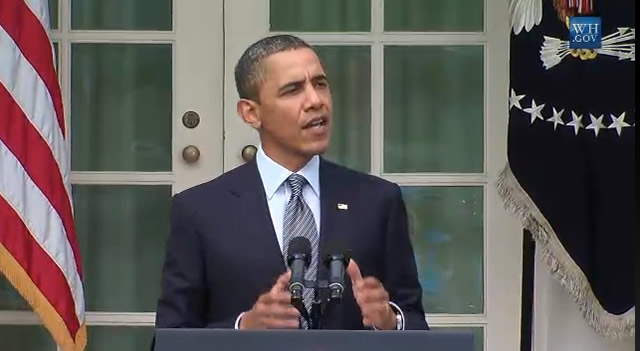
Heritage’s experts watched President Barack Obama’s debt reduction and tax increase proposal. Here are their immediate reactions:
_______________
Here’s How to Pay Your “Fair Share,” Mr. Buffett
President Obama proposes the “Buffett Rule” to make sure the rich pay their “fair share.” However, there is already a system in place for Mr. Buffett and all the other millionaires and billionaires to pay more without a new job-killing tax hike.
There they can follow these simple instructions for sending more of their money to the Treasury to reduce the national debt:
How do I make a contribution to the U.S. government?
Citizens who wish to make a general donation to the U.S. government may send contributions to a specific account called “Gifts to the United States.” This account was established in 1843 to accept gifts, such as bequests, from individuals wishing to express their patriotism to the United States. Money deposited into this account is for general use by the federal government and can be available for budget needs. These contributions are considered an unconditional gift to the government. Financial gifts can be made by check or money order payable to the United States Treasury and mailed to the address below.
Gifts to the United States
U.S. Department of the Treasury
Credit Accounting Branch
3700 East-West Highway, Room 622D
Hyattsville, MD 20782
Any tax-related questions regarding these contributions should be directed to the Internal Revenue Service at (800) 829-1040.
It is as simple as that. Now how can we stop seeing poor Warren every time we turn on the television incorrectly whining about his taxes are lower than his secretary?
Curtis Dubay
Where Will the Tax Hike REALLY Go???
Obama’s economics are at times stunning. Proposing tax hikes in the midst of the highest and most persistent unemployment in decades is stunning. Doing it to pay for a massive jobs package is also stunning. But for a moment, set all that aside.
Set aside the terrible effect these tax hikes would have on jobs in America. On investors. On job creators. On American competitiveness. Set aside the cigarette tax that went to pay for expansion of SCHIP at the very beginning of the President’s term. Set aside the 18 new or increased taxes in Obamacare. Set all that aside and consider this.
Do you believe for one simple moment that these new taxes will be used for paying down the deficit? Or do you believe that past is prologue? The President’s own jobs package is proof: New taxes go to pay for new spending.
The Sixty Six who resisted “Sugar-coated Satan Sandwich” Debt Deal (Part 17)
This post today is a part of a series I am doing on the 66 Republican Tea Party favorites that resisted eating the “Sugar-coated Satan Sandwich” Debt Deal. Actually that name did not originate from a representative who agrees with the Tea Party, but from a liberal.
Rep. Emanuel Clever (D-Mo.) called the newly agreed-upon bipartisan compromise deal to raise the debt limit “a sugar-coated satan sandwich.”
“This deal is a sugar-coated satan sandwich. If you lift the bun, you will not like what you see,” Clever tweeted on August 1, 2011.
Washington –Congressman Phil Gingrey (GA-11) today issued the following statement after the passage of S. 365, the bill to provide for an increase in the debt limit.“I commend our leadership for so steadfastly pursuing a deal that results in spending cuts that exceed the level of the debt ceiling increase. Since Republicans took over the House, the tenor in Washington has changed from how much are we going to spend to how much are we going to cut. This is a victory in and of itself for the American people.However, I am firmly committed to the principles of Cut, Cap and Balance, and while this bill moves the ball in the right direction, it does not make the debt ceiling increase contingent upon passage of a Balanced Budget Amendment. It further concerns me that tax increases could come into play as the newly created commission formulates its proposal and that the Department of Defense could be disproportionately affected by the process of sequestration. While I applaud some aspects of this agreement, I believe that this is the time to amend to our Constitution to finally force Washington to live within its means—and I encourage my colleagues to continue their efforts to advance this principle.”
In addition to several other tax increases, Senator Barack Obama wants to increase the Social Security payroll tax burden by imposing the tax on income above $250,000. This would be a sharp departure from current law, which only requires that the tax be imposed on the amount of income needed to “pay for” promised benefits. But more important, at least from an economic perspective, the Senator’s initiative would increase the top tax rate on productive behavior by as much as 12 percentage points – and this would be in addition to his proposal to kill the 2003 tax rate reductions and further boost the top rate by 4.6 percentage points. This mini-documentary explains why a big tax rate increase on highly productive people would be very damaging to America’s prosperity, especially in a competitive global economy. Simply stated, pushing top tax rates in the United States to French and German levels means at least some degree of French-style and German-style economic stagnation. Visit http://www.freedomandprosperity.org for more information.
Herman Cain is the hot Republican candidate at the moment, so Ernest Dumas’ examination of some of his ideas is timely. His easy 9-9-9 tax plan? The details aren’t so hot. More like appalling.
He would replace all federal taxes—individual and corporate income taxes, and social security, Medicare, disability, unemployment, gasoline, cigarette and all other excise taxes—with three simple tax rates: 9 percent on personal income, 9 percent on business income and a 9 percent sales tax on all commercial activity. That sounds fair enough. There would be no exemptions and deductions. Well, only a few. Investment income—capital gains, interest and dividends, the income of the leisure class—wouldn’t be taxed at all. Your social security? Yes, tax it. As for the 9 percent business tax, it would apply only to the share of a company’s revenue that was spent on wages.It would be a mammoth tax cut for the rich and corporations and a giant tax increase for the middle class, the elderly and disabled.
_________________
I have to say that I am not able to go along with the sales tax portion myself. My views are closer to those of the Cato Institute below:
PrintPresidential candidate Herman Cain has made a splash with his 9-9-9 tax reform plan. I love his 9 percent income tax, but the skunk at the tax reform picnic is his 9 percent retail sales tax. Mr. Cain is an articulate advocate of free enterprise and I wish him well in the contest, but he should ditch the sales tax.Adding a retail sales tax to the federal government’s powerful tax armada would be a terrible idea from a small-government perspective. Democrats are desperate to find ways to fund soaring entitlement costs, so it’s dangerous to give them conservative political cover to add a new federal funding source.Cain’s 9 percent business tax is also a problem. It is similar to a value-added tax (VAT) because would it disallow a business deduction for wages, which would make the base much broader than the corporate income tax base. And like a VAT, Cain’s business tax would apparently be imposed on all businesses, not just those currently paying the corporate income tax.The result would be that American businesses would be collecting a large tax on workers’ wages — but workers wouldn’t see this major government grab. One caveat is that the Cain business tax would allow a deduction for dividends paid, which would narrow the base compared to the standard VAT.
In sum, two of Cain’s three 9’s are bad ideas. His advocacy of lower marginal rates and reduced taxes on savings and investment are great, but he should drop the 9-9-9 plan.
Instead, Cain and other candidates should consider a 15-15-15 plan. At first blush, that doesn’t sound very appealing because the rates are higher than Cain’s. But the business tax base would be much smaller than Cain’s, and the plan would make existing revenue sources more visible and efficient. Here’s the 15-15-15 plan:
15 Percent Payroll Tax. Cain would abolish the current 15.3 percent payroll tax that funds Social Security and Medicare. That’s odd because Cain — to his credit — is proposing a Chilean-style Social Security system with personal accounts. I’d keep the current payroll tax, but move to a Chilean-style system by allowing workers to put 6 percentage points or more of the tax into a personal account. That would feel like a tax cut for workers because they would retain ownership of the money. I would also require that all 15.3 percent of the tax be listed on employee pay stubs so that the burden is highly visible. Currently, workers only see half of the payroll tax, and thus might be unaware of the high cost of these retirement programs.
15 Percent Personal Income Tax. Like Cain, I’d get rid of just about all deductions and other breaks under the income tax, except pro-savings features such as the 401(k) rules. It’s also reasonable to retain a substantial basic exemption for low-income filers, as under the Dick Armey/Steve Forbes “flat tax” plans. The Armey/Forbes plans had rates in the range of 17 to 20 percent, but they only taxed labor income at the individual level, not capital income. Technically, that is the right way to go under a flat tax, but as a bow to today’s political realities, we might want to tax wages, dividends, interest and capital gains all at 15 percent.
15 Percent Corporate Income Tax. We should cut the 35 percent corporate income tax rate to 15 percent. People say we should trade a rate cut for loophole closing, but loophole closing is not worth the effort. Corporate loopholes are far smaller than loopholes in the individual code, and trying to scrap them just creates a blockade of business opposition to reform. Also, if we dropped the rate to 15 percent, the base would automatically broaden as businesses reduced their tax avoidance and evasion. Corporate profits parked offshore would flood back into the United States, and capital investment would get a huge boost. In the long-run, policymakers should consider switching to the simpler cash-flow business base under the Armey/Forbes flat tax, but if we cut the rate to 15 percent, the distortions caused by the current base would be greatly reduced anyway.
How much revenue would 15-15-15 raise? You could probably make it revenue-neutral by adjusting the basic exemption amount under the individual income tax. Dick Armey’s flat tax exemption was huge at about $35,000 for a family of four. A lower exemption amount makes more sense, but this is a variable that could be fine-tuned.
Of course, tax reform would be much easier if it created an overall tax cut. And that would be much easier to achieve if Congress cut spending. So I’d encourage Mr. Cain and the other candidates to roll up their sleeves and give us their detailed spending-cut plans. As a modest first step, how about a 9-9-9-9-9-9-9-9 plan to slice 9 percent off the budget of every federal agency?
Saving Social Security with Personal Retirement Accounts Uploaded by afq2007 on Jan 10, 2011 There are two crises facing Social Security. First the program has a gigantic unfunded liability, largely thanks to demographics. Second, the program is a very bad deal for younger workers, making them pay record amounts of tax in exchange for comparatively meager benefits. This […]
Milton Friedman and Ronald Reagan John Brummett is critical of Republicans for opposing the payroll tax reduction and I have to agree with him on this. In an interview shortly after the Bush Tax Cuts passed Milton Friedman was asked: John Hawkins:Do you think George Bush, with the economy being as it was, did the […]
Uploaded by YAFTV on Aug 19, 2009 Here is the first part of the interview: Written By : John Hawkins Yesterday, I did a twenty minute interview by phone with Milton Friedman. Of course, Mr. Friedman has an INCREDIBLE resume. He won the 1976 Nobel Memorial Prize for economic science, won the “Presidential Medal of […]
U.S. Senator Rand Paul Speaks at Cato University 2011 Uploaded by catoinstitutevideo on Sep 6, 2011 http://www.cato.org/multimedia/subscribe.php U.S. Senator Rand Paul (R-KY) spoke at this year’s Cato University on everything from national healthcare and the commerce clause to spending cuts and social security reform. Cato University is the Cato Institute’s premier educational event of the […]
Dan Mitchell on Social Security Uploaded by catoinstitutevideo on Aug 19, 2010 Discussing the troubles facing social security, with Mark Walsh, Left Jab host and Dan Mitchell, Cato Institute. Social Security is a Ponzi scheme (Part 4) Governor Rick Perry got in trouble for calling Social Security a Ponzi scheme and I totally agree with […]
Uploaded by YAFTV on Aug 19, 2009 Nobel Laureate Dr. Milton Friedman discusses the principles of Ronald Reagan during this talk for students at Young America’s Foundation’s 25th annual National Conservative Student Conference MILTON FRIEDMAN ON RONALD REAGAN In Friday’s WSJ, Milton Friedman reflectedon Ronald Reagan’s legacy. (The link should work for a few more […]
Milton Friedman – The Social Security Myth Uploaded by LibertyPen on Mar 5, 2010 Using Social Security as his prime example, Professor Friedman explodes the myth that the major expansions in government resulted from popular demand. In a speech delivered more than 30 years ago, he directly relates this dynamic to today’s health care debate. […]
Reagan’s statement concerning 1982 tax increase is responded to by Republican Candidates in this clip below:
Washington Could Learn a Lot from a Drug Addict
Concerning spending cuts Reagan believed, that members of Congress “wouldn’t lie to him when he should have known better.” However, can you believe a drug addict when he tells you he is not ever going to do his habit again? Congress is addicted to spending too much money. Lee Edwards wrote in his article “Golden Years” about Ronald Reagan:
Sometimes Reagan went along with a pragamatist like chief of staff James Baker, who persuaded the president to accept the Tax Equity and Fiscal Responsibility Act of 1982 (TEFRA), which turned out to be the great tax increase of 1982 — $98 billion over the next three years. That was too much for eighty-nine House Republicans (including second-term Congressman Newt Gingrich of Georgia) or for prominent conservative organizations from the American Conservative Union like the Conservative Caucus and the U.S. Chamber of Commerce, which all opposed the measure.
Baker assured his boss that Congress would approve three dollars in spending cuts for every dollar of tax increase. To Reagan, TEFRA looked like a pretty good “70 percent” deal. But Congress wound up cutting less than twenty-seven cents for every new tax dollar. What had seemed to be an acceptable 70-30 compromise turned out to be a 30-70 surrender. Ed Meese described TEFRA as “the greatest domestic error of the Reagan administration,” although it did leave untouched the individual tax rate reductions approved the previous year. (TEFRA was built on a series of business and excise taxes plus the removal of business tax deductions.)[xxx]
The basic problem was that Reagan believed, as Lyn Nofziger put it, that members of Congress “wouldn’t lie to him when he should have known better.”[xxxi] As a result of TEFRA, Reagan learned to “trust but verify,” whether he was dealing with a Speaker of the House or a president of the Soviet Union.
I really like Rick Perry because he was right when he called Social Security a “Ponzi Scheme” which it is. How did he do in the last debate? You be the judge by watching his response above. Rick Perry’s Moment Posted by Roger Pilon Last night POLITICO Arena asked: Who won the Reagan debate? My […]
I am not too pleased with Mitt Romney and the article below shows one good reason to oppose him. Can Mitt Romney Escape His Romneycare Albatross? by Doug Bandow Doug Bandow is a senior fellow at the Cato Institute. A former special assistant to Ronald Reagan, he is the author of Foreign Follies: America’s New […]
Reagan’s statement concerning 1982 tax increase is responded to by Republican Candidates in this clip below: Washington Could Learn a Lot from a Drug Addict Concerning spending cuts Reagan believed, that members of Congress “wouldn’t lie to him when he should have known better.” However, can you believe a drug addict when he tells you […]
Herman Cain’s 9-9-9 plan did steal the show at the Republican debate of October 11, 2011. Take a look at this article below: The Republican presidential debate in Hanover, N.H. (AP) There was one clear winner from Tuesday’s Republican presidential debate, based on the simple metrics of name recognition: businessman Herman Cain’s “9-9-9 Plan.” Virtually […]
Ron Paul speaking at Values Voter Summit In this speech above Ron Paul repeats his view that we should not have a Dept of Education and the article below does the same thing. Beating Back Big (Ed.) Brother? Posted by Neal McCluskey It certainly seems quixotic to try to reverse the federal invasion of American […]
This issue concerning Mitt Romney’s religion is heating up. Baptist pastor taken to task Russ Jones and Chad Groening – OneNewsNow – 10/10/2011 11:05:00 am Popular radio and television commentator Glenn Beck wrapped up the Values Voter Summit in Washington, DC, Sunday in a wave of anti-Mormonism comments lodged towards GOP presidential hopeful Mitt Romney. […]
Will the Republicans embrace an agenda that will get our country back on tract? Republicans need to cut spending as the video above says. I wish the Republican candidates for president will embrace these policy positions: A Republican Agenda for Real Change by Doug Bandow This article appeared in Forbes on October 3, 2011 The desperate search […]
I think that many evangelical Christians may have a problem with supporting Mitt Romney who is a Mormon. I think that Romney is a very good speaker and will beat President Obama easily. He is not my favorite candidate though. John Brummett rightly noted that this endorsement by Lt. Governor was sought after by Romney […]
I really like Ron Paul and Rick Perry. Only three Republican presidential candidates are worth any money _ campaign money, that is. Mitt Romney, Rick Perry and Ron Paul have banked millions. But the other GOP candidates are struggling or broke, putting their candidacies in question four months before the first nominating contests take place. […]
Rick Perry says Social Security is a Ponzi scheme Rick Perry and Mitt Romney went after each other at the debate over this term “Ponzi scheme.” Over and over Rick Perry has said that Social Security is a Ponzi scheme and I agree with him. John Brummett asserted,”Rick Perry was last week’s savior, but then he […]
Dan Mitchell is right about the “Occupy Wall St crowd”
Here is some video and pictures of the Occupy Arkansas March of October 15, 2011 followed by an excellent article by Jason Tolbert. Steve Brawner has rightly said:
For now, the Occupy movement doesn’t seem to be offering a lot of concrete solutions for the nation’s problems, and until it does, it won’t accomplish much.
In this video clip there is mention of the peaceful march. It was peaceful but one of the targets, the Bank of America, did get attacked with a large rock that busted the window out front.
Few will deny that the Tea Party has had a dramatic impact on politics the last couple of years. What has been interesting to watch is the reaction from the left, which has gone from dismissing them, to demonizing them, to finally trying to copy them.
The Tea Party — which stands for Taxed Enough Already — began around the country on April 15, 2009. Although it is a movement made up of a number of viewpoints, its participants are united behind one simple idea — taxes are too high and government spending is too big.
When this group burst onto the scene, they were dismissed by most as a flash in the pan — little more than Republicans disgruntled over President Obama’s landslide 2008 election.
But then curiously they did not go away. So instead, we were told that they must be right-wing extremists or, worse, racists. But little to no evidence of that ever turned up.
A recent poll conducted by Talk Business and Hendrix College showed that at least in Arkansas the Tea Party movement is quite popular, with 41 percent having a favorable view compared to 37 percent with an unfavorable view. Among self-identified independent voters, the favorable rate goes up to 50 percent and unfavorable, 30 percent.
So if you can’t beat them, imitate them. By all appearances, that is what the new Occupy Wall Street movement is attempting to do. But they are going about it all wrong.
For one thing, Occupy Wall Street and their local spin off protests, Occupy Arkansas and Occupy Little Rock, have little idea what they are protesting. It appears to be a group of angry liberals spurred on by liberal groups such as MoveOn.org and labor unions that are mad about the general poor state of the economy.
Videos from the organizational meetings in Little Rock showed them debating what they are upset about and what they want to advocate.
But they did not let that get in the way of a good march. So perhaps I could offer some suggestions, lest this new group become little more than an urban hiking club.
First, if Occupy Wall Street really wants to be as effective as the Tea Party, the protesters should learn from the Tea Party’s successes. The Tea Party’s primary influence has been to move the political discussion to the right. They have done that by not just holding big rallies and marches but by getting involved in the political process, many for the first time.
Occupy Wall Street could do the same thing by moving the political discussion to the left.
Republican officials became increasingly aware that a move toward the middle could get them a primary Tea Party challenger forcing them to battle a flank from their right. The mere threat of that has been strong enough to force most of them to shift markedly to a more conservative position.
If Occupy Wall Street wants to have the same impact, they should quit marching on the stock exchange and corporate headquarters and move their attention to the White House and the statehouse. If they want to shift the country to their left-leaning positions, go recruit some primary opponents for some moderate Democrats. Candidates definitely will listen then.
Second — and this is key — the OWS folks should figure out what they are for and keep it simple. The Tea Party’s success was largely because it was organized around one simple idea with broad appeal. It is not hard for many to understand that Americans are over taxed and that government has grown too big.
If Occupy Wall Street figures these two things out, perhaps they will have success. In the meantime, my Tea drinking friends, sit back and enjoy the show. After all, imitation is the sincerest form of flattery.
Demonstrators march through the streets of Little Rock on Saturday in a protest organized by Occupy Little Rock. (John Lyon photo) Occupy Arkansas got cranked up today in Little Rock with their first march and several hundred showed up. It was unlike the pro-life marches that I have been a part of that have had […]
COUNTER-DEMONSTRATION: At Kappa Sigma house in Fayetteville. The Drew Wilson photo above went viral last night — at least in Arkansas e-mail and social media users — after the Fayetteville Flyer posted it in coverage of an Occupy Northwest Arkansas demonstration in Fayetteville. The 1 percent banner was unfurled briefly on the Kappa Sigma frat […]
I found this article interesting from the Wall Street Journal: OCTOBER 10, 2011 The Corporate Exec: Hollywood Demon Nazis are getting old, moviemakers don’t want to offend foreign audiences, so corporate types top the list of evil stereotypes By EDWARD JAY EPSTEIN It is not surprising that pop-culture protesters are now intent on occupying Wall […]
Left leaning blogs like Blue Arkansas have praised the “Occupy Arkansas” but I wonder if they know about some of the crazy things the leaders of this movement have said. Jason Tolbert noted on October 7, 2011: Max Brantley with the Arkansas Times reports on the efforts currently under way to organize an “Occupy Arkansas” […]
Dan Mitchell, Senior Fellow at the Cato Institute, speaks at Moving Forward on Entitlements: Practical Steps to Reform, NTUF’s entitlement reform event at CPAC, on Feb. 11, 2011.
This testimony was delivered on September 20, 2011.
Harmful Effects of Deficit Spending
Federal deficit spending has exploded. Even with the recent passage of the Budget Control Act, the deficit is still expected to be about $1 trillion next year. The damage caused by this spending includes:
1. Transferring resources from higher-valued private activities to lower-valued government activities. With government spending already at 41 percent of GDP, new spending will likely have a negative return, which will reduce output.
2. Creating pressure to increase taxes in the future, which would reduce growth. Higher taxes impose “deadweight losses” on the economy of at least $1 for every $2 of added revenues, as discussed below.
3. Increasing federal debt, which creates economic uncertainty and a higher risk of financial crises, as Europe’s woes illustrate. Research indicates that economic growth tends to fall as debt rises above about 90 percent of GDP, as discussed below.
Economists in the Keynesian tradition dispute the first point. They believe that the demand-side “stimulus” benefits of spending are so important that they outweigh the problems of microeconomic distortions and misallocations caused by federal programs. However, it is very difficult to see any economic boost from the huge deficit spending of recent years.
The total Keynesian stimulus in recent years includes not only the 2009 stimulus package of more than $800 billion, but the total amount of federal deficit spending. We’ve had deficit spending of $459 billion in fiscal 2008, $1.4 trillion in fiscal 2009, $1.3 trillion in fiscal 2010, and $1.3 trillion in fiscal 2011. Despite that huge supposed stimulus, U.S. unemployment remains at high levels and the current recovery has been the slowest since World War II.5
The Obama administration claimed that there are large “multiplier” benefits of federal spending, but the recent spending spree seems to have mainly just suppressed private-sector activities.6 Stanford University’s John Taylor took a detailed look at GDP data over recent years, and he found little evidence of any benefits from the 2009 stimulus bill.7 Any “sugar high” to the economy from spending increases was apparently small and short-lived. Harvard University’s Robert Barro estimates that any small multiplier benefits that the stimulus bill may have had is greatly outweighed by the future damage caused by higher taxes and debt.8
John Taylor recently testified that deficit-spending stimulus actions “have not only been ineffective, they have lowered investment and consumption demand by increasing concerns about the federal debt, another financial crisis, threats of inflation or deflation, higher taxes, or simply more interventions. Most businesses have plenty of cash to invest and create jobs. They’re sitting on it because of these concerns.”9
As federal debt grows larger, the problems caused by fiscal uncertainty will get magnified. The CBO notes that “growing federal debt also would increase the probability of a sudden fiscal crisis, during which investors would lose confidence in the government’s ability to manage its budget and the government would thereby lose its ability to borrow at affordable rates. Such a crisis would . . . probably have a very significant negative impact on the country.”10
Research by economists Kenneth Rogoff and Carmen Reinhart found that government debt burdens above 90 percent of GDP are associated with lower economic growth.11 After examining data on dozens of countries, they concluded that “high debt is associated with slower growth; a relationship which is robust across advanced and emerging markets.”12 High debt can also be associated with inflation crises, “financial repression,” and other problems. Furthermore, high public and private debt acts as a “contagion amplifier” in the globalized economy.
A new paper by economists at the Bank for International Settlements (BIS) similarly found that when government debt in OECD countries rises above a threshold of about 85 percent of GDP, economic growth is slower.13 As debt rises, borrowers become increasingly sensitive to changes in interest rates and other shocks. “Higher nominal debt raises real volatility, increases financial fragility, and reduces average growth,” the authors note.14
The BIS economists conclude that countries should build a “fiscal buffer” by keeping its debt well below the danger threshold. They note that without major reforms, debt-to-GDP levels will soar in coming decades in most advanced economies due to population aging. Thus, one more reason for the United States to cut its spending and debt is to help it weather future financial crises spilling over from countries that are in even worse shape than we are.
5 See Joint Economic Committee, “Uncharted Depths: Welcome to Barack Obama’s ‘Recover Bummer,'” Republican Staff, June 23, 2011. And see the comments of economists Robert Gordon and Robert Hall at http://www.cato-at-liberty.org/biggest-keynesian-stimulus-slowest-recovery. 6 See Robert J. Barro, “Government Spending Is No Free Lunch,” Wall Street Journal, January 22, 2009; John F. Cogan and John B. Taylor, “The Obama Stimulus Impact? Zero,” Wall Street Journal, December 9, 2010; John H. Cochrane, “Fiscal Stimulus, Fiscal Inflation, or Fiscal Fallacies,” University of Chicago Booth School of Business, February 27, 2009. 7 John Taylor, Testimony to the House Committee on Oversight and Government Reform, Subcommittee on Regulatory Affairs, Stimulus Oversight, and Government Spending, February 16, 2011. 8 Robert J. Barro, “The Stimulus Evidence One Year Later,” Wall Street Journal, February 23, 2010. 9 John Taylor, Testimony to the Senate Finance Committee, Subcommittee on Fiscal Responsibility and Economic Growth, September 13, 2011. 10 Congressional Budget Office, “Long-Term Budget Outlook,” June 2011, p. 22. 11 The authors summarize their findings in Carmen Reinhart and Kenneth Rogoff, “A Decade of Debt,” National Bureau of Economic Research, Working Paper 16827, February 2011. 12 Carmen Reinhart and Kenneth Rogoff, “A Decade of Debt,” National Bureau of Economic Research, Working Paper 16827, February 2011, p. 5. 13 Stephen Cecchetti, M.S. Mohanty, and Fabrizio Zampolli, “The Real Effects of Debt,” Bureau for International Settlements, September 2011. 14 Stephen Cecchetti, M.S. Mohanty, and Fabrizio Zampolli, “The Real Effects of Debt,” Bureau for International Settlements, September 2011, p. 4.
Who was Steve Jobs? A revered technology pioneer and a relentless innovator, the Apple founder remained in many ways a mystery | Marvin Olasky
Steve Jobs/Photo by Bernard Gotfryd/Getty Images
Rosebud.
Seventy years ago Orson Welles directed Citizen Kane, which critics still praise as the most innovative film ever. Welles modeled the main character, Kane, on a famous northern California magnate who revolutionized the media of his day, William Randolph Hearst.
“Rosebud” was Kane’s dying declaration, and the narrative structure of the film emphasized the work of a reporter trying to figure out the meaning of that word and the meaning of Kane’s life. Everyone he interviewed saw Kane through the prism of his own preoccupations. The reporter ended up much like the blind man feeling different parts of the elephant and thinking he’s in the presence of a tree trunk, a snake—or something else.
When Steve Jobs died on Oct. 5, newspapers and airwaves (along with iPhones and iPads) were flush with accounts of the Apple founder’s life and legacy—but each biographer seemed to recreate Jobs in the beholder’s own image:
Those wanting a classic American success story described Jobs as the college dropout who co-created the first user-friendly computer and became a multimillionaire at age 25.
Those crafting a moral tale about never giving up wrote of how Jobs, booted from Apple at age 30, gained even greater financial and artistic success by propelling Pixar (Toy Story), regaining control of Apple, and making it not only one of the most valuable U.S. companies but perhaps the most loved.
Workaholics called him a workaholic who loved his work and said so: “Your work is going to fill a large part of your life, and the only way to be truly satisfied is to do what you believe is great work. And the only way to do great work is to love what you do. … Like any great relationship, it just gets better and better as the years roll on.”
The Harvard Business Review called Jobs the “world’s greatest philanthropist” even though he wasn’t much of a donor: “What a loss to humanity it would have been if Jobs had dedicated the last 25 years of his life to figuring out how to give his billions away, instead of doing what he does best. We’d still be waiting for a cell phone on which we could actually read e-mail and surf the web. … We’d be a decade or more away from the iPad, which has ushered in an era of reading electronically that promises to save a Sherwood Forest worth of trees and all of the energy associated with trucking them around.”
Other writers focused on Jobs’ personal life:
For adoption advocates he was an adoptee who made it big. His biological mom and dad placed him for adoption soon after his birth in 1955. “My parents, who were on a waiting list, got a call in the middle of the night asking: ‘We have an unexpected baby boy; do you want him?’ They said: ‘Of course.'”
For parents with hyperactive children he was the child rushed to the emergency room after ingesting a bottle of ant poison, and the one who received a bad shock by sticking a bobby pin into a wall socket.
For those with children born out of wedlock he was a man who initially denied paternity and refused to pay child support for his first daughter Lisa, but eventually accepted her and helped her to become a New York writer.
Still other observers emphasized his style and beliefs:
To romantics he was the romantic who gave a lecture to a class of Stanford business students, noticed a good-looking woman in the front row, chatted her up, headed to his car, and … “I was in the parking lot with the key in the car, and I thought to myself, ‘If this is my last night on earth, would I rather spend it at a business meeting or with this woman?’ I ran across the parking lot, asked her if she’d have dinner with me. She said yes, we walked into town, and we’ve been together ever since.”
To marriage advocates he was the man who married that woman in a small ceremony at Yosemite National Park 20 years ago, and stayed married as they bore and raised three children.
To a neighbor writing in a Palo Alto paper, he was “a regular guy, a good dad having fun with his kids. The next time I met him was when our children attended school together. He sat in on back-to-school night listening to the teacher drone on about the value of education. … I saw him at his son’s high school graduation. There Steve stood, tears streaming down his cheeks, his smile wide and proud, as his son received his diploma.”
To Buddhists and vegetarians he was a fellow-follower of the principles of minimalism, almost always appearing in public in a black turtleneck and worn jeans.
During the last year and a half of Jobs’ life, some conservatives were not immune to the tendency to see him largely in connection with their own campaigns:
Jobs was a hero in June 2010 when he banned most pornography from his devices: One blogger called that decision antagonistic to freedom, but Jobs replied that he wanted “freedom from porn.” Tony Perkins of the Family Research Council punned, “We’re grateful that Jobs is trying to keep the iPad from becoming an eyesore.”
He was a villain six months later, in December 2010, when Apple banned an app for the Manhattan Declaration that urged opposition to abortion and same-sex marriage. The National Organization for Marriage produced a 95-second video that depicted Jobs as the censorious “Big Brother” featured in Apple’s famous 1984 ad.
So who was Steve Jobs? Reportedly, young Jobs was confirmed in the Lutheran Church-Missouri Synod, but he spoke later of his desire to “make a dent in the universe”—and did not want God to make a dent in him. At the first Apple Halloween costume party, Jobs reportedly dressed up as Jesus. Was he attempting to be commercially omniscient—he said he knew what consumers wanted before they knew it—and omnipotent, making any product he produced a hit?
I see him also as wanting to be the outsider who would enter a town and tame it, like the classic Western hero. His Buddhist twist would have fit him well for the odd western TV series that hit the airwaves when Jobs was a teenager, Kung Fu, the story of a monk who travels through 19th-century western America and survives through spiritual training and martial arts skill.
But I may be as wrong as everyone else attempting to characterize an individual who cherished his privacy. Maybe the best approach is to get the words closest to “Rosebud” that Jobs ever uttered in public—his Stanford commencement speech in 2005, one year after his first encounter with cancer. On that day, whistling past the graveyard, he described death as “very likely the best invention of life. All pride, all fear of embarrassment or failure, these things just fall away in the face of death, leaving only what is truly important.”
One problem, though, is that he never clarified to listeners what is truly important. He did tell the Stanford graduates, “Follow your heart. … Don’t be trapped by dogma—which is living with the results of other people’s thinking. … Have the courage to follow your heart and intuition.”
Did Jobs remain a rebel against his youthful Lutheranism and the belief that our hearts are fallen? Did he ever realize that the thinking of some wise people, and especially that of a wise God, would help? Did Jobs ever come to grips with even three of the questions God hurls at the biblical Job: “Where were you when I laid the foundation of the earth? Have the gates of death been revealed to you? Where is the way to the dwelling of light?”
If Jobs’ devotees were waiting for a final revelation from him as he approached death, it doesn’t seem that one came. Jobs was one of the gods of our age, conquering the computer world and fostering vehicles for new media in a way even grander than that of Citizen Kane/William Randolph Hearst. Through God’s common grace Jobs’ creations improved life. But he could not conquer death.
Left unfulfilled were not only those curious about what Jobs’ Rosebud might be, but his biological father, Abdulfattah John Jandali, an 80-year-old Syrian immigrant who is now a casino vice-president in Reno, Nev.
Several weeks before Jobs’ death, newspapers quoted Jandali saying he didn’t know until just a few years ago that the baby he and his girlfriend placed for adoption a half-century before had become a famous billionaire. Jandali said he had not called his son for fear Jobs would think Jandali was after his fortune, but he hoped Jobs would call him someday: “I just live in hope that, before it is too late, he will reach out to me, because even to have just one coffee with him just once would make me a very happy man.”
Apparently, that meeting never happened.
Listen to a report on Steve Jobs’ life from the Oct. 8 edition of the radio program The World and Everything in It.
Steve Jobs was raised as a conservative Lutheran but he chose to leave those beliefs behind. Below is a very good article on his life. COVER STORY ARTICLE | Issue: “Steve Jobs 1955-2011″ October 22, 2011 A god of our age Who was Steve Jobs? A revered technology pioneer and a relentless innovator, the Apple […]
COUNTER-DEMONSTRATION: At Kappa Sigma house in Fayetteville. The Drew Wilson photo above went viral last night — at least in Arkansas e-mail and social media users — after the Fayetteville Flyer posted it in coverage of an Occupy Northwest Arkansas demonstration in Fayetteville. The 1 percent banner was unfurled briefly on the Kappa Sigma frat […]
(If you want to check out other posts I have done about about Steve Jobs:Some say Steve Jobs was an atheist , Steve Jobs and Adoption , What is the eternal impact of Steve Jobs’ life? ,Steve Jobs versus President Obama: Who created more jobs? ,Steve Jobs’ view of death and what the Bible has to say about it ,8 things you might not know about Steve Jobs ,Steve […]
(If you want to check out other posts I have done about about Steve Jobs:Some say Steve Jobs was an atheist , Steve Jobs and Adoption , What is the eternal impact of Steve Jobs’ life? ,Steve Jobs versus President Obama: Who created more jobs? ,Steve Jobs’ view of death and what the Bible has to say about it ,8 things you might not know about Steve Jobs ,Steve […]
It is strange that the New Yorker Magazine did no research. (If you want to check out other posts I have done about about Steve Jobs:Some say Steve Jobs was an atheist , Steve Jobs and Adoption , What is the eternal impact of Steve Jobs’ life? ,Steve Jobs versus President Obama: Who created more jobs? ,Steve Jobs’ view of death and what the Bible […]
(If you want to check out other posts I have done about about Steve Jobs:Some say Steve Jobs was an atheist , Steve Jobs and Adoption , What is the eternal impact of Steve Jobs’ life? ,Steve Jobs versus President Obama: Who created more jobs? ,Steve Jobs’ view of death and what the Bible has to say about it ,8 things you might not know about Steve Jobs ,Steve […]
Some people have called Steve Jobs an atheist. According to published reports Steve Jobs was a Buddhist and he had a very interesting quote on death which I discussed in another post. Back in 1979 I saw the film series HOW SHOULD WE THEN LIVE? by Francis Schaeffer and I also read the book. Francis Schaeffer observes […]
Steve Jobs’ 2005 Stanford Commencement Address Uploaded by StanfordUniversity on Mar 7, 2008 It was a quite moving story to hear about Steve Jobs’ adoption. Ryan Scott Bomberger (www.toomanyaborted.com), co-founder of The Radiance Foundation, an adoptee and adoptive father: “As a creative professional, [Jobs’] visionary work has helped my own visions become reality. But his […]
(If you want to check out other posts I have done about about Steve Jobs:Some say Steve Jobs was an atheist , Steve Jobs and Adoption , What is the eternal impact of Steve Jobs’ life? ,Steve Jobs versus President Obama: Who created more jobs? ,Steve Jobs’ view of death and what the Bible has to say about it ,8 things you might not know about Steve Jobs ,Steve […]
I loved reading this article below. (Take a look at the link to other posts I have done on Steve Jobs.) David Boaz makes some great observations: How much value is the Post Office creating this year? Or Amtrak? Or Solyndra? And if you point out that the Post Office does create value for its […]
(If you want to check out other posts I have done about about Steve Jobs:Some say Steve Jobs was an atheist , Steve Jobs and Adoption , What is the eternal impact of Steve Jobs’ life? ,Steve Jobs versus President Obama: Who created more jobs? ,Steve Jobs’ view of death and what the Bible has to say about it ,8 things you might not know about Steve Jobs ,Steve […]
(If you want to check out other posts I have done about about Steve Jobs:Some say Steve Jobs was an atheist , Steve Jobs and Adoption , What is the eternal impact of Steve Jobs’ life? ,Steve Jobs versus President Obama: Who created more jobs? ,Steve Jobs’ view of death and what the Bible has to say about it ,8 things you might not know about Steve Jobs ,Steve […]
(If you want to check out other posts I have done about about Steve Jobs: Some say Steve Jobs was an atheist , Steve Jobs and Adoption , What is the eternal impact of Steve Jobs’ life? ,Steve Jobs versus President Obama: Who created more jobs? ,Steve Jobs’ view of death and what the Bible has to say about it ,8 things you might not […]
Did Steve Jobs help people even though he did not give away a lot of money? (I just finished a post concerning Steve’s religious beliefs and a post about 8 things you may not know about Steve Jobs) Uploaded by UM0kusha0kusha on Sep 16, 2010 clip from The First Round Up *1934* ~~enjoy!! ______________________________________________ In the short film […]
There are two crises facing Social Security. First the program has a gigantic unfunded liability, largely thanks to demographics. Second, the program is a very bad deal for younger workers, making them pay record amounts of tax in exchange for comparatively meager benefits. This video explains how personal accounts can solve both problems, and also notes that nations as varied as Australia, Chile, Sweden, and Hong Kong have implemented this pro-growth reform. http://www.freedomandprosperity.org
Social Security is a Ponzi scheme (Part 2)
Governor Rick Perry got in trouble for calling Social Security a Ponzi scheme and I totally agree with that. This is a series of articles that look at this issue.
Governor Rick Perry of Texas is being attacked by two rivals in the GOP presidential race. His sin, if you can believe it, is that he told the truth (as acknowledged by everyone from Paul Krugman to Milton Friedman) about Social Security being a Ponzi scheme.
Mitt Romney doubled down on his attack against Texas Gov. Rick Perry this afternoon, warning in an interview with Sean Hannity that his critique of Social Security amounted to “terrible politics” that would cost Republicans the election. Romney’s decision to pile on suggests that he’s willing to play the “granny card” against Perry if it will help him get elected, a tactic more becoming of the likes of DNC chairwoman Debbie Wasserman Schultz than a potential Republican nominee.
…another Republican rival, Michele Bachmann, is preparing to hit Perry on the same issue. “Bernie Madoff deals with Ponzi schemes, not the grandparents of America,” says a Bachmann adviser. “Clearly she feels differently about the value of Social Security than Gov. Perry does. She believes Social Security needs to be saved, that it’s an important safety net for Americans who have paid into it all their lives.” … “She strongly disagrees with his position on that…”
Shame on Romney and Bachmann. With an inflation-adjusted long-run shortfall of about $28 trillion, Social Security is a Ponzi scheme on steroids.
But as I explain in this video, that’s just part of the problem. The program also is a terrible deal for workers, particularly young people and minorities.
Here’s what’s so frustrating. Romney and Bachmann almost certainly understand that Social Security is actuarially bankrupt. And they probably realize that personal retirement accounts are the only long-run answer.
But they’re letting political ambition lure them into saying things that they know are not true. Why? Because they think Perry will lose votes and they can improve their respective chances of getting the GOP nomination.
Sounds like a smart approach, assuming truth and morality don’t matter.
But here’s what’s so ironic. The Romney and Bachmann strategy is only astute if Social Security is sacrosanct and personal accounts are political poison.
I’m not a political scientist, so maybe something has changed, but I wouldn’t be surprised if Perry benefited from the left-wing demagoguery being utilized by Romney and Bachmann.
(On last night’s episode on Oct 17, 2011, Gene Simmons admitted that he did not have a problem with his head or his heart but with his sexual desires that have been allowed to get what they want anytime they want it with whomever they desired. )
First, we were excited by a video preview of Gene Simmons‘ marriage proposal to longtime girlfriend Shannon Tweed on last night’s season finale of ‘Family Jewels.’ Then, the reality show teased all of us by letting Tweed’s answer be a cliffhanger. Now, we find out that the engagement may be on the rocks since the taping of the episode.
According to People magazine, the taping of the proposal was several months ago and it’s been a bumpy ride for the Kiss singer-bassist and the actress/model ever since. In a recent interview with People, Tweed admitted, “You’re seeing this happy family, but in my heart, I am dying.” She also said she moved out of their home and gave the relationship a ‘slim chance.’
More recently, as in the last 12 hours, Tweed herself tweeted, ‘We are taking it day by day. Stay tuned.’
And for those of us who thought we cleverly spotted an engagement ring on Tweed’s left ring finger during the confessional portions of the show, it turns out we were were greatly mistaken:
“And to everyone who thinks they know,” tweets Tweed. “I AM NOT wearing an engagement ring in the couch interviews. Just an every day ring. Sorry.”
So, it doesn’t look like a marriage will happen anytime soon for Gene Simmons and Shannon Tweed. But with this unpredictable couple, we never know.
_______________
IT IS OBVIOUS THAT GENE SIMMONS THINKS THAT ADULTERY IS NOT A BIG DEAL. HOWEVER, TAKE A LOOK AT THIS ARTICLE:
Personalized List of Anticipated Consequences of Immorality
Grieving my Lord; displeasing the One whose opinion most matters.
Dragging into the mud Christ’s sacred reputation.
Loss of reward and commendation from God.
Having to one day look Jesus in the face at the judgment seat and give an account of why I did it. Forcing God to discipline me in various ways.
Following in the footsteps of men I know of whose immorality forfeited their ministry and caused me to shudder. List of these names:
Suffering of innocent people around me who would get hit by my shrapnel (a la Achan).
Untold hurt to Nanci, my best friend and loyal wife.
Loss of Nanci’s respect and trust.
Hurt to and loss of credibility with my beloved daughters, Karina and Angela. (“Why listen to a man who betrayed Mom and us?”)
If my blindness should continue or my family be unable to forgive, I could lose my wife and my children forever.
Shame to my family. (The cruel comments of others who would invariably find out.)
Shame to my church family.
Shame and hurt to my fellow pastors and elders. List of names:
Shame and hurt to my friends, and especially those I’ve led to Christ and discipled. List of names:
Guilt awfully hard to shake—even though God would forgive me, would I forgive myself?
Plaguing memories and flashbacks that could taint future intimacy with my wife.
Disqualifying myself after having preached to others.
Surrender of the things I am called to and love to do—teach and preach and write and minister to others. Forfeiting forever certain opportunities to serve God. Years of training and experience in ministry wasted for a long period of time, maybe permanently.
Being haunted by my sin as I look in the eyes of others, and having it all dredged up again wherever I go and whatever I do.
Undermining the hard work and prayers of others by saying to our community “this is a hypocrite—who can take seriously anything he and his church have said and done?”
Laughter, rejoicing and blasphemous smugness by those who disrespect God and the church (2 Samuel 12:14).
Bringing great pleasure to Satan, the Enemy of God.
Heaping judgment and endless problems on the person I would have committed adultery with.
Possible diseases (pain, constant reminder to me and my wife, possible infection of Nanci, or in the case of AIDS, even causing her death, as well as mine.)
Possible pregnancy, with its personal and financial implications.
Loss of self-respect, discrediting my own name, and invoking shame and lifelong embarrassment upon myself.
I’m older now, turned 55 a few days ago. My daughters are grown, with children of their own. But the list of consequences of immorality is larger than ever. I have two sons-in-law and four grandsons. Many people have read my books, so the circle of people I would be letting down has grown. (For resources on this subject, see my book The Purity Principle, and my booklet Sexual Temptation: How Christian Workers Can Win the Battle.)
It would still break my heart to let down my Lord Jesus and my wonderful wife. That’s why I’m more careful than ever to avoid the little compromises and indulgences that could lead to moral disaster.
If we would rehearse in advance the ugly and overwhelming consequences of immorality, we would be far more prone to avoid it.
Gene, 61, and Shannon, 54, have been together for 27 years and have two children, Nicholas, 22, and Sophie, 19. The ‘Rock and Roll All Nite’ hitmaker has previously made his views on marriage very clear, saying in 2007: “I don’t believe man is designed to be married. Marriage means nothing to me. Happiness means […]
Gene Simmons and his son Nick (Refer to end of post for more on Nick and Gene) 28 July 2011 Gene Simmons has proposed to long-term girlfriend Shannon Tweed. The Kiss bassist – who claims to have slept with over 2,000 women and has for a long time vowed never to marry – popped the question […]
Nick is Gene and Shannon’s son and he appears often on Gene Simmons Family Jewels show. Gene Simmons has been guilty of having affairs while on tour for years. On July 19th episode of Gene Simmons Family Jewels he told his tour manager that he was not going to the after party. Then […]
Gene Simmons and Shannon Tweed John McArthur The Truth About Divorce, #2 (Mark 10:1-12) On the show Gene Simmons has been arguing the point that he admits that he is selfish, but he still feels he has the right to be selfish. In the conclusion of the final episode of the year on July 24th […]
I thought this day would never arrive. Gene Simmons and Shannon Tweed have a date to get married — finally. The KISS singer and the former Playmate have been together for 28 years and have two children. Invitations to the Oct. 1 wedding, sent out under the kids’ names, contain art by Nick, 22, and […]
Gene Simmons and Shannon Tweed The series I have been doing on “Advice to Gene Simmons” that I am starting what I am calling “Tip Tuesday.” For the next few months we will be looking at the Simmons family. In the July 19th episode Nick said to his father “You were a great father but […]
__________________________________ Gene Simmons Family Jewels The series I have been doing on “Advice to Gene Simmons” that I am starting what I am calling “Tip Tuesday.” For the next few months we will be looking at the Simmons family. In the July 19th episode Nick said to his father “You were a great father but […]
Gene Simmons Family Jewels, Shannon Tweed, 54 yrs old, has been with Gene Simmons 27 years and raised two children with him. The series I have been doing on “Advice to Gene Simmons” that I am starting what I am calling “Tip Tuesday.” For the next few months we will be looking at the Simmons […]
Gene Simmons Family Jewels Adrian Rogers – [2/3] How to Cultivate a Marriage The series I have been doing on “Advice to Gene Simmons” that I am starting what I am calling “Tip Tuesday.” For the next few months we will be looking at the Simmons family. On July 19th on Gene Simmons Jewels, in a […]
Last night I watched Gene Simmons Family Jewels and I was struck by the good advice that his son Nick gave him. He told him that he grew up thinking that his father was the best. However, now that the marital infidility has come out, it has made Nick think long and hard about what […]
I watched with great interest the first episode of Gene Simmons show two days ago when his wife left him because of his repeated unfaithfulness. Nerve editors are divided on the subject of Chelsea Handler, by which I mean that I find her kind of funny and Ben made a barfy face when I said […]
“Your disrespect for women, you got a daughter and how old is she? (He responds, “19.”) How many 19 yr olds have you slept with. How about some man like you, some rock star take her, what will you do? Do you want her to be treated like that? (Gene Simmons shakes his head no.) Well every other 19, 22, 25, 40 year old, I don’t care, they are somebody’s daughter and you can not even remember their name. (Gene nods his head yes like he agrees with what she is saying.) I am done.”
Gene Simmons and Shannon Tweed People Magazine reported: You can’t always believe what you see on reality TV. Case in point: KISS bassist Gene Simmons finally proposed to longtime girlfriend Shannon Tweed. Turns out, the proposal scene in Tuesday night’s finale of A&E’s reality show Gene Simmons Family Jewels was taped “several months ago,” […]
Gene had a lot to deal with this in the opening. Gene had to commit to Shannon that he will be faithful and he did finally get around to making that verbal commitment. 30 years ago Gene should have stepped up and been faithful to Shannon or join the “he-man woman-haters club.” There is no […]
Gene Simmons and Shannon Tweed Gene, 61, and Shannon, 54, have been together for 27 years and have two children, Nicholas, 22, and Sophie, 19. The ‘Rock and Roll All Nite’ hitmaker has previously made his views on marriage very clear, saying in 2007: “The problem with marriage is somebody else has a right to […]
I have known Jerry and Sally Johnson since 1983 and they are some great people. Here is an article in today’s Arkansas Democrat-Gazette about them. RIGHT TIME RIGHT PLACE God, Uncle Sam in sync when plotting their future By KIMBERLY DISHONGH SPECIAL TO THE DEMOCRAT-GAZETTE LITTLE ROCK — Jerry Johnson joined the Army hoping for a […]
Some will find this next story hard to believe: Gene Simmons and Shannon Tweed have tied the knot in a lavish Beverly Hills ceremony. The wacky KISS rocker and his girlfriend of 28 years, Shannon Tweed, finally said “I do” Saturday night in front of friends and family at the Beverly Hills Hotel. The happy couple – who have their […]
Gene, 61, and Shannon, 54, have been together for 27 years and have two children, Nicholas, 22, and Sophie, 19. The ‘Rock and Roll All Nite’ hitmaker has previously made his views on marriage very clear, saying in 2007: “I don’t believe man is designed to be married. Marriage means nothing to me. Happiness means […]
Take a look above at this clip. In his article “Class Warfare versus Pay it forward,” Sept 26, 2011, Arkansas News Bureau, John Brummett tries to make the case that Obama is not involved in class warefare. He quotes Elizabeth Warren to prove his point. Unfortunately, logically this argument fails because although we all benefit […]
Gene Simmons and his son Nick (Refer to end of post for more on Nick and Gene) 28 July 2011 Gene Simmons has proposed to long-term girlfriend Shannon Tweed. The Kiss bassist – who claims to have slept with over 2,000 women and has for a long time vowed never to marry – popped the question […]
David Barton on Glenn Beck – Part 1 of 5 Uploaded by ToRenewAmerica on Apr 9, 2010 Wallbuilders’ Founder and President David Barton joins Glenn Beck on the Fox News Channel for the full hour to discuss our Godly heritage and how faith was the foundational principle upon which America was built. ___________ David Barton did […]
Nick is Gene and Shannon’s son and he appears often on Gene Simmons Family Jewels show. Gene Simmons has been guilty of having affairs while on tour for years. On July 19th episode of Gene Simmons Family Jewels he told his tour manager that he was not going to the after party. Then he said […]