President Obama a socialist?

Uploaded by on Dec 14, 2008

Thomas Sowell discusses his concerns with the unconstrained vision of Barack Obama. http://www.LibertyPen.com

_______________

Government does not have the answer to all of our problems. I wish people would stop looking to it for every answer.

A couple of years ago, Newt Gingrich accused Obama of being a socialist, causing some squawking and grousing about incivility from the more sensitive types in Washington.

I jumped to the President’s defense, pointing out that Obama is a different type of statist.

I’m gratified that Thomas Sowell of Stanford University’s Hoover Institution agrees with me.

It bothers me a little when conservatives call Barack Obama a “socialist.” He certainly is an enemy of the free market, and wants politicians and bureaucrats to make the fundamental decisions about the economy. But that does not mean that he wants government ownership of the means of production, which has long been a standard definition of socialism. What President Obama has been pushing for, and moving toward, is more insidious: government control of the economy, while leaving ownership in private hands. That way, politicians get to call the shots but, when their bright ideas lead to disaster, they can always blame those who own businesses in the private sector. Politically, it is heads-I-win when things go right, and tails-you-lose when things go wrong. This is far preferable, from Obama’s point of view, since it gives him a variety of scapegoats for all his failed policies… Thus the Obama administration can arbitrarily force insurance companies to cover the children of their customers until the children are 26 years old. Obviously, this creates favorable publicity for President Obama. But if this and other government edicts cause insurance premiums to rise, then that is something that can be blamed on the “greed” of the insurance companies.

So what is the right technical description of what Obama is proposing? Well, if you allow nominal private property, but impose government control, it’s called fascism. Sowell agrees, and also adds some history for the unenlightened.

One of the reasons why both pro-Obama and anti-Obama observers may be reluctant to see him as fascist is that both tend to accept the prevailing notion that fascism is on the political right, while it is obvious that Obama is on the political left. Back in the 1920s, however, when fascism was a new political development, it was widely — and correctly — regarded as being on the political left. Jonah Goldberg’s great book “Liberal Fascism” cites overwhelming evidence of the fascists’ consistent pursuit of the goals of the left, and of the left’s embrace of the fascists as one of their own during the 1920s.Mussolini, the originator of fascism, was lionized by the left, both in Europe and in America, during the 1920s. Even Hitler, who adopted fascist ideas in the 1920s, was seen by some, including W.E.B. Du Bois, as a man of the left. …What socialism, fascism and other ideologies of the left have in common is an assumption that some very wise people — like themselves — need to take decisions out of the hands of lesser people, like the rest of us, and impose those decisions by government fiat. …Only our own awareness of the huge stakes involved can save us from the rampaging presumptions of our betters, whether they are called socialists or fascists. So long as we buy their heady rhetoric, we are selling our birthright of freedom.

All this being said, I want to reiterate something else that I wrote back in 2010. It is counterproductive to call Obama a fascist because that term is now linked to the specific form of evil produced by Hitler and the National Socialist Party.

So if you disapprove of Obama’s policies, call him a statist or a corporatist. Heck, you can say he believes in cronyism or maybe even collectivism. Those terms get across that he wants more government without causing needless controversy that distracts from the main message.

But make sure you apply the same term to Republicans who impose the same types of policies, such as Bush and Nixon.

If we don’t tackle entitlements we will end up in Greece

If we don’t cut spending then we will end up at Greece. We have to tackle entitlement reforms.

Will America Face a Greek-Style Fiscal Crisis?

June 14, 2012 by Dan Mitchell

Since I’ve written several times that the United States will face a fiscal crisis if entitlement programs aren’t reformed, you won’t be surprised to see that I repeat those points in this CNBC debate.

But I’m not happy with my performance.

Not because my leftist opponent grabbed more air time (mostly because the host started challenging him, which also happens periodically when I’m on Kudlow’s show), but because he gave me a giant opening to completely destroy his arguments and I failed to seize the opportunity.

He kept arguing that America is more dynamic and innovative than Europe, which generally is true, but then he argued that we should copy Europe’s fiscal policy by increasing the burden of government spending.

I think the points I made to wrap up the debate were fine, but I would be much happier with my performance if I had pointed out this huge hole in his position.

As shown in this amusing and clever poster, you don’t solve the problems created by government with more government.

Open letter to President Obama (Part 88)

Rick Santorum’s (entire) Speech at Chattanooga Tea Party’s Liberty Forum

Uploaded by on Feb 25, 2012

http://www.tinshipproductions.com Chattanooga Tea Party’s Liberty Forum Saturday, February 25, 2012
This speech is unedited and shown in it’s entire 55 minutes.

____________

President Obama c/o The White House
1600 Pennsylvania Avenue NW
Washington, DC 20500

Dear Mr. President,

I know that you receive 20,000 letters a day and that you actually read 10 of them every day. I really do respect you for trying to get a pulse on what is going on out here.

This recovery is way too slow and too small.

Mike Brownfield

March 9, 2012 at 9:11 am

In the Super Tuesday primary, the economy was the number one issue on voters’ minds, be they in Massachusetts, Georgia, Ohio, or Virginia. And that wasn’t because they were happy about high unemployment and slow wage growth. Yet according to President Barack Obama, “the economy is getting stronger, and the recovery is speeding up.” Of course, these things are relative. A disappointing recovery is underway. It just hasn’t touched the millions of Americans who remain out of work, the millions more whose wages can’t keep up with inflation, and it doesn’t offset the effects of high gas prices on family budgets.

Voters’ old-fashioned common sense about the economy was backed up by the numbers in the February jobs report just released this morning. According to the Bureau of Labor Statistics, the U.S. economy added 227,000 jobs last month. That’s the good news, and it does evidence that the recovery continues, albeit slowly. And this slow-trot recovery is why the unemployment rate remains at 8.3 percent, while the number of long-term unemployed workers remained at 5.4 million, accounting for 42.6 percent of the unemployed.

What’s more, an extraordinarily high number of Americans have dropped out of the work force, either choosing not to work, losing heart and abandoning the hunt for jobs, or accepting disability benefits. Because of the meager recovery, very few potential workers have returned to the job market to find work. With fewer people in the work force, the unemployment rate appears lower than it should as a matter of simple arithmetic. But this artificially low rate does not disguise the fact that talented, experienced, discouraged workers are choosing to sit on the sidelines instead of participating in the economy. In short, though the labor market is improving, it’s nowhere near where it should be given America’s potential.

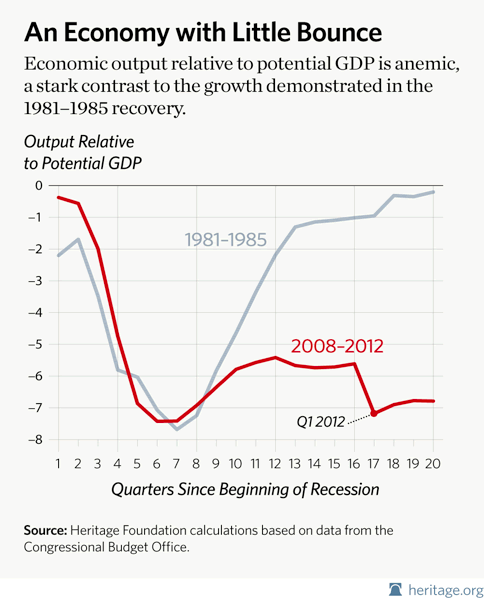
What should the economy’s recovery look like? Take a glance at history (and the chart below). Following the 1981-1982 recession — which looked a lot like the one America saw in 2008 in both depth and duration — the economy returned to near-full employment (which is around 5.5 percent) by 1984. Today, nearly three years after the most recent recession ended, the unemployment rate remains stuck well above 8 percent. So while the economy has grown for 10 straight quarters, it’s only done so at a measly 2.4 percent rate. In fact, it’s the slowest recovery America has seen in the post-war era. No wonder millions of Americans aren’t feeling the effects of the economic rebound and are voting their displeasure. (Article continued below chart.)

Even liberal economist / columnist Paul Krugman sees the economy for what it is. In a recent column in The New York Times, he wrote, “our economy remains deeply depressed” and that “every silver lining comes with a cloud.” So what’s bringing about that cloud? Why is this economy growing, and yet growing so slowly by comparison to the 1980s recovery?

While President Obama might like to take credit for the meager growth the economy is seeing, there’s an important fact to keep in mind. It’s the natural tendency for the economy to grow — and taking credit for its meager improvement is sort of like accepting kudos for the rising and setting of the sun. In fact, the President should of course (but never will) accept some blame for the fact that the economy isn’t growing faster. The policies Obama ushered in are markedly different from those that President Ronald Reagan adopted to unleash the economic recovery in the 1980s, and the results show the difference — a powerful recovery under Reagan, and weak recovery under Obama.

For starters, President Obama says he wants to encourage job creators to ramp up their economic engines, while at the same time he has proposed $2 trillion in higher taxes, much of which would fall on small businesses — the job creators. Add onto that a discouragingly successful policy of encouraging higher gas prices by opposing domestic energy production. This policy is so unpopular that eleven Democratic Senators voted with their Republican colleagues on Thursday to overturn the Obama decision to kill the Keystone XL pipeline. Proponents failed to get the 60 votes necessary to overturn the Keystone decision, but with Democratic support it came very close. Instead of tapping proven resources, Obama puts his faith in pie-in-the-sky renewable energy projects like Solyndra. No wonder Super Tuesday’s voters were worried about the economy.

On top of job-killing tax hikes and higher gas prices, President Obama continues to embrace the burden of untenably high spending and debt — which will of course motivate the left to call for even higher taxes — and you’re left with a mess of policies emanating from Washington signaling small businesses to hunker down instead of investing for the future. A better path for growth would be to enact a budget that curbs spending, reforms entitlements, and reforms the tax code to focus it on economic growth as proposed in Heritage’s Saving the American Dream plan — all of which would free the economy to grow at a faster rate than we’re witnessing today.

While any economic growth and job creation is welcome, a barely perceptible, incremental recovery doesn’t offer much hope for those Americans who can’t feel, see, or touch the fruits of recovery. Millions remain unemployed in the Obama economy, and Washington can and should do better for the American people.

__________

Thank you so much for your time. I know how valuable it is. I also appreciate the fine family that you have and your commitment as a father and a husband.

Sincerely,

Everette Hatcher III, 13900 Cottontail Lane, Alexander, AR 72002, ph 501-920-5733, lowcostsqueegees@yahoo.com

“Music Monday” Levon Helm 2007 interview with CBS

Uploaded by on Oct 16, 2007

Drummer and singer for The Band, Levon Helm, talks to Anthony Mason about losing his voice to cancer of the vocal chord, and how it returned years later. (CBSNews.com)

__________________________

Levon Helm

From Wikipedia, the free encyclopedia


Jump to: navigation, search

Levon Helm

Levon Helm performing in 2004 on the Village Green in Woodstock, New York.
Background information
Birth name Mark Lavon Helm
Born May 26, 1940(1940-05-26)
Elaine, Arkansas, United States
Died April 19, 2012(2012-04-19) (aged 71)
New York City, New York, United States
Genres Rock and roll, rhythm and blues, rock, blues, country, folk
Occupations Musician, songwriter, actor, producer
Instruments Vocals, drums, percussions, mandolin, guitar, bass, harmonica, banjo
Years active 1957–2012
Labels Capitol, Mobile Fidelity, MCA, Breeze Hill, Levon
Associated acts The Band, Ronnie Hawkins & The Hawks, Bob Dylan, Levon Helm’s Ramble on the Road, Levon Helm and The RCO All-Stars, Ringo Starr & His All-Starr Band
Website levonhelm.com

Mark Lavon “Levon” Helm (May 26, 1940 – April 19, 2012)[1] was an American rock multi-instrumentalist and actor who achieved fame as the drummer and frequent lead and backing vocalist for The Band.

Helm was known for his deeply soulful, country-accented voice, and creative drumming style highlighted on many of the Band’s recordings, such as “The Weight“, “Up on Cripple Creek“, “Ophelia” and “The Night They Drove Old Dixie Down“. His 2007 comeback album Dirt Farmer earned the Grammy Award for Best Traditional Folk Album in February 2008, and in November of that year, Rolling Stone magazine ranked him #91 in the list of The 100 Greatest Singers of All Time.[2] In 2010, Electric Dirt, his 2009 follow-up to Dirt Farmer, won the first ever Grammy Award for Best Americana Album, an inaugural category in 2010.[3] In 2011, his live album Ramble at the Ryman was nominated for the Grammy in the same category and won.[4]

On April 17, 2012, his wife and daughter announced on Helm’s website that he was “in the final stages of his battle with cancer” and thanked fans while requesting prayers.[5] Helm died on April 19, 2012, at Memorial Sloan-Kettering Cancer Center in New York City.[6][7]

Contents

 [hide] 

[edit] Biography

[edit] Early years

Helm was born in Marvell, Arkansas, and grew up in Turkey Scratch, a hamlet west of Helena, Arkansas, the son of Nell and Diamond Helm, who were cotton farmers and also great lovers of music who encouraged their children to play and sing. Young Lavon (as he was christened) began playing the guitar at the age of eight and also played drums during his formative years. He saw “Bill Monroe & his Blue Grass Boys” at the age of six and decided then to become a musician.

Arkansas in the 1940s and 50s was at the confluence of a variety of musical styles—blues, country and R&B—that later became known as rock and roll. Helm was influenced by all these styles listening to the Grand Ole Opry show on radio station WSM and R&B on radio station WLAC out of Nashville, Tennessee. He also saw traveling shows such as F.S. Walcott’s Rabbit’s Foot Minstrels that featured top African-American artists of the time.

Another early influence on Helm was the work of harmonica, guitarist and singer Sonny Boy Williamson II, who played blues and early rhythm and blues on the King Biscuit Time radio show on KFFA in Helena and performed regularly in Marvell with blues guitarist Robert Lockwood, Jr. In his 1993 autobiography, This Wheel’s on Fire – Levon Helm and the Story of The Band, Helm describes watching Williamson’s drummer, James “Peck” Curtis, intently during a live performance in the early 1950s and later imitating this R&B drumming style. Helm established his first band, The Jungle Bush Beaters, while in high school.

Helm also witnessed some of the earliest performances by Southern country music, blues and rockabilly artists such as Elvis Presley, Conway Twitty, Bo Diddley and a fellow Arkansan, Ronnie Hawkins. At age 17, Helm began playing in clubs and bars around Helena.

[edit] The Hawks

After graduating from high school, Helm was invited to join Ronnie Hawkins’ band, “The Hawks”, who were a popular bar and club act across the South and also in Canada, where rockabilly acts were very popular. Soon after Helm joined “The Hawks”, they moved to Toronto, Canada, where, in 1959, they signed with Roulette Records and released several singles, including a few hits.

Helm reports in his biography, This Wheel’s on Fire, that fellow “Hawks” band members had difficulty pronouncing “Lavon” correctly, and started calling him “Levon” (/ˈliːvɒn/ LEE-von) because it was easier.

In the early 1960s Helm and Hawkins recruited an all-Canadian lineup of musicians: guitarist Robbie Robertson, bassist Rick Danko, pianist Richard Manuel and organist Garth Hudson– although all the musicians were multi-instrumentalists. In 1963, the band parted ways with Hawkins and started touring under the name “Levon and The Hawks,” and later as “The Canadian Squires” before finally changing back to “The Hawks.” They recorded two singles, but remained mostly a popular touring bar band in Texas, Arkansas, Canada, and on the East Coast of the United States, where they found regular summer club gigs on the New Jersey shore.

Helm with The Band, at the Santa Cruz Civic Auditorium 1976 Photo: David Gans

By the mid 1960s, songwriter and musician Bob Dylan was interested in performing electric rock music and asked “The Hawks” to be his backing band. Disheartened by fans’ negative response to Dylan’s new sound, Helm returned to Arkansas for what turned out to be a two-year layoff, being replaced by drummer Mickey Jones. During this period, Helm ended up working on off-shore oil rigs in the Gulf of Mexico until he was asked to rejoin the band.

After the “Hawks” toured Europe with Dylan, they followed him to live around Woodstock, New York, and remained under salary to him. The “Hawks” recorded a large volume of demo and practice tapes in Woodstock, playing almost daily with Dylan, who had completely withdrawn from public life the previous year. These recordings were widely bootlegged and were partially released officially in 1975 as The Basement Tapes. The songs and themes developed during this period played a crucial role in the group’s future direction and style. The “Hawks” members also began writing their own songs. Rick Danko and Richard Manuel also shared writing credits with Dylan on a few songs. In 1967, Danko called Helm and invited him to return to the band in Woodstock.

[edit] The Band

See also: The Band

Helm returned to the group, which by then was often referred to simply as “the band.” While contemplating a recording contract, Helm had dubbed the band as “The Crackers.” However, when Robertson and their new manager Albert Grossman worked out the contracts, the group’s name was cited as “The Band.” Under these contracts, “The Band” was contracted to Grossman, who in turn contracted their services to Capitol Records. This arrangement allowed “The Band” to release recordings on other labels if the work was done in support of Dylan. This allowed The Band to play on Dylan’s Planet Waves album and on The Last Waltz, both non-Capitol releases. “The Band” also recorded their own album Music from Big Pink, which catapulted them into stardom.

Helm, center, performing with The Band. Hamburg, 1971.

On Big Pink, Manuel was the most prominent vocalist and Helm sang mainly backup, with the exception of “The Weight.” However, as Manuel’s health deteriorated and Robbie Robertson‘s songwriting increasingly looked south for influence and direction, subsequent albums relied more and more on Helm’s vocals, alone or in harmony with Danko. Helm played drums for perhaps 85% of The Band’s songs,[citation needed] including most of those for which he sang lead. On the others, Manuel switched to drums while Helm played mandolin or, on rare occasion, guitar or bass guitar. The entire group was multi-instrumental and certain songs featured Manuel on drums, Helm on mandolin (as on “Evangeline”), rhythm guitar (the 12-string guitar backdrop to “Daniel and the Sacred Harp” is by Helm), or bass (while Danko played fiddle).[8]

Helm remained with “The Band” until their 1976 farewell performance, The Last Waltz, which was recorded in a documentary film by director Martin Scorsese. Many music enthusiasts know Helm through his appearance in the concert film, a performance remarkable for the fact that Helm’s vocal tracks appear substantially as he sang them during a grueling concert. However, Helm repudiated his involvement with The Last Waltz shortly after the final scenes were shot and. In his autobiography, Helm offers scathing criticisms of the film and of Robertson, who produced it.[9]

[edit] Solo artist and the reformed Band

Helm playing mandolin in 1971

With the breakup of “The Band” in its original form, Helm began working on a solo album Levon Helm and the RCO All Stars, followed by Levon Helm. Helm recorded solo albums in 1980 and 1982 entitled American Son and (once again) Levon Helm. Helm also participated in musician Paul Kennerley‘s 1980 country music concept album, The Legend of Jesse James, singing the role of Jesse James alongside Johnny Cash, Emmylou Harris and Albert Lee.

In 1983, “The Band” reunited without Robbie Robertson, with Jim Weider on guitar. In 1986, while on tour, Manuel committed suicide. Helm, Danko and Hudson continued in “The Band”, releasing the album Jericho in 1993 and High on the Hog in 1996. The final album from The Band was the 30th anniversary album, Jubilation, released in 1998.

In 1989, Helm and Danko toured with drummer Ringo Starr and His All-Starr Band. Other musicians in the band included singer/guitarist Joe Walsh, singer/pianist Dr. John, guitarist Nils Lofgren, singer Billy Preston, saxophonist Clarence Clemons and drummer Jim Keltner. Garth Hudson was a guest on accordion on certain dates. Levon played drums and harmonica, and sang “The Weight” and “Up On Cripple Creek” each night.

Helm performed with Danko and Hudson as “The Band” in 1990 at Roger Waters‘ epic The Wall – Live in Berlin Concert in Germany to an estimated 300,000 to half a million people.

In 1993, Helm published an autobiography entitled This Wheel’s on Fire – Levon Helm and the Story of The Band.

[edit] The Midnight Ramble

Helm’s performance career in the 2000s revolved mainly around the Midnight Ramble at his home and studio, “the Barn,” in Woodstock, New York. These concerts, featuring Helm and a variety of musical guests, allowed Helm to raise money for his medical bills and to resume performing after a nearly career-ending bout with cancer.

In the late 1990s, Helm was diagnosed with throat cancer suffering hoarseness. Advised to undergo a laryngectomy, Helm instead underwent an arduous regimen of radiation treatments at Memorial Sloan–Kettering Cancer Center in New York City. Although the tumor was then successfully removed, Helm’s vocal cords were damaged, and his clear, powerful tenor voice was replaced by a quiet rasp. Initially Helm only played drums and relied on guest vocalists at the Rambles, but Helm’s singing voice grew stronger. On January 10, 2004, he sang again of his Ramble Sessions. In 2007, during production of Dirt Farmer, Helm estimated that his singing voice was 80% recovered.

The “Levon Helm Band” featured his daughter guitarist Amy Helm, along with Larry Campbell, Teresa Williams, Jim Weider (the Band’s last guitarist), Jimmy Vivino, Mike Merritt, Brian Mitchell, Erik Lawrence, Steven Bernstein, Howard Johnson (tuba player in the horn section who played on “The Band”‘s “Rock of Ages” and “The Last Waltz” live albums), Byron Isaacs, and blues harmonica player Little Sammy Davis. Helm hosted Midnight Rambles at his home in Woodstock that were open to the public.

Helm performing in Central Park, New York, 2007

The Midnight Ramble was an outgrowth of an idea Helm explained to Martin Scorsese in The Last Waltz. Earlier in the 20th century, Helm explained, traveling medicine shows and music shows such as F.S. Walcott Rabbit’s Foot Minstrels, featuring African-American blues singers and dancers, would put on titillating performances in rural areas. This was also turned into a song by the Band, “The W.S. Walcott Medicine Show,” with the name altered so the lyric was easier to sing.

“After the finale, they’d have the midnight ramble,” Helm told Scorsese. With young children off the premises, the show resumed: “The songs would get a little bit juicier. The jokes would get a little funnier and the prettiest dancer would really get down and shake it a few times. A lot of the rock and roll duck walks and moves came from that.”

Artists who have performed at the Rambles include Helm’s former bandmate Garth Hudson, as well as Elvis Costello, Emmylou Harris, Dr. John, Chris Robinson, Allen Toussaint, Donald Fagen of Steely Dan and Jimmy Vivino of “Late Night with Conan O’Brien‘s” The Max Weinberg 7. Other performers have included Sean Costello, The Muddy Waters Tribute Band, Pinetop Perkins, Hubert Sumlin, Carolyn Wonderland, Kris Kristofferson, Gillian Welch, David Rawlings, Justin Townes Earle, Bow Thayer, Luther “Guitar Junior” Johnson, Rickie Lee Jones, Kate Taylor, Ollabelle, The Holmes Brothers, Catherine Russell, Norah Jones, Elvis Perkins in Dearland, Phil Lesh (along with his sons Grahame and Brian), Hot Tuna (although Jorma Kaukonen introduced the group as “The Secret Squirrels”), Michael Angelo D’Arrigo with various members of the Sistine Chapel, Johnny Johnson, Ithalia, David Bromberg, and Grace Potter and the Nocturnals[10].

As for his drumming, in recent years Helm switched to the matched grip and adopted a less busy, greatly simplified style, as opposed to his years with “The Band” when he played with the traditional grip.[11]

Helm was busy touring every year during 2000s, generally traveling by tour bus to venues in Eastern Canada and the Eastern United States. Since 2007, Helm had performed in large venues such the Beacon Theater in New York. Dr. John and Warren Haynes (The Allman Brothers Band, Gov’t Mule) and Garth Hudson played at the concerts as well along with several other guests. At a show in Vancouver, Canada, Elvis Costello joined to sing “Tears of Rage.” The “Alexis P. Suter Band” was a frequent opening act. Helm was a favorite of radio personality Don Imus and was frequently featured on Imus in the Morning. In the Summer of 2009, it was reported that a reality television series centering around the Midnight Ramble was in development.

[edit] Dirt Farmer and after

The Levon Helm Band performing at Austin City Limits Music Festival 2009

Levon Helm at Life is Good Festival in 2011

The Fall of 2007 saw the release of Dirt Farmer, Helm’s first studio solo album since 1982. Dedicated to Helm’s parents and co-produced by his daughter Amy, the album combines traditional tunes Levon recalled from his youth with newer songs (by Steve Earle, Paul Kennerley and others) which flow from similar historical streams. The album was released to almost immediate critical acclaim, and earned him a Grammy Award in the Traditional Folk Album category for 2007.

Helm declined to attend the Grammy Awards ceremony, instead holding a “Midnight Gramble” and celebrating the birth of his grandson, named Lavon (Lee) Henry Collins.[12][13][14]

In 2008, Helm performed at Warren Haynes‘ Mountain Jam Music Festival in Hunter, New York. Helm played alongside Warren Haynes on the last day of the three-day festival. Levon also joined guitarist Bob Weir and his band RatDog on stage as they closed out the festival. Helm performed to great acclaim at the 2008 Bonnaroo Music Festival in Manchester, Tennessee.[15][16]

Helm drummed on a couple of tracks for Jorma Kaukonen‘s February, 2009 album River of Time, recorded at the Levon Helm studio.

Helm released the album Electric Dirt on his own label on June 30, 2009.[17] The album won a best album Grammy for the newly created Americana category in 2010. Helm performed on the CBS Television program David Letterman Show on July 9, 2009. He also toured that same year in a supporting role with the band Black Crowes.

In March, 2010, a documentary on Helm’s day-to-day life titled Ain’t in It for My Health: A Film About Levon Helm was released. Directed by Jacob Hatley, it made its debut at the South by Southwest film festival in Austin, Texas, and went on to screen at the Los Angeles Film Festival in June 2009.[18]

On May 11, 2011, Helm released Ramble at the Ryman, a live album recorded during his September 17, 2008 performance at Nashville’s Ryman Auditorium. The album features Helm’s band playing six songs by “The Band” and other cover material, including some songs from previous Helm solo releases.[19] The album won the Grammy Award for Best Americana Album.[20]

[edit] Death

In 2012, during the Rock and Roll Hall of Fame Induction Ceremonies in New York City, Robbie Robertson sent “love and prayers” to Helm, fueling speculation on Helm’s health. Helm had previously cancelled several performances due to an alleged slipped disk in his back.[21]

On April 17, 2012, Helm’s wife Sandy and daughter Amy revealed that Helm had end-stage cancer. They posted the following message on Helm’s website:

“Dear Friends,
Levon is in the final stages of his battle with cancer. Please send your prayers and love to him as he makes his way through this part of his journey.
Thank you fans and music lovers who have made his life so filled with joy and celebration… he has loved nothing more than to play, to fill the room up with music, lay down the back beat, and make the people dance! He did it every time he took the stage…
We appreciate all the love and support and concern.
From his daughter Amy, and wife Sandy”[22]

Helm died on April 19, 2012, at 1:30 pm at Memorial Sloan-Kettering Cancer Center in New York.[23][24] A few days before his death, Robertson had a long visit with him at the hospital.[25]

[edit] Acting career

In addition to his work as musician, Helm also acted in several dramatic films after the breakup of The Band. His first acting role was the 1980 film Coal Miner’s Daughter in which he portrayed Loretta Lynn‘s father.

[edit] Filmography

[edit] Discography

[edit] With The Band

[edit] Solo and other works

[edit] Tributes

The subject of Elton John‘s song “Levon” was reportedly named after Helm.[27]

Marc Cohn wrote the song “Listening to Levon” in 2007. “The Man Behind the Drums,” written by Robert Earl Keen and Bill Whitbeck, appeared on Keen’s 2009 album The Rose Hotel

Open letter to President Obama (Part 87)

Uploaded by on Mar 6, 2012

Learn More at http://oversight.house.gov

The Oversight Committee is examining reports of food stamp merchants previously disqualified who continue to defraud the program. According to a Scripps Howard News Service report, food stamp fraud costs taxpayers hundreds of millions every year.

Watch the Oversight hearing live tomorrow at 930 AM EST at http://oversight.house.gov. Full hearing information is available here: http://oversight.house.gov/index.php?option=com_content&view=article&…

_______________________

President Obama c/o The White House
1600 Pennsylvania Avenue NW
Washington, DC 20500

Dear Mr. President,

I know that you receive 20,000 letters a day and that you actually read 10 of them every day. I really do respect you for trying to get a pulse on what is going on out here.

The Food Stamp Program is a very bad program and it is abused every day. It should be abolished.

Alison Meyer

March 9, 2012 at 4:35 pm

Food-stamp fraud and the government’s failed attempts to stop it were the focus of a House Oversight and Government Reform Committee hearing yesterday.

Chairman Darrell Issa (R-CA) called the hearing in response to a Scripps Howard News Service investigative report exposing widespread abuse. The investigation revealed that retailers who lost authorization to accept food stamps were still conducting business despite their restrictions.

“[D]ozens of individuals who had been banned as food-stamp vendors nonetheless remained in the business in New York; Los Angeles; Phoenix; San Diego; Tulsa, Okla.; West Palm Beach, Fla.; Baltimore and other communities across the country,” according to the report. Scripps Howard discovered this by comparing U.S. Department of Agriculture disqualification records against documents from health-inspection reports to business filings and corporate certificates.

At yesterday’s hearing, Kevin Concannon, undersecretary of the U.S. Department of Agriculture’s Food and Nutrition Service, defended the government’s efforts to combat fraud. He also cast blame on the messenger.

“As with other leads and observations we receive from the public, we took this information very seriously. We began an immediate investigation into all of the stores that were brought to our attention and we have added further layers of security to our retailer oversight process. However, our research indicates that many of the cases identified by Scripps Howard do not involve improper activity,” he said.

Scripps Howard isn’t the first to expose food-stamp fraud. Heritage’s Rachel Sheffield wrote last year on The Foundry that $2.5 billion in taxpayer money that was spent on improper food-stamp payments. Lawmakers such as Rep. Jim Jordan (R–OH) and Sen. Jim DeMint (R–SC) have proposed reforms to the program.

Issa, meanwhile, vowed to keep a watchful eye on USDA, demanding additional documents and information.

“With record numbers of Americans using food stamps, with an annual price tag of $75.3 billion, anything short of rigorous anti-fraud measures will be very costly to taxpayers,” Issa said.

The USDA should have been conducting the oversight that the Scripps Howard News Service was doing, according to Issa. “It was the government’s own databases that [Scripps] went to and discovered there was no enforcement under this administration,” he said.

The most common type of fraud is food-stamp trafficking where retailers encourage food-stamp recipients to trade their benefits for cash, alcohol or cigarettes. Once the card is swiped, the merchant takes full payment for the transaction’s stated price and pockets the difference, which can add up to $50,000 a month.

“The crime is as widespread as it is simple: Stores accept food stamps, but instead of requiring that customers walk away with wholesome groceries, they provide the customers a small amount of cash — typically 50 cents on the food stamp dollar. While taxpayers lose out — the money isn’t going toward wholesome food — food stamp recipients are receiving no-strings attached cash while stores are taking a hefty profit for serving as a moneychanger,” according to the Scripps Howard report.

This fraud comes at a high price to taxpayers. “According to Reuters, food stamp fraud accounts for just 1 percent of food stamp benefits, but equals about $750 million each year,” Issa wrote in a letter to USDA. “Since President Obama took office three years ago, the number of SNAP enrollees has dramatically increased. Today approximately 46.1 million people receive food stamps, with 14 million of those individuals enrolling since President Obama took office.  According to the Washington Times, SNAP enrolled six million new people in Fiscal Year 2011 at an increased cost of $7 billion.”

The Supplemental Nutrition Assistance Program, which administers food stamps, has a mission to address hunger and poverty. The SNAP website reads like an advertisement: “Only 86% of eligible District residents, and 41% of eligible low-income working families, receive SNAP/Food Stamps. Every $1 of SNAP/Food Stamps spent in the community generates $1.85 in local economic activity. D.C. would gain millions in federal funds by signing up eligible households — funds that would stimulate the local economy. People who work sometimes assume they are not eligible for SNAP/Food Stamps, or that time-off from work is required to apply. This is not true. A family of 3 with a minimum wage earner could be eligible for over $3,000 annually in benefits, and working families can complete phone interviews rather than go to the SNAP/Food Stamps office in-person.”

Under the Obama administration, the United States has seen a dramatic increase in the welfare state, making individuals more dependent on government.

“Now, more than 67.3 million Americans depend on the federal government for everything from food stamps and college tuition to retirement services and health care,” according to Heritage’s Index of Dependence on Government, which revealed an 8.1 percent increase at a cost of roughly $2.5 trillion.

__________

Thank you so much for your time. I know how valuable it is. I also appreciate the fine family that you have and your commitment as a father and a husband.

Sincerely,

Everette Hatcher III, 13900 Cottontail Lane, Alexander, AR 72002, ph 501-920-5733, lowcostsqueegees@yahoo.com

Bertrand Russell v. Frederick Copleston debate transcript and audio (Part 1)

Fr. Frederick C. Copleston vs Bertrand Russell – Part 1

Uploaded by on Jul 15, 2009

BBC Radio Third Programme Recording January 28, 1948. BBC Recording number T7324W. This is an excerpt from the full broadcast from cassette tape A303/5 Open University Course, Problems of Philosophy Units 7-8. Older than 50 years, out of UK/BBC copyright.
Pardon the hissy audio. It was recorded 51 years ago after all. I tried to clean it up but I found that the voices were clearer without any filters. Meh.

This is an excerpt from the famous BBC Radio debate between Father Frederick C. Copleston and Bertrand Russell. In this section, they discuss Leibniz’s Argument from Contingency, which is a form of the Cosmological Argument. It differs from other Cosmological arguments (e.g. Kalam) in that it is consistent with an eternal universe, as it doesn’t appeal to first causes, but rather the principle of sufficient reason. It can be summarized in this way:

(1) Everything that exists contingently has a reason for its existence.
(2) The universe exists contingently.
Therefore:
(3) The universe has a reason for its existence.
(4) If the universe has a reason for its existence then that reason is God.
Therefore:
(5) God exists.

_________________________

A DEBATE
ON THE EXISTENCE
OF GOD
 
 
A DEBATE
ON THE EXISTENCE OF GOD
 
FATHER COPLESTON VERSUS BERTRAND RUSSELL     
Fredric Charles Copleston, (1907 – 1994)          
A Jesuit priest and author of a nine-volume History of Philosophy


        FATHER COPLESTON
As we are going to discuss the existence of God, it might perhaps be as well to come to some provisional agreement as to what we understand by the term “God.” I presume that we mean a supreme personal being — distinct from the world and creator of the world. Would you agree — provisionally at least — to accept this statement as the meaning of the term “God”?

        BERTRAND RUSSELL
Yes, I accept this definition.

       FATHER COPLESTON
Well, my position is the affirmative position that such a being actually exists, and that His existence can be proved philosophically. Perhaps you would tell me if your position is that of agnosticism or of atheism. I mean, would you say that the non-existence of God can be proved?

        BERTRAND RUSSELL

No, I should not say that: my position is agnostic.

        FATHER COPLESTON
Would you agree with me that the problem of God is a problem of great importance? For example, would you agree that if God does not exist, human beings and human history can have no other purpose than the purpose they choose to give themselves, which — in practice — is likely to mean the purpose which those impose who have the power to impose it?

        BERTRAND RUSSELL
Roughly speaking, yes, though I should have to place some limitation on your last clause.

        FATHER COPLESTON
Would you agree that if there is no God — no absolute Being — there can be no absolute values? I mean, would you agree that if there is no absolute good that the relativity of values results?

        BERTRAND RUSSELL
No, I think these questions are logically distinct. Take, for instance, G. E. Moore’s Principia Ethica, where he maintains that there is a distinction of good and evil, that both of these are definite concepts. But he does not bring in the idea of God to support that contention.

        FATHER COPLESTON
Well, suppose we leave the question of good till later, till we come to the moral argument, and I give first a metaphysical argument. I’d like to put the main weight on the metaphysical argument based on Leibniz’s argument from “Contingency” and then later we might discuss the moral argument. Suppose I give a brief statement on the metaphysical argument and that then we go on to discuss it?

        BERTRAND RUSSELL
That seems to me to be a very good plan.

THE ARGUMENT FROM CONTINGENCY

        FATHER COPLESTON

Well, for clarity’s sake, I’ll divide the argument into distinct stages. First of all, I should say, we know that there are at least some beings in the world which do not contain in themselves the reason for their existence. For example, I depend on my parents, and now on the air, and on food, and so on. Now, secondly, the world is simply the real or imagined totality or aggregate of individual objects, none of which contain in themselves alone the reason for their existence. There isn’t any world distinct from the objects which form it, any more than the human race is something apart from the members. Therefore, I should say, since objects or events exist, and since no object of experience contains within itself reason of its existence, this reason, the totality of objects, must have a reason external to itself. That reason must be an existent being. Well, this being is either itself the reason for its own existence, or it is not. If it is, well and good. If it is not, then we must proceed farther. But if we proceed to infinity in that sense, then there’s no explanation of existence at all. So, I should say, in order to explain existence, we must come to a being which contains within itself the reason for its own existence, that is to say, which cannot not exist.

        BERTRAND RUSSELL
This raises a great many points and it is not altogether easy to know where to begin, but I think that, perhaps, in answering your argument, the best point at which to begin is the question of necessary being. The word “necessary” I should maintain, can only be applied significantly to propositions. And, in fact, only to such as are analytic
— that is to say — such as it is self-contradictory to deny. I could only admit a necessary being if there were a being whose existence it is self-contradictory to deny. I should like to know whether you would accept Leibniz’s division of propositions into truths of reason and truths of fact. The former — the truths of reason — being necessary.

        FATHER COPLESTON
Well, I certainly should not subscribe to what seems to be Leibniz’s idea of truths of reason and truths of fact, since it would appear that, for him, there are in the long run only analytic propositions. It would seem that for Leibniz truths of fact are ultimately reducible to truths of reason. That is to say, to analytic propositions, at least for an omniscient mind. Well, I couldn’t agree with that. For one thing it would fail to meet the requirements of the experience of freedom. I don’t want to uphold the whole philosophy of Leibniz. I have made use of his argument from contingent to necessary being, basing the argument on the principle of sufficient reason, simply because it seems to me a brief and clear formulation of what is, in my opinion, the fundamental metaphysical argument for God’s existence.

        BERTRAND RUSSELL
But, to my mind, “a necessary proposition” has got to be analytic. I don’t see what else it can mean. And analytic propositions are always complex and logically somewhat late. “Irrational animals are animals” is an analytic proposition; but a proposition such as “This is an animal” can never be analytic. In fact, all the propositions that can be analytic are somewhat late in the build-up of propositions.

        FATHER COPLESTON
Take the proposition “if there is a contingent being then there is a necessary being.” I consider that that proposition hypothetically expressed is a necessary proposition. If you are going to call every necessary proposition an analytic proposition, then — in order to avoid a dispute in terminology — I would agree to call it analytic, though I don’t consider it a tautological proposition. But the proposition is a necessary proposition only on the supposition that there is a contingent being. That there is a contingent being actually existing has to be discovered by experience, and the proposition that there is a contingent being is certainly not an analytic proposition, though once you know, I should maintain, that there is a contingent being, it follows of necessity that there is a necessary being.

        BERTRAND RUSSELL
The difficulty of this argument is that I don’t admit the idea of a necessary being and I don’t admit that there is any particular meaning in calling other beings “contingent.” These phrases don’t for me have a significance except within a logic that I reject.

        FATHER COPLESTON
Do you mean that you reject these terms because they won’t fit in with what is called “modern logic”?

        BERTRAND RUSSELL
Well, I can’t find anything that they could mean. The word “necessary,” it seems to me, is a useless word, except as applied to analytic propositions, not to things.

        FATHER COPLESTON
In the first place, what do you mean by “modern logic?” As far as I know, there are somewhat differing systems. In the second place, not all modern logicians surely would admit the meaninglessness of metaphysics. We both know, at any rate, one very eminent modern thinker whose knowledge of modern logic was profound, but who certainly did not think that metaphysics are meaningless or, in particular, that the problem of God is meaningless. Again, even if all modern logicians held that metaphysical terms are meaningless, it would not follow that they were right. The proposition that metaphysical terms are meaningless seems to me to be a proposition based on an assumed philosophy.

The dogmatic position behind it seems to be this: What will not go into my machine is non-existent, or it is meaningless; it is the expression of emotion. I am simply trying to point out that anybody who says that a particular system of modern logic is the sole criterion of meaning is saying something that is over-dogmatic; he is dogmatically insisting that a part of philosophy is the whole of philosophy. After all, a “contingent” being is a being which has not in itself the complete reason for its existence that’s what I mean by a contingent being. You know, as well as I do, that the existence of neither of us can be explained without reference to something or somebody outside us, our parents, for example. A “necessary” being, on the other hand means a being that must and cannot not exist. You may say that there is no such being, but you will find it hard to convince me that you do not understand the terms I am using. If you do not understand them, then how can you be entitled to say that such a being does not exist, if that is what you do say?

        BERTRAND RUSSELL
Well, there are points here that I don’t propose to go into at length. I don’t maintain the meaninglessness of metaphysics in general at all. I maintain the meaninglessness of certain particular terms — not on any general ground, but simply because I’ve not been able to see an interpretation of those particular terms. It’s not a general dogma — it’s a particular thing. But those points I will leave out for the moment. And I will say that what you have been saying brings us back, it seems to me, to the ontological argument that there is a being whose essence involves existence, so that his existence is analytic. That seems to me to be impossible, and it raises, of course, the question what one means by existence, and as to this, I think a subject named can never be significantly said to exist but only a subject described. And that existence, in fact, quite definitely is not a predicate.

Open letter to President Obama (Part 86)

Uploaded by on Mar 5, 2012

If you listen to the media, conservatives are fading everywhere from Congress to the campaign trail. Nothing could be further from the truth; the strength of conservative principles continues to endure and thrive.

There is an awakening across the country, and the fight is on to return power to individuals and localities, empower individuals and unleash America’s entrepreneurial spirit.

Join the fight: http://heritageaction.com/join/fight-for-freedom/

______________________________

President Obama c/o The White House
1600 Pennsylvania Avenue NW
Washington, DC 20500

Dear Mr. President,

I know that you receive 20,000 letters a day and that you actually read 10 of them every day. I really do respect you for trying to get a pulse on what is going on out here.

I really think the Tea Party movement is here to stay. They have a message of cutting back on the overreach of the federal government in our lives. I named my son Wilson after my hero Ronald Wilson Reagan and he said “It is time to check and reverse the growth of government, which shows signs of having grown beyond the consent of the governed.”

Ericka Andersen

March 10, 2012 at 8:15 am

Constitutional conservatism is alive and well in America today.

From conservatives in Congress working to roll back big government spending to the backlash over Obamacare’s anti-conscience mandate, it’s clear that Americans are clinging to the foundational principles of our country.

Two years ago, the Tea Party movement launched grassroots conservative activists to the forefront of political debate, giving big-government liberals a force to be reckoned with. Reinvigorated citizens began to fight for the constitutional cornerstones of limited government, free markets, and localized empowerment.

The fight to return to a constitutional government is still raging—and it isn’t going anywhere. As Ronald Reagan said, “It is time to check and reverse the growth of government, which shows signs of having grown beyond the consent of the governed.”

America is checking and reversing, President Reagan. The fight has only begun.

Thank you so much for your time. I know how valuable it is. I also appreciate the fine family that you have and your commitment as a father and a husband.

Sincerely,

Everette Hatcher III, 13900 Cottontail Lane, Alexander, AR 72002, ph 501-920-5733, lowcostsqueegees@yahoo.com

Freedom compared in UK, USA, Canada and the World

Another great chart from the Heritage Foundation:

(The USA average is Red, UK is orange, Canada is blue and the World ave is black)

Rob Bluey

January 15, 2012 at 11:23 am

Heritage and the Wall Street Journal released the 2012 Index of Economic Freedom on Thursday, ranking 179 countries on 10 benchmarks that gauge their economic success. This year Heritage introduced a new interactive feature that gives you the opportunity to create a comparative graph.

This week’s chart shows how the United States stacks up against Canada and the United Kingdom. As recently as 2009, the United States led both countries in economic freedom. But after four years of decline, the United States is heading in the wrong direction. This year it fell to 10th in the Index of Economic Freedom.

For the 18th straight year, Hong Kong and Singapore finished first and second in the rankings, followed this year by Australia, New Zealand and Switzerland. North Korea was at the bottom of the rankings. All contents of the book are available online.

A few notable developments in this year’s Index:

The Index of Economic Freedom was first released in 1995 by the Wall Street Journal and Heritage to measure economist Adam Smith’s theories about liberty, prosperity and economic freedom among countries today.

Uploaded by on Jan 6, 2012

According to the 2012 Index of Economic Freedom, a joint publication of The Heritage Foundation and The Wall Street Journal, global economic freedom has declined over the past year. But what does this mean for America and the world?

Economic freedom empowers ordinary people with greater opportunity and individual choice, and it lets people decide for themselves how best to achieve their highest aspirations. From the amount a government spends, to the individual property rights extended to its citizens, a nation’s economic freedom is closely tied to key values like the elimination of poverty and freedom from corruption.

To learn more about economic freedom and view the 2012 Index country rankings, visit us online at heritage.org/Index

Freedom abundant in the USA? I got this info below from the Heritage Foundation:

Arkansas and Ole Miss football rivalry Part 4

Arkansas and Ole Miss football rivalry Part 4

Wikipedia talks about the Arkansas and Ole Miss football rivalry:

[edit] 2008 – Houston Nutt’s first return to Arkansas

  1 2 3 4 Total
Rebels 3 10 0 10 23
Razorbacks 0 7 0 14 21

Ole Miss 23 – Arkansas 21

On October 25, 2008, Ole Miss returned to Donald W. Reynolds Razorback Stadium in Fayetteville, Arkansas for the 55th meeting between the two programs. This was the first game between Ole Miss and Arkansas with former Razorback head coach Houston Nutt as the head coach of the Rebels. Ole Miss won the game by a score of 23 to 21. This was the Rebels’ first win in the series since 2003.

[edit] 2011 – Houston Nutt’s last stand

  1 2 3 4 Total
Razorbacks 0 7 19 3 29
Rebels 3 14 0 7 24

Arkansas 29 – Ole Miss 24

When the two teams met on October 22, 2011, on a sunny afternoon at Vaught-Hemingway Stadium in Oxford, Mississippi. The two teams were seeming to head in different directions. Arkansas was ranked in the top ten fresh off two top 15 victories while the Rebels were winless in the SEC with coach Houston Nutt on the hot seat. The Rebels though surprised the Razorbacks by opening up a 17-0 lead in the second quarter behind quarterback Randall Mackey. Arkansas would close within 17-7 at the half with a late touchdown.

The Razorbacks continued in the third quarter with a 19-0 scoring run including two touchdown runs by Arkansas quarterback Tyler Wilson as well as a safety forced by Arkansas to put the Razorbacks up 26-17. Arkansas would add a field goal in the fourth quarter before Nutt led the Rebels on a late rally. Ole Miss closed within 29-24 late in the game and was able to recover the ensuing onside kick. The Rebels’s chance of a winning touchdown as well as an upset bid however were thwarted with Eric Bennett’s interception of Randall Mackey with little time remaining sealing the win for Arkansas. Arkansas moved up to 6-1(2-1 SEC) while Ole Miss fell to 2-5 (0-4 SEC).

The win was Arkansas’s second win in a row in the series. It was also Houston Nutt’s final game against his former team as he was fired at the end of the 2011 season due to his poor performance in his last two seasons. Nutt had a 2-2 record against the Razorbacks losing the last two games against them.

Total Welfare Spending Is Rising Despite Attempts at Reform

Total Welfare Spending Is Rising Despite Attempts at Reform

Everyone wants to know more about the budget and here is some key information with a chart from the Heritage Foundation and a video from the Cato Institute.

Total means-tested welfare spending (cash, food, housing, medical care, and social services for the poor) has increased 17-fold since the beginning of Lyndon Johnson’s War on Poverty in 1964. Though the current trend is unsustainable, the Obama Administration plans to increase future welfare spending rather than enact true policy reforms.

WELFARE SPENDING IN INFLATION-ADJUSTED DOLLARS (2010)

Receive Information on Federal Budget Data

First Name
Last Name
Email Address
Zip Code
SUBMIT
Download

Total Welfare Spending Is Rising Despite Attempts at Reform

Source: Heritage Foundation calculations based on data from current and previous White House Office of Management and Budget documents and other official government sources.

Chart 10 of 42

In Depth

  • Policy Papers for Researchers

  • Technical Notes

    The charts in this book are based primarily on data available as of March 2011 from the Office of Management and Budget (OMB) and the Congressional Budget Office (CBO). The charts using OMB data display the historical growth of the federal government to 2010 while the charts using CBO data display both historical and projected growth from as early as 1940 to 2084. Projections based on OMB data are taken from the White House Fiscal Year 2012 budget. The charts provide data on an annual basis except… Read More

  • Authors

    Emily GoffResearch Assistant
    Thomas A. Roe Institute for Economic Policy StudiesKathryn NixPolicy Analyst
    Center for Health Policy StudiesJohn FlemingSenior Data Graphics Editor